
- Home
- »
- Next Generation Technologies
- »
-
Environmental Technology Market Size, Growth Report, 2026-2033GVR Report cover
![Environmental Technology Market (2026 - 2033)Report]()
Environmental Technology Market (2026 - 2033)
Size, Share & Trends Analysis Report By Component, By Application, By Technological Solutions (Greentech/Renewable Energy, Carbon Capture), By Vertical, By Region, And Segment Forecasts
Market Size, 2025
$742.8BMarket Estimate, 2026
$795.4BMarket Forecast, 2033
$1,289.7BCAGR, 2026–2033
7.1%Environmental Technology Market Summary
The global environmental technology market was valued at USD 742.8 billion in 2025 and is projected to grow from USD 795.4 billion in 2026 to USD 1,289.7 billion in 2033, at a CAGR of 7.1% from 2026 to 2033. North America dominated the market in 2025, accounting for over 35.0% share. Environmental technology refers to the application of scientific and engineering principles to develop technologies that address environmental concerns and promote sustainable development.
Key Market Trends & Insights
- By component: The solution segment led the environmental technology market in 2025, accounting for over 70.0% share.
- By application: The wastewater treatment segment led the market in 2025, accounting for around 15.0% share.
- By technology solutions: The waste valorization/recycling & composting segment held the largest revenue share in 2025.
- By vertical: The energy & utilities segment held the largest revenue share of approximately 15.0% in 2025.
Regional Highlights
- Largest regional market: North America (over 35.0% revenue share, 2025)
- Fastest-growing regional market: Asia Pacific (highest CAGR, 2026-2033)
Market Size & Forecast
- Market size in 2025: USD 742.8 Billion
- Estimated market size in 2026: USD 795.4 billion
- Projected market size by 2033: USD 1,289.7 Billion
- CAGR (2026-2033): 7.1%
These technologies can take many forms, such as pollution control devices, renewable energy systems, water treatment processes, and waste management techniques. Environmental technology aims to decrease the negative impact of human activity on the earth and build a healthier, cleaner, and more sustainable environment. It is an interdisciplinary field that blends skills and knowledge from various fields, such as chemistry, biology, engineering, physics, and environmental science. Overall, environmental technology is a vital tool in the battle against pollution, climate change, and other environmental challenges.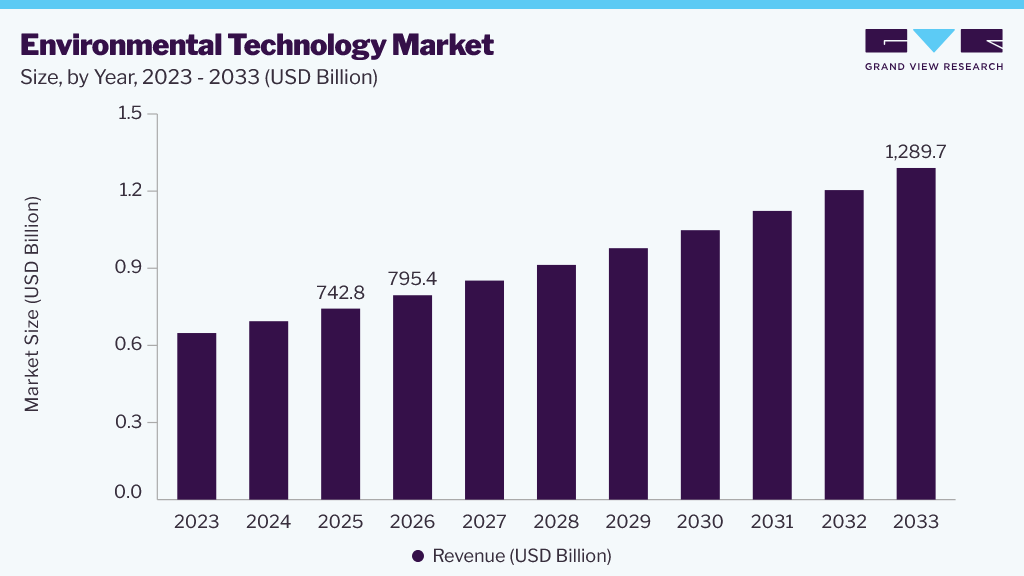
The cost savings presented by environmental technologies is a significant driver of growth in the market. Enterprises and customers can lower energy costs by implementing energy-efficient practices and embracing renewable energy sources. Additionally, waste reduction and enhanced efficiency can lead to cost savings in the long period. As renewable energy prices continue to decrease, more companies are expected to implement clean environmental technologies, further driving the growth of the market.
Furthermore, the growing awareness of environmental issues plays a vital role in driving the expansion of the market. As people become more aware of the negative consequences of human activities on the environment, there has been a rising demand for innovative solutions that can mitigate these impacts and promote sustainable practices. Additionally, as governments and businesses recognize the benefits of investing in sustainable solutions, they will likely continue supporting and driving innovation in the environmental sector. For instance, in July 2023, The United Nations Environment Programme (UNEP) partnered with Massive Earth Foundation (MEF) to launch LowCarbon. Earth (LCE) 2023, a climate tech accelerator. By focusing on climate change and pollution reduction, the LCE 2023 accelerator could provide a platform for passionate startup founders to access resources, mentorship, and funding to develop and scale their projects.
Market Dynamics
The growing adoption of cost-effective, energy-efficient environmental technologies is a key driver of the environmental technology market. Organizations are increasingly investing in solutions that reduce energy consumption, lower operating costs, and support long-term sustainability objectives. Technologies such as renewable energy systems, pollution control equipment, water treatment solutions, and waste management systems help enterprises improve resource efficiency while reducing environmental impact. In addition, declining renewable energy costs and the growing importance of sustainable business practices are further supporting market growth. For instance, in March 2025, Schneider Electric expanded its sustainability and energy management solutions range to help organizations improve energy efficiency, reduce emissions, and accelerate de carbonization initiatives. Such developments are expected to support the global adoption of environmental technologies.
The high initial investment required to implement environmental technologies remains a key challenge restraining market growth. Many environmental solutions, including renewable energy systems, advanced water treatment technologies, pollution control equipment, and waste management infrastructure, require significant upfront capital expenditures. In addition, installation, maintenance, and technology integration costs can further increase the financial burden on organizations. These challenges are mainly significant for small and medium-sized enterprises with limited financial resources. While environmental technologies often provide long-term operational savings and sustainability benefits, the substantial initial investment required for deployment may limit adoption across certain end-use sectors and regions. Dynamic environmental changes and inadequate infrastructure in developing regions are also termed as key restraining factors.
The increasing focus on climate technology innovation and sustainability initiatives is creating significant opportunities for the environmental technology market. Governments, international organizations, and private enterprises are increasingly supporting the development of technologies to reduce emissions, improve resource efficiency, and address environmental challenges. Growing awareness of climate change, pollution reduction, and sustainable development is encouraging investment in innovative environmental solutions. For instance, in 2025, the United Nations Environment Programme (UNEP) continued supporting climate technology innovation initiatives and partnerships to accelerate the development and commercialization of sustainable environmental solutions. Such initiatives are expected to create substantial growth opportunities for environmental technology providers during the forecast period.
Analyst Perspective
The environmental technology market has become extremely crucial as businesses and governments seek to balance economic growth with environmental responsibility. Demand is shifting toward solutions that help reduce emissions, improve resource efficiency, manage waste, conserve water, and support compliance with evolving environmental regulations. Companies with strong technological expertise, proven performance, and the ability to deliver measurable environmental outcomes are likely to strengthen their market position. As sustainability has become a strategic business priority rather than a compliance requirement, organizations are expected to invest in technologies that offer both environmental and operational benefits. Competitive positioning is likely to strengthen around companies that combine technical expertise with deep industry knowledge. Customers increasingly prefer partners that can address complex environmental challenges while minimizing operational disruption, creating an advantage for providers with established track records and strong customer relationships.
Component Insights
The solution segment led the environmental technology market in 2025, accounting for over 70.0% of global revenue, driven by increasing demand for technologies that effectively address environmental challenges. Environmental technology encompasses a wide range of solutions to mitigate the impact of human activities on the environment and promote sustainable development. These technologies may include waste management systems, renewable energy sources, energy-efficient products, and technologies for controlling water and air pollution. As the environment continues to degrade, there is a growing recognition of the need to find innovative solutions to repair and mitigate the damage caused by human activities. This recognition has sparked increased research and development efforts in the environmental sector.
The services segment is estimated to grow significantly over the forecast period. The market study services include water, waste management, energy, and industrial services. As businesses and governments become more aware of the importance of environmental protection and sustainable development, they are turning to environmental technology providers to help them achieve their objectives. This has led to increased demand for these services, which help identify areas where they can reduce their environmental impact and improve their sustainability practices.
Application Insights
The wastewater treatment segment led the market in 2025, accounting for over 15.0% share of the global revenue, owing to the growing importance of addressing water pollution and managing wastewater. Wastewater treatment involves removing contaminants and pollutants from industrial, domestic, and agricultural wastewater before being discharged into the environment. As industrial activities expand, populations grow, and urbanization increases, wastewater generation has surged, making appropriate treatment necessary to safeguard water resources and public health.
The water purification management segment is estimated to grow significantly over the forecast period. The growing awareness of water scarcity and the need for clean, safe water has driven demand for water purification technologies and solutions. Contamination of water sources from agricultural runoff, industrial discharge, and improper waste disposal poses significant environmental and health risks. Water purification management is crucial for removing pollutants and ensuring water safety.
Technological Solutions Insights
The waste valorization/recycling & composting segment accounted for the largest revenue share, over 10.0%, in 2025. The waste valorization/recycling & composting segment encompasses technologies and processes that extract value from waste materials through recycling, composting, and other resource recovery methods. This process helps divert waste from landfills, contributes to resource conservation, and reduces the overall environmental impact of waste disposal. Increased investments and advancements in recycling and composting technologies are likely to drive the segment's expansion and contribute to more reliable and sustainable waste management practices globally.
The Greentech/renewable energy segment is expected to grow significantly over the forecast period. The Greentech/renewable energy segment encompasses a range of technologies and practices, including wind, solar, geothermal, hydropower, bioenergy, and more. The growing global emphasis on sustainable development, the need to address climate change, and the need to reduce reliance on fossil fuels have driven demand for renewable energy technologies and green solutions. Furthermore, enterprises and industries are increasingly adopting renewable energy to meet their sustainability goals and reduce their carbon footprint, driving demand for Greentech solutions.
Vertical Insights
The energy & utilities segment accounted for the largest revenue share, approximately 15.0%, in 2025. The global shift towards renewable energy sources, such as wind, solar, and hydro, has driven investments in renewable energy infrastructure and technologies. The energy & utilities segment encompasses various technologies and solutions to optimize energy production, distribution, and consumption while minimizing environmental footprint. Key areas within this segment include smart grid solutions, renewable energy integration, energy-efficient technologies, and sustainable water and wastewater management.
The food & beverages segment is expected to grow significantly over the forecast period. Sustainability is now crucial in the food and beverage (F&B) industry. Climate change effects, crop failure, logistics issues, and drought are all factors in rising global food insecurity. The F&B industry needs greater efficiency in transporting food from surplus points to places of shortage or famine. Products in the F&B sector have a very short life span, meaning product recycling and disposal options are a significant part of eco-friendly purchase decisions. Enterprises are vigorously promoting their recyclable packaging.
Regional Insights
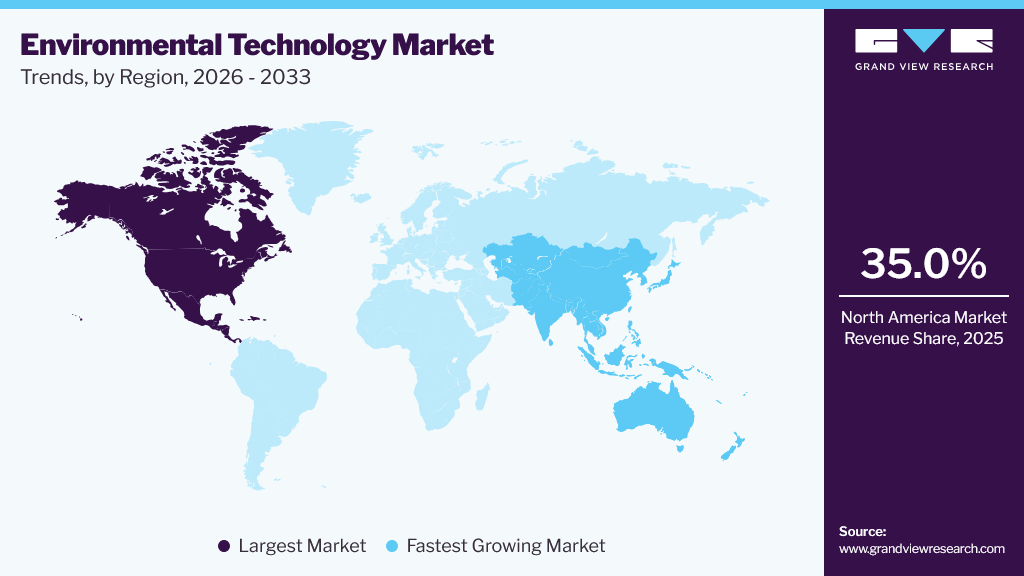
North America dominated the market in 2025, accounting for over 35.0% of global revenue, owing to a strong emphasis on environmental protection and sustainable development. The region has high awareness among companies and consumers of environmental issues, which has driven the adoption of new environmental technologies. Additionally, the regional government has invested significantly in the research and development of new environmental technologies and has demonstrated robust support for environmental conservation. For instance, in January 2025, Honda announced plans to introduce the Honda 0 Series electric vehicle lineup in North America, supporting its long-term objective of achieving 100% battery-electric and fuel-cell electric vehicle sales globally by 2040. The initiative reflects the company’s continued focus on environmental sustainability, electrification, and the adoption of advanced clean technologies across North America. This initiative is part of the company’s continued commitment to advancing safety and environmental technology.
Asia Pacific Environmental Technology Market Trends
Asia Pacific is anticipated to register the fastest CAGR over the forecast period, driven by population growth, rapid industrialization, and increasing environmental awareness. The region has a large and expanding renewable energy sector, particularly in countries such as India and China. The region has a strong focus on renewable energy and energy-efficient buildings, which have driven the adoption of environmental technologies. The region's strong economic growth has driven increased consumption, industrial activity, and urban development, leading to a rise in environmental challenges that require attention.
Key Environmental Technology Company Insights
Prominent firms have used product launches and developments, followed by expansions, mergers and acquisitions, contracts, agreements, partnerships, and collaborations as their primary business strategy to increase their market share. The companies have used various techniques to enhance market penetration and boost their position in the competitive industry.
-
In June 2026, Green SM launched Green SM Limo, a fully electric taxi service in New Delhi, marking the company’s entry into the Indian mobility market. The service operates a fleet of VinFast Limo Green electric vehicles and aims to promote sustainable urban transportation while expanding Green SM’s presence across key international markets.
-
In January 2026, Blackstone Energy Transition Partners acquired Alliance Technical Group, a leading provider of environmental testing, monitoring, and compliance services. The acquisition is expected to strengthen Blackstone’s environmental solutions portfolio and expand its capabilities in emissions monitoring, environmental compliance, and industrial sustainability services, supporting the growing demand for environmental technology solutions across North America.
-
In June 2025, Amazon expanded its Climate Pledge Friendly program by increasing the availability of certified sustainable products across multiple categories, making it easier for consumers to identify and purchase products that meet recognized sustainability standards. Customers can identify products, services, and solutions that support reuse, recycling, and sustainable consumption practices. This is likely to increase awareness about the importance of choosing eco-friendly products and encourage more people to make environmentally responsible purchasing decisions.
Key Environmental Technology Companies:
The following key companies have been profiled for this study on the environmental technology market.
-
AECOM
-
Lennox International Inc.
-
Teledyne Technologies Incorporated
-
Thermo Fisher Scientific Inc.
-
Abatement Technologies Inc.
-
Waste Connections Inc.
-
Biffa
-
Svante Technologies Inc.
-
Carbon Clean
-
Veolia
Environmental Technology Market Report Scope
Report Attribute
Details
Market size in 2025
USD 742.8 Billion
Estimated market size in 2026
USD 795.4 Billion
Projected market size by 2033
USD 1,289.7 Billion
Growth rate
CAGR of 7.1% from 2026 to 2033
Base year for estimation
2025
Historical data
2021 - 2024
Forecast period
2026 - 2033
Quantitative units
Revenue in USD billion, and CAGR from 2026 to 2033
Report coverage
Revenue forecast, company ranking, competitive landscape, growth factors, and trends
Segments covered
Component, application, technological solutions, vertical, region
Regional Scope
North America; Europe; Asia Pacific; Latin America; MEA
Key companies profiled
AECOM; Lennox International Inc.; Teledyne Technologies Incorporated; Thermo Fisher Scientific Inc.; Abatement Technologies; Waste Connections Inc.; Biffa; Svante Technologies Inc.; Carbon Clean; Veolia
Customization scope
Free report customization (equivalent up to 8 analysts working days) with purchase. Addition or alteration to country, regional & segment scope.
Pricing and purchase options
Avail of customized purchase options to meet your exact research needs. Explore purchase options
Global Environmental Technology Market Report Segmentation
This report forecasts revenue growth at global, regional, and country levels and provides an analysis of the latest industry trends in each of the sub-segments from 2021 to 2033. For this study, Grand View Research has segmented the global environmental technology market report based on component, application, technological solutions, vertical, and region.
-
Component Outlook (Revenue, USD Billion, 2021 - 2033)
-
Solution
-
Services
-
Water Services
-
Waste Management Services
-
Energy Services
-
Industrial Services
-
-
-
Application Outlook (Revenue, USD Billion, 2021 - 2033)
-
Power Generation & Fuel
-
Solid Waste Treatment
-
Pollution Monitoring
-
Wastewater Treatment
-
Water Purification Management
-
Sewage Treatment
-
Precision Cooling
-
Gas Dissolution
-
Others
-
-
Technological Solutions Outlook (Revenue, USD Billion, 2021 - 2033)
-
Waste Valorization/Recycling & Compositing
-
Nuclear Energy
-
Data Center Cooling
-
Desalination
-
Greentech/Renewable Energy
-
Photovoltaic
-
Wind Energy
-
Geothermal Power
-
Carbon Capture (CCUS)
-
Bioremediation
-
Others
-
-
Vertical Outlook (Revenue, USD Billion, 2021 - 2033)
-
Residential/Municipal
-
Industrial
-
Energy & Utilities
-
Transportation & Logistics
-
Oil & gas
-
Food & Beverages
-
Construction & Building Materials
-
Retail & Consumer goods
-
Government
-
Others
-
-
Regional Outlook (Revenue, USD Billion, 2021 - 2033)
-
North America
-
U.S.
-
Canada
-
-
Europe
-
Germany
-
UK
-
France
-
-
Asia Pacific
-
China
-
Japan
-
India
-
South Korea
-
Australia
-
-
Latin America
-
Brazil
-
Mexico
-
-
Middle East and Africa (MEA)
-
Saudi Arabia
-
UAE
-
South Africa
-
-
Frequently Asked Questions About This Report
The global environmental technology market size was valued at USD 742.8 billion in 2025 and is estimated at USD 795.4 billion for 2026.
The global environmental technology market is expected to grow at a CAGR of 7.1% from 2026 to 2033, reaching USD 1,289.7 billion.
Key players include AECOM; Lennox International Inc.; Teledyne Technologies Incorporated; Thermo Fisher Scientific Inc.; Abatement Technologies; Waste Connections Inc.; Biffa; Svante Technologies Inc.; Carbon Clean; Veolia
North America dominated with a 35.0% revenue share in 2025.
Solution dominated the environmental technology market with a share of 70.0% in 2025, while wastewater treatment is the fastest-growing segment.
About the Author(s)
Next Generation Technologies Research Team
Technology · Next Generation TechnologiesThis report was authored by the next generation technologies research team at Grand View Research - comprising two research analysts, one senior research analyst, and one industry expert - with specialized expertise in the next generation technologies segment of the technology industry. All findings are based on proprietary technology databases, executive interviews, and regulatory analysis, subject to internal peer review prior to publication.
Last Updated:
Speak to Analyst


Customize this report to your needs — add regions, segments, or data points, with 20% free customization.
Or view our licence options:


ISO 9001:2015 & 27001:2022 Certified
We are GDPR and CCPA compliant! Your transaction & personal information is safe and secure. For more details, please read our privacy policy.


