
- Home
- »
- Nutraceuticals & Functional Foods
- »
-
Europe Digestive Health Products Market, Industry Report, 2030GVR Report cover

Europe Digestive Health Products Market (2024 - 2030) Size, Share & Trends Analysis Report By Product (Dairy Products, Bakery & Cereals), By Ingredient (Prebiotics, Probiotics), And Segment Forecasts
Market Size & Trends
The Europe digestive health products market size was estimated at USD 14.11 billion in 2023 and is expected to grow at a CAGR of 7.3% from 2024 to 2030. The market growth is driven by growing consumer awareness about the link between gut health and overall well-being. Another key factors driving the growth of the European market is the high rates of pancreatitis reported in countries such as Finland, Poland, Scotland, and Spain. This is due in part to the aging European population, which is more susceptible to gastrointestinal diseases and disorders. As a result, European consumers are increasingly seeking natural and effective solutions to support their digestive health. This has led to an increased demand for dietary supplements, functional foods, and other products containing natural ingredients, such as probiotics, prebiotics, fiber, and enzymes.
 Source: Grand View Research, IR Documents, Primary Interviews, Paid DatabasesTo learn more about this report,
 Download Free Sample Report
 Europe digestive health products market accounted for the share of 27.34% of the global digestive health products market in 2023.
Growing technological innovations in the sector also offers lucrative opportunities for the players operating in the digestive health products market. The Federation of European Nutrition Societies (FENS) and the European Society for Clinical Nutrition and Metabolism (ESPEN) fund and invest in various nutritional foods and nutraceutical businesses, and govern and grant for business in the nutrition sector, respectively.
These initiatives have encouraged participants in the digestive health products market to develop highly beneficial and new innovative products, which drives the growth of the market. For instance, technological advancements in the development of probiotics, prebiotics, and other digestive health supplements have made it easier to formulate more effective products that can provide targeted support to specific digestive issues.
Market players are adopting various strategies to gain a competitive edge in the growing Canadian market. For instance, in May 2022, BioGaia, a Swedish biotechnology company, announced that it would be starting its distribution channel for probiotics in Germany. BioGaia's decision to sell probiotics under its own management in Germany is a strategic move in line with its overall goal of increasing B2C sales and strengthening its position in the probiotics market
Market Concentration & Characteristics
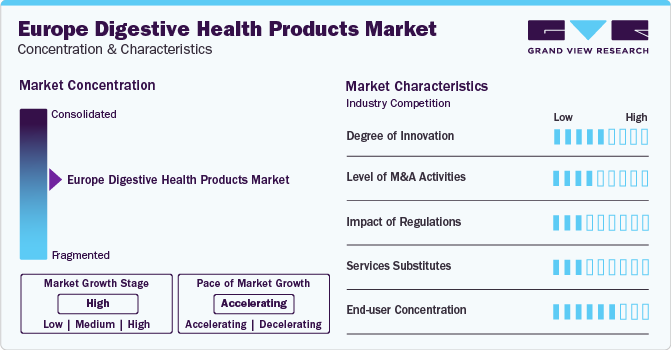
The Europe digestive health products market is characterized by high degree of innovation, with businesses continuously focusing on differentiating themselves through unique experiences and offerings. Product innovations and technological advancements are expected to be major factors attributable to the expansion of the market over the forecast period. Probiotics now have diverse applications, such as probiotic drinks, probiotic dairy products, probiotic supplements, and probiotic cosmetics, as well as in animal agriculture, especially aquaculture.
 To learn more about this report, Download Free Sample Report
 Market players are adopting various strategies, such as collaborations and product portfolio expansion, to gain a competitive edge in the growing market. For instance, in August 2022, Yeo Valley Organic introduced kefir drinks to its 'Love Your Gut' yogurt line in the U.K. The range of kefir drinks is available in three flavors: natural, cherry, and mango & passionfruit. It contains a blend of 14 distinct culture strains. Similarly, in February 2022, Remedy, a kombucha brand based in the U.K., introduced a new flavor variant called Remedy Kombucha Wild Berry.
The European Commission has stated the terms prebiotic probiotic and wellbeing and health claims require approval to be utilized, which has not been allowed in any event, following many applications. In this way, the use of these terms on product labels was banned. Since prebiotics and probiotics constitute an important part of digestive health products, its ban impacted the sales of several prebiotics and probiotics manufacturers. On the contrary,the support of authoritative bodies such as the European Commission and the EPA toward the production and consumption of naturally-derived ingredients is likely to act in favor of the digestive health products market. This scenario has pushed manufacturers to use naturally-derived ingredients.
Product Type Insights
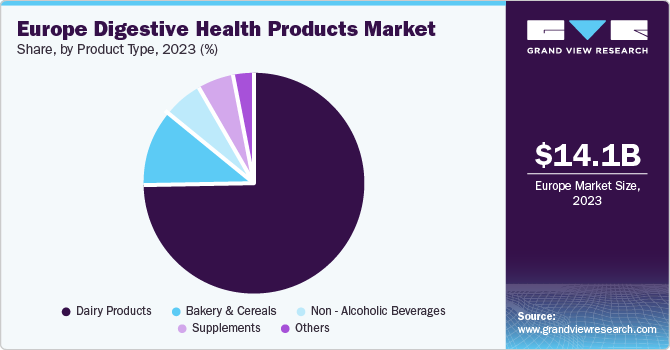
The dairy products segment accounted for a revenue share of around 74.3% in 2023.Digestive health ingredients are often used in dairy products because these ingredients improve digestibility and nutritional value and provide a range of health benefits. For instance, dairy products such as yogurt and kefir are often fortified with probiotics to improve digestive health and strengthen the immune system. These probiotics balance the bacteria in the gut, improve digestion, and alleviate symptoms of certain digestive disorders such as irritable bowel syndrome (IBS). In addition, other digestive health ingredients, such as enzymes and fibers, are added to dairy products to improve their nutritional value and digestibility. For instance, lactase enzyme may be added to lactose-free milk products to help individuals who are lactose intolerant digest lactose more easily.
 To learn more about this report, Download Free Sample Report
 The supplements segment is expected to grow at a CAGR of 8.1% over the forecast period. Growing number of aging population coupled with rising consumer spending on products that improve the health is expected to boost segment’s growth. Ingredient suppliers and supplement manufacturers are increasingly focusing on product innovation and collaborations to expand their product portfolio according to consumers’ nutritional needs. In September 2022, Garden of Life, a Nestle Health Science's probiotics brand, expanded its product line by launching two probiotics specifically formulated to promote kids' growth and immunity. These products were introduced in China's offline retail market. Furthermore, in June 2021, Probi, a probiotic supplier, partnered with Oriflame to launch a global probiotic supplement that promotes general gut health. The supplement will feature a scientifically-proven probiotic strain and a custom formulation based on Probi's Probi Digestis concept, which aims to support healthy digestion.
Ingredient Insights
The probiotics segment accounted for a revenue share of 87.3% in 2023. The popularity of probiotic ingredients in healthy food and nutritional supplements is attributed to the growing consumer awareness of their potential health benefits, such as supporting immune function, improving digestive health, reducing inflammation, and promoting mental health. This trend is driven in part by a growing concern about health and wellness, as well as an increasing desire for natural and healthy dietary options. Furthermore, probiotic ingredients are believed to have a positive impact on a range of health issues, including allergies, autoimmune disorders, and mental health. As such, they are increasingly being incorporated into a wide range of products, including yogurts, kefir, and other fermented foods, as well as dietary supplements and other health products.
The food enzymes segment is projected to grow at a CAGR of 8.3% from 2024 to 2030. The multi-functionality of food enzymes and the growing demand for enzyme cultures from the food & beverage industry are expected to drive the segment growth over the forecast period. Food enzymes are mainly used in dairy product manufacturing and processing. They are used extensively across the food industry to enhance the quality, texture, and flavor of various products. The application areas in the food industry include traditional ones like baking, brewing, and cheese making, as well as newer areas such as modification of fat and development of new sweeteners.
Country Insights
In 2023, the Europe digestive health products market accounted for a revenue share of 27.34% in global digestive health products market. Increasing consumer awareness and aging population are the key factors to boost regional growth over the forecast period.
Germany Digestive Health Products Market Trends
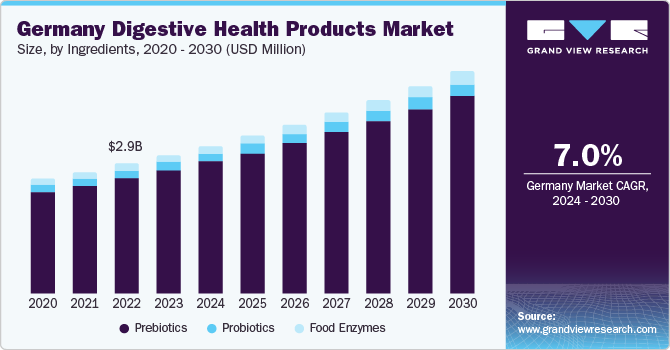
The digestive health products market in Germany is expected to grow at a CAGR of 7.0% over the forecast period. Growing demand for natural, specialty, and organic food items in Germany, particularly among high-income consumers. These consumers are willing to pay a premium price for products that are perceived as healthier or more environmentally friendly. As a result, food items containing digestive health ingredients like probiotics, prebiotics, and food enzymes have become increasingly popular among consumers looking for natural and organic alternatives to conventional products. Additionally, Germany's well-established supply network for daily consumable and commercial food items has made it a stable market for businesses entering the digestive health products market. The increasing population in Germany has also led to a flourishing food and beverages retail sector, creating opportunities for market growth.
U.K. Digestive Health Products Market Trends
The digestive health products market in the U.K. is expected to grow at a CAGR of 7.8% over the forecast period. the rising demand for nutritional supplements, pet food, and functional food & beverages in the country. Digestive health products offer several benefits such as prevention of intestinal diseases, weight management, and mitigation of digestion issues, which consumers are increasingly recognizing in the country. A significant population of lactose-intolerant consumers in the U.K. is also a key reason for the growth of the probiotic market in the country. Companies such as Nestlé SA, Danone, and Yakult are key players operating in the probiotic market segment in the U.K.
Key Europe Digestive Health Products Company Insights
Some of the key players operating in the market include BASF SE, Chr. Hansen Holding A/S, andArla Foods amba
-
BASF SE manufactures chemicals, functionalmaterials, and agricultural products.BASF operates through the following segments: Chemicals, Industrial Solutions, Materials, Surface Technologies, Nutrition & Care, and Agricultural Solutions.
-
Chr. Hansen Holding A/Sis a bioscience company engaged in manufacturing probiotics strains and enzymes, cultures, and natural color-based products. The company was founded in 1874 and is located in Hørsholm, Denmark. The probiotics products of the company are used in dietary supplements, infant formulas, and fermented milk products.
Nestle SA, Bayer AG, andSanofi are some of the other participants in the Europe digestive health products market,
-
Nestle S.A. is a food and drinks manufacturing company. It was formed as a result of the merger between the Anglo-Swiss Condensed Milk Company and Henri Nestlé, both founded in 1866. The company is headquartered in Vaud, Switzerland.
-
Sanofi is a multinational pharmaceutical company. The company specializes in the research, development, manufacturing, and marketing of pharmaceutical products, vaccines, and healthcare solutions. The firm’s consumer healthcare unit is responsible for over-the-counter products, dietary supplements, and medical devices.
Europe Digestive Health Products Companies:
- BASF SE
- Chr. Hansen Holding A/S
- Arla Foods amba
- Nestle SA
- Bayer AG
- Sanofi
- Danone
- ADM
- Evonik
- General Mills
- Amway
Three ways to get this report
Buy it, customize it, or ask a question.Ask an Analyst
Analyst response in 1 business day
- AccessReport author, directly
- Reply timeWithin 1 working day
- No sales callDirect answer only
- FormatEmail reply
- CostFree, no cost
Get the Full Report
What the study covers
- FormatsPDF · Excel · Dashboard
- Timeline2024–2030 annual, 2023 base
- Coverage20+ countries, 5 regions
- Companies10+ key players profiled
Customize the Report
20% free customization
- IncludeCountries, segments, points
- TailorTo your product definition
- ExtendDeeper competitor detail
- OrA fully bespoke study
- Turnaround5–10 working days
Recent Developments
-
In February 2023, ADM, a company renowned for its science-based nutrition solutions, opened a cutting-edge production facility in Valencia, Spain, worth more than USD 30 million. The new facility has been established to cater to the increasing demand for probiotics, postbiotics, and other products that promote health and wellness.
-
In February 2023, Evonik completed the modernization and expansion of its probiotics production facilities in León, Spain. This upgrade will allow the company to meet the growing demand for its probiotic products, including Fecinor, Ecobiol, and GutCare.
Europe Digestive Health Products Market Report Scope
Report Attribute
Details
Market size value in 2024
USD 15.11 billion
Revenue forecast in 2030
USD 23.02 billion
Growth rate
CAGR of 7.3% from 2024 to 2030
Actuals
2018 - 2023
Forecast period
2024 - 2030
Quantitative units
Revenue in USD million/billion and CAGR from 2024 to 2030
Report coverage
Revenue forecast, company ranking, competitive landscape, growth factors, and trends
Segments covered
product, ingredient, country
Regional scope
Europe
Country scope
UK; Germany; France; Italy; Spain
Key companies profiled
BASF SE; Chr. Hansen Holding A/S; Arla Foods amba; Nestle SA; Bayer AG; Sanofi; Danone; ADM; Evonik; General Mills; Amway
Customization scope
Free report customization (equivalent up to 8 analysts’ working days) with purchase. Addition or alteration to country, regional & segment scope.
Pricing and purchase options
Avail customized purchase options to meet your exact research needs. Explore purchase options
Europe Digestive Health Products Market Report Segmentation
This report forecasts revenue growth at the regional and country levels and provides an analysis of the latest industry trends and opportunities in each of the sub-segments from 2018 to 2030. For the purpose of this study, Grand View Research has segmented the Europe digestive health products market report based on product, ingredient, and country:
-
Product Outlook (Revenue, USD Million, 2018 - 2030)
-
Dairy Products
-
Bakery & Cereals
-
Non - Alcoholic Beverages
-
Supplements
-
Others
-
-
Ingredient Outlook (Revenue, USD Million, 2018 - 2030)
-
Prebiotics
-
Probiotics
-
Food Enzymes
-
Animal Based
-
Plant Based
-
Microbial Based
-
-
-
Country Outlook (Revenue, USD Million, 2018 - 2030)
-
Europe
-
Germany
-
UK
-
France
-
Italy
-
Spain
-
-
Frequently Asked Questions About This Report
The Europe digestive health products market size was estimated at USD 14.11 billion in 2023 and is expected to reach USD 15.11 billion in 2024.
The Europe digestive health products market is expected to grow at a compounded growth rate of 7.3% from 2024 to 2030 to reach USD 23.03 billion by 2030.
The dairy products segment accounted for a revenue share of around 74.3% in 2023. Digestive health ingredients are often used in dairy products because these ingredients improve digestibility and nutritional value and provide a range of health benefits. For instance, dairy products such as yogurt and kefir are often fortified with probiotics to improve digestive health and strengthen the immune system.
Some key players operating in the Europe digestive health products market include BASF SE; Chr. Hansen Holding A/S; Arla Foods amba; Nestle SA; Bayer AG; Sanofi; Danone; ADM; Evonik; General Mills; Amway
Key factors that are driving the Europe digestive health products market growth include growing consumer awareness about the link between gut health and overall well-being. Another key factors driving the growth of the European market is the high rates of pancreatitis reported in countries such as Finland, Poland, Scotland, and Spain.
About the Author(s)
Nutraceuticals & Functional Foods Research Team
Consumer Goods · Nutraceuticals & Functional FoodsThis report was authored by the nutraceuticals & functional foods research team at Grand View Research - comprising two research analysts, one senior research analyst, and one industry expert - with specialized expertise in the nutraceuticals & functional foods segment of the consumer goods industry. All findings are based on proprietary consumer goods databases, executive interviews, and regulatory analysis, subject to internal peer review prior to publication.
Last Updated:
Speak to Analyst -

Customize this report to your needs - add regions, segments, or data points, with 20% free customization.
Or view our licence options:


ISO 9001:2015 & 27001:2022 Certified
We are GDPR and CCPA compliant! Your transaction & personal information is safe and secure. For more details, please read our privacy policy.


