
- Home
- »
- Electronic & Electrical
- »
-
Europe Small Kitchen Appliances Market Size Report, 2033GVR Report cover
![Europe Small Kitchen Appliances Market Size, Share & Trends Report]()
Europe Small Kitchen Appliances Market (2026 - 2033) Size, Share & Trends Analysis Report By Product (Coffee Makers, Toasters, Juicers, Blenders & Food Processors, Deep Fryers, Rice Cookers & Steamers), By Distribution Channel, By Country, And Segment Forecasts
- Report ID: GVR-4-68040-887-9
- Number of Report Pages: 125
- Format: PDF
- Historical Range: 2021 - 2025
- Forecast Period: 2026 - 2033
- Industry: Consumer Goods
- Report Summary
- Table of Contents
- Segmentation
- Methodology
- Download FREE Sample
-
 Download Sample Report
Europe Small Kitchen Appliances Market Summary
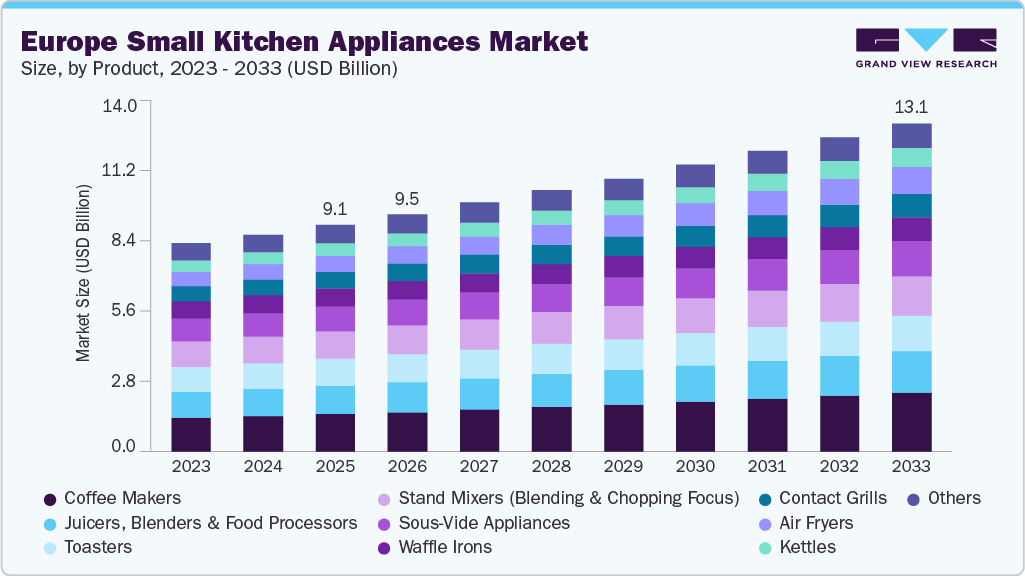
The Europe small kitchen appliances market size was estimated at USD 9.06 billion in 2025 and is projected to reach USD 13.12 billion by 2033, growing at a CAGR of 4.7% from 2026 to 2033. The industry represents a mature yet continuously evolving sector, supported by strong household penetration and shifting consumption patterns rather than first-time adoption.
Key Market Trends & Insights
- The Germany small kitchen appliances market accounted for a revenue share of 20.8% in 2025.
- By product, coffee makers accounted for a revenue share of 16.4% in 2025.
- By distribution channel, sales through electronic stores accounted for a revenue share of 45.5% in 2025.
Market Size & Forecast
- 2025 Market Size: USD 9.06 Billion
- 2033 Projected Market Size: USD 13.12 Billion
- CAGR (2026-2033): 4.7%
Growth in the region is increasingly shaped by structural lifestyle changes, particularly the rising number of single-person households and dual-income families, which are driving demand for appliances that enable quick, portion-controlled, and flexible meal preparation. Consumers are relying more on appliances such as coffee machines, compact blenders, air fryers, and food processors to prepare smaller meals more frequently throughout the day, rather than engaging in time-intensive cooking. This behavioral shift is reinforcing steady demand for appliances that reduce preparation time while maintaining consistency and ease of use.A key market driver in Europe is the strong consumer inclination toward premiumization and product differentiation, particularly in Western European markets. Consumers are not only purchasing appliances for functionality but are increasingly evaluating them based on build quality, finish, noise levels, and overall user experience. This has led to a growing demand for appliances with brushed metal finishes, minimalist interfaces, and durable components that align with modern kitchen aesthetics. In addition, kitchen appliances are increasingly viewed as long-term household investments, prompting consumers to prioritize reliability, warranty coverage, and brand reputation over low upfront pricing. This shift is encouraging manufacturers to focus on engineering quality, refined design, and performance consistency as key differentiators.
For instance, in April 2025, Haier Europe was recognized with three iF Design Awards for its I-Master Series 7 small kitchen appliances, including a kettle, toaster, and blender, highlighting its shift toward turning everyday appliances into design-focused home décor elements. Developed at its Milan Experience Design Center, the products combine premium aesthetics with advanced features, including AI integration, app-based controls, and energy-efficient performance. The range is designed to deliver both functionality and visual appeal, reflecting growing consumer demand for appliances that enhance both usability and the overall look of modern living spaces.
Replacement demand and upgrade cycles play a critical role in sustaining market momentum across Europe. A large share of households already owns essential appliances, and growth is now being driven by consumers replacing older models with newer versions that offer enhanced efficiency, faster operation, and improved safety features. For instance, newer-generation appliances are incorporating faster heating elements, precision controls, and user-friendly interfaces that improve everyday usability. This replacement-driven dynamic is particularly strong in mature markets such as Germany, France, and the UK, where consumers are more inclined to upgrade appliances periodically to benefit from improved performance and convenience.
Another important growth driver is the growing role of private-label brands and retailer-led product strategies in shaping purchasing behavior. Major European retailers and supermarket chains are expanding their own appliance offerings, providing competitively priced alternatives to established brands while maintaining acceptable quality standards. This is making small kitchen appliances more accessible to a wider consumer base, particularly in price-sensitive segments. At the same time, frequent promotional campaigns, seasonal discounts, and bundled offers are significantly influencing purchase timing, with consumers often aligning purchases with major retail events rather than immediate need. This promotional environment is intensifying competition and encouraging manufacturers to balance pricing strategies with feature differentiation.
Energy efficiency and operating cost awareness are also becoming increasingly important in shaping consumer decisions, particularly in the context of relatively high electricity prices across Europe. Consumers are actively evaluating appliances based on power consumption, heating efficiency, and long-term operating costs, rather than focusing solely on purchase price. This has fueled the demand for appliances that deliver faster cooking times with optimized energy usage, as well as products that comply with stringent European energy regulations. As a result, manufacturers are focusing on improving thermal efficiency, reducing standby power consumption, and designing appliances that align with sustainability expectations without compromising performance.
Brand Market Share Insights
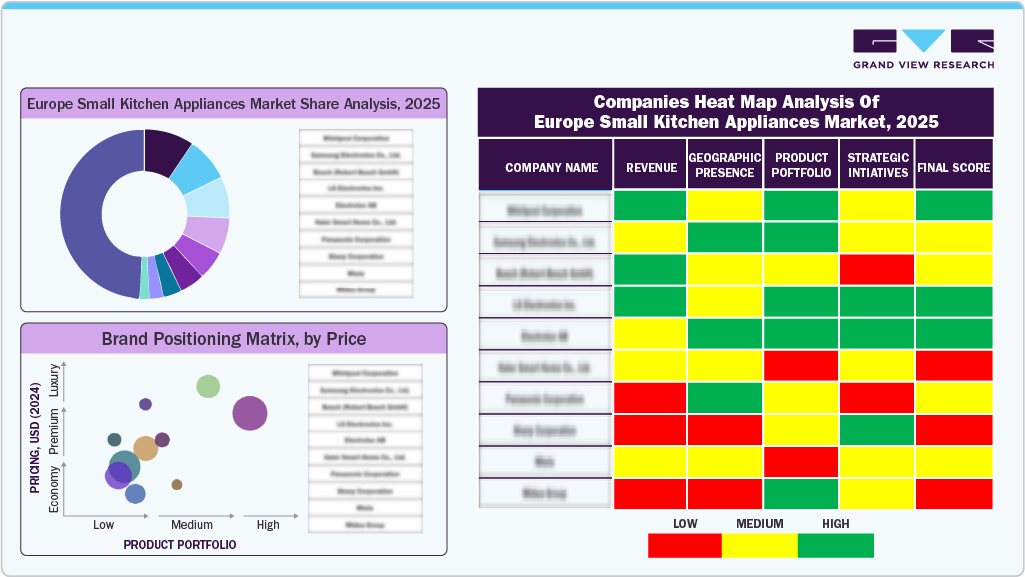
The Europe small kitchen appliances market is characterized by the presence of well-established global and regional manufacturers alongside a growing base of design-focused and innovation-led brands, all competing to address evolving consumer expectations around quality, efficiency, and functionality. Companies in the region are increasingly developing advanced product portfolios with features such as precision controls, preset cooking programs, and energy-efficient performance across categories like coffee machines, air fryers, and food processors. These innovations aim to enhance cooking consistency, reduce preparation time, and improve overall user convenience. At the same time, manufacturers are placing strong emphasis on premium build quality, compact formats, and aesthetically refined designs that align with modern European kitchen spaces. In addition, increasing focus on sustainability, including durable materials and energy-efficient operation, is shaping product development, positioning small kitchen appliances as essential, high-value tools within contemporary European households.
Consumer Insights
Consumer penetration of small kitchen appliances across Europe is broadly mature, with core products such as electric kettles, coffee makers, and basic food preparation appliances already present in a majority of households. However, disparities remain across product categories, particularly for premium, multifunctional, and smart appliances that are more closely tied to discretionary spending. Price-sensitive consumers, especially in parts of Southern and Eastern Europe, tend to prioritize affordable, durable appliances such as basic kettles, hand blenders, and entry-level coffee machines that deliver essential functionality without significantly increasing electricity consumption. In these segments, purchasing decisions are heavily influenced by promotional pricing, private-label offerings, and seasonal retail discounts, underscoring the role of affordability in shaping consumption patterns.
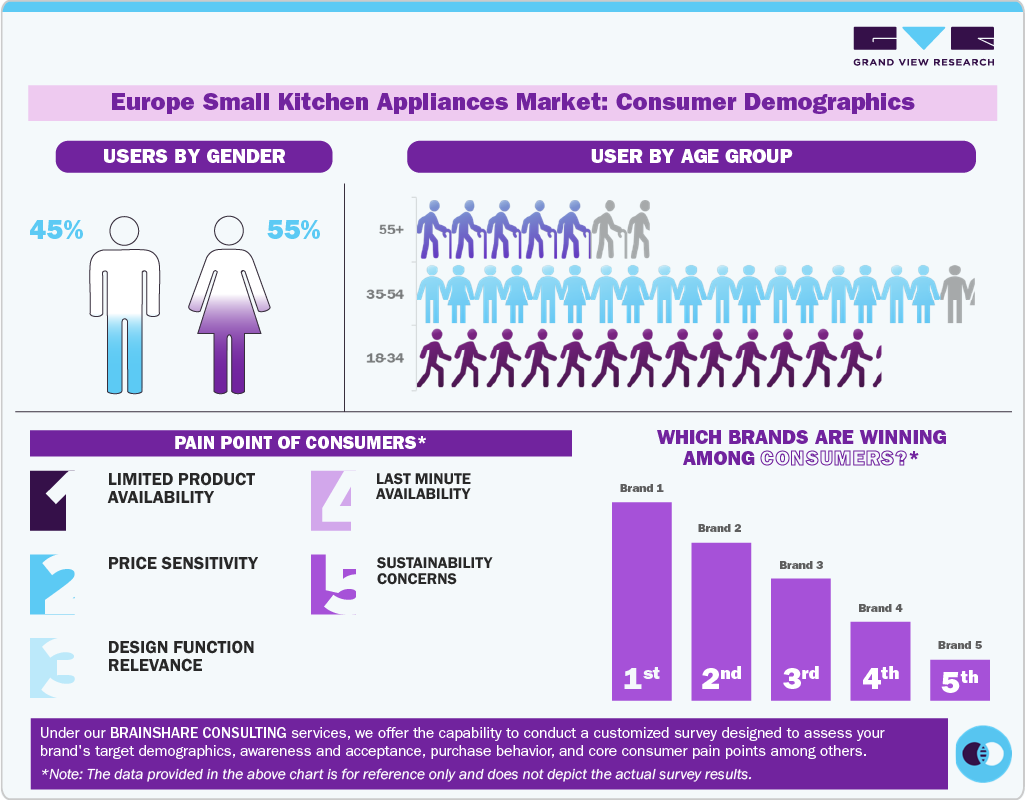
Income and regional variations further influence adoption across Europe. Higher-income markets such as Germany, the UK, and Nordic countries demonstrate stronger uptake of premium appliances, including bean-to-cup coffee machines, advanced air fryers, and multifunctional cooking devices with digital interfaces. In contrast, parts of Eastern and Southern Europe continue to show relatively lower penetration of high-end and connected appliances due to budget constraints and limited exposure to specialty retail environments. However, the rapid expansion of e-commerce platforms and cross-border online retail is gradually improving access to a wider range of products, enabling consumers in smaller cities and underserved regions to explore mid-range and premium options, thereby supporting gradual market upgrading.
Energy consumption and efficiency considerations play a central role in appliance purchasing decisions across Europe, where electricity costs are relatively high compared to global averages. Consumers are increasingly prioritizing appliances that deliver energy-efficient performance, faster cooking times, and optimized power use to manage household expenses. This behavior is reinforced by stringent European Union regulations and energy labeling standards, which provide clear guidance on product efficiency and lifecycle costs. As a result, appliances that balance performance with lower energy consumption are gaining preference, particularly in markets such as Germany, France, and the Netherlands, where sustainability awareness is high. This combination of regulatory influence, cost sensitivity, and environmental consciousness continues to shape consumer behavior, driving demand for efficient, durable, and value-oriented small kitchen appliances across Europe.
Product Insights
Coffee makers accounted for 16.4% of revenue in 2025, driven by the rising demand for convenient in-home beverage preparation as consumers seek to reduce spending on out-of-home coffee purchases. The rising adoption of work-from-home and hybrid work models is further driving frequent at-home coffee consumption, encouraging investment in reliable, easy-to-use coffee machines. In addition, growing consumer interest in compact and space-efficient appliances is boosting demand for sleek, countertop-friendly coffee makers suited to smaller kitchens. The market is also benefiting from replacement demand, with consumers upgrading to newer models that offer faster brewing, improved energy efficiency, and enhanced user interfaces.
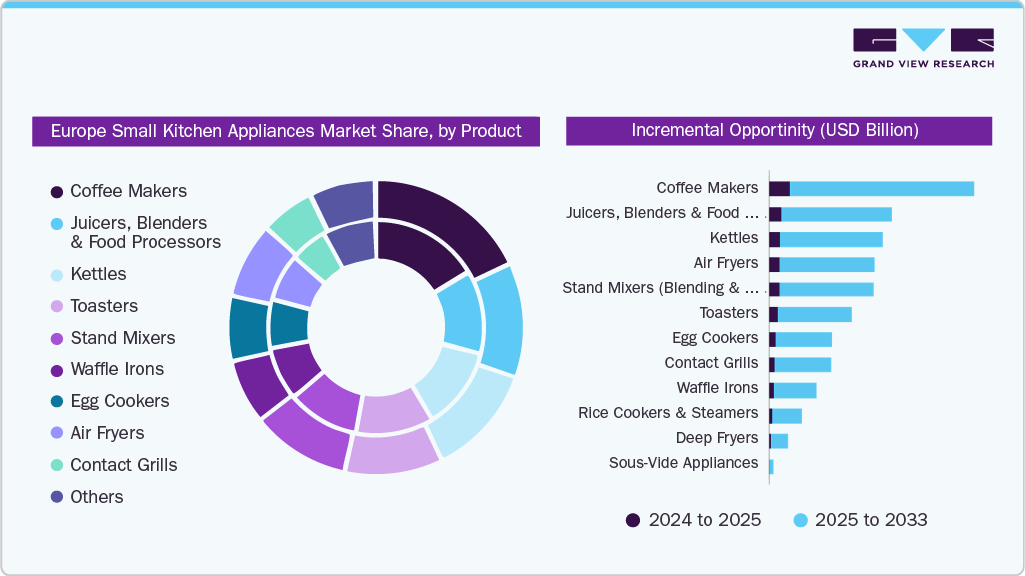
The air fryers segment is expected to grow at a CAGR of 6.8% from 2026 to 2033, driven by rising demand for energy-efficient, cost-effective cooking solutions in households. Consumers in Europe are showing a growing preference for appliances that reduce electricity consumption while maintaining cooking performance, positioning air fryers as an efficient alternative to conventional ovens and deep fryers. In addition, the growing trend toward compact living spaces is driving the adoption of appliances with multiple cooking functions in a single unit, supporting demand for air fryers with baking, grilling, and roasting capabilities. The market is also benefiting from increased experimentation with international cuisines at home, prompting consumers to invest in versatile appliances that can handle a range of recipes.
Distribution Channel Insights
Sales through electronic stores accounted for a revenue share of 45.5% in 2025 in the Europe market, supported by consumers’ preference for in-store product evaluation and expert guidance before purchase. Electronic stores offer a wide assortment of appliances, including coffee makers, blenders, air fryers, and food processors, allowing customers to compare features, performance, and pricing across multiple brands in a single location. These stores also play a key role in showcasing premium and technologically advanced products, attracting consumers seeking high-performance and durable appliances. In addition, the availability of in-store demonstrations, personalized recommendations, and after-sales support enhances consumer confidence, making electronic stores a preferred channel.
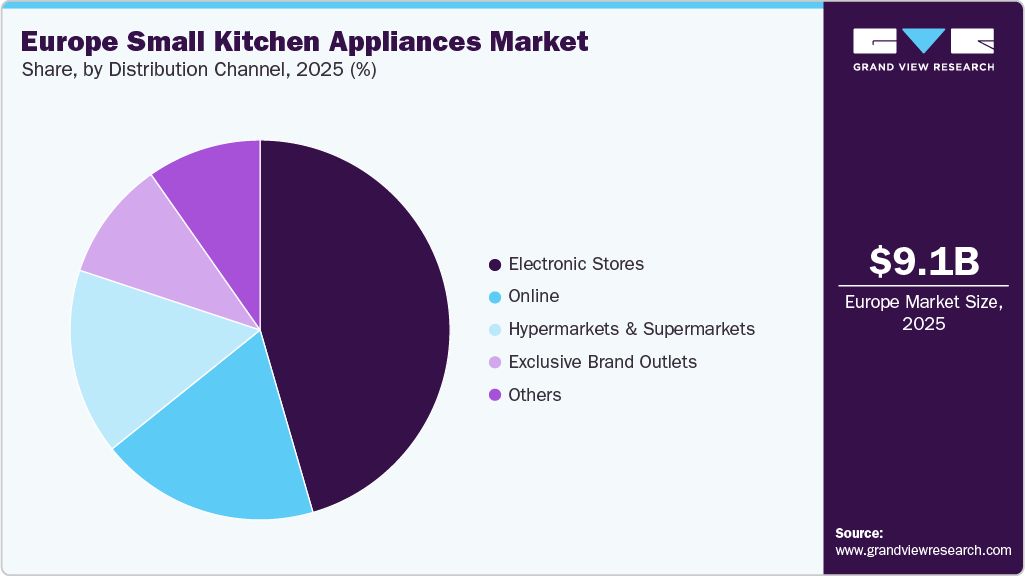
Sales of major appliances through online channels are expected to grow with a CAGR of 5.6% from 2026 to 2033. Consumers are increasingly preferring online channels due to the convenience of browsing a wide range of products, comparing features and prices, and accessing customer reviews before making purchase decisions. The availability of exclusive online discounts, bundled offers, and easy financing options further encourages purchases on e-commerce platforms. In addition, improvements in last-mile delivery, faster shipping timelines, and hassle-free return policies are enhancing consumer confidence in buying appliances online. The growing presence of brand-owned websites alongside major e-commerce marketplaces is also enabling manufacturers to engage consumers directly.
Country Insights
Germany Small Kitchen Appliances Market Trends
The Germany small kitchen appliances industry accounted for the largest share of 20.8% in 2025. The market is driven by high consumer purchasing power, strong preference for quality engineering, and widespread adoption of modern kitchen solutions across households. Consumers in Germany are increasingly investing in appliances such as coffee machines, electric kettles, food processors, and air fryers to enhance efficiency and convenience in daily cooking routines. The market is further driven by a growing emphasis on home cooking and healthier eating habits, encouraging the use of appliances that enable precise temperature control and low-oil preparation. In addition, demand for energy-efficient and durable products is rising as consumers prioritize sustainability and long-term value.
UK Small Kitchen Appliances Market Trends
The small kitchen appliances industry in the UK accounted for the revenue share of 16.6% in 2025. The growth is driven by high household appliance penetration, strong purchasing power, and a well-established culture of home cooking. Consumers in the UK are increasingly investing in appliances such as coffee machines, electric kettles, air fryers, and food processors to enhance convenience and efficiency in daily meal preparation. The market is further driven by a growing preference for premium, energy-efficient, and technologically advanced appliances that offer durability and consistent performance. In addition, rising interest in healthier eating habits is encouraging the adoption of appliances that enable low-oil cooking and precise control over ingredients.
France Small Kitchen Appliances Market Trends
The France small kitchen appliances industry is expected to grow at a CAGR of 5.3% from 2026 to 2033. The sector is supported by increasing demand for premium and design-focused kitchen appliances that align with modern lifestyle preferences. French consumers place strong emphasis on product aesthetics and build quality, encouraging the adoption of appliances that combine functionality with sleek, space-efficient designs. In addition, the rising popularity of specialty beverages, such as espresso and gourmet coffee, is driving demand for advanced coffee machines and related appliances in households. The market is also benefiting from the growing trend of at-home entertaining and cooking experimentation, which is driving interest in appliances that enable diverse meal preparation.
Italy Small Kitchen Appliances Market Trends
The small kitchen appliances industry in Italy is expected to grow at a CAGR of 4.9% from 2026 to 2033. The market is supported by rising demand for compact, space-efficient appliances suited to smaller urban kitchens and apartment living. Consumers are showing a strong preference for multifunctional products that can perform multiple cooking tasks within a single device, reducing the need for multiple appliances. In addition, the rising adoption of energy-efficient appliances is influencing purchase decisions, as households seek to manage electricity consumption and long-term operating costs. The market is also supported by a growing replacement cycle, as consumers upgrade to newer models that offer improved performance, faster cooking times, and enhanced safety features.
Spain Small Kitchen Appliances Market Trends
The Spain small kitchen appliances industry is expected to grow at a CAGR of 5.1% from 2026 to 2033. The growth is driven by increasing demand for energy-efficient appliances as consumers become more conscious of electricity usage and household costs. In addition, the growing popularity of healthy eating habits is encouraging the adoption of appliances such as air fryers, juicers, and steamers that enable low-oil and nutrient-preserving cooking. Furthermore, frequent product innovations and new feature introductions by manufacturers, along with strong seasonal promotions and discount-driven sales across retail and e-commerce channels, are stimulating consumer purchases and supporting steady market growth in Spain.
Key Europe Small Kitchen Appliances Companies:
- BSH Hausgeräte GmbH
- Groupe SEB
- Electrolux AB
- Miele & Cie. KG
- Smeg S.p.A.
- Morphy Richards
- Whirlpool Corporation
- LG Electronics Inc.
- Samsung Electronics Co., Ltd.
- Panasonic Corporation
Recent Developments
-
In September 2025, Smeg introduced a new manual espresso machine that also offers a fast cold brew feature, cutting preparation time significantly compared to traditional methods. The machine supports a range of coffee styles with adjustable settings and milk frothing capability, combining versatile performance with the brand’s signature retro design.
-
In March 2025, Nestlé expanded its Maggi air fryer mixes range in key markets such as the UK and Malaysia to align with the growing use of air fryers in home cooking. The update includes new crispy coating recipe mixes in the UK designed to enhance texture and flavor, along with new variants like satay in Malaysia and repositioned marinades for air fryer use. The move aims to help consumers prepare quick, flavorful meals with minimal effort, reflecting rising demand for convenient and modern cooking solutions.
Europe Small Kitchen Appliances Market Report Scope
Report Attribute
Details
Market size in 2026
USD 9.49 billion
Revenue forecast in 2033
USD 13.12 billion
Growth rate (revenue)
CAGR of 4.7% from 2026 to 2033
Actuals
2021 - 2025
Forecast period
2026 - 2033
Quantitative units
Volume in million/thousand units, revenue in USD million/billion, and CAGR from 2026 to 2033
Report coverage
Revenue and volume forecast, company ranking, competitive landscape, growth factors, and trends
Segments covered
Product, distribution channel, country
Regional scope
Europe
Country scope
Germany; UK; France; Italy; Spain
Key companies profiled
BSH Hausgeräte GmbH; Groupe SEB; Electrolux AB; Miele & Cie. KG; Smeg S.p.A.; Morphy Richards; Whirlpool Corporation; LG Electronics Inc.; Samsung Electronics Co., Ltd.; Panasonic Corporation
Customization scope
Free report customization (equivalent up to 8 analysts working days) with purchase. Addition or alteration to country, regional & segment scope.
Pricing and purchase options
Avail customized purchase options to meet your exact research needs. Explore purchase options
Europe Small Kitchen Appliances Market Report Segmentation
This report forecasts revenue and volume growth at the regional, and country levels and provides an analysis of the latest industry trends and opportunities in each of the sub-segments from 2021 to 2033. For this study, Grand View Research has segmented the Europe small kitchen appliances market report on the basis of product, distribution channel, and region:
-
Product Outlook (Volume, Million Units; Revenue, USD Million, 2021 - 2033)
-
Coffee Makers
-
Toasters
-
Juicers, Blenders & Food Processors
-
Deep Fryers
-
Rice Cookers & Steamers
-
Air Fryers
-
Waffle Irons
-
Egg Cookers
-
Sous-Vide Appliances
-
Stand Mixers (Blending & Chopping Focus)
-
Kettles
-
Contact Grills
-
-
Distribution Channel Outlook (Volume, Million Units; Revenue, USD Million, 2021 - 2033)
-
Hypermarkets & Supermarkets
-
Electronic Stores
-
Exclusive Brand Outlets
-
Online
-
Others
-
-
Country Outlook (Volume, Million Units; Revenue, USD Million, 2021 - 2033)
-
Europe
-
Germany
-
UK
-
France
-
Italy
-
Spain
-
-
Frequently Asked Questions About This Report
b. The Europe small kitchen appliances market size was valued at USD 9.06 billion in 2025 and is expected to reach USD 9.49 billion in 2026.
b. The Europe small kitchen appliances market is expected to witness a compound annual growth rate of 4.7% from 2026 to 2033 to reach USD 13.12 billion by 2033.
b. Coffee makers accounted for 16.4% of revenue in 2025, due to strong daily coffee consumption habits across households. High demand for convenient, at-home brewing solutions, including espresso machines and pod-based systems, continues to drive consistent product adoption.
b. Some key players operating in the Europe small kitchen appliances market include BSH Hausgeräte GmbH; Groupe SEB; Electrolux AB; Miele & Cie. KG; Smeg S.p.A.; Morphy Richards; Whirlpool Corporation; LG Electronics Inc.; Samsung Electronics Co., Ltd.; Panasonic Corporation
b. The Europe small kitchen appliances market is driven by rising demand for convenient and time-saving cooking solutions, supported by busy lifestyles and increasing urbanization


Share this report with your colleague or friend.
Need a Tailored Report?
Customize this report to your needs — add regions, segments, or data points, with 20% free customization.


ISO 9001:2015 & 27001:2022 Certified
We are GDPR and CCPA compliant! Your transaction & personal information is safe and secure. For more details, please read our privacy policy.
Trusted market insights - try a free sample
See how our reports are structured and why industry leaders rely on Grand View Research. Get a free sample or ask us to tailor this report to your needs.













