
- Home
- »
- Plastics, Polymers & Resins
- »
-
Foam Blowing Agents Market Size And Share Report, 2033GVR Report cover

Foam Blowing Agents Market (2026 - 2033)
Size, Share & Trends Analysis Report Market By Foam Type (Polyurethane, Polystyrene, Polyolefin), By End-use (Building & Construction, Appliances & Refrigeration, Packaging, Furniture), By Region, And Segment Forecasts
Market Size, 2025
$2.1BMarket Estimate, 2026
$2.2BMarket Forecast, 2033
$3.1BCAGR, 2026–2033
5.2%Foam Blowing Agents Market Summary
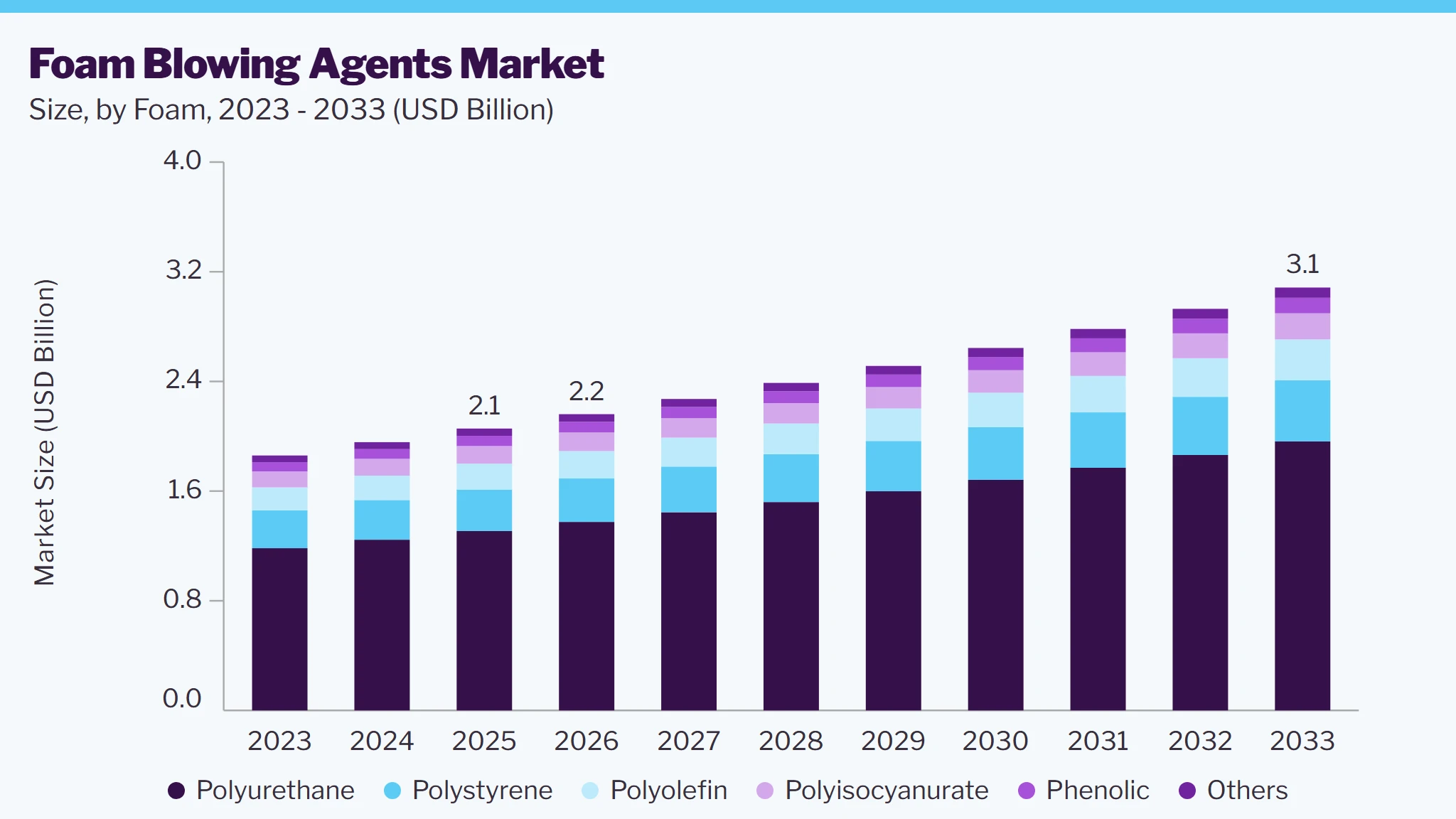
The global foam blowing agents market size was valued at USD 2.1 billion in 2025 and is projected to grow from USD 2.2 billion in 2026 to USD 3.1 billion by 2033, at a CAGR of 5.2% from 2026 to 2033. Asia Pacific dominated the market, accounting for a revenue share of 56.1% in 2025. The foam blowing agents market is driven by rising demand for energy-efficient insulation in buildings, refrigeration equipment, and appliances.
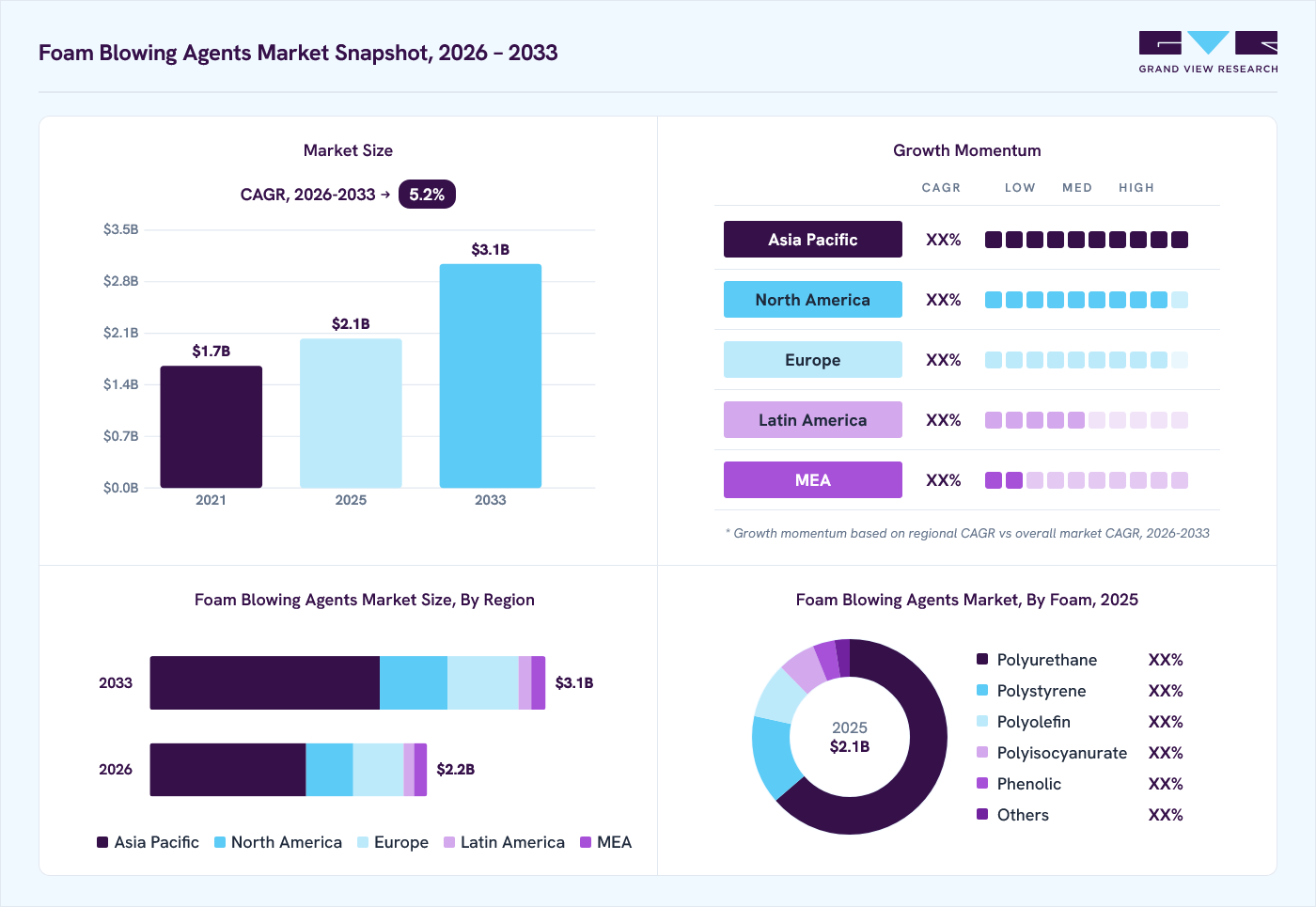 Source: Grand View Research, IR Documents, Primary Interviews, Paid DatabasesTo learn more about this report,
 Download Free Sample Report
 Key Market Trends & Insights
- By foam type: Polyurethane segment dominated the market and held a market share of 63.6% in 2025.
- By end-use: Appliances & refrigeration segment is expected to grow at a 6.0% CAGR in revenue from 2026 to 2033.
Regional Highlights
- Largest regional market: Asia Pacific (56.1% revenue share, 2025)
- By country: China held the largest share in 2025.
Market Size & Forecast
- Market size in 2025: USD 2.1 billion
- Estimated market size in 2026: USD 2.2 billion
- Projected market size by 2033: USD 3.1 billion
- CAGR (2026 - 2033): 5.2%
Three ways to get this report
Buy it, customize it, or ask a question.Ask an Analyst
A direct answer, usually in 1 working day
- AccessReport author, directly
- Reply timeWithin 1 working day
- No sales callDirect answer only
- FormatEmail reply
- CostFree, no cost
Get the Full Report
What the study covers
- FormatsPDF · Excel · Dashboard
- Timeline2026–2033 annual, 2025 base
- Coverage20+ countries, 5 regions
- Companies10+ key players profiled
Customize the Report
20% free customization
- IncludeCountries, segments, points
- TailorTo your product definition
- ExtendDeeper competitor detail
- OrA fully bespoke study
- Turnaround5–10 working days
Growing construction activities and stringent energy efficiency regulations encourage the adoption of high-performance foam materials. Increasing automotive production further supports demand for lightweight components that improve fuel efficiency and reduce vehicle weight. In addition, the transition toward low-global-warming-potential blowing agents, driven by environmental regulations and sustainability targets, creates opportunities for advanced formulations and replacement technologies.
 To learn more about this report, Download Free Sample Report
 The foam blowing agents market is shifting toward low-global-warming-potential (GWP) alternatives as manufacturers phase down high-impact hydrofluorocarbons (HFCs). Hydrocarbons, hydrofluoroolefins (HFOs), and carbon dioxide-based systems are gaining attention across insulation and refrigeration applications. This transition requires reformulation of foam systems, equipment adjustments, and process optimization. Demand is increasingly shaped by lifecycle emissions, thermal conductivity, flammability, and regulatory compliance. Suppliers that combine environmental performance with consistent foam quality are positioned to address changing customer specifications.
Market Dynamics
The expansion of construction, cold-chain logistics, and refrigeration manufacturing is increasing demand for foam blowing agents used in thermal insulation applications. Rigid polyurethane (PU) and extruded polystyrene (XPS) foams provide low thermal conductivity, supporting energy efficiency in buildings, refrigerated transportation, and appliances. Growing investments in commercial infrastructure, residential construction, and temperature-controlled storage facilities are driving the adoption of insulation materials with improved thermal performance and durability.
Stricter building energy codes and sustainability requirements are encouraging manufacturers to adopt high-performance insulation systems with lower environmental impacts. Emerging economies are witnessing increased demand due to urbanization, infrastructure development, and expanding appliance production. Foam blowing agents that support efficient foam expansion, consistent cell structure, and thermal insulation performance are gaining importance. These developments create opportunities for suppliers offering solutions compatible with evolving regulatory requirements and manufacturing processes.
High costs associated with advanced low-GWP blowing agents can limit adoption, particularly among price-sensitive foam manufacturers. HFO-based systems may require higher formulation expenditure than hydrocarbon or water-based alternatives. Conversion can also involve equipment modifications, process optimization, and additional safety controls. Hydrocarbon agents present flammability-related handling requirements, while alternative chemistries require compatibility testing to maintain foam quality. These cost and operational considerations can slow replacement of conventional blowing agents in developing markets.
The transition to low-GWP blowing agents creates opportunities for suppliers to develop specialized formulations for rigid PU, polyisocyanurate (PIR), and spray foam systems. HFO-based technologies can deliver improved environmental profiles while supporting thermal insulation performance. Manufacturers can differentiate through optimized blends, reduced flammability risks, and compatibility with existing processing equipment. Additional opportunities exist in energy-efficient appliances, cold-chain infrastructure, and electric vehicle battery insulation. These applications require tailored solutions that balance thermal performance, safety, and lifecycle costs.
Market Concentration & Characteristics
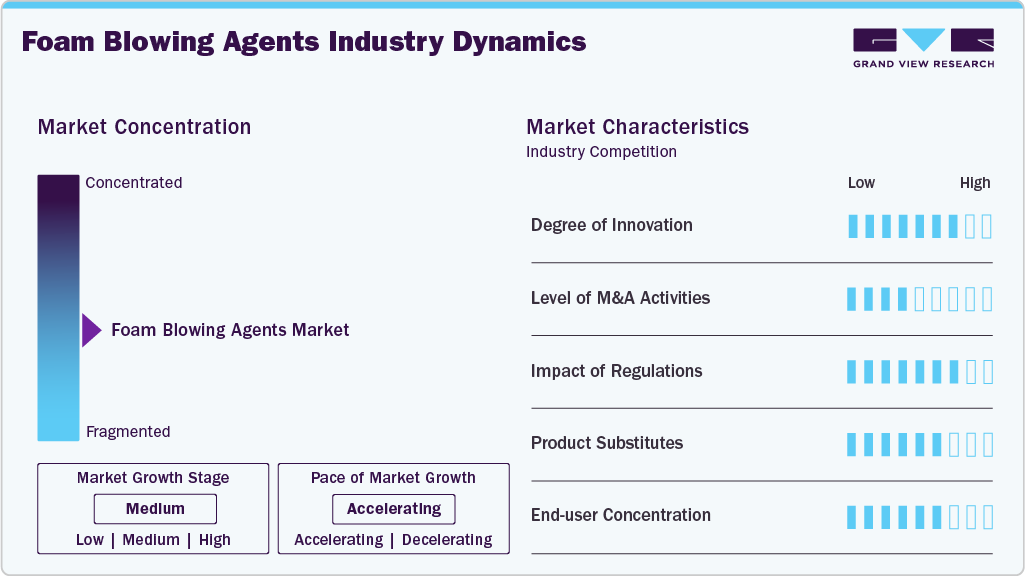
The market growth stage is medium, and growth is accelerating. The market exhibits fragmentation, with key players dominating the industry landscape. Major companies such as Honeywell International Inc., Arkema S.A., The Chemours Company, Solvay S.A., Daikin Industries, Ltd., Exxon Mobil Corporation, Linde plc, BASF SE, HCS Group GmbH, Harp International Ltd. and others play a significant role in shaping the market dynamics. These leading players often drive innovation in the market by introducing new products, technologies, and materials to meet the industry's evolving demands.
 To learn more about this report, Download Free Sample Report
 Innovation in the foam blowing agents market is high and increasingly chemistry-driven. Suppliers are developing HFO and HCFO technologies that combine very low GWP with thermal insulation performance, process compatibility, and safety. Arkema’s Forane FBA 1233zd, for example, has a reported GWP of 1 and is designed for PU insulation applications. Honeywell has also invested more than USD 1 billion in HFO technology and manufacturing capacity. Current innovation is therefore focused on molecule development, formulation optimization, and scalable production.
Regulations are a major structural force reshaping the foam blowing agents market. In the U.S., EPA restrictions under the Technology Transitions Program established a GWP limit of 150 for several foam categories from January 1, 2025, including rigid PU, XPS, polyisocyanurate, phenolic, and polyolefin foams. The rules accelerate substitution of high-GWP HFCs and create demand for HFOs, HCFOs, hydrocarbons, carbon dioxide (CO₂), and other alternatives. Regulatory compliance is consequently influencing product development, formulation choices, and supplier investment.
Analyst Perspective
Over the next few years, the foam blowing agents market will transition from a volume-driven model toward a value-driven, sustainability-led landscape. Core demand from building insulation, appliances, automotive, packaging, and furniture remains fundamental, while cold-chain expansion and energy-efficiency standards drive adoption of high-performance systems. As restrictions on HFCs and HCFCs intensify globally, low-GWP technologies like HFOs, HCFOs, and hydrocarbons will capture significant market share. Competitive advantage will center on molecular innovation, formulation expertise, supply reliability, and application-specific technical support. Producers featuring global manufacturing networks and strong customer qualification capabilities are best positioned to navigate regional technology shifts. Nevertheless, feedstock volatility, flammability risks, high specialized production costs, and regulatory complexity will continue to squeeze margins. Long-term value creation depends on low-GWP formulations, energy-efficient insulation, localized supply chains, and strategic conversion partnerships.
Foam Type Insights
The polyurethane dominated the market across foam type segmentation in terms of revenue, accounting for 63.6% market share in 2025, and is predicted to grow at a CAGR of 5.2% from 2026 to 2033. Polyurethane foam remains a major outlet for blowing agents because its formulation can be engineered across rigid insulation, spray foam, appliances, and refrigeration. The key demand driver is the need to preserve low thermal conductivity while replacing high-GWP chemistries. Suppliers are therefore optimizing HFO and HCFO systems for specific PU formulations, processing conditions, and fire-performance requirements.
The polyolefin segment is expected to expand at a 5.9% CAGR in the foam blowing agents market over the forecast period. Polyolefin foam demand is increasingly linked to lightweighting and material efficiency in packaging, automotive, and industrial components. Within the blowing-agent market, formulation flexibility is important because polyethylene and polypropylene foams require controlled cell growth, melt strength, and dimensional stability. Recent material development demonstrates this direction. LyondellBasell’s foamed polypropylene technology uses chemical blowing agents to reduce component weight while maintaining processability and structural performance. Regulatory pressure also supports lower-GWP blowing-agent substitution in polyolefin foam production.
End-use Insights
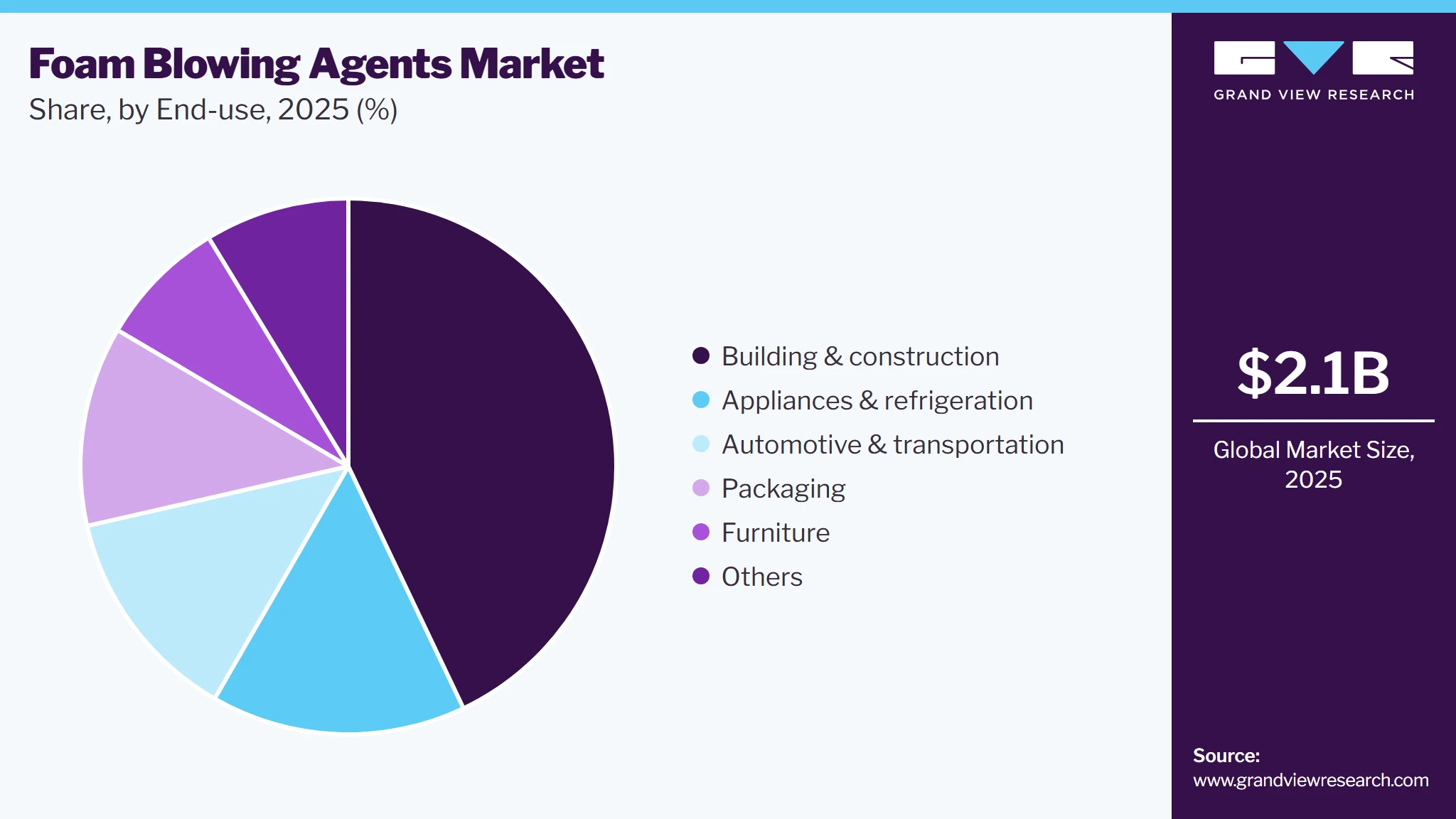
The building & construction segment led the market by end-use, accounting for 42.9% of revenue in 2025, and is projected to grow at an 5.2% CAGR from 2026 to 2033. Building and construction is driven by the growing requirement to improve envelope energy performance rather than simply increase insulation volumes. Rigid PU, PIR, XPS, and related foams are used in walls, roofs, panels, and other envelope applications where thermal resistance directly affects building energy consumption. The U.S. Department of Energy identifies opaque building envelopes as a significant energy-efficiency opportunity. Consequently, blowing-agent selection increasingly focuses on achieving low thermal conductivity with lower environmental impact and compliance with evolving GWP restrictions.
 To learn more about this report, Download Free Sample Report
 The appliances & refrigeration segment is expected to grow at the fastest CAGR of 6.0% over the forecast period. Appliances and refrigeration generate specialized demand because insulation performance directly influences equipment energy efficiency and internal temperature retention. Rigid PU foam is widely used around refrigerator and freezer cabinets, creating demand for blowing agents that provide fine cell structures and low thermal conductivity. Regulatory changes are accelerating chemistry substitution. In the U.S., appliance insulation foam using HFC blowing agents must meet a GWP below 150 from January 2025. This requirement is encouraging the adoption of alternatives such as HFOs and hydrocarbons.
Regional Insights
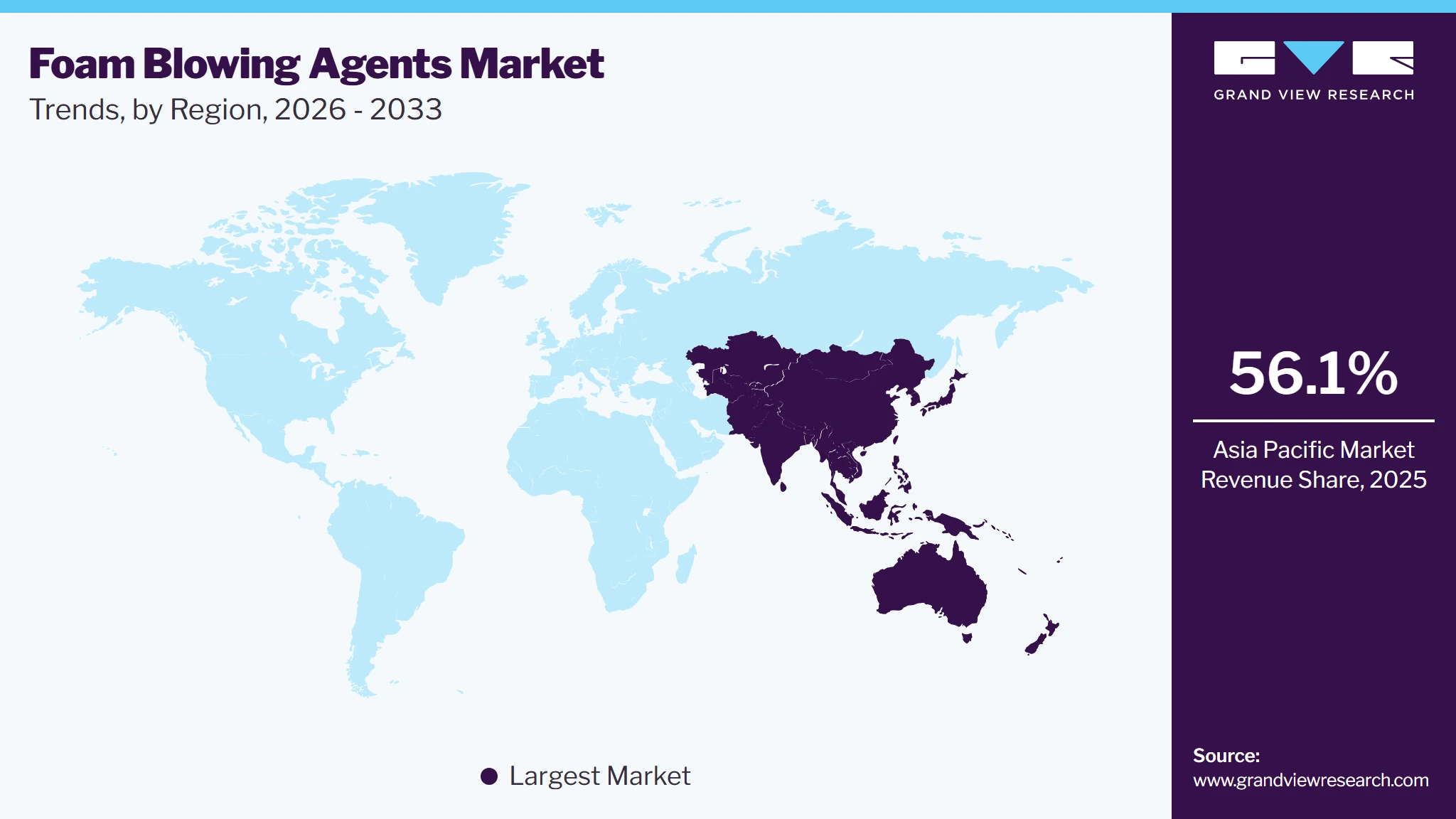
The Asia Pacific foam blowing agents market held the largest revenue share of 56.1% in 2025. The region is expected to grow at a CAGR of 5.7% over the forecast period. Asia Pacific is supported by the scale of foam manufacturing, expanding refrigeration demand, and the ongoing implementation of Montreal Protocol requirements. UNEP’s recent regional work highlights continued conversion toward lower-GWP technologies across refrigeration and air conditioning. The region also contains a large base of foam producers transitioning away from HCFC-141b and other ozone-depleting substances. China and other Asian manufacturing centers are developing local formulations and supply chains for replacement technologies. This combination of production scale and regulatory conversion sustains demand for alternative blowing agents.
 To learn more about this report, Download Free Sample Report
 China Foam Blowing Agents Market Trends
China’s market is increasingly influenced by the intersection of foam insulation requirements, fire-safety standards, and HCFC phaseout commitments. The country continues to support Montreal Protocol and Kigali Amendment implementation, while its building sector has adopted updated fire-safety requirements for insulation materials. China’s General Code for Building Fire Prevention introduced a classification approach for composite insulation systems. These changes encourage manufacturers to optimize blowing-agent chemistry alongside foam fire performance. The country’s large foam manufacturing base creates substantial demand for compliant, technically optimized alternatives.
North America Foam Blowing Agents Market Trends
North America’s foam blowing agents market is being shaped by the rapid replacement of high-GWP HFCs in insulation foams. U.S. EPA restrictions effective from January 2025 set a GWP limit of 150 for polyurethane, polyolefin, XPS, and other major foam categories. This is accelerating demand for HFOs, hydrocarbons, and other lower-GWP alternatives across construction and appliance applications. The region also benefits from established fluorochemical manufacturing capabilities and strong investment in formulation conversion, supporting faster commercialization of compliant blowing-agent technologies.
The U.S. market is primarily driven by regulatory-led technology conversion rather than volume expansion alone. EPA rules now restrict the manufacture and import of several foam products using blowing agents with a GWP above 150. This has created immediate substitution requirements for rigid PU, polyolefin, XPS, and polyisocyanurate systems. Manufacturers are consequently reformulating products and qualifying alternative chemistries across insulation applications. The breadth of the U.S. construction and appliance industries provides a substantial installed manufacturing base for these lower-GWP blowing-agent transitions.
Europe Foam Blowing Agents Market Trends
Europe is a regulation-intensive market where restrictions on fluorinated greenhouse gases are accelerating the transition toward alternative foam blowing technologies. The EU F-gas Regulation already restricts HFCs with a GWP of 150 or higher in several foam applications and introduces broader restrictions on fluorinated gases. These measures are pushing manufacturers toward HFOs, hydrocarbons, CO₂, and other lower-impact systems. Demand is therefore increasingly linked to regulatory compliance, product reformulation, and the need to maintain insulation performance while reducing the climate impact of foam production.
Latin America Foam Blowing Agents Market Trends
Latin America presents growth potential as energy efficiency programs expand across refrigeration, air conditioning, and buildings. The Inter-American Development Bank identifies substantial regional energy-saving potential from more efficient refrigeration and air-conditioning equipment. This supports demand for higher-performance insulation systems, particularly in cold-chain and appliance applications. At the same time, Montreal Protocol implementation is encouraging the replacement of ozone-depleting blowing agents. Market development, therefore, depends on the combined effect of appliance modernization, energy-efficiency investment, and gradual adoption of lower-GWP foam technologies.
Middle East and Africa Foam Blowing Agents Market Trends
The demand in the Middle East and Africa is increasingly connected to cooling requirements, appliance efficiency, and insulation performance in hot climates. The IEA notes that improving air-conditioner efficiency could materially reduce electricity demand in the Middle East and North Africa, where cooling represents a major load. Regional minimum energy performance standards are also expanding, including requirements for refrigerators and air conditioners in Southern and Eastern Africa. These developments strengthen the case for efficient insulation foams and compatible blowing agents with improved environmental performance.
Key Foam Blowing Agents Company Insights
Some of the key players operating in the market include Arkema S.A. and The Chemours Company
-
Arkema has a strong position in foam blowing agents through its Forane FBA 1233zd technology. The low-GWP, non-flammable HFO targets PU insulation for construction panels, spray foam, appliances, and refrigeration. In 2025, Arkema started a 15-kilotonne-per-year U.S. production unit, reinforcing regional supply and supporting the company’s expansion in lower-GWP foam technologies.
-
Chemours participates in the foam blowing agents market through its Opteon portfolio, particularly Opteon 1100 for PU and polyisocyanurate applications. The HFO-based product targets spray foam, appliances, panels, pipe insulation, and other applications requiring low-GWP chemistry. Its value proposition combines thermal resistance, dimensional stability, formulation compatibility, and regulatory transition support.
Solvay S.A. and HCS Group GmbH are some of the emerging participants in the foam blowing agents market.
-
Solvay has fluorochemical expertise and a broad specialty-materials portfolio relevant to the transition toward lower-impact blowing-agent technologies. However, its current direct positioning in dedicated foam blowing agents is narrower than major specialists such as Arkema and Chemours. Its capabilities in fluorinated chemistry and global customer relationships provide a platform for serving applications where environmental performance and material compatibility are increasingly important.
-
HCS Group operates a specialized hydrocarbon portfolio that supports applications requiring high-purity hydrocarbons, including foam blowing agents. Its positioning is centered on hydrocarbon-based alternatives rather than broad HFO technology. The company’s product specialization and international customer base support demand for pentane-based blowing systems, particularly where manufacturers prioritize cost efficiency and established processing technologies.
Key Foam Blowing Agents Companies:
The following key companies have been profiled for this study on the foam blowing agents market.
-
Honeywell International Inc.
-
Arkema S.A.
-
The Chemours Company
-
Solvay S.A.
-
Daikin Industries, Ltd.
-
Exxon Mobil Corporation
-
Linde plc
-
BASF SE
-
HCS Group GmbH
-
Harp International Ltd.
Company Categorization
Operating Strategies
Competitive Edge
Weakness
Mature Players: Honeywell International Inc. / Solstice Advanced Materials, Arkema S.A., The Chemours Company, Daikin Industries, Ltd., Exxon Mobil Corporation, Linde plc, BASF SE
- Maintain broad blowing-agent portfolios covering HFOs, HCFOs, hydrocarbons, physical blowing agents, and application-specific formulations for polyurethane, polyisocyanurate, XPS, polyolefin, appliances, refrigeration, construction, and industrial insulation.
- Invest in low-GWP technologies, thermal performance, foam-cell control, flammability management, process compatibility, and replacement of high-GWP HFCs and HCFCs.
- Expand through global manufacturing, regional production capacity, technical service, formulation support, customer qualification, and application development to support regulatory-driven conversion across major foam-producing markets.
- Established fluorochemical, hydrocarbon, and industrial-gas expertise supports development of blowing agents with controlled boiling points, low thermal conductivity, process compatibility, and improved environmental profiles.
- Diverse chemical and material portfolios allow suppliers to address different foam chemistries, including rigid PU, PIR, XPS, polyolefin, appliances, refrigeration, and construction insulation.
- Global production and technical networks support regulatory compliance, supply continuity, formulation conversion, customer qualification, and large-scale adoption across North America, Europe, and Asia Pacific.
- Large global manufacturing and R&D infrastructures can increase operating costs and create complex portfolio management across different blowing-agent chemistries and regional regulations.
- Broad chemical portfolios expose companies to competition from specialized fluorochemical suppliers, hydrocarbon producers, industrial-gas companies, and alternative foam technologies.
- Transitioning customers from established HFC or HCFC systems requires extensive formulation testing, equipment adjustments, safety assessment, and qualification, which can lengthen commercialization cycles.
Emerging Players: Solvay S.A., HCS Group GmbH, Harp International Ltd.
- Focus on specialty fluorochemicals, hydrocarbon-based blowing agents, high-purity hydrocarbons, and application-specific products for polyurethane, insulation, refrigeration, construction, and industrial foam applications.
- Develop solutions targeting lower environmental impact, controlled evaporation, foam density, thermal insulation, processing efficiency, and compatibility with established foam manufacturing systems.
- Expand through specialty product development, regional supply networks, technical collaboration, customer-specific formulations, and greater penetration of applications transitioning toward lower-GWP blowing agents.
- Specialized fluorochemical and hydrocarbon capabilities support development of blowing agents for manufacturers seeking alternatives to high-GWP and ozone-depleting chemistries.
- Focused product portfolios can enable faster customization around purity, boiling characteristics, formulation requirements, and specific foam-processing conditions.
- Established positions in specialty chemicals and hydrocarbon supply provide access to customers across insulation, refrigeration, construction, and industrial applications requiring cost-effective blowing-agent solutions.
- Comparatively narrower blowing-agent portfolios can limit scale advantages relative to major global fluorochemical and chemical suppliers.
- Smaller manufacturing and distribution footprints may provide less geographic coverage and supply redundancy across major foam-producing regions.
- Limited breadth across HFO, HCFO, hydrocarbon, and other blowing-agent chemistries can constrain participation in applications requiring multiple technology options and complex regulatory compliance.
Recent Developments
-
In February 2026, BASF launched biomass-balance Autofroth polyurethane foam systems for the North American low-pressure PU foam market. The products target sustainability requirements while allowing customers to scale without reformulation or process changes, supporting lower-carbon foam solutions across applications served by the polyurethane industry.
-
In August 2025, Arkema completed its new Forane 1233zd production unit in Kentucky, increasing North American capacity to 15 kilotons per year. The more than $60 million investment strengthens regional supply reliability for low-GWP foam blowing agents used in construction, roofing, and appliance insulation applications.
Foam Blowing Agents Market Report Scope
Report Attribute
Details
Market size in 2025
USD 2.1 billion
Estimated market size in 2026
USD 2.2 billion
Projected market size by 2033
USD 3.1 billion
Growth rate
CAGR of 5.2% from 2026 to 2033
Historical data
2021 - 2025
Forecast period
2026 - 2033
Quantitative units
Revenue in USD million/billion, volume in kilotons and CAGR from 2026 to 2033
Report coverage
Revenue & volume forecast, competitive landscape, growth factors, and trends
Segments covered
Foam type, end-use, region
Regional scope
North America; Europe; Asia Pacific; Latin America; Middle East & Africa
Country scope
U.S.; Canada; Mexico; Europe; Germany; UK; France; Italy; Spain; China; India; Japan; South Korea; Australia; Brazil; Argentina; Saudi Arabia; UAE; South Africa
Key companies profiled
Honeywell International Inc.; Arkema S.A.; The Chemours Company; Solvay S.A.; Daikin Industries, Ltd.; Exxon Mobil Corporation; Linde plc; BASF SE; HCS Group GmbH; Harp International Ltd.
Customization scope
Free report customization (equivalent to up to 8 analyst working days) with purchase. Addition or alteration to country, regional & segment scope
Pricing and purchase options
Avail customized purchase options to meet your exact research needs. Explore purchase options
Global Foam Blowing Agents Market Report Segmentation
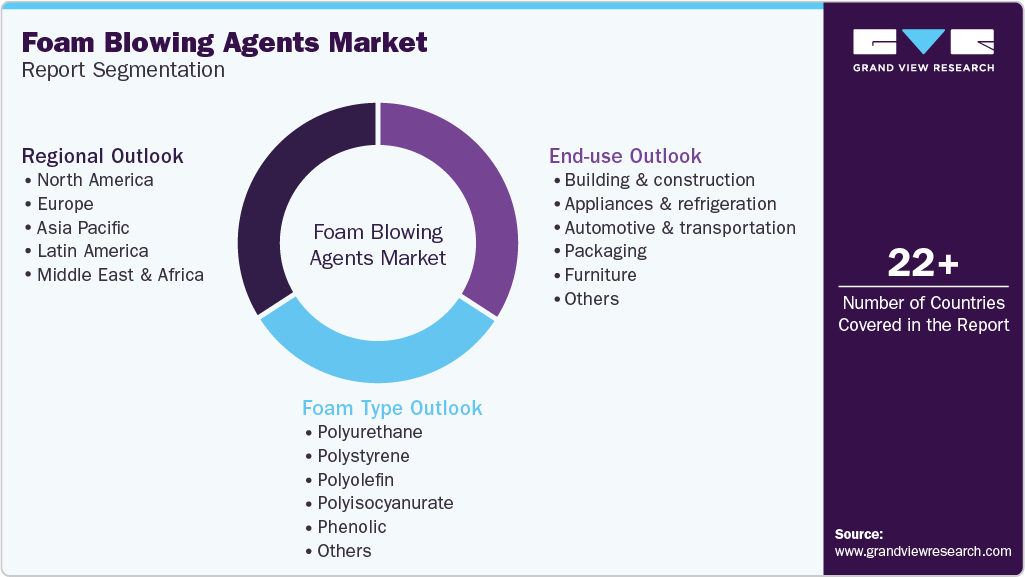
This report forecasts revenue growth at the global, regional, and country levels and provides an analysis of the latest industry trends across sub-segments from 2021 to 2033. For this study, Grand View Research has segmented the global foam blowing agents market report based on foam type, end-use, and region:
 To learn more about this report, Download Free Sample Report
 -
Foam Type Outlook (Volume, Kilotons; Revenue, USD Million, 2021 - 2033)
-
Polyurethane
-
Polystyrene
-
Polyolefin
-
Polyisocyanurate
-
Phenolic
-
Others
-
-
End-use Outlook (Volume, Kilotons; Revenue, USD Million, 2021 - 2033)
-
Building & construction
-
Appliances & refrigeration
-
Automotive & transportation
-
Packaging
-
Furniture
-
Others
-
-
Regional Outlook (Volume, Kilotons; Revenue, USD Million, 2021 - 2033)
-
North America
-
U.S.
-
Canada
-
Mexico
-
-
Europe
-
Germany
-
UK
-
France
-
Italy
-
Spain
-
-
Asia Pacific
-
China
-
India
-
Japan
-
South Korea
-
Australia
-
-
Latin America
-
Brazil
-
Argentina
-
-
Middle East & Africa
-
Saudi Arabia
-
UAE
-
South Africa
-
-
Research Methodology
The foam blowing agents market figures in this report are based on a proven research process that combines executive interviews with secondary research from proprietary databases, company filings, and recognized regulatory and institutional sources. Market size is built through value-chain sizing-reconciling supply-side and demand-side estimates-and triangulated with bottom-up and top-down approaches. Every estimate passes multiple levels of expert validation before publication, with each foam blowing agents segment quantified using the revenue-capture definitions in the table below.
Segment Definition
Foam Type
Revenue capture definition
Polyurethane
Revenue is captured through blowing agents used in rigid and flexible polyurethane foam systems requiring controlled cell formation, low thermal conductivity, dimensional stability, and processing efficiency. Demand comes from building insulation, appliances, refrigeration equipment, automotive components, furniture, and spray foam applications. Increasing substitution of high-GWP HFCs with HFOs, HCFOs, hydrocarbons, and other lower-impact technologies supports demand. Manufacturers select blowing agents based on foam density, insulation performance, flammability, processing temperature, formulation compatibility, and regulatory requirements.
Polystyrene
Revenue is generated through blowing agents used in expanded polystyrene (EPS) and extruded polystyrene (XPS) foams requiring lightweight construction, thermal insulation, cushioning, and moisture resistance. Demand comes from building insulation, packaging, cold-chain applications, and protective materials. Hydrocarbons remain important in EPS production, while XPS manufacturers are transitioning toward lower-GWP alternatives in response to environmental regulations. Blowing-agent selection depends on thermal conductivity, cell structure, dimensional stability, processing efficiency, flammability, and compliance with regional GWP restrictions.
Polyolefin
Revenue is captured through blowing agents used in polyethylene and polypropylene foam systems requiring lightweight construction, flexibility, impact resistance, and controlled cellular structures. Applications include automotive components, packaging, insulation, sports products, and industrial materials. Demand is supported by lightweighting and the replacement of heavier materials with foamed polymers. Manufacturers select physical or chemical blowing agents based on polymer melt strength, expansion ratio, cell uniformity, processing temperature, surface quality, and required mechanical performance.
Polyisocyanurate
Revenue is generated through blowing agents used in polyisocyanurate (PIR) insulation systems requiring high thermal resistance, dimensional stability, and improved fire performance. Demand is concentrated in roofing systems, wall insulation, insulated panels, cold-storage facilities, and commercial buildings. Low-GWP HFO and HCFO technologies are gaining relevance as manufacturers replace higher-impact fluorinated blowing agents. Formulation selection depends on thermal conductivity, foam density, fire performance, processing conditions, dimensional stability, and compliance with increasingly stringent environmental requirements.
Phenolic
Revenue is captured through blowing agents used in phenolic foam systems designed for applications requiring low thermal conductivity, dimensional stability, and strong fire-performance characteristics. Demand comes primarily from building insulation, ductwork, wall systems, roofing, and industrial insulation. Manufacturers require blowing agents that support fine cell structures and consistent foam expansion while maintaining thermal and fire performance. Adoption is influenced by building energy-efficiency requirements, fire-safety standards, formulation compatibility, processing conditions, and the transition toward lower-GWP blowing-agent technologies.
Others
Revenue is generated through blowing agents used in additional foam systems, including EVA, PVC, melamine, and specialty polymer foams. These materials serve construction, footwear, automotive, packaging, electronics, industrial, and specialized insulation applications. Demand varies according to required density, flexibility, thermal insulation, cushioning, flame resistance, and mechanical performance. Manufacturers develop physical and chemical blowing-agent systems according to polymer chemistry, processing temperature, expansion requirements, cell structure, regulatory conditions, and specific end-use performance requirements.
End-use
Revenue capture definition
Building & construction
Revenue is captured through blowing agents used to manufacture insulation foams for walls, roofs, floors, pipes, doors, windows, panels, and building envelopes. Rigid PU, PIR, XPS, and phenolic foams require blowing agents that provide low thermal conductivity and stable cellular structures. Demand is supported by building energy-efficiency requirements, insulation upgrades, green-building initiatives, and expanding construction activity. Low-GWP blowing agents are gaining importance as regulations increasingly restrict high-GWP HFCs and encourage lower-impact insulation technologies.
Appliances & refrigeration
Revenue is generated through blowing agents used in refrigerator, freezer, heat-pump, and other appliance insulation systems. Rigid PU foam provides thermal insulation around cabinets and equipment, helping manufacturers improve energy efficiency and temperature retention. Demand is supported by rising appliance production, replacement of older equipment, cold-chain expansion, and increasingly stringent energy-efficiency requirements. Blowing-agent selection focuses on low thermal conductivity, fine cell structure, dimensional stability, processing efficiency, flammability, and compliance with regional restrictions on high-GWP substances.
Automotive & transportation
Revenue is captured through blowing agents used in foamed materials for vehicle insulation, seating, interior components, acoustic systems, energy-management components, and transportation equipment. Demand is supported by vehicle lightweighting, electrification, thermal management, and requirements for improved passenger comfort. PU and polyolefin foams require blowing agents that deliver controlled density, cushioning, thermal insulation, acoustic performance, and dimensional stability. Electric vehicles also create additional requirements for insulation and thermal-management materials around batteries and electrical systems.
Packaging
Revenue is generated through blowing agents used in EPS, EPE, EPP, and other foamed packaging materials requiring lightweight construction, cushioning, impact absorption, and thermal protection. Demand comes from protective packaging, food transportation, electronics, appliances, and temperature-sensitive products. Foam packaging manufacturers prioritize blowing agents that provide uniform cell structures, controlled expansion, low density, and efficient processing. Growth in e-commerce, consumer electronics distribution, and cold-chain logistics supports consumption, while environmental requirements encourage development of lower-impact blowing-agent technologies.
Furniture
Revenue is captured through blowing agents used primarily in flexible polyurethane foam for furniture cushioning, mattresses, seating, and related comfort products. Demand is influenced by residential construction, furniture replacement, hospitality development, and consumer preference for lightweight cushioning materials. Blowing agents support controlled foam density, resilience, cell structure, and processing characteristics. Manufacturers increasingly evaluate water-based systems and alternative blowing technologies alongside conventional approaches to meet evolving environmental requirements while maintaining cushioning performance, production efficiency, and product durability.
Others
Revenue is generated through blowing agents used across footwear, sports equipment, medical products, insulation for industrial systems, marine applications, and specialized consumer and industrial products. These applications require different combinations of low density, flexibility, cushioning, thermal insulation, impact resistance, and dimensional stability. Demand depends on product design, polymer selection, processing requirements, and end-use performance specifications. Manufacturers use application-specific blowing-agent technologies to control expansion ratio, cell morphology, density, surface quality, and environmental performance across specialized foam products.
Estimation Model
Layer Name
Key Question
Description
Top-Down Foam Blowing Agents Demand Assessment Layer
What defines overall market demand?
Establishes overall global demand for foam blowing agents across polyurethane, polystyrene, polyolefin, polyisocyanurate, phenolic, and other foam types. The layer assesses consumption across building & construction, appliances & refrigeration, automotive & transportation, packaging, furniture, and other end-uses. It considers demand for HFOs, HCFOs, hydrocarbons, CO₂, water-based systems, and other blowing-agent technologies based on thermal insulation, foam density, processing efficiency, environmental performance, and regulatory requirements.
End-use Demand Validation Layer
Where is demand concentrated?
Maps demand across building & construction, appliances & refrigeration, automotive & transportation, packaging, furniture, and other end-uses. The assessment considers requirements such as low thermal conductivity, controlled cell structure, dimensional stability, fire performance, lightweighting, cushioning, impact resistance, and processing efficiency. It validates end-use demand through construction activity, insulation installation, appliance and refrigeration production, vehicle manufacturing, packaging output, furniture production, and cold-chain infrastructure development.
Consumption-to-Revenue Conversion Layer
How is demand monetized?
Converts foam blowing-agent consumption into market revenue using foam type, blowing-agent chemistry, formulation requirements, purity, environmental performance, end-use specifications, production scale, manufacturing costs, supplier positioning, and prevailing pricing structures. The layer evaluates price differences between conventional and low-GWP technologies, including HFOs, HCFOs, hydrocarbons, and other alternatives. Premiums associated with specialized formulations, regulatory compliance, high-purity products, and application-specific performance are also assessed.
Regional Demand Verification Layer
Where is demand validated?
Validates foam blowing-agent demand across North America, U.S., Asia Pacific, China, Europe, Latin America, and Middle East & Africa. The assessment considers construction activity, building insulation demand, appliance and refrigeration production, automotive manufacturing, packaging output, cold-chain development, foam production capacity, and regional chemical supply. It also examines HFC and HCFC phase-down policies, low-GWP technology adoption, import and supply patterns, raw material availability, manufacturing investments, and supplier localization strategies influencing regional consumption.
Delivered Customizations
This report has been delivered with the following In-depth customizations
Client Request
Customization Delivered
Value Adds
Regional segmentation
Developed market sizing and analysis across North America, U.S., Asia Pacific, China, Europe, Latin America, and Middle East & Africa, considering regional foam production, construction activity, appliance manufacturing, refrigeration demand, regulatory transition, and availability of HFOs, hydrocarbons, and other blowing agents.
Identifies regional demand concentrations, technology-transition patterns, regulatory-driven growth pockets, and differences in adoption of low-GWP blowing agents across developed and emerging markets.
Competitive benchmarking
Benchmarked Honeywell International Inc. / Solstice Advanced Materials, Arkema, Chemours, Daikin, Exxon Mobil, Linde, BASF, Solvay, HCS Group, and Harp International based on product portfolio, low-GWP technology, manufacturing footprint, application coverage, technical capabilities, geographic presence, and strategic positioning.
Clarifies competitive differentiation between fluorochemical specialists, hydrocarbon suppliers, industrial-gas companies, and diversified chemical manufacturers. Supports assessment of mature versus emerging market participants and technology positioning.
Opportunity assessment
Identified opportunities arising from HFC phase-downs, low-GWP technology adoption, energy-efficient insulation, appliance and refrigeration modernization, building energy-efficiency requirements, and expansion of foam manufacturing in emerging economies. Assessed opportunities for HFO, HCFO, hydrocarbon, CO₂, and optimized blend technologies across PU, XPS, polyolefin, and other foam systems.
Highlights technology-transition opportunities and application segments with potential for higher-value blowing-agent adoption. It also helps suppliers prioritize markets where regulation and energy-efficiency requirements are accelerating substitution.
Frequently Asked Questions About This Report
The polyurethane dominated the market , accounting for 63.6% market share in 2025 and is the fastest growing foam type.
Key players include Honeywell International Inc., Arkema S.A., The Chemours Company, Solvay S.A., Daikin Industries, Ltd., Exxon Mobil Corporation, Linde plc, BASF SE, HCS Group GmbH, Harp International Ltd.
The foam blowing agents market is expected to grow at a CAGR of 5.2% from 2026 to 2033 to reach around 3.1 billion by 2033.
Asia Pacific dominated the market, accounting for a revenue share of 56.1% in 2025.
The building & construction segment led the market by end-use, accounting for 42.9% of revenue in 2025 and is the fastest growing end-use.
The foam blowing agents market was valued at USD 2.1 billion in 2025 and is estimated at USD 2.2 billion in 2026.
The foam blowing agents market is supported by increasing demand for energy-efficient insulation across buildings, refrigeration, and appliances. Expanding construction and automotive production, alongside stricter efficiency standards and environmental regulations, is accelerating adoption of lightweight foams and low-global-warming-potential blowing agent technologies.
About the Author(s)
Plastics, Polymers & Resins Research Team
Bulk Chemicals · Plastics, Polymers & ResinsThis report was authored by the plastics, polymers & resins research team at Grand View Research - comprising two research analysts, one senior research analyst, and one industry expert - with specialized expertise in the plastics, polymers & resins segment of the bulk chemicals industry. All findings are based on proprietary bulk chemicals databases, executive interviews, and regulatory analysis, subject to internal peer review prior to publication.
Last Updated:
Speak to Analyst

Customize this report to your needs - add regions, segments, or data points, with 20% free customization.
Or view our licence options:


ISO 9001:2015 & 27001:2022 Certified
We are GDPR and CCPA compliant! Your transaction & personal information is safe and secure. For more details, please read our privacy policy.


