Food Grade Calcium Carbonate Market Summary
The global food grade calcium carbonate market size was valued at USD 4.92 billion in 2022 and is projected to reach USD 8.49 billion by 2030, growing at a CAGR of 7.1% from 2023 to 2030. This is attributable to the growing food production to cater to the growing global population. The total global consumption of food is predicted to increase by 35% over the next 15 years.
Key Market Trends & Insights
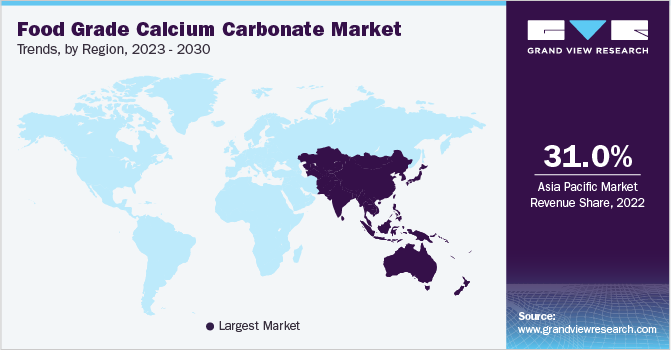
- The Asia Pacific was the dominating region and accounted for a revenue share of over 31% in 2022.
- Europe is predicted to grow at a notable CAGR of 6.8% over the 2023 to 2030 period.
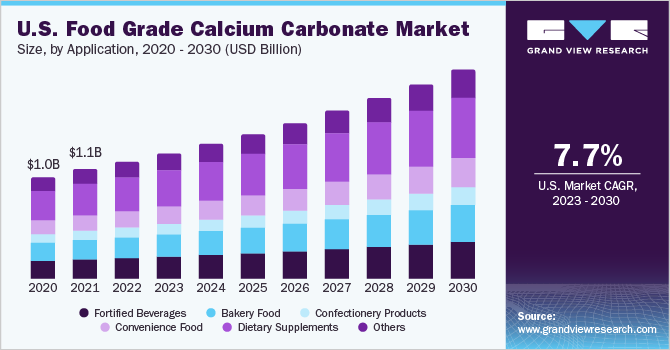
- By application, the dietary supplements segment dominated the market with a revenue share of over 32% in 2022.
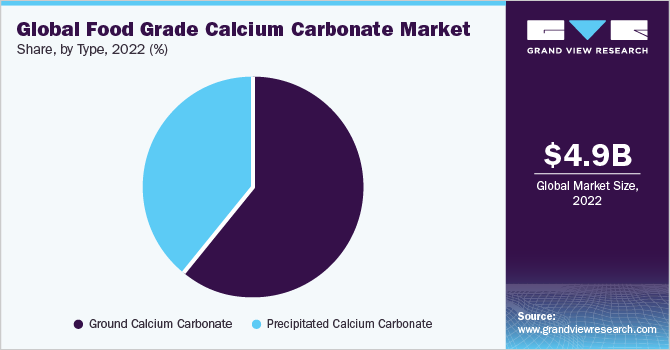
- By type, the ground calcium carbonate was a dominating segment in the market accounting for a revenue share of over 60% in 2022.
Market Size & Forecast
- 2022 Market Size: USD 4.92 Billion
- 2030 Projected Market Size: USD 8.49 Billion
- CAGR (2023-2030): 7.1%
- Asia Pacific: Largest market in 2022
Additionally, the growing demand for bakery and convenience food across the globe due to changing lifestyles, along with increasing consumption of nutraceutical products owing to the growing awareness regarding fitness among youngsters is expected to drive the market over the forecast period.
The product is added to a wide range of food and beverage products to increase their calcium content. This is particularly important for products that are not naturally high in calcium, such as juices, dairy alternatives, and baked goods. It is used in the production of calcium-rich nutritional supplements. These supplements are consumed to provide additional nutrients to individuals who may have inadequate intake through their regular diet, supporting bone health and overall calcium requirements.
Food and beverage products often require precise pH control. Calcium carbonate (CaCO3) is used as a pH adjuster, helping to stabilize and maintain the desired pH levels in various formulations. This is particularly important for products that need to maintain a specific pH range for flavor, preservation, or other purposes. The products are employed as anticaking agents in powdered or granulated products. The product helps prevent clumping and improves the flowability of substances such as spices, baking mixes, powdered sugar, and salt.
The food-grade calcium carbonate is typically manufactured through a process that involves the extraction, purification, and precipitation of calcium carbonate from natural sources. High-quality sources of CaCO3, such as limestone or marble, are selected as the starting material. The selected calcium carbonate source is extracted from the quarry or mine and undergoes mechanical grinding to reduce it to a fine powder or granular form.
Application Insights
The dietary supplements segment dominated the market with a revenue share of over 32% in 2022. This is attributed to the growing demand for nutritional products to treat minerals and vitamin deficiencies. The dietary supplements sector witnessed notable growth over the last few decades, from 4,000 products in the 90s to 90,000 products today.
The fortified beverages segment is predicted to grow at a notable CAGR of 7.6% over the forecast period as they are enriched with specific vitamins, minerals, or other beneficial ingredients, offering a convenient way for individuals to supplement their nutrient intake and meet their nutritional needs. Calcium-fortified beverages, such as juices, plant-based milk alternatives, & nutritional drinks, and provide consumers with a convenient way to supplement their nutrient intake.
The product can be used in chocolate manufacturing as an anticaking agent and to control viscosity. It helps prevent the chocolate from clumping and improves the flowability of chocolate coatings. Additionally, it is often added to chewing gum formulations as a texturizing agent. It helps to improve the texture, consistency, and mouthfeel of the gum, giving it a smooth and chewy texture.
Type Insights
Ground calcium carbonate was a dominating segment in the market accounting for a revenue share of over 60% in 2022. This is attributed to its advantages such as high brightness and cheap price. GCC is added to a variety of food products to fortify them with calcium. GCC is used as a dough conditioner in baking applications. It helps improve the texture, structure, and elasticity of dough, leading to better volume and crumb texture in baked goods like bread, cakes, and pastries.
GCC is also used in the production of supplements and dietary formulations. It provides a source of bioavailable calcium for individuals who may have insufficient intake through their regular diet. The calcium-rich nutraceutical supplements are consumed to support bone health and meet dietary requirements.
The precipitated calcium carbonate (PCC) is predicted to grow at a significant CAGR of 7.2% during the forecast period. PCC can act as an emulsifying and stabilizing agent in food products. It helps create and maintain stable emulsions, improving the texture, consistency, and shelf stability of products like salad dressings, sauces, and beverages.
Regional Insights
The Asia Pacific was the dominating region and accounted for a revenue share of over 31% in 2022. The growth is attributed to the growing product demand owing to the growing awareness of the importance of proper nutrition and the role of fortification in addressing nutrient deficiencies in the region. The food industry in the Asia Pacific region has been experiencing significant industrialization and modernization. This includes the adoption of advanced food processing technologies and the use of additives like CaCO3 to improve product quality, texture, and stability.
China is one of the largest consumers of the product globally. The country has the world's largest population and its urbanization rate is on the rise. As more people move to urban areas, there is a greater demand for processed and convenience foods that often contain food-grade CaCO3 as an ingredient.
Europe is predicted to grow at a notable CAGR of 6.8% over the 2023 to 2030 period. Several European countries have regulations in place that require the fortification of certain food products with essential nutrients. European dietary guidelines emphasize the importance of calcium intake for maintaining healthy bones and teeth. As a result, there is a growing awareness among consumers about the need for sufficient calcium in their diets.
Key Companies & Market Share Insights
The food-grade calcium carbonate industry has seen advancements in production processes to improve the efficiency, quality, and consistency of the final product. These advancements include the use of advanced grinding and purification techniques, as well as innovative methods to control particle size and morphology. Some of the market participants are focusing on sustainable sourcing practices, reducing energy consumption during production, and implementing waste management strategies. For instance, in January 2023, Holcim acquired a leader in grounded calcium carbonate named Nicem in Italy. The low-emission raw materials of Nicem will boost the green formulation of Holcim’s sustainable solutions. Some prominent players in the global food grade calcium carbonate market include:
-
Omya AG
-
Huber Engineered Materials
-
Guangdong Qiangda New Materials Technology Co., Ltd.
-
Essential Living
-
Neelkanth Finechem LLP
-
FUJIAN SANMU NANO CALCIUM CARBONATE CO., LTD.
Food Grade Calcium Carbonate Market Report Scope
|
Report Attribute
|
Details
|
|
Market size value in 2023
|
USD 5.25 billion
|
|
Revenue forecast in 2030
|
USD 8.49 billion
|
|
Growth Rate
|
CAGR of 7.1% from 2023 to 2030
|
|
Base year for estimation
|
2022
|
|
Historical data
|
2018 - 2021
|
|
Forecast period
|
2023 - 2030
|
|
Quantitative units
|
Volume in kilotons, revenue in USD million, CAGR from 2023 to 2030
|
|
Report coverage
|
Revenue forecast, company ranking, competitive landscape, growth factors, and trends
|
|
Segments covered
|
Type, application, region
|
|
Country scope
|
U.S.; Canada; Mexico; Germany; Italy; France; UK; Spain; China; Japan; India; South Korea; Brazil; Argentina; South Africa; Saudi Arabia
|
|
Key companies profiled
|
Omya AG; Huber Engineered Materials; Guangdong Qiangda New Materials Technology Co., Ltd.; Essential Living; Neelkanth Finechem LLP; FUJIAN SANMU NANO CALCIUM CARBONATE CO., LTD.; others
|
|
Customization scope
|
Free report customization (equivalent up to 8 analysts working days) with purchase. Addition or alteration to country, regional & segment scope.
|
|
Pricing and purchase options
|
Avail customized purchase options to meet your exact research needs. Explore purchase options
|
Global Food Grade Calcium Carbonate Market Report Segmentation
This report forecasts volume & revenue growth at global, regional, and country levels and provides an analysis of the latest industry trends in each of the sub-segments from 2018 to 2030. For the purpose of this study, Grand View Research has segmented the global food-grade calcium carbonate market report based on type, application, and region:
-
Type Outlook (Volume, Kilotons; Revenue, USD Million; 2018 - 2030)
-
Application Outlook (Volume, Kilotons; Revenue, USD Million; 2018 - 2030)
-
Fortified Beverages
-
Bakery Food
-
Confectionery Products
-
Convenience Food
-
Dietary Supplements
-
Others
-
Regional Outlook (Volume, Kilotons; Revenue, USD Million; 2018 - 2030)
-
North America
-
Europe
-
Germany
-
U.K.
-
France
-
Italy
-
Spain
-
Asia Pacific
-
China
-
India
-
Japan
-
South Korea
-
Central & South America
-
Middle East & Africa
-
Saudi Arabia
-
South Africa
Frequently Asked Questions About This Report
b. The global food grade calcium carbonate market size was estimated at USD 4.92 billion in 2022 and is expected to reach USD 5.25 billion in 2023.
b. The global food grade calcium carbonate market is expected to grow at a compound annual growth rate of 7.1% from 2023 to 2030 to reach USD 8.49 billion by 2030.
b. Asia Pacific dominated the food grade calcium carbonate market with a share of 31.5% in 2022. This is attributable to the growing product demand owing to the growing awareness of the importance of proper nutrition and the role of fortification in addressing nutrient deficiencies in the region.
b. Some key players operating in the food grade calcium carbonate market include Omya AG, Huber Engineered Materials, Guangdong Qiangda New Materials Technology Co.,Ltd., Essential Living, Neelkanth Finechem LLP, FUJIAN SANMU NANO CALCIUM CARBONATE CO.,LTD., and others.
b. Key factors that are driving the market growth include the growing demand for bakery and convenience food across the globe due to changing lifestyle, along with the increasing consumption of nutraceutical products owing to the growing awareness regarding fitness among youngsters.

 Download Sample Report