
- Home
- »
- Plastics, Polymers & Resins
- »
-
Fungi-based Alternative Materials Market Size Report, 2033GVR Report cover

Fungi-based Alternative Materials Market (2026 - 2033)
Size, Share & Trends Analysis Report By Material Type (Mycelium Composites, Mycelium Leather Alternatives, Mycelium Foams & Insulation, Fungal Biomass-Based Flexible Materials), By End Use, By Region, And Segment Forecasts
Market Size, 2025
$1.3BMarket Estimate, 2026
$1.5BMarket Forecast, 2033
$3.4BCAGR, 2026–2033
13.0%Fungi-based Alternative Materials Market Summary
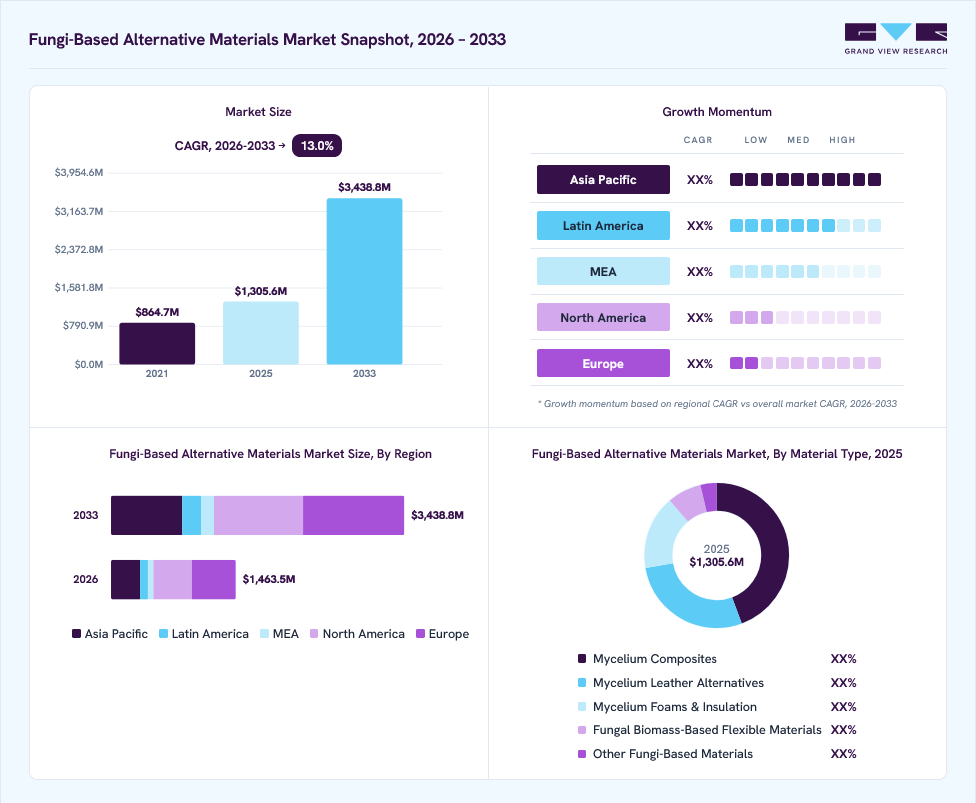
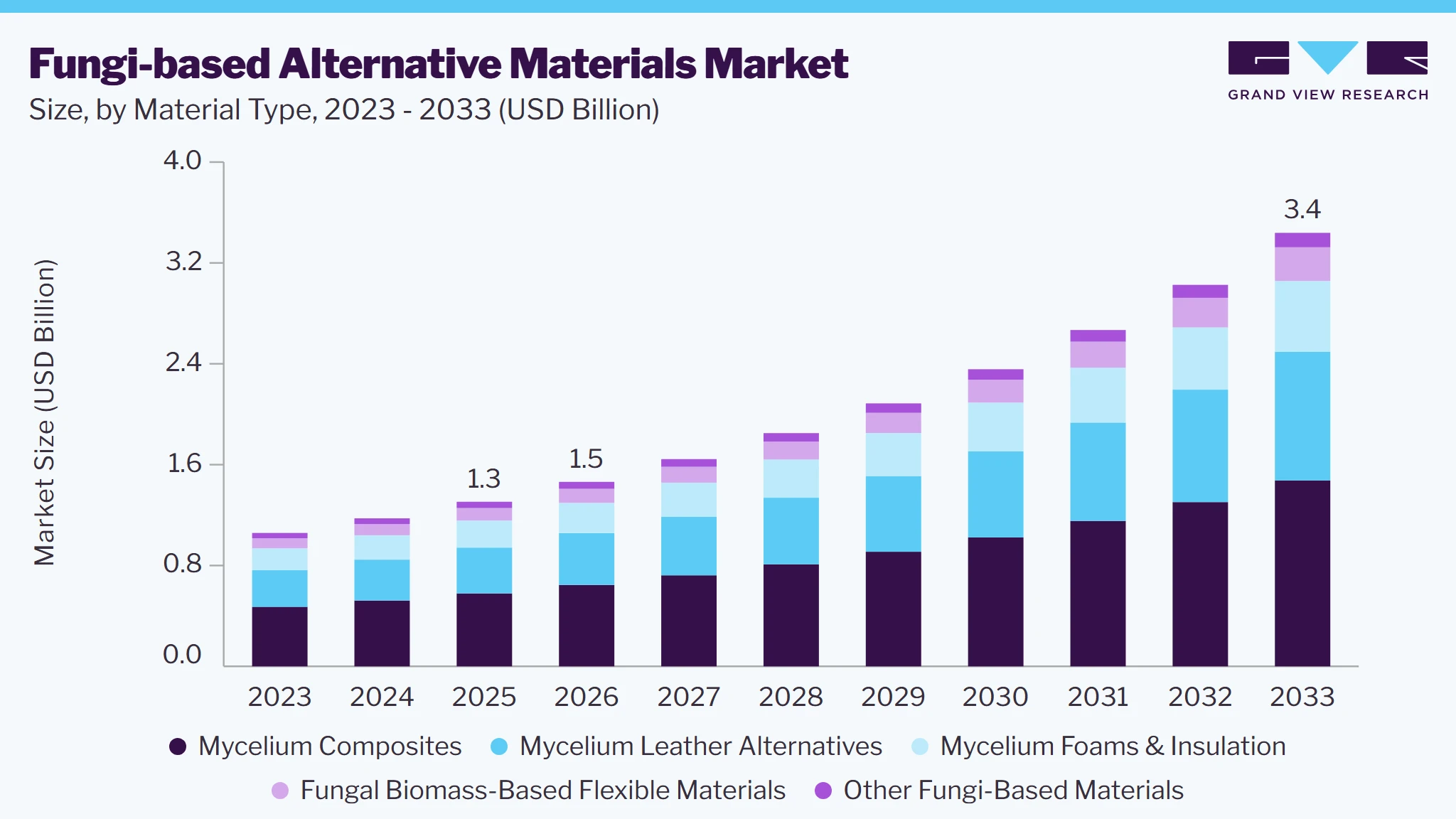
The global fungi-based alternative materials market size was valued at USD 1.3 billion in 2025 and is projected to grow from USD 1.5 billion in 2026 to USD 3.4 billion by 2033, at a CAGR of 13.0% from 2026 to 2033. The market in Europe dominated with a revenue share of 35.4% in 2025. The market is driven by rising demand for sustainable, biodegradable, and low-impact materials, as industries adopt mycelium- and fungi-derived alternatives to plastics, foams, leather, and other petroleum-based materials.
 Source: Grand View Research, IR Documents, Primary Interviews, Paid DatabasesTo learn more about this report,
 Download Free Sample Report
 Key Market Trends & Insights
- By material type: Mycelium composites segment held the largest market share of 44.3% in 2025.
- By end use: Packaging segment held the largest market share of 36.1% in 2025.
Regional Highlights
- Largest regional market: Europe (35.4% revenue share, 2025)
- Fastest-growing regional market: Asia Pacific (highest CAGR, 2026-2033)
- By country: Germany held the largest market share in 2025
Market Size & Forecast
- Market size in 2025: USD 1.3 Billion
- Estimated market size in 2026: USD 1.5 Billion
- Projected market size by 2033: USD 3.4 Billion
- CAGR (2026-2033): 13.0%
Three ways to get this report
Buy it, customize it, or ask a question.Ask an Analyst
A direct answer, usually in 1 working day
- AccessReport author, directly
- Reply timeWithin 1 working day
- No sales callDirect answer only
- FormatEmail reply
- CostFree, no cost
Get the Full Report
What the study covers
- FormatsPDF · Excel · Dashboard
- Timeline2026–2033 annual, 2025 base
- Coverage20+ countries, 5 regions
- Companies10+ key players profiled
Customize the Report
20% free customization
- IncludeCountries, segments, points
- TailorTo your product definition
- ExtendDeeper competitor detail
- OrA fully bespoke study
- Turnaround5–10 working days
The fungi-based alternative materials are witnessing demand across packaging, construction, fashion, furniture, automotive, and consumer goods industries. As manufacturers increasingly seek alternatives to petroleum-based plastics, synthetic foams, conventional leather, and other resource-intensive materials, mycelium composites and fungi-derived materials are gaining adoption due to their lightweight structure, biodegradability, design flexibility, and potential for lower environmental impact. The expansion of sustainable product development and growing investment in bio-based material technologies are further supporting market growth.An increasing focus on material sustainability, circularity, and reduced dependence on conventional materials is expected to boost market growth in the coming years. Industries such as fashion, footwear, packaging, construction, and automotive are exploring mycelium-based materials as alternatives to traditional leather, foam, insulation, and composites.
 To learn more about this report, Download Free Sample Report
 Mycelium materials can be produced using agricultural and forestry residues as feedstocks, supporting resource efficiency and waste valorization. In addition, growing consumer preference for plant- and bio-based products and increasing corporate sustainability commitments are encouraging manufacturers to incorporate fungi-derived materials into commercial products.
Transition toward bio-based material systems are also significantly contributing to the market growth. A defining trend in the fungi-based alternative materials industry is accelerated innovation focused on improving durability, scalability, functionality, and end-of-life characteristics.
The commercialization of mycelium-based leather and composites by biomaterial developers broadens fungi-derived materials' uses beyond packaging. These advances aim to enhance performance, scalability, and availability, encouraging wider adoption of these materials.
Market Dynamics
The fungi-based alternative materials market is witnessing strong growth, driven by increasing demand for sustainable biomaterials, rising environmental concerns associated with conventional plastics and synthetic materials, and growing adoption of bio-based alternatives across packaging, fashion, construction, automotive, furniture, and consumer goods. Manufacturers are increasingly developing mycelium composites, fungi-based leather alternatives, foams, insulation, and flexible materials to provide lower-impact alternatives to conventional materials. Additionally, advances in fungal cultivation, material processing, product design, and commercialization are supporting market expansion, while scalability and performance requirements remain key challenges.
The increasing demand for sustainable and bio-based materials across industries is a key driver of the fungi-based alternative materials market. Growing environmental awareness, efforts to reduce dependence on petroleum-based materials, and corporate sustainability commitments are encouraging manufacturers to explore mycelium and other fungi-derived materials as alternatives to conventional plastics, foams, leather, and composite materials. The ability of fungi-based materials to utilize renewable biomass and agricultural residues further strengthens their attractiveness for sustainable material development.
As manufacturers expand their sustainable product portfolios, the need for lightweight, biodegradable, customizable, and functional material solutions is growing. Mycelium composites are increasingly being developed for packaging, furniture, construction components, and interior applications, while mycelium leather alternatives are gaining interest in fashion, footwear, and consumer products. The expansion of these applications is supporting broader commercialization of fungi-based materials and increasing demand across multiple end-use industries.
Commercial production of fungi-based materials can require controlled cultivation, specialized processing, and quality management to maintain uniformity in properties such as strength, moisture resistance, durability, and flexibility. These requirements can increase production costs compared with established conventional materials and may limit adoption in price-sensitive applications. In addition, the relatively developing supply chain and limited large-scale manufacturing infrastructure can create challenges for companies seeking to commercialize fungi-based materials at high volumes.
A major opportunity for the fungi-based alternative materials market lies in the expanding adoption of mycelium-based materials across fashion, footwear, construction, automotive, furniture, packaging, and consumer goods applications. Growing demand for sustainable alternatives to conventional leather, plastics, foams, and synthetic materials is encouraging manufacturers to develop innovative fungi-derived solutions with improved durability, flexibility, and performance. The rapid development of mycelium leather alternatives, foams, insulation, and flexible fungal biomass materials, supported by advances in cultivation and processing technologies, is expected to create significant opportunities for market participants to expand into new applications and increase commercial adoption.
Market Concentration & Characteristics
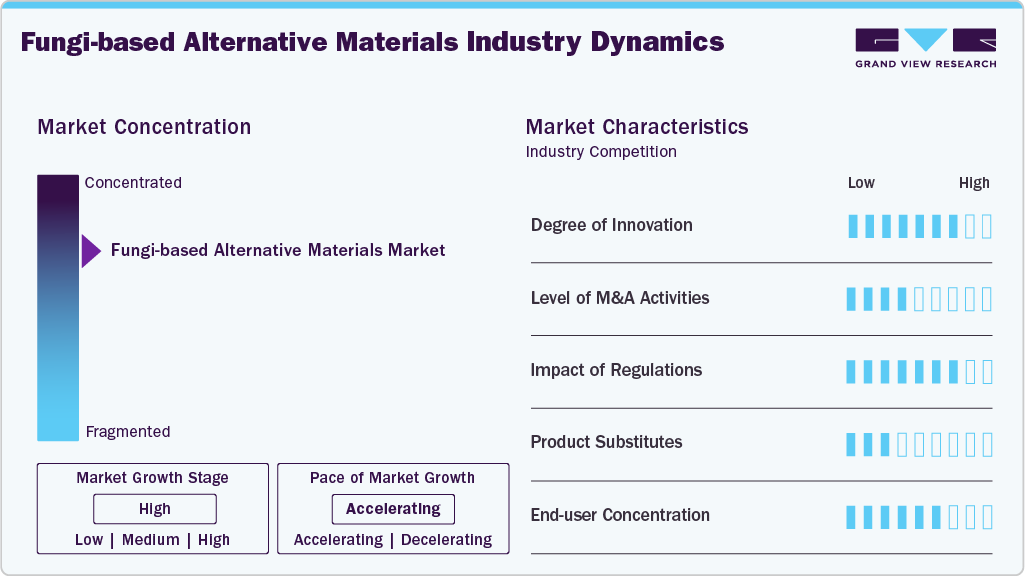
The fungi-based alternative materials market is characterized by its emerging, technology-driven nature, with production focused on developing scalable and commercially viable alternatives to conventional plastics, leather, foams, and composite materials. The industry relies heavily on controlled fungal cultivation, mycelium growth, substrate preparation, material processing, and specialized finishing technologies. Manufacturers prioritize material consistency, scalability, functional performance, and production efficiency as they transition fungi-based materials from niche applications toward commercial use. Key participants are increasingly developing mycelium composites, leather alternatives, foams, insulation, and flexible fungal biomass materials for applications across fashion, packaging, construction, automotive, furniture, and consumer goods.
 To learn more about this report, Download Free Sample Report
 A defining feature of the industry is its dependence on biological feedstocks and mycelium-based production processes, which differentiate fungi-based materials from petroleum-derived and animal-based alternatives. Agricultural residues, forestry by-products, and other biomass resources can serve as substrates for fungal growth, supporting resource efficiency and waste valorization. However, production characteristics vary according to fungal species, substrate composition, cultivation conditions, processing methods, and required material properties. Increasing investments in biotechnology, material engineering, and large-scale cultivation are therefore influencing product development and commercialization strategies across the industry.
Analyst Perspective
The global fungi-based alternative materials market has evolved from a niche biomaterials segment into an emerging commercial industry, supported by advances in mycelium cultivation, fungal biomass processing, and bio-based material engineering. Increasing demand for sustainable alternatives to plastics, synthetic leather, foams, and conventional composites is driving adoption across packaging, fashion, construction, furniture, automotive, and consumer goods. Going forward, continued improvements in scalability, material consistency, durability, cost efficiency, and circular production are expected to accelerate commercialization and expand fungi-based materials into higher-value applications, supporting strong market growth through the forecast period.
Material Type Insights
The mycelium composites segment led the market with the largest revenue share of 44.3% in 2025. Mycelium composites are the most widely adopted fungi-based material, offering lightweight, moldable, and biodegradable alternatives to conventional plastics, foams, and synthetic composites. They are increasingly used in packaging, furniture, construction components, interior applications, and consumer products due to their ability to be produced from agricultural and forestry residues. Their market leadership is supported by established cultivation and processing techniques, growing demand for low-impact materials, and increasing commercialization of mycelium-based products across multiple industries.
The mycelium leather alternatives segment is expected to grow at the fastest CAGR of 13.9% during the forecast period. These materials provide a fungi-derived alternative to animal leather and petroleum-based synthetic leather, with growing adoption in fashion, footwear, accessories, automotive interiors, and consumer goods. Their growth is driven by increasing demand for animal-free and lower-impact materials, along with advances in mycelium cultivation, material finishing, texture development, and durability.
End Use Insights
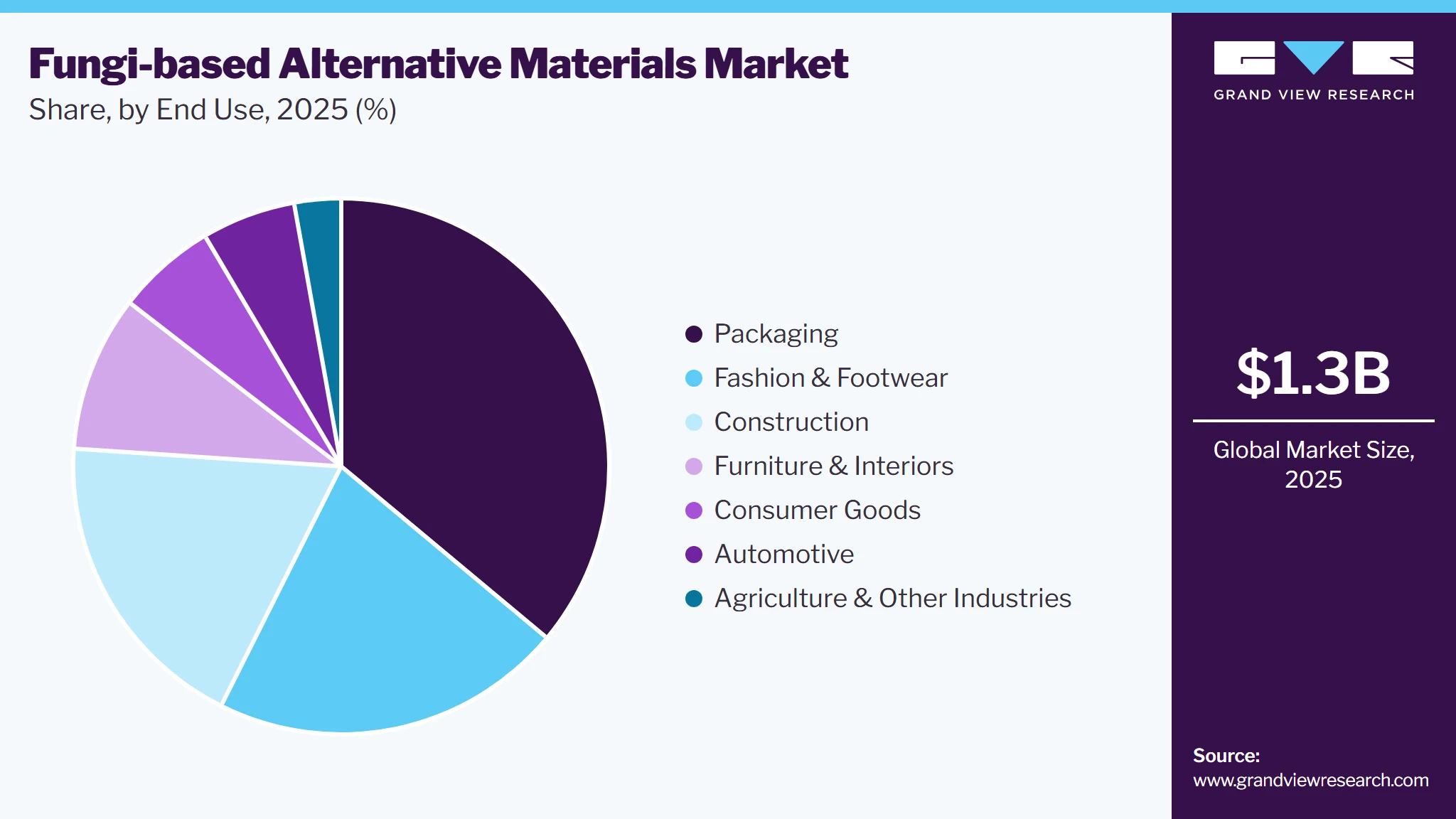
The packaging segment held the largest revenue share of 36.1% in 2025. Fungi-based materials are increasingly used in protective packaging applications as sustainable alternatives to conventional plastic foams and other petroleum-based cushioning materials. Mycelium composites are particularly suitable for molded protective packaging as they can be grown into customized shapes, provide lightweight cushioning, and utilize agricultural and other biomass residues as feedstocks. The growth of fungi-based packaging is supported by increasing demand for biodegradable material solutions, corporate sustainability targets, and efforts to reduce reliance on conventional plastics.
 To learn more about this report, Download Free Sample Report
 The automotive segment is expected to grow at the fastest CAGR of 13.9% during the forecast period. Fungi-based materials are gaining interest in automotive applications such as interior components, trim elements, cushioning, insulation, and lightweight composite parts. Their potential for lightweight construction, utilization of renewable feedstocks, and lower environmental impact attracts automotive manufacturers pursuing sustainable material strategies. Growth is further supported by advances in mycelium composites, foams, and flexible fungal materials, enabling developers to explore fungi-based alternatives for vehicle interiors and other non-structural applications.
Regional Insights
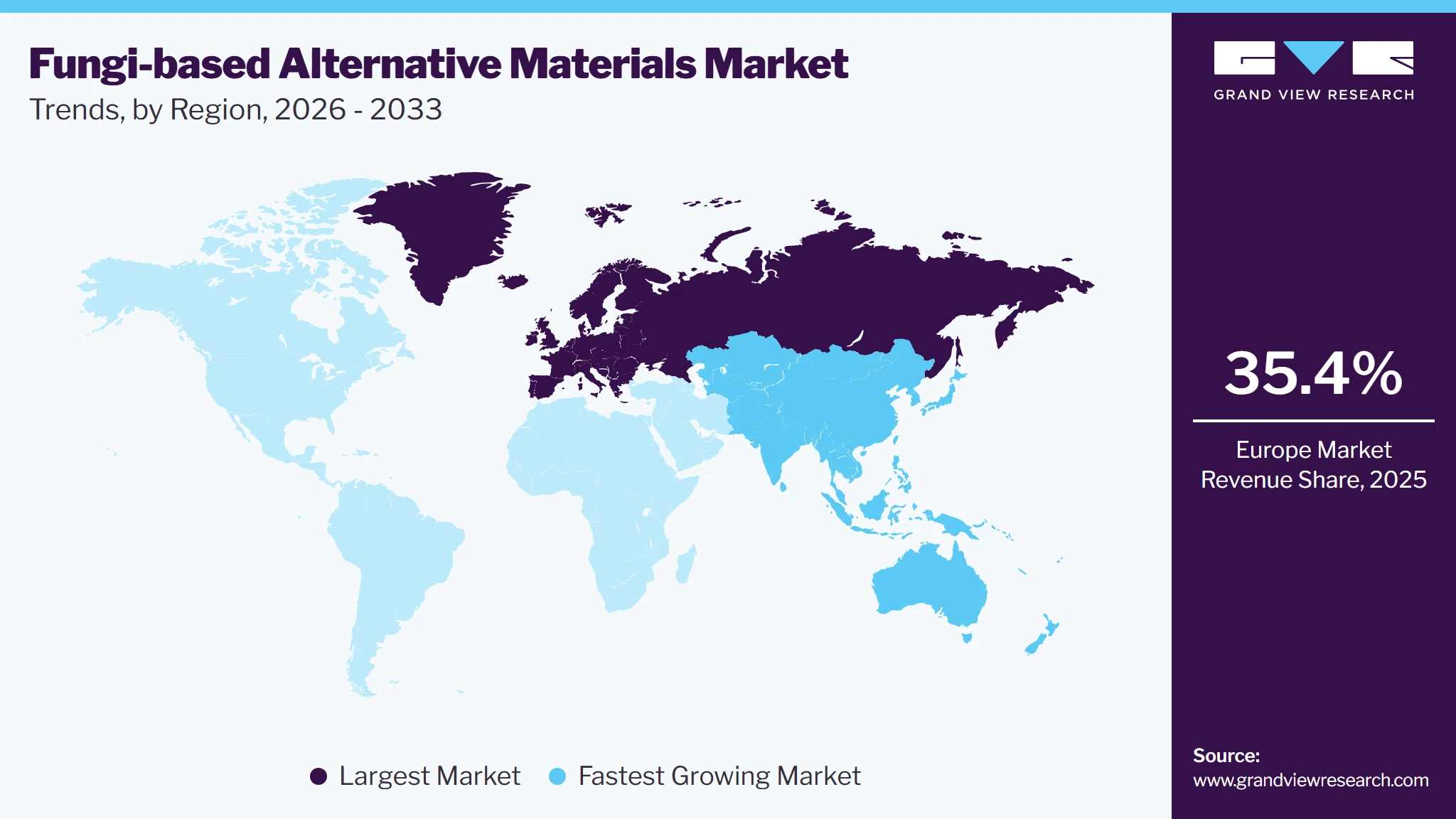
Europe fungi-based alternative materials market dominated the global market with a revenue share of 35.4% in 2025, supported by strong sustainability priorities, circular-economy initiatives, and growing demand for bio-based materials. The region is witnessing increasing use of mycelium composites and leather alternatives in packaging, fashion, construction, furniture, and consumer products. Established sustainability-focused industries and growing interest in replacing petroleum- and animal-derived materials are expected to maintain Europe's leading position, with the regional market projected to reach USD 1,187.5 million by 2033.
 To learn more about this report, Download Free Sample Report
 Fungi-based alternative materials market in Germany represents a significant market within Europe, supported by its strong manufacturing base, advanced automotive and industrial sectors, and emphasis on resource-efficient materials. Demand for fungi-based composites, foams, insulation, and leather alternatives is emerging across automotive interiors, furniture, construction, and consumer applications. Continued focus on sustainable manufacturing and material innovation is expected to create opportunities for fungi-based material developers.
The UK fungi-based alternative materials market is expected to progress steadily, driven by growing interest in sustainable fashion, footwear, packaging, furniture, and consumer products. Increasing experimentation with mycelium leather alternatives and other bio-based materials is encouraging product innovation. The presence of sustainability-oriented brands and material developers is also supporting the transition from niche applications toward broader commercial use.
North America Fungi-based Alternative Materials Market Trends
Fungi-based alternative materials market in North America is expected to expand steadily during the forecast period, growing at a CAGR of 12.8% over the forecast period. Growth is supported by increasing adoption of sustainable materials across packaging, fashion, automotive, construction, and consumer goods. The region's established innovation ecosystem and growing interest in mycelium-based composites, leather alternatives, and insulation materials are encouraging commercial development and application diversification.
U.S. Fungi-based Alternative Materials Market Trends
The U.S. fungi-based alternative materials market is anticipated to witness consistent growth as manufacturers and consumer brands explore bio-based substitutes for conventional plastics, leather, foams, and synthetic materials. Demand is particularly supported by applications in sustainable packaging, fashion & footwear, furniture, and automotive interiors. Increasing investment in biomaterial research, product development, and scalable fungal cultivation is expected to strengthen domestic commercialization.
Asia Pacific Fungi-based Alternative Materials Market Trends
Fungi-based alternative materials market in APAC is projected to register the fastest CAGR of 13.7% during 2026-2033. Rapid industrialization, expanding manufacturing capabilities, growing sustainability awareness, and increasing demand for bio-based materials across packaging, fashion, automotive, construction, and consumer goods are driving regional expansion.
Fungi-based alternative materials market in China is expected to remain a key market in Asia Pacific, supported by its large manufacturing ecosystem, extensive consumer goods industry, and expanding interest in sustainable material solutions. Growing demand for alternatives to petroleum-based plastics, synthetic leather, and conventional foams is creating opportunities for mycelium composites and other fungi-derived materials. Increasing investment in biotechnology and advanced material production is expected to support further commercialization.
India fungi-based alternative materials market is expected to experience strong growth during the forecast period, supported by expanding manufacturing, rising environmental awareness, and increasing interest in sustainable materials. Applications in packaging, fashion and footwear, consumer goods, and construction are creating emerging opportunities for fungi-derived solutions. Growing availability of agricultural biomass and increasing interest in waste-to-material approaches could further support the development of fungi-based material production.
Latin America Fungi-based Alternative Materials Market Trends
The fungi-based alternative materials market in Latin America is projected to grow at a CAGR of 13.3% over the forecast period. Expansion is supported by increasing sustainability initiatives, availability of agricultural biomass resources, and growing demand for lower-impact materials in packaging, consumer goods, furniture, construction, and fashion. The region's agricultural base also provides potential feedstock opportunities for fungal cultivation and biomass-based material production.
The fungi-based alternative materials market in Brazil accounts for a significant portion of the Latin American opportunity due to its large agricultural and industrial base and growing focus on sustainable production. The availability of agricultural residues provides a favorable foundation for the development of fungi-based materials, particularly mycelium composites and biomass-derived materials. Increasing demand for sustainable packaging, consumer products, and alternative materials is expected to support market expansion.
Argentina fungi-based alternative materials market is expected to develop gradually, supported by agricultural biomass availability and increasing interest in sustainable material solutions. Opportunities are emerging in packaging, consumer goods, furniture, and other applications where fungi-derived materials can replace conventional materials. Further commercialization and investment in local biomaterial production could strengthen market adoption.
Middle East & Africa Fungi-based Alternative Materials Market Trends
The MEA fungi-based alternative materials market is expected to register steady growth, supported by increasing sustainability initiatives, diversification of manufacturing activities, and growing interest in renewable and resource-efficient materials. Adoption is expected to emerge across packaging, construction, furniture, consumer goods, and other applications as regional industries explore alternatives to conventional materials.
Key Fungi-based Alternative Material Company Insights
Some key companies in the Fungi-based Alternative Materials market include MycoWorks, Ecovative LLC, MYCL, Mogu, MYCOTEX, Biohm Limited, Mycelium Materials Europe, COMU Labs Inc., NatureTech, and PurewayBio. The market is characterized by mycelium cultivation, bio-based material engineering, waste biomass utilization, sustainable material development, and collaboration with fashion, construction, furniture, automotive, and consumer goods manufacturers. Key participants are focusing on developing biodegradable, renewable, lightweight, customizable, and high-performance alternatives to conventional leather, plastics, foams, insulation, composites, and wood-based materials.
-
MycoWorks is a biomaterials company known for developing Fine Mycelium™ technology and its Reishi™ material, a premium mycelium-based alternative to animal leather. Its materials are designed to provide leather-like strength, durability, flexibility, and surface characteristics for applications in fashion, luxury goods, accessories, furniture, and automotive interiors.
-
Ecovative LLC develops mycelium-based materials designed to replace conventional petroleum-derived materials across multiple applications. Its technology portfolio includes mycelium-based foams, leather-like materials, packaging, and other material solutions, with a focus on utilizing biological feedstocks and scalable fungal cultivation. The company's material platform supports applications requiring lightweight, renewable, biodegradable, and functional alternatives to conventional materials.
Key Fungi-based Alternative Material Companies
The following key companies have been profiled for this study on the fungi-based alternative materials market.
-
MycoWorks
-
Ecovative LLC
-
Mycl.
-
mogu
-
MYCOTEX
-
Biohm Limited
-
Mycelium Materials Europe
-
COMU Labs Inc.
-
NatureTech
-
PurewayBio
Competitive Benchmarking
Category
Operating Strategies
Competitive Edge
Weakness
Established Players (MycoWorks; Ecovative LLC; MYCL; Mogu)
- Focus on mycelium cultivation, biomaterial R&D, product scaling, and partnerships across fashion, construction, furniture, automotive, and consumer goods.
- Proprietary mycelium technology, material expertise, diverse applications, strong innovation capabilities, and growing commercial partnerships.
- High production costs, scalability challenges, limited material consistency, and competition from conventional materials.
Emerging Players (MYCOTEX; Biohm Limited; Mycelium Materials Europe; COMU Labs Inc.; NatureTech; PurewayBio)
- Focus on specialized fungi-based materials, biomass utilization, sustainable textiles, insulation, composites, and customized material development.
- Application-specific innovation, waste biomass utilization, flexible development, and focus on sustainable material solutions.
- Limited production capacity, smaller distribution networks, lower investment capabilities, and limited market penetration.
Recent Development
-
In 2026, MycoWorks entered a new phase following its acquisition by DFx Corporation, with the company continuing development and commercialization of its Fine Myceliu and Reishi materials. The restructuring is intended to strengthen operational capabilities and support the continued scaling of premium mycelium-based materials for applications including fashion, accessories, furniture, and automotive interiors.
-
In April 2026, Mogu participated in Milano Design Week through the “Fòco, Living Notes” interior project, showcasing biomaterial applications and highlighting the use of mycelium-based materials in contemporary interior and design applications. The initiative supports the company's positioning of fungi-based materials as alternatives for sustainable interiors and design products.
Fungi-based Alternative Materials Market Report Scope
Report Attribute
Details
Market size in 2025
USD 1.3 billion
Estimated market size in 2026
USD 1.5 billion
Projected market size by 2033
USD 3.4 billion
Growth rate
CAGR of 13.0% from 2026 to 2033
Base year for estimation
2025
Historical data
2021 - 2024
Forecast period
2026 - 2033
Quantitative units
Revenue in USD Billion and CAGR from 2026 to 2033
Report coverage
Revenue forecast, company ranking, competitive landscape, growth factors, and trends
Segments covered
Material type, end use, region
Regional scope
North America; Europe; Asia Pacific; Latin America; Middle East & Africa
Country scope
U.S.; Canada; Mexico; Germany; France; UK; Italy; Spain; China; India; Japan; South Korea; Australia; Brazil; Argentina; Saudi Arabia; UAE; South Africa
Key companies profiled
MycoWorks; Ecovative LLC; Mycl.; mogu; MYCOTEX; Biohm Limited; Mycelium Materials Europe; COMU Labs Inc.; NatureTech; PurewayBio
Customization scope
Free report customization (equivalent up to 8 analysts working days) with purchase. Addition or alteration to country, regional & segment scope.
Pricing and purchase options
Avail of customized purchase options to meet your exact research needs. Explore purchase options
Global Fungi-based Alternative Materials Market Report Segmentation
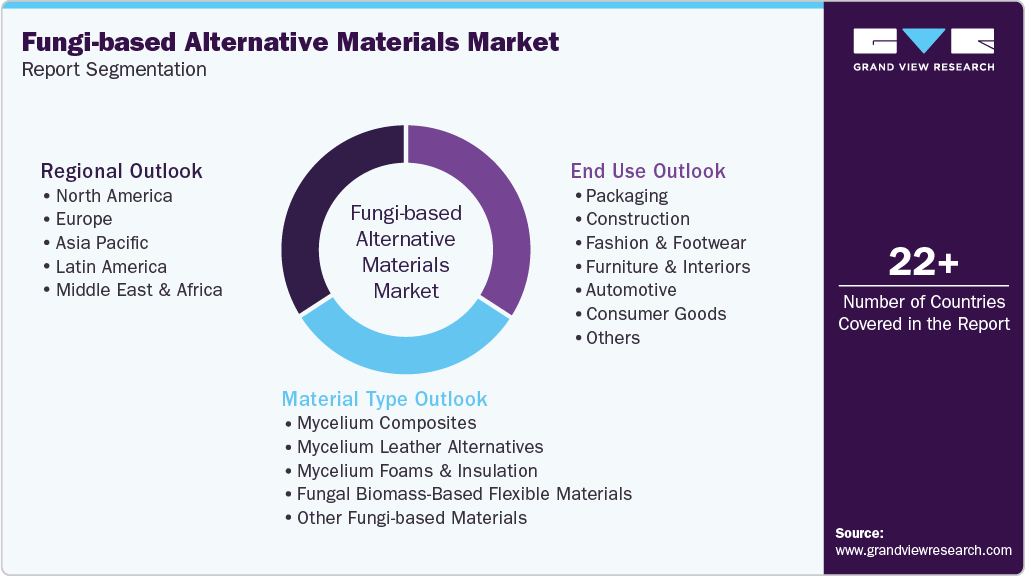
This report forecasts revenue growth at the global, regional, and country levels and provides an analysis of the latest industry trends and opportunities in each of the sub-segments from 2021 to 2033. For this study, Grand View Research has segmented the fungi-based alternative materials market report based on material type, end use, and region:
 To learn more about this report, Download Free Sample Report
 -
Material Type Outlook (Revenue, USD Billion, 2021 - 2033)
-
Mycelium Composites
-
Mycelium Leather Alternatives
-
Mycelium Foams & Insulation
-
Fungal Biomass-Based Flexible Materials
-
Other Fungi-based Materials
-
-
End Use Outlook (Revenue, USD Billion, 2021 - 2033)
-
Packaging
-
Construction
-
Fashion & Footwear
-
Furniture & Interiors
-
Automotive
-
Consumer Goods
-
Agriculture & Other Industries
-
-
Regional Outlook (Revenue, USD Billion, 2021 - 2033)
-
North America
-
U.S.
-
Canada
-
Mexico
-
-
Europe
-
Germany
-
France
-
UK
-
Italy
-
Spain
-
-
Asia Pacific
-
China
-
India
-
Japan
-
South Korea
-
Australia
-
-
Latin America
-
Brazil
-
Argentina
-
-
Middle East & Africa
-
Saudi Arabia
-
UAE
-
South Africa
-
-
Research Methodology
The fungi-based alternative materials market figures in this report are based on a proven research process that combines executive interviews with secondary research from proprietary databases, company filings, and recognized regulatory and institutional sources. Market size is built through value-chain sizing-reconciling supply-side and demand-side estimates-and triangulated with bottom-up and top-down approaches. Every estimate passes multiple levels of expert validation before publication, with eachfungi-based alternative materials segment quantified using the revenue-capture definitions in the table below.
Segment Definition
Material Type
Revenue capture definition
Mycelium Composites
Revenue generated from the sale of mycelium-based composite materials produced by growing fungal mycelium on agricultural, forestry, or other biomass substrates. Includes materials used as alternatives to plastics, wood composites, foams, and conventional composite materials across packaging, construction, furniture, automotive, and consumer applications.
Mycelium Leather Alternatives
Revenue generated from the sale of mycelium-based leather alternatives designed to replicate the appearance, texture, flexibility, and functional properties of conventional animal or synthetic leather. Includes materials supplied for fashion, footwear, accessories, automotive interiors, furniture, and other consumer applications.
Mycelium Foams & Insulation
Revenue generated from the sale of mycelium-based foam and insulation materials developed as alternatives to petroleum-based foams and conventional insulation products. Includes materials used for thermal insulation, acoustic applications, cushioning, interior components, construction, furniture, and other industrial applications.
Fungal Biomass-Based Flexible Materials
Revenue generated from the sale of flexible materials produced using fungal biomass, fungal fibers, or mycelium-based biological structures. Includes flexible material solutions used in textiles, apparel, footwear, interiors, accessories, consumer products, and other applications requiring lightweight and adaptable material properties.
Other Fungi-based Materials
Revenue generated from the sale of other fungi-derived materials not classified under mycelium composites, leather alternatives, foams and insulation, or flexible materials. Includes specialized fungal biomaterials, molded materials, coatings, fibers, and other customized fungi-based solutions used across emerging industrial and consumer applications.
End Use
Revenue capture definition
Packaging
Revenue generated from fungi-based materials used as alternatives to conventional packaging materials, including protective packaging, cushioning, inserts, and molded packaging components.
Construction
Revenue generated from fungi-based materials used in construction applications, including insulation, acoustic materials, panels, composites, and other bio-based building components.
Fashion & Footwear
Revenue generated from mycelium leather alternatives and other fungi-based materials used in apparel, footwear, handbags, accessories, and textile applications.
Furniture & Interiors
Revenue generated from fungi-based materials used in furniture, interior products, acoustic panels, decorative components, and other interior design applications.
Automotive
Revenue generated from fungi-based materials used in automotive interiors, cushioning, insulation, trim components, and lightweight material applications.
Consumer Goods
Revenue generated from fungi-based materials used in consumer products, accessories, household products, lifestyle goods, and other sustainable product applications.
Agriculture & Other Industries
Revenue generated from fungi-based materials used in agricultural, industrial, and other specialized applications, including soil-related products, specialty composites, and customized biomaterial solutions.
Estimation Model
Layer Name
Key Question
Description
End-use Industry Layer
What drives demand?
Estimate demand from key industries including packaging, construction, fashion & footwear, furniture & interiors, automotive, consumer goods, and agriculture that adopt fungi-based materials as alternatives to conventional plastics, leather, foams, composites, and other materials.
Material Adoption Layer
Where are fungi-based materials used?
Assess adoption of fungi-based materials across major applications based on requirements such as biodegradability, lightweight properties, flexibility, insulation, cushioning, durability, and sustainability performance.
Material Consumption Layer
Which materials generate demand?
Evaluate consumption of mycelium composites, mycelium leather alternatives, mycelium foams & insulation, fungal biomass-based flexible materials, and other fungi-based materials across major end-use industries.
Revenue Layer
How is revenue generated?
Revenue is generated through the sale of fungi-based alternative materials used in packaging, construction, fashion & footwear, furniture & interiors, automotive, consumer goods, and other specialized applications.
Delivered Customizations
We have successfully delivered the following deep-dive customizations:
Client Request
Customization Delivered
Value Adds
Competitive Benchmarking
Comparative assessment of key cultured meat packaging suppliers based on packaging formats, barrier properties, sterile packaging capabilities, material portfolio, sustainability initiatives, customization capabilities, manufacturing capacity, and presence across cultivated meat applications.
Identifies competitive positioning, technology differentiation, product gaps, and opportunities for suppliers serving the cultured meat industry.
- Pricing Analysis
Assessment of packaging prices based on material type, packaging format, barrier requirements, sterilization compatibility, temperature-control requirements, customization, production scale, and regional cost variations.
Supports understanding of cost structures, pricing benchmarks, premium packaging opportunities, and cost drivers across cultured meat packaging solutions.
Trade Assessment
Evaluation of import and export trends, cross-border movement of packaging materials and components, regional supply chains, trade dependencies, sourcing patterns, and regulatory requirements relevant to cultured meat packaging.
Helps identify key sourcing markets, supply-chain dependencies, trade opportunities, regional production advantages, and potential market-entry risks for cultured meat packaging suppliers.
Frequently Asked Questions About This Report
The global fungi-based alternative materials market size was valued at USD 1.3 billion in 2025 and is estimated at USD 1.5 billion for 2026.
Europe dominated the fungi-based alternative materials market with a 35.4% revenue share in 2025.
Asia Pacific is the fastest-growing region in the fungi-based alternative materials market, with a CAGR of 13.7% from 2026 to 2033.
The global fungi-based alternative materials market is expected to grow at a CAGR of 13.0% from 2026 to 2033, reaching USD 3.4 billion by 2033.
Thefungi-based alternative materials market is primarily driven by increasing demand for bio-based and biodegradable materials, growing sustainability initiatives, reduction of dependence on petroleum-based materials, waste valorization, circular economy adoption, and rising use of mycelium-based materials across packaging, fashion, construction, automotive, furniture, and consumer goods.
The mycelium leather alternatives segment is the fastest-growing material segment, with a CAGR of 13.9% from 2026 to 2033.
The mycelium composites segment led the fungi-based alternative materials market with a 44.3% revenue share in 2025.
The packaging segment led the fungi-based alternative materials market with a 36.1% revenue share in 2025.
Key players in the fungi-based alternative materials market include MycoWorks, Ecovative LLC, MYCL, Mogu, MYCOTEX, Biohm Limited, Mycelium Materials Europe, COMU Labs Inc., NatureTech, and PurewayBio.
About the Author(s)
Plastics, Polymers & Resins Research Team
Bulk Chemicals · Plastics, Polymers & ResinsThis report was authored by the plastics, polymers & resins research team at Grand View Research - comprising two research analysts, one senior research analyst, and one industry expert - with specialized expertise in the plastics, polymers & resins segment of the bulk chemicals industry. All findings are based on proprietary bulk chemicals databases, executive interviews, and regulatory analysis, subject to internal peer review prior to publication.
Last Updated:
Speak to Analyst

Customize this report to your needs - add regions, segments, or data points, with 20% free customization.
Or view our licence options:


ISO 9001:2015 & 27001:2022 Certified
We are GDPR and CCPA compliant! Your transaction & personal information is safe and secure. For more details, please read our privacy policy.


