
- Home
- »
- Power Generation & Storage
- »
-
Graphene Battery Market Size, Share & Growth Report, 2033GVR Report cover

Graphene Battery Market (2026 - 2033)
Size, Share & Trends Analysis Report By Type (Lithium-ion Graphene Battery, Lithium Sulfur Graphene Battery, Graphene Supercapacitor), By Application (Automotive, Consumer Electronics, Power), By Region, And Segment Forecasts
Market Size, 2025
$264.0MMarket Estimate, 2026
$333.4MMarket Forecast, 2033
$1,709.1MCAGR, 2026–2033
26.3%Graphene Battery Market Summary
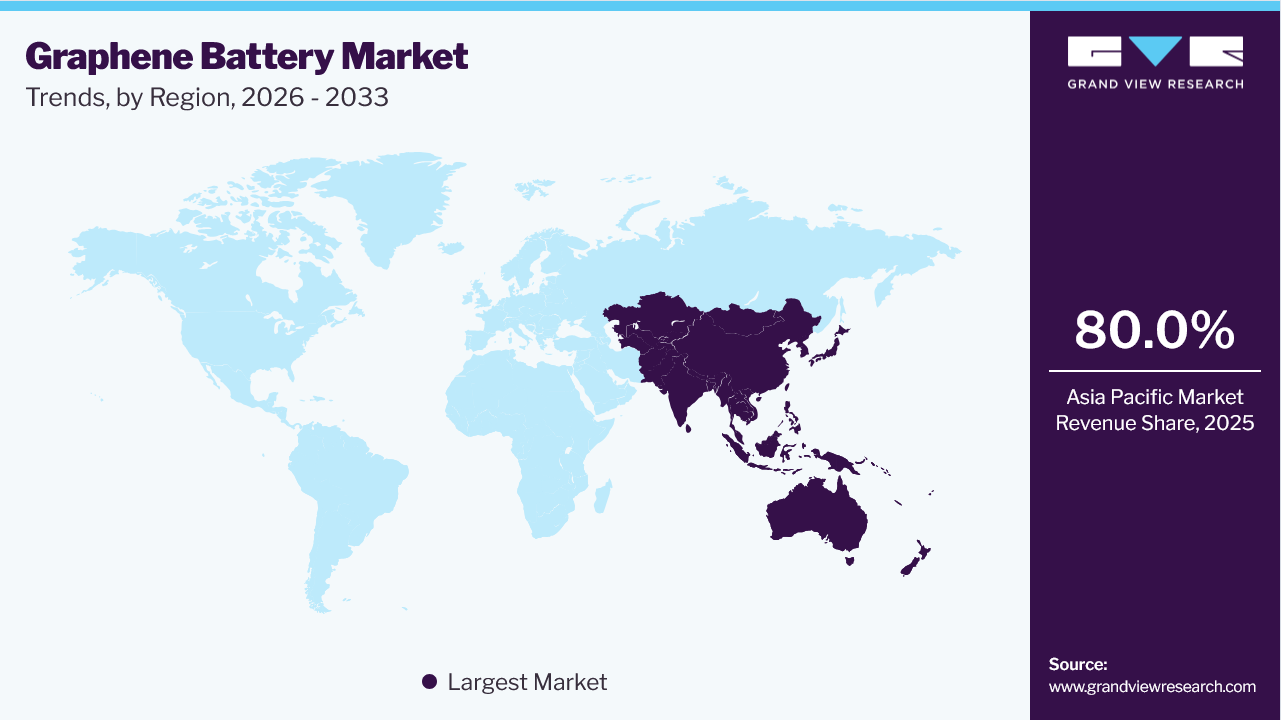
The global graphene battery market size was valued at USD 264.0 million in 2025 and is projected to grow from USD 333.4 million in 2026 to USD 1,709.1 million by 2033, at a CAGR of 26.3% from 2026 to 2033. Asia Pacific dominated the market, accounting for a revenue share of 80.0% in 2025. Advancements in the electric vehicle industry and the ever-growing demand for high-performance electronics are expected to augment market growth.
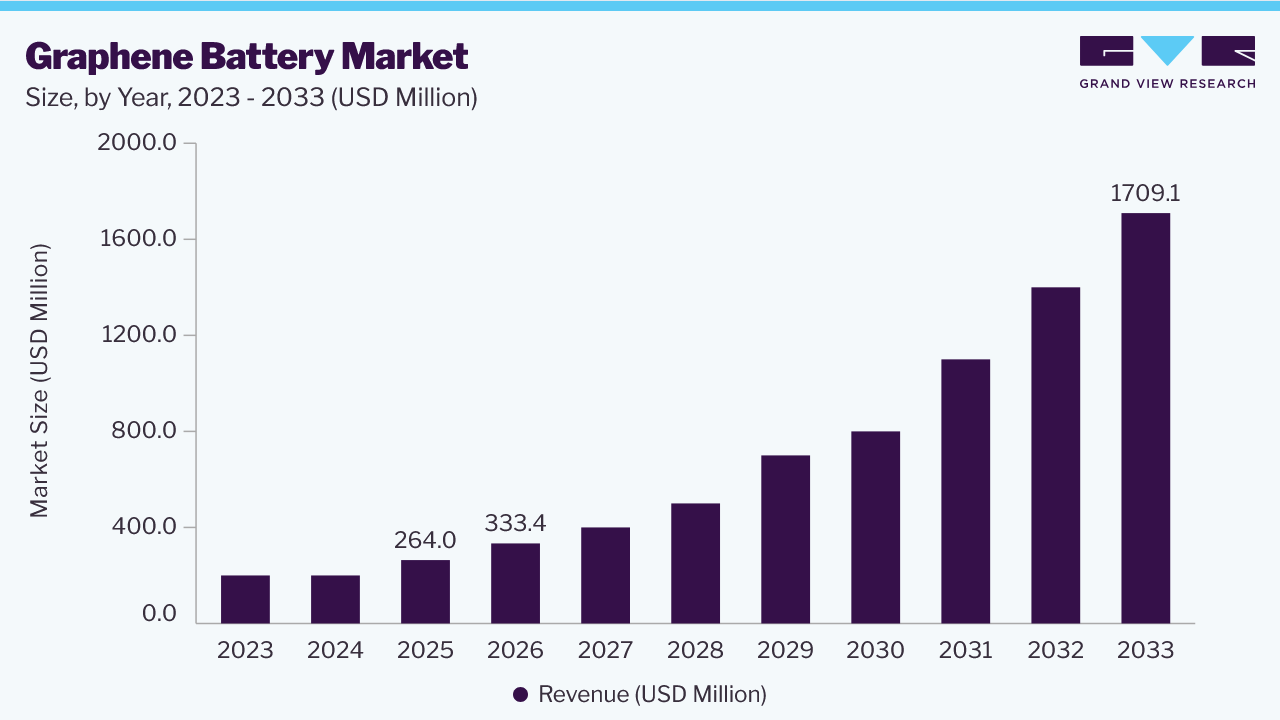 Source: Grand View Research, IR Documents, Primary Interviews, Paid DatabasesTo learn more about this report,
 Download Free Sample Report
Key Market Trends & Insights
- By type: The lithium-ion graphene battery segment dominated the market, with a revenue share of about 89.0% in 2025.
- By application: The automotive segment held the largest revenue share of over 56.0% in 2025.
Regional Highlights
- Largest regional market: Asia Pacific (80.0% revenue share, 2025)
Market Size & Forecast
- Market size in 2025: USD 264.0 Million
- Estimated market size in 2026: USD 333.4 Million
- Projected market size by 2033: USD 1,709.1 Million
- CAGR (2026-2033): 26.3%
Three ways to get this report
Buy it, customize it, or ask a question.Ask an Analyst
Analyst response in 1 business day
- AccessReport author, directly
- Reply timeWithin 1 working day
- No sales callDirect answer only
- FormatEmail reply
- CostFree, no cost
Get the Full Report
What the study covers
- FormatsPDF · Excel · Dashboard
- Timeline2026–2033 annual, 2025 base
- Coverage20+ countries, 5 regions
- Companies10+ key players profiled
Customize the Report
20% free customization
- IncludeCountries, segments, points
- TailorTo your product definition
- ExtendDeeper competitor detail
- OrA fully bespoke study
- Turnaround5–10 working days
The U.S. is a major hub for electric vehicle (EV) innovation, battery technology development, and advanced consumer electronics, creating strong demand for next-generation energy storage solutions. As these industries prioritize longer driving range, shorter charging times, improved energy efficiency, and enhanced thermal stability, graphene batteries are gaining attention for their potential to deliver higher energy density, faster charging, and longer cycle life.
In addition, the country’s growing emphasis on renewable energy integration is increasing demand for advanced energy storage systems for grid stabilization and backup power applications. Graphene batteries are being explored for these applications because of their potential to enable rapid charging and discharging, improve efficiency, and deliver better performance under high-load conditions.
The U.S. also benefits from a strong research ecosystem supported by universities, research institutions, government initiatives, and private-sector investments, which is accelerating innovation in graphene-based battery technologies and supporting progress toward commercialization. Furthermore, the country’s increasing focus on sustainable energy solutions and reducing dependence on fossil fuels is expected to create new growth opportunities for graphene batteries across multiple industries. Their lightweight properties and high-performance potential are also driving interest in aerospace and defense applications, where energy efficiency and weight reduction remain critical priorities.
Analyst Perspective
The graphene battery market is expected to grow significantly over the forecast period, driven by rising demand for advanced energy storage solutions in electric vehicles, consumer electronics, renewable energy systems, and industrial applications. The global transition toward electrification and clean energy is accelerating investments in next-generation battery technologies capable of delivering faster charging, higher energy efficiency, improved thermal management, and longer operational life. Continuous advancements in graphene production technologies, nanomaterial engineering, and battery manufacturing processes are improving the commercial viability of graphene-enhanced batteries while enhancing their performance, safety, and scalability.
Type Insights
Lithium-ion graphene battery emerged as the largest segment, accounting for approximately 89.0% of the market revenue in 2025, and is expected to witness robust growth over the forecast period. This segment’s dominance is primarily attributed to the combination of the proven performance of lithium-ion battery technology and graphene's advanced properties. Graphene enhances conventional lithium-ion batteries by enabling faster charging, higher energy density, improved thermal conductivity, and longer operational life. These performance advantages are driving adoption across electric vehicles, consumer electronics, and renewable energy storage applications, where demand for efficient, reliable, and high-performance energy storage solutions continues to increase.
The Lithium-Sulfur Graphene Battery segment is anticipated to grow at the fastest rate over the forecast period. Growth in this segment is primarily driven by its potential to significantly outperform conventional lithium-ion batteries in energy density and weight. Lithium-sulfur batteries offer a theoretical energy density substantially higher than traditional lithium-ion chemistries, enabling greater energy storage within the same volume. The integration of graphene further enhances battery performance by improving electrical conductivity, charge efficiency, and thermal stability, making these batteries increasingly attractive for high-performance applications. Rising demand for ultra-high-energy-density batteries that extend driving range, reduce battery weight, and improve overall efficiency is accelerating investment in lithium-sulfur graphene battery technologies. For instance, in February 2025, Lyten announced that it had secured domestically sourced sulfur for its U.S. lithium-sulfur battery manufacturing facilities, supporting the commercialization of next-generation battery technologies. The company stated that its lithium-sulfur batteries can weigh up to 40% less than NMC batteries and 70% less than LFP batteries, highlighting growing industry interest in lightweight, ultra-high-energy-density battery chemistries.
Application Insights
The automotive segment dominated the global market, accounting for a revenue share of approximately 56.0% in 2025. The segment’s dominance is primarily driven by rising demand for electric vehicles and the growing need for batteries that offer longer driving range, faster charging, improved safety, and reduced weight. Graphene-enhanced batteries are gaining attention in the automotive sector due to their potential advantages over conventional lithium-ion batteries. Graphene improves electrical conductivity, thermal management, and charging efficiency, enabling faster charging and discharging cycles and enhancing battery performance. Additionally, increasing investment in next-generation electric-vehicle battery manufacturing and rising demand for high-energy-density, safer battery technologies are accelerating innovation in advanced battery materials, supporting growth in the automotive segment. For instance, in August 2024, Samsung SDI and General Motors finalized a joint venture to establish a USD 3.5 billion battery manufacturing facility in Indiana, U.S., focused on producing nickel-rich prismatic battery cells for next-generation electric vehicles. This investment highlights the automotive industry’s continued focus on advanced battery technologies that improve energy density, safety, and vehicle performance, supporting broader innovation in next-generation battery materials.
The industrial robotics segment is anticipated to exhibit the highest growth over the forecast period. The advancement of Industry 4.0 and smart manufacturing is driving increased adoption of robotics across industrial environments, creating demand for high-performance energy storage solutions that support greater power efficiency, longer operating cycles, and faster charging. Graphene batteries are gaining attention in this segment for their potential to deliver high power density, improved energy efficiency, enhanced thermal management, and longer battery life, enabling robots to perform more demanding tasks with greater reliability. These advantages are expected to support the integration of advanced robotics into next-generation industrial automation systems, thereby driving market growth. For instance, in December 2023, Nanotech Energy partnered with Rockwell Automation to integrate advanced Manufacturing Execution Systems (MES) and Quality Management Systems (QMS) into its Chico 2 battery manufacturing facility. The collaboration aims to establish one of the world's most advanced graphene-based lithium-ion battery production plants by leveraging industrial automation to enhance manufacturing efficiency, quality control, and scalability, supporting the growing demand for next-generation energy storage solutions across industrial applications.
Regional Insights
The North American industry for graphene batteries is poised for steady growth during the forecast period, driven by the growing electric vehicle (EV) market and demand for efficient energy storage. Major players in both graphene and EV manufacturing are collaborating to develop graphene-based anode materials for lithium-ion batteries, aiming for faster charging, longer range, and environmentally friendly solutions. The North American market is driven by increasing investments in advanced battery manufacturing, the rapid expansion of the electric vehicle ecosystem, and the growing commercialization of graphene-enhanced lithium-ion batteries for energy storage and e-mobility applications. In February 2024, Nanotech Energy announced that its Chico 2 manufacturing facility would begin commercial production of graphene-enhanced lithium-ion battery cells, with deliveries of next-generation 21700 battery cells scheduled for 2025. The company also highlighted the expansion of its U.S.-based manufacturing capabilities to support demand from energy storage, electric mobility, and industrial applications, reinforcing North America's position as a hub for next-generation graphene battery innovation.
 To learn more about this report, Download Free Sample Report
U.S. Graphene Battery Market Trends
The graphene battery industry in the U.S. is expected to grow at a significant CAGR from 2026 to 2033. It is poised for significant growth, driven by two key trends. Firstly, there is a growing demand for longer-lasting and faster-charging batteries, particularly in electric vehicles and consumer electronics. Graphene's unique properties hold immense promise for achieving these goals. Secondly, rising environmental concerns are pushing for a shift towards sustainable technologies. Graphene batteries are seen as a cleaner alternative to traditional batteries, further fueling market expansion.
Asia Pacific Graphene Battery Market Trends
Asia Pacific graphene battery industry is expected to witness significant growth over the forecast period. The region’s growth is primarily driven by rapid electric vehicle adoption, expanding battery manufacturing capacity, strong government support for advanced energy storage technologies, and increasing investments in next-generation battery materials across China, Japan, South Korea, and India. The region accounted for the largest revenue share of about 80.0% in 2025, supported by the presence of major battery manufacturers, advanced material suppliers, and strong investments in research and development. Growing demand for batteries with higher energy density, faster charging capabilities, improved thermal stability, and enhanced safety is accelerating innovation in graphene-enhanced battery technologies across electric mobility, consumer electronics, and energy storage applications. In addition, supportive government policies promoting clean energy adoption and domestic battery manufacturing are further strengthening the region’s position as a key hub for advanced battery innovation and commercialization.
China’s graphene battery industry accounted for approximately 67.0% of the Asia-Pacific market's revenue in 2025, driven by the country’s leadership in electric vehicle manufacturing, battery production, and advanced materials innovation. China’s strong position in graphene research, coupled with its large-scale battery manufacturing ecosystem, has established the country as a major hub for graphene battery development and commercialization. In addition, supportive government policies, strong investments in clean energy technologies, and rising domestic demand for electric vehicles are accelerating innovation in next-generation battery technologies, supporting market growth in the country.
The graphene battery industry in South Korea is anticipated to register a significant CAGR from 2026 to 2033. Market growth is primarily driven by the country’s advanced technology ecosystem and strong presence in battery manufacturing and materials innovation. South Korea is home to major battery manufacturers such as Samsung SDI and LG Energy Solution, which continue to invest heavily in next-generation battery research and development, including graphene-based technologies. Their strong technical expertise, manufacturing capabilities, and ongoing investments in battery innovation are expected to support growth in the country's graphene battery market.
Europe Graphene Battery Market Trends
The graphene battery industry in Europe is expected to grow steadily over the forecast period. The region’s growth is primarily driven by stringent environmental regulations, increasing electrification, and a well-established electric vehicle industry. Europe’s strong focus on reducing carbon emissions and accelerating clean energy adoption is creating favorable conditions for the development of next-generation battery technologies. The growing demand for batteries with higher energy density, faster charging capabilities, improved safety, and enhanced thermal performance is accelerating interest in graphene-enhanced battery technologies across electric mobility and energy storage applications. In addition, increasing investments in battery manufacturing, research and development, and advanced material innovation are supporting the commercialization of graphene-based battery solutions across the region. Supportive government initiatives promoting sustainable mobility, renewable energy integration, and domestic battery production are further strengthening Europe’s position as a key market for advanced battery innovation.
The Germany graphene battery industry accounted for over 40.0% of the European market revenue in 2025, driven by the country’s strong automotive manufacturing base and rapid advancements in electric vehicle technologies. Germany remains a key hub for battery innovation in Europe due to the presence of major automotive manufacturers, battery technology developers, and increasing investments in next-generation energy storage solutions. Growing demand for batteries with higher energy density, faster charging capabilities, and improved efficiency is further supporting market growth in the country.
The graphene battery industry in the UK is anticipated to grow at a significant CAGR from 2026 to 2033. The market growth is primarily driven by increasing government initiatives supporting clean technologies, rising investments in battery innovation, and expanding research activities in advanced materials. In addition, research grants and funding for graphene-related technologies are accelerating the development and commercialization of graphene battery solutions, supporting market expansion in the country.
The France graphene battery industry is growing at a significant CAGR over the forecast period, driven by the country’s increasing focus on electric mobility and sustainable energy solutions. France is witnessing the growing adoption of electric vehicles, supported by favorable government policies, expanding charging infrastructure, and rising investments in clean transportation technologies. Growing demand for batteries with higher energy density, faster charging, improved safety, and enhanced efficiency is accelerating interest in graphene-enhanced battery technologies in the automotive sector. As automotive manufacturers increasingly focus on improving vehicle performance, battery range, and charging efficiency, graphene batteries are gaining attention as a promising next-generation energy storage solution.
Key Graphene Battery Company Insights
The market is moderately fragmented, with a sizable number of medium- and large-sized companies. The graphene battery industry is a dynamic landscape with established players and innovative startups. Key companies are adopting several organic and inorganic growth strategies, such as facility expansion, new product development, research & development, mergers & acquisitions, and joint ventures, to maintain and expand their market share.
Key Graphene Battery Companies
The following key companies have been profiled for this study on the graphene battery market:
-
Samsung SDI
-
Log 9 Materials
-
Nanotech Energy
-
Cabot Corporation
-
Global Graphene Group
-
Nanotech Energy
-
Vorbeck Materials
-
Grupo Graphenano
-
Huawei Technologies Co., Ltd.
-
GRAPHENEA S.A.
-
Targray Technology International Inc.
Recent Developments
- In December 2023, Nanotech Energy announced the launch of its 150 MW graphene battery production plant in California, with operations expected to commence in early 2024. The strategy shall help the company increase its market share in the graphene battery market.
- In November 2023, a conglomerate of 11 partners from six European nations officially launched the GRAPHERGIA project. The project aims to develop graphene-based materials into energy harvesting and storage devices.
Graphene Battery Market Report Scope
Report Attribute
Details
Market size in 2025
USD 264.0 million
Estimated Market size in 2026
USD 333.4 million
Projected Market size by 2033
USD 1,709.1 million
Growth rate
CAGR of 26.3% from 2026 to 2033
Base year for estimation
2025
Historical data
2021 – 2024
Forecast period
2026 – 2033
Quantitative units
Revenue in USD million and CAGR from 2026 to 2033
Report coverage
Revenue forecast, company ranking, competitive landscape, growth factors, trends
Segments covered
Type, application, region
Regional Scope
North America; Europe; Asia Pacific; Latin America; MEA
Country scope
U.S.; Canada; Mexico; Germany; France; UK; Italy; Spain; China; India; Japan; South Korea; Australia; Brazil; Argentina; Saudi Arabia; South Africa; UAE
Key companies profiled
Samsung SDI; Log 9 Materials; Nanotech Energy; Cabot Corporation; Global Graphene Group; Nanotek Instruments; Vorbeck Materials; Grupo Graphenano; Huawei Technologies Co., Ltd.; GRAPHENEA S.A.; Targray Technology International Inc.
Customization scope
Free report customization (equivalent to up to 8 analysts working days) with purchase. Addition or alteration to country, regional & segment scope.
Pricing and purchase options
Avail of customized purchase options to meet your exact research needs. Explore purchase options
Graphene Battery Market Report Segmentation
This report forecasts revenue growth at regional and country levels and provides an analysis of the latest industry trends in each of the sub-segments from 2021 to 2033. For this study, Grand View Research has segmented the global graphene battery market based on type, application, and region:
-
Type Outlook (Revenue, USD Million, 2021 - 2033)
-
Lithium-ion Graphene Battery
-
Graphene Supercapacitor
-
Lithium Sulfur Graphene Battery
-
Others
-
-
Application Outlook (Revenue, USD Million, 2021 - 2033)
-
Automotive
-
Consumer Electronics
-
Power
-
Industrial Robotics
-
Aerospace & Defence
-
Healthcare
-
-
Regional Outlook (Revenue, USD Million, 2021 - 2033)
-
North America
-
U.S.
-
Canada
-
Mexico
-
-
Europe
-
Germany
-
UK
-
France
-
Italy
-
Spain
-
-
Asia Pacific
-
China
-
India
-
Japan
-
South Korea
-
Australia
-
-
Central & South America
-
Brazil
-
Argentina
-
-
Middle East & Africa
-
Saudi Arabia
-
UAE
-
South Africa
-
-
Frequently Asked Questions About This Report
The global graphene battery market size was valued at USD 264.0 million in 2025 and is estimated at USD 333.4 million for 2026.
Asia Pacific dominated with an approximately 80.0% revenue share in 2025.
The global graphene battery market is expected to grow at a CAGR of 26.3% from 2026 to 2033, reaching USD 1,709.1 million.
Key players in the market include Samsung SDI; Log 9 Materials; Nanotech Energy; Cabot Corporation; Global Graphene Group; Nanotek Energy; Vorbeck Materials; Grupo Graphenano; Huawei Technologies Co., Ltd.; GRAPHENEA S.A.; Targray Technology International Inc., and others.
The lithium-ion graphene battery segment accounted for the largest revenue share of approximately 89.0% in 2025.
About the Author(s)
Power Generation & Storage Research Team
Energy & Power · Power Generation & StorageThis report was authored by the power generation & storage research team at Grand View Research - comprising two research analysts, one senior research analyst, and one industry expert - with specialized expertise in the power generation & storage segment of the energy & power industry. All findings are based on proprietary energy & power databases, executive interviews, and regulatory analysis, subject to internal peer review prior to publication.
Last Updated:
Speak to Analyst

Customize this report to your needs - add regions, segments, or data points, with 20% free customization.
Or view our licence options:


ISO 9001:2015 & 27001:2022 Certified
We are GDPR and CCPA compliant! Your transaction & personal information is safe and secure. For more details, please read our privacy policy.


