
- Home
- »
- Network Security
- »
-
Hardware Security Modules Market Size Report, 2026-2033GVR Report cover

Hardware Security Modules Market (2026 - 2033)
Size, Share & Trends Analysis Report By Type (LAN-based, PCIE-based, USB-based, Cloud-based), By Deployment, By Application (Payment Processing, Authentication, PKI Management, Database Encryption), By End Use, By Region, And Segment Forecasts
Market Size, 2025
$1.8BMarket Estimate, 2026
$2.0BMarket Forecast, 2033
$5.0BCAGR, 2026–2033
14.0%Hardware Security Modules Market Summary
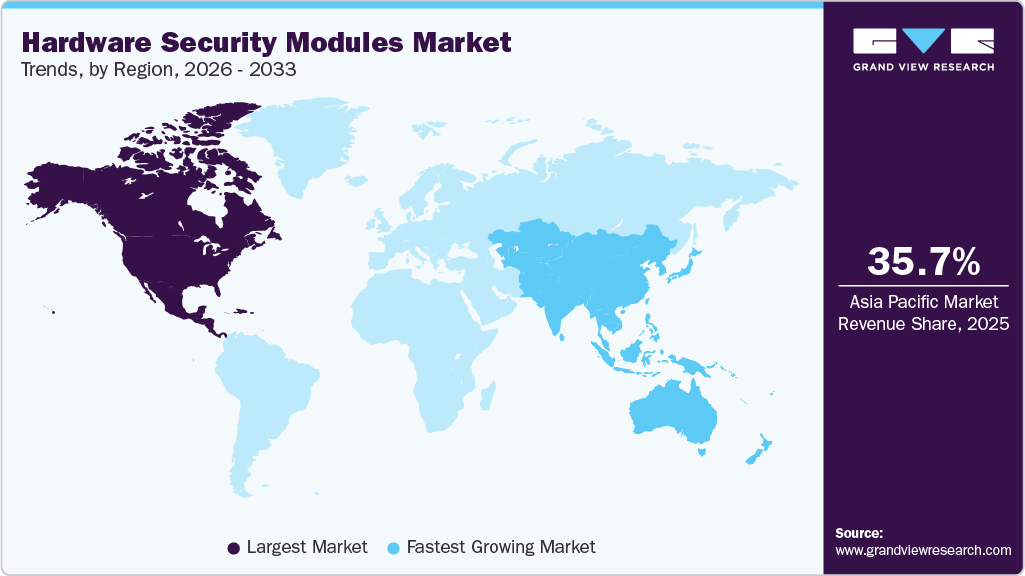
The global hardware security modules market size was valued at USD 1.8 billion in 2025 and is projected to grow from USD 2.0 billion in 2026 to USD 5.0 billion by 2033, at a CAGR of 14.0% from 2026 to 2033. The market in North America dominated with a revenue share of 37.4% in 2025. This growth is driven by rising implementation of zero-trust security architectures.
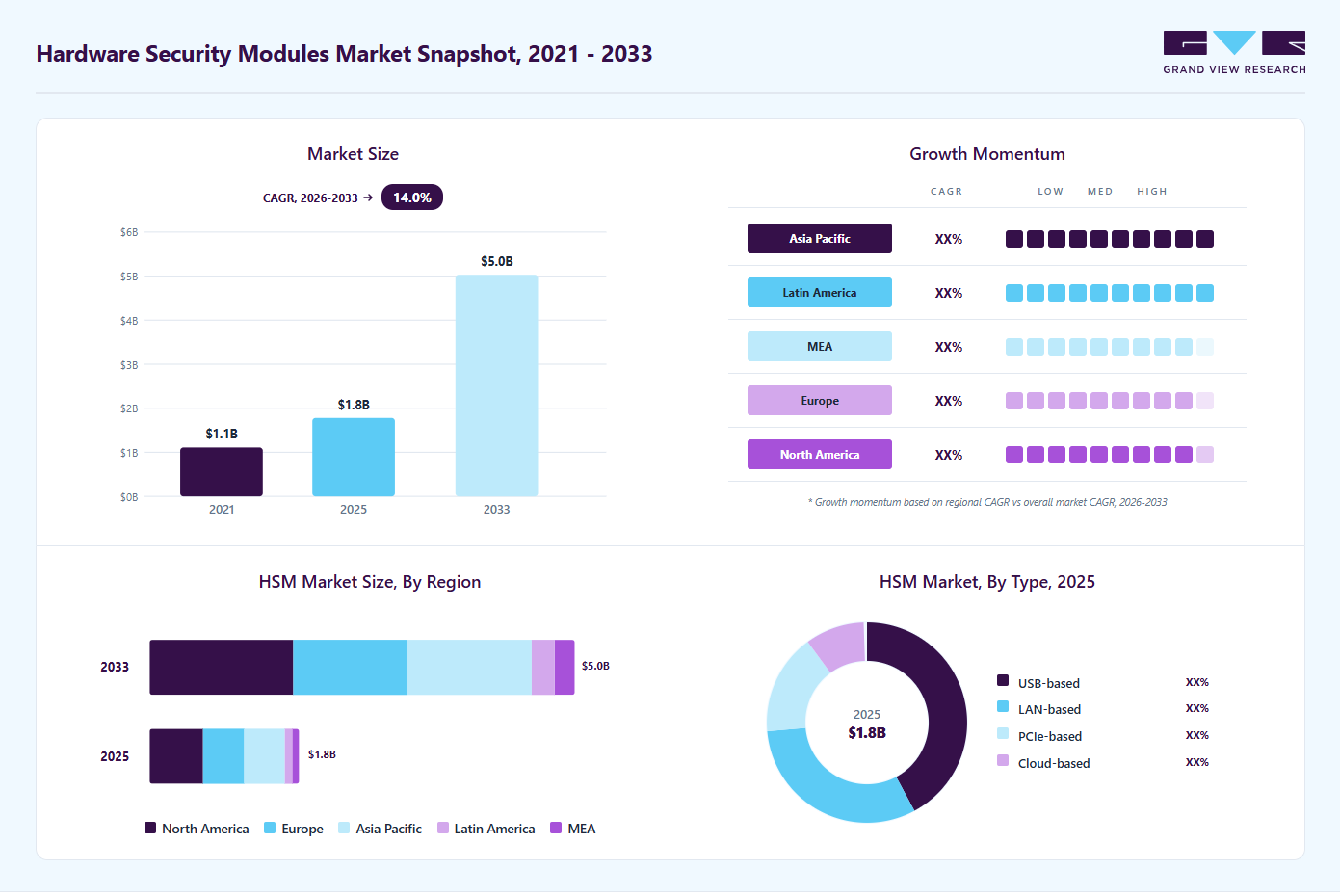 Source: Grand View Research, IR Documents, Primary Interviews, Paid DatabasesTo learn more about this report,
 Download Free Sample Report
 Key Market Trends & Insights
- By type: LAN-based segment dominated the market, with a revenue share of 41.5% in 2025.
- By deployment: On-premise held the largest market share of 63.2% in 2025.
- By application: Payment processing segment held the largest market share of 28.1% in 2025.
- By end use: Automotive segment held the largest market share of 21.5% in 2025.
Regional Highlights
- Largest regional market: North America (37.4% revenue share, 2025)
- Fastest-growing regional market: Asia Pacific (highest CAGR, 2026-2033)
- By country: The U.S. held the largest market share in 2025.
Market Size & Forecast
- Market size in 2025: USD 1.8 Billion
- Estimated market size in 2026: USD 2.0 Billion
- Projected market size by 2033: USD 5.0 Billion
- CAGR (2026–2033): 14.0%
Three ways to get this report
Buy it, customize it, or ask a question.Ask an Analyst
A direct answer, usually in 1 working day
- AccessReport author, directly
- Reply timeWithin 1 working day
- No sales callDirect answer only
- FormatEmail reply
- CostFree, no cost
Get the Full Report
What the study covers
- FormatsPDF · Excel · Dashboard
- Timeline2026–2033 annual, 2025 base
- Coverage20+ countries, 5 regions
- Companies10+ key players profiled
Customize the Report
20% free customization
- IncludeCountries, segments, points
- TailorTo your product definition
- ExtendDeeper competitor detail
- OrA fully bespoke study
- Turnaround5–10 working days
These modules are widely used to perform encryption, decryption, digital signing, and authentication in a secure environment, helping protect against unauthorized access and cyber threats. As organizations increasingly adopt digital transformation, cloud computing, and online financial transactions, the demand for robust cryptographic security solutions such as HSMs continues to grow significantly across industries, including banking, government, healthcare, and IT & telecommunications.The market is witnessing strong growth driven by rising concerns over data breaches, stringent regulatory compliance requirements, and the rapid expansion of digital payment ecosystems. Within emerging economies, the Brazil hardware security modules (HSM) market is gaining traction, supported by the country’s expanding fintech sector, increasing digital banking penetration, and growing adoption of secure payment infrastructures such as PIX, which is driving demand for advanced cryptographic security solutions. Regulations such as GDPR, PCI DSS, and other data protection frameworks are compelling enterprises to adopt advanced key management solutions, thereby boosting HSM adoption.
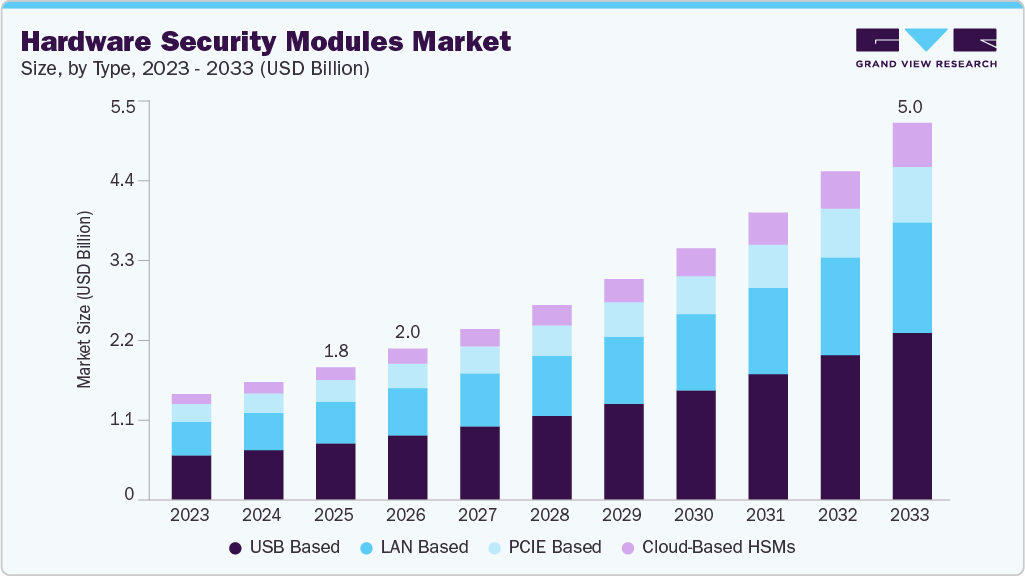 To learn more about this report, Download Free Sample Report
 Additionally, the growing adoption of cloud-based services and hybrid IT infrastructures has increased the need for cloud-compatible, scalable HSM solutions, enabling organizations to secure sensitive workloads both on-premises and in virtual environments. Further, North America dominates the HSM market due to the early adoption of advanced cybersecurity technologies, the strong presence of key vendors, and strict regulatory enforcement. Europe follows closely, supported by stringent data privacy laws and increasing investments in digital identity protection. Meanwhile, the Asia-Pacific is emerging as the fastest-growing region, fueled by rapid digitalization, expansion of fintech services, and increasing cybersecurity investments in countries such as China and India. Latin America and the Middle East & Africa are also experiencing steady growth as organizations in these regions enhance their security infrastructure.
Consequently, the hardware security modules market is expected to expand steadily as enterprises prioritize zero-trust security architectures and secure key management becomes central to enterprise cybersecurity strategies. The integration of HSMs with cloud services, blockchain applications, and IoT ecosystems is further expected to create new growth opportunities. Key players are also focusing on developing flexible deployment models, including as-a-service offerings, to cater to evolving enterprise needs, making HSMs an essential component of modern digital security frameworks.
Market Dynamics
The hardware security modules market is experiencing significant growth as organizations strengthen their cybersecurity frameworks to protect sensitive data, cryptographic keys, and digital transactions from increasingly sophisticated cyber threats. HSMs provide dedicated, tamper-resistant environments for encryption, decryption, authentication, digital signing, and key management, making them essential for industries such as banking, financial services, government, healthcare, telecommunications, and cloud computing. The growing adoption of digital payments, cloud services, e-signatures, public key infrastructure (PKI), and data protection regulations is accelerating demand for advanced cryptographic security solutions. Furthermore, the emergence of technologies such as IoT, 5G networks, and connected devices is expanding the volume of encrypted data and machine-to-machine communications, creating additional opportunities for HSM deployment.
The rising adoption of electronic signatures is contributing significantly to hardware security modules (HSMs) market growth. Businesses, governments, financial institutions, and healthcare organizations increasingly use digital signatures to authenticate documents, approve transactions, and validate electronic records. Digital signatures rely on cryptographic keys managed within PKI frameworks, making key security essential to maintaining trust and legal validity. Hardware security modules ensure that private signing keys remain protected against unauthorized access while enabling secure signing operations. This capability is particularly important for organizations handling high-value transactions or legally binding documents. As electronic signature adoption expands globally, demand for HSMs that support secure PKI-based signing processes continues to rise.
 To learn more about this report, Download Free Sample Report
 The high acquisition and deployment costs of enterprise-grade hardware security modules are among the most significant constraints on the growth of the HSM market. Enterprise-grade HSM solutions are designed to provide the highest levels of cryptographic security, tamper resistance, key management, and compliance support, which requires specialized hardware architectures, certified security components, and advanced software capabilities. As a result, the purchase price of these systems is often substantially higher than that of conventional security solutions or software-based encryption platforms. Many organizations, particularly small and medium-sized enterprises, may find it difficult to justify such a significant upfront investment despite the security benefits HSMs offer. Budget limitations frequently lead businesses to prioritize other technology initiatives over advanced cryptographic infrastructure. Consequently, high acquisition costs can slow adoption rates and restrict market expansion among cost-sensitive customer segments.
The growing adoption of hardware security modules for cryptocurrency custody and digital asset protection presents a significant opportunity for the HSM market, as the security of private cryptographic keys is fundamental to the ownership and transfer of digital assets. Unlike traditional financial systems, where assets are protected through centralized institutions, cryptocurrencies rely entirely on private keys for access and control. If these keys are lost, stolen, or compromised, the associated digital assets may become permanently inaccessible or vulnerable to unauthorized transactions. HSMs provide highly secure, tamper-resistant environments specifically designed to generate, store, and manage cryptographic keys without exposing them to external threats. As cryptocurrency ownership expands among institutional investors, exchanges, custodians, and enterprises, the demand for robust key protection solutions continues to increase. This growing requirement positions HSM vendors to capitalize on the expanding digital asset ecosystem.
Market Concentration & Characteristics
The hardware security modules (HSM) market is moderately concentrated, with a combination of established cybersecurity vendors, encryption technology providers, and specialized cryptographic hardware companies leading the competitive landscape. Major players such as Thales Group, IBM Corporation, Entrust Corporation, Utimaco, and Futurex hold significant market share due to their strong cryptographic expertise, extensive compliance certifications, global enterprise customer base, and integrated security portfolios. These vendors offer a broad range of HSM solutions including payment HSMs, general-purpose HSMs, cloud HSMs, and key management platforms, creating substantial entry barriers for new participants due to stringent regulatory standards, certification requirements such as FIPS 140-2/3 and Common Criteria, and the highly sensitive nature of cryptographic infrastructure.
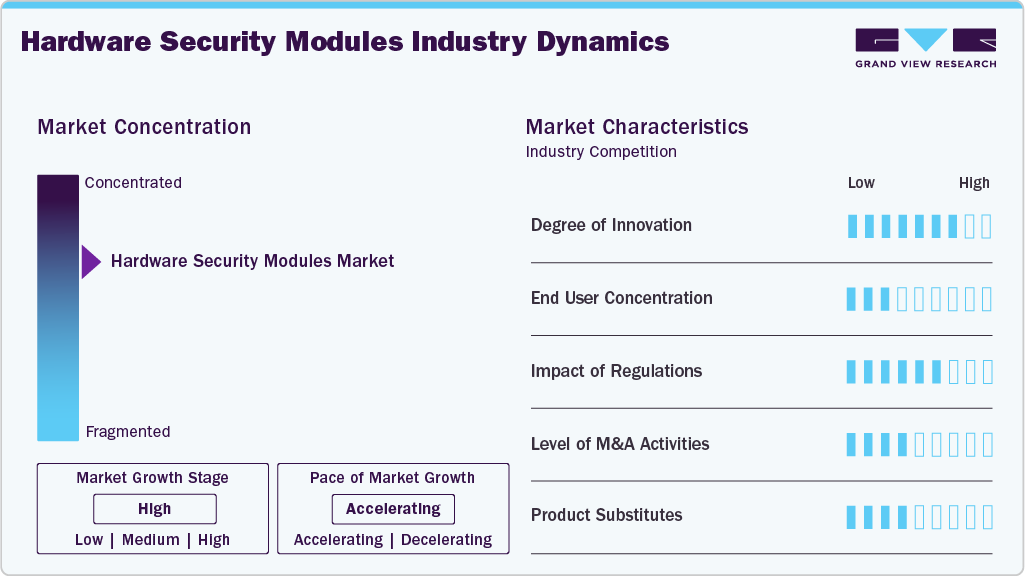 To learn more about this report, Download Free Sample Report
In terms of market characteristics, the industry is highly security-centric, compliance-driven, and innovation-intensive, with strong focus on cloud security, post-quantum cryptography readiness, secure digital payments, and hybrid cloud key management. Demand is primarily driven by rising cyber threats, increasing adoption of digital banking and e-commerce, expansion of cloud computing environments, and growing regulatory requirements for data protection and encryption. The market is also characterized by long enterprise procurement cycles, high integration complexity, and strong customer retention due to deep integration with critical IT infrastructure, payment systems, and identity management frameworks. Additionally, the growing adoption of HSM-as-a-Service (HSMaaS), confidential computing, blockchain security, and zero-trust cybersecurity architectures is accelerating innovation and intensifying competition among vendors globally.Analyst Perspective
The hardware security modules market is increasingly being shaped by the strategic importance of cryptographic trust rather than traditional perimeter-based cybersecurity approaches. As organizations migrate critical workloads to cloud environments and adopt zero-trust security architectures, the ability to securely generate, store, and manage cryptographic keys has become a foundational requirement rather than an optional security enhancement. Competitive leadership is likely to favor vendors that can provide seamless interoperability across on-premise, cloud, and hybrid environments while addressing evolving compliance and data sovereignty requirements. Looking ahead, the transition toward quantum-resistant cryptography, increasing reliance on digital identity frameworks, and the rapid growth of machine-driven transactions are expected to elevate HSMs from specialized security appliances to core infrastructure components within modern digital ecosystems.
Type Insights
Based on type, the LAN-based segment led the market with the largest revenue share of 41.5% in 2025. The increasing adoption of digital signatures is driving market growth for LAN-based HSMs as organizations use cryptographic signing for software, documents, certificates, transactions, APIs, and other digital assets. Signing operations can require private keys to remain within a protected cryptographic boundary while applications request signing functions remotely. LAN-based HSMs provide a network-accessible architecture in which multiple authorized applications can use centralized signing infrastructure. The growing volume of software releases, digital transactions, certificates, and electronically signed information creates additional demand for protected signing keys. This contributes to market growth for network-attached HSMs that can handle signing workloads across multiple applications. The market impact includes greater demand for centralized signing infrastructure, protected private-key storage, high-throughput cryptographic processing, and integration with enterprise signing workflows.
The cloud-based segment is expected to grow at a significant CAGR from 2026 to 2033 due to the rapid shift of enterprises toward cloud-native architectures, increasing adoption of hybrid and multi-cloud environments, and the rising need for on-demand cryptographic key management without heavy hardware dependency. Organizations are facing challenges related to “secret sprawl,” API security, and distributed workloads across containers, Kubernetes, and serverless platforms, which is driving demand for cloud-delivered HSMs that offer centralized control, automation, and elastic scalability while maintaining high levels of compliance and security. In addition, the growing focus on zero-trust security models and regulatory requirements for data protection is pushing enterprises to integrate HSM functionality directly into cloud security stacks to ensure secure key generation, storage, and rotation across dynamic digital environments. For instance, in November 2025, Crypto4A introduced QxVault, a next-generation secrets management platform that integrates a FIPS 140-3 Level 3 hardware security module directly into a cloud-ready vault, enabling organizations to manage cryptographic keys, credentials, and API secrets with built-in hardware-backed security while supporting both on-premises and private cloud deployments. This development reflects vendors' efforts to embed hardware-grade security into cloud platforms to eliminate complexity and improve agility in managing sensitive cryptographic operations across distributed infrastructures. Consequently, the cloud-based segment is projected to witness the fastest growth as enterprises increasingly prioritize flexible, software-defined security models that combine the strength of hardware encryption with the scalability and accessibility of cloud environments.
Deployment Insights
Based on deployment, the on-premise segment led the market with the largest revenue share of 63.2% in 2025 due to the strong requirement for full control over cryptographic keys, strict regulatory compliance, and data sovereignty needs across highly sensitive industries. Organizations in these sectors prefer on-premise HSMs because they ensure that encryption keys never leave internal data centers, significantly reducing exposure to external threats, third-party risks, and jurisdictional uncertainties. This deployment model also aligns with stringent compliance frameworks that mandate physical and logical control over cryptographic assets, making it the most trusted option for mission-critical workloads. In addition, enterprises continue to maintain legacy security architectures and hybrid transition strategies, where on-premise HSMs act as the root-of-trust for identity, authentication, and key management while cloud adoption gradually scales. For instance, in December 2025, Crypto4A’s sovereign and post-quantum-ready solutions highlight the growing emphasis on maintaining cryptographic sovereignty, with its QxVault platform and related deployments designed to support both cloud and on-premise environments while ensuring full control over secrets, credentials, and cryptographic keys within organizational boundaries. Consequently, the on-premise segment remained dominant in 2025 as organizations balanced growing digital transformation with uncompromising security, compliance, and sovereignty requirements, ensuring that sensitive cryptographic operations remain securely managed within internal infrastructure.
The cloud segment is expected to grow at the fastest CAGR from 2026 to 2033 due to the rapid acceleration of cloud-first digital transformation strategies, where enterprises are migrating critical workloads, applications, and data infrastructures to public, private, and hybrid cloud environments, creating strong demand for cloud-native cryptographic key management and scalable hardware-backed security services. Organizations are prioritizing flexible, on-demand security models such as HSM-as-a-Service and cloud-integrated HSMs because they eliminate the need for heavy upfront infrastructure investment, reduce operational complexity, and enable seamless integration with DevOps pipelines, containerized applications, and multi-cloud ecosystems. Additionally, the rise of zero-trust architectures, API-driven ecosystems, and distributed computing environments is further driving the need for centralized, automated, and highly scalable key management solutions that cloud-based HSM platforms are uniquely positioned to deliver. For instance, in January 2025, Fortanix highlighted in its research that modern enterprises are adopting software-defined, cloud-integrated HSM solutions that combine traditional hardware-grade security with cloud-scale agility, enabling organizations to secure sensitive data, cryptographic keys, and workloads across hybrid and multi-cloud environments. This trend demonstrates that cloud-based HSMs are evolving beyond standalone hardware appliances into fully integrated security services embedded within cloud infrastructures, supporting real-time encryption, key lifecycle automation, and secure application development at scale. Subsequently, the cloud segment is expected to witness strong growth as enterprises increasingly demand scalable, flexible, and future-ready security architectures that align with modern cloud-native operating models.
Application Insights
Based on application, the payment processing segment led the market with the largest revenue share of 28.1% in 2025 in the hardware security modules market, driven by its critical role in securing highly sensitive financial transactions, including card authentication, PIN verification, encryption, tokenization, and cryptographic key management, which are essential to ensuring secure and compliant digital payment ecosystems. The rapid expansion of digital banking, contactless payments, real-time settlement systems, and cross-border e-commerce has increased transaction volumes, thereby driving strong demand for HSMs that comply with stringent standards such as PCI DSS, EMV, and PCI PIN, as financial institutions and payment service providers prioritize robust infrastructure to prevent fraud and data breaches. Additionally, the increasing migration of payment workloads to cloud environments is further strengthening the need for scalable, hardware-backed cryptographic services that can support high-throughput transaction processing. For instance, in June 2023, AWS introduced Payment Cryptography, a fully managed service that enables organizations to move payment processing operations to the cloud while leveraging HSM-backed cryptographic operations for secure key management, encryption, and transaction processing through scalable APIs. This development highlights the industry shift toward cloud-enabled, HSM-backed payment security solutions that combine scalability with strong cryptographic protection. In conclusion, the payment processing segment continues to dominate the market as it remains fundamental to global financial operations, driven by rising digital payment adoption, evolving regulatory requirements, and the increasing need for secure, high-volume transaction processing across modern financial ecosystems.
The IoT security segment is expected to grow at the fastest CAGR from 2026 to 2033 due to the rapid expansion of connected devices across industries such as smart manufacturing, healthcare, automotive, energy, and smart cities, which has increased the attack surface and created strong demand for hardware-backed cryptographic protection to secure device identity, authentication, firmware updates, and data communication across highly distributed environments. The rising frequency of IoT-targeted cyberattacks, combined with the fact that many IoT endpoints have limited built-in security capabilities, is further pushing enterprises to adopt HSM-enabled solutions for secure key management, encryption, and device trust establishment. In addition, increasing regulatory focus on IoT security standards and the adoption of zero-trust architectures are accelerating investments in scalable, hardware-rooted security frameworks that can support massive device fleets while ensuring compliance and operational resilience. For instance, in July 2025, Asimily enhanced its IoT security platform by introducing advanced password management and automated device patching capabilities, enabling organizations to more effectively secure and update large-scale IoT deployments and reduce vulnerabilities arising from unmanaged or outdated devices, reflecting the growing industry emphasis on continuous protection and lifecycle security for IoT ecosystems, where weak credentials and unpatched firmware remain major attack vectors. This development highlights that vendors are expanding IoT security solutions to address operational complexity and security gaps across heterogeneous device environments, reinforcing the need for integrated, scalable security frameworks supported by hardware-level cryptographic controls. Consequently, the IoT security segment is projected to grow rapidly over the forecast period as organizations increasingly prioritize securing billions of connected endpoints, ensuring device authenticity, and protecting real-time data flows in highly dynamic, decentralized digital infrastructures.
End-use Insights
Based on end use, the automotive segment led the market with the largest revenue share of 21.5% in 2025. The expansion of connected vehicle communication is driving market growth for automotive HSMs as vehicles increasingly communicate with smartphones, cloud platforms, infrastructure, other vehicles, service systems, and external networks. These communication channels require authentication and cryptographic protection to establish trusted relationships between vehicle components and external entities. HSMs can provide protected key storage and cryptographic processing for communication authentication, message protection, and certificate-based security mechanisms. The growing number of communication interfaces in vehicles is driving growth in the market for hardware-backed security components capable of handling multiple cryptographic workloads. Vehicle communication architectures increasingly require security mechanisms that operate continuously alongside normal vehicle functions.
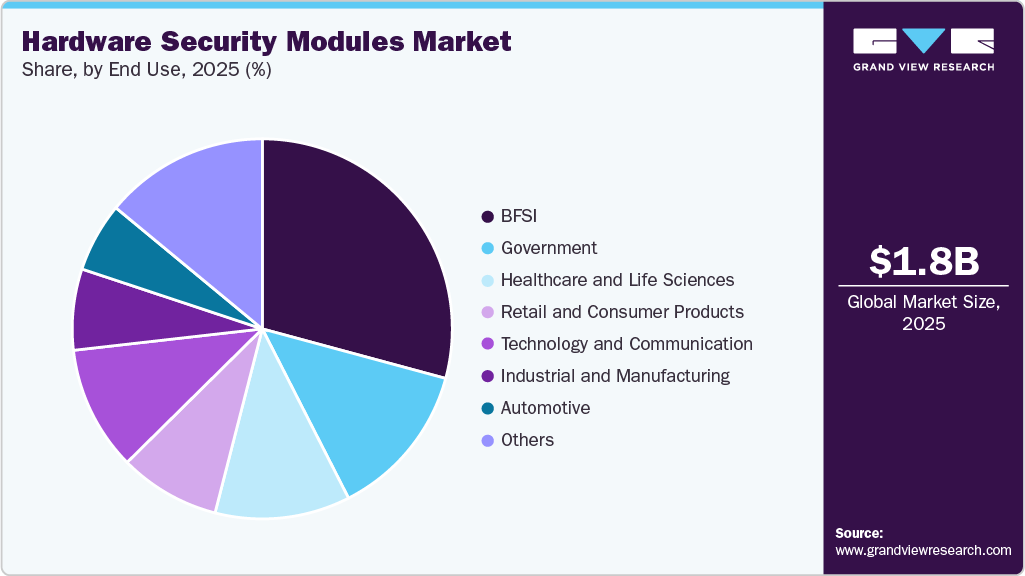 To learn more about this report, Download Free Sample Report
 The retail and consumer products segment is expected to grow at a significant CAGR in the hardware security modules (HSM) market due to the rapid expansion of digital commerce, omnichannel retailing, and data-driven customer engagement models, which are generating massive volumes of sensitive consumer and transaction data that require strong cryptographic protection. Retailers are adopting e-commerce platforms, mobile shopping applications, and digital payment systems, which depend on secure key management, encryption, and authentication to protect payment information, customer identities, and loyalty program data from rising cyber threats. In addition, the growing adoption of cloud-based retail infrastructure, APIs, and third-party integrations is increasing exposure to data breaches, prompting organizations to invest in HSM-enabled security solutions that ensure secure transactions, tokenize payment data, and comply with regulations such as PCI DSS and global data protection laws. The rise of personalized retail experiences powered by AI and analytics is further amplifying the need for secure data handling across distributed systems, driving demand for scalable and automated cryptographic security frameworks. Consequently, the retail and consumer products segment is expected to register the fastest growth as organizations prioritize secure digital payment processing, enhanced customer data protection, and scalable security architectures that can support rapidly expanding e-commerce ecosystems and evolving consumer expectations.
Regional Insights
North America dominated the global hardware security modules market with the largest revenue share of 37.4% in 2025, due to strong adoption of advanced cryptographic security infrastructure across BFSI, government, and technology sectors, where enterprises are rapidly deploying HSMs to support secure digital payment processing, cloud migration, and identity management systems. The region is witnessing high demand for FIPS-certified HSMs driven by stringent regulatory frameworks such as PCI DSS, HIPAA, and federal cybersecurity mandates that require secure key generation, encryption, and tamper-resistant hardware to protect sensitive data. Additionally, the widespread integration of cloud-based HSM services across hyperscale cloud providers and fintech ecosystems is accelerating deployment, as organizations shift toward hybrid and multi-cloud environments while maintaining strict security and compliance standards. Another key trend is the increasing use of HSMs in digital identity, authentication, and zero-trust architectures, particularly in financial services and government digital transformation initiatives, where secure cryptographic key management is essential for large-scale secure transactions and data protection.
U.S. Hardware Security Modules Market Trends
The hardware security modules market in the U.S. held the largest share in the North America region in 2025, driven by the rapid expansion of cloud computing, the increasing adoption of zero-trust security architectures, and the rising demand for advanced cryptographic key management across the BFSI, government, and technology sectors. Organizations in the U.S. are increasingly deploying HSMs to secure digital payment systems, protect sensitive enterprise data, and enable secure authentication in highly distributed hybrid and multi-cloud environments, where cybersecurity threats are becoming more sophisticated and frequent. In addition, stringent regulatory requirements such as PCI DSS, HIPAA, and federal cybersecurity standards are driving enterprises to invest in FIPS-certified HSM solutions to ensure compliance, data integrity, and secure encryption of critical workloads. The growing focus on digital identity protection, API security, and secure software development practices is further accelerating HSM adoption across enterprises undergoing large-scale digital transformation.
Asia Pacific Hardware Security Modules Market Trends
The hardware security modules industry in the Asia Pacific region is expected to grow at the fastest CAGR during the forecast period, due to rapid digital transformation across emerging economies, strong expansion of cloud computing, and fintech ecosystems. The growth is also attributed to the increasing adoption of digital payment platforms across countries such as China, India, and Japan, including the growing South Korean market, which is being driven by advanced digital banking infrastructure and strong national cybersecurity initiatives. The region is witnessing a surge in cybersecurity investments as enterprises modernize IT infrastructure and shift toward hybrid and multi-cloud environments, creating strong demand for hardware-backed cryptographic security to protect sensitive data, digital identities, and financial transactions. In addition, rising government initiatives focused on data protection regulations, digital economy development, and secure digital identity frameworks are further accelerating the deployment of HSM solutions across the BFSI, telecom, and public sectors. The rapid growth of e-commerce, IoT deployments, and mobile-first business models is also increasing the need for scalable key management and encryption solutions, making the Asia Pacific the most dynamic and fastest-growing regional market for HSM adoption.
 To learn more about this report, Download Free Sample Report
 The China hardware security modules industry held a significant share in 2025 due to the rapid expansion of its digital economy, strong adoption of cloud computing, and large-scale deployment of secure payment and identity infrastructure across banking, government, and enterprise sectors. The country’s increasing focus on cybersecurity regulations, data localization requirements, and digital sovereignty has significantly driven demand for hardware-based cryptographic solutions to secure sensitive financial data, critical infrastructure, and cross-border digital transactions. In addition, the rapid growth of e-commerce platforms, fintech innovation, and mobile payment ecosystems, such as digital wallets, has further accelerated the need for secure key management and encryption technologies. The rising adoption of cloud-native architectures and enterprise digital transformation initiatives across industries has also supported sustained demand for HSM solutions, making China one of the key contributors to the Asia Pacific HSM market in 2025.
The hardware security modules industry in Japan is expected to grow at a significant CAGR from 2026 to 2033, due to accelerating digital transformation across enterprises, rising adoption of cloud computing, and increasing deployment of advanced cybersecurity frameworks to protect sensitive financial, industrial, and government data. Japan’s strong focus on data protection, regulatory compliance, and secure digital infrastructure is driving organizations to adopt hardware-based cryptographic solutions for secure key management, encryption, and authentication across hybrid and multi-cloud environments. In addition, the expansion of digital payment systems, IoT-enabled manufacturing (Industry 4.0), and smart city initiatives is increasing the need for high-assurance security solutions that can protect connected devices and real-time data flows. The growing emphasis on zero-trust security architectures and the modernization of legacy IT systems across sectors such as BFSI, telecommunications, and automotive are further driving sustained demand for HSM solutions, supporting strong market growth throughout the forecast period.
The India hardware security modules industry is witnessing strong growth driven by rapid digital transformation, expanding cloud adoption, and the large-scale rise of digital payment ecosystems across banking, fintech, and e-commerce sectors. Increasing cybersecurity threats and data breaches are pushing enterprises to adopt hardware-based cryptographic solutions for secure key management, encryption, and authentication, particularly in highly regulated industries such as BFSI and government. In addition, government-led initiatives such as Digital India, Aadhaar-enabled services, and the expansion of digital public infrastructure are significantly increasing the demand for secure identity verification and transaction processing systems. The rapid growth of cloud computing, IoT deployments, and hybrid IT environments is further accelerating the need for scalable and tamper-resistant HSM solutions that can secure sensitive data across distributed networks.
Europe Hardware Security Modules Market Trends
The hardware security modules industry in Europe is growing at a significant CAGR from 2026 to 2033, due to increasing regulatory pressure for data privacy and cybersecurity compliance, particularly under frameworks such as GDPR, eIDAS, and evolving EU cybersecurity directives that require strong encryption, secure key management, and tamper-resistant hardware for protecting sensitive data. Within the region, Spain is also witnessing steady growth, driven by rising digital banking adoption, increasing cloud migration among enterprises, and expanding government-led digital identity and cybersecurity initiatives. Organizations across BFSI, government, healthcare, and industrial sectors are rapidly adopting HSM solutions to secure digital identities, financial transactions, and critical infrastructure as cyber threats continue to rise in sophistication and frequency. In addition, the accelerated adoption of cloud computing, hybrid IT architectures, and digital payment systems is driving demand for scalable and compliant cryptographic infrastructure that ensures data sovereignty and secure cross-border data processing within the region. The growing focus on digital identity frameworks, secure authentication systems, and zero-trust security models is further supporting sustained HSM adoption across enterprises undergoing large-scale digital transformation.
The UK hardware security modules industryis expected to grow rapidly in the coming years, supported by increasing adoption of cloud computing, rising demand for secure digital payment systems, and the expansion of cybersecurity frameworks across financial services, government, and enterprise sectors. The growing shift toward digital banking, fintech innovation, and real-time payment processing is driving strong demand for hardware-based cryptographic solutions to secure sensitive financial data, manage encryption keys, and ensure compliance with stringent regulatory standards such as GDPR and PCI DSS. In addition, the UK’s focus on strengthening national cybersecurity infrastructure, including zero-trust architectures and secure identity management systems, is further accelerating the deployment of HSM solutions. The rising integration of HSMs into hybrid cloud environments and digital transformation initiatives across industries is also contributing to sustained market growth.
The hardware security modules industry in Germanyheld a significant market share in 2025, driven by strong industrial digitization, stringent data protection regulations, and widespread adoption of secure cryptographic infrastructure across BFSI, automotive, manufacturing, and government sectors. The country’s strict compliance environment under GDPR and national cybersecurity frameworks has significantly increased the need for hardware-based key management, encryption, and authentication solutions to secure sensitive enterprise and industrial data. In addition, Germany’s leadership in Industry 4.0 initiatives and smart manufacturing has accelerated the deployment of HSMs to protect IoT-enabled systems, connected production environments, and industrial control networks. The rapid shift toward cloud computing, hybrid IT environments, and digital identity systems is further strengthening demand for secure and scalable cryptographic solutions, supporting the country’s strong position in the European HSM market in 2025.
Key Hardware Security Modules Company Insights
Some of the key companies operating in the market include Amazon Web Services (AWS), Atos SE, Cavium (Marvell Technology), and Crypto4A Technologies, among others. These companies are some of the leading participants in the hardware security modules market.
-
In April 2026, BTQ Technologies partnered with Daou Data to develop hardware-rooted post-quantum cryptography solutions for securing South Korea’s payment infrastructure, focusing on strengthening payment gateways and networks against future quantum computing threats.
-
In April 2026, Sectigo launched Private PQC, a new feature in its certificate management platform that allows enterprises to test and manage post-quantum cryptography (PQC) certificates within existing workflows without requiring new infrastructure or tools.
Key Hardware Security Modules Companies
The following key companies have been profiled for this study on the hardware security modules market.
-
Amazon Web Services (AWS)
-
Atos SE
-
Cavium (Marvell Technology)
-
Crypto4A Technologies
-
Entrust Corporation
-
Futurex
-
Google LLC
-
Hewlett Packard Enterprise (HPE)
-
IBM Corporation
-
Ledger
-
Micro Focus
-
Microsoft Corporation
-
Securosys SA
-
Thales Group
-
Utimaco GmbH
Competitive Benchmarking
Operating Strategies
Competitive Edge
Weaknesses
Established Players (Thales Group; Entrust; IBM; Utimaco; Futurex)
- Mature players in the Hardware Security Modules market focus on protecting cryptographic keys for banking, government, cloud, and enterprise environments.
- They offer on-premise, cloud-based, and hybrid HSM deployments to meet diverse security requirements.
- Their strategy emphasizes compliance with global security standards and support for high-volume transaction processing.
- They also strengthen their position through partnerships with cloud providers, financial institutions, and PKI vendors.
- Mature players benefit from proven security certifications and long-standing customer trust.
- Their HSMs are designed to support mission-critical encryption and digital identity applications.
- Extensive expertise in cryptographic standards enables them to serve highly regulated industries.
- Strong global support capabilities further enhance reliability for enterprise customers.
- These solutions often involve lengthy procurement and deployment cycles.
- High certification and compliance requirements increase development costs.
- Customers may face challenges integrating HSMs into legacy IT infrastructures.
- Dependence on highly regulated sectors can also limit market flexibility.
Emerging Players (Fortanix; Crypto4A; Securosys; Unbound Security; Xiphera)
- Emerging players focus on cloud-native, virtualized, and next-generation cryptographic security platforms.
- They emphasize flexible deployment models that support multi-cloud and digital-first environments.
- Their strategy targets growing use cases such as blockchain, digital assets, and confidential computing.
- Many also invest in post-quantum cryptography and advanced key management technologies.
- Emerging players offer modern architectures optimized for cloud and distributed environments.
- Their solutions provide greater scalability and deployment flexibility than traditional hardware-centric models.
- Strong focus on innovation helps address evolving cybersecurity threats.
- They are also well-positioned to capitalize on emerging opportunities in digital assets and quantum security.
- Emerging players have limited brand recognition in highly regulated enterprise markets.
- Their technologies may face longer validation cycles before widespread adoption.
- Smaller customer bases can restrict recurring revenue and market influence.
- Competition from established security vendors may also slow enterprise penetration.
Hardware Security Modules Market Report Scope
Report Attribute
Details
Market size in 2025
USD 1.8 billion
Estimated market size in 2026
USD 2.0 billion
Projected market size by 2033
USD 5.0 billion
Growth rate
CAGR of 14.0% from 2026 to 2033
Base year for estimation
2025
Historical data
2021 - 2024
Forecast period
2026 - 2033
Quantitative units
Revenue in USD million/billion and CAGR from 2026 to 2033
Report coverage
Revenue forecast, company market share analysis, competitive landscape, growth factors, and trends
Segments covered
Type, deployment, application, end use, region
Regional scope
North America; Europe; Asia Pacific; Latin America; MEA
Country scope
U.S.; Canada; Mexico; UK; Germany; France; China; India; Japan; Australia; South Korea; Brazil; UAE; Saudi Arabia; South Africa
Key companies profiled
Amazon Web Services (AWS); Atos SE; Cavium (Marvell Technology); Crypto4A Technologies; Entrust Corporation; Futurex; Google LLC; Hewlett Packard Enterprise (HPE); IBM Corporation; Ledger; Micro Focus; Microsoft Corporation; Securosys SA; Thales Group; Utimaco GmbH
Customization scope
Free report customization (equivalent up to 8 analysts' working days) with purchase. Addition or alteration to country, regional & segment scope.
Pricing and purchase options
Avail customized purchase options to meet your exact research needs. Explore purchase options
Global Hardware Security Modules Market Report Segmentation
This report forecasts revenue growth at global, regional, and country levels and provides an analysis of the latest industry trends in each of the sub-segments from 2021 to 2033. For this study, Grand View Research has segmented the global hardware security modules market report based on type, deployment, application, end-use, and region.
-
Type Outlook (Revenue, USD Billion, 2021 - 2033)
-
LAN-based
-
PCIE-based
-
USB-based
-
Cloud-based
-
-
Deployment Outlook (Revenue, USD Billion, 2021 - 2033)
-
On-Premises
-
Cloud
-
-
Application Outlook (Revenue, USD Billion, 2021 - 2033)
-
Payment Processing
-
Authentication
-
Public Key Infrastructure (PKI) Management
-
Database Encryption
-
IoT Security
-
Others
-
-
End-use Outlook (Revenue, USD Billion, 2021 - 2033)
-
BFSI
-
Government
-
Healthcare and Life Sciences
-
Retail and Consumer Products
-
Technology and Communication
-
Industrial and Manufacturing
-
Automotive
-
Others
-
-
Regional Outlook (Revenue, USD Billion, 2021 - 2033)
-
North America
-
U.S.
-
Canada
-
Mexico
-
-
Europe
-
Germany
-
UK
-
France
-
-
Asia Pacific
-
China
-
India
-
Japan
-
South Korea
-
Australia
-
-
Latin America
-
Brazil
-
-
Middle East & Africa
-
UAE
-
Saudi Arabia
-
South Africa
-
-
Research Methodology
The hardware security modules market figures in this report are based on a proven research process that combines executive interviews with secondary research from proprietary databases, company filings, and recognized regulatory and institutional sources. Market size is built through value-chain sizing-reconciling supply-side and demand-side estimates-and triangulated with bottom-up and top-down approaches. Every estimate passes multiple levels of expert validation before publication, with each hardware security modules segment quantified using the revenue-capture definitions in the table below.
Segment Definition
Segment – Type
Revenue capture definition
LAN-based
Revenue is driven by network-attached HSM deployments that allow multiple applications and users to securely access centralized cryptographic resources. Demand is particularly strong among enterprises requiring scalable key management, digital signing, and encryption services across distributed IT environments.
PCIE-based
Value is captured through high-performance HSM cards installed directly into servers for ultra-low-latency cryptographic operations. Adoption is concentrated in financial trading platforms, payment systems, and mission-critical applications where transaction speed and security must operate simultaneously.
USB-based
Market activity stems from portable cryptographic devices used for secure key storage, authentication, code signing, and certificate management. Organizations favor these solutions for individual users, administrators, and smaller deployments requiring mobility and straightforward implementation.
Cloud-based
The fastest-growing segment is benefiting from the increasing adoption of cloud-native security architectures. Providers monetize through subscription-based access to HSM functionality, enabling customers to secure cryptographic keys without investing in dedicated hardware infrastructure.
Segment – Deployment
Revenue capture definition
On-Premise
Demand originates from organizations that require complete control over cryptographic assets, security policies, and compliance processes. This deployment model remains prevalent in highly regulated sectors where data sovereignty and stringent security standards are top priorities.
Cloud
Growth is supported by enterprises migrating workloads to public and hybrid cloud environments while maintaining strong encryption and key protection practices. Consumption-based pricing and rapid scalability make cloud deployments increasingly attractive across industries.
Segment – Application
Revenue capture definition
Payment Processing
The largest application segment is where HSMs secure payment transactions, PIN generation, card issuance, tokenization, and payment gateway operations. Financial institutions and payment processors rely on HSMs to comply with global payment security standards and prevent fraud.
Authentication
Value is generated through secure credential management, multifactor authentication, identity verification, and digital certificate protection. Growing cybersecurity threats are prompting organizations to strengthen their authentication infrastructure with hardware-backed trust mechanisms.
Public Key Infrastructure (PKI) Management
Market demand is linked to certificate authority operations, digital certificate issuance, key lifecycle management, and secure communications infrastructure. HSMs serve as the root of trust within PKI ecosystems, supporting critical enterprise and government security frameworks.
Database Encryption
Revenue opportunities arise from solutions that safeguard sensitive corporate, financial, healthcare, and customer information stored within databases. Organizations increasingly invest in HSM-backed encryption to meet compliance requirements and reduce data breach risks.
IoT Security
Adoption is accelerating as connected devices proliferate across industrial, automotive, healthcare, and consumer environments. HSMs enable secure device authentication, protection of firmware integrity, and cryptographic key management throughout the IoT lifecycle.
Others
This category includes blockchain security, code signing, secure communications, document signing, DNS security, and emerging cryptographic applications. Vendors generate value by supporting specialized security requirements across evolving digital ecosystems.
Segment – End Use
Revenue capture definition
BFSI
The highest-spending end-user segment, utilizing HSMs to secure digital banking platforms, payment infrastructure, mobile transactions, ATM networks, and financial data. Regulatory compliance and fraud prevention remain key investment drivers.
Government
Government agencies deploy HSMs to protect classified information, citizen identity systems, national security applications, and public digital services. Procurement is often influenced by stringent cybersecurity mandates and data protection requirements.
Healthcare and Life Sciences
Investment is directed toward safeguarding patient records, research data, connected medical devices, and healthcare information exchanges. Security requirements surrounding sensitive medical information continue to drive HSM adoption across the sector.
Retail and Consumer Products
Retailers leverage HSMs to secure payment transactions, loyalty platforms, e-commerce operations, and customer databases. Increasing digital commerce activity and data privacy obligations support ongoing investment in cryptographic security infrastructure.
Technology and Communication
Cloud providers, telecom operators, software vendors, and digital service companies utilize HSMs to secure applications, networks, digital identities, and customer data. Rapid growth in digital services continues to expand the need for scalable cryptographic protection.
Industrial and Manufacturing
Demand is fueled by industrial IoT deployments, smart factory initiatives, operational technology security, and intellectual property protection. HSMs help manufacturers establish trusted communications and secure machine-to-machine interactions.
Automotive
Automotive companies deploy HSM technology to secure connected vehicles, software updates, vehicle-to-everything (V2X) communications, and autonomous driving systems. Increasing vehicle digitalization is creating new opportunities for hardware-based cryptographic security.
Others
This segment includes education, energy, defense contractors, logistics, transportation, and media organizations. Adoption is driven by the growing importance of encryption, digital trust, and cybersecurity resilience across diverse operational environments.
Estimation Model
Layer Name
Key Question
Description
Digital Trust Requirement Layer
Where are Hardware Security Modules (HSMs) essential?
Identify environments where the protection of cryptographic keys and sensitive digital assets is mission-critical. These include banking systems, payment networks, government agencies, cloud service providers, telecommunications operators, healthcare organizations, and enterprise data centers. This layer defines the market based on applications requiring high-assurance encryption, secure authentication, digital signatures, and regulatory compliance.
Security & Compliance Layer
What factors drive the deployment of HSMs?
Assess security requirements arising from increasing cyber threats, data privacy regulations, payment security mandates, and digital identity initiatives. Organizations deploy HSMs to meet compliance standards, safeguard cryptographic operations, establish root-of-trust architectures, and reduce the risk of key compromise. Growing adoption of cloud computing and zero-trust security frameworks further strengthens the need for dedicated hardware-based security solutions.
Cryptographic Infrastructure Layer
How are HSMs integrated into enterprise and cloud environments?
Analyze the deployment of HSMs across payment processing systems, public key infrastructure (PKI), certificate management, database encryption, code signing, blockchain platforms, and secure cloud services. Organizations increasingly integrate HSMs with identity and access management systems, cloud-native applications, and hybrid IT environments to centralize cryptographic key management while maintaining stringent security controls.
Security Services & Revenue Layer
How is value generated within the HSM ecosystem?
Evaluate revenue streams from on-premise HSM appliances, cloud-based HSM services, subscription licensing, managed security offerings, implementation services, maintenance contracts, and compliance consulting. Additional value is created through secure key lifecycle management, reduced breach risks, support for digital transformation initiatives, and the growing demand for encryption services driven by expanding volumes of sensitive digital transactions and data exchanges.
Delivered Customizations
This report has been delivered with the following In-depth customizations
Client Request
Customization Delivered
Value Adds
Cryptographic Key Management & Data Protection Trends
Conducted a focused analysis of Hardware Security Module (HSM) adoption across banking, payment processing, government, cloud services, and enterprise security environments, focusing on encryption key lifecycle management, secure key storage, and cryptographic processing requirements.
Helps stakeholders identify high-security application areas, evaluate enterprise encryption adoption trends, and assess commercialization opportunities in hardware-based cybersecurity solutions.
Digital Trust, Identity Security & Compliance Adoption Trends
Evaluated adoption trends for HSMs supporting Public Key Infrastructure (PKI), digital signatures, certificate management, code signing, authentication services, and compliance with regulatory standards such as PCI DSS, eIDAS, and data protection frameworks.
Provides insights into evolving compliance requirements, digital trust initiatives, and commercially attractive security deployments supporting secure digital transactions and identity management.
Cloud Security Infrastructure & Post-Quantum Readiness Opportunity Assessment
Assessed demand for cloud HSM services, Bring Your Own Key (BYOK) frameworks, confidential computing environments, and quantum-resistant cryptographic architectures, along with challenges related to integration complexity, performance requirements, and multi-cloud security management.
Supports investment and expansion strategies by identifying emerging cybersecurity opportunities, evaluating cryptographic modernization readiness, and strengthening long-term growth potential in cloud-native and next-generation security ecosystems.
Frequently Asked Questions About This Report
The global hardware security modules market is expected to grow at a CAGR of 14.0% from 2026 to 2033, reaching USD 5.0 billion by 2033.
The global hardware security modules market size was valued at USD 1.8 billion in 2025 and is estimated at USD 2.0 billion for 2026.
The hardware security modules (HSM) market is driven by several key factors, reflecting the increasing emphasis on robust cybersecurity measures across industries. The growing incidences of data breaches and cyber-attacks have heightened the need for advanced security solutions, prompting organizations to adopt HSMs for their superior encryption and key management capabilities.
Asia Pacific is the fastest-growing region over the forecast period.
North America dominated the hardware security modules market with a market share of 37.4% in 2025.
The automotive held the largest share (over 21%) in 2025, while technology and communication segment is the fastest-growing segment.
Some key players operating in the hardware security modules market include Amazon Web Services (AWS); Atos SE; Cavium (Marvell Technology); Crypto4A Technologies; Entrust Corporation; Futurex; Google LLC; Hewlett Packard Enterprise (HPE); IBM Corporation; Ledger; Micro Focus; Microsoft Corporation; Securosys SA; Thales Group; Utimaco GmbH
LAN-based segment accounted for the largest revenue share of 41.5% in 2025 and it is the fastest-growing segment.
The payment processing segment accounted for the largest revenue share of 28.1% in 2025, while IoT security segment is the fastest-growing segment.
The on-premise segment accounted for the largest revenue share of 63.2% in 2025, while cloud segment is the fastest-growing segment.
About the Author(s)
Network Security Research Team
Technology · Network SecurityThis report was authored by the network security research team at Grand View Research - comprising two research analysts, one senior research analyst, and one industry expert - with specialized expertise in the network security segment of the technology industry. All findings are based on proprietary technology databases, executive interviews, and regulatory analysis, subject to internal peer review prior to publication.
Last Updated:
Speak to Analyst

Customize this report to your needs - add regions, segments, or data points, with 20% free customization.
Or view our licence options:


ISO 9001:2015 & 27001:2022 Certified
We are GDPR and CCPA compliant! Your transaction & personal information is safe and secure. For more details, please read our privacy policy.


