
- Home
- »
- Healthcare IT
- »
-
Healthcare Mobility Solutions Market Size Report, 2026-2033GVR Report cover

Healthcare Mobility Solutions Market (2026 - 2033)
Size, Share & Trends Analysis Report By Product & Services (Enterprise Mobility, Mobile Applications, Mobile Devices), By Application (Enterprise Solutions, mHealth), By End Use, By Region, And Segment Forecasts
Market Size, 2025
$248.3BMarket Estimate, 2026
$298.9BMarket Forecast, 2033
$1,096.3BCAGR, 2026–2033
20.4%Healthcare Mobility Solutions Market Summary
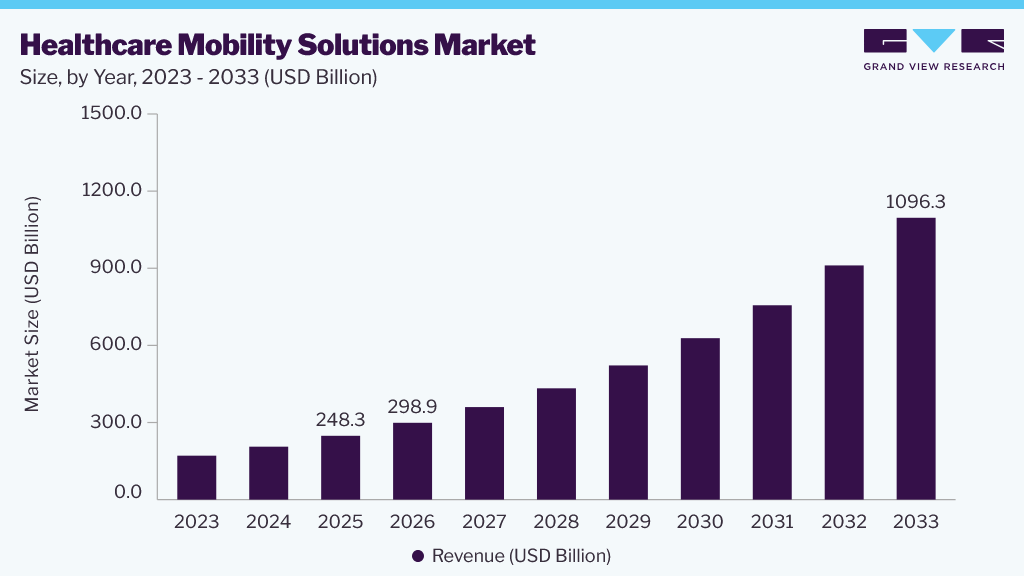
The global healthcare mobility solutions market size was valued at USD 248.3 billion in 2025 and is projected to grow from USD 298.9 billion in 2026 to USD 1,096.3 billion in 2033, at a CAGR of 20.4% from 2026 to 2033. North America dominated the market, accounting for a revenue share of approximately 43.0% in 2025. The market growth is driven by the rising need to improve patient care and clinical outcomes, increasing smartphone and tablet adoption in healthcare systems, and increasing connectivity to raise the standard of healthcare solutions.
 Source: Grand View Research, IR Documents, Primary Interviews, Paid DatabasesTo learn more about this report,
 Download Free Sample Report
Key Market Trends & Insights
- By product & services: The mobile devices accounted for the largest share of market revenue, at approximately 42.0% in 2025.
- By application: The enterprise solutions dominated the market, accounting for approximately 65.0% in 2025.
- By end use: The healthcare providers accounted for the largest market revenue of approximately 55.0% in 2025.
Regional Highlights
- Largest regional market: North America (43.0% revenue share, 2025)
- Fastest-growing regional market: Asia Pacific (highest CAGR, 2026-2033)
- By Country: U.S. held largest market share in 2025
Market Size & Forecast
- Market size in 2025: USD 248.3 Billion
- Estimated market size in 2026: USD 298.9 Billion
- Projected market size by 2033: USD 1,096.3 Billion
- CAGR (2026-2033): 20.4%
Three ways to get this report
Buy it, customize it, or ask a question.Ask an Analyst
Analyst response in 1 business day
- AccessReport author, directly
- Reply timeWithin 1 working day
- No sales callDirect answer only
- FormatEmail reply
- CostFree, no cost
Get the Full Report
What the study covers
- FormatsPDF · Excel · Dashboard
- Timeline2026–2033 annual, 2025 base
- Coverage20+ countries, 5 regions
- Companies10+ key players profiled
Customize the Report
20% free customization
- IncludeCountries, segments, points
- TailorTo your product definition
- ExtendDeeper competitor detail
- OrA fully bespoke study
- Turnaround5–10 working days
The ongoing transformation in healthcare and adoption of advanced technologies are aiding in boosting efficiency and delivering a better experience for users, thus fueling the market demand for mobile healthcare solutions.
The increasing demand for remote patient monitoring, driven by mobile health applications and connected devices that enable efficient patient monitoring and streamlined healthcare delivery, is a key driver of market growth. The adoption of Electronic Health Records (EHRs) has also supported market expansion by improving the integration and accessibility of patient data, thereby accelerating the use of healthcare mobility solutions. Furthermore, technological advancements in mobile applications, wearable devices, and wireless connectivity have improved healthcare delivery, workflow efficiency, and patient outcomes. The widespread use of smartphones and tablets in healthcare settings has further strengthened the adoption of mobility solutions.
For instance, in September 2025, Koninklijke Philips N.V. launched its Smart Telemetry Platform for cardiac monitoring, featuring the next-generation Telemetry Monitor 5500 and wearable telemetry devices that provide continuous, enterprise-wide wireless connectivity beyond the bedside. The platform enables clinicians to remotely monitor patients, streamline workflows, reduce alarm fatigue, and improve real-time clinical decision-making, supporting the growing adoption of healthcare mobility solutions across hospitals.
In addition, healthcare providers are increasingly investing in cost-optimization initiatives such as AI-powered workforce management, supply chain optimization, and resource planning to improve operational efficiency while maintaining the quality of care. The growing elderly population and increasing prevalence of chronic diseases such as diabetes, cardiovascular disease, and cancer are further driving demand for mobile health applications and connected care solutions. Government initiatives promoting e-health and digital health adoption continue to support market expansion. Overall, the healthcare mobility solutions market is being driven by rapid healthcare digitalization, increasing use of connected devices, growing demand for real-time care delivery, and the shift toward patient-centric healthcare models.
Analyst Perspective
The healthcare mobility solutions market is expanding as providers adopt mobile technologies for patient-centric care. Integrating mHealth apps, remote monitoring, AI, cloud computing, and IoMT enhances decision-making and patient engagement. Market growth is driven by aging populations, chronic diseases, and demand for telehealth models, alongside supportive government initiatives. Mobile platforms also improve productivity, optimize resources, and lower operational costs. However, interoperability, data privacy, and cybersecurity remain key challenges. Ultimately, secure and scalable platforms will determine long-term success.
Product & Services Insights
Mobile devices accounted for the largest market revenue share in 2025, at approximately 42.0%, driven by healthcare institutions’ preference for their portability, user-friendly interfaces, and remote access to patient information. These devices include medical tablets, carts, and wearable technology, along with accessories such as barcode scanners, RFID readers, and mobile printers. This enables healthcare staff to streamline patient data management and optimize workflow efficiency. The segment is also benefiting from the growing adoption of connected devices and wireless healthcare infrastructure, which support real-time communication, faster decision-making, and improved point-of-care delivery.
Mobile applications are expected to register the fastest CAGR during the forecast period. Mobile applications empower patients to access healthcare information and services remotely, allowing them to schedule appointments, order medications, and view health records from anywhere, at any time. For instance, in January 2025, Tempus AI launched Olivia, an AI-enabled personal health concierge application that enables patients to securely access health records from more than 1,000 health systems through EHR integration, synchronize data from connected health devices, receive AI-powered health insights, and manage their healthcare information through a single mobile platform. Patients can track symptoms, vital signs, and educational resources, promoting improved health outcomes. For healthcare providers, mobile apps streamline workflows, enabling efficient patient record retrieval, enhanced patient engagement, and remote service delivery, including telemedicine.
Application Insights
Enterprise solutions dominated the market, accounting for approximately 65.0% in 2025, as they offer comprehensive, end-to-end tools and services to meet the needs of healthcare institutions across hospitals, clinics, and health centers. These solutions span various domains, including EHR systems, patient management systems, telehealth platforms, and mobile apps for healthcare professionals, and are driven by benefits such as increased availability, enhanced data security, simplified processes, and better patient outcomes. The segment is also driven by the growing need for seamless interoperability and real-time data exchange across healthcare systems, enabling more coordinated care delivery and improved clinical decision-making.
mHealth applications are expected to register the fastest CAGR during the forecast period. These mobile applications enable patients to access medical information, test results, and educational resources, empowering informed decision-making. By promoting remote monitoring, mHealth apps can facilitate preventive care and reduce hospital readmissions, resulting in cost savings for patients and healthcare systems alike. The growing demand for wearable devices, such as smartwatches and fitness bands, that integrate seamlessly with mHealth apps has also contributed to their development.
End use Insights
Healthcare providers accounted for the largest share of market revenue at approximately 55% in 2025. Healthcare mobility solutions provide healthcare practitioners with easy, convenient access to patient information and records. In addition, healthcare providers are rapidly implementing mobile technologies to more effectively manage patient care and administrative tasks, and to monitor operational efficiency. Furthermore, it provides superior flexibility, mobility, and connectivity for healthcare providers, enabling better patient outcomes through efficient workflows and enhanced healthcare services.
Healthcare payers are expected to be the fastest-growing end-use segment over the forecast period, registering a CAGR. Healthcare payers are incentivized to implement solutions that prevent unnecessary hospital admissions. Healthcare mobility solutions, including remote patient monitoring, can help identify and address potential complications early, leading to cost savings for payers. For instance, in February 2025, Teladoc Health acquired Catapult Health to expand its virtual preventive care capabilities, combining at-home diagnostic testing, digital health assessments, and telehealth services to enable earlier identification of chronic conditions and reduce avoidable healthcare costs for health plans and employers. Mobile platforms can enable real-time claims processing and verification, reducing the risk of fraudulent claims and improving efficiency.
Regional Insights
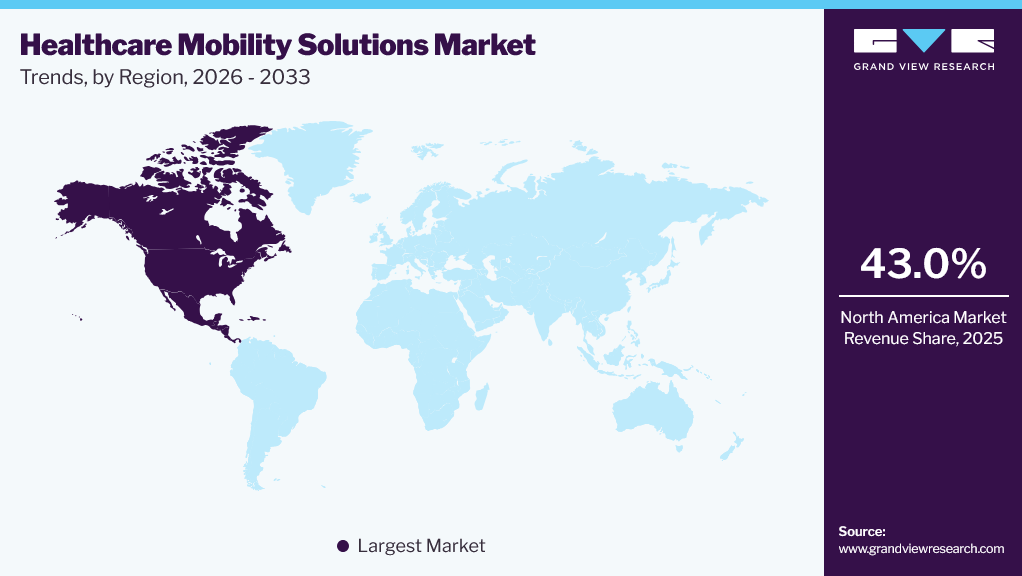
The North American healthcare mobility solutions market dominated the global healthcare mobility solutions market with a share of approximately 43.0% in 2025, driven by the widespread adoption of smartphones and online services. The region’s healthcare sector is witnessing significant growth, fueled by the increasing popularity of mHealth solutions that empower individuals to proactively manage their health.
 To learn more about this report, Download Free Sample Report
U.S. Healthcare Mobility Solutions Market Trends
The healthcare mobility solutions market in the U.S. dominated the North America healthcare mobility solutions market in 2025, capturing an approximately 83.0% share, driven by the industry’s relentless innovation and adoption of cutting-edge technologies such as artificial intelligence. For instance, in July 2025, Cedars-Sinai expanded its AI-powered virtual care platform, Cedars-Sinai Connect, enabling patients to access healthcare services 24/7 via a mobile application and integrating AI-assisted symptom assessment with electronic health records. The health system is also piloting AI-enabled remote patient monitoring for chronic disease management, reinforcing the adoption of advanced healthcare mobility solutions across the U.S. To ensure seamless integration and robust security, the market is focused on addressing data compatibility concerns, thereby paving the way for sustained growth and effectiveness of mobile healthcare solutions.
Europe Healthcare Mobility Solutions Market Trends
Europe healthcare mobility solutions market was identified as a lucrative region in 2025, aided by growing demand for patient-centric care, the implementation of healthcare IT solutions, and public awareness of the benefits of mobile healthcare. Moreover, the need for mHealth solutions, increased healthcare spending, and widespread adoption of mobile devices in healthcare settings are expected to propel revenue growth in this region.
The healthcare mobility solutions market in the UK is poised for rapid growth, fueled by widespread smartphone and tablet adoption. Existing devices enable seamless access to mobile healthcare solutions, facilitating ease of use for patients and healthcare professionals. This convenience factor is expected to drive market expansion in the coming years.
Asia Pacific Healthcare Mobility Solutions Market Trends
The Asia Pacific healthcare mobility solutions market is expected to witness the fastest growth in the global healthcare mobility solutions market, registering a CAGR over the forecast period. Market growth in the region is driven by the large population, rising healthcare costs, and the increasing number of healthcare facilities. Market revenue is further supported by the growing demand for patient-centric care, increasing adoption of mobile devices in healthcare settings, and government initiatives promoting healthcare IT adoption. Rising digital health investments and expanding mobile health awareness across developing economies are also accelerating market growth. Awareness of the benefits of mobile health solutions also supports market expansion. For instance, Apollo Hospitals continued to expand its digital health ecosystem through mobile-enabled teleconsultation, remote patient monitoring, and AI-powered patient engagement solutions, supporting the broader adoption of healthcare mobility solutions across India and the Asia Pacific region.
The healthcare mobility solutions market in China is expected to grow rapidly in the coming year, fueled by the country’s massive population and resulting demand for efficient healthcare solutions. Mobile health apps and platforms can address this need by providing remote consultations, chronic disease management, and improved access to information, ultimately improving patient care and outcomes.
Key Healthcare Mobility Solutions Company Insights
Some of the key companies operating in the healthcare mobility solutions market include OMRON Healthcare, Inc.; McKesson Corporation; Apple Inc.; Wipro; Oracle; IBM; GE HealthCare; Koninklijke Philips N.V.; Microsoft; AirStrip Technologies, Inc.; and Zebra Technologies Corp. Key players in the healthcare mobility solutions market are focusing on strategic initiatives such as partnerships, acquisitions, product innovations, and platform enhancements to strengthen their market position. These efforts are helping companies expand mobile healthcare capabilities, improve clinical workflow efficiency, enhance patient engagement, and address the growing demand for connected healthcare solutions.
- Omron Healthcare, Inc. offers medical devices for monitoring health and providing therapy. The company provides digital thermometers, pedometers, nebulizers, body composition monitors, inhalers, electric toothbrushes, and blood pressure monitors. The company creates and markets software for managing health and offers services for promoting health.
- GE HealthCare specializes in medical technology, pharmaceutical diagnostics, and digital solutions. The company creates, produces, and disperses imaging systems for diagnosis and clinical use; goods for drug research, biopharmaceutical production, and cellular technologies; agents for medical scans; and healthcare technology solutions.
Key Healthcare Mobility Solutions Companies
The following are the leading companies in the healthcare mobility solutions market. These companies collectively hold the largest market share and dictate industry trends.
-
OMRON Healthcare, Inc.
-
McKesson Corporation
-
Apple Inc.
-
Wipro
-
Oracle
-
IBM
-
GE HealthCare
-
Koninklijke Philips N.V.
-
Microsoft
-
AirStrip Technologies, Inc.
-
Zebra Technologies Corp.
Recent Developments
-
In May 2025, Corti launched its Corti Assistant mobile application, an AI-powered ambient clinical documentation tool that enables healthcare professionals to capture patient conversations in real time and automatically generate structured clinical notes directly on mobile devices.
-
In June 2024, Koninklijke Philips N.V. announced the U.S. launch and first implant of its Duo Venous Stent System, a device intended to treat symptomatic venous outflow obstruction in the iliofemoral veins, following FDA premarket approval in December 2023.
Healthcare Mobility Solutions Market Report Scope
Report Attribute
Details
Market size in 2025
USD 248.3 billion
Estimated market size in 2026
USD 298.9 billion
Projected market size by 2033
USD 1,096.3 billion
Growth r ate
CAGR of 20.4% from 2026 to 2033
Base year for estimation
2025
Actual data
2021 – 2024
Forecast period
2026 – 2033
Quantitative units
Revenue in USD million/billion and CAGR from 2026 to 2033
Report coverage
Revenue forecast, company ranking, competitive landscape, growth factors, and trends
Segments covered
Product & services, application, end use, region
Regional s cope
North America; Europe; Asia Pacific; Latin America; MEA
Country s cope
U.S. ; Canada ; Mexico ; UK ; Germany ; France ; Italy ; Spain ; Denmark ; Sweden ; Norway ; China ; Japan ; India ; South Korea ; Australia ; Thailand ; Brazil ; Argentina ; Saudi Arabia ; UAE ; Kuwait ; South Africa
Key companies profiled
OMRON Healthcare, Inc.; McKesson Corporation; Apple Inc.; Wipro; Oracle; IBM; GE HealthCare; Koninklijke Philips N.V.; Microsoft; AirStrip Technologies, Inc.; Zebra Technologies Corp.
Customization scope
Free report customization (equivalent up to 8 analysts working days) with purchase. Addition or alteration to country, regional & segment scope.
Pricing and purchase options
Avail of customized purchase options to meet your exact research needs. Explore purchase options
Global Healthcare Mobility Solutions Market Report Segmentation
This report forecasts revenue growth at global, regional, and country levels and provides an analysis of the latest industry trends and opportunities in each of the sub-segments from 2021 to 2033. For this study, Grand View Research has segmented the global Healthcare Mobility Solutions market report based on product & services, application, end use, and region:
-
Product & Services Outlook (Revenue, USD Billion, 2021 - 2033)
-
Enterprise Mobility Platforms
-
Mobile Applications
-
Mobile Devices
-
Mobile Computers
-
RFID Scanners
-
Barcode Scanners
-
Other Mobile Devices
-
-
-
Application Outlook (Revenue, USD Billion, 2021 - 2033)
-
Enterprise Solutions
-
Patient Care Management
-
Patient Monitoring
-
Case Management
-
Medication Administration
-
Patient Id (PPID)/Patient Tracking
-
Specimen Collection And Tracking
-
Dietary And Nutrition
-
Infectious Disease Monitoring/Field Data Collection
-
Other Patient Care Management Solutions
-
-
Operation Management
-
Patient Admissions/Discharge
-
Revenue Management/Billing
-
Claims Processing
-
Asset And Facilities Management
-
Materials Management
-
Other Operation Management Solutions
-
-
Work Force Management
-
Scheduling
-
Time And Attendance Management
-
Other Workforce Management Solutions
-
-
-
mHealth Applications
-
Chronic Care Management
-
Exercise
-
Weight Loss
-
Women’s Health
-
Sleep Monitoring
-
Medication Management
-
Other mHealth Applications
-
-
-
End Use Outlook (Revenue, USD Billion, 2021 - 2033)
-
Healthcare Payers
-
Healthcare Providers
-
Hospitals
-
Laboratories
-
Other Healthcare Providers
-
-
Patients
-
-
Regional Outlook (Revenue, USD Billion, 2021 - 2033)
-
North America
-
U.S.
-
Canada
-
Mexico
-
-
Europe
-
UK
-
Germany
-
France
-
Italy
-
Spain
-
Denmark
-
Sweden
-
Norway
-
-
Asia Pacific
-
China
-
Japan
-
India
-
South Korea
-
Australia
-
Thailand
-
-
Latin America
-
Brazil
-
Argentina
-
-
MEA
-
South Africa
-
Saudi Arabia
-
UAE
-
Kuwait
-
-
Frequently Asked Questions About This Report
The global healthcare mobility solutions market size was estimated at USD 248.3 billion in 2025 and is expected to reach USD 298.9 billion in 2026.
North America market dominated with a revenue share of approximately 43.0% in 2025.
The global healthcare mobility solutions market is expected to grow at a compound annual growth rate of 20.4% from 2026 to 2033 to reach USD 1,096.3 billion by 2033.
The mobile devices segment accounted for the largest revenue share of 42.0% in 2025.
Some key players operating in the healthcare mobility solutions market include OMRON Healthcare, Inc.; McKesson Corporation; Apple Inc.; Wipro; Oracle; IBM; GE HealthCare; Koninklijke Philips N.V.; Microsoft; AirStrip Technologies, Inc.; Zebra Technologies Corp., and others.
About the Author(s)
Healthcare IT Research Team
Healthcare · Healthcare ITThis report was authored by the healthcare it research team at Grand View Research - comprising two research analysts, one senior research analyst, and one industry expert - with specialized expertise in the healthcare it segment of the healthcare industry. All findings are based on proprietary healthcare databases, executive interviews, and regulatory analysis, subject to internal peer review prior to publication.
Last Updated:
Speak to Analyst

Customize this report to your needs - add regions, segments, or data points, with 20% free customization.
Or view our licence options:


ISO 9001:2015 & 27001:2022 Certified
We are GDPR and CCPA compliant! Your transaction & personal information is safe and secure. For more details, please read our privacy policy.


