
- Home
- »
- Electronic Devices
- »
-
Hearables Market Size, Share & Growth Report, 2026-2033GVR Report cover
![Hearables Market (2026 - 2033)Report]()
Hearables Market (2026 - 2033)
Size, Share & Trends Analysis By Product (True Wireless Stereo Earbuds, Smart Hearing Aids), By Connectivity (Bluetooth, Wi-Fi), By Application (Gaming, Healthcare & Hearing Assistance), By Distribution Channel, By Region, And Segment Forecasts
Market Size, 2025
$42.4BMarket Estimate, 2026
$47.1BMarket Forecast, 2033
$106.2BCAGR, 2026–2033
12.3%Hearables Market Summary
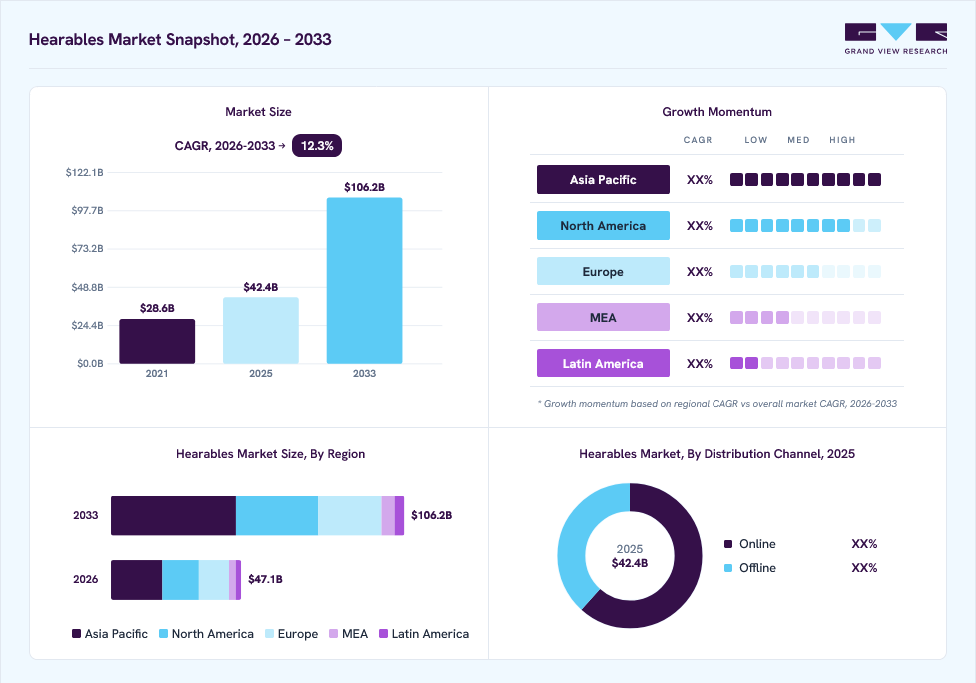
The global hearables market size was valued at USD 42.4 billion in 2025 and is projected to grow from USD 47.1 billion in 2026 to USD 106.2 billion by 2033, at a CAGR of 12.3% from 2026 to 2033. Asia Pacific dominated the market, accounting for the largest revenue share of 39.0% in 2025. The growing consumption of music streaming, video content, podcasts, audiobooks, and online gaming is increasing demand for high-performance hearables.
Key Market Trends & Insights
- By product: True wireless stereo (TWS) earbuds segment held the largest market share of 47.5% in 2025.
- By connectivity: Bluetooth segment held the largest market share of 71.2% in 2025.
- By application: Consumer entertainment segment held the largest market share of 45.2% in 2025.
- By distribution channel: Online segment dominated the market with the largest revenue share in 2025.
Regional Highlights
- Largest regional market: Asia Pacific (39.0% revenue share, 2025)
- By country: India dominated Asia Pacific region with the largest revenue share in 2025.
Market Size & Forecast
- Market size in 2025: USD 42.4 Billion
- Estimated market size in 2026: USD 47.1 Billion
- Projected market size by 2033: USD 106.2 Billion
- CAGR (2026-2033): 12.3%
Meanwhile, hybrid work and virtual collaboration are driving adoption of devices with Active Noise Cancellation (ANC), high-quality microphones, low-latency connectivity, and reliable voice communication, making hearables increasingly essential for both entertainment and professional applications. The rapid growth of digital entertainment and hybrid work is significantly accelerating demand for hearables worldwide. Consumers are spending more time streaming music, watching video-on-demand content, listening to podcasts and audiobooks, and playing online games, increasing the demand for high-quality wireless audio devices that deliver immersive sound experiences.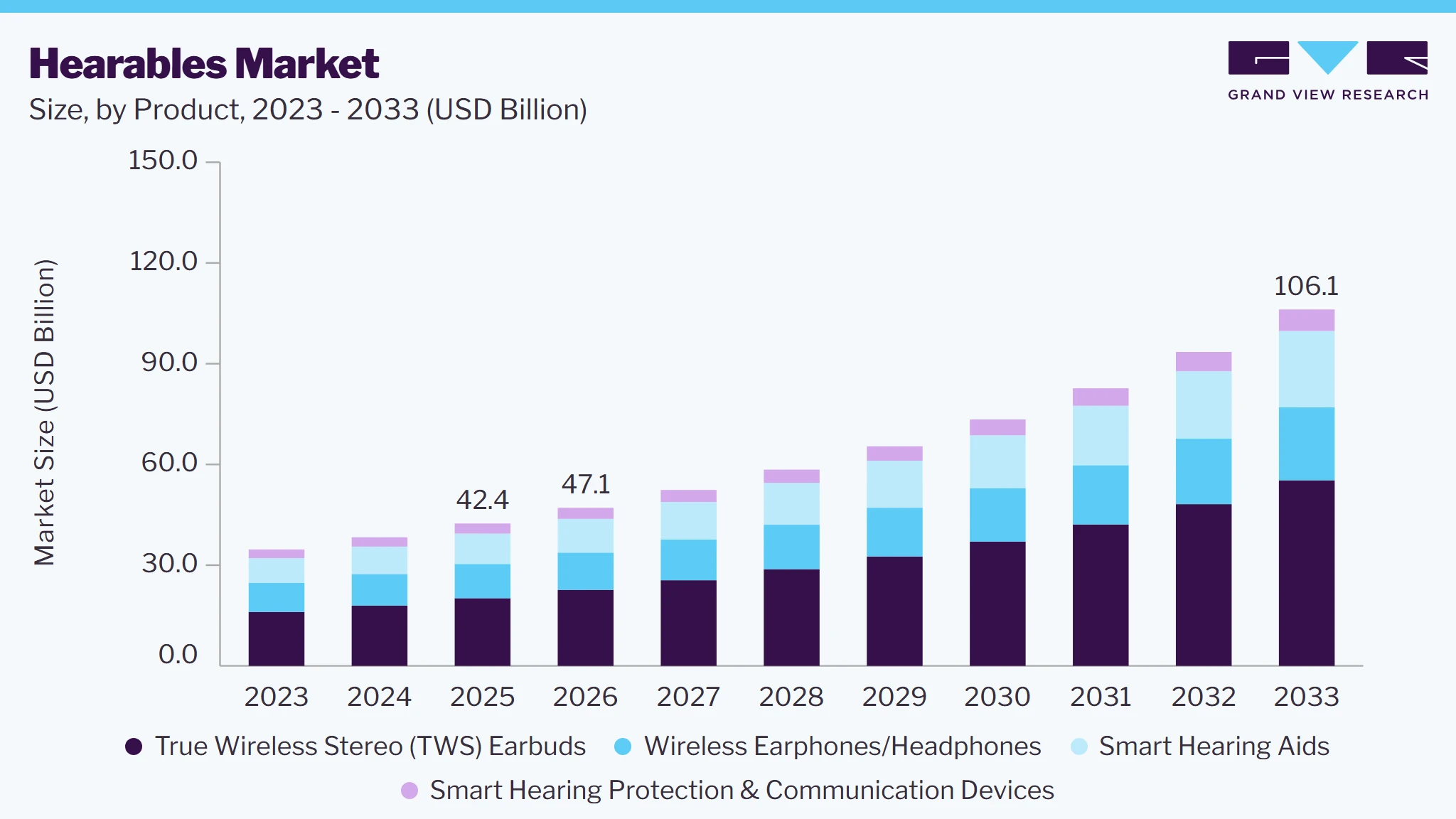
Simultaneously, the widespread adoption of hybrid and remote work models has made premium hearables essential for virtual meetings, voice calls, and collaborative work. Features such as Active Noise Cancellation (ANC), beamforming microphones, low-latency connectivity, long battery life, and seamless multi-device pairing enhance communication, productivity, and entertainment, encouraging consumers and enterprises to invest in advanced hearables and upgrade to premium models.
Market Dynamics
The hearables industry is experiencing robust growth as consumers increasingly adopt wireless, intelligent, and connected audio devices for entertainment, communication, health monitoring, and productivity. The widespread adoption of smartphones, the expansion of Bluetooth-enabled device ecosystems, and growing consumer preference for True Wireless Stereo (TWS) earbuds are driving demand for advanced hearables that offer seamless connectivity, superior audio quality, and enhanced mobility. Rising demand for premium features such as Active Noise Cancellation, adaptive sound optimization, biometric sensing, and health monitoring is encouraging consumers to upgrade to next-generation hearables, supporting higher average selling prices and market expansion. The rapid growth of digital entertainment, including music streaming, video-on-demand, podcasts, audiobooks, and mobile gaming, together with the continued adoption of hybrid work and virtual collaboration, is increasing the need for high-performance wireless earbuds and headphones equipped with premium microphones, low-latency connectivity, and long battery life.
The increasing prevalence of hearing impairment, coupled with rising health awareness and aging populations, is driving demand for smart hearing solutions. Modern hearables now incorporate hearing enhancement, biometric sensing, health monitoring, and remote fitting capabilities, extending their use beyond entertainment. Supportive regulations for over-the-counter hearing aids and advancements in tele-audiology are further expanding accessibility and accelerating adoption across healthcare and consumer wellness applications.
Intense competition among global and regional manufacturers, combined with rapid technological advancements, remains a significant restraint for the hearables industry. Frequent product launches and declining product life cycles increase pressure on manufacturers to continuously invest in research and development while managing pricing pressures. In addition, premium hearables with advanced features such as AI-enabled audio processing, biometric sensing, and high-quality Active noise cancellation remain relatively expensive for price-sensitive consumers. Counterfeit products, fluctuations in component supply, and battery performance limitations also pose challenges affecting product differentiation, profitability, and long-term customer retention.
The increasing convergence of consumer audio devices with digital health technologies presents significant opportunities for the hearables industry. Rising awareness of hearing health, aging populations, and supportive regulatory frameworks for over-the-counter hearing aids are driving demand for smart hearing assistance devices. At the same time, manufacturers are integrating artificial intelligence (AI), biometric sensing, real-time language translation, personalized sound optimization, health monitoring, and cloud-connected services into next-generation hearables. The growing adoption of hearables across healthcare, enterprise communication, sports and fitness, gaming, and augmented reality (AR) applications is expected to create substantial growth opportunities for innovative, multifunctional, and AI-powered hearable devices worldwide.
Analyst Perspective
The hearables market is evolving into a key segment of the connected wearable ecosystem as consumers increasingly adopt intelligent wireless audio devices for entertainment, communication, digital health, and productivity. The rapid shift toward true wireless stereo earbuds, premium wireless headphones, and smart hearing aids is driving demand for hearables that combine superior audio quality with artificial intelligence (AI), seamless connectivity, and health-focused capabilities. The convergence of hearables with digital health technologies, supported by the growing prevalence of hearing impairment, aging populations, and the expansion of over-the-counter hearing aids, is creating new growth opportunities beyond traditional consumer audio. At the same time, the rapid growth of music and video streaming, online gaming, hybrid work, and virtual collaboration is accelerating demand for high-performance hearables with advanced microphones, low-latency connectivity, and long battery life. The primary competitive advantage will belong to manufacturers that can successfully integrate AI-powered audio processing, Bluetooth LE Audio, advanced battery technologies, biometric health monitoring, and seamless ecosystem connectivity while maintaining ergonomic designs and competitive pricing.
Product Insights
The true wireless stereo earbuds segment led the market with the largest revenue share of 47.5% in 2025 and is projected to grow at the fastest CAGR during the forecast period. Consumers are increasingly prioritizing superior sound quality and advanced audio technologies when purchasing true wireless stereo (TWS) earbuds. Features such as active noise cancellation, adaptive equalization, high-resolution audio codecs, and AI-powered sound optimization are enhancing the listening experience. In response, manufacturers are launching premium models with improved acoustics, longer battery life, seamless multi-device connectivity, and intelligent features, driving higher consumer adoption, increased replacement rates, and growth in average selling prices (ASPs).
The smart hearing aids segment is anticipated to grow at a significant CAGR during the forecast period. The expansion of over-the-counter hearing aids is making hearing care more accessible and affordable for individuals with mild-to-moderate hearing loss. Supportive regulations enable consumers to purchase hearing aids without a prescription, reducing barriers to adoption and encouraging innovation, broader product availability, and increased market penetration in both developed and emerging healthcare markets.
Connectivity Insights
The Bluetooth segment led the market with the largest revenue share of 71.2% in 2025 and is projected to grow at the fastest CAGR during the forecast period. Continuous advancements in Bluetooth technologies, including Bluetooth 5.3, Bluetooth 5.4, and Bluetooth LE Audio, are significantly improving the performance of hearables. These standards offer enhanced audio quality, lower power consumption, reduced latency, and more reliable connectivity. Features such as Auracast broadcast audio, multi-stream audio, and improved codec support enable seamless device pairing and richer listening experiences, driving the adoption of next-generation Bluetooth-enabled hearables across consumer, healthcare, and enterprise applications.
The Bluetooth + Wi-Fi segment is expected to grow at a significant CAGR during the forecast period. Growing consumer demand for premium audio experiences is accelerating the adoption of Bluetooth + Wi-Fi hearables. While Bluetooth enables seamless wireless pairing and mobility, Wi-Fi provides higher bandwidth for high-resolution and lossless audio streaming. This combination delivers superior sound quality, lower latency, and a more immersive listening experience across connected devices.
Application Insights
The consumer entertainment segment led the market with the largest revenue share of 45.2% in 2025 and is projected to grow at the fastest CAGR during the forecast period. Consumers are increasingly seeking immersive and personalized entertainment experiences, driving demand for hearables equipped with advanced features such as Active Noise Cancellation (ANC) and high-resolution audio. These technologies enhance sound clarity, depth, and realism across music, movies, and gaming. As a result, consumers are upgrading to premium hearables with superior audio performance, supporting higher adoption rates and increasing average selling prices across the market.
The healthcare & hearing assistance segment is expected to grow at a significant CAGR during the forecast period. The increasing prevalence of hearing loss, particularly among the aging population, is driving demand for smart hearing aids and hearing assistance devices. Greater awareness of hearing health, early diagnosis, and improved access to advanced hearing technologies are encouraging timely intervention, expanding the addressable market, and supporting sustained growth in healthcare-focused hearables.
Distribution Channel Insights
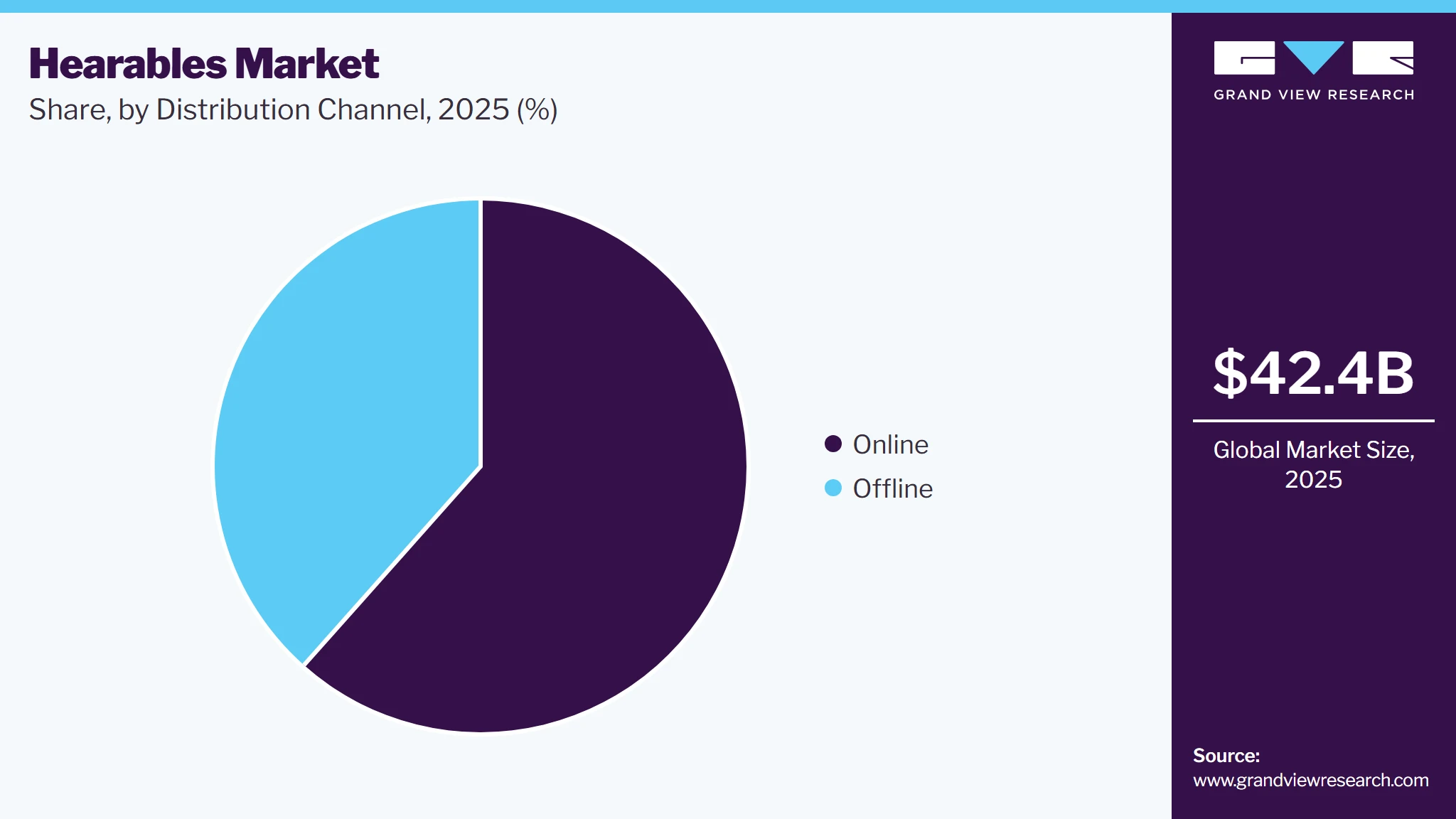
The online segment led the market with the largest revenue share of 61.6% in 2025 and is projected to grow at the fastest CAGR during the forecast period. The rapid expansion of global and regional e-commerce platforms is significantly improving the accessibility and availability of hearables worldwide. Consumers can conveniently compare products, prices, features, and customer reviews before making informed purchasing decisions. Attractive discounts, exclusive online launches, doorstep delivery, flexible payment options, and hassle-free return policies further encourage online purchases. In addition, manufacturers are leveraging direct-to-consumer (D2C) channels to strengthen brand engagement, expand market reach, and accelerate hearables sales.
The offline segment is expected to grow at a significant CAGR over the forecast period. Leading hearables manufacturers are expanding their presence through branded stores, consumer electronics retailers, and specialty audio outlets to strengthen customer engagement. These retail channels offer hands-on product demonstrations, expert guidance, exclusive product launches, and comprehensive after-sales services, enabling consumers to make informed purchasing decisions while supporting the growth of offline hearables sales.
Regional Insights
The hearables market in North America held a significant market share in 2025. North America's high disposable incomes and strong preference for premium consumer electronics are driving demand for advanced hearables. The growing adoption of smartphones, smartwatches, laptops, and smart home devices is increasing demand for hearables that integrate seamlessly across connected ecosystems. Features such as automatic device switching, voice assistants, synchronized notifications, and personalized audio experiences improve convenience. Strong ecosystems from Apple, Samsung, and Google also encourage repeat purchases and strengthen customer loyalty.
U.S. Hearables Market Trends
The hearables market in the U.S. accounted for the largest market revenue share in North America in 2025. The presence of major technology companies such as Apple, Bose, Qualcomm, Google, and Microsoft is accelerating innovation in the U.S. hearables industry. Continuous advancements in AI-powered audio processing, health monitoring, Bluetooth LE Audio, spatial audio, and seamless connectivity are driving product upgrades and supporting long-term market growth.
Asia Pacific Hearables Market Trends
Asia Pacific dominated the global hearables market with the largest revenue share of 39.0% in 2025 and is anticipated to grow at the fastest CAGR during the forecast period. The region is home to major hearables manufacturers and component suppliers, particularly in China, Japan, South Korea, and Vietnam. Large-scale manufacturing capabilities, localized production, and intense competition among regional brands have improved product affordability, accelerating hearables adoption across both developed and emerging markets.

The hearables market in Japan is expected to grow rapidly during the forecast period. Japan has one of the world's oldest populations, resulting in a high prevalence of age-related hearing loss. Rising awareness of hearing health, increasing demand for early intervention, and widespread availability of advanced hearing care services are driving the adoption of smart hearing aids and connected hearing assistance devices.
The China hearables market held a substantial market share in the Asia Pacific in 2025. China's advanced e-commerce ecosystem and growing popularity of live-streaming commerce are improving product accessibility and accelerating hearables sales. Online platforms offer competitive pricing, exclusive product launches, and direct-to-consumer sales models, enabling manufacturers to reach a broad customer base efficiently.
Europe Hearables Market Trends
The hearables market in Europe is anticipated to register at a considerable CAGR from 2026 to 2033. Europe has one of the world's largest aging populations, contributing to a growing prevalence of hearing impairment. Increasing awareness of hearing health, coupled with favorable reimbursement policies and access to advanced hearing care, is driving demand for smart hearing aids and hearing assistance devices.
The UK hearables market is expected to grow rapidly during the forecast period. The UK has a mature e-commerce ecosystem supported by leading online marketplaces, brand-owned websites, and consumer electronics retailers. Easy product comparison, competitive pricing, rapid delivery, and omnichannel shopping experiences are increasing hearables accessibility and supporting higher online sales.
The hearables market in Germany held a substantial market share in Europe in 2025. The expansion of digital healthcare and tele-audiology services is improving access to hearing assessments, remote fitting, and personalized hearing management. Integration of smart hearing aids with mobile applications and cloud-based platforms is enhancing patient convenience and driving market growth.
Key Hearables Company Insights
Key players operating in the hearables industry are Apple Inc., Samsung Electronics Co., Ltd., Sony Group Corporation, Bose Corporation, GN Group, Sonova Holding AG, WS Audiology, Demant A/S, Harman International, Sennheiser electronic GmbH & Co. KG, Shokz, and Huawei Technologies Co., Ltd. The companies are focusing on various strategic initiatives, including new product development, partnerships & collaborations, and agreements to gain a competitive advantage over their rivals.
Key Hearables Companies
The following key companies have been profiled for this study on the global hearables market:
-
Apple Inc.
-
Samsung Electronics Co., Ltd.
-
Sony Group Corporation
-
Bose Corporation
-
GN Group
-
Sonova Holding AG
-
WS Audiology
-
Demant A/S
-
Harman International
-
Sennheiser electronic GmbH & Co. KG
-
Shokz
-
Huawei Technologies Co., Ltd
Competitive Benchmarking
Category
Operating Strategies
Competitive Edge
Weakness
Established Players: Apple, Samsung Electronics, Sony, Bose, Sennheiser, Sonova, GN Group, Demant
- Established companies focus on developing premium hearables, including TWS earbuds, wireless headphones, smart hearing aids, and enterprise communication devices. Their strategies emphasize continuous investment in R&D, AI-powered audio processing, Active Noise Cancellation (ANC), spatial audio, biometric sensing, Bluetooth LE Audio, and seamless ecosystem integration. They also strengthen their market position through brand loyalty, omnichannel distribution, strategic partnerships with smartphone OEMs and telecom operators, and expansion into digital health and hearing care solutions.
- These companies benefit from strong global brand recognition, extensive distribution networks, robust intellectual property portfolios, and established customer ecosystems. Their expertise in premium audio engineering, hearing technologies, AI integration, and connected device ecosystems enables them to deliver high-performance, reliable, and feature-rich hearables. Strong financial resources and global after-sales support further enhance their competitive position across consumer, healthcare, and enterprise segments.
- Established players face challenges such as intense competition, rapid technology evolution, pricing pressure from regional brands, and high research and product development costs. Maintaining premium pricing while continuously introducing innovative features, improving battery performance, and managing global supply chain disruptions can impact profitability and product launch timelines.
Emerging Players: Shokz, Cleer Audio, EarFun, SoundPEATS, JLab, Tranya, Edifier
- Emerging companies primarily focus on delivering affordable and feature-rich hearables by leveraging AI-enabled audio technologies, Active Noise Cancellation (ANC), Bluetooth LE Audio, long battery life, and ergonomic designs. Their strategies emphasize rapid product innovation, online-first sales models, direct-to-consumer (D2C) channels, competitive pricing, and partnerships with e-commerce platforms to expand global market presence.
- Emerging vendors compete through aggressive pricing, faster product launch cycles, and the rapid adoption of new technologies. Their ability to offer premium features at mid-range price points attracts cost-conscious consumers. Digital-first marketing strategies, social media engagement, and strong online distribution enable them to quickly build brand awareness and penetrate high-growth markets.
- Emerging companies generally face limited brand recognition compared with established manufacturers, smaller distribution networks, and lower customer loyalty. They often rely on third-party component suppliers and contract manufacturers, making them more vulnerable to supply chain disruptions and margin pressures. Limited investment capacity for large-scale R&D, marketing, and global expansion can also constrain long-term competitiveness.
Recent Developments
-
In April 2026, Earweiss announced a strategic partnership with USound to integrate semiconductor-grade MEMS speaker technology into its next-generation hearables. Through this collaboration, Earweiss aims to develop slimmer, lighter, and more power-efficient devices while delivering superior audio performance. The partnership also supports innovative wearable designs, improved manufacturing scalability, and enhanced user experiences, accelerating the development of intelligent, premium hearables for both consumer and healthcare applications.
-
In March 2026, Sonova announced its decision to divest its Consumer Hearing business, which operates under the licensed Sennheiser brand, to sharpen its strategic focus on core hearing care businesses, including hearing instruments and cochlear implants. The move reflects Sonova's commitment to strengthening its leadership in medical hearing solutions while enabling the Consumer Hearing business to pursue future growth under new ownership.
-
In October 2025, Demant-owned Oticon announced the launch of Oticon Zeal, a next-generation in-the-ear hearing aid that combines a discreet design with AI-powered sound processing, rechargeable battery technology, and advanced connectivity features. The device supports Bluetooth LE Audio, Google's Fast Pair, and Auracast, enhancing user convenience and accessibility. With its innovative form factor and always-on AI technology, Oticon Zeal strengthens Demant's position in the premium smart hearing aids segment while advancing connected hearing care solutions.
Hearables Market Report Scope
Report Attribute
Details
Market size in 2025
USD 42.4 billion
Estimated market size in 2026
USD 47.1 billion
Projected market size by 2033
USD 106.2 billion
Growth rate
CAGR of 12.3% from 2026 to 2033
Base year for estimation
2025
Historical data
2021 - 2024
Forecast period
2026 - 2033
Quantitative units
Revenue in USD million/billion, and CAGR from 2026 to 2033
Report coverage
Revenue forecast, company ranking, competitive landscape, growth factors, and trends
Segments covered
Product, connectivity, application, distribution channel, region
Regional scope
North America; Europe; Asia Pacific; Latin America; MEA
Country scope
U.S.; Canada; Mexico; Germany; UK; France; China; Japan; India; South Korea; Australia; Brazil; Saudi Arabia; South Africa; UAE
Key companies profiled
Apple Inc.; Samsung Electronics Co., Ltd.; Sony Group Corporation; Bose Corporation; GN Group; Sonova Holding AG; WS Audiology; Demant A/S; Harman International; Sennheiser Electronic GmbH & Co. KG; Shokz; Huawei Technologies Co., Ltd.
Customization scope
Free report customization (equivalent up to 8 analysts' working days) with purchase. Addition or alteration to country, regional & segment scope.
Pricing and purchase options
Avail customized purchase options to meet your exact research needs. Explore purchase options
Global Hearables Market Report Segmentation
This report forecasts revenue growth at the global, regional, and country levels and provides an analysis of the latest industry trends in each of the sub-segments from 2021 to 2033. For this study, Grand View Research has segmented the global hearables market report based on product, connectivity, application, distribution channel, and region.
-
Product Outlook (Revenue, USD Billion, 2021 - 2033)
-
True Wireless Stereo (TWS) Earbuds
-
Wireless Earphones/Headphones
-
Smart Hearing Aids
-
Smart Hearing Protection & Communication Devices
-
-
Connectivity Outlook (Revenue, USD Billion, 2021 - 2033)
-
Bluetooth
-
Wi-Fi
-
Bluetooth + Wi-Fi
-
Others (RF, DECT, etc.)
-
-
Application Outlook (Revenue, USD Billion, 2021 - 2033)
-
Consumer Entertainment
-
Communication & Collaboration
-
Gaming
-
Healthcare & Hearing Assistance
-
Sports & Fitness
-
Industrial & Enterprise
-
-
Distribution Channel Outlook (Revenue, USD Billion, 2021 - 2033)
-
Online
-
Offline
-
-
Regional Outlook (Revenue, USD Billion, 2021 - 2033)
-
North America
-
U.S.
-
Canada
-
Mexico
-
-
Europe
-
UK
-
Germany
-
France
-
-
Asia Pacific
-
China
-
India
-
Japan
-
South Korea
-
Australia
-
-
Latin America
-
Brazil
-
-
Middle East & Africa
-
UAE
-
Saudi Arabia
-
South Africa
-
-
Research Methodology
The hearables market figures in this report are based on a proven research process that combines executive interviews with secondary research from proprietary databases, company filings, and recognized regulatory and institutional sources. Market size is built through value-chain sizing-reconciling supply-side and demand-side estimates-and triangulated with bottom-up and top-down approaches. Every estimate passes multiple levels of expert validation before publication, with each hearables segment quantified using the revenue-capture definitions in the table below.
Segment Definition
Segment - Product
Revenue capture definition
True Wireless Stereo (TWS) Earbuds
Completely wireless in-ear audio devices with no cable connecting the left and right earbuds. They use Bluetooth connectivity and typically offer features such as Active Noise Cancellation (ANC), voice assistants, touch controls, spatial audio, and seamless smartphone integration.
Wireless Earphones/Headphones
Bluetooth-enabled earphones (including neckbands) and on-ear or over-ear headphones that provide wireless audio for music, communication, and entertainment. These devices may include microphones, ANC, high-resolution audio, and multi-device connectivity.
Smart Hearing Aids
Advanced hearing assistance devices designed to improve hearing while offering smart features such as Bluetooth connectivity, AI-powered sound processing, mobile app integration, remote fitting, and audio streaming from connected devices.
Smart Hearing Protection &
Communication Devices
Intelligent ear-worn devices designed to protect users from hazardous noise while enabling clear voice communication. These products are widely used in industrial, construction, defense, aviation, and public safety applications and often incorporate Bluetooth connectivity, active hearing protection, and noise suppression technologies.
Segment - Connectivity
Revenue capture definition
Bluetooth
Hearables that primarily rely on Bluetooth technology for wireless audio transmission and communication with smartphones, tablets, laptops, smartwatches, and other connected devices.
Wi-Fi
Hearables that utilize Wi-Fi connectivity to support high-bandwidth audio streaming, cloud-based services, firmware updates, and integration with smart home or enterprise networks.
Bluetooth + Wi-Fi
Hearables equipped with both Bluetooth and Wi-Fi connectivity, enabling seamless device pairing through Bluetooth while leveraging Wi-Fi for high-resolution audio streaming, cloud connectivity, and multi-device synchronization.
Others (RF, DECT, etc.)
Hearables using alternative wireless communication technologies such as Radio Frequency (RF), Digital Enhanced Cordless Telecommunications (DECT), proprietary wireless protocols, or Near Field Communication (NFC), primarily for enterprise, industrial, or specialized communication applications.
Segment - Application
Revenue capture definition
Consumer Entertainment
Hearables used for personal entertainment, including music streaming, video streaming, podcasts, audiobooks, and general multimedia consumption.
Communication & Collaboration
Hearables designed for voice communication, video conferencing, hybrid work, unified communications, customer service, and remote collaboration using integrated microphones and advanced audio technologies.
Gaming
Hearables optimized for gaming applications, offering low-latency audio, immersive sound, high-quality microphones, and enhanced spatial audio for PC, console, and mobile gaming.
Healthcare & Hearing Assistance
Hearables used for hearing enhancement, hearing loss management, tele-audiology, hearing rehabilitation, and health monitoring, including smart hearing aids and hearing assistance devices.
Sports & Fitness
Hearables designed for physical activities and fitness applications, featuring sweat and water resistance, secure fit, biometric monitoring, fitness tracking, and durable construction.
Industrial & Enterprise
Hearables deployed in industrial, manufacturing, logistics, construction, public safety, defense, and enterprise environments for workforce communication, hearing protection, and operational productivity.
Segment - Distribution Channel
Revenue capture definition
Online
Sales of hearables through digital channels, including e-commerce marketplaces, manufacturer websites, direct-to-consumer (D2C) platforms, and online consumer electronics retailers.
Offline
Sales of hearables through physical retail channels, including consumer electronics stores, branded retail outlets, specialty audio stores, telecom retailers, audiology clinics, hospitals, pharmacies, and hypermarkets/supermarkets.
Estimation Model
Layer
Question
Analysis
Consumer Demand & Connected Device Ecosystem Layer
Who drives demand for Hearables?
Identify the primary demand drivers, including smartphone users, tablet and laptop users, smartwatch owners, digital entertainment consumers, hybrid workers, gamers, fitness enthusiasts, and individuals with hearing impairment. Assess global smartphone penetration, Bluetooth-enabled device adoption, digital content consumption, aging populations, and healthcare awareness to estimate the Total Addressable Market (TAM) for hearables.
Distribution & Product Adoption Layer
Where is demand for Hearables generated?
Evaluate demand generated through consumer electronics retail, e-commerce platforms, direct-to-consumer (D2C) channels, telecom operators, audiology clinics, hospitals, pharmacies, and enterprise procurement. Assess regional adoption of TWS earbuds, wireless headphones, smart hearing aids, and industrial communication devices across developed and emerging markets to determine the Operationally Reachable Market (ORM).
Technology Adoption & End-User Layer
Who adopts Hearables?
Analyze adoption across consumer entertainment, communication & collaboration, gaming, sports & fitness, healthcare & hearing assistance, industrial, defense, manufacturing, logistics, and enterprise sectors. Evaluate the adoption of Bluetooth, Wi-Fi, AI-powered audio processing, Active Noise Cancellation (ANC), spatial audio, biometric sensing, and health monitoring features to identify product penetration and end-user demand.
Revenue Generation Layer
How is revenue generated?
Assess revenue generated from the sales of TWS earbuds, wireless earphones/headphones, smart hearing aids, and smart hearing protection & communication devices. Include revenue from online and offline retail sales, OEM partnerships, telecom channels, audiology clinics, enterprise procurement, and replacement purchases. Analyze average selling prices (ASPs), shipment volumes, product mix, premium feature adoption (ANC, AI, spatial audio, health monitoring), and replacement cycles to estimate the overall hearables market revenue.
Delivered Customizations
This report has been delivered with the following In-depth customizations
Client Request
Customization Delivered
Value Adds
Hearables Vendor Competitive Benchmarking
Assessed leading hearables vendors based on product portfolio (TWS earbuds, wireless earphones/headphones, smart hearing aids, hearing protection devices), audio technologies (ANC, spatial audio, AI-powered audio), connectivity (Bluetooth, Wi-Fi), battery performance, health monitoring capabilities, pricing strategies, distribution channels, geographic presence, innovation roadmap, strategic partnerships, and market positioning.
Enables stakeholders to benchmark competitors, identify technology leaders, evaluate product differentiation, assess innovation capabilities, and develop effective product positioning and go-to-market strategies.
Hearing Healthcare Market Assessment
Evaluated the adoption of smart hearing aids, OTC hearing aids, tele-audiology platforms, remote fitting solutions, and digital hearing care ecosystems across major markets.
Enables healthcare technology providers to identify growth opportunities and align product offerings with evolving regulatory and healthcare trends.
Regulatory & Standards Assessment
Analyzed regulations and standards related to wireless connectivity, hearing aid approvals, consumer safety, EMC compliance, Bluetooth certification, and environmental requirements across major regions.
Helps companies ensure regulatory compliance, reduce market entry risks, and accelerate product commercialization.
Frequently Asked Questions About This Report
The global hearables market size was estimated at USD 42.4 billion in 2025 and is expected to reach USD 47.1 billion in 2026.
The global hearables market is expected to grow at a compound annual growth rate of 12.3% from 2026 to 2033 to reach USD 106.2 billion by 2033.
The rapid growth of digital entertainment and hybrid work is significantly accelerating demand for hearables worldwide. Consumers are spending more time streaming music, watching video-on-demand content, listening to podcasts and audiobooks, and engaging in online gaming, increasing the need for high-quality wireless audio devices that deliver immersive sound experiences. Simultaneously, the widespread adoption of hybrid and remote work models has made premium hearables essential for virtual meetings, voice calls, and collaborative work
Asia Pacific dominated with 39.0% revenue share in 2025.
Asia Pacific is the fastest-growing region over the forecast period.
The True Wireless Stereo (TWS) Earbuds segment led with a 47.5% revenue share in 2025, and is the fastest-growing segment.
The Bluetooth segment led with a 71.2% revenue share in 2025, and is the fastest-growing segment.
The consumer segment led with a 45.2% revenue share in 2025 and is the fastest-growing segment.
Key players operating in the hearables industry are Apple Inc., Samsung Electronics Co., Ltd., Sony Group Corporation, Bose Corporation, GN Group, Sonova Holding AG, WS Audiology, Demant A/S, Harman International, Sennheiser electronic GmbH & Co. KG, Shokz, and Huawei Technologies Co., Ltd.
About the Author(s)
Electronic Devices Research Team
Semiconductors & Electronics · Electronic DevicesThis report was authored by the electronic devices research team at Grand View Research - comprising two research analysts, one senior research analyst, and one industry expert - with specialized expertise in the electronic devices segment of the semiconductors & electronics industry. All findings are based on proprietary semiconductors & electronics databases, executive interviews, and regulatory analysis, subject to internal peer review prior to publication.
Last Updated:
Speak to Analyst


Customize this report to your needs — add regions, segments, or data points, with 20% free customization.
Or view our licence options:


ISO 9001:2015 & 27001:2022 Certified
We are GDPR and CCPA compliant! Your transaction & personal information is safe and secure. For more details, please read our privacy policy.


