
- Home
- »
- Advanced Interior Materials
- »
-
High Purity Quartz Market Size & Share Report, 2026-2033GVR Report cover

High Purity Quartz Market (2026 - 2033)
Size, Share & Trends Analysis Report By Grade (4N8, 4N5, 4N, 3N), By Application (Semiconductors, Solar PV, Opticals, Lighting), By Region (North America, Europe, Asia Pacific), And Segment Forecasts
Market Size, 2025
$1.1BMarket Estimate, 2026
$1.2BMarket Forecast, 2033
$1.5BCAGR, 2026–2033
4.2%High Purity Quartz Market Summary
The global high purity quartz market size was valued at USD 1.1 billion in 2025 and is projected to grow from USD 1.2 billion in 2026 to USD 1.5 billion by 2033, at a CAGR of 4.2% from 2026 to 2033. The market in Asia Pacific dominated with a revenue share of 59.0% in 2025. The growing semiconductor industry has become the central pillar driving the demand for high purity quartz.
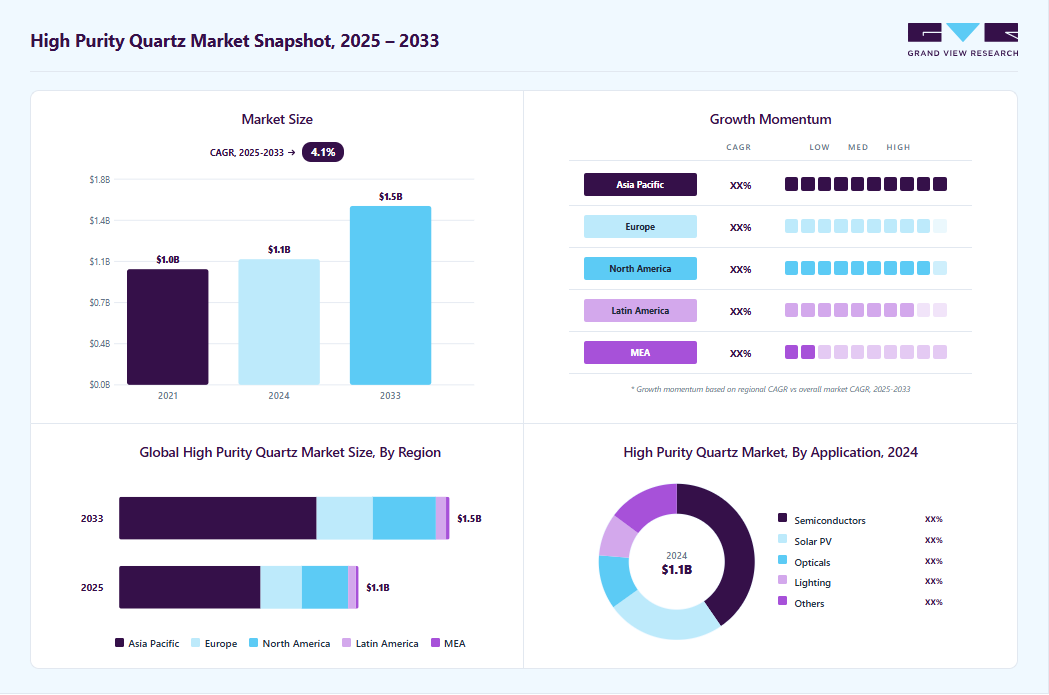 Source: Grand View Research, IR Documents, Primary Interviews, Paid DatabasesTo learn more about this report,
 Download Free Sample Report
Key Market Trends & Insights
- By grade: 4n8 segment held the largest market share of 38.5% in 2025.
- By application: Semiconductors segment held the largest market share of 40.5% in 2025.
Regional Highlights
- Largest regional market: Asia Pacific (59.0% revenue share, 2025)
- By country: China held the largest market share in 2025
Market Size & Forecast
- Market size in 2025: USD 1.1 Billion
- Estimated market size in 2026: USD 1.2 Billion
- Projected market size by 2033: USD 1.5 Billion
- CAGR (2026-2033): 4.2%
Prism AI by Grand View Research Free to tryAsk a question about the high purity quartz marketTry asking✓Every figure cited from GVR research Prefer the report? Download free sample →Semiconductor fabrication involves ultra-clean and high-temperature processes that rely heavily on quartz components such as crucibles, tubes, and boats used in wafer production. With the global surge in chip consumption across devices, electric vehicles, and data centers, manufacturers are establishing new fabrication plants and upgrading existing ones. The continuous advancement toward smaller node sizes and higher transistor densities has raised the requirement for materials with exceptional purity, as even minute contaminants can compromise chip yields. As a result, the expansion of integrated circuit manufacturing in countries such as China, South Korea, Japan, and the U.S. has created a robust and sustained demand for electronic-grade quartz.
The solar photovoltaic industry represents another major contributor to market growth. The transition to renewable energy has accelerated the installation of solar panels worldwide, thereby increasing the demand for high-purity quartz in the production of silicon ingots and wafers. Quartz crucibles play a vital role in maintaining the purity of molten silicon during crystal pulling processes, ensuring high efficiency and performance in solar cells. Government incentives, net-zero emission goals, and declining production costs have encouraged the rapid adoption of solar technology in both residential and industrial sectors. As solar energy capacity expands globally, manufacturers of quartz components are scaling up production to meet the higher consumption from photovoltaic cell and module producers.
 To learn more about this report, Download Free Sample Report
High purity quartz is also gaining importance in optical and lighting applications. Its high transmission, low thermal expansion, and superior resistance to chemical corrosion make it essential in the manufacture of lenses, prisms, fiber optics, and ultraviolet lamps. With growing applications in advanced imaging systems, autonomous vehicle sensors, and high-speed communication networks, the demand for optical-grade quartz continues to strengthen. The expansion of the telecom sector and ongoing investments in fiber optic infrastructure across North America, Europe, and Asia are key factors sustaining the upward trajectory of this segment. Moreover, the rise of precision optics in healthcare and defense sectors is contributing to a stable long-term demand.
Technological innovation and tighter quality standards are amplifying the market’s growth potential. Manufacturers are investing in advanced purification techniques, automated sorting systems, and contamination-free processing to meet the evolving demands of industries like semiconductors, optics, and solar. The continuous improvement in analytical and quality control technologies enables producers to deliver quartz products with impurity levels as low as parts per billion. In addition, the rise of precision-driven industries and R&D activities is increasing the demand for ultra-high-purity materials. As the Asia Pacific emerges as the dominant manufacturing hub, supported by strong government policies and industrial expansion, the global high-purity quartz market is poised for sustained growth over the coming decade.
Market Dynamics
The high purity quartz (HPQ) market is driven by rising demand from the semiconductor, solar photovoltaic, and advanced electronics industries, where ultra-high-purity materials are essential for manufacturing precision components. Increasing investments in semiconductor fabrication facilities and renewable energy projects are supporting long-term market growth. However, the market faces challenges such as limited availability of high-grade quartz deposits, complex purification processes, and supply chain constraints, which can impact production costs and availability. Ongoing technological advancements in quartz processing, coupled with expanding applications in optical, telecommunications, and specialty lighting industries, are creating new opportunities for market expansion.
The rapid expansion of the solar PV industry is a primary driver of the high purity quartz market. HPQ is an essential raw material for manufacturing quartz crucibles used in the production of high-purity silicon ingots and wafers for solar cells. As countries accelerate renewable energy deployment to meet decarbonization targets and strengthen energy security, investments in solar manufacturing and installation continue to grow. This has significantly increased demand for ultra-high-purity quartz, particularly for next-generation high-efficiency solar technologies that require superior material purity and thermal stability.
In 2025, global solar PV installations surpassed 600 GW of new capacity for the first time, while cumulative installed solar capacity reached approximately 2.8 TW, reflecting continued expansion of the solar manufacturing value chain. Solar PV accounted for more than 75% of all new renewable power capacity additions during the year, prompting manufacturers to expand polysilicon, ingot, and wafer production capacities. This surge in solar manufacturing has significantly increased demand for high-purity quartz crucibles used in silicon crystal growth, reinforcing solar PV expansion as a key growth driver for the HPQ market.
The limited availability of high-grade quartz deposits is the primary restraint for the HPQ market. Only a very small fraction of global quartz resources possesses the exceptionally low impurity levels required for semiconductor, solar photovoltaic, and advanced optical applications. The scarcity of suitable deposits, combined with the complex and capital-intensive purification process, restricts raw material supply, increases production costs, and creates supply chain vulnerabilities. As demand from high-tech industries continues to rise, the imbalance between limited premium-grade quartz resources and growing consumption remains a key challenge for market expansion. Less than 1% of global quartz reserves meet the ultra-high-purity requirements for semiconductor and solar applications.
The rapid expansion of advanced semiconductor manufacturing presents a significant growth opportunity for the HPQ market. Increasing investments in AI, high-performance computing, and next-generation chips are driving the construction of new semiconductor manufacturing facilities, boosting demand for HPQ-based quartz crucibles, diffusion tubes, and wafer-processing components. As manufacturers transition to advanced process nodes, the requirement for ultra-high-purity quartz is expected to increase due to stricter contamination control standards. In 2025, Taiwan Semiconductor Manufacturing Company announced plans to invest an additional US$100 billion in U.S. semiconductor manufacturing, expanding advanced chip production capacity and creating long-term demand for high-purity quartz components used in wafer fabrication.
Analyst Perspective
The high purity quartz (HPQ) market is expected to witness strong growth, driven by rising investments in semiconductor manufacturing, solar photovoltaic production, advanced electronics, and optical technologies. Demand is anticipated to remain robust as countries expand domestic chip manufacturing and renewable energy capacity, despite challenges related to the limited availability of premium-grade quartz deposits and complex purification processes. Manufacturers are increasingly investing in resource development, advanced beneficiation technologies, and capacity expansions to produce ultra-high-purity grades (4N5 and 4N8) that meet the stringent quality requirements of semiconductor and photovoltaic applications.
Grade Insights
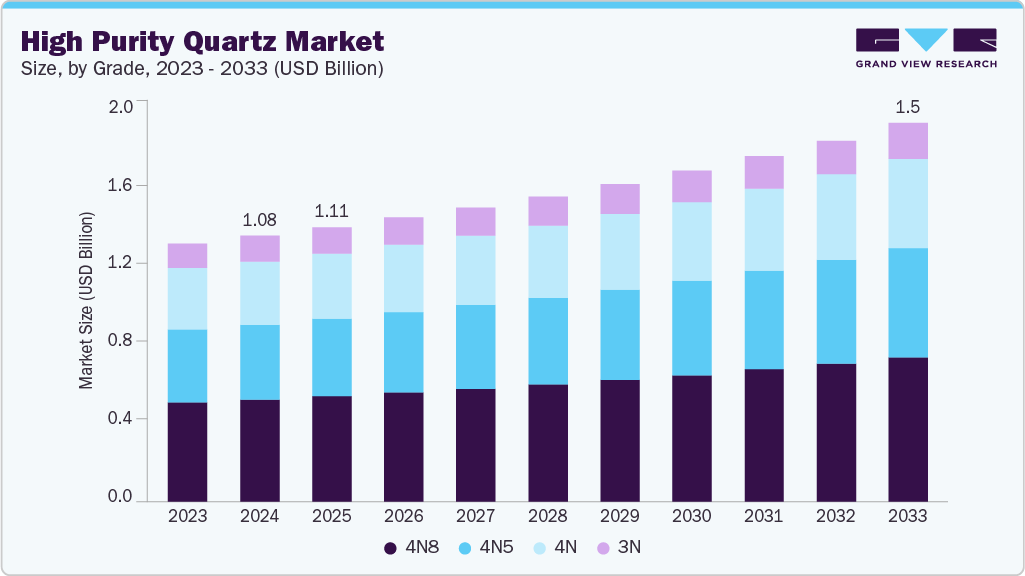
Based on grade, the 4N8 segment led the market with the largest revenue share of 38.5% in 2025. The growth of the 4N8 segment is primarily driven by its critical use in semiconductor manufacturing and advanced electronic applications. This grade, with a purity of around 99.998% SiO₂, meets the stringent standards required in wafer production, crucibles, and photomask substrates, where even trace impurities can disrupt device performance. The transition toward smaller chip geometries and higher frequency components in the electronics sector has intensified demand for 4N8 quartz due to its superior thermal stability and low contamination profile.
The 4N5 grade segment, representing quartz with approximately 99.995% SiO₂ purity, is experiencing steady growth due to its wide acceptance across semiconductor, solar, and specialty glass applications, where extremely high purity is required but cost optimization remains a priority. Semiconductor manufacturers utilize 4N5 quartz in crucibles, quartzware, and diffusion tubes, as it offers excellent thermal resistance and minimal metallic contamination, thereby ensuring process consistency in wafer fabrication. The grade is particularly favored in mid-range integrated circuit production and emerging markets where balancing purity and cost efficiency is crucial.
Application Insights
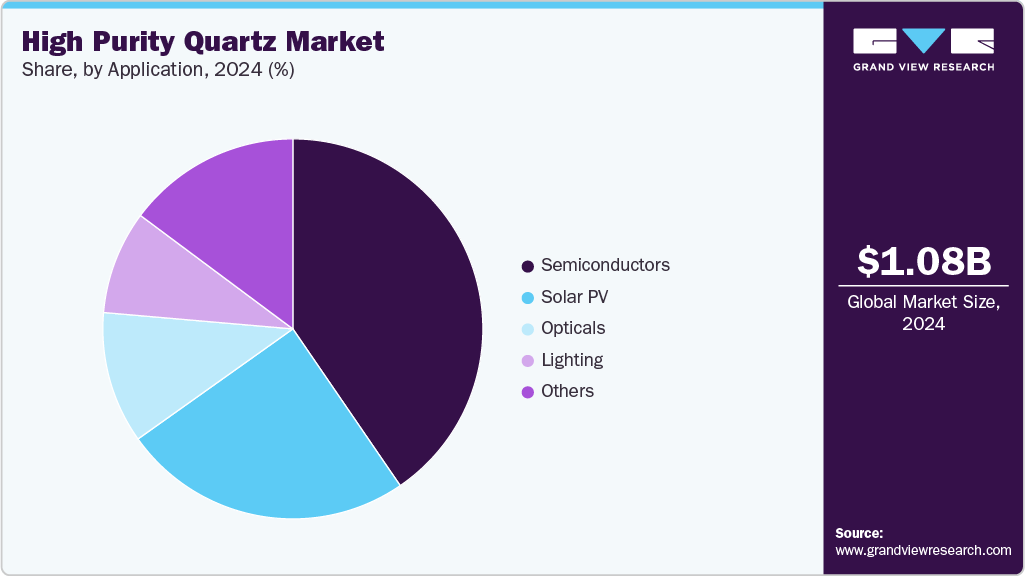
Based on application, the semiconductors segment led the market with the largest revenue share of 40.5% in 2025. The material’s exceptional thermal stability, low coefficient of thermal expansion, and high resistance to chemical corrosion make it indispensable in semiconductor fabrication processes. High purity quartz is used in crucibles, diffusion tubes, and wafer carriers that are critical in producing silicon wafers. As the semiconductor industry advances toward smaller node technologies and higher wafer throughput, contamination control has become increasingly important, boosting demand for quartz with purity levels exceeding 4N.
 To learn more about this report, Download Free Sample Report
The solar PV segment represents one of the fastest-growing application areas for the high purity quartz market, driven by the global transition toward renewable energy and the rapid expansion of photovoltaic manufacturing capacity. High purity quartz is a vital raw material for producing crucibles and other components used in the growth of high-quality polysilicon ingots, which are then sliced into wafers for solar cells.
Regional Insights
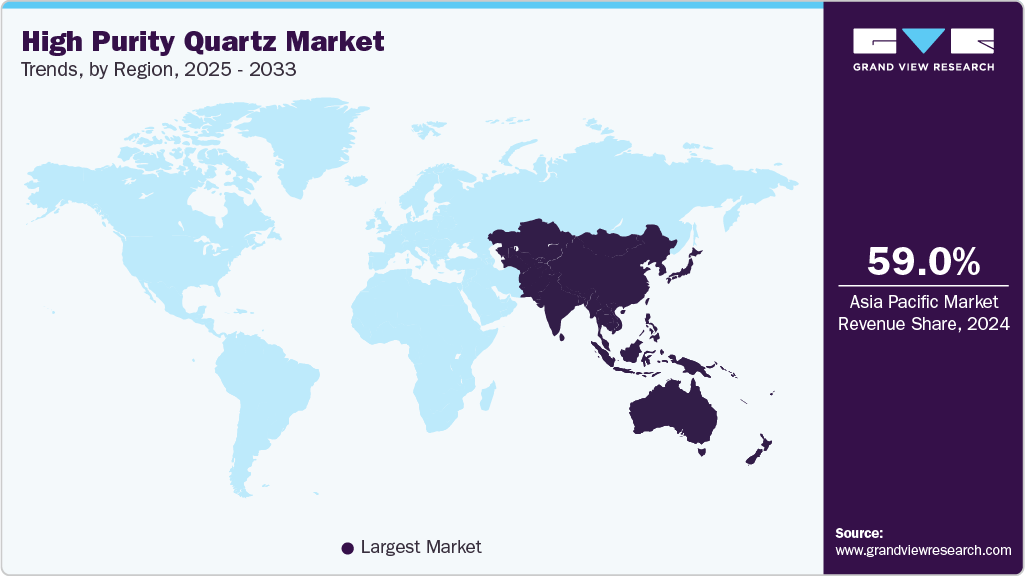
The Asia Pacific region dominated the high purity quartz market with a revenue share of 59.0% in 2025. Asia Pacific high purity quartz market growth is strongly driven by the rapid expansion of semiconductor manufacturing across China, South Korea, Japan, Taiwan, and India. The region has become a key hub for wafer fabrication, integrated circuit production, and other microelectronic processes that rely on ultra-pure materials.
 To learn more about this report, Download Free Sample Report
High purity quartz is essential for producing crucibles, tubes, and other components used in semiconductor furnaces and deposition systems, where even minor contamination can affect yield and performance. Increasing government support for domestic chip production, along with the establishment of new fabrication plants, is intensifying demand for high-grade quartz raw materials and refined products.
China High Purity Quartz Market Trends
The high purity quartz market in China held the largest share in the Asia Pacific region in 2025. China’s high-purity quartz market is supported by growing demand from semiconductor, solar PV, optics, and electronics applications. Increasing domestic semiconductor manufacturing and efforts to localize critical raw-material supply are encouraging investment in domestic high-purity quartz resources and processing capabilities. China is also developing newly identified deposits in Henan and Xinjiang, while domestic producers are advancing qualification for semiconductor-grade applications.
North America High Purity Quartz Market Trends
The high purity quartz market in North America is witnessing strong growth due to the resurgence of semiconductor manufacturing and the localization of critical supply chains. The United States and Canada are investing heavily in new chip fabrication plants and materials processing facilities to reduce dependence on imports. High purity quartz plays a vital role in producing silicon wafers, crucibles, and other heat-resistant equipment used in chip production. The increasing focus on advanced technologies such as 5G, electric vehicles, and artificial intelligence has fueled demand for high-performance semiconductors, further strengthening the need for premium-grade quartz materials with minimal impurities.
U.S. High Purity Quartz Market Trends
In the U.S., the high purity quartz market is expanding rapidly, driven by the revival of domestic semiconductor production and the nation’s push for technological independence. The construction of advanced chip fabrication facilities by major players such as Intel, TSMC, and Samsung in states like Arizona, Texas, and Ohio has led to an upsurge in demand for ultra-pure quartz components used in wafer processing, diffusion, and crystal growth. Government initiatives, such as the CHIPS and Science Act, are further accelerating investment in local manufacturing, thereby boosting the consumption of high-purity quartz for crucibles, tubes, and other semiconductor-grade materials.
Europe High Purity Quartz Market Trends
The high purity quartz market in Europe is expanding steadily, supported by the region’s strong semiconductor, solar, and optical industries. European nations such as Germany, France, and the Netherlands are investing in new semiconductor fabs and advanced material processing units to strengthen their technological independence.
Latin America High Purity Quartz Market Trends
The high purity quartz market in Latin America is gaining traction with the region’s expanding solar energy sector and growing interest in advanced materials manufacturing. Countries such as Brazil, Chile, and Mexico are increasing investments in renewable energy infrastructure, creating a solid base for quartz demand in solar photovoltaic production.
Middle East & Africa High Purity Quartz Market Trends
The high purity quartz market in the Middle East and Africa is expanding due to rapid industrialization, growing solar energy initiatives, and rising investments in semiconductor-related infrastructure. The Gulf countries, particularly the United Arab Emirates, Saudi Arabia, and Qatar, are promoting renewable energy and advanced material industries as part of their economic diversification strategies.
Key High Purity Quartz Company Insights
Some of the key players operating in the market include American Isostatic Presses, Inc., Bodycote, and others
-
Australian Silica Quartz Group Ltd is an Australian-based exploration and development company specializing in high-grade silica sand and hard rock quartz resources. Headquartered in Western Australia, the company focuses on identifying and developing deposits with high silica purity suitable for advanced industrial applications. In high purity quartz, ASQ is actively developing projects such as Gingin and Quartz Hill that target ultra-high silica concentrations exceeding 99.95% SiO₂. The company’s products are designed for use in semiconductor manufacturing, solar-grade silicon production, precision optics, and specialty glass applications.
-
Creswick Quartz Pty Ltd is an Australian company based in Victoria, specializing in the supply of premium-grade quartz and silica products. It specializes in mining, processing, and refining quartz materials used across industrial and high-technology applications. In the high purity quartz segment, Creswick Quartz offers hard rock quartz and ultrahigh-grade silica materials designed for specialized applications including semiconductors, photovoltaic cells, and optical components.
Key High Purity Quartz Companies:
The following key companies have been profiled for this study on the high purity quartz market.
-
Australian Silica Quartz Group Ltd
-
Creswick Quartz Pty Ltd
-
HPQ Materials
-
Imerys
-
Jiangsu Pacific Quartz Co., Ltd
-
Momentive Technologies
-
Nordic Mining ASA
-
Russian Quartz LLC
-
Sibelco
-
The Quartz Corporation
Competitive Benchmarking
Category
Operating Strategies
Competitive Edge
Weakness
Established Players (Sibelco, The Quartz Corporation, Momentive Technologies, Jiangsu Pacific Quartz Co., Ltd., Imerys S.A.)
- Secure long-term supply agreements with semiconductor and solar PV manufacturers.
- Invest in purification technologies and capacity expansions to produce ultra-high-purity grades (4N5–4N8).
- Pursue vertical integration from mining to processing and global distribution.
- Expand geographically through strategic partnerships, acquisitions, and new processing facilities.
- Access to premium-quality quartz deposits and advanced purification expertise.
- Strong relationships with leading semiconductor and photovoltaic manufacturers.
- Large-scale production capabilities with consistent product quality and supply reliability.
- Well-established global distribution networks and strong brand reputation.
- Dependence on a limited number of high-grade quartz deposits.
- High capital expenditure and operational costs associated with purification processes.
- Longer timelines for expanding production due to regulatory approvals and resource constraints.
- Exposure to fluctuations in semiconductor and solar industry demand.
Emerging Players (Australian Silica Quartz Group Ltd., Russian Quartz LLC, Nordic Mining ASA, Creswick Quartz, Elcan Industries Inc.)
- Focus on developing new high-purity quartz deposits and exploration projects.
- Invest in pilot-scale purification technologies and processing capabilities.
- Target niche applications and regional customers to establish market presence.
- Form partnerships or supply agreements with technology providers and downstream manufacturers.
- Flexibility to adopt newer extraction and purification technologies.
- Opportunity to develop untapped quartz resources and diversify global supply.
- Lower legacy infrastructure enables quicker adoption of process innovations.
- Ability to address growing regional demand with localized production.
- Limited commercial production capacity and customer base.
- Lower brand recognition and fewer long-term supply contracts.
- Dependence on external funding for project development and expansion.
- Technical challenges in consistently achieving semiconductor-grade purity levels.
Recent Development
- In April 2025, China announced the discovery of a major high-purity quartz deposit in Jiangxi Province, attracting global attention due to its strategic importance in advanced manufacturing sectors. The deposit, located in Yixi Village, Xingan County, contains quartz with a silicon dioxide content exceeding 99.9 percent, positioning it among the world’s top reserves and offering significant potential for supporting the semiconductor, photonics, and solar industries.
High Purity Quartz Market Report Scope
Report Attribute
Details
Market Definition
The market size represents the total revenue generated globally from the sale of high purity quartz (HPQ) products within a specific year.
Market size in 2025
USD 1.1 billion
Estimated market size in 2026
USD 1.2 billion
Projected market size by 2033
USD 1.5 billion
Growth rate
CAGR of 4.2% from 2026 to 2033
Base year for estimation
2025
Historical data
2021 - 2024
Forecast period
2026 - 2033
Quantitative units
Revenue in USD Billion, Volume in Kilotons, and CAGR from 2026 to 2033
Report coverage
Revenue forecast, volume forecast, company ranking, competitive landscape, growth factors, and trends
Segments covered
Grade, application, region
Regional scope
North America, Europe, Asia Pacific, Latin America, Middle East & Africa
Country scope
U.S.; Canada; Mexico; Germany; UK; France; Italy; China; South Korea; Japan; Taiwan; Brazil
Key companies profiled
Sibelco, The Quartz Corporation, Momentive Technologies, Australian Silica Quartz Group Ltd, Jiangsu Pacific Quartz Co., Ltd., Russian Quartz LLC, Nordic Mining ASA, Creswick Quartz, Elcan Industries Inc., Imerys S.A.
Customization scope
Free report customization (equivalent up to 8 analysts' working days) with purchase. Addition or alteration to country, regional & segment scope.
Pricing and purchase options
Avail customized purchase options to meet your exact research needs. Explore purchase options
Global High Purity Quartz Market Report Segmentation
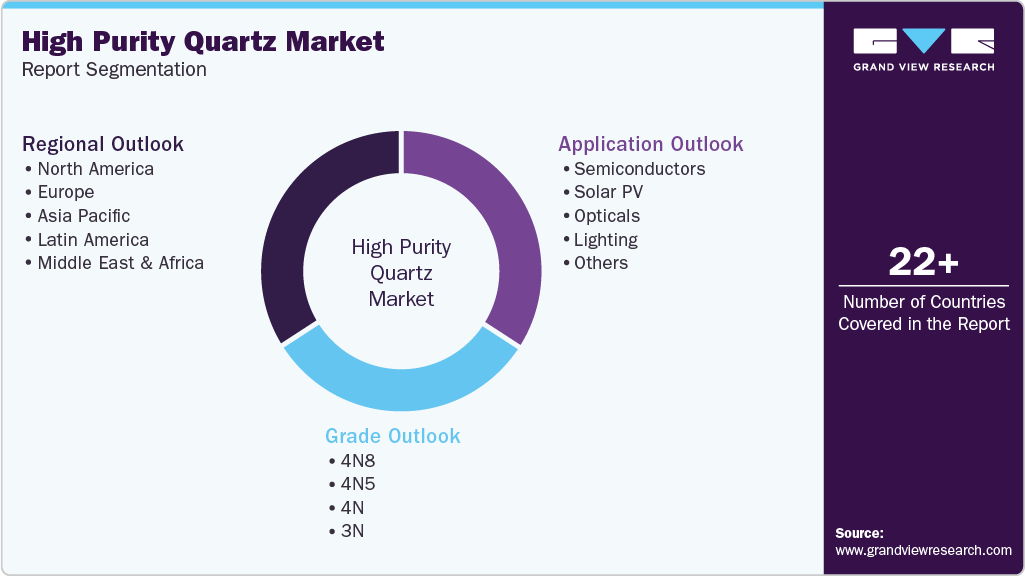
This report forecasts revenue and volume growth at global, regional, and country levels and provides an analysis of the latest industry trends in each of the sub-segments from 2021 to 2033. For this study, Grand View Research has segmented the global high purity quartz market report based on grade, application, and region:
 To learn more about this report, Download Free Sample Report
-
Grade Outlook (Revenue, USD Million; Volume, Kilotons, 2021 - 2033)
-
4N8
-
4N5
-
4N
-
3N
-
-
Application Outlook (Revenue, USD Million; Volume, Kilotons, 2021 - 2033)
-
Semiconductors
-
Solar PV
-
Opticals
-
Lighting
-
Others
-
-
Regional Outlook (Revenue, USD Million; Volume, Kilotons, 2021 - 2033)
-
North America
-
U.S.
-
Canada
-
Mexico
-
-
Europe
-
Germany
-
UK
-
France
-
-
Asia Pacific
-
China
-
India
-
Japan
-
-
Latin America
-
Brazil
-
-
Middle East & Africa
-
Research Methodology
The high purity quartz market figures in this report are based on a proven research process that combines executive interviews with secondary research from proprietary databases, company filings, and recognized regulatory and institutional sources. Market size is built through value-chain sizing - reconciling supply-side and demand-side estimates - and triangulated with bottom-up and top-down approaches. Every estimate passes multiple levels of expert validation before publication, with each high purity quartzsegment quantified using the revenue-capture definitions in the table below.
Segment Definition
Grade
Revenue capture definition
4N8
High purity quartz with a minimum purity of 99.998% is primarily used in advanced semiconductor manufacturing, high-end optical components, and other ultra-high-purity applications requiring extremely low impurity levels. Revenue is generated from the sales of 4N8 high purity quartz across these applications.
4N5
High purity quartz with a minimum purity of 99.995% is widely used in semiconductor processing equipment, solar photovoltaic manufacturing, and precision optical applications where high material purity is essential. Revenue is generated from the sales of 4N5 high purity quartz for these end-use industries.
4N
High purity quartz with a minimum purity of 99.99% is used in solar photovoltaic production, specialty lighting, engineered quartz products, and industrial applications requiring high thermal and chemical stability. Revenue is generated from the sales of 4N high purity quartz across these applications.
3N
High purity quartz with a minimum purity of 99.9% is mainly used in specialty glass, refractories, ceramics, fillers, and other industrial applications with moderate purity requirements. Revenue is generated from the sales of 3N high purity quartz for these applications.
Application
Revenue capture definition
Semiconductors
High purity quartz is used in quartz crucibles, diffusion tubes, wafer carriers, process chambers, and other components required for semiconductor wafer fabrication. Revenue is generated from the sales of high purity quartz used in semiconductor manufacturing applications.
Solar PV
High purity quartz is used in quartz crucibles and other components for the production of polysilicon, silicon ingots, and wafers used in solar photovoltaic cells and modules. Revenue is generated from the sales of high purity quartz used in solar photovoltaic manufacturing.
Opticals
High purity quartz is used in optical fibers, precision lenses, optical windows, laser components, and other high-performance optical products requiring exceptional transparency and purity. Revenue is generated from the sales of high purity quartz used in optical applications.
Lighting
High purity quartz is used in quartz glass tubes, envelopes, and components for UV lamps, halogen lamps, HID lamps, and specialty lighting products that require high thermal resistance. Revenue is generated from the sales of high purity quartz used in lighting applications.
Others
High purity quartz is used in laboratory equipment, specialty glass, telecommunications, electronics, aerospace, chemical processing, and other industrial applications requiring high-purity silica materials. Revenue is generated from the sales of high purity quartz used across these other applications.
Estimation Model
Layer Name
Key Question
Description
Demand Generation Layer
What forms the demand base for high purity quartz?
Assess demand for high purity quartz driven by semiconductor manufacturing, solar photovoltaic production, optical component manufacturing, specialty lighting, and other advanced industrial applications. Evaluate investments in semiconductor fabrication facilities, solar manufacturing capacity, electronics production, renewable energy deployment, and technological advancements to determine the underlying market demand.
Purity Grade Layer
Which purity grades are being consumed?
Analyze the consumption of high purity quartz across purity grades (3N, 4N, 4N5, and 4N8). Assess application-specific purity requirements, contamination tolerance, processing complexity, and performance characteristics to determine grade-wise market demand.
Application Layer
Which applications consume high purity quartz?
Evaluate the consumption of high purity quartz across semiconductors, solar PV, opticals, lighting, and other applications. Analyze production volumes, manufacturing capacity expansions, technology adoption, and material intensity to estimate application-wise market contribution.
Revenue Estimation Layer
How is market revenue estimated?
Market revenue is estimated by evaluating the sales volume of high purity quartz across different purity grades and application segments. The overall market value is determined using regional production, imports, exports, inventory adjustments, end-use consumption, and the average selling price (ASP) of high purity quartz by grade and application across key regions.
Delivered Customizations
This report has been delivered with the following In-depth customizations
Client Request
Customization Delivered
Value Adds
Purity Grade-wise Analysis
Analyzed the high purity quartz market across 3N, 4N, 4N5, and 4N8 grades by evaluating market size, demand patterns, pricing trends, key applications, purity requirements, and growth potential. Assessed grade-wise adoption across semiconductor, solar PV, optical, lighting, and other end-use industries.
Helped identify high-growth purity grades, understand application-specific demand, optimize product portfolios, and prioritize investments in high-value market segments.
Competitive Benchmarking
Profiled prominent high purity quartz manufacturers based on production capacity, purity grades offered, geographic presence, processing capabilities, strategic initiatives, customer focus, and recent developments. Assessed the competitive positioning of established and emerging market participants.
Helped benchmark key competitors, identify technology and capacity gaps, evaluate competitive strengths, and support strategic planning, partnerships, and expansion decisions.
Regional High Purity Quartz Market Assessment
Conducted a detailed regional assessment of the high purity quartz market by evaluating resource availability, demand from semiconductor and solar PV industries, trade flows, pricing trends, regulatory landscape, and growth outlook across major regions.
Helped identify high-growth regional markets, understand supply-demand dynamics, assess raw material availability, and support regional expansion, sourcing, and investment strategies.
Frequently Asked Questions About This Report
The global high purity quartz market size was valued at USD 1.1 billion in 2025 and is estimated at USD 1.2 billion for 2026.
The key factor driving the growth of the global high purity quartz market is the increasing demand from the semiconductor and solar industries for materials with exceptional purity and thermal stability.
The global high purity quartz market is expected to grow at a CAGR of 4.2% from 2026 to 2033, reaching USD 1.5 billion by 2033.
Based on grade, the 4N8 segment led the market with the largest revenue share of 38.5% in 2025.
The Asia Pacific region dominated the high purity quartz market with a revenue share of 59.0% in 2025.
China dominated the Asia Pacific region market with a revenue share of 42.5% in 2025.
Europe is anticipated to register the second-fastest CAGR of 4.1% over the forecast period.
Based on application, the semiconductors segment led the market with the largest revenue share of 40.5% in 2025.
The key players operating in the high purity quartz market are Sibelco, The Quartz Corporation, Momentive Technologies, Australian Silica Quartz Group Ltd., Jiangsu Pacific Quartz Co., Ltd., Russian Quartz LLC, Nordic Mining ASA, Creswick Quartz, Elcan Industries Inc., Imerys S.A., and others.
About the Author(s)
Advanced Interior Materials Research Team
Advanced Materials · Advanced Interior MaterialsThis report was authored by the advanced interior materials research team at Grand View Research - comprising two research analysts, one senior research analyst, and one industry expert - with specialized expertise in the advanced interior materials segment of the advanced materials industry. All findings are based on proprietary advanced materials databases, executive interviews, and regulatory analysis, subject to internal peer review prior to publication.
Last Updated:
Speak to Analyst

Customize this report to your needs - add regions, segments, or data points, with 20% free customization.
Or view our licence options:


ISO 9001:2015 & 27001:2022 Certified
We are GDPR and CCPA compliant! Your transaction & personal information is safe and secure. For more details, please read our privacy policy.


