Indonesia Personal Protective Equipment Market Summary
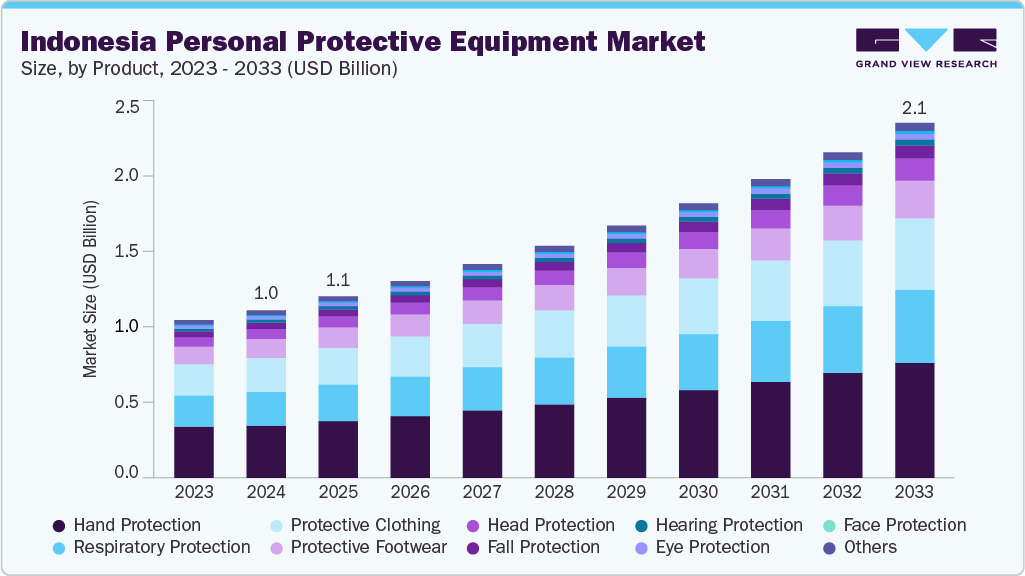
The Indonesia personal protective equipment market size was estimated at USD 1,009.0 million in 2024 and is projected to reach USD 2,137.9 million by 2033, growing at a CAGR of 8.7% from 2025 to 2033. The market is expected to grow due to rising workplace safety awareness, stricter government regulations, and expanding industrial activities.
Key Market Trends & Insights
- By product, head protection segment is expected to grow at a considerable CAGR of 9.4% from 2025 to 2033 in terms of revenue.
- By end use, healthcare segment is expected to grow at a considerable CAGR of 12.0% from 2025 to 2033 in terms of revenue.
Market Size & Forecast
- 2024 Market Size: USD 1,009.0 Million
- 2033 Projected Market Size: USD 2,137.9 Million
- CAGR (2025-2033): 8.7%
Manufacturing, construction, mining, and healthcare sectors are increasingly prioritizing worker protection, driving higher demand for products such as helmets, gloves, masks, protective clothing, and safety footwear. The country’s ongoing infrastructure development projects also require extensive personal protective equipment (PPE) usage, further boosting consumption.
In addition, post-pandemic habits have sustained demand for medical and hygiene-related PPE. Local production capacity is improving as manufacturers invest in better technology and quality standards, reducing reliance on imports. Together, these factors support consistent market expansion over the next several years.
Market Concentration & Characteristics
Indonesia’s PPE market is moderately fragmented with a wide mix of local manufacturers, regional suppliers, and international brands. Local firms typically specialize in basic PPE such as masks, gloves, and safety helmets, while global companies focus on premium products like advanced respiratory protection and high-grade protective clothing. Many small and mid-sized distributors compete on price, creating a highly competitive environment.
Innovation in Indonesia’s PPE market is moderate, driven mainly by rising safety standards and growing demand for higher-quality products. Manufacturers are gradually adopting better materials, ergonomic designs, and improved filtration technologies, especially in respiratory and medical PPE. However, most innovation is incremental rather than breakthrough, as many local producers still focus on cost-effective, basic protection. International brands introduce advanced features, which encourage local companies to upgrade their offerings and remain competitive.
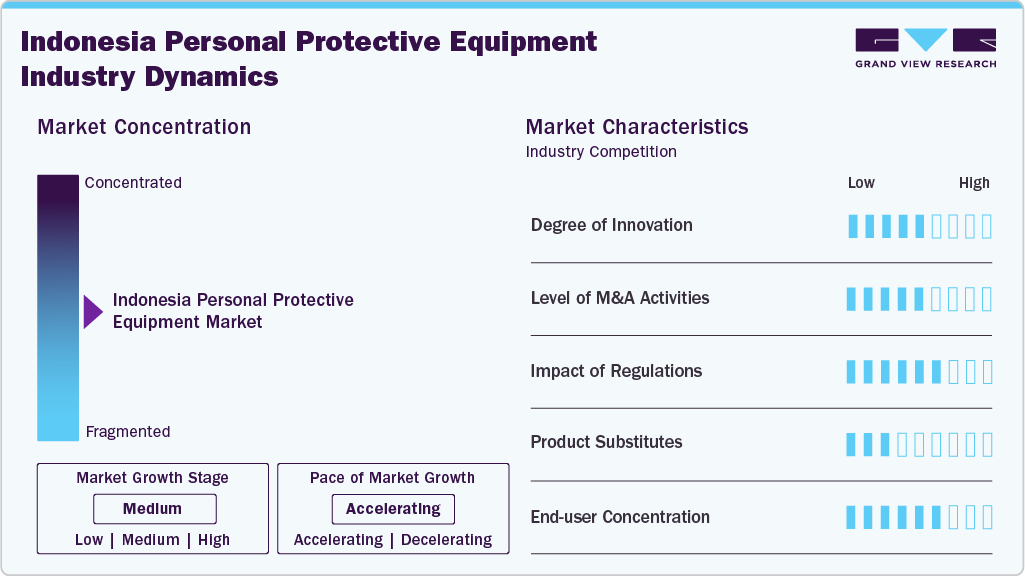
M&A activity in the market is gradually increasing as companies seek scale, stronger distribution networks, and improved manufacturing capabilities. Local firms are exploring strategic partnerships with regional players to access new technologies and expand product portfolios. International companies occasionally acquire or collaborate with Indonesian producers to strengthen their presence in Southeast Asia.
Regulations significantly influence Indonesia’s PPE market by enforcing stricter workplace safety standards and certification requirements. Government bodies mandate compliance with SNI standards and sector-specific guidelines, pushing companies to improve product quality and reliability. Stricter enforcement in construction, manufacturing, and mining sectors increases demand for certified PPE. Post-pandemic policies also maintain higher hygiene and medical PPE standards. These regulations collectively raise market entry barriers and encourage manufacturers to adopt better materials, testing processes, and safety designs.
Drivers, Opportunities & Restraints
Rapid expansion of industrial and infrastructure projects, which increases the need for reliable worker protection, is significantly driving the market in Indonesia. Construction, mining, manufacturing, and oil and gas sectors must comply with stricter safety regulations, boosting demand for certified helmets, gloves, footwear, and respiratory equipment. Growing awareness of occupational health risks further strengthens market growth as companies invest more in high-quality PPE to reduce accidents and improve workplace safety standards.
Rising demand for higher-quality, technologically advanced PPE, especially in respiratory protection and medical-grade equipment, is significantly creating opportunities. As industries modernize and adopt global safety standards, there is increasing space for companies offering innovative, durable, and comfortable products. Local manufacturers that upgrade production capabilities or collaborate with international players can capture new segments. In addition, Indonesia’s growing export potential for certain PPE items presents further expansion opportunities for competitive domestic producers.
One major challenge in the Indonesia personal protective equipment industry is the prevalence of low-cost, low-quality PPE that floods the market and undermines compliance efforts. Many small manufacturers focus on inexpensive production, making it difficult for certified, high-quality suppliers to compete on price. Inconsistent enforcement of safety regulations also allows substandard products to circulate. This reduces trust, limits innovation, and pressures companies to cut costs instead of improving materials and designs, ultimately hindering overall market development and quality improvement.
Product Insights
Hand protection dominated the market in 2024, accounting for the highest revenue share at 31.1% due to rising industrial activities in manufacturing, construction, mining, and automotive sectors, where hand injuries remain among the most common workplace incidents. Increasing enforcement of safety regulations and greater employer focus on reducing accidents are driving demand for cut-resistant, chemical-resistant, and heat-resistant gloves. Growth in food processing and healthcare also supports consistent consumption.
The head protection segment is projected to expand as Indonesia continues large-scale infrastructure development and strengthens safety compliance across construction, mining, and heavy engineering industries. Mandatory use of certified helmets and stricter monitoring by authorities are major growth catalysts. Companies are increasingly adopting durable, lightweight, and ergonomically improved helmets to enhance worker comfort and reduce injury risks.
End Use Insights
The manufacturing segment dominated the market in 2024, holding the largest revenue share at 19.0% as factories expand operations and adopt stricter safety standards. Rising production activities in electronics, automotive, textiles, and food processing are increasing the need for gloves, safety footwear, helmets, and protective clothing. Regulators are enforcing compliance more consistently, pushing manufacturers to upgrade worker protection. In addition, foreign investments in industrial facilities drive demand for higher-quality, certified PPE.
The healthcare segment is projected to see sustained PPE demand due to continuous improvements in infection control practices and higher safety awareness among hospitals and clinics. Gloves, masks, gowns, and face shields remain essential for both routine care and emergency preparedness. Post-pandemic policies have strengthened hygiene standards, requiring consistent PPE usage. Growth in private healthcare facilities, telemedicine-supporting laboratories, and medical tourism also boosts consumption. As Indonesia invests more in healthcare infrastructure and workforce protection, demand for reliable, medical-grade PPE is expected to increase steadily.
Key Indonesia Personal Protective Equipment Company Insights
Some of the key players operating in the market include 3M, Lakeland Inc., and Ansell Ltd.
-
3M is a global technology and manufacturing company known for its extensive PPE portfolio, including respiratory protection, hearing protection, protective eyewear, and safety apparel. With a strong focus on innovation and quality, 3M serves industries such as construction, healthcare, manufacturing, and mining, providing reliable solutions that meet international safety standards. Its global presence supports widespread distribution and customer trust.
-
Lakeland Inc. is a company engaged in the production of protective clothing and accessories, serving industries such as biotechnology, chemical manufacturing, construction, healthcare, and pharmaceuticals. Its well-known brands include ChemMax, Arc X Rainwear, Lakeland FR, and SafeGard, offering products such as disposable wear, flame-resistant gear, and arc flash clothing. The company has a strong presence across North America, Europe, Asia Pacific, and the Middle East.
Key Indonesia Personal Protective Equipment Companies:
- 3M
- Durasafe. Ltd.
- DuPont de Nemours
- Ansell Ltd.
- MSA Safety Inc.
- Lakeland Industries
- Delta Plus Group
- PT. Maesindo Indonesia
- PT. Yutaka Asia Indonesia
- PIP
Recent Developments
-
In September 2025, MSA Safety Indonesia introduced two new PPE solutions at the 2025 National Safety Congress: the V-Gard H2 Full Brim Safety Helmet and the ALTAIR io 6 Multigas Detector. These innovations aim to enhance worker safety by providing advanced head protection and real-time gas detection, reflecting MSA’s commitment to developing high-quality, reliable safety equipment for industrial and construction environments.
-
In May 2025, Honeywell finalized the sale of its Personal Protective Equipment (PPE) business to 3M. (PIP) for USD 1.325 billion. PIP, backed by Odyssey Investment Partners, is a global PPE manufacturer and supplier. The sale allows Honeywell to streamline operations while expanding PIP’s global footprint and product portfolio.
Indonesia Personal Protective Equipment Market Report Scope
|
Report Attribute
|
Details
|
|
Market size value in 2025
|
USD 1,092.9 million
|
|
Revenue forecast in 2033
|
USD 2,137.9 million
|
|
Growth Rate
|
CAGR of 8.7% from 2025 to 2033
|
|
Historical data
|
2021 - 2023
|
|
Forecast period
|
2025 - 2033
|
|
Quantitative units
|
Revenue in USD million/billion and CAGR from 2025 to 2033
|
|
Report coverage
|
Revenue forecast, company ranking, competitive landscape, growth factors, and trends
|
|
Segments covered
|
Product, end use
|
|
Key companies profiled
|
3M.; Durasafe. Ltd.; DuPont de Nemours; Ansell Ltd.; MSA Safety Inc.; Lakeland Industries; Delta Plus Group; PT. Maesindo Indonesia; PT. Yutaka Asia Indonesia; PIP
|
|
Customization scope
|
Free report customization (equivalent up to 8 analysts working days) with purchase. Addition or alteration to country, regional & segment scope.
|
|
Pricing and purchase options
|
Avail customized purchase options to meet your exact research needs. Explore purchase options
|
Indonesia Personal Protective Equipment Market Report Segmentation
This report forecasts revenue growth at global, regional, and country levels and provides an analysis of the latest industry trends in each of the sub-segments from 2021 to 2033. For this study, Grand View Research has segmented the Indonesia personal protective equipment market report based on product and end use:
-
Product Outlook (Revenue, USD Million, 2021 - 2033)
-
Head Protection
-
Eye Protection
-
Face Protection
-
Hearing Protection
-
Protective Clothing
-
Respiratory Protection
-
Protective Footwear
-
Fall Protection
-
Hand Protection
-
Others
-
End Use Outlook (Revenue, USD Million, 2021 - 2033)
-
Construction
-
Manufacturing
-
Oil & Gas
-
Chemicals
-
Food
-
Pharmaceuticals
-
Healthcare
-
Transportation
-
Mining
- Others
Frequently Asked Questions About This Report
b. The Indonesia personal protective equipment market size was estimated at USD 1,009.0 million in 2024 and is expected to be USD 1,092.9 million in 2025.
b. The Indonesia personal protective equipment market, in terms of revenue, is expected to grow at a compound annual growth rate of 8.7% from 2025 to 2033 to reach USD 2,137.9 million by 2033.
b. Hand protection segment dominated the market in 2024, accounting for the highest revenue share at 31.1% due to rising industrial activities in manufacturing, construction, mining, and automotive sectors, where hand injuries remain among the most common workplace incidents.
b. Some of the key players operating in the Indonesia personal protective equipment market include 3M, Durasafe. Ltd.., DuPont de Nemours, Ansell Ltd., MSA Safety Inc., Lakeland Industries, Delta Plus Group, PT. Maesindo Indonesia, PT. Yutaka Asia Indonesia, PIP
b. The Indonesia PPE market is driven by stricter safety regulations, rapid industrial and infrastructure growth, rising awareness of worker protection, increasing healthcare demand, technological innovations in protective equipment, and foreign investments in industrial and construction projects, boosting overall PPE adoption.

 Download Sample Report
















