
- Home
- »
- Display Technologies
- »
-
Industrial Display Market Size And Share Report, 2026-2033GVR Report cover
![Industrial Display Market (2026 - 2033)Report]()
Industrial Display Market (2026 - 2033)
Size, Share & Trends Analysis Report By Type (Rugged, Open Frame, Panel-mount, Video Walls), By Application (HMI, Remote Monitoring), By Technology (LCD, LED, OLED, E-paper), By Panel Size, By End-use, By Region, And Segment Forecasts
Market Size, 2025
$6.3BMarket Estimate, 2026
$6.7BMarket Forecast, 2033
$10.6BCAGR, 2026–2033
6.7%Industrial Display Market Summary
The global industrial display market size was valued at USD 6.3 billion in 2025 and is projected to grow from USD 6.7 billion in 2026 to USD 10.6 billion by 2033, at a CAGR of 6.7% from 2026 to 2033. The market in Asia Pacific dominated with a revenue share of 37.1% in 2025. This growth is driven by increasing demand for human-machine interface (HMI) solutions in manufacturing environments. The rising penetration of multi-featured human-machine interface (HMI) devices, increasing adoption of the Industrial Internet of Things (IIoT), and proliferation of smart industrial displays are some of the factors contributing to market growth.

Key Market Trends & Insights
- By type: Panel-mount monitors segment dominated the market, with a revenue share of 30.4% in 2025.
- By application: HMI segment held the largest market share of 33.3% in 2025.
- By technology: LCD segment held the largest market share of 36.9% in 2025.
Regional Highlights
- Largest regional market: Asia Pacific (37.1% revenue share, 2025)
- By country: The China held the largest market share in 2025.
Market Size & Forecast
- Market size in 2025: USD 6.3 Billion
- Estimated market size in 2026: USD 6.7 Billion
- Projected market size by 2033: USD 10.6 Billion
- CAGR (2026-2033): 6.7%
Three ways to get this report
Buy it, customize it, or ask a question.Get the Full Report
What the study covers
- FormatsPDF · Excel · Dashboard
- Timeline2026–2033 annual, 2025 base
- Coverage20+ countries, 5 regions
- Companies10+ key players profiled
Customize the Report
20% free customization
- IncludeCountries, segments, points
- TailorTo your product definition
- ExtendDeeper competitor detail
- OrA fully bespoke study
- Turnaround5–10 working days
Ask Prism AI
A cited answer in seconds
- Corpus30K studies, 1.2M points
- ScopeAll markets, not just this
- CitationTraced to report & table
- HonestySays "not covered" if so
- SpeedSeconds, not days
The industry is gaining prominence on account of innovative features offered by the displays, which include automatic touch detectors and touch screen panels; radio frequency identification (RFID); ethernet connectivity; and resistance to high temperature, shock, vibration, dust, scratch, and chemicals. The industry offers a huge investment opportunity as the displays are a suitable replacement for manual processes and outdated push-button technology.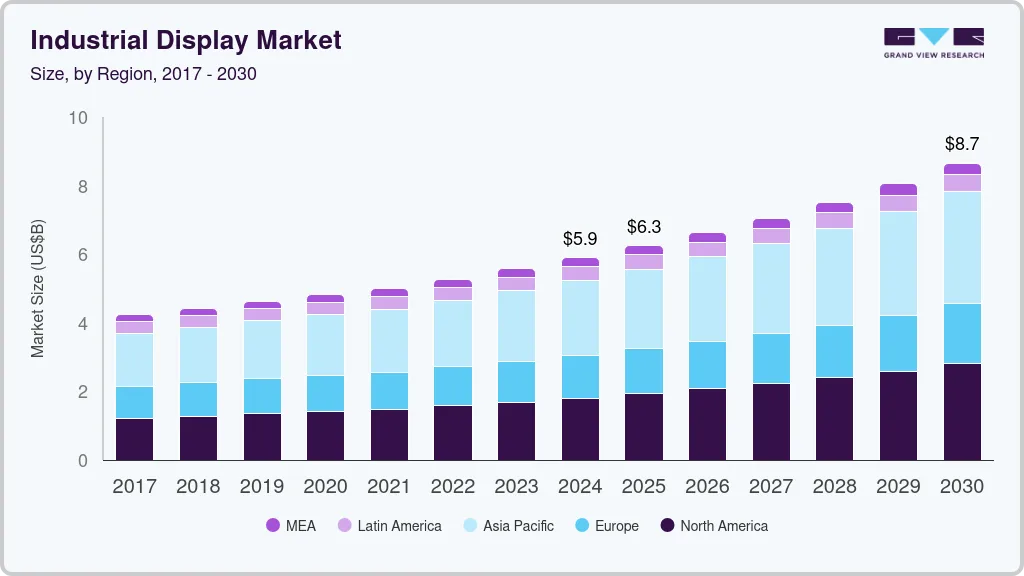
The market has benefited from technological advancements in areas such as the Industrial Internet of Things (IIoT), which has improved the effectiveness of predictive analytics. For instance, displays equipped with IIoT sensors can provide real-time data on machine performance and other critical parameters, allowing operators to make data-driven decisions quickly. This helps identify potential issues and reduce downtime, thereby increasing production efficiency. Manufacturers leverage these capabilities to enhance productivity and remain competitive in the global market. Countries like the U.S. and China have adopted predictive analytics to improve their manufacturing processes on a large scale. This trend is expected to continue with the increasing use of predictive analytics solutions for predictive maintenance, asset management, and remote monitoring in the manufacturing industry.
The industrial sector is constantly evolving and adapting to changing needs, with technological advancements driving this progress. Some of the latest innovations in the industry include Thin-Film-Transistor (TFT), Liquid Crystal Display (LCD), Low-Temperature Poly-Silicon (LTPS), Digital Light Processing (DLP), and Color Filter (CF) technologies. For instance, Samsung introduced ultra-efficient Color E-Paper with near-zero power use and its AI-powered SmartThings Pro platform for smarter device management. It also includes a giant 115” 4K Smart Signage screen, setting new standards in sustainable, intelligent digital displays. The demand for multi-featured HMIs and smart touch screen displays is a key driver for technological advancement and innovation. However, regulations governing the manufacturing and sale of industrial displays can vary regionally or by country.
Market Dynamics
The industrial display market is witnessing steady growth as manufacturing facilities, control rooms, transportation systems, and energy infrastructure increasingly require reliable visualization solutions for mission-critical operations. Demand is particularly strong for ruggedized displays capable of operating under extreme temperatures, vibration, dust, moisture, and continuous-use environments. The ongoing expansion of industrial automation, smart factories, and human-machine interface applications is driving the need for high-performance displays that support real-time monitoring and operational control. Additionally, the modernization of legacy industrial infrastructure and the growing deployment of digital control systems across sectors such as oil & gas, power generation, and logistics are contributing to market expansion.
The expansion of smart factories and Industry 4.0 initiatives is accelerating market growth. Operators increasingly rely on human-machine interfaces, control panels, and monitoring screens to oversee automated production lines and industrial equipment. Rugged displays provide uninterrupted visualization of operational data even in challenging factory environments, ensuring process continuity and minimizing downtime. Their ability to maintain performance under demanding conditions makes them a critical component of modern industrial control systems. The 2025 State of Smart Manufacturing Report indicates that 56% of manufacturers are currently piloting smart manufacturing initiatives, while 20% have already implemented these solutions at scale, and another 20% are planning future investments. Additionally, 38% of organizations intend to utilize data collected from existing operational systems to support product quality monitoring and continuous process improvements, underscoring the growing role of data-driven decision-making in modern manufacturing environments.
The high acquisition cost of specialized industrial-grade display systems is a significant restraint on the industrial display market, particularly for small- and medium-sized industrial operators. Unlike commercial displays, industrial displays are engineered to meet demanding operational requirements, including 24/7 operation, resistance to extreme temperatures, protection against dust and moisture, and long-term reliability. These specialized design requirements substantially increase manufacturing costs, making industrial displays considerably more expensive than standard display solutions.
The growing adoption of autonomous manufacturing systems is creating a significant opportunity for the industrial display market as factories increasingly transition from manually supervised operations to intelligent, self-optimizing production environments. Even in highly automated facilities, industrial displays remain essential for visualizing machine status, production workflows, robotic operations, and system diagnostics. As manufacturers deploy autonomous equipment and robotics at scale, demand is increasing for advanced display solutions that provide real-time operational visibility and control.
Analyst Perspective
The industrial display market is less influenced by consumer display innovation cycles and more dependent on long product lifecycles, reliability requirements, and industry-specific certifications. Competitive differentiation is increasingly centered on durability, customization capabilities, touchscreen performance, and integration with industrial automation ecosystems rather than display resolution alone. As factories become more connected and data-intensive, display manufacturers that can provide application-specific solutions for industrial environments while ensuring long-term product availability and support will be better positioned to secure contracts in sectors where equipment replacement cycles often span several years. The market is expected to benefit from sustained industrial digitalization, but suppliers must balance technological advancement with the stringent reliability expectations of industrial end users.
Type Insights
Based on type, the panel-mount monitors segment led the market with the largest revenue share of 30.4% in 2025. Panel-mount monitors are industrial displays made to be put directly into a control panel or enclosure. They are often manufactured with a rugged shell, bezel, and mounting brackets to survive harsh industrial conditions and offer a secure and sturdy installation. The sizes and resolutions of panel-mount monitors range from tiny displays for embedded systems to large panels for process control applications. They may additionally have touchscreen functionality, high brightness, and several interface options to support numerous industrial applications. Panel-mount monitors are frequently used in manufacturing, automation, and process control applications, where reliable and durable equipment is essential for the best performance and safety. They can also be found in transportation, defense, and aerospace applications where resistance to shock and vibration is essential.
The open frame monitors segment registered a CAGR of 8.1% from 2025 to 2030. Industrial displays without a bezel or casing are known as open-frame monitors. They comprise a metal frame, a display panel, electronics, and interface connectors. This frame is a popular option for industrial and commercial applications that demand flexibility and customization since it can be easily integrated into custom enclosures, kiosks, or other machinery. Widescreen formats are available on open frame displays, which typically have a sleek style and come in various sizes and resolutions. They also feature touchscreen capabilities and great brightness for the best visibility under varied lighting conditions. Gaming machines, self-service kiosks, ATMs, digital signage, and industrial automation equipment are examples of applications where open-frame monitors are frequently employed.
Application Insights
Based on application, the HMI segment led the market with the largest revenue share of 33.3% in 2025. A HMI display is a visual display employed in industrial automation systems to give users and operators real-time information. These displays frequently use cutting-edge technologies such as touchscreens, high-resolution graphics, and ruggedized designs to resist severe industrial conditions. Typically, HMI displays are used to monitor and manage various industrial operations, including production lines, assembly lines, and power generation facilities. They give operators access to real-time data on the condition of the monitored process, including temperature, pressure, flow rate, and other relevant aspects. HMI industrial displays can be used alone or with other industrial automation components like programmable logic controllers (PLC) or supervisory control and data acquisition (SCADA) systems to form a more comprehensive solution. They are designed simple with user-friendly interfaces and legible, easy-to-read visuals and displays.
The interactive display segment is projected to grow significantly over the forecast period. An interactive display lets viewers engage with digital content using touch, gestures, or other input techniques. It typically consists of a display screen, sensors, and software to allow users to interact with or traverse digital content on the screen. Users can engage with digital content on interactive displays by using several input devices, such as touchscreens, styluses, or motion sensors. They might also contain software programs that offer extra features, such as augmented reality applications, virtual whiteboards, and collaborative workplaces. Applications for interactive displays in industrial environments include monitoring and managing assembly lines, production operations, and power generation facilities. They provide operators with real-time information on the status of the monitored process, allowing them to adjust and control the process as needed. Interactive displays in industrial settings typically use touchscreens or other input methods to enable operators to interact with the system. They may also include software applications that provide additional functionality, such as real-time data visualization, remote monitoring, and diagnostic tools.
Technology Insights
Based on technology, the LCD segment led the market with the largest revenue share of 36.9% in 2025. A liquid crystal display (LCD) is a flat panel display that generates images using liquid crystals. LCDs are widely utilized in various industrial applications, such as instrumentation and control panels, medical equipment, automobile displays, and many more. High brightness, a thin profile, and low power consumption are all characteristics of LCDs. They can be used in applications where numerous users must view the display simultaneously because they also have a broad viewing angle. These displays provide more dependability, toughness, and versatility in extreme environments.
The e-paper segment is projected to grow significantly over the forecast period. Electronic paper, often known as an e-ink or an e-paper display, is a display technology that resembles the look of ink on paper. E-readers, electronic shelf labels, and digital signage are just a few examples of industrial applications that frequently use e-paper displays. These displays are renowned for their great contrast, low power usage, and sunlight readability. E-paper displays have several benefits, one of which is their low power consumption, enabling them to run for extended periods on a single battery charge. They are appropriate for applications where battery life and power conservation are important considerations because they also offer a broad viewing angle and can retain an image without electricity. E-paper comes in various sizes and shapes, and it can also be flexible or even translucent, opening up new creative opportunities.
Panel Size Insights
Based on panel size, the 14"-21" segment led the market with the largest revenue share of 33.1% in 2025. This category includes displays with a diagonal screen size between 14 and 21 inches. They are commonly used in industrial applications such as human-machine interfaces, point-of-sale systems, and kiosks. Rising demand for handheld devices, tablets, and touch screens with rugged capabilities has propelled the demand for the 14”-21” segment. Moreover, the 14”-21” panel size is ideal for daily industrial operations and factory applications and generally includes TFT, LCD, or plasma technologies. These displays are designed to protect computers and screens from physical impact, dust, grease, oil, water splashes, metal shavings and filings, and theft.
The 21" - 40" segment is projected to grow significantly over the forecast period. This category includes displays with a diagonal screen size between 21 and 40 inches. They are commonly used in industrial applications such as factory automation, digital signage, and control rooms. The demand for touch screen computer equipment in heavy-duty work environments is expected to propel the 21"-40" segment. The monitors and touch screen panels include anodized coatings with stainless-steel chassis and are designed to offer operators better durability and operation across wide temperature ranges. The tablets and monitors are built with multiple input and output options and advanced touch screen configurations.
End-use Insights
Based on end use, the manufacturing segment led the market with the largest revenue share of 34.2% in 2025. It provides industrial displays to show real-time statistics on production rates, machine status, and quality control information. In addition, they can manage automated equipment like robotics and production lines. Industrial displays can also be used in production for communication, safety, and employee training. They can provide safety instructions, training videos, and other pertinent data to assist staff in performing their duties more proficiently and safely.

The energy & power segment is projected to grow significantly over the forecast period. Industrial displays show real-time statistics on energy use and production, including electrical output, temperature, and pressure. They can also be used to operate and keep an eye on automated equipment, like power distribution systems, turbines, and generators. Industrial displays can be utilized in the energy and power sector for safety, communication, process management, and monitoring. To assist workers to stay safe in potentially dangerous energy and power conditions, they can display safety regulations, emergency procedures, and other crucial information.
Regional Insights
North America industrial display industry held a significant share in 2025, driven by rising demand for automation, IoT integration, and advanced human-machine interfaces (HMIs) across sectors like manufacturing and oil & gas. The push for remote monitoring, increased use of digital signage, and regional manufacturing capabilities are further boosting market growth. Technological innovations, including LED-backlit LCDs, are also enhancing product appeal and adoption. There is a wide demand for industrial displays in the U.S. and Canada in this region. Furthermore, the rising preference for using industrial displays can be attributed to rising automation, the increasing demand for safer and more effective workplaces, and rising expenditures on cutting-edge technology. Due to the growing adoption of automation and improved driver assistance systems, the demand for rugged and dependable displays is anticipated to increase, notably in the automotive and transportation sectors.
U.S. Industrial Display Market trends
The industrial display industry in the U.S. is experiencing rapid growth, driven by the rise of automation, smart manufacturing, and the need for durable, high-performance displays across key industries. Demand is fueled by the integration of Industrial IoT for real-time data visualization, increasing use of touchscreen interfaces, and ongoing technological advancements. Industries such as manufacturing, healthcare, and logistics are key contributors to this expansion.
Europe Industrial Display Market Trends
The industrial display industry in Europe is experiencing fast growth, driven by the adoption of Industry 4.0, IoT, and digital transformation across sectors like manufacturing, energy, and healthcare. Demand is rising for rugged, high-resolution displays capable of real-time data visualization and integration with smart factory systems. Key trends include the use of touchscreen interfaces, 4K displays, and panel-mount designs that ensure durability and reliable performance in harsh environments.

Asia Pacific Industrial Display Market Trends
Asia Pacific dominated the global industrial display market with the largest revenue share of 37.1% in 2025. The industrial display market in the China held the largest share in the Asia Pacific region in 2025. Industrial display market in Asia Pacific is undergoing significant growth,driven by the fact that Asia Pacific is home to some of the biggest and fastest-growing economies in the world, including China, Japan, and India. China is the largest market for industrial displays in the Asia Pacific due to the rising need for automation and digitalization across various industries, including manufacturing, healthcare, and the automobile industry. Japan also witnesses significant growth in the market due to the demand for high-quality displays in the automobile industry and other application areas.
Key Industrial Display Company Insights
Prominent firms have used product launches and developments, followed by expansions, mergers and acquisitions, contracts, agreements, partnerships, and collaborations as their primary business strategy to increase their market share. The companies have used various techniques to enhance market penetration and boost their position in the competitive industry.
Key Industrial Display Companies:
The following key companies have been profiled for this study on the industrial display market.
-
SAMSUNG DISPLAY
-
LG Electronics India Limited
-
AUO Corporation
-
Innolux Corporation
-
SHARP CORPORATION
-
HannStar.
-
BOE Technology Group Co., Ltd.
-
TCL
-
UNIVERSAL DISPLAY 2022
-
Maple Systems Inc.
Competitive Benchmarking
Category
Operating Strategies
Competitive Edge
Weakness
Established Players (Advantech; Siemens; Schneider Electric; Rockwell Automation)
- Mature players in the industrial display market focus on ruggedized display solutions for harsh operating environments. They develop HMI panels, touchscreen displays, and control-room visualization systems for industrial applications. Their strategy emphasizes integration with automation, SCADA, and industrial IoT platforms. They also expand through long-term contracts with the manufacturing, energy, and transportation sectors.
- Mature players benefit from strong expertise in industrial automation and control systems. Their displays offer high durability, reliability, and long product life cycles. Established relationships with industrial enterprises support recurring demand. Broad product portfolios allow them to serve multiple end-use industries.
- Industrial-grade displays involve higher production and certification costs. Product development cycles are often longer due to stringent industry requirements. Dependence on capital-intensive industries can lead to fluctuations in demand. Maintaining compatibility with legacy industrial systems can also increase complexity.
Emerging Players (Winmate; Avalue Technology; Beijer Electronics; NEXCOM)
- Emerging players focus on application-specific displays for smart factories and industrial IoT environments. They emphasize compact designs, modular architectures, and customizable display solutions. Many target niche sectors such as logistics, healthcare equipment, and transportation systems. Their strategy centers on flexibility and faster product customization.
- Emerging players offer tailored solutions for specialized industrial requirements. Their products can be customized more quickly than those of larger competitors. Strong focus on industrial IoT compatibility supports modern automation projects. They also compete effectively in regional and niche markets.
- Emerging players have limited global distribution and service capabilities. Their smaller scale can affect pricing competitiveness and production capacity. Brand recognition is lower among large industrial customers. Limited R&D budgets may restrict the development of advanced display technologies.
Recent Developments
-
In April 2025, AUO introduced its latest display innovations, including the Smart Cockpit 2025 featuring Micro LED technology that delivers transparency, scalability, and flexibility for next-gen automotive HMI systems. The company also showcased energy-saving Field Sequential Color LCDs and a 16-inch Security Protection Display with an invisible watermark for enhanced data security in public environments. In collaboration with its subsidiary BHTC, AUO presented advanced Haptifold Displays with foldable, force-sensitive features and high-brightness Holographic Head-Up Displays, emphasizing its vision for smart, sustainable, and secure display technologies shaping the future of mobility and user interaction.
-
In February 2025, Samsung Display and Intel have entered into a Memorandum of Understanding (MoU) to jointly develop next-generation IT display solutions, reshape for Intel’s cutting-edge processors, focusing on high-performance AI PCs and premium laptops. The collaboration merges Samsung’s OLED expertise with Intel’s system-on-a-chip technology to boost visual quality and energy efficiency. Both companies also plan to co-promote their innovations at major global events, including the AI Media Art Exhibition in Korea, aiming to drive advancement in the evolving AI PC market.
Industrial Display Market Report Scope
Report Attribute
Details
Market size in 2025
USD 6.3 billion
Estimated market size in 2026
USD 6.7 billion
Projected market size by 2033
USD 10.6 billion
Growth rate
CAGR of 6.7% from 2026 to 2033
Base year for estimation
2025
Historical data
2021 - 2024
Forecast period
2026 - 2033
Quantitative units
Revenue in USD million/billion and CAGR from 2026 to 2033
Report coverage
Revenue forecast, company market share analysis, competitive landscape, growth factors, and trends
Segments covered
Type, application, technology, panel size, end use, region
Regional scope
North America; Europe; Asia Pacific; Latin America; MEA
Country scope
U.S.; Canada; Mexico; Germany; UK; France; China; Japan; India; South Korea; Australia; Brazil; Saudi Arabia; South Africa; UAE
Key companies profiled
SAMSUNG DISPLAY; LG Electronics India Limited; AUO Corporation; Innolux Corporation; SHARP CORPORATION; HannStar.; BOE Technology Group Co., Ltd.; TCL; UNIVERSAL DISPLAY 2022; Maple Systems Inc.
Customization scope
Free report customization (equivalent up to 8 analysts' working days) with purchase. Addition or alteration to country, regional & segment scope.
Pricing and purchase options
Avail customized purchase options to meet your exact research needs. Explore purchase options
Global Industrial Display Market Report Segmentation
This report forecasts revenue growth at the global, regional, and country levels and provides an analysis of the latest industry trends in each of the sub-segments from 2021 to 2033. For this study, Grand View Research has segmented the global industrial display market report based on type, application, technology, panel size, end-use, and region.
-
Type Outlook (Revenue, USD Million, 2021 - 2033)
-
Rugged Displays
-
Open Frame Monitors
-
Panel-Mount Monitors
-
Marine Displays
-
Video Walls
-
-
Application Outlook (Revenue, USD Million, 2021 - 2033)
-
HMI
-
Remote Monitoring
-
Interactive Display
-
Digital Signage
-
-
Technology Outlook (Revenue, USD Million, 2021 - 2033)
-
LCD
-
LED
-
OLED
-
E-paper
-
-
Panel Size Outlook (Revenue, USD Million, 2021 - 2033)
-
Up to 14"
-
14"-21"
-
21"-40"
-
40" and Above
-
-
End-use Outlook (Revenue, USD Million, 2021 - 2033)
-
Manufacturing
-
Mining & Metals
-
Chemical, oil & gas
-
Energy & power
-
Others
-
-
Regional Outlook (Revenue, USD Million, 2021 - 2033)
-
North America
-
U.S.
-
Canada
-
Mexico
-
-
Europe
-
UK
-
Germany
-
France
-
Others
-
-
Asia Pacific
-
China
-
Japan
-
India
-
South Korea
-
Australia
-
Others
-
-
Latin America
-
Brazil
-
Others
-
-
Middle East and Africa (MEA)
-
KSA
-
UAE
-
South Africa
-
-
Research Methodology
The industrial display market figures in this report are based on a proven research process that combines executive interviews with secondary research from proprietary databases, company filings, and recognized regulatory and institutional sources. Market size is built through value-chain sizing - reconciling supply-side and demand-side estimates - and triangulated with bottom-up and top-down approaches. Every estimate passes multiple levels of expert validation before publication, with each industrial display segment quantified using the revenue-capture definitions in the table below.
Segment Definition
Segment - Type
Revenue capture definition
Rugged Displays
Premium pricing is supported by military-grade durability, ingress protection, shock resistance, and extended operating temperature ranges. Procurement is often driven by mission-critical environments where equipment downtime can result in significant operational losses.
Open Frame Monitors
Market value is derived from OEM integration into industrial machinery, self-service kiosks, automation equipment, and specialized control systems. Manufacturers benefit from long-term supply agreements with equipment builders and system integrators.
Panel-Mount Monitors
Demand originates from industrial control cabinets and operator workstations where compact integration and reliability are essential. Suppliers generate business through factory automation upgrades and the modernization of legacy production facilities.
Marine Displays
Specialized maritime requirements such as sunlight readability, waterproofing, and corrosion resistance create opportunities for higher-margin display solutions. Adoption is supported by vessel navigation, offshore exploration, and port management applications.
Video Walls
Revenue opportunities emerge from large-scale visualization projects deployed in command centers, surveillance facilities, utilities, and transportation hubs. These installations often involve customized configurations and long-term maintenance agreements.
Segment - Application
Revenue capture definition
HMI
The segment benefits from the growing adoption of Industry 4.0 technologies, in which operators require real-time access to machine performance, diagnostics, and production controls. Equipment manufacturers frequently bundle displays with automation platforms to enhance operational efficiency.
Remote Monitoring
Growth is linked to industrial digitalization initiatives that require continuous visibility into geographically dispersed assets. Organizations invest in monitoring displays to support predictive maintenance, process optimization, and centralized operations management.
Interactive Display
Value creation stems from touch-enabled interfaces that improve operator engagement, workflow navigation, and equipment configuration. Adoption is expanding in manufacturing environments focused on reducing human error and simplifying complex processes.
Digital Signage
Demand is fueled by industrial facilities seeking efficient communication of production metrics, safety information, workforce announcements, and operational alerts. The segment increasingly supports smart factory communication ecosystems.
Segment - Technology
Revenue capture definition
LCD
LCD technology remains a mainstream choice due to its proven reliability, widespread availability, and compatibility with a wide range of industrial applications. Large installed bases continue to generate replacement and upgrade opportunities.
LED
Strong adoption is supported by superior brightness levels, longer operational lifespans, and lower energy consumption. Industrial users often prioritize LED displays for outdoor environments and facilities requiring continuous operation.
OLED
Market penetration is concentrated in advanced industrial systems, where image quality, design flexibility, and superior contrast enhance visualization capabilities. The technology is particularly attractive for next-generation control interfaces.
E-paper
Growth is emerging in applications that require static information displays with minimal power consumption. Warehouses, logistics centers, and smart manufacturing facilities increasingly utilize e-paper for operational labeling and status monitoring.
Segment - Panel Size
Revenue capture definition
Up to 14"
Revenue is largely associated with compact industrial terminals, handheld devices, portable diagnostic equipment, and space-constrained machinery. The segment serves applications where mobility and limited installation space are critical considerations.
14"-21"
This range is widely utilized in machine control stations, production line interfaces, and industrial workstations. Its popularity stems from its ability to balance display visibility with installation flexibility across various industrial environments.
21"-40"
Spending in this category is driven by advanced control rooms, manufacturing dashboards, and process visualization systems requiring larger viewing areas for enhanced operational oversight.
40" and Above
High-value deployments are concentrated in command centers, industrial video walls, energy control facilities, and monitoring applications where large-format displays support collaborative decision-making and real-time situational awareness.
Segment - End Use
Revenue capture definition
Manufacturing
The largest end-use segment, manufacturing facilities deploy industrial displays to support automation, quality control, production monitoring, and machine operation. Continuous investment in smart factory initiatives sustains demand across the sector.
Mining & Metals
Equipment suppliers benefit from requirements for highly durable displays capable of operating in dusty, high-vibration, and extreme-temperature environments. Operational safety and remote equipment management are key drivers of adoption.
Chemical, oil & gas
Demand is centered on displays designed for hazardous environments, process control systems, and refinery operations. Compliance with industrial safety standards and reliable performance under challenging conditions support premium product positioning.
Energy & power
Utilities and power generation facilities utilize industrial displays for grid monitoring, plant management, substation operations, and renewable energy control systems. Modernization of energy infrastructure continues to create opportunities for replacement and expansion.
Others
This category includes transportation, logistics, defense, marine, pharmaceuticals, food processing, and public infrastructure applications. Growth is supported by increasing requirements for real-time data visualization and operational transparency across diverse industrial sectors.
Estimation Model
Layer
Question
Analysis
Industrial Visualization Demand Layer
Who needs industrial display solutions?
Identify industries requiring real-time operational monitoring, machine control, process visualization, and data display capabilities to define the addressable market.
Infrastructure Compatibility Layer
Who can deploy industrial displays?
Assess industrial automation maturity, control system penetration, and digital infrastructure readiness to determine the reachable market.
Deployment & Utilization Layer
Who actively uses industrial displays?
Analyze adoption across HMIs, control rooms, factory automation systems, transportation networks, and industrial monitoring applications to identify active users.
Value Capture Layer
How is revenue generated?
Assess revenue potential by analyzing investments in industrial display hardware, integration services, visualization software, and modernization projects, while incorporating recurring revenues from maintenance, upgrades, and support services.
Delivered Customizations
This report has been delivered with the following In-depth customizations
Client Request
Customization Delivered
Value Adds
Industrial Visualization & Human-Machine Interface (HMI) Technology Trends
Conducted a focused analysis of industrial display deployments in manufacturing plants, process industries, energy facilities, transportation systems, and control rooms, covering HMI panels, operator interfaces, rugged monitors, and touchscreen displays.
Helps stakeholders identify high-growth industrial applications, evaluate modernization trends in plant operations, and assess commercialization opportunities in industrial visualization technologies.
Industrial Automation, Remote Monitoring & Control Room Display Adoption Trends
Evaluated adoption trends for industrial displays used in SCADA systems, machine monitoring, production line supervision, predictive maintenance dashboards, and real-time operational control environments, including demand for high-brightness and ruggedized display solutions.
Provides insights into operational visibility requirements, automation-driven display demand, and commercially attractive segments supporting Industry 4.0 transformation initiatives.
Connected Industrial Infrastructure & Smart Factory Display Opportunity Assessment
Assessed demand for displays integrated with IoT platforms, edge computing systems, digital twins, and intelligent manufacturing environments, along with challenges related to harsh operating conditions, system interoperability, cybersecurity, and lifecycle management.
Supports investment and expansion strategies by identifying emerging smart factory opportunities, evaluating technology readiness, and strengthening long-term growth potential in connected industrial ecosystems.
Frequently Asked Questions About This Report
The global industrial display market size was estimated at USD 6.3 billion in 2025 and is expected to reach USD 6.7 billion in 2026.
Asia Pacific dominated the global industrial display market with the largest revenue share of 37.1% in 2025.
North America is the fastest-growing region over the forecast period.
The HMI segment led with a 33.3% revenue share in 2025, while interactive display segment is the fastest-growing segment.
The LCD segment held the largest share (over 36%) in 2025, while OLED segment is the fastest-growing segment.
The global industrial display market is expected to grow at a compound annual growth rate of 6.7% from 2026 to 2033 to reach USD 10.6 billion by 2033.
The panel-mount monitors segment led with a 30.4% revenue share in 2025, while open frame monitors segment is the fastest-growing segment.
Key players operating in the industrial display market include SAMSUNG DISPLAY; LG Electronics India Limited; AUO Corporation; Innolux Corporation; SHARP CORPORATION; HannStar.; BOE Technology Group Co., Ltd.; TCL; UNIVERSAL DISPLAY; Maple Systems Inc.
Key factors include increasing demand for human-machine interface (HMI) solutions in manufacturing environments and growing demand for rugged displays capable of operating in harsh industrial conditions.
About the Author(s)
Display Technologies Research Team
Semiconductors & Electronics · Display TechnologiesThis report was authored by the display technologies research team at Grand View Research - comprising two research analysts, one senior research analyst, and one industry expert - with specialized expertise in the display technologies segment of the semiconductors & electronics industry. All findings are based on proprietary semiconductors & electronics databases, executive interviews, and regulatory analysis, subject to internal peer review prior to publication.
Last Updated:
Speak to Analyst


Customize this report to your needs - add regions, segments, or data points, with 20% free customization.
Or view our licence options:


ISO 9001:2015 & 27001:2022 Certified
We are GDPR and CCPA compliant! Your transaction & personal information is safe and secure. For more details, please read our privacy policy.


