
- Home
- »
- Next Generation Technologies
- »
-
Industrial Edge Market Size And Share Report, 2026-2033GVR Report cover

Industrial Edge Market (2026 - 2033)
Size, Share & Trends Analysis Report By Component (Hardware, Software), By Deployment Mode (On-premises, Cloud), By Organization Size (Large Enterprises, Small & Medium Enterprises), By Application, By End-use, By Region, And Segment Forecasts
Market Size, 2025
$24.1BMarket Estimate, 2026
$27.2BMarket Forecast, 2033
$69.6BCAGR, 2026–2033
14.3%Industrial Edge Market Summary
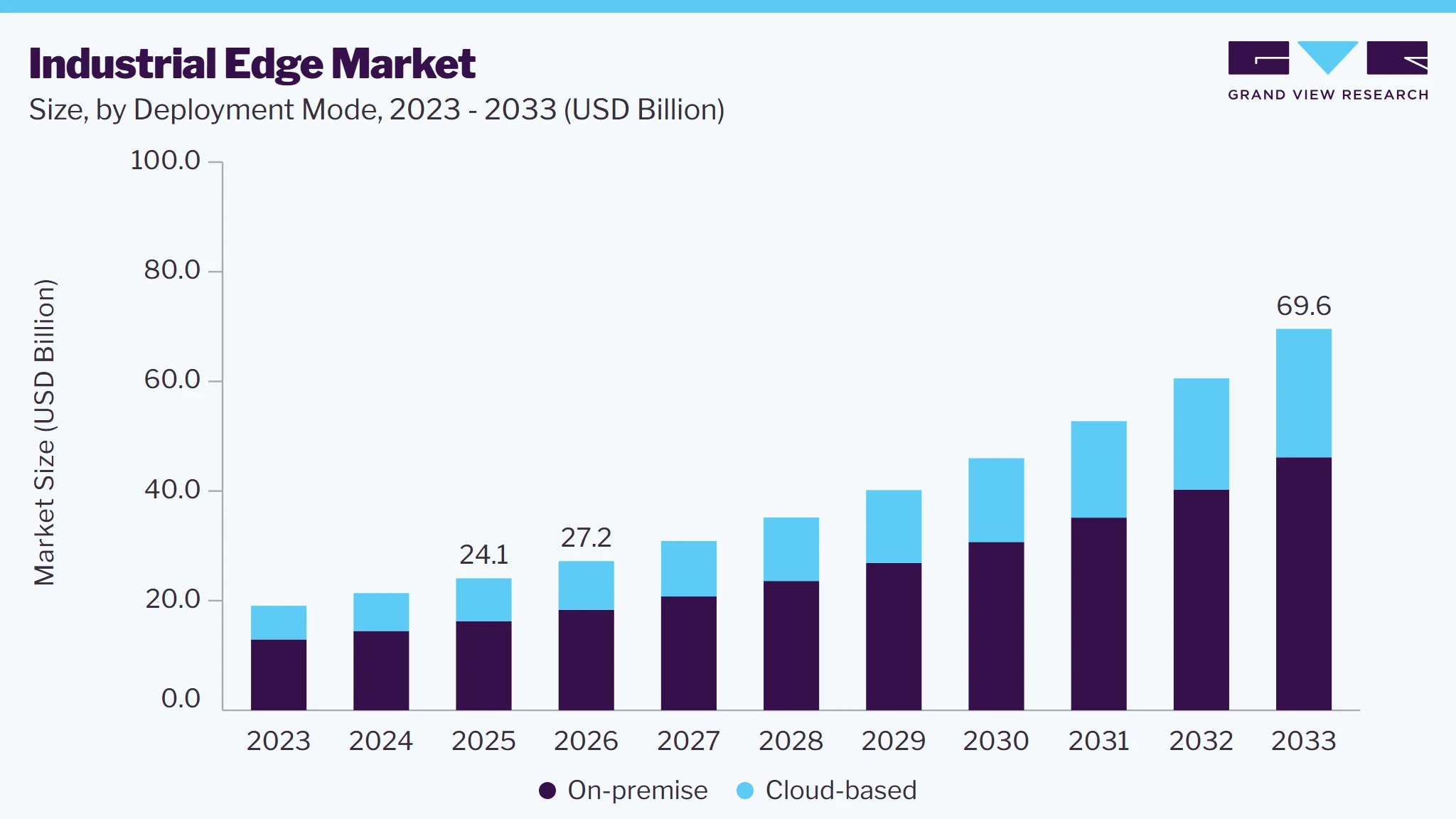
The global industrial edge market size was valued at USD 24.1 billion in 2025 and is projected to grow from USD 27.2 billion in 2026 to USD 69.6 billion by 2033, at a CAGR of 14.3% from 2026 to 2033. North America dominated the market, accounting for a revenue share of 38.7% in 2025. The market growth is primarily driven by the increasing adoption of industrial automation, Industrial IoT (IIoT), edge AI, robotics, and connected equipment, coupled with rising demand for real-time data processing, low-latency decision-making, and predictive maintenance across industrial operations.
 Source: Grand View Research, IR Documents, Primary Interviews, Paid DatabasesTo learn more about this report,
 Download Free Sample Report
 Key Market Trends & Insights
- By component: Hardware segment held the largest market share of 52.7% in 2025.
- By deployment mode: On-premises segment held the largest market revenue share in 2025.
- By organization size: Large Enterprises segment led the market with the largest revenue share in 2025.
- By application: Predictive Maintenance segment held the largest market revenue share in 2025.
- By end use: Manufacturing segment led the market with the largest revenue share in 2025.
Regional Highlights
- Largest regional market: North America (38.7% revenue share, 2025)
- Fastest-growing regional market: Asia Pacific (highest CAGR, 2026-2033)
- By country: U.S. held the largest share in 2025
Market Size & Forecasts
- Market size in 2025: USD 24.1 Billion
- Estimated market size in 2026: USD 27.2 Billion
- Projected market size by 2033: USD 69.6 Billion
- CAGR (2026-2033): 14.3%
Three ways to get this report
Buy it, customize it, or ask a question.Ask an Analyst
Analyst response in 1 business day
- AccessReport author, directly
- Reply timeWithin 1 working day
- No sales callDirect answer only
- FormatEmail reply
- CostFree, no cost
Get the Full Report
What the study covers
- FormatsPDF · Excel · Dashboard
- Timeline2026–2033 annual, 2025 base
- Coverage20+ countries, 5 regions
- Companies10+ key players profiled
Customize the Report
20% free customization
- IncludeCountries, segments, points
- TailorTo your product definition
- ExtendDeeper competitor detail
- OrA fully bespoke study
- Turnaround5–10 working days
The growing emphasis on smart manufacturing, IT/OT convergence, data security, operational efficiency, and reduced dependence on centralized cloud infrastructure is encouraging enterprises to invest in edge computing platforms, industrial gateways, edge servers, and AI-enabled edge solutions. The increasing adoption of AI-enabled edge computing presents a significant opportunity for industrial edge providers to deliver real-time analytics closer to machines and production processes. Manufacturers are deploying edge AI for machine vision, predictive maintenance, anomaly detection, quality inspection, and process optimization, reducing latency and reliance on centralized cloud infrastructure. The integration of AI accelerators and advanced analytics into edge devices is expected to create opportunities for vendors offering scalable platforms capable of processing increasingly complex industrial workloads.
 To learn more about this report, Download Free Sample Report
 Additionally, the growing deployment of Industrial IoT devices and private 5G networks is expanding, as edge computing providers support high-volume, low-latency data exchange across connected factories. Industrial facilities are connecting machines, sensors, robots, and control systems to improve operational visibility and enable automated decision-making. Edge platforms that combine 5G connectivity, device management, and localized processing can support applications such as autonomous mobile robots, real-time asset tracking, remote monitoring, and connected production lines.
Furthermore, the growing adoption of automation, robotics, predictive maintenance, and machine vision is further strengthening demand for industrial edge technologies. These applications require low-latency processing and reliable connectivity to coordinate machines, analyze equipment conditions, and respond to production events in real time. Edge computing also supports the integration of operational technology with enterprise IT systems, enabling manufacturers to connect shop-floor data with broader analytics and management platforms.
Market Dynamics
The Industrial Edge Market is experiencing significant growth, driven by the increasing adoption of Industry 4.0 technologies, industrial automation, and real-time data processing across manufacturing, energy, automotive, logistics, and other industrial sectors. Growing demand for low-latency computing, predictive maintenance, operational efficiency, and intelligent industrial systems is accelerating investments in edge computing platforms, industrial IoT (IIoT) gateways, edge servers, and AI-enabled analytics solutions. The rising deployment of smart factories, connected industrial equipment, and autonomous production systems is further supporting market expansion. However, high implementation costs, integration complexities with legacy industrial infrastructure, and cybersecurity concerns remain key challenges. Meanwhile, advancements in edge AI, private 5G networks, digital twins, and software-defined industrial automation are creating significant growth opportunities for market participants.
The Industrial Edge Market is primarily driven by the growing adoption of Industry 4.0 initiatives and smart manufacturing technologies across industrial sectors. Manufacturers are increasingly deploying industrial edge computing solutions to enable real-time equipment monitoring, predictive maintenance, automated quality inspection, and process optimization. The integration of industrial IoT sensors, programmable logic controllers (PLCs), robotics, and AI-powered analytics is generating substantial volumes of operational data, increasing the need for localized data processing and low-latency decision-making. Additionally, the growing emphasis on reducing production downtime, improving asset utilization, enhancing worker safety, and optimizing energy consumption is accelerating investments in edge-enabled industrial infrastructure. The expansion of connected factories and autonomous manufacturing operations is further strengthening demand for scalable and reliable industrial edge solutions.
Despite strong growth prospects, the Industrial Edge Market faces challenges associated with high initial deployment costs and the complexity of integrating edge computing technologies into existing industrial infrastructure. Implementing industrial edge solutions requires investments in specialized computing hardware, industrial gateways, networking equipment, cybersecurity systems, and software platforms, increasing overall deployment expenditure. Many industrial facilities continue to operate legacy operational technology (OT) systems, making integration with modern edge computing architectures technically challenging and resource-intensive. Furthermore, concerns regarding data security, interoperability across equipment and communication protocols, and the shortage of skilled professionals with expertise in IT-OT convergence can restrict widespread adoption. Ensuring consistent performance, reliability, and cybersecurity across distributed industrial edge environments also adds to operational complexity.
The growing integration of artificial intelligence, machine learning, private 5G networks, and digital twin technologies is creating substantial opportunities for the Industrial Edge Market. Edge AI enables industrial enterprises to perform real-time analytics, automated defect detection, predictive maintenance, and intelligent process control directly at production facilities, reducing dependence on centralized cloud infrastructure. The expansion of private 5G networks and industrial IoT ecosystems is further enabling reliable, low-latency connectivity for autonomous mobile robots, connected machinery, and advanced manufacturing applications. Increasing investments in smart factories, industrial digital transformation, energy management, and autonomous operations are also supporting demand for advanced edge computing solutions. Moreover, advancements in containerized edge applications, industrial AI accelerators, and edge-to-cloud orchestration platforms are expected to improve deployment flexibility, scalability, and operational efficiency, creating long-term growth opportunities for industrial technology providers, hardware manufacturers, software developers, and system integrators.
Market Concentration & Characteristics
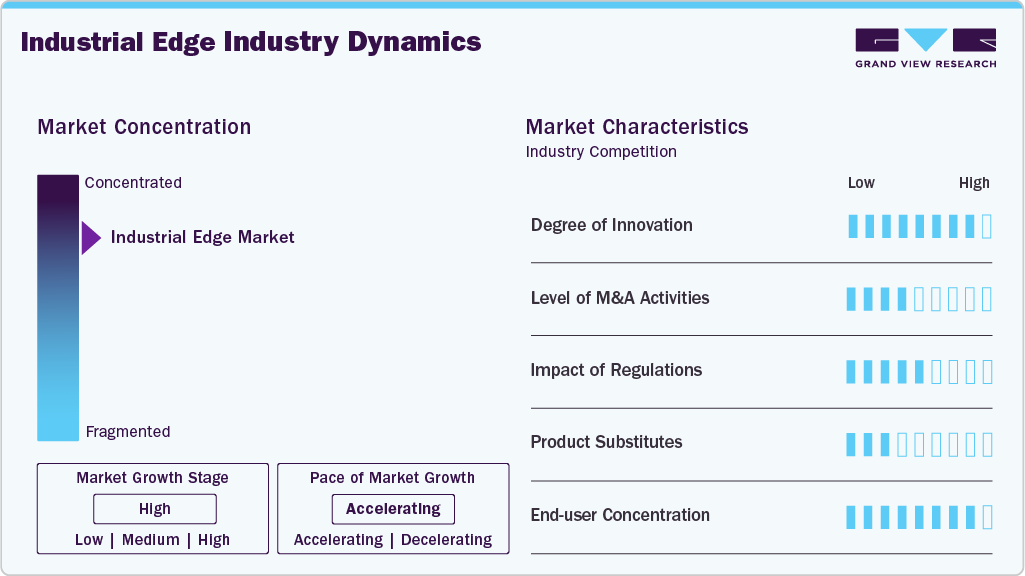
The industrial edge market is moderately concentrated, with competition among established industrial automation companies, edge computing providers, cloud technology companies, hardware manufacturers, software providers, and system integrators offering edge hardware, software platforms, analytics, connectivity, cybersecurity, and managed services. The market is characterized by high technological expertise, interoperability requirements, real-time data processing capabilities, industrial-grade hardware, scalable software architectures, and strong relationships with manufacturing, energy & utilities, transportation & logistics, automotive, oil & gas, and other industrial end users.
 To learn more about this report, Download Free Sample Report
 Technology capabilities, edge processing performance, industrial IoT expertise, AI and analytics capabilities, cybersecurity, connectivity infrastructure, deployment flexibility, and integration with existing operational technology systems play important roles in competitive positioning. Increasing adoption of smart manufacturing, industrial IoT, 5G connectivity, AI-enabled analytics, predictive maintenance, machine vision, and automated production systems is encouraging providers to invest in advanced edge platforms and real-time processing capabilities. High technical requirements, interoperability challenges, established industrial relationships, cybersecurity requirements, and the need for reliable deployment and support create barriers for new entrants, while fragmented technology environments, long industrial procurement cycles, and competition from cloud-based processing solutions can influence market expansion and pricing.
Analyst Perspective
The expansion of smart factories and Industry 4.0 initiatives is encouraging enterprises to modernize legacy industrial infrastructure and deploy decentralized computing capabilities. Organizations are increasingly seeking scalable edge architectures that can support distributed operations while maintaining data security, operational continuity, and efficient resource utilization. The continued convergence of industrial automation, connected assets, and real-time analytics is therefore expected to sustain investments in industrial edge infrastructure and solutions in the coming years.
Component Insights
The hardware segment dominated the market with a share of 52.7% in 2025, driven by the growing deployment of industrial PCs, edge servers, gateways, processors, controllers, sensors, and networking equipment across factories and other industrial environments. Increasing adoption of automation, robotics, machine vision, and connected industrial equipment requires high-performance edge hardware to process large volumes of operational data close to the source. Rising demand for low-latency computing, real-time control, reliable connectivity, and AI inference is further encouraging industrial enterprises to invest in ruggedized edge devices, and high-performance edge infrastructure.
The software segment is expected to grow at the highest CAGR of 15.0% from 2026 to 2033, driven by increasing demand for edge analytics, real-time data processing, AI-enabled applications, remote device management, and software platforms that enable seamless coordination between industrial equipment, edge infrastructure, and cloud environments. The segmental growth is expected to grow in the coming years, as industrial organizations require platforms to collect, contextualize, analyze, secure, and manage data generated across increasingly connected production environments.
Deployment Mode Insights
The on-premises segment dominated the market in 2025, fueled by the need for low-latency data processing, greater control over sensitive industrial data, reliable real-time monitoring, and seamless connectivity with existing operational technology (OT) systems. Its adoption is particularly strong across manufacturing, energy, automotive, and other industrial environments where continuous operations, data security, and localized decision-making are critical.
The cloud segment is expected to grow at the highest CAGR from 2026 to 2033, driven by the increasing need for scalable and flexible computing infrastructure, centralized data management, remote monitoring of distributed industrial assets, and real-time analytics across geographically dispersed operations. The growing adoption of Industrial IoT, AI-driven applications, and cloud-connected edge platforms is further encouraging enterprises to shift from standalone infrastructure to cloud-enabled environments, thereby supporting efficient data sharing, centralized management, and rapid deployment of industrial applications.
Organization Size Insights
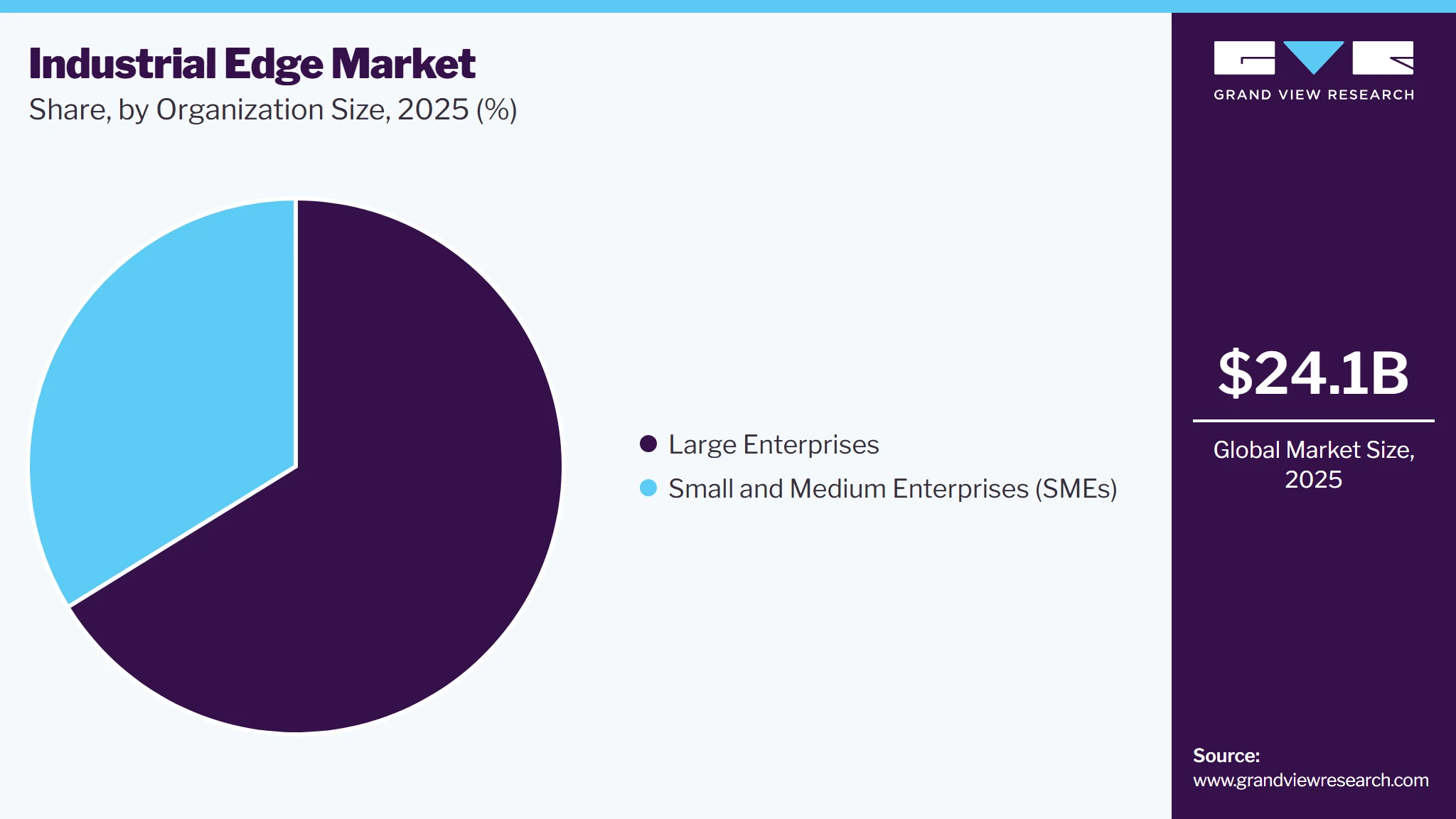
The large enterprises segment dominated the market in 2025, driven by extensive deployment of connected machinery, industrial IoT devices, automated production systems, and data-intensive applications across large-scale facilities. Large enterprises typically operate multiple plants and geographically distributed assets, creating significant requirements for real-time data processing and centralized edge management. Greater financial and technical resources enable these organizations to invest in edge AI, predictive maintenance and robotics solutions to improve efficiency.
 To learn more about this report, Download Free Sample Report
 The small and medium enterprises segment is expected to grow at the highest CAGR from 2026 to 2033, driven by the increasing availability of cost-effective edge solutions, growing adoption of Industrial IoT and automation, and the need for real-time data processing, remote monitoring, and operational efficiency. The emergence of scalable cloud-connected edge platforms and subscription-based solutions is further lowering deployment barriers for SMEs, enabling them to adopt industrial edge capabilities without substantial investments in complex infrastructure.
Application Insights
The predictive maintenance segment dominated the market in 2025, fueled by the increasing focus on preventing unplanned equipment failures and a shift from scheduled to condition-based maintenance. Industrial machines continuously generate vibration, temperature, pressure, current, and other operating data that can indicate equipment deterioration before failure occurs. The growing adoption of edge AI and machine learning is enabling maintenance teams to identify complex patterns across motors, compressors, turbines, pumps, and production machinery. This approach can improve asset availability while reducing emergency maintenance and unnecessary component replacement.
The real-time monitoring and control segment is expected to grow at the highest CAGR from 2026 to 2033, fueled by the growing need for continuous visibility into industrial equipment and processes, rapid detection of operational anomalies, and real-time decision-making across connected production environments. The increasing adoption of Industrial IoT, smart sensors, connected machinery, and edge analytics is enabling enterprises to process operational data closer to the point of generation, supporting faster responses to equipment conditions, production disruptions, and quality issues. The growing deployment of automated manufacturing systems and distributed industrial assets is further increasing demand for real-time monitoring solutions that improve operational visibility, equipment utilization, process control, and overall productivity.
End Use Insights
The manufacturing segment led the market in 2025, driven by the rapid digitalization of production facilities and increasing deployment of connected machinery, industrial IoT devices, machine vision, and automated production systems. Manufacturing facilities generate large volumes of data from cameras, sensors, PLCs, robots, and production equipment, all of which require rapid processing to support operational decisions. Edge computing enables manufacturers to analyze this data locally for quality inspection, predictive maintenance, production optimization, and worker safety without relying continuously on cloud connectivity.
The transportation & logistic segment is expected to grow at the highest CAGR from 2026 to 2033, propelled by increasing automation across transportation and logistics in railways, commercial vehicles, warehouses, distribution centers, ports, and fleet operations. These environments increasingly rely on cameras, positioning systems, vehicle sensors, and connected equipment to support fleet management, cargo monitoring, autonomous movement, passenger safety, and operational surveillance. Large volumes of video and sensor data often require immediate processing, making local edge inference more practical than transmitting raw information to centralized data centers.
Regional Insights
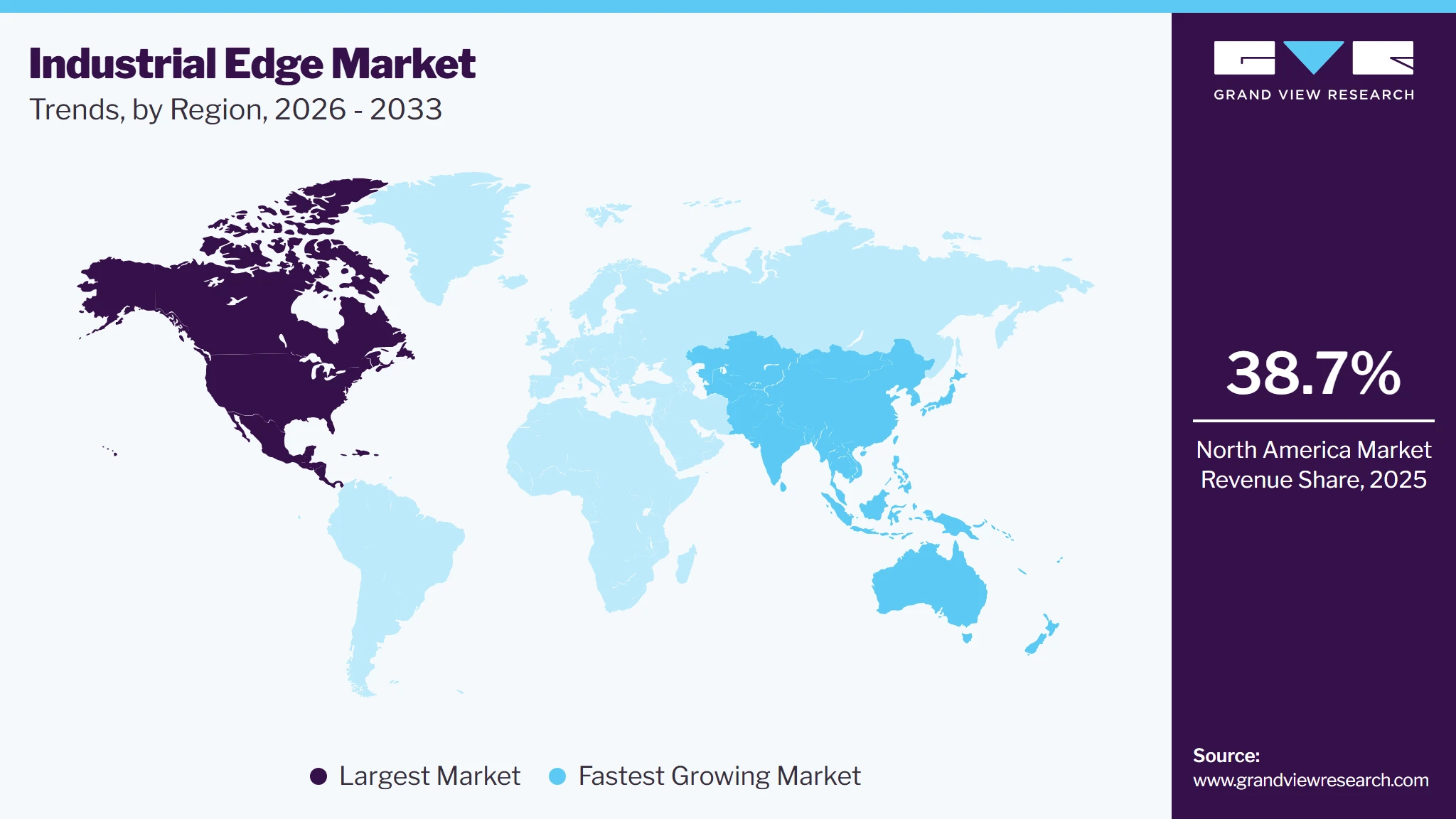
The North America industrial edge market dominated the market with a share of 38.7% in 2025, supported by the region’s advanced manufacturing base, strong digital infrastructure, and early adoption of industrial automation. The growing deployment of smart factories, industrial IoT devices, robotics, and AI-enabled production systems is increasing demand for localized computing to support real-time monitoring, predictive maintenance, machine vision, and process control. The strong presence of cloud, semiconductor, and industrial automation companies, coupled with increasing adoption of private 5G, edge AI, and hybrid edge-cloud architectures, is further supporting market expansion.
 To learn more about this report, Download Free Sample Report
 U.S. Industrial Edge Market Trends
The industrial edge market in the U.S. dominated the regional sector in 2025. The major growth driver is the need for real-time monitoring, predictive maintenance, lower downtime, and faster production decisions, particularly as U.S. manufacturers modernize their operations. NIST estimates that the U.S. has approximately 500,000 machine tools, many of which are not continuously monitored, creating an opportunity for smart, edge-enabled systems that can analyze machine data and predict equipment health in real time.
Europe Industrial Edge Market Trends
The industrial edge market in Europe accounted for a significant share in 2025, driven by the shift from cloud-based AI toward AI-at-the-edge in manufacturing SMEs, where local processing can reduce latency, limit data transfers, and improve responsiveness in industrial applications. This transition is supported by the EU-funded AI REDGIO 5.0 project, which ran from 2023 to 2025 with 43 partners across 18 countries and 15 regions and focused specifically on helping Industry 5.0 manufacturing SMEs adopt AI-at-the-edge solutions. The project conducted 41 industrial experiments, including 14 test-before-invest experiments and 27 SME-driven experiments, covering productivity, agility, sustainability, circularity, and energy optimization.
The UK industrial edge market is gaining momentum as manufacturers seek to move AI and analytics closer to machines and production environments, particularly for predictive maintenance, quality inspection, digital twins, robotics, and real-time process optimization. The UK Government’s Advanced Manufacturing AI Adoption Plan, published in June 2026, specifically identifies operational technology deployment as a challenge and proposes regional AI testbeds and fast-track programs to help manufacturers deploy AI in real production environments. The emphasis on deploying AI directly within factories creates demand for localized computing, edge AI, industrial connectivity, and real-time data processing.
The industrial edge market in Germany is driven by the growing need to process sensitive production data close to machines while maintaining interoperability across connected factories and supply chains, particularly for machine monitoring, predictive maintenance, quality control, and AI-based process optimization. Germany’s shift toward hybrid edge-cloud architectures that can balance real-time factory requirements with centralized computing is expected to further drive the market growth in the coming years.
Asia Pacific Industrial Edge Market Trends
The industrial edge market in the Asia Pacific is expected to grow at the highest CAGR of 16.5% from 2026 to 2033. The market is developing around the region’s large base of electronics, semiconductor, automotive, and advanced manufacturing facilities, where manufacturers increasingly need real-time processing at the factory level for machine vision, robotics, predictive maintenance, quality inspection, and automated process control. The combination of advanced manufacturing, robotics, semiconductor capabilities, and government-backed edge infrastructure is creating opportunities for localized computing and industrial AI solutions across the region.
The China industrial edge market is driven by the rapid expansion of smart manufacturing and industrial automation, as manufacturers increasingly deploy Industrial IoT, connected machinery, machine vision, and real-time monitoring systems across production environments. Edge computing enables localized processing of large volumes of operational data, reducing latency and supporting faster decision-making for predictive maintenance, quality control, production optimization, and equipment monitoring. The country's continued investment in advanced manufacturing, 5G infrastructure, and digitally connected factories further supports the deployment of edge computing solutions across automotive, electronics, semiconductors, machinery, and other industrial sectors.
The industrial edge market in Japan is shaped by the rapid adoption of robotics, factory automation, and connected manufacturing systems, supported by the country's advanced industrial base and focus on improving production efficiency. Edge computing enables manufacturers to process machine and sensor data closer to production lines, supporting real-time monitoring, predictive maintenance, quality inspection, and automated decision-making. Growing deployment of industrial robots, IoT-enabled equipment, and smart factory technologies across automotive, electronics, machinery, and semiconductor manufacturing further strengthens demand for localized computing capabilities.
Key Industrial Edge Company Insights
Some of the key players operating in the industrial edge market include Amazon Web Services, Inc. and Google LLC, among others.
-
Amazon Web Services, Inc. is a cloud computing and technology services provider offering edge computing, Industrial Internet of Things (IIoT), artificial intelligence, machine learning, analytics, and data management solutions. The company supports industrial edge deployments through technologies such as AWS IoT Greengrass, AWS IoT SiteWise Edge, and AWS Outposts, enabling manufacturers to collect, process, and analyze equipment data.
-
Google LLC provides cloud, data analytics, artificial intelligence, machine learning, and infrastructure technologies. The company enables manufacturers to connect operational data with cloud-based AI and analytics platforms, supporting applications such as predictive maintenance, digital twins, autonomous robotics, and intelligent factory operations. Google Cloud's manufacturing solutions focus on converting siloed shop-floor and enterprise data into actionable intelligence.
Some of the emerging players operating in the industrial edge market include ZEDEDA and Kontron AG, among others.
-
ZEDEDA is an edge computing infrastructure company focused on edge orchestration, device management, security, and distributed application deployment. The company's edge platform enables industrial enterprises to centrally manage heterogeneous edge hardware, operating environments, and applications deployed across factories, remote facilities, and other distributed locations.
-
Kontron AG is an IoT and embedded computing technology provider offering industrial computers, embedded platforms, edge computing systems, connectivity technologies, and software solutions for industrial applications. The company provides computing platforms designed for deployment close to machines, production equipment, and other operational assets, enabling local processing of industrial and IoT data.
Key Industrial Edge Companies
The following key companies have been profiled for this study on the industrial edge market.
-
Advantech Co., Ltd.
-
Amazon Web Services, Inc.
-
Google LLC
-
Hewlett-Packard Enterprise Development LP
-
Intel Corporation
-
International Business Machines Corporation (IBM)
-
Kontron AG
-
NVIDIA Corporation
-
Rockwell Automation
-
Siemens AG
-
ZEDEDA
Competitive Benchmarking
Operating Strategies
Competitive Edge
Weaknesses
Mature Players: Amazon Web Services, Inc., Google LLC, NVIDIA Corporation
- Mature players develop integrated industrial edge ecosystems combining edge hardware, software, cloud connectivity, industrial automation, and AI capabilities across manufacturing environments
- Their competitive edge stems from established industrial customer relationships, extensive R&D capabilities, broad technology portfolios, service networks, and strong enterprise integration expertise.
- Mature players may experience slower responsiveness to specialized industrial edge requirements due to large organizational structures, complex product portfolios, and lengthy technology development cycles
Emerging Players: ZEDEDA, Advantech Co., Ltd., Kontron AG
- Emerging players focus on specialized industrial edge platforms offering flexible deployment, device orchestration, edge AI processing, and interoperable solutions for distributed industrial environments.
- Their competitive edge lies in greater agility, specialized edge expertise, flexible architectures, and faster adaptation to evolving industrial automation, AI, and connectivity requirements.
- Emerging players generally have smaller global service networks, limited enterprise relationships, and fewer financial resources compared with established industrial automation and technology providers.
Recent Developments
-
In July 2026, International Business Machines Corporation (IBM) introduced Maximo Application Suite 9.2, expanding AI capabilities for industrial asset management. The release includes Maximo Condition Insight, Maximo Assistant on Mobile, and enhanced Maximo Visual Inspection with local inference directly on devices, supporting condition monitoring, reliability, and field operations.
-
In June 2026, Amazon Web Services, Inc. expanded its industrial edge and physical AI capabilities through a partnership with SoftServe, introducing the AI-Powered Product Journey, an autonomous production line demonstrated at Hannover Messe. The solution used AWS IoT Greengrass to deploy trained AI models to NVIDIA Jetson Thor edge devices, while Amazon Bedrock AgentCore orchestrated factory workflows.
-
In June 2026, Hewlett-Packard Enterprise Development LP expanded its self-driving networking strategy across the enterprise edge, campus, data centers, and AI factories. The expansion adds AI-native networking, autonomous operations, predictive maintenance, edge AI switching, zero-trust security, and tighter integration across HPE networking and hybrid-cloud infrastructure.
Industrial Edge Market Report Scope
Report Attribute
Details
Market size in 2025
USD 24.1 billion
Estimated market size in 2026
USD 27.2 billion
Projected market size by 2033
USD 69.6 billion
Growth rate
CAGR of 14.3% from 2026 to 2033
Actual data
2021 - 2025
Forecast period
2026 - 2033
Quantitative units
Revenue in USD billion and CAGR from 2026 to 2033
Report coverage
Revenue forecast, company share, competitive landscape, growth factors, and trends
Segments covered
Component, deployment mode, organization size, application, end use, region
Regional scope
North America; Europe; Asia Pacific; Latin America; Middle East and Africa
Country scope
U.S.; Canada; Mexico; UK; Germany; France; Italy; Spain; China; Japan; India; South Korea; Australia; Taiwan; Brazil; UAE; KSA; South Africa
Key companies profiled
Advantech Co., Ltd.; Amazon Web Services, Inc.; Google LLC; Hewlett-Packard Enterprise Development LP; Intel Corporation; International Business Machines Corporation (IBM); Kontron AG; NVIDIA Corporation; Rockwell Automation; Siemens AG; ZEDEDA
Customization scope
Free report customization (equivalent to up to 8 analyst working days) with purchase. Addition or alteration to country, regional & segment scope.
Pricing and purchase options
Avail customized purchase options to meet your exact research needs. Explore purchase options
Global Industrial Edge Market Report Segmentation
This report forecasts revenue growth at global, regional, and country levels and provides an analysis of the latest industry trends in each of the sub-segments from 2021 to 2033. For this study, Grand View Research has segmented the global industrial edge market report based on component, deployment mode, organization size, application, end use, and region:
-
Component Outlook (Revenue, USD Billion, 2021 - 2033)
-
Hardware
-
Software
-
Services
-
-
Deployment Mode Outlook (Revenue, USD Billion, 2021 - 2033)
-
On-premises
-
Cloud-based
-
-
Organization Size Outlook (Revenue, USD Billion, 2021 - 2033)
-
Large Enterprises
-
Small & Medium Enterprises (SMEs)
-
-
Application Outlook (Revenue, USD Billion, 2021 - 2033)
-
Real-Time Monitoring and Control
-
Predictive Maintenance
-
Asset Tracking and Management
-
Remote Monitoring and Management
-
Automation and Robotics
-
Quality Control and Inspection
-
Process Optimization
-
Security and Compliance
-
Others
-
-
End Use Outlook (Revenue, USD Billion, 2021 - 2033)
-
Manufacturing
-
Energy & Utilities
-
Transportation & Logistics
-
Healthcare
-
Oil & Gas
-
Automotive
-
Others
-
-
Regional Outlook (Revenue, USD Billion, 2021 - 2033)
-
North America
-
U.S.
-
Canada
-
Mexico
-
-
Europe
-
UK
-
Germany
-
France
-
Italy
-
Spain
-
-
Asia Pacific
-
China
-
Japan
-
India
-
South Korea
-
Australia
-
Taiwan
-
-
Latin America
-
Brazil
-
-
Middle East and Africa
-
UAE
-
KSA
-
South Africa
-
-
Research Methodology
The industrial edge marketfigures in this report are based on a proven research process that combines executive interviews with secondary research from proprietary databases, company filings, and recognized regulatory and institutional sources. Market size is built through value-chain sizing-reconciling supply-side and demand-side estimates-and triangulated with bottom-up and top-down approaches. Every estimate passes multiple levels of expert validation before publication, with each industrial edge segment quantified using the revenue-capture definitions in the table below.
Segment Definition
Component
Revenue Capture Definition
Hardware
Revenue is generated through the sale of edge computing hardware, including edge servers, gateways, industrial PCs, sensors, and networking equipment deployed for localized data processing.
Software
Revenue is generated through the sale or licensing of edge computing software, including edge platforms, operating systems, analytics applications, and device-management solutions.
Services
Revenue is generated through consulting, system integration, deployment, maintenance, support, and managed services associated with industrial edge computing infrastructure.
Deployment Mode
Revenue Capture Definition
On-premises
Revenue is generated through the sale, installation, configuration, and maintenance of industrial edge infrastructure deployed within customer-owned facilities.
Cloud-based
Revenue is generated through subscription, usage-based, and service fees for cloud-connected edge platforms, applications, data processing, and remote management capabilities.
Organization Size
Revenue Capture Definition
Large Enterprises
Revenue is generated through enterprise-scale edge hardware, software, and services deployed across large industrial operations, production facilities, and distributed assets.
Small & Medium Enterprises
Revenue is generated through affordable, scalable edge hardware, software subscriptions, and managed services designed for smaller industrial operations.
Application
Revenue Capture Definition
Predictive Maintenance
Revenue is generated through edge-based solutions that monitor equipment conditions and analyze operational data to identify potential failures and optimize maintenance activities.
Real-Time Monitoring and Control
Revenue is generated through edge platforms, sensors, and control systems that enable continuous monitoring and real-time management of industrial processes and equipment.
Asset Tracking and Management
Revenue is generated through edge-enabled tracking systems, sensors, gateways, and software used to monitor the location, condition, and utilization of industrial assets.
Remote Monitoring and Management
Revenue is generated through solutions that provide remote access, monitoring, diagnostics, and management of industrial equipment and infrastructure.
Automation and Robotics
Revenue is generated through edge computing systems, controllers, software, and services supporting automated machinery, industrial robots, and autonomous operations.
Quality Control and Inspection
Revenue is generated through edge-based machine vision, inspection systems, analytics software, and related services used to detect defects and maintain product quality.
Process Optimization
Revenue is generated through edge analytics, monitoring platforms, and optimization software used to improve production processes, resource utilization, and operational efficiency.
Security and Compliance
Revenue is generated through edge-based cybersecurity, data protection, access control, monitoring, and compliance solutions for industrial environments.
Others
Revenue is generated through edge computing solutions supporting additional industrial applications, including data aggregation, energy monitoring, and operational analytics.
End Use
Revenue Capture Definition
Manufacturing
Revenue is generated through deployment of edge hardware, software, and services across production lines, factories, and manufacturing operations.
Energy & Utilities
Revenue is generated through edge solutions used for monitoring, control, asset management, and optimization of power generation, transmission, distribution, and utility infrastructure.
Transportation & Logistics
Revenue is generated through edge computing solutions supporting fleet monitoring, asset tracking, route operations, infrastructure management, and logistics processes.
Healthcare
Revenue is generated through edge hardware, software, and services supporting real-time monitoring, medical equipment management, diagnostics, and connected healthcare operations.
Oil & Gas
Revenue is generated through edge solutions used for monitoring, automation, predictive maintenance, process optimization, and remote management across oil and gas operations.
Automotive
Revenue is generated through edge computing solutions deployed across automotive manufacturing, production-line automation, quality inspection, and connected vehicle-related operations.
Others
Revenue is generated through industrial edge hardware, software, and services deployed across additional end-use industries requiring localized data processing and real-time operational management.
Estimation Model
Layer
Key Questions
Description
End-User Adoption Layer
Who are the potential adopters?
Identifies manufacturing companies, energy and utility operators, transportation and logistics companies, healthcare organizations, oil & gas companies, automotive manufacturers, and other industrial enterprises that adopt edge computing to process operational data closer to equipment and facilities, support real-time decision-making, improve asset performance, optimize processes, and reduce dependence on centralized cloud infrastructure.
Industrial Edge Solution Provider Layer
Who supplies industrial edge solutions and services?
Evaluates hardware manufacturers, industrial software providers, cloud and edge technology companies, automation vendors, system integrators, and managed service providers offering edge servers, industrial PCs, gateways, edge platforms, analytics software, device-management solutions, cybersecurity, deployment, and maintenance services.
Deployment & Infrastructure Layer
Where and how are industrial edge solutions deployed?
Maps deployment across manufacturing plants, production lines, warehouses, energy facilities, utilities, transportation infrastructure, oil & gas sites, healthcare facilities, and other industrial environments, covering on-premises and cloud-connected configurations that enable localized data processing, monitoring, control, and remote management.
Technology & Data Processing Layer
What technologies influence adoption?
Evaluates edge servers, industrial PCs, gateways, IoT sensors, 5G connectivity, AI and machine learning, edge analytics, computer vision, real-time operating systems, containerization, cybersecurity technologies, and data-processing platforms that enable low-latency processing, real-time monitoring, predictive maintenance, automation, quality inspection, and process optimization at the industrial site.
Delivered Customizations
This report has been delivered with the following In-depth customizations
Client Request
Customization Delivered
Value Adds
Market Sizing, Segmentation & Growth Opportunity Assessment
Assessed the global Industrial Edge Market size, historical trends, forecast growth outlook, and detailed segmentation by component, deployment mode, organization size application, and end use.
Enables industrial enterprises, automation providers, edge technology companies, system integrators, and solution providers to identify high-growth segments, prioritize technology investments, optimize resource allocation, expand solution portfolios, and capture emerging opportunities in industrial edge computing.
Regional Market Demand & Growth Opportunity Assessment
Assessed industrial edge market demand across North America, Europe, Asia Pacific, Latin America, and Middle East & Africa, considering industrial automation adoption, smart manufacturing initiatives, Industrial IoT deployment, 5G infrastructure development, factory digitization, robotics adoption, and demand for real-time data processing across key industries.
Provides insights into regional growth opportunities, market-entry priorities, investment hotspots, and competitive positioning, enabling industrial edge providers and stakeholders to prioritize high-potential geographies, strengthen regional capabilities, target industrial digitization projects, and align solution portfolios with regional demand patterns.
Competitive Landscape & Strategic Positioning Analysis
Evaluated the competitive environment across edge computing providers, industrial automation companies, cloud technology providers, hardware manufacturers, software companies, and system integrators, comparing edge hardware portfolios, software platforms, industrial IoT capabilities, AI and analytics solutions, connectivity capabilities, cybersecurity offerings, deployment models, industry coverage, geographic presence, partnerships, and recent developments.
Enables companies to benchmark their market position, identify technology and solution gaps, assess differentiation opportunities, evaluate capabilities across hardware, software, and services, prioritize technology investments, strengthen strategic partnerships, and enhance competitive positioning across manufacturing, energy & utilities, transportation & logistics, healthcare, oil & gas, and automotive applications.
Frequently Asked Questions About This Report
The hardware segment accounted for the largest market share of 52.7% in 2025.
North America dominated the global market, accounting for the largest revenue share of 38.7% in 2025.
The global industrial edge market is expected to grow at a compound annual growth rate of 14.3% from 2026 to 2033 to reach USD 69.6 billion by 2033.
The large enterprises segment led the market with a share in 2025.
Some key players operating in the industrial edge market include Amazon Web Services, Inc.; Google LLC; NVIDIA Corporation; Siemens AG; Rockwell Automation; Hewlett Packard Enterprise Development LP; Intel Corporation; International Business Machines Corporation (IBM); ZEDEDA; Advantech Co., Ltd.; Kontron AG
The key factors driving the industrial edge market include increasing demand for real-time data processing and low-latency decision-making in industrial environments, the integration of advanced technologies such as AI, machine learning, and 5G connectivity, and the growing focus on cybersecurity and data sovereignty.
The on-premise segment led the market with a share in 2025.
The global industrial edge market size was estimated at USD 24.1 billion in 2025 and is expected to reach USD 27.2 billion in 2026.
The predictive maintenance segment dominated the market in 2025.
About the Author(s)
Next Generation Technologies Research Team
Technology · Next Generation TechnologiesThis report was authored by the next generation technologies research team at Grand View Research - comprising two research analysts, one senior research analyst, and one industry expert - with specialized expertise in the next generation technologies segment of the technology industry. All findings are based on proprietary technology databases, executive interviews, and regulatory analysis, subject to internal peer review prior to publication.
Last Updated:
Speak to Analyst

Customize this report to your needs - add regions, segments, or data points, with 20% free customization.
Or view our licence options:


ISO 9001:2015 & 27001:2022 Certified
We are GDPR and CCPA compliant! Your transaction & personal information is safe and secure. For more details, please read our privacy policy.


