
- Home
- »
- Advanced Interior Materials
- »
-
Instrumentation Services Market Size & Share Report, 2033GVR Report cover

Instrumentation Services Market (2026 - 2033)
Size, Share & Trends Analysis Report By Service (Calibration Services, Maintenance & Repair Services), By Instrument Type, By End-use (Oil & Gas, Food & Beverage, Water & Wastewater), By Region, And Segment Forecasts
Market Size, 2025
$7.3BMarket Estimate, 2026
$7.6BMarket Forecast, 2033
$11.7BCAGR, 2026–2033
6.2%Instrumentation Services Market Summary
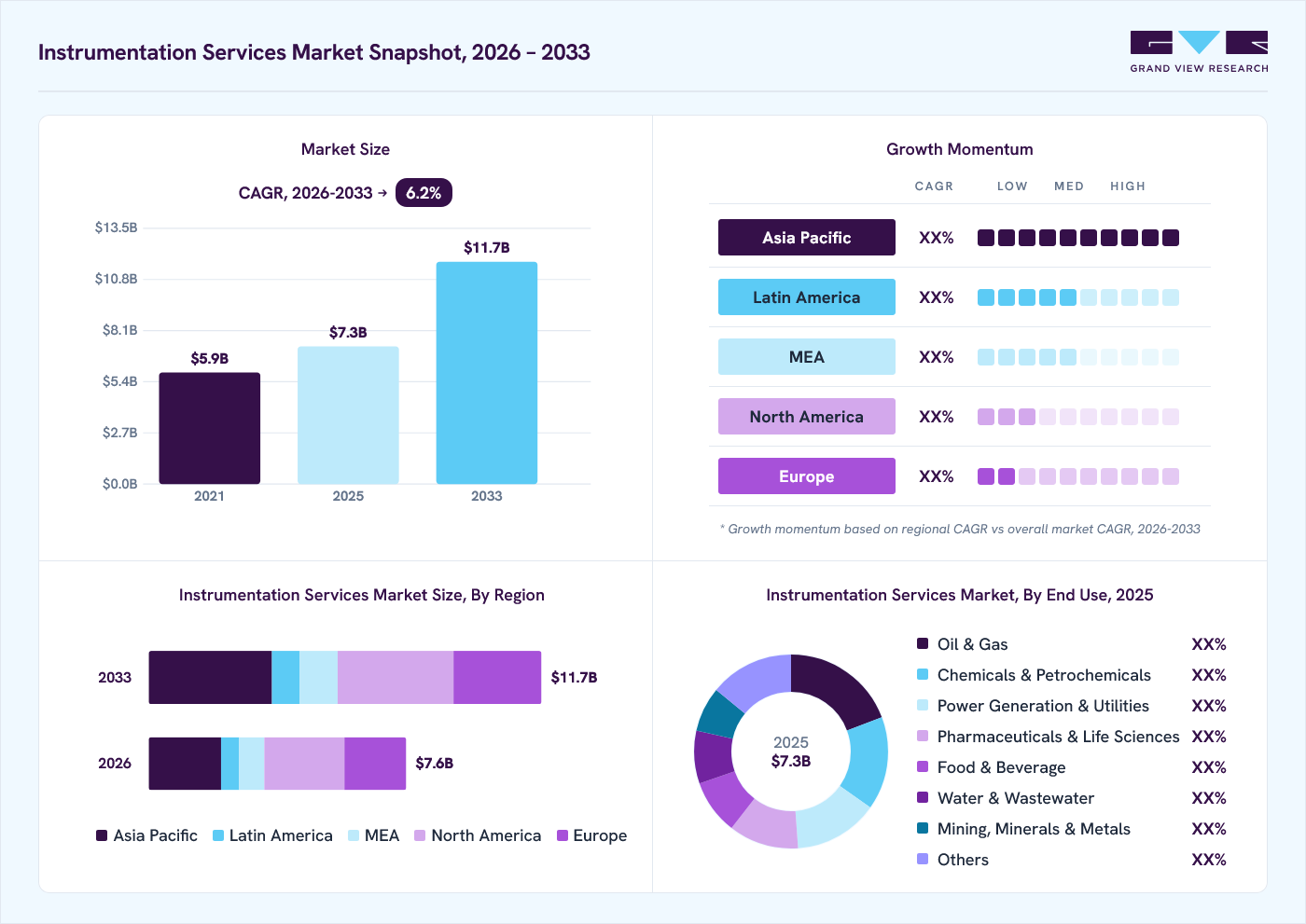
The global instrumentation services market size was valued at USD 7.3 billion in 2025 and is projected to grow from USD 7.7 billion in 2026 to USD 11.7 billion by 2033, at a CAGR of 6.2% from 2026 to 2033. North America dominated the market, accounting for the largest revenue share of 31.4% in 2025. The instrumentation services market is driven by increasing industrial automation, expansion of process industries, aging instrumentation infrastructure, and growing adoption of smart and connected instruments.
 Source: Grand View Research, IR Documents, Primary Interviews, Paid DatabasesTo learn more about this report,
 Download Free Sample Report
 Key Market Trends & Insights
- By service: Calibration services segment led the market with the largest revenue share of 32.2% in 2025.
- By instrument type: Pressure instruments segment held an 18.1% revenue share in 2025.
- By end-use: Pharmaceuticals & life sciences segment is expected to grow at a CAGR of 7.8% during the forecast period.
Regional Highlights
- Largest regional market: North America (31.4% revenue share, 2025)
- Fastest-growing regional market: Asia Pacific (highest CAGR, 2026-2033)
- By country: The U.S. held the largest market share in 2025.
Market Size & Forecast
- Market size in 2025: USD 7.3 Billion
- Estimated Market Size in 2026: USD 7.6 Billion
- Projected market size by 2033: USD 11.7 Billion
- CAGR (2026-2033): 6.2%
Three ways to get this report
Buy it, customize it, or ask a question.Ask an Analyst
A direct answer, usually in 1 working day
- AccessReport author, directly
- Reply timeWithin 1 working day
- No sales callDirect answer only
- FormatEmail reply
- CostFree, no cost
Get the Full Report
What the study covers
- FormatsPDF · Excel · Dashboard
- Timeline2026–2033 annual, 2025 base
- Coverage20+ countries, 5 regions
- Companies10+ key players profiled
Customize the Report
20% free customization
- IncludeCountries, segments, points
- TailorTo your product definition
- ExtendDeeper competitor detail
- OrA fully bespoke study
- Turnaround5–10 working days
Moreover, requirements for accurate measurement, process safety, emissions control, and documented instrument performance drive recurring calibration, testing, inspection, validation, and maintenance services. Additionally, aging installed bases across process industries increase the need for preventive maintenance, repair, recalibration, retrofits, troubleshooting, and replacement-related services.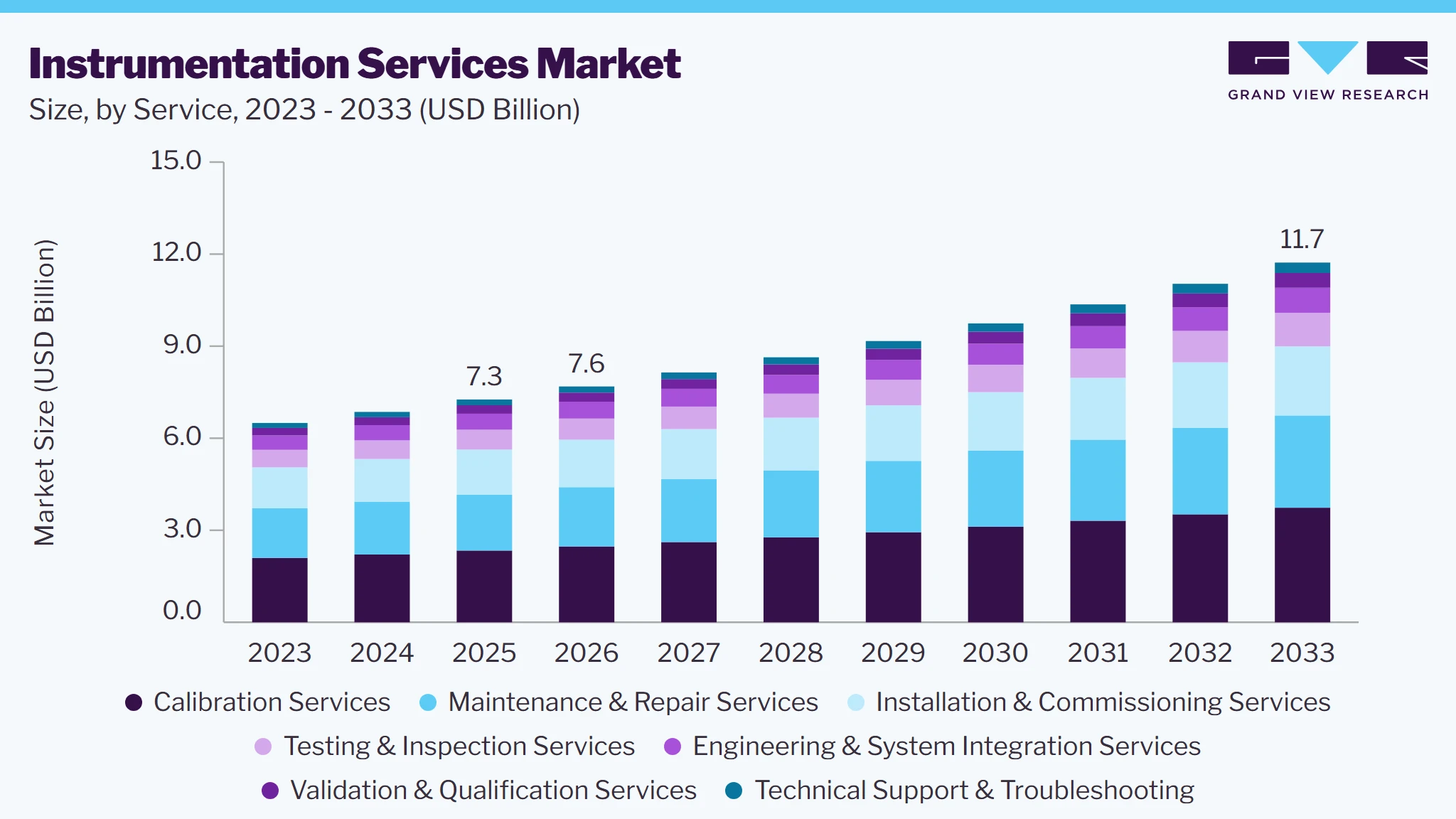 To learn more about this report, Download Free Sample Report
 Market Dynamics
The instrumentation services market is shaped by the increasing complexity of industrial processes, expansion of automation and digital control systems, aging instrumentation infrastructure, and stringent requirements for measurement accuracy, safety, quality, and regulatory compliance. Demand is also influenced by capital investments in process industries, the shift toward smart and connected instrumentation, availability of skilled technicians, and the growing preference for outsourced maintenance and specialized technical services. Regional industrial activity, technology adoption, and the installed base of process instrumentation further determine service requirements across end-use industries.
Increasing adoption of industrial automation, distributed control systems, smart sensors, and connected instrumentation is driving demand for specialized instrumentation services. As manufacturers seek greater process accuracy, uptime, and operational efficiency, they increasingly require calibration, installation and commissioning, system integration, testing, maintenance, and troubleshooting services to ensure automated instrumentation operates reliably and delivers accurate process data.
The shortage of skilled instrumentation technicians is constraining the market by limiting the availability of personnel capable of installing, calibrating, maintaining, troubleshooting, and integrating increasingly sophisticated instrumentation systems. The complexity of digital and automated process-control technologies, combined with an aging industrial workforce and limited availability of specialized technical skills, can increase service lead times, labor costs, and reliance on external service providers.
The growing adoption of smart and connected instrumentation is creating opportunities for service providers to offer remote monitoring, diagnostics, and predictive maintenance services. By using Industrial Internet of Things (IIoT) connectivity, cloud platforms, and data analytics, providers can remotely assess instrument performance, identify abnormal operating conditions, and predict potential failures before they cause production disruptions. This enables industrial customers to reduce unplanned downtime, optimize maintenance schedules, and extend instrumentation asset life, while allowing service providers to develop recurring, digitally enabled service contracts.
Market Concentration & Characteristics
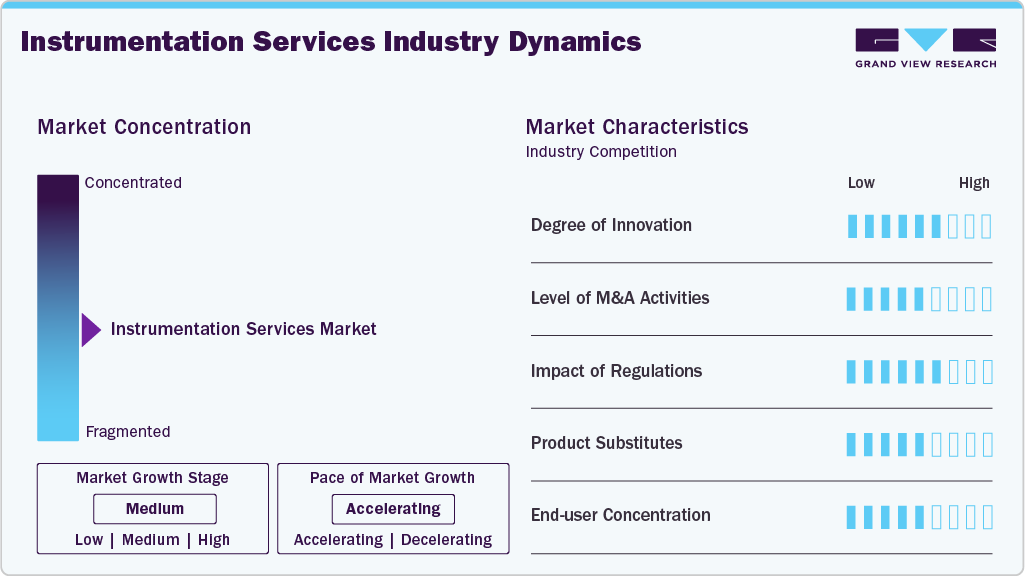
The instrumentation services market is relatively fragmented, with global engineering and industrial service companies competing alongside specialized calibration, testing, maintenance, and system-integration providers. Large players benefit from broad geographic coverage, established industrial relationships, multidisciplinary capabilities, and the ability to provide integrated services, while specialized providers compete through technical expertise, application-specific services, faster response times, and localized support.
Competition is increasingly influenced by capabilities in smart instrumentation, Industrial Internet of Things (IIoT), remote diagnostics, predictive maintenance, digital calibration, and integration with distributed control systems (DCS) and supervisory control and data acquisition (SCADA) systems. Providers are expanding beyond conventional maintenance and calibration toward lifecycle services that combine installation, commissioning, monitoring, troubleshooting, and system optimization.
 To learn more about this report, Download Free Sample Report
 Long-term service contracts, installed-base relationships, regulatory documentation, response capabilities, and technical expertise are important competitive factors because instrumentation services often require recurring maintenance and calibration throughout equipment lifecycles. Companies are also strengthening their positions through partnerships with instrument manufacturers, regional service networks, acquisitions of specialized service providers, and expansion into high-value sectors such as pharmaceuticals, oil & gas, chemicals, and power generation.
Service Insights
The calibration services segment accounted for 32.2% of market revenue in 2025, making them a major component of instrumentation service expenditure due to the recurring requirement to maintain measurement accuracy and traceability. Services include comparison of instrument readings against established standards, adjustment or correction where required, certification, and documentation for pressure, flow, temperature, level, analytical, and other process instruments across industrial facilities.
The technical support and troubleshooting services are projected to register a 7.8% CAGR during the forecast period as industrial facilities increasingly rely on sophisticated digital instrumentation and automated control systems. These services include fault diagnosis, instrument configuration, system diagnostics, remote or on-site technical assistance, and resolution of operational issues, helping end users address instrumentation failures and minimize disruptions to production processes.
Instrument Type Insights
The pressure instruments segment held an 18.1% revenue share in 2025, reflecting their extensive deployment across process equipment, pipelines, storage systems, and industrial control applications. The segment includes pressure transmitters, gauges, switches, and related devices, for which service requirements cover calibration, preventive and corrective maintenance, testing, installation, commissioning, and troubleshooting to maintain measurement accuracy and reliable process operation.
The process analyzers segment is projected to expand at a 7.6% CAGR during the forecast period. The demand for these instruments is supported by their increasing significance for continuous monitoring of chemical composition and other critical process parameters. The segment includes analyzers used for applications such as gas composition, moisture, pH, conductivity, and other process measurements, generating demand for installation, calibration, validation, maintenance, troubleshooting, and system integration services throughout their operating lifecycle.
End-use Insights
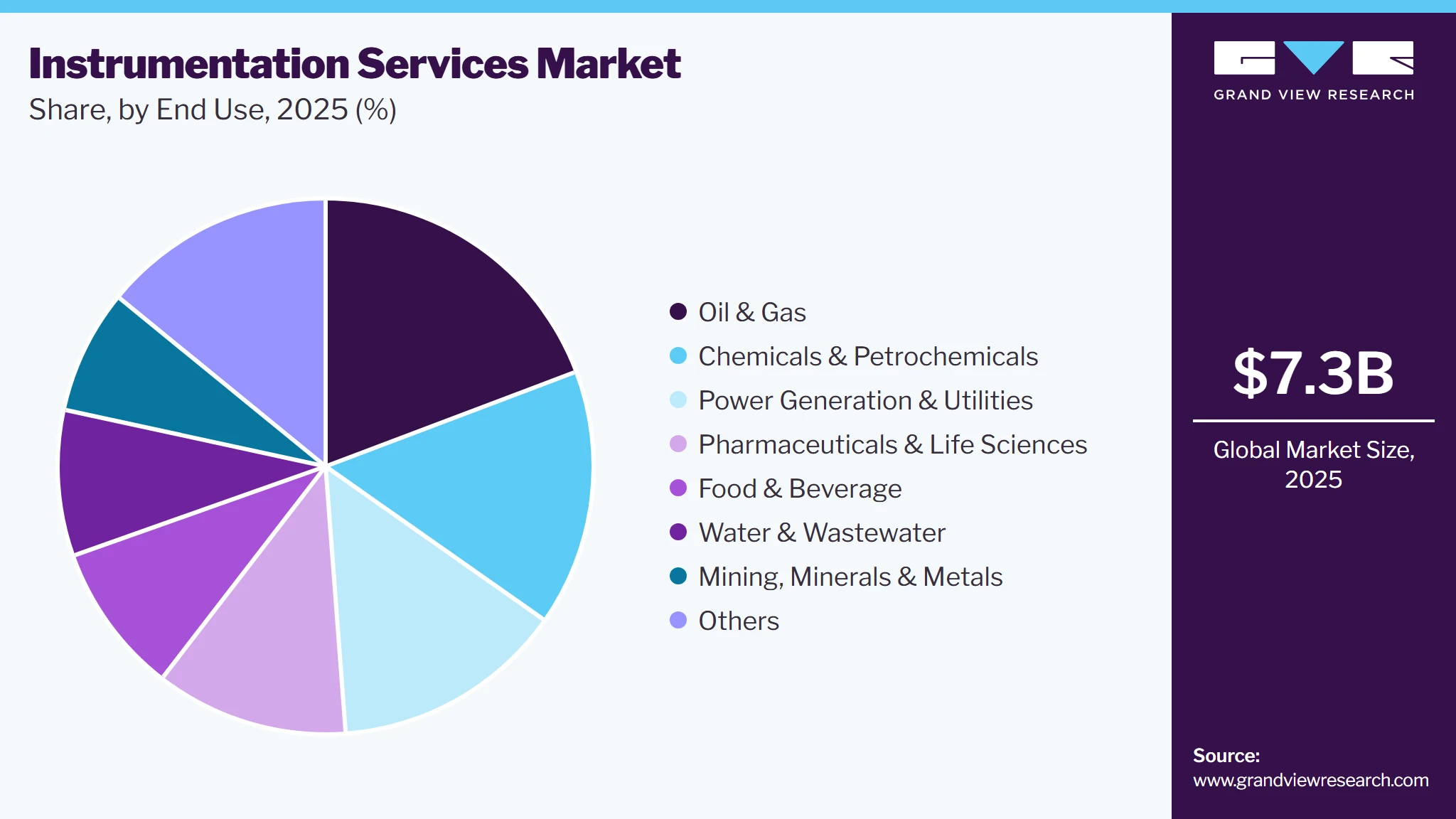
The oil & gas segment accounted for 19.2% of market revenue in 2025, supported by the extensive deployment of instrumentation across upstream production, midstream transportation and storage, refining, and petrochemical processing operations. The segment generates demand for calibration, maintenance, testing, installation and commissioning, troubleshooting, and system integration services for pressure, flow, temperature, level, analytical, and control instrumentation used throughout oil and gas facilities.
 To learn more about this report, Download Free Sample Report
 The pharmaceuticals & life sciences segment is projected to register a 7.8% CAGR during the forecast period, reflecting the industry's increasing requirements for precise, reliable, and documented process measurements. Instrumentation services in this segment include calibration, validation and qualification, testing, maintenance, commissioning, and technical support for critical instruments used in pharmaceutical manufacturing, biotechnology, laboratories, and other regulated life sciences applications.
Regional Insights
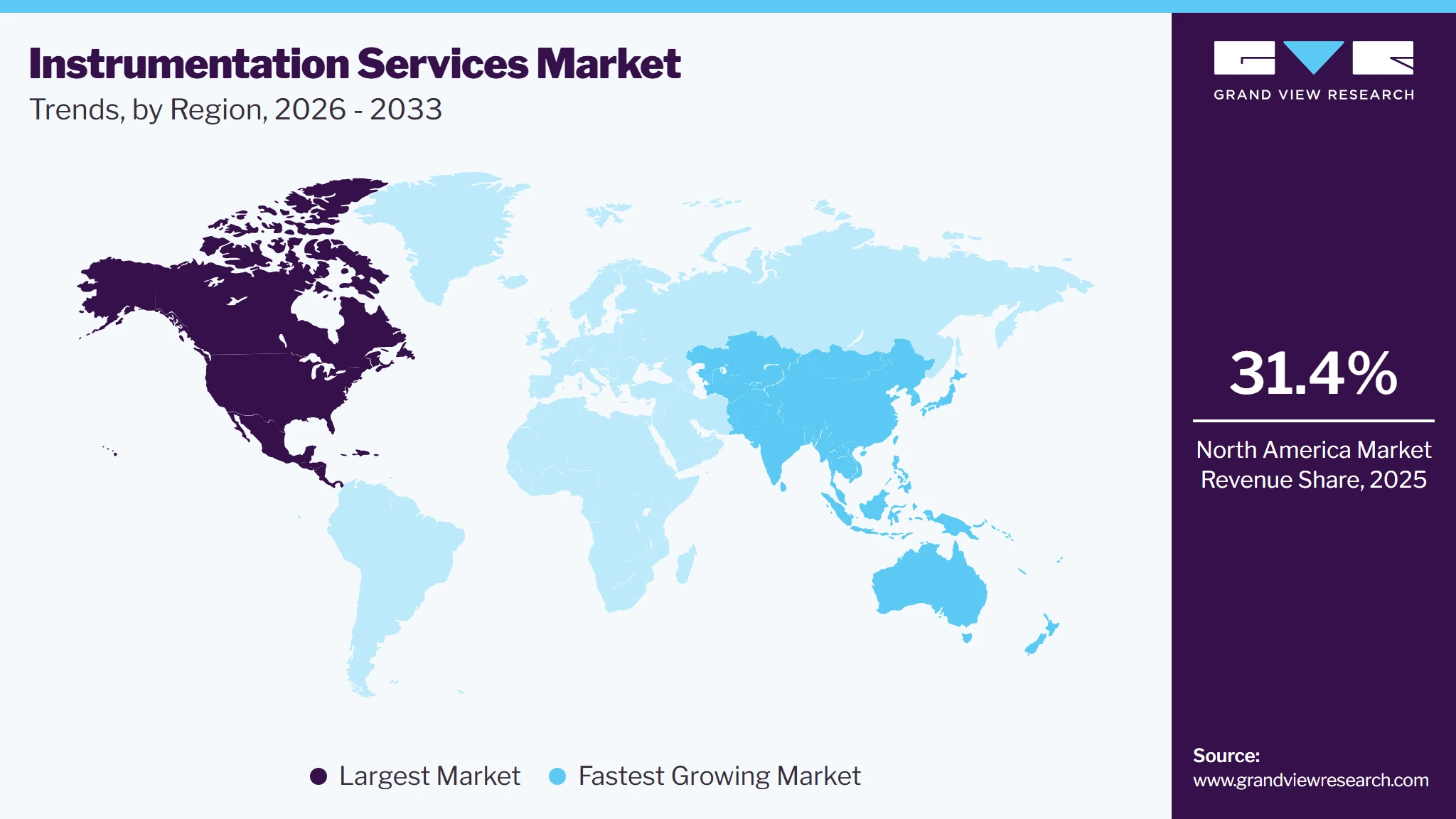
North America dominated the market, accounting for the largest revenue share of 31.4% in 2025. The market is characterized by a large installed base of process instrumentation across oil & gas, chemicals, power generation, pharmaceuticals, food & beverage, and water & wastewater. The region’s mature industrial infrastructure creates substantial recurring demand for calibration, maintenance, testing, repair, and technical support, while ongoing automation, plant modernization, and adoption of smart and connected instrumentation support higher-value engineering and system integration services. High labor costs, shortages of specialized technicians, and the complexity of servicing legacy and digitally integrated systems remain key market challenges.
 To learn more about this report, Download Free Sample Report
 U.S. Instrumentation Services Market Trends
The U.S. represents a mature and technologically advanced instrumentation services market, supported by a large installed base across oil & gas, chemicals, power generation, pharmaceuticals, food & beverage, and water & wastewater. Industrial production increased 1.1% year over year in July 2026, while manufacturing capacity continued to expand modestly, indicating a relatively stable industrial base for recurring calibration, maintenance, testing, and technical support requirements. Demand is increasingly shaped by automation, digital process control, asset modernization, and the need to maintain aging instrumentation, although high labor costs, shortages of specialized technicians, and capital-expenditure uncertainty relatively constrain service spending. The country's mature industrial ecosystem also supports higher-value engineering, system integration, remote diagnostics, and predictive maintenance services rather than only conventional maintenance and calibration.
Europe Instrumentation Services Market Trends
Europe represents a mature instrumentation services market supported by established chemicals, pharmaceuticals, power, food & beverage, automotive, manufacturing, and water infrastructure. Demand is shaped by stringent requirements for process safety, measurement accuracy, environmental compliance, equipment reliability, and documentation, generating recurring requirements for calibration, testing, validation, maintenance, and inspection services. Germany, the U.K., France, and Italy constitute important markets, while industrial modernization and Industry 4.0 adoption are increasing demand for smart instrumentation integration, digital diagnostics, and predictive maintenance. At the same time, relatively high labor and energy costs, slower industrial growth in some economies, and constrained capital expenditure can limit new installation and commissioning activity.
The Germany instrumentation services market is a large, mature industry by chemicals, pharmaceuticals, automotive, machinery, power, food processing, and other process and discrete manufacturing industries. Industrial conditions remain challenging at present, with machinery production expected to decline for a fourth consecutive year, while investment willingness across German industry remains weak. Nevertheless, identified investment projects remain substantial, with chemicals and pharmaceuticals among the sectors showing comparatively stronger investment activity. This creates a mixed market environment; new greenfield demand is constrained in some industries, while modernization, automation, maintenance, and replacement of existing instrumentation continue to generate recurring service requirements. High energy costs, supply-chain uncertainty, and pressure on industrial competitiveness remain challenges, while Germany's Industry 4.0 ecosystem supports demand for smart instrumentation integration, digital diagnostics, and advanced engineering services.
The Italy instrumentation services market is supported by a diversified industrial base spanning chemicals, pharmaceuticals, food & beverage, machinery, metals, energy, and water infrastructure, with demand concentrated around maintaining and modernizing established industrial assets. Industrial production contracted modestly in 2025 overall, although pharmaceuticals, food, electronics, and machinery-related segments provided areas of resilience; pharmaceutical production in particular recorded strong growth in December 2025. Currently, manufacturers are also dealing with export uncertainty, energy costs, geopolitical disruptions, and stronger competition from Chinese imports, which can affect new capital investment and therefore demand for project-based instrumentation services. Consequently, recurring calibration, maintenance, repair, testing, and troubleshooting represent an important portion of the market, while automation and modernization of production facilities support higher-value engineering and integration services.
Asia Pacific Instrumentation Services Market Trends
Asia Pacific is characterized by a rapidly expanding installed base of industrial instrumentation, supported by manufacturing capacity expansion and investments in chemicals, petrochemicals, oil & gas, power, pharmaceuticals, mining, food processing, and water infrastructure. China and India represent major sources of demand, while Japan, South Korea, Australia, and Southeast Asian economies contribute through mature industrial assets and new infrastructure investments. Rapid industrial automation, smart-factory adoption, expansion of process industries, and construction of new production facilities are supporting demand across installation, commissioning, calibration, maintenance, and system integration services. However, the region remains diverse in terms of technology adoption, service maturity, labor costs, and technical expertise, with price sensitivity and shortages of skilled instrumentation personnel affecting service delivery in several developing markets.
The China instrumentation services market is among the largest and fastest-evolving, due to its extensive manufacturing base. Industrial output increased 5.2% year over year in August 2026, with particularly strong activity in advanced manufacturing, lithium-ion batteries, and industrial robots, supporting demand for instrumentation associated with increasingly automated production systems. At the same time, the property downturn remains a constraint on broader economic activity, creating uneven investment conditions across industries. China's policy emphasis on advanced manufacturing, intelligent manufacturing, industrial digitalization, and technological self-reliance is nevertheless supporting continued deployment and modernization of automated process-control systems. The market therefore, combines substantial recurring aftermarket demand from its enormous installed base with expanding opportunities in smart instrumentation, system integration, diagnostics, and automation-related services.
The India instrumentation services market is an expanding industry supported by rapid industrialization and investment across oil & gas, chemicals, pharmaceuticals, power, food processing, metals, water infrastructure, and emerging high-technology manufacturing. The economy grew 7.8% year over year in April - June 2026, with investment and manufacturing contributing strongly to growth, while government-backed industrial initiatives and private-sector capacity additions continue to expand the country's industrial asset base. New investment in semiconductor manufacturing and related equipment, materials, chemicals, and supporting infrastructure is adding another technology-intensive source of instrumentation demand; semiconductor investment proposals under the latest initiative were reported at USD 11 - 12 billion, while Applied Materials announced a planned USD 5 billion India investment over the next decade. However, elevated input and energy costs, with wholesale prices rising sharply in August 2026, together with uneven automation penetration among smaller industrial facilities and shortages of specialized technical personnel, can constrain service adoption.
Middle East & Africa Instrumentation Services Market Trends
The Middle East & Africa market is supported by extensive oil & gas, refining, petrochemical, power, water, mining, and industrial infrastructure, with Saudi Arabia, the UAE, and South Africa representing important regional markets. Large-scale energy and infrastructure investments, refinery and petrochemical capacity additions, industrial diversification, and water-treatment projects are generating demand for installation, commissioning, calibration, maintenance, inspection, and system integration services. The Middle East is increasingly adopting automated and digitally connected process-control systems as new industrial facilities are developed, while Africa's demand is more closely associated with mining, energy, water, and industrial modernization. Dependence on oil and commodity cycles, uneven infrastructure development, skilled-labor shortages, and differences in technology adoption across countries remain important challenges for service providers.
The Saudi Arabia instrumentation services market has a strategically important position, centered on oil & gas, refining, petrochemicals, power, water & wastewater, mining, and expanding non-oil industrial activities. The market benefits from continued investment under Vision 2030, which is aimed at industrial diversification, localization, private-sector participation, and development of sectors including chemicals, pharmaceuticals, advanced manufacturing, energy, and mining. The 2026 - 2030 Public Investment Fund strategy continues to emphasize domestic economic ecosystems and greater private-sector participation, while the National Industrial Development and Logistics Program supports industrial projects and advanced manufacturing. This supports demand for installation, commissioning, calibration, maintenance, system integration, and technical support as new facilities are developed and existing oil and gas assets are modernized. Localization requirements and the targeted increase in domestic energy-sector content also create opportunities for local instrumentation service providers, although dependence on large project cycles, availability of specialized technical skills, and oil-price volatility remain important market considerations.
Latin America Instrumentation Services Market Trends
Latin America’s instrumentation services market is primarily supported by oil & gas, mining, minerals & metals, chemicals, food processing, power generation, and water infrastructure. Brazil and Mexico represent significant demand centers, with large resource industries and expanding manufacturing activities generating requirements for calibration, maintenance, testing, commissioning, and troubleshooting services. Industrial investment is closely linked to commodity prices, energy projects, infrastructure development, and broader economic conditions, resulting in variations in project activity across countries. Currency volatility, limited availability of specialized technical personnel, uneven industrial automation penetration, and geographically dispersed industrial facilities can increase service costs and constrain adoption of advanced instrumentation services.
The Brazil instrumentation services market is strongly linked to oil & gas, mining, minerals and metals, chemicals, food processing, power generation, and water infrastructure. The country's large resource and processing industries create a substantial installed base of pressure, flow, temperature, level, analytical, and control instrumentation, generating recurring demand for calibration, maintenance, inspection, troubleshooting, and commissioning services, while offshore oil and gas and mining projects create demand for specialized engineering and integration capabilities. Current market conditions are being influenced by higher global energy prices and geopolitical disruptions, which are affecting fuel economics and industrial operating costs; Brazil's refinery system is operating at high utilization while the country remains dependent on diesel imports for part of domestic demand. Investment therefore remains closely tied to commodity cycles and large industrial projects, while currency volatility, geographic dispersion of industrial assets, skilled-labor availability, and infrastructure constraints can affect service costs and project execution.
Key Instrumentation Services Company Insights
Some of the key players operating in the market include Emerson Electric Co. and Siemens among others
-
Emerson Electric Co. is a global automation and industrial technology company with a portfolio spanning automation systems, measurement instrumentation, final control, discrete automation, test & measurement, and industrial software. For the instrumentation-services market specifically, its measurement & analytical portfolio covers pressure, temperature, level, flow, acoustics, corrosion, pH, conductivity, water quality, toxic gas, and flame measurement, while its broader automation portfolio includes control systems, safety instrumented systems, supervisory control and data acquisition (SCADA), asset performance management, digital twins, analytics, and industrial software. Emerson has a broad global footprint spanning the Americas, Europe, and Asia, Middle East & Africa, supported by manufacturing, engineering, sales, service, and customer-support infrastructure.
-
Siemens provides industrial automation, process control, measurement instrumentation, drives, industrial software, electrification, and lifecycle services, with relevant instrumentation covering pressure, temperature, flow, level, and other process parameters. Its customer base spans automotive, chemicals, pharmaceuticals, food & beverage, electronics and semiconductor manufacturing, machinery, energy infrastructure, buildings, and transportation, supported by a global footprint across Europe, the Americas, Asia Pacific, the Middle East, and Africa through extensive sales, engineering, manufacturing, and service operations.
Key Instrumentation Services Companies
The following key companies have been profiled for this study on the instrumentation services market.
-
Emerson Electric Co.
-
Endress+Hauser Group Services AG
-
Yokogawa Electric Corporation
-
ABB
-
Siemens
-
KROHNE MARSHALL Pvt Ltd.
-
Fluke Corporation
-
Thermo Fisher Scientific Inc
-
Baker Hughes Company
-
Intertek Group plc
-
SGS Société Générale de Surveillance SA
-
Honeywell International, Inc.
-
Schneider Electric
-
CBRE
-
Avantor
Competitive Benchmarking
Category
Operating Strategies
Competitive Edge
Weakness
Established Players (e.g., Emerson Electric Co., Siemens, ABB, Endress+Hause, Yokogawa Electric Corporation)
- Established players offer end-to-end instrumentation services covering installation, commissioning, calibration, maintenance, testing, validation, engineering integration, and technical support.
- They expand through regional service centers, acquisitions, and partnerships to provide local technical support near major industrial clusters.
- They increasingly incorporate remote diagnostics, connected instrumentation, predictive maintenance, and digital calibration capabilities into conventional field services.
- Broad field-service networks enable rapid deployment of technicians, calibration equipment, and specialized engineering resources across multiple regions.
- Strong brands, technical credentials, and established quality systems provide credibility for safety-critical and highly regulated applications.
- Dependence on established technologies can make differentiation more difficult as newer processing technologies emerge
- Broad field-service networks enable rapid deployment of technicians, calibration equipment, and specialized engineering resources across multiple regions.
- Strong brands, technical credentials, and established quality systems provide credibility for safety-critical and highly regulated applications.
- Dependence on established technologies can make differentiation more difficult as newer processing technologies emerge.
Emerging & Regional Players (e.g., Fluke Corporation, KROHNE MARSHALL Pvt Ltd.)
- They compete through localized service teams, shorter response times, and flexible scheduling for maintenance and troubleshooting requirements.
- They typically expand into new industrial clusters through local partnerships, technicians, or targeted service facilities rather than building extensive networks immediately.
- Concentration on specific instruments, technologies, or applications can provide deeper technical expertise than broad-based service providers in selected areas.
- Localized operations and leaner structures tend to enable faster responses to breakdowns, troubleshooting requests, and urgent calibration requirements.
- Lean operating models can support competitive pricing for individual service assignments and outsourced maintenance contracts.
- Smaller field-service networks can restrict their ability to support customers operating across multiple countries or widely dispersed facilities.
- Limited brand visibility can make it more difficult to qualify for large, safety-critical, or highly regulated industrial contracts
- Smaller financial and technical resources can limit investment in advanced calibration equipment, digital platforms, technician training, and international expansion.
Recent Developments
-
In September 2026, Trescal strengthened its presence in Spain by acquiring SAICA S.L. and the validation & qualification business unit of AIRVENTO. This strategic move broadens Trescal's accredited laboratory network into key hubs like Madrid, Cádiz, and Vigo, expanding its offerings in Good Manufacturing Practice (GMP) qualification, cleanroom validation, advanced metrology, and EN 9100 certified scope to better serve the heavily regulated aerospace, pharmaceutical, biotechnology, and medical device sectors.
-
In February 2025, Emerson Electric Co. announced that it has designated its North America Impact Partner Network as Premier Service Providers, expanding their coverage to deliver on-site servicing for select measurement instrumentation devices across the United States. This expansion enables their 18 local strategic partner organizations to act as authorized factory service providers for prominent brands like Rosemount and Micro Motion. By leveraging more than 80 certified support centers and over 7,600 regional personnel, Emerson aims to pair its national automation capabilities with localized support for calibration, assembly diagnostics, and facility maintenance.
Instrumentation Services Market Report Scope
Report Attribute
Details
Market size in 2025
USD 7.3 billion
Estimated market size in 2026
USD 7.6 billion
Projected market size by 2033
USD 11.7 billion
Growth rate
CAGR of 6.2% from 2026 to 2033
Historical data
2021 - 2024
Forecast period
2026 - 2033
Quantitative units
Revenue in USD billion and CAGR from 2026 to 2033
Report coverage
Revenue forecast, company ranking, competitive landscape, growth factors, and trends
Segments covered
Service, instrument type, end-use, region
Regional scope
North America; Europe; Asia Pacific; Latin America; Middle East & Africa; Africa
Country scope
U.S.; Canada; Mexico; UK; Germany; France; Spain; Italy; China; Japan; India; Australia; South Korea; Brazil; Argentina; Saudi Arabia; UAE; South Africa
Key companies profiled
Emerson Electric Co.; Endress+Hauser Group Services AG; Yokogawa Electric Corporation; ABB; Siemens; KROHNE MARSHALL Pvt Ltd.; Fluke Corporation; Thermo Fisher Scientific Inc.; Baker Hughes Company; Intertek Group plc; SGS Société Générale de Surveillance SA; Honeywell International, Inc.; Schneider Electric; CBRE; Avantor
Customization scope
Free report customization (equivalent up to 8 analysts working days) with purchase. Addition or alteration to country, regional & segment scope.
Pricing and purchase options
Avail customized purchase options to meet your exact research needs. Explore purchase options
Global Instrumentation Services Market Report Segmentation
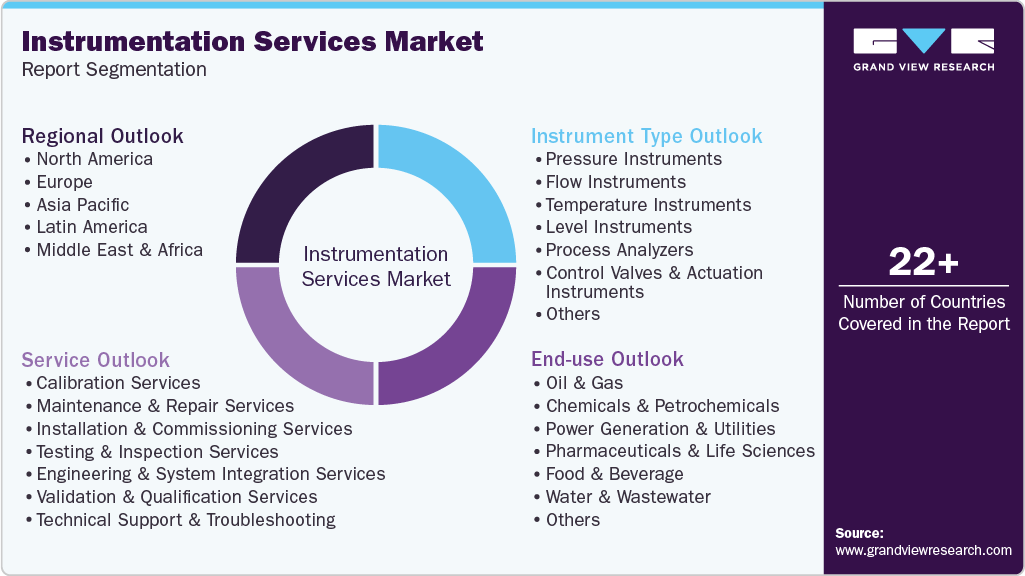
This report forecasts revenue growth at global, regional, and country levels and provides an analysis of the latest industry trends in each of the sub-segments from 2021 to 2033. For this study, Grand View Research has segmented the instrumentation services market report based on service, instrument type, end-use, and region:
 To learn more about this report, Download Free Sample Report
 -
Service Outlook (Revenue, USD Billion, 2021 - 2033)
-
Calibration Services
-
Maintenance & Repair Services
-
Installation & Commissioning Services
-
Testing & Inspection Services
-
Engineering & System Integration Services
-
Validation & Qualification Services
-
Technical Support & Troubleshooting
-
-
Instrument Type Outlook (Revenue, USD Billion, 2021 - 2033)
-
Pressure Instruments
-
Flow Instruments
-
Temperature Instruments
-
Level Instruments
-
Process Analyzers
-
Control Valves & Actuation Instruments
-
Others
-
-
End-use Outlook (Revenue, USD Billion, 2021 - 2033)
-
Oil & Gas
-
Chemicals & Petrochemicals
-
Power Generation & Utilities
-
Pharmaceuticals & Life Sciences
-
Food & Beverage
-
Water & Wastewater
-
Mining, Minerals & Metals
-
Others
-
-
Regional Outlook (Revenue, USD Billion, 2021 - 2033)
-
North America
-
U.S.
-
Canada
-
Mexico
-
-
Europe
-
Germany
-
France
-
Italy
-
Spain
-
UK
-
-
Asia Pacific
-
China
-
India
-
Japan
-
South Korea
-
Australia
-
-
Latin America
-
Brazil
-
Argentina
-
-
Middle East & Africa
-
Saudi Arabia
-
UAE
-
South Africa
-
-
Research Methodology
The instrumentation services market figures in this report are based on a proven research process that combines executive interviews with secondary research from proprietary databases, company filings, and recognized regulatory and institutional sources. Market size is built through value-chain sizing - reconciling supply-side and demand-side estimates - and triangulated with bottom-up and top-down approaches. Every estimate passes multiple levels of expert validation before publication, with each instrumentation services segment quantified using the revenue-capture definitions in the table below.
Segment Definition
Service
Revenue Capture Definition
Calibration Services
Calibration services involve comparing instrumentation against established measurement standards and adjusting or documenting performance to ensure measurement accuracy and traceability. The segment represents the revenue captured from the provision of calibration services for industrial instrumentation.
Maintenance & Repair Services
Maintenance and repair services comprise preventive, corrective, and breakdown-related activities performed to maintain or restore the operational condition of instrumentation. The segment represents the revenue captured from the provision of maintenance and repair services for industrial instrumentation.
Installation & Commissioning Services
Installation and commissioning services comprise the physical installation, configuration, startup, and functional verification of instrumentation at industrial facilities. The segment represents the revenue captured from the provision of installation and commissioning services for industrial instrumentation.
Testing & Inspection Services
Testing and inspection services involve evaluating instrumentation and associated systems to verify operational performance, condition, and compliance with specified requirements. The segment represents the revenue captured from the provision of testing and inspection services for industrial instrumentation.
Engineering & System Integration Services
Engineering and system integration services comprise the design, configuration, integration, and technical implementation of instrumentation within industrial measurement and control systems. The segment represents the revenue captured from the provision of engineering and system integration services for industrial instrumentation.
Validation & Qualification Services
Validation and qualification services involve documented activities used to verify that instrumentation and associated systems meet specified performance and operational requirements. The segment represents the revenue captured from the provision of validation and qualification services for industrial instrumentation.
Technical Support & Troubleshooting
Technical support and troubleshooting services comprise diagnostic assistance, fault identification, configuration support, and resolution of instrumentation-related operational issues. The segment represents the revenue captured from the provision of technical support and troubleshooting services for industrial instrumentation.
Instrument Type
Revenue Capture Definition
Pressure Instruments
Pressure instruments comprise devices used to measure, monitor, or control pressure in industrial processes, including pressure transmitters, gauges, and switches. The segment represents the revenue captured from the provision of instrumentation services for pressure instruments.
Flow Instruments
Flow instruments comprise devices used to measure, monitor, or control the movement and flow rate of liquids, gases, or other process media. The segment represents the revenue captured from the provision of instrumentation services for flow instruments.
Temperature Instruments
Temperature instruments comprise devices used to measure, monitor, or control temperature within industrial processes and equipment. The segment represents the revenue captured from the provision of instrumentation services for temperature instruments.
Level Instruments
Level instruments comprise devices used to measure, monitor, or control the level of liquids, solids, or other materials within tanks, vessels, and process equipment. The segment represents the revenue captured from the provision of instrumentation services for level instruments.
Process Analyzers
Process analyzers comprise instruments used to measure and analyze the chemical or physical properties of process streams and materials. The segment represents the revenue captured from the provision of instrumentation services for process analyzers.
Control Valves & Actuation Instruments
Control valves and actuation instruments comprise devices used to regulate process-fluid flow and actuate valves within industrial measurement and control systems. The segment represents the revenue captured from the provision of instrumentation services for control valves and actuation instruments.
Others - Instrument Type
Others comprise instrumentation not specifically classified under pressure, flow, temperature, level, process analyzers, or control valves and actuation instruments within the defined market scope. The segment represents the revenue captured from the provision of instrumentation services for other industrial instrumentation.
End Use
Revenue Capture Definition
Oil & Gas
The oil & gas segment comprises upstream, midstream, refining, and gas-processing facilities that use industrial instrumentation for process measurement and control. The segment represents the revenue captured from instrumentation services provided to oil & gas facilities.
Chemicals & Petrochemicals
The chemicals & petrochemicals segment comprises facilities involved in the production and processing of chemicals, petrochemicals, and related products using industrial process instrumentation. The segment represents the revenue captured from instrumentation services provided to chemicals and petrochemicals facilities.
Power Generation & Utilities
The power generation & utilities segment comprises electricity-generation and utility facilities that use instrumentation for monitoring and controlling operational processes. The segment represents the revenue captured from instrumentation services provided to power generation and utilities facilities.
Pharmaceuticals & Life Sciences
The pharmaceuticals & life sciences segment comprises pharmaceutical, biotechnology, and related life sciences manufacturing facilities that rely on industrial instrumentation for process measurement and control. The segment represents the revenue captured from instrumentation services provided to pharmaceuticals and life sciences facilities.
Food & Beverage
The food & beverage segment comprises facilities involved in the processing and production of food and beverage products using industrial measurement and control instrumentation. The segment represents the revenue captured from instrumentation services provided to food and beverage facilities.
Water & Wastewater
The water & wastewater segment comprises facilities involved in water treatment, distribution, and wastewater treatment that use instrumentation for process monitoring and control. The segment represents the revenue captured from instrumentation services provided to water and wastewater facilities.
Mining, Minerals & Metals
The mining, minerals & metals segment comprises mining, mineral processing, metal production, and related processing facilities that use instrumentation for process measurement and control. The segment represents the revenue captured from instrumentation services provided to mining, minerals, and metals facilities.
Others
Others comprise end-use industries within the defined market scope that are not specifically classified under the listed end-use segments such as paper & pulp, automotive, semiconductor & electronics, and aerospace & defense. The segment represents the revenue captured from instrumentation services provided to other applicable end-use facilities.
Estimation Model
Layer No.
Layer Name
Key Question
Description
01
Industry & Demand Assessment
What is the underlying demand for instrumentation services?
Assess industrial installed base, number of operating facilities, new facility additions, maintenance expenditure, automation penetration, instrumentation density, regulatory requirements, and replacement/service cycles across oil & gas, chemicals, power, pharmaceuticals, food & beverage, water & wastewater, mining, and other industries.
02
Segment & Regional Assessment
How is demand distributed across the defined segments and geographies??
Estimate service requirements based on the installed base of pressure, flow, temperature, level, analytical, control valve, and other instruments; service frequency; facility-level instrumentation intensity; and regional industrial activity. Cross-check against capital expenditure, plant expansions, automation investments, and industry-specific maintenance practices..
03
Supply & Distribution Assessment
What is the size and structure of the supply base?
Analyze major instrumentation service providers, instrument manufacturers offering lifecycle services, engineering and system integrators, calibration laboratories, independent service companies, geographic presence, service capabilities, customer relationships, outsourcing models, and direct versus distributor/service-partner delivery. Company disclosures, service portfolios, project announcements, and industry sources are used to establish supply-side benchmarks.
04
Revenue Estimation & Triangulation
What market revenue is supported after reconciling demand and supply estimates?
Triangulate bottom-up service demand with provider revenues, industrial maintenance expenditure, facility-level service requirements, instrument installed-base estimates, service frequency, indicative service pricing, company market presence, and available industry benchmarks. Historical estimates are validated against company financial disclosures and industry indicators, while forecasts incorporate industrial investment, automation adoption, installed-base growth, replacement cycles, and outsourcing trends.
Delivered Customizations
This report has been delivered with the following In-depth customizations
Client Request
Customization Delivered
Value Adds
Regional Segmentation
The study was segmented by region and key countries, incorporating industrial activity, instrumentation installed base, automation adoption, new project activity, and service-market maturity.
Helped the client identify geographically attractive markets and align expansion plans with local demand conditions.
Competitive Benchmarking
Benchmarked instrumentation service providers by service portfolio, instrument expertise, end-use exposure, geographic coverage, lifecycle capabilities, and technology adoption.
Helped the client identify priority service areas and target applications for portfolio and business expansion.
Opportunity Assessment
Assessed service opportunities across calibration, maintenance, commissioning, testing, engineering integration, validation, and technical support, with demand mapped across key instrument types and end-use industries.
Helped the client identify competitive gaps, differentiation opportunities, and areas requiring capability development.
Frequently Asked Questions About This Report
The global instrumentation services market was valued at USD 7.3 billion in 2025 and is estimated to reach USD 7.7 billion in 2026.
The global instrumentation services market is projected to grow at a CAGR of 6.2% from 2026 to 2033, reaching USD 11.7 billion by 2033.
North America dominated the market, accounting for the largest revenue share of 31.4% in 2025.
Asia Pacific is the fastest-growing region over the forecast period.
The oil & gas segment accounted for 19.2% of market revenue in 2025, while pharmaceuticals & life sciences segment is the fastest-growing end-use.
The calibration services segment accounted for 32.2% of market revenue in 2025, while technical support and troubleshooting services is the fastest-growing service.
The pressure instruments segment held an 18.1% revenue share in 2025, while process analyzers segment is the fastest-growing instrument type.
Key factors driving the global instrumentation services market include increasing industrial automation, expansion of process industries, aging instrumentation infrastructure, adoption of smart and connected instruments, stringent regulatory requirements, and growing demand for operational efficiency and predictive maintenance.
Key players include Emerson Electric Co., Endress+Hauser Group Services AG, Yokogawa Electric Corporation, ABB, Siemens, KROHNE MARSHALL Pvt Ltd., Fluke Corporation, Thermo Fisher Scientific Inc., Baker Hughes Company, Intertek Group plc, SGS Société Générale de Surveillance SA, Honeywell International, Inc., Schneider Electric, CBRE, and Avantor.
About the Author(s)
Advanced Interior Materials Research Team
Advanced Materials · Advanced Interior MaterialsThis report was authored by the advanced interior materials research team at Grand View Research - comprising two research analysts, one senior research analyst, and one industry expert - with specialized expertise in the advanced interior materials segment of the advanced materials industry. All findings are based on proprietary advanced materials databases, executive interviews, and regulatory analysis, subject to internal peer review prior to publication.
Last Updated:
Speak to Analyst

Customize this report to your needs - add regions, segments, or data points, with 20% free customization.
Or view our licence options:


ISO 9001:2015 & 27001:2022 Certified
We are GDPR and CCPA compliant! Your transaction & personal information is safe and secure. For more details, please read our privacy policy.


