
- Home
- »
- Plastics, Polymers & Resins
- »
-
Internet of Packaging Market Size, Industry Report, 2033GVR Report cover

Internet of Packaging Market (2025 - 2033) Size, Share & Trends Analysis Report By Technology (Sensor & Tags, Barcode & QR code, RFID), By End-use (Automotive, Healthcare), By Region, And Segment Forecasts
Market Size, 2024
$21.1BMarket Estimate, 2026
$22.7BMarket Forecast, 2033
$42.7BCAGR, 2025–2033
8.2%Internet of Packaging Market Summary
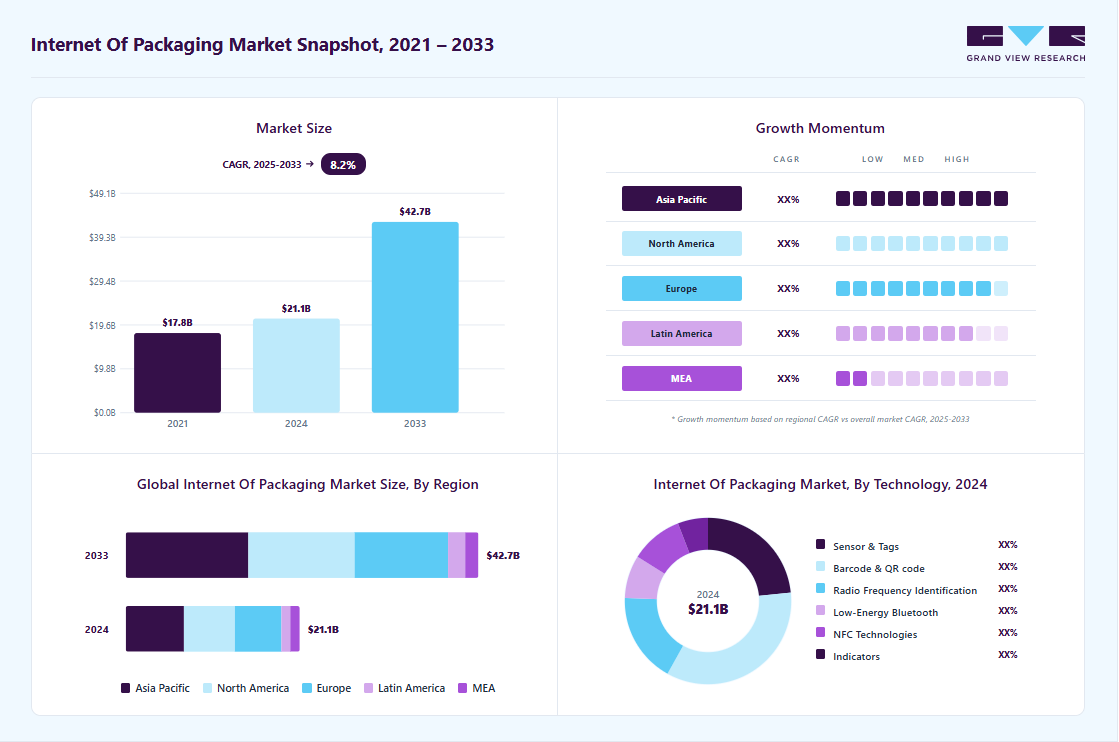
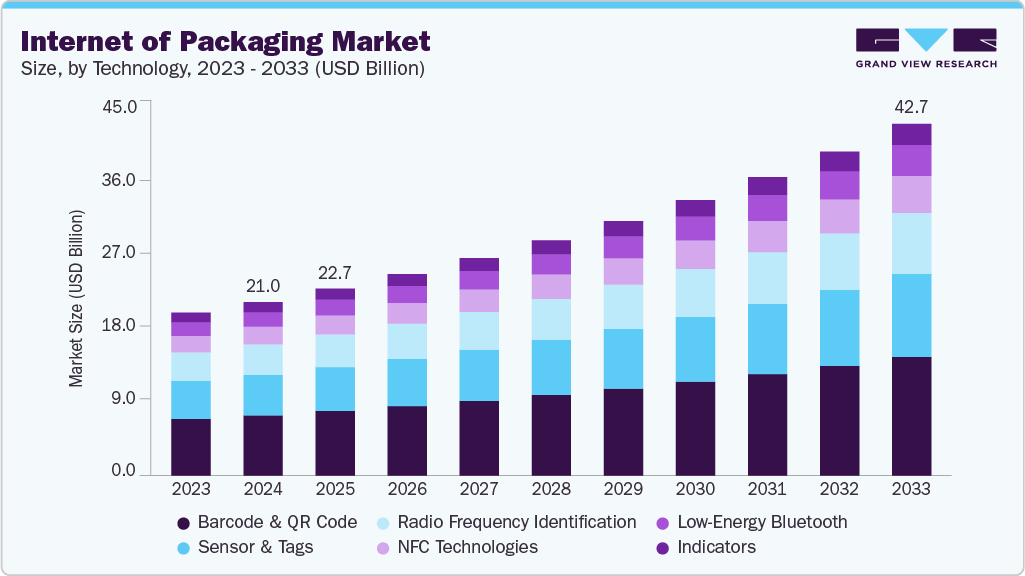
The global internet of packaging market size was estimated at USD 21.05 billion in 2024 and is projected to reach USD 42.67 billion by 2033, growing at a CAGR of 8.2% from 2025 to 2033. The growing demand for smart packaging solutions that enhance product traceability, consumer engagement, and supply chain transparency drives the market.
 Source: Grand View Research, IR Documents, Primary Interviews, Paid DatabasesTo learn more about this report,
 Download Free Sample Report
 Key Market Trends & Insights
- North America dominated the internet of packaging market with the largest revenue share of over 35.0% in 2024.
- The internet of packaging market in the U.S. is expected to grow at a substantial CAGR of 8.4% from 2025 to 2033.
- By technology, the low-energy Bluetooth segment is expected to grow at a fastest CAGR of 8.9% from 2025 to 2033 in terms of revenue.
- By end use, the healthcare segment is expected to grow at a fastest CAGR of 8.9% from 2025 to 2033 in terms of revenue.
Market Size & Forecast
- 2024 Market Size: USD 21.05 Billion
- 2033 Projected Market Size: USD 42.67 Billion
- CAGR (2025-2033): 8.2%
- North America: Largest market in 2024
- Asia Pacific: Fastest growing market
Three ways to get this report
Buy it, customize it, or ask a question.Ask an Analyst
Analyst response in 1 business day
- AccessReport author, directly
- Reply timeWithin 1 working day
- No sales callDirect answer only
- FormatEmail reply
- CostFree, no cost
Get the Full Report
What the study covers
- FormatsPDF · Excel · Dashboard
- Timeline2025–2033 annual, 2024 base
- Coverage20+ countries, 5 regions
- Companies10+ key players profiled
Customize the Report
20% free customization
- IncludeCountries, segments, points
- TailorTo your product definition
- ExtendDeeper competitor detail
- OrA fully bespoke study
- Turnaround5–10 working days
In addition, the rising adoption of IoT technologies and NFC/RFID-enabled packaging fuels market growth. Modern consumers increasingly seek transparency, authenticity, and real-time product information. IoT-enabled packaging, integrated with QR codes, NFC (Near Field Communication), or RFID (Radio Frequency Identification) tags, allows consumers to access detailed product data instantly, including origin, expiry date, nutritional content, and authentication features. For example, luxury cosmetic brands like L’Oréal have started integrating QR codes on their packaging to allow customers to verify product authenticity and engage with personalized content, enhancing brand trust and customer engagement.The global surge in counterfeit goods and increasing concerns over food safety are key factors driving the adoption of internet of packaging (IoP) solutions. Packaging with IoT capabilities can track and authenticate products throughout the supply chain, reducing the risk of counterfeit items reaching consumers. In the pharmaceutical industry, companies such as Pfizer and Johnson & Johnson are piloting IoP solutions to ensure that medicines are traceable from production to the pharmacy, minimizing counterfeit risks and enhancing consumer safety. Similarly, IoP can monitor storage conditions in the food industry, such as temperature and humidity, ensuring products remain safe and fresh during transport and storage.
 To learn more about this report, Download Free Sample Report
 Advancements in IoT, blockchain, and cloud computing enable deploying highly secure, scalable, and cost-effective IoP solutions. Packaging integrated with IoT sensors can collect real-time data, which can be stored and analyzed via cloud platforms to improve supply chain efficiency and inventory management. Blockchain technology further ensures the integrity of product data by providing tamper-proof records. For instance, beverage companies like Diageo use blockchain-enabled smart packaging to track the origin and journey of premium spirits, which helps both in anti-counterfeiting and in offering an interactive consumer experience.
The rapid expansion of e-commerce and D2C sales channels is another significant driver for IoP adoption. With the increase in online purchases, consumers often lack physical interaction with products before purchase, making trust and authenticity crucial. IoP packaging addresses this by providing digital engagement opportunities, product verification, and real-time tracking. Companies such as Nestlé and Unilever have begun deploying IoP-enabled packaging for certain product lines to improve transparency, enhance customer engagement, and reduce returns by ensuring product authenticity and condition upon delivery.
Market Concentration & Characteristics
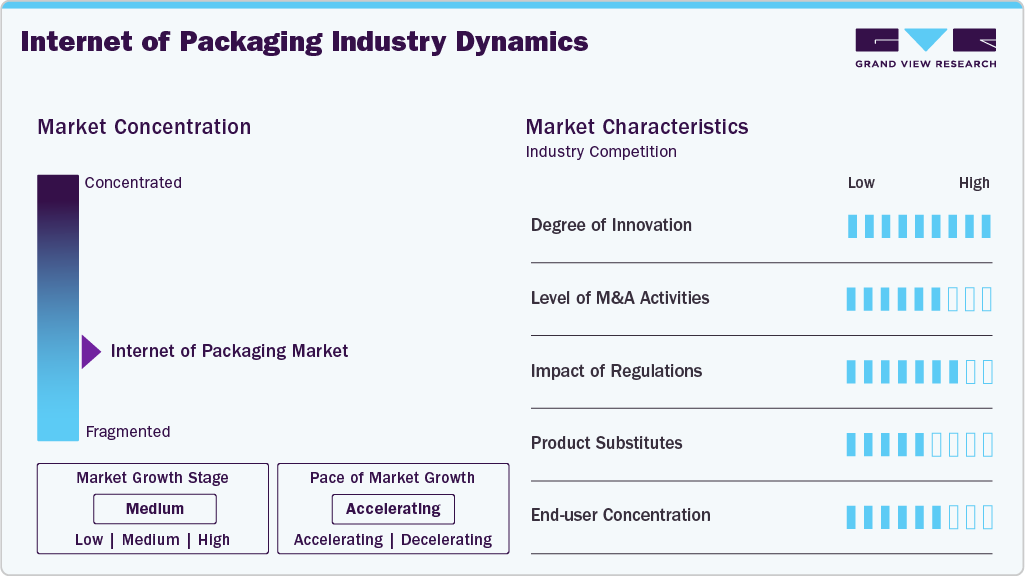
The internet of packaging (IoP) industry is fundamentally technology-centric, relying on advancements in IoT, NFC, RFID, QR codes, blockchain, and cloud computing. Innovation is constant, as companies strive to develop smarter, more interactive packaging solutions that enhance product traceability, consumer engagement, and supply chain efficiency. For example, tech-driven startups are creating packaging that can monitor temperature, humidity, and tampering in real time, making the industry highly dynamic and research-intensive.
 To learn more about this report, Download Free Sample Report
 A defining characteristic of the IoP industry is its focus on data generation and analytics. IoT-enabled packaging captures valuable consumer and supply chain data, enabling brands to make informed decisions, enhance marketing strategies, and optimize logistics. Companies such as Nestlé and Unilever leverage insights from IoP solutions to monitor product movement, reduce waste, and create personalized customer experiences, highlighting the industry’s strong link with data intelligence and digital transformation.
Technology Insights
The barcode & QR code segment recorded the largest market revenue share of over 34.0% in 2024. Barcodes and QR codes are the most widely used identification technologies in packaging. Barcodes are linear patterns that encode product ID, batch number, or price information, while QR codes can store larger datasets, including URLs, manufacturing details, or traceability information. They are used across retail, FMCG, and pharmaceutical sectors to enable inventory management, anti-counterfeiting, and customer engagement. Regulatory mandates for traceability in food and pharmaceuticals are accelerating the adoption. In addition, rising smartphone penetration makes QR codes an effective tool for direct consumer interaction.
The low-energy Bluetooth (BLE) segment is expected to grow at the fastest CAGR of 8.9% during the forecast period. BLE enables continuous communication between products and nearby devices over short distances with minimal energy consumption. This technology allows proximity marketing, asset tracking, and smart home integration. BLE adoption is driven by its ability to enable real-time engagement, accurate location tracking, and extended battery life for connected devices. BLE also supports dynamic pricing, promotions, and consumer loyalty programs, creating marketing incentives.
End Use Insights
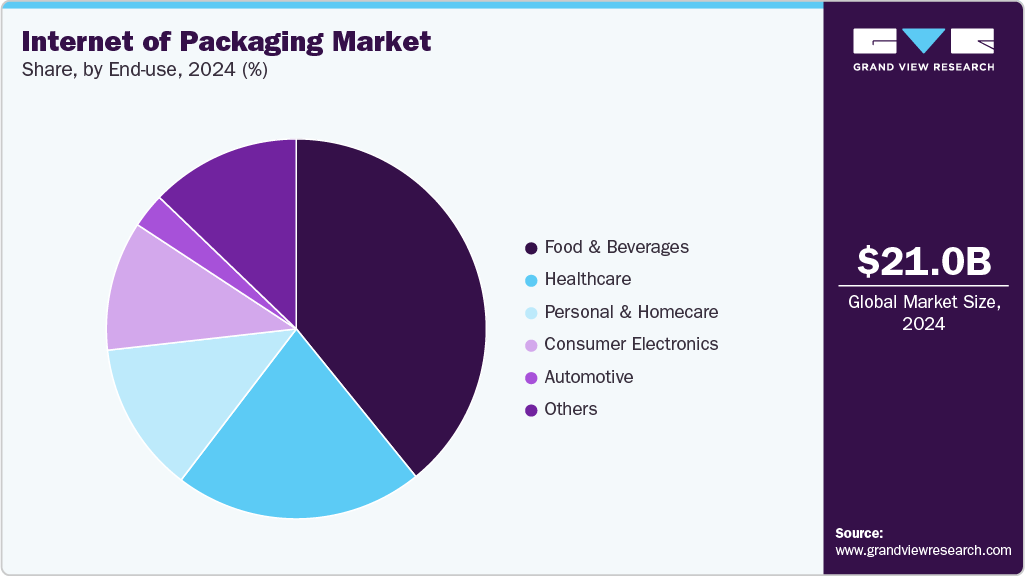
The food & beverage segment recorded the largest market share of over 36.0% in 2024. This segment dominates the IoP market by leveraging smart packaging to enhance food safety, traceability, and consumer engagement. IoP technologies monitor freshness, track supply chain movements, and provide consumers with nutritional information or interactive experiences. For instance, beverage brands like Coca-Cola and Pepsi have implemented QR-enabled packaging campaigns to engage consumers with promotions, sustainability messages, or gamified content. Smart packaging also helps prevent counterfeit premium food products such as dairy, organic items, or imported delicacies. Regulatory pressures on food safety and anti-counterfeit measures further encourage brands to invest in IoP technologies.
 To learn more about this report, Download Free Sample Report
 The healthcare segment is projected to grow at the fastest CAGR of 8.9% during the forecast period. In healthcare, IoP enables real-time monitoring of pharmaceuticals and medical devices. Smart packaging tracks temperature-sensitive medicines such as vaccines, monitors dosage compliance, and prevents counterfeit drugs. IoP also helps hospitals and pharmacies manage inventories efficiently, reducing wastage and ensuring patient safety. The primary drivers include stringent regulatory requirements, rising counterfeit drug incidents, and the need for patient-centric healthcare solutions.
Regional Insights
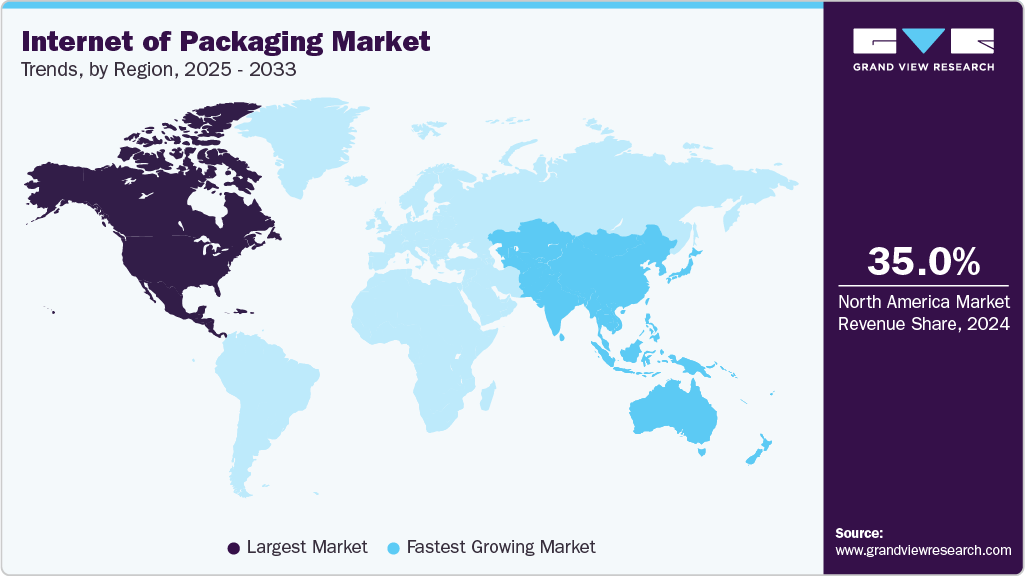
North America dominated the market and accounted for the largest revenue share of over 35.0% in 2024. This positive outlook is due to high technological penetration, early adoption of IoT solutions, and a mature retail and e-commerce ecosystem. In particular, the U.S. invests heavily in smart packaging technologies to improve supply chain transparency, anti-counterfeiting measures, and consumer engagement. Brands such as Nestlé and Johnson & Johnson have integrated IoP solutions for pharmaceuticals and food products, using NFC and blockchain to provide traceability and product authentication.
 To learn more about this report, Download Free Sample Report
 U.S. Internet of Packaging Market Trends
The internet of packaging market in the U.S. drives North America due to early technological adoption, high consumer demand for transparency, and a mature retail ecosystem. Companies across the food & beverage, pharmaceuticals, and luxury goods sectors use smart packaging solutions to offer interactive experiences and track product authenticity. For example, Johnson & Johnson uses IoP solutions to ensure medicine traceability and safety.
Europe Internet of Packaging Market Trends
The internet of packaging market in Europe is growing due to stringent regulations around food safety, pharmaceuticals, and consumer goods, which promote traceable and interactive packaging solutions. Countries such as Germany, France, and the UK have seen rapid adoption of IoP technologies in the pharmaceutical and luxury sectors, where authenticity and anti-counterfeiting are critical. For example, German pharmaceutical companies are deploying NFC-enabled smart packaging to ensure compliance with EU anti-counterfeit directives and to enhance consumer safety.
Asia Pacific Internet of Packaging Market Trends
The internet of packaging market in the Asia Pacific is witnessing strong growth at the fastest CAGR of 8.5% during the forecast period, owing to its large consumer base, rapid e-commerce growth, and increasing adoption of smart packaging technologies. Countries such as China, Japan, and India are witnessing rising demand for interactive and traceable packaging in food & beverages, pharmaceuticals, and luxury goods. The surge in smartphone penetration and digital literacy in this region further supports adopting QR codes, NFC, and IoT-enabled packaging, allowing consumers to engage directly with products. For example, Chinese e-commerce giant Alibaba has experimented with smart packaging for luxury and perishable goods to enhance consumer trust and authenticity verification.
Key Internet of Packaging Company Insights
The market is moderately fragmented with a mix of global technology giants, specialized packaging solution providers, and emerging startups competing for market share. Key players differentiate themselves through smart packaging innovations, integration of IoT and NFC technologies, and advanced data analytics capabilities. Competitive strategies often include partnerships with consumer goods companies, acquisitions of smaller tech firms, and investments in R&D to enhance traceability, consumer engagement, and sustainability features. Price pressures are moderate due to the value-added nature of IoP solutions, while market entry barriers, such as technology expertise and regulatory compliance, maintain a balance between competition and opportunities for innovation-driven growth.
Key Internet of Packaging Companies:
The following are the leading companies in the internet of packaging market. These companies collectively hold the largest market share and dictate industry trends.
- Avery Dennison
- Thinfilm
- CCL Industries
- Zebra Technologies
- Inovar Packaging Group
- Schreiner Group
- TOPPAN Holdings Inc.
- Mayr-Melnhof Karton AG
- Graphic Packaging International, LLC
- NATco
Recent Developments
-
In August 2025, Zebra Technologies showcased solutions at Automate 2025 to boost packaging line visibility, including the Aurora Scan Tunnel, AI vision sensors, and RFID tools. The Aurora Scan Tunnel enables high-speed six-sided barcode scanning, package dimensioning, damage inspection, and hazardous goods label detection. In collaboration with Xemelgo, Zebra’s RFID tech provides real-time inventory tracking and shipping verification. Its AI-powered NS42 vision sensor detects anomalies and ensures quality control, enhancing throughput, accuracy, and operational insights in automated packaging.
-
In June 2025, Avery Dennison launched the first RFID label recognized for recyclability by the Association of Plastic Recyclers (APR), compatible with North America's PET recycling. Using its CleanFlake adhesive, the label separates cleanly during recycling, reducing contamination and boosting material recovery. This innovation enhances sortation, traceability, and inventory visibility, supporting major brands’ sustainability goals.
Internet of Packaging Market Report Scope
Report Attribute
Details
Market size value in 2025
USD 22.68 billion
Revenue forecast in 2033
USD 42.67 billion
Growth rate
CAGR of 8.2% from 2025 to 2033
Actual data
2021 - 2024
Forecast period
2025 - 2033
Quantitative units
Revenue in USD million/billion, and CAGR from 2025 to 2033
Report coverage
Revenue forecast, competitive landscape, growth factors, and trends
Segments covered
Technology, end use, region
Regional scope
North America; Europe; Asia Pacific; Latin America; Middle East & Africa
Country scope
U.S.; Canada; Mexico; Germany; France; UK; Italy; Spain; China; India; Japan; Australia; South Korea; Brazil; Argentina; South Africa; Saudi Arabia; UAE
Key companies profiled
Avery Dennison; Thinfilm; CCL Industries; Zebra Technologies; Inovar Packaging Group; Schreiner Group; TOPPAN Holdings Inc.; Mayr-Melnhof Karton AG; Graphic Packaging International, LLC; NATco
Customization scope
Free report customization (equivalent up to 8 analyst’s working days) with purchase. Addition or alteration to country, regional, and segment scope.
Pricing and purchase options
Avail customized purchase options to meet your exact research needs. Explore purchase options
Global Internet of Packaging Market Report Segmentation
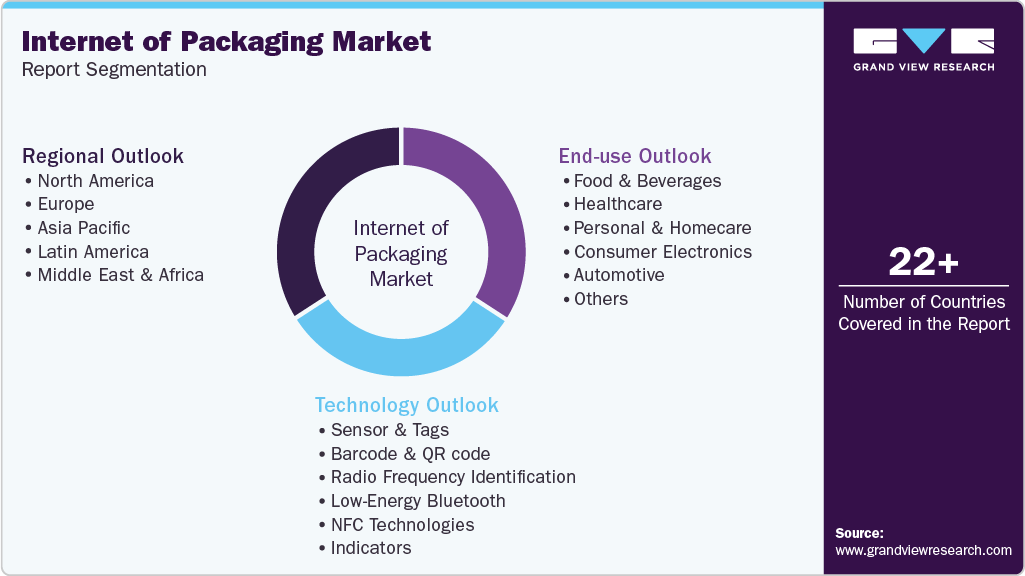
This report forecasts revenue growth at a global level and provides an analysis of the latest industry trends in each of the sub-segments from 2021 to 2033. For this study, Grand View Research has segmented the global internet of packaging market report based on technology, end use, and region:
 To learn more about this report, Download Free Sample Report
 -
Technology Outlook (Revenue, USD Million, 2021 - 2033)
-
Sensor & Tags
-
Barcode & QR code
-
Radio Frequency Identification
-
Low-Energy Bluetooth
-
NFC Technologies
-
Indicators
-
-
End Use Outlook (Revenue, USD Million, 2021 - 2033)
-
Food & Beverages
-
Healthcare
-
Personal & Homecare
-
Others
-
Consumer Electronics
-
Automotive
-
-
Regional Outlook (Revenue, USD Million, 2021 - 2033)
-
North America
-
U.S.
-
Canada
-
Mexico
-
-
Europe
-
Germany
-
France
-
UK
-
Italy
-
Spain
-
-
Asia Pacific
-
China
-
India
-
Japan
-
Australia
-
South Korea
-
-
Latin America
-
Brazil
-
Argentina
-
-
Middle East & Africa
-
South Africa
-
Saudi Arabia
-
UAE
-
-
Frequently Asked Questions About This Report
The internet of packaging market was estimated at around USD 21.05 billion in the year 2024 and is expected to reach around USD 22.68 billion in 2025.
The internet of packaging market is expected to grow at a compound annual growth rate of 8.2% from 2025 to 2033 to reach around USD 42.67 billion by 2033.
The food & beverage segment dominates the internet of packaging market due to increasing demand for product transparency, freshness monitoring, and traceability across the supply chain.
The key players in the internet of packaging market include Avery Dennison; Thinfilm; CCL Industries; Zebra Technologies; Inovar Packaging Group; Schreiner Group; TOPPAN Holdings Inc.; Mayr-Melnhof Karton AG; Graphic Packaging International, LLC; and NATco.
The market is driven by the growing demand for smart packaging solutions that enhance product traceability, consumer engagement, and supply chain transparency.
About the Author(s)
Plastics, Polymers & Resins Research Team
Bulk Chemicals · Plastics, Polymers & ResinsThis report was authored by the plastics, polymers & resins research team at Grand View Research - comprising two research analysts, one senior research analyst, and one industry expert - with specialized expertise in the plastics, polymers & resins segment of the bulk chemicals industry. All findings are based on proprietary bulk chemicals databases, executive interviews, and regulatory analysis, subject to internal peer review prior to publication.
Last Updated:
Speak to Analyst

Customize this report to your needs - add regions, segments, or data points, with 20% free customization.
Or view our licence options:


ISO 9001:2015 & 27001:2022 Certified
We are GDPR and CCPA compliant! Your transaction & personal information is safe and secure. For more details, please read our privacy policy.


