
- Home
- »
- Plastics, Polymers & Resins
- »
-
Intrinsically Conductive Polymers Market, Industry Report, 2033GVR Report cover

Intrinsically Conductive Polymers Market (2025 - 2033) Size, Share & Trends Analysis Report By Product (PANI, PPy, PEDOT, PT), By End-use (Electronics & Electricals, Automotive, Energy Storage, Medical Devices, Coatings & Anticorrosion), By Region, And Segment Forecasts
Market Size, 2024
$3.5BMarket Estimate, 2026
$3.8BMarket Forecast, 2033
$7.1BCAGR, 2025–2033
8.1%Intrinsically Conductive Polymers Market Summary
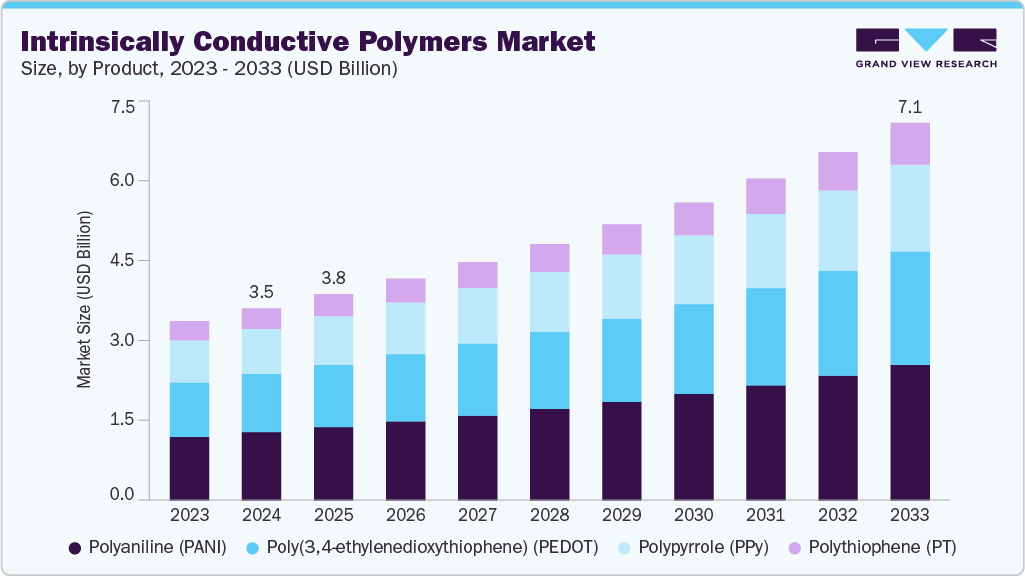
The global intrinsically conductive polymers market size was estimated at USD 3.51 billion in 2024 and is projected to reach USD 7.06 billion by 2033, growing at a CAGR of 8.1% from 2025 to 2033. The growth is driven by the growing use of conductive polymers in renewable energy systems, especially in flexible solar panels and advanced batteries, as they improve efficiency and reduce weight.
 Source: Grand View Research, IR Documents, Primary Interviews, Paid DatabasesTo learn more about this report,
 Download Free Sample Report
 Key Market Trends & Insights
- Asia Pacific dominated the intrinsically conductive polymers market with the largest revenue share of 46.43% in 2024.
- The intrinsically conductive polymers industry in Canada is expected to grow at a substantial CAGR of 9.2% from 2025 to 2033.
- By product, the polythiophene (PT) segment is expected to grow at a considerable revenue CAGR of 8.6% from 2025 to 2033.
- By end use, the automotive segment is expected to grow in revenue at a considerable CAGR of 8.8% from 2025 to 2033.
Market Size & Forecast
- 2024 Market Size: USD 3.51 Billion
- 2033 Projected Market Size: USD 7.06 Billion
- CAGR (2025-2033): 8.1%
- Asia Pacific: Largest market in 2024
Three ways to get this report
Buy it, customize it, or ask a question.Ask an Analyst
A direct answer, usually in 1 working day
- AccessReport author, directly
- Reply timeWithin 1 working day
- No sales callDirect answer only
- FormatEmail reply
- CostFree, no cost
Get the Full Report
What the study covers
- FormatsPDF · Excel · Dashboard
- Timeline2025–2033 annual, 2024 base
- Coverage20+ countries, 5 regions
- Companies10+ key players profiled
Customize the Report
20% free customization
- IncludeCountries, segments, points
- TailorTo your product definition
- ExtendDeeper competitor detail
- OrA fully bespoke study
- Turnaround5–10 working days
Increasing investment in sustainable energy solutions is pushing manufacturers to adopt these materials for long-term performance gains. The Intrinsically Conductive Polymers market is moving from niche laboratory applications toward broader integration in functional electronics and smart materials, driven by improvements in polymer processability and formulation stability. Manufacturers are shifting from proof-of-concept demonstrations to scalable production methods that support roll-to-roll coating and additive manufacturing. End users in automotive, wearable electronics, and energy storage are increasingly specifying conductive polymers for lightweight and flexible designs rather than rigid metal-based solutions. This transition is creating a steady maturity curve where material performance, supply chain readiness, and application engineering are becoming the primary differentiators.
 To learn more about this report, Download Free Sample Report
 Drivers, Opportunities & Restraints
Rapid demand for miniaturized, flexible, and lightweight electronic components is a principal commercial driver for conductive polymers, as device makers seek materials that reduce weight and enable form factors that metals cannot. Concurrent advances in formulation chemistry and compatibilizers have improved conductivity retention and environmental stability, making polymers credible alternatives in sensing, EMI shielding, and printed circuitry. Regulatory pressure to reduce electronic waste and increase recyclability is also encouraging designers to consider polymer-based solutions that can be more easily integrated into circular product strategies. Strong interest from OEMs to reduce assembly complexity further accelerates adoption in prototype and low-volume production.
There is a substantial opportunity to capture value through application-specific formulations and system-level partnerships that tie conductive polymers to modular electronics platforms. Companies that invest in co-development with OEMs to tailor adhesion, conductivity profile, and rheology for particular manufacturing lines can command premium positioning and recurring revenue. Adjacent service offerings such as design for manufacturability, standardization of testing protocols, and take back schemes for end of life create differentiated business models beyond commodity resin sales. Expansion into emerging markets for smart packaging, medical disposables, and industrial sensing offers a large white space where localized technical support and small batch customization will win share.
Widespread commercialization is constrained by inconsistent long-term performance data and by compatibility challenges when integrating conductive polymers into established manufacturing ecosystems. Variability in batch-to-batch conductivity, sensitivity to moisture, and limited thermal tolerance raise concerns among conservative buyers who require predictable lifecycles for mission-critical systems. Supply chain limitations for specialty monomers and cost volatility compared with conventional conductive materials increase procurement risk for large-scale adopters. Until independent, standardized reliability metrics and easier integration recipes are widely available, many large OEMs will continue to prefer incumbent materials for high-volume production.
Market Concentration & Characteristics
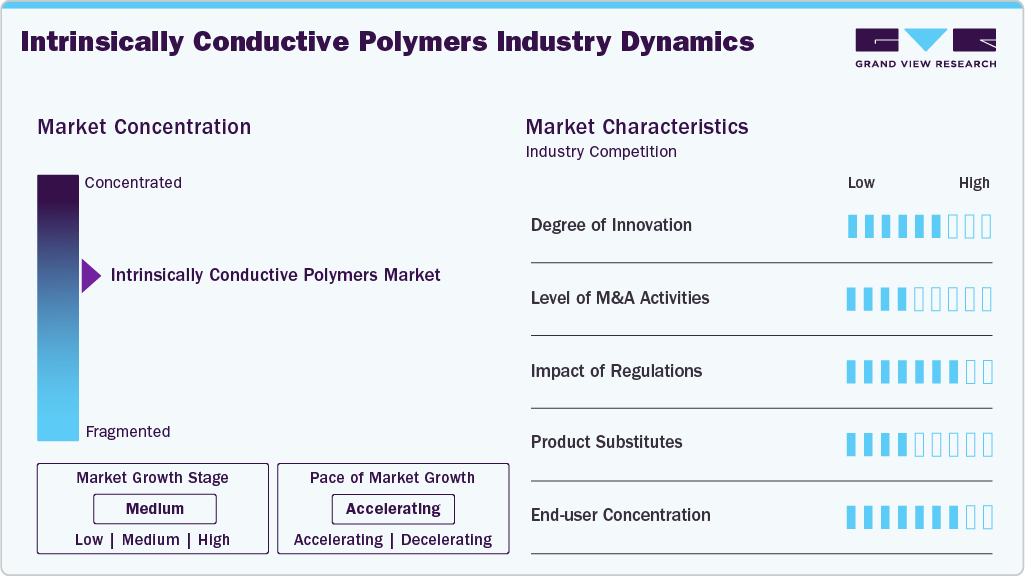
The growth stage of the intrinsically conductive polymers market is high, and the pace is accelerating. The market exhibits slight fragmentation, with key players dominating the industry landscape. Major companies like 3M, Solvay, SABIC, PolyOne Corporation, Lehmann & Voss & Co., RTP Company, Parker Hannifin, Sumitomo Chemical, Premix OY, Heraeus Group, The Lubrizol Corporation, Covestro, and others play a significant role in shaping the market dynamics. These leading players often drive innovation within the market, introducing new products, technologies, and applications to meet evolving industry demands.
Innovation in the intrinsically conductive polymers industry is converging along two tracks: materials chemistry and manufacturability. Breakthroughs such as plasticizer-enabled PEDOT: PSS formulations and transfer printing methods have materially improved conductivity, stretchability, and compatibility with roll-to-roll processes, closing the gap with traditional conductors for flexible and wearable electronics. Parallel work on eco-friendly, bio-based conductive pastes and printable polymer inks is widening application windows into biomedical and disposable sensors where non-toxicity and printability matter as much as raw performance. These advances are shifting the market from lab curiosities to commercially engineered materials with defined process windows and supplier support models.
 To learn more about this report, Download Free Sample Report
 Conductive polymers now compete with a broad set of substitutes that each carry different trade-offs: silver and copper nanoparticle inks for the highest conductivity and mature printing workflows, carbon allotropes such as graphene and carbon nanotubes for cost and mechanical resilience, and emerging liquid metal and shape-shifting inks that deliver unique stiffness and conductivity profiles. Buyers evaluate substitutes on a mix of unit cost, process compatibility, lifecycle stability, and regulatory risk, which means polymers win where flexibility, low mass, and biocompatibility are prioritized. At the same time, metal or carbon solutions remain preferred for high-current or harsh environment applications. The rising variety of hybrid and composite inks is intensifying supplier competition but also expanding use cases across consumer, industrial, and medical segments.
Product Insights
Polyaniline (PANI) dominated the intrinsically conductive polymers market with the largest revenue share of 35.65% in 2024, and is forecasted to grow at an 8.2% CAGR from 2025 to 2033. Polyaniline’s commercial momentum is being driven by its versatility across electrochemical applications where cost-effective synthesis and tunable doping chemistry meet real-world needs. Buyers in anticorrosion coatings, electrochemical sensors, and secondary batteries favor PANI because its chemistry allows rapid tailoring of conductivity, adhesion, and environmental stability for specific manufacturing processes. Suppliers that can offer consistent batch quality and application support are finding faster adoption among industrial end users who prioritize lifecycle predictability over experimental performance.
The polythiophene (PT) segment is anticipated to grow at a substantial CAGR of 8.6% over the forecast period. Polythiophene derivatives are gaining traction as a driver of organic and printed electronics because they combine superior processability with proven performance as electron donor materials in organic photovoltaics and flexible devices. Manufacturers of flexible solar modules and printable semiconductors prefer PT chemistries for their film-forming ability and compatibility with roll-to-roll processing, enabling lower unit costs at scale. Market entrants that translate lab-scale efficiencies into manufacturable ink formulations are therefore capturing design wins with OEMs focused on lightweight, bendable power and display solutions.
End-use Insights
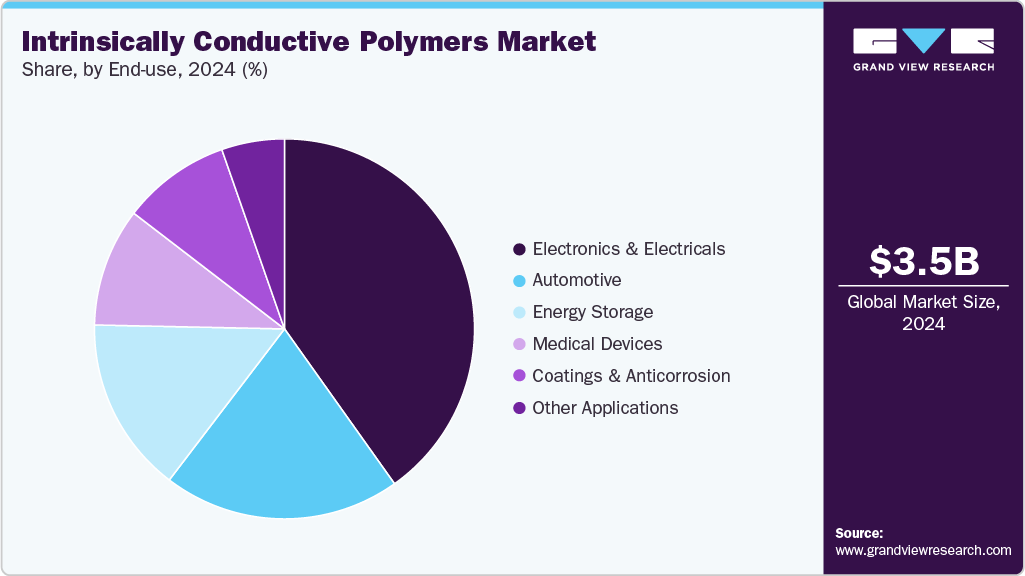
The electronics and electricals segment dominated the intrinsically conductive polymers industry with the largest revenue share of 40.17% in 2024, and is forecasted to grow at an 8.3% CAGR from 2025 to 2033. Demand from electronics and electricals is principally propelled by the move to printed and flexible circuitry, where conductive polymers enable integration of functions like sensing, interconnects, and EMI shielding without adding weight or assembly complexity. Design teams value materials that allow direct deposition onto plastic substrates and that reduce the need for heavy metal components, accelerating adoption in wearables, IoT modules, and flexible antennas. Suppliers who provide validated process windows and compatibility data for common PCB and substrate lines win procurement preference from conservative OEM purchasing groups.
 To learn more about this report, Download Free Sample Report
 The automotive segment is expected to grow at a substantial CAGR of 8.8% through the forecast period. Automotive adoption is being driven by vehicle electrification and the industry’s relentless focus on weight reduction and system integration, which creates natural use cases for conductive polymers in sensors, printed heating films, and lightweight wiring alternatives. Tier one suppliers and OEMs are piloting polymer-based solutions to replace bulky metal assemblies in cabins and battery management systems, where even small mass savings translate to efficiency gains. Commercial scale uptake hinges on suppliers demonstrating thermal stability, long-term cycle life, and clear failure mode data so that conductive polymers can move from pilot projects into volume vehicle platforms.
Regional Insights
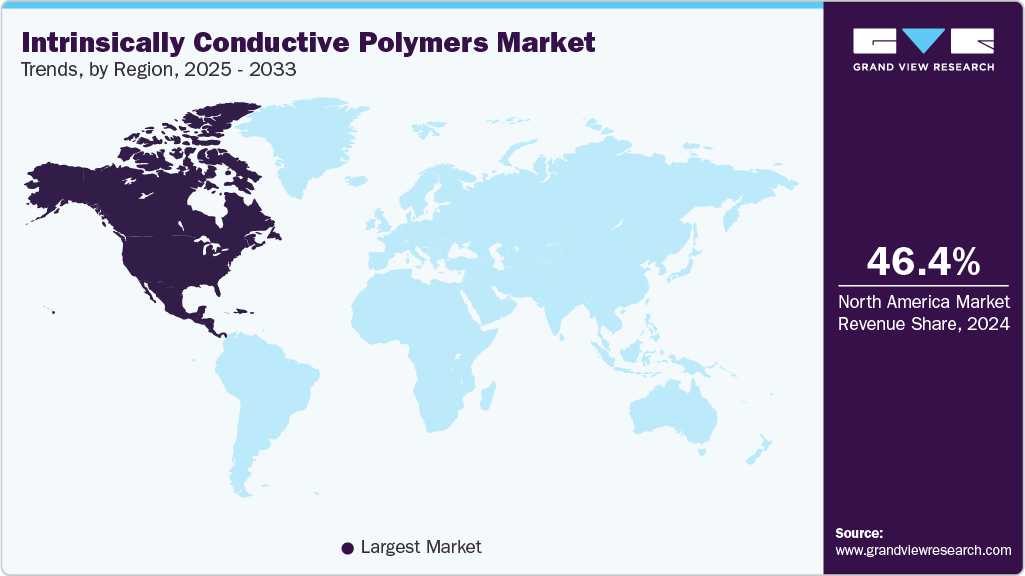
The North America intrinsically conductive polymers market held the significant revenue share in 2024. Adoption in North America is being propelled by strong cross-sector demand from advanced electronics, energy storage, and medical device makers that prize rapid prototyping and flexible form factors. Large OEMs and component suppliers in the region are investing in qualified supply chains and pilot lines to translate conductive polymer chemistries into reliable manufacturing processes, shortening the time from material qualification to design wins. Regulatory attention to product recyclability and lightweighting for transportation and consumer goods further encourages material substitution away from metal-heavy solutions. Suppliers that provide process support and validated performance data are therefore seeing faster commercial traction.
 To learn more about this report, Download Free Sample Report
 U.S. Intrinsically Conductive Polymers Market Trends
In the U.S., the primary commercial driver is vehicle electrification and advanced sensing for defense and industrial automation, which create high-value use cases for conductive polymers in battery management, sensor films, and electromagnetic interference control. Federal and corporate R&D funding is accelerating materials scale-up and standards development, enabling tier one suppliers to pilot polymer-based alternatives in constrained weight and volume applications. Procurement teams are increasingly receptive to materials that reduce assembly complexity, provided they come with clear reliability data and integration roadmaps.
Asia Pacific Intrinsically Conductive Polymers Market Trends
The APAC intrinsically conductive polymers market held the largest revenue share of 46.43% in 2024 and is expected to grow at the fastest CAGR of 8.5% over the forecast period. The market growth is driven by the region’s dominant consumer electronics manufacturing base and rapidly scaling EV supply chains, which create both high-volume demand and local opportunities for formulation and ink house services. Proximity between materials developers, contract manufacturers, and OEMs enables fast iteration on processability and cost to support roll-to-roll and printed electronics adoption. Local players who can deliver low-cost, manufacturable conductive polymer inks and local technical support are best positioned to capture market share as volume applications move from pilot to production.
The growth of the China intrinsically conductive polymers market is driven by a potent combination of government-backed industrial policy, massive electronics and battery manufacturing capacity, and rapid deployment of smart consumer devices that favor lightweight, printable conductors. Domestic material suppliers are scaling specialty monomer and formulation capabilities to meet local content requirements and aggressive cost targets. At the same time, downstream OEMs push for integrated supply agreements that include co-development and quality assurance. Companies that localize production and alignment with China’s industrial roadmap will have a decisive edge in this market.
Europe Intrinsically Conductive Polymers Market Trends
The demand in the Europe intrinsically conductive polymers industry is shaped by sustainability policy and the circular economy agenda, which is pushing designers to favor materials that enable easier end-of-life recovery and lower lifecycle carbon footprints. This regulatory backdrop, combined with strong electrification efforts in e-mobility and renewable energy deployment, is motivating OEMs and converters to trial recyclable or bio-based conductive polymer formulations. Companies that can demonstrate compliance with EU material and recycling directives while offering consistent performance will capture preferential procurement in regulated industries.
Key Intrinsically Conductive Polymers Company Insights
The intrinsically conductive polymers industry is highly competitive, with several key players dominating the landscape. The market is characterized by a competitive landscape with several key players driving innovation and market growth. Major companies in this sector are investing heavily in research and development to enhance the performance, cost-effectiveness, and sustainability of their products.
Key Intrinsically Conductive Polymers Companies:
The following are the leading companies in the intrinsically conductive polymers market. These companies collectively hold the largest market share and dictate industry trends.
- 3M
- Solvay
- SABIC
- PolyOne Corporation
- Lehmann&Voss&Co.
- RTP Company
- Parker Hannifin
- Sumitomo Chemical
- Premix OY
- Heraeus Group
- The Lubrizol Corporation
- Covestro
Recent Developments
-
In March 2024,Toray Industries announced that it had developed an ion-conductive polymer membrane with 10 times the ion conductivity of previous membranes. This breakthrough polymer uses a hopping conduction mechanism, allowing lithium ions to move efficiently through a non-porous membrane. Using their expertise in aramid polymers, Toray designed a polymer with more hopping sites, achieving ionic conductivity in the 10^-4 S/cm range.
-
In October 2023, Solvay announced the launch of SolvaLite 716 FR, an innovative fast-curing epoxy prepreg system designed for a wide range of structural parts and reinforcements in premium battery electric vehicles (BEVs).
Intrinsically Conductive Polymers Market Report Scope
Report Attribute
Details
Market size value in 2025
USD 3.77 billion
Revenue forecast in 2033
USD 7.06 billion
Growth rate
CAGR of 8.1% from 2025 to 2033
Historical data
2021 - 2023
Forecast period
2025 - 2033
Quantitative units
Revenue in USD million/billion, volume in kilotons, and CAGR from 2025 to 2033
Report coverage
Revenue forecast, volume forecast, competitive landscape, growth factors, and trends
Report Segmentation
Product, end use, region
Regional scope
North America; Europe; Asia Pacific; Latin America; Middle East & Africa
Country Scope
U.S.; Canada; Mexico; Germany; France; UK; Spain; Italy; China; Japan; India; South Korea; Brazil; Argentina; Saudi Arabia; South Africa; UAE
Key companies profiled
3M; Solvay; SABIC; PolyOne Corporation; Lehmann & Voss & Co.; RTP Company; Parker Hannifin; Sumitomo Chemical; Premix OY; Heraeus Group; The Lubrizol Corporation; Covestro
Customization scope
Free report customization (equivalent up to 8 analyst’s working days) with purchase. Addition or alteration to country, regional & segment scope
Pricing and purchase options
Avail customized purchase options to meet your exact research needs. Explore purchase options
Global Intrinsically Conductive Polymers Market Report Segmentation
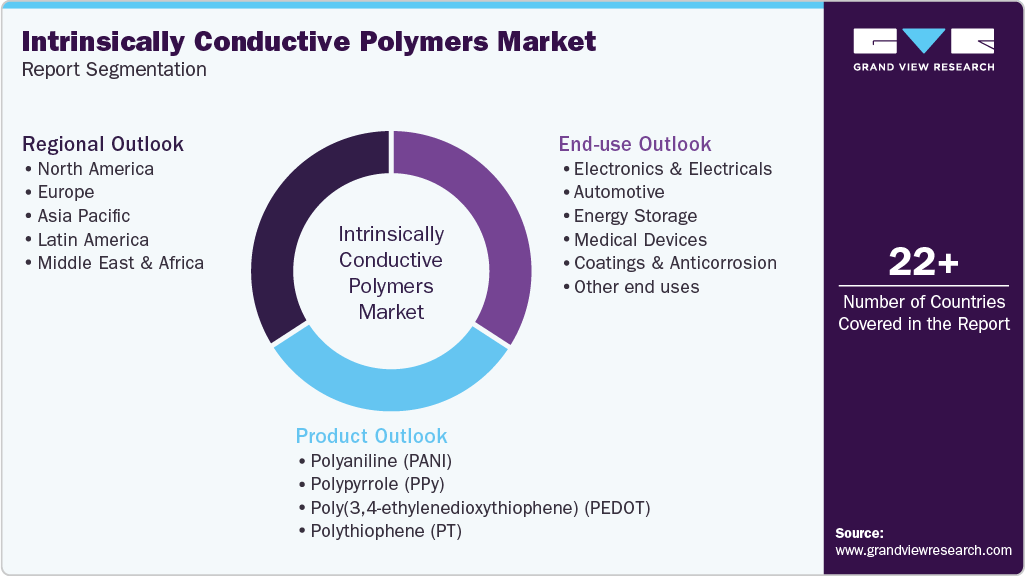
This report forecasts volume & revenue growth at the global, regional, and country levels and provides an analysis of the latest industry trends in each of the sub-segments from 2021 to 2033. For this study, Grand View Research has segmented the global intrinsically conductive polymers market report based on product, end-use, and region:
 To learn more about this report, Download Free Sample Report
 -
Product Outlook (Volume, Kilotons; Revenue, USD Million, 2021 - 2033)
-
Polyaniline (PANI)
-
Polypyrrole (PPy)
-
Poly(3,4-ethylenedioxythiophene) (PEDOT)
-
Polythiophene (PT)
-
-
End-use Outlook (Volume, Kilotons; Revenue, USD Million, 2021 - 2033)
-
Electronics & Electricals
-
Automotive
-
Energy Storage
-
Medical Devices
-
Coatings & Anticorrosion
-
Other end uses
-
-
Regional Outlook (Volume, Kilotons; Revenue, USD Million, 2021 - 2033)
-
North America
-
U.S.
-
Canada
-
Mexico
-
-
Europe
-
Germany
-
UK
-
France
-
Italy
-
Spain
-
-
Asia Pacific
-
China
-
India
-
Japan
-
South Korea
-
-
Latin America
-
Brazil
-
Argentina
-
-
Middle East & Africa
-
Saudi Arabia
-
South Africa
-
UAE
-
-
About the Author(s)
Plastics, Polymers & Resins Research Team
Bulk Chemicals · Plastics, Polymers & ResinsThis report was authored by the plastics, polymers & resins research team at Grand View Research - comprising two research analysts, one senior research analyst, and one industry expert - with specialized expertise in the plastics, polymers & resins segment of the bulk chemicals industry. All findings are based on proprietary bulk chemicals databases, executive interviews, and regulatory analysis, subject to internal peer review prior to publication.
Last Updated:
Speak to Analyst

Customize this report to your needs - add regions, segments, or data points, with 20% free customization.
Or view our licence options:


ISO 9001:2015 & 27001:2022 Certified
We are GDPR and CCPA compliant! Your transaction & personal information is safe and secure. For more details, please read our privacy policy.


