
- Home
- »
- Petrochemicals
- »
-
Liquid Packaging Market Size, Share & Trends Report, 2033GVR Report cover

Liquid Packaging Market (2026 - 2033)
Size, Share & Trends Analysis Report By Material (Plastic, Paper & Paperboard, Glass), By Type (Rigid, Flexible), By End-use (Food and Beverages, Personal Care, Pharmaceutical), By Region, And Segment Forecasts
Market Size, 2025
$389.3BMarket Estimate, 2026
$408.3BMarket Forecast, 2033
$568.8BCAGR, 2026–2033
4.8%Liquid Packaging Market Summary
The global liquid packaging market size was valued at USD 389.3 billion in 2025 and is projected to grow from USD 408.3 billion in 2026 to USD 568.8 billion by 2033, growing at a CAGR of 4.8% from 2026 to 2033. Asia Pacific dominated the market, accounting for the largest global share of 42.5% in 2025. The liquid packaging market is driven by the rising demand for convenient, sustainable, and lightweight packaging solutions in the food & beverage, pharmaceutical, and personal care industries.
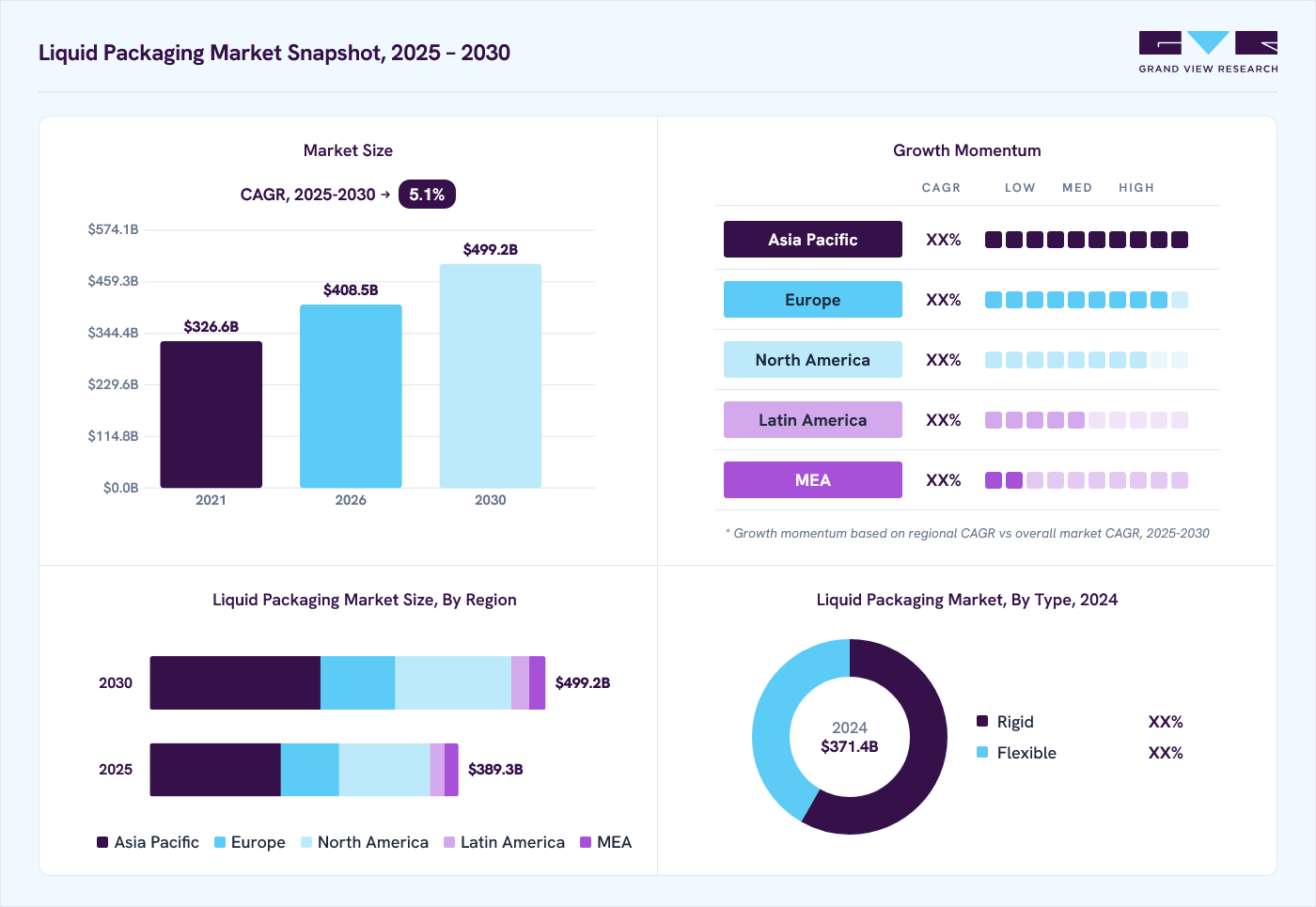 Source: Grand View Research, IR Documents, Primary Interviews, Paid DatabasesTo learn more about this report,
 Download Free Sample Report
 Key Market Trends & Insights
- By material: Plastic segment led the market with the largest revenue share of 39.7% in 2025.
- By type: Rigid segment led the market with the largest revenue share of 57.9% in 2025.
- By end-use: Food & beverages segment led the market with the largest share of 38.3% in 2025.
Regional Highlights
- Largest regional market: Asia Pacific (42.5% revenue share, 2025)
- By country: China held the largest share of Asia Pacific in 2025.
Market Size & Forecast
- Market size in 2025: USD 389.3 Billion
- Estimated market size in 2026: USD 408.3 Billion
- Projected market size by 2033: USD 568.8 Billion
- CAGR (2026-2033): 4.8%
Three ways to get this report
Buy it, customize it, or ask a question.Ask an Analyst
Analyst response in 1 business day
- AccessReport author, directly
- Reply timeWithin 1 working day
- No sales callDirect answer only
- FormatEmail reply
- CostFree, no cost
Get the Full Report
What the study covers
- FormatsPDF · Excel · Dashboard
- Timeline2026–2033 annual, 2025 base
- Coverage20+ countries, 5 regions
- Companies10+ key players profiled
Customize the Report
20% free customization
- IncludeCountries, segments, points
- TailorTo your product definition
- ExtendDeeper competitor detail
- OrA fully bespoke study
- Turnaround5–10 working days
Additionally, advancements in barrier technologies and increasing consumer preference for eco-friendly materials like paper-based and recyclable plastics further fuel market growth. The rising demand for sustainable and eco-friendly packaging is a significant driver for the liquid packaging industry. Consumers and regulatory bodies are increasingly pushing for environmentally friendly solutions, leading to a shift toward recyclable and biodegradable materials. For example, companies such as Tetra Pak and SIG are investing in paper-based liquid cartons with minimal plastic and aluminum layers to improve recyclability. The demand for plant-based and biodegradable plastics, such as polylactic acid (PLA) and bio-PET, is also growing, especially in markets with stringent regulations such as the EU and North America. This trend aligns with global sustainability goals and circular economy initiatives, driving innovation in liquid packaging. To learn more about this report, Download Free Sample Report
 Additionally, an increasing consumption of packaged beverages and dairy products is driving market growth, particularly in emerging markets. Rapid urbanization, changing consumer lifestyles, and rising disposable incomes are fueling the demand for ready-to-drink (RTD) beverages, flavored milk, and plant-based alternatives such as almond and oat milk. For example, in India and China, the demand for aseptic liquid cartons for dairy and juice products is surging due to their longer shelf life and convenience. Additionally, the growth of energy drinks and functional beverages with added vitamins and minerals is driving innovation in packaging formats, including portion-controlled packs and resealable caps.
The growth of e-commerce and home delivery services has further propelled the liquid packaging industry. The shift toward online grocery shopping, accelerated by the COVID-19 pandemic, has increased the demand for sturdy, leak-proof, and tamper-evident liquid packaging solutions. Brands are focusing on lightweight and durable packaging that minimizes transportation costs while ensuring product safety. Flexible pouches with spouts, bag-in-box solutions, and PET bottles with improved barrier properties are becoming more popular for e-commerce distribution. For example, Coca-Cola and PepsiCo have introduced lightweight PET bottles with enhanced durability to cater to the booming direct-to-consumer (DTC) beverage segment.
Market Dynamics
The liquid packaging market is experiencing steady growth, driven by increasing demand for packaged beverages, dairy products, liquid foods, and pharmaceutical liquids. Rising urbanization, changing consumer lifestyles, and the growing preference for convenient and sustainable packaging solutions are supporting market expansion. Advancements in packaging materials and aseptic technologies are improving product shelf life and safety, while increasing adoption of recyclable and renewable packaging aligns with sustainability goals. Although raw material price volatility and regulatory compliance pose challenges, expanding end-use industries and ongoing packaging innovations continue to create growth opportunities for the market.
The primary driver of the liquid packaging market is the increasing global demand for packaged food and beverage products. Rapid urbanization, busy lifestyles, and changing consumption patterns have led consumers to prefer ready-to-drink beverages, dairy products, juices, plant-based drinks, and other conveniently packaged liquid products. As consumption of these products continues to rise across both developed and emerging economies, manufacturers are expanding production capacities and adopting advanced liquid packaging solutions to ensure product protection, portability, and extended shelf life.
The growth of organized retail, e-commerce distribution channels, and on-the-go consumption trends is further accelerating the need for efficient liquid packaging formats. Packaging solutions such as cartons, bottles, pouches, and aseptic containers help maintain product quality while supporting transportation and storage requirements. The increasing focus on sustainable and recyclable packaging materials is also encouraging innovation in liquid packaging, enabling manufacturers to meet evolving consumer expectations and regulatory standards while supporting market growth.
A significant restraint for the liquid packaging market is the volatility in raw material prices, particularly for paperboard, plastics, aluminum, and specialty barrier materials used in packaging production. Price fluctuations can increase manufacturing costs and pressure profit margins for packaging companies and product manufacturers. Furthermore, increasingly stringent environmental regulations and sustainability requirements are compelling companies to invest in recyclable, renewable, and low-carbon packaging solutions, which often involve higher development and production costs. These factors can create operational and financial challenges, particularly for small and mid-sized market participants, potentially limiting market growth.
A major opportunity in the liquid packaging market lies in the increasing adoption of sustainable and aseptic packaging solutions across the food, beverage, and healthcare industries. Rising environmental awareness among consumers and stricter regulations on packaging waste are encouraging manufacturers to develop recyclable, renewable, and lightweight packaging formats. At the same time, growing demand for products with extended shelf life and reduced reliance on refrigeration is driving the use of aseptic packaging technologies. These trends are creating opportunities for packaging companies to innovate with eco-friendly materials, advanced barrier technologies, and resource-efficient production processes, thereby expanding their market presence and enhancing long-term growth potential.
Analyst Perspective
The liquid packaging market is expected to grow steadily, driven by increasing demand for packaged beverages, dairy products, liquid foods, pharmaceuticals, and personal care products. Rising urbanization, evolving consumer lifestyles, and the growing preference for convenient and sustainable packaging solutions are supporting market expansion. Advancements in packaging materials and aseptic technologies are improving product safety and shelf life, while increasing adoption of recyclable packaging formats is creating new growth opportunities. Companies focused on innovation and sustainability are expected to strengthen their market position in the coming years.
Material Insights
Based on material, the plastic segment led the market with the largest revenue share of 39.7% in 2025 and is expected to grow at the fastest CAGR of 5.4% during the forecast period. This positive outlook is due to its lightweight nature, cost-effectiveness, and flexibility. It is widely used across various industries, including food and beverages, personal care, household cleaning, and pharmaceuticals. Different types of plastics, such as PET, HDPE, and LDPE, are commonly used for liquid packaging, providing durability and convenience. The rapid expansion of the e-commerce and food delivery industries has further fueled the need for lightweight, shatterproof, and cost-efficient packaging.
Paper & paperboard are increasingly used in the liquid packaging market, particularly in applications such as dairy products, juices, and plant-based beverages. Paper-based cartons provide a sustainable alternative to plastic packaging while maintaining the required barrier properties through additional coating or laminations. The primary driving factor for paper & paperboard packaging is the rising global emphasis on sustainability and reducing plastic waste.
Glass is a widely used material in the liquid packaging market due to its superior barrier properties, chemical resistance, and ability to preserve the taste and freshness of beverages and pharmaceuticals. It is extensively used in industries such as alcoholic and non-alcoholic beverages, pharmaceuticals, and perfumes. Additionally, glass is 100% recyclable without loss of quality, making it a preferred option for sustainable packaging solutions.
Type Insights
Based on type, the rigid segment led the market with the largest revenue share of 57.9% in 2025. The rising preference for premium packaging in the food and beverage industry, especially for alcoholic and non-alcoholic beverages, is fueling the segment growth. Rigid liquid packaging includes containers made from materials such as plastic, glass, and metal. Common examples include bottles, cartons, cans, and jars, which provide durability and structural integrity to protect liquid contents.
The flexible liquid packaging segment is expected to grow at the fastest CAGR of 5.5% during the forecast period. It consists of pouches, sachets, bag-in-box, and other lightweight packaging products that offer convenience and cost-effectiveness. These packages are typically made from plastic films, foil, and paper-based laminates that provide barrier protection while reducing material usage. Flexible liquid packaging is gaining popularity in industries such as dairy, juices, sauces, and liquid detergents due to its ease of storage, lightweight nature, and extended shelf-life benefits.
End Use Insights
Based on end-use, the food & beverages segment led the market with the largest revenue share of 38.3% in 2025 and is projected to grow at the fastest CAGR of 5.5% during the forecast period. This positive outlook is due to the rising demand for dairy products, juices, soft drinks, and alcoholic beverages. Liquid packaging solutions such as cartons, pouches, bottles, and cans help in maintaining the freshness, safety, and shelf life of consumable liquids. The increasing focus on convenience, sustainability, and extended shelf-life packaging solutions is further fueling the demand for innovative liquid packaging in this sector.
 To learn more about this report, Download Free Sample Report
 The personal care industry includes liquid packaging for products such as shampoos, conditioners, lotions, liquid soaps, and perfumes. Aesthetic appeal, user convenience, and sustainability are key considerations in this segment. Packaging formats include flexible pouches, squeeze bottles, pumps, and spray containers, often with innovative dispensing solutions.
The pharmaceutical industry relies on liquid packaging for syrups, vaccines, intravenous fluids, and other medicinal formulations. Packaging in this segment is crucial for maintaining product integrity, sterility, and dosage accuracy. Glass and plastic bottles, ampoules, vials, and flexible pouches are commonly used in pharmaceutical liquid packaging, ensuring compliance with regulatory standards and patient safety.
Regional Insights
Asia Pacific liquid packaging market dominated the global market and accounted for the largest revenue share of over 42.5% in 2025 and is projected to grow at the fastest CAGR of 5.2% during the forecast period. The region’s dominance in the global liquid packaging market is due to its rapid economic development, increasing urbanization, and changing consumer lifestyles. Countries such as China, India, Japan, and South Korea are experiencing significant growth in packaged consumer goods, particularly in the food and beverage sector. This growth is supported by rising disposable incomes, which enables consumers to purchase more packaged products that offer convenience and longer shelf life.
 To learn more about this report, Download Free Sample Report
 China Liquid Packaging Market Trends
The liquid packaging market in China held the largest share in the Asia Pacific region in 2025. The liquid packaging market in Chinais primarily driven by its massive manufacturing capacity, rapidly growing consumer base, and government policies supporting sustainable packaging initiatives. As the world's most populous nation with a burgeoning middle class, China's demand for packaged beverages, dairy, and other liquid products has increased, necessitating innovative packaging solutions that meet both consumer preferences and regulatory requirements. Chinese companies such as Greatview Aseptic Packaging have emerged as formidable competitors to traditional Western packaging companies, offering cost-effective aseptic carton packaging for milk, juice, and other liquid products.
North America Liquid Packaging Market Trends
The food and beverage industry, particularly the ready-to-drink segment, drives substantial demand for advanced liquid packaging in the region. North America's busy lifestyle has accelerated the consumption of on-the-go beverages, functional drinks, and convenience foods, requiring specialized packaging solutions. The pharmaceutical and personal care industries also contribute significantly, with increasing demand for precise dosing mechanisms and tamper-evident packaging.
The liquid packaging market in the U.S. is primarily driven by its robust industrial infrastructure, technological innovation, and diverse consumer demands. Major manufacturers have invested heavily in advanced packaging technologies that extend shelf life while reducing environmental impact, allowing them to set industry standards worldwide. Companies such as Tetra Pak, Berry Global Inc., and Amcor plc have established significant operations in the U.S., leveraging the country's research capabilities to develop solutions such as aseptic packaging and innovative barrier materials.
Europe Liquid Packaging Market Trends
Europe liquid packaging market’s growth is primarily due to its robust regulatory framework and sustainability initiatives. The European Union's Circular Economy Action Plan and Single-Use Plastics Directive have pushed manufacturers to adopt eco-friendly packaging solutions ahead of other regions. This regulatory pressure has fostered innovation, with companies such as Tetra Pak pioneering recyclable cartons and Carlsberg developing the "Snap Pack," which reduces plastic usage by up to 76% compared to traditional six-pack rings.
Germany liquid packaging market is primarily driven by its robust manufacturing infrastructure, stringent environmental regulations, and innovative approach to packaging solutions. The country's robust circular economy approach has further strengthened its position. Germany's deposit return scheme for beverage containers achieves recycling rates above 90% for PET bottles, creating a reliable stream of high-quality recycled material. This has enabled companies such as ALPLA to develop recycled PET bottles for liquid packaging, meeting the growing consumer demand for sustainable options without compromising performance.
Key Liquid Packaging Company Insights
The global liquid packaging market is highly competitive and fragmented. Prominent players dominate the market through innovations in aseptic and eco-friendly packaging. Market share distribution is influenced by factors such as material advancements, regulatory compliance, and regional consumption trends. Emerging players compete by offering biodegradable and lightweight packaging, while established brands leverage economies of scale and strategic partnerships to maintain dominance.
Key Liquid Packaging Companies:
The following key companies have been profiled for this study on the liquid packaging market.
- Amcor plc
- Sonoco Products Company
- Berry Global Inc
- Stora Enso
- Tetra Pak
- SIG
- DS Smith
- Mondi
- Ball Corporation
- ProAmpac
- Sealed Air
- Smurfit Kappa
- International Paper
- WestRock Company
- Greiner Packaging
- ALPLA
Competitive Benchmarking
Category
Operating Strategies
Competitive Edge
Weakness
Established Players (Amcor plc, Sonoco Products Company, Berry Global Inc., Stora Enso, Tetra Pak, SIG, DS Smith, Mondi, Ball Corporation, Sealed Air, Smurfit Kappa, International Paper, and WestRock Company)
- Focus on large-scale manufacturing, global supply chain integration, and long-term contracts with leading food, beverage, and pharmaceutical companies to maintain market leadership.
- Invest heavily in sustainable packaging technologies, aseptic packaging innovations, and automation to enhance operational efficiency and meet evolving regulatory requirements.
- Extensive global production networks, strong brand recognition, and diversified product portfolios enable them to serve multinational customers across multiple end-use industries.
- Significant financial resources support continuous R&D, technological innovation, and capacity expansion, strengthening their competitive position.
- Large operational structures can reduce agility, making it more challenging to rapidly adapt to changing customer preferences and emerging packaging trends.
- High capital expenditure requirements and complex global supply chains increase exposure to raw material price volatility and regulatory changes.
Emerging Players (ProAmpac, Greiner Packaging, and ALPLA)
- Concentrate on niche liquid packaging segments and customized solutions to address specific customer requirements and differentiate from larger competitors.
- Expand market presence through strategic partnerships, acquisitions, and investments in sustainable and high-performance packaging formats.
- Greater organizational flexibility allows for faster product development, quicker response to market trends, and tailored customer solutions.
- Strong focus on innovation in recyclable, lightweight, and sustainable liquid packaging solutions helps capture emerging market opportunities.
- Limited financial resources and smaller production capacities can restrict large-scale expansion and global market penetration.
- Lower brand visibility and narrower product portfolios may make it difficult to compete for contracts with major multinational customers.
Recent Developments
-
In June 2024, AeroFlexx and Chemipack partnered to introduce sustainable liquid packaging solutions in Europe, addressing the growing demand for eco-friendly alternatives. AeroFlexx, known for its innovative liquid packaging technology, installed its proprietary filling machine at Chemipack’s production site in Poland. This collaboration leverages Chemipack’s expertise in blending and filling operations, with a production capacity exceeding 100 million liters annually, to expand AeroFlexx’s reach in the European market
-
In February 2024, Amcor plc, Stonyfield Organic, and Cheer Pack North America collaborated to launch the first all-polyethylene (PE) spouted pouch, marking a significant advancement in sustainable packaging. This innovative solution replaces Stonyfield Organic's previous multi-laminate packaging for its YoBaby refrigerated yogurt with a mono-material PE design that is recycle-ready and eco-friendly.
Liquid Packaging Market Report Scope
Report Attribute
Details
Market size value in 2025
USD 389.3 billion
Market size value in 2026
USD 408.3 billion
Revenue forecast in 2033
USD 568.8 billion
Growth rate
CAGR of 4.8% from 2026 to 2033
Base year for estimation
2025
Historical data
2021 - 2024
Forecast period
2026 - 2033
Quantitative units
Revenue in USD million/billion, and CAGR from 2026 to 2033
Report coverage
Revenue forecast, company ranking, competitive landscape, growth factors, and trends
Segments covered
Material, type, end-use, region
Regional scope
North America; Europe; Asia Pacific; Latin America; MEA
Country scope
U.S.; Canada; Mexico; Germany; UK; France; Italy; Spain; China; Japan; India; South Korea; Australia; Brazil; Argentina; Saudi Arabia; South Africa; UAE
Key companies profiled
Amcor plc; Sonoco Products Company; Berry Global Inc; Stora Enso; Tetra Pak; SIG; DS Smith; Mondi; Ball Corporation; ProAmpac; Sealed Air; Smurfit Kappa; International Paper; WestRock Company; Greiner Packaging; ALPLA
Customization scope
Free report customization (equivalent up to 8 analysts' working days) with purchase. Addition or alteration to country, regional & segment scope.
Pricing and purchase options
Avail customized purchase options to meet your exact research needs. Explore purchase options
Global Liquid Packaging Market Report Segmentation
This report forecasts revenue growth at a global, regional, and country levels and provides an analysis of the latest industry trends in each of the sub-segments from 2021 to 2033. For this study, Grand View Research has segmented the global liquid packaging market report based on material, type, end use, and region:
 To learn more about this report, Download Free Sample Report
 -
Material Outlook (Revenue, USD Million 2021 - 2033)
-
Glass
-
Plastic
-
Paper & Paperboard
-
Others
-
-
Type Outlook (Revenue, USD Million 2021 - 2033)
-
Rigid
-
Flexible
-
-
End Use Outlook (Revenue, USD Million 2021 - 2033)
-
Food & Beverages
-
Pharmaceutical
-
Personal Care
-
Others
-
-
Region Outlook (Revenue, USD Million 2021 - 2033)
-
North America
-
U.S.
-
Canada
-
Mexico
-
Europe
-
Germany
-
France
-
UK
-
Italy
-
Spain
-
Asia Pacific
-
China
-
India
-
Japan
-
Australia
-
South Korea
-
Central & South America
-
Brazil
-
Argentina
-
Middle East & Africa
-
South Africa
-
Saudi Arabia
-
UAE
-
Research Methodology
The liquid packaging market figures in this report are based on a proven research process that combines executive interviews with secondary research from proprietary databases, company filings, and recognized regulatory and institutional sources. Market size is built through value-chain sizing - reconciling supply-side and demand-side estimates - and triangulated with bottom-up and top-down approaches. Every estimate passes multiple levels of expert validation before publication, with each liquid packaging segment quantified using the revenue-capture definitions in the table below.
Segment Definition
Segment - Material
Revenue capture definition
Glass
Revenue generated from the sale of glass-based liquid packaging solutions designed to provide superior barrier properties, product integrity, and chemical resistance. This segment includes glass bottles and containers used for beverages, pharmaceuticals, personal care products, and specialty liquid applications.
Plastic
Revenue generated from the sale of plastic liquid packaging products manufactured using materials such as PET, HDPE, PP, and other polymers. This segment includes bottles, containers, pouches, and other packaging formats used across food & beverages, pharmaceuticals, and personal care industries.
Paper
Revenue generated from the sale of paper-based liquid packaging solutions designed to offer lightweight, recyclable, and sustainable packaging alternatives. This segment includes liquid cartons and paperboard-based containers used for dairy products, juices, beverages, and other liquid food applications.
Others
Revenue generated from the sale of liquid packaging products manufactured using alternative materials such as metal, aluminum composites, bio-based materials, and multi-layer structures. This segment includes packaging solutions used for specialized liquid storage, transportation, and dispensing applications.
Segment - Type
Revenue capture definition
Rigid
Revenue generated from the sale of rigid liquid packaging formats that maintain their shape during handling, storage, and transportation. This segment includes bottles, jars, cartons, cans, and containers used across food & beverages, pharmaceuticals, and personal care applications.
Flexible
Revenue generated from the sale of flexible liquid packaging solutions designed to reduce material consumption, improve transportation efficiency, and enhance convenience. This segment includes pouches, sachets, bag-in-box systems, and other flexible packaging formats used for liquid products.
Segment - End Use
Revenue capture definition
Food & Beverages
Revenue generated from the sale of liquid packaging solutions used for packaging dairy products, juices, soft drinks, alcoholic beverages, edible oils, sauces, and other liquid food products. This segment includes packaging designed to preserve product quality, safety, and shelf life.
Pharmaceuticals
Revenue generated from the sale of liquid packaging products used for medicines, vaccines, syrups, intravenous solutions, and other healthcare liquids. This segment includes packaging solutions designed to meet stringent regulatory, safety, and product protection requirements.
Personal Care
Revenue generated from the sale of liquid packaging solutions used for shampoos, conditioners, lotions, liquid soaps, cosmetics, and other personal care products. This segment includes packaging formats focused on product protection, dispensing convenience, and brand differentiation.
Others
Revenue generated from the sale of liquid packaging products used in industrial chemicals, household care products, agricultural liquids, and other non-food applications. This segment includes specialized packaging designed to ensure safe storage, handling, and transportation of liquid products.
Estimation Model
Layer Name
Key Question
Description
Liquid Consumption Demand Layer
What forms the demand base?
Identify global consumption volumes of liquid products across major end-use industries, including food & beverages, pharmaceuticals, personal care, household products, and industrial liquids. This layer establishes the total addressable demand for liquid packaging solutions by analyzing production, consumption, and distribution volumes of packaged liquid products across key regions.
Packaging Adoption & Penetration Layer
Where are liquid packaging solutions utilized?
Estimate the adoption and penetration of liquid packaging formats across end-use industries and geographic markets. Assess the utilization of glass, plastic, paper, and other packaging materials, along with rigid and flexible formats, based on product requirements, shelf-life considerations, sustainability trends, and regulatory standards.
Packaging Volume & Supply Chain Layer
How much liquid packaging volume is consumed?
Analyze packaging unit volumes generated from liquid product production and distribution activities. Evaluate packaging intensity by product category, filling technology, transportation requirements, storage conditions, and distribution channels. This layer considers factors such as packaging replacement rates, export-import flows, and growth in organized retail and e-commerce networks.
Revenue Layer
How is market revenue generated?
Market revenue is quantified through the sale of liquid packaging products, including bottles, cartons, pouches, containers, and related packaging solutions. Revenue is generated from demand across food & beverages, pharmaceuticals, personal care, and other end-use industries, supported by value-added offerings such as sustainable packaging innovations, aseptic packaging technologies, custom packaging designs, and advanced barrier solutions.
Delivered Customizations
This report has been delivered with the following In-depth customizations
Client Request
Customization Delivered
Value Adds
Regional Segmentation Analysis
Delivered a detailed regional assessment of the liquid packaging market across North America, Europe, Asia Pacific, Central & South America, and Middle East & Africa, covering market size, growth patterns, regulatory landscape, packaging adoption trends, sustainability initiatives, and end-use industry demand.
Enabled identification of high-growth regional markets, investment opportunities, evolving consumer preferences, and region-specific expansion strategies.
Cross-Segmentation Analysis
Conducted a comprehensive cross-segmentation analysis of the liquid packaging market by Material (Glass, Plastic, Paper, Others), Type (Rigid, Flexible), and End Use (Food & Beverages, Pharmaceuticals, Personal Care, Others) across key geographic regions.
Provided detailed insights into demand distribution, high-growth segment combinations, emerging application areas, and strategic market positioning opportunities.
Competitive Benchmarking
Performed benchmarking of key market participants based on product portfolio breadth, packaging material offerings, manufacturing capabilities, geographic presence, sustainability initiatives, innovation focus, and end-use industry penetration.
Facilitated assessment of competitive positioning, identification of market leaders, and evaluation of strategic differentiation opportunities.
Frequently Asked Questions About This Report
The global liquid packaging market size was valued at USD 389.3 billion in 2025 and is estimated at USD 408.3 billion for 2026.
The plastic segment led the liquid packaging market with a 39.7% revenue share in 2025.
Asia Pacific is the fastest-growing region in the liquid packaging market with a CAGR of 5.2% over the forecast period.
The rigid segment led the liquid packaging market with a 57.9% revenue share in 2025.
The food & beverages segment led the liquid packaging market with a 38.3% revenue share in 2025.
Key players in the liquid packaging market include Amcor plc; Sonoco Products Company; Berry Global Inc; Stora Enso; Tetra Pak; SIG; DS Smith; Mondi; Ball Corporation; ProAmpac; Sealed Air; Smurfit Kappa; International Paper; WestRock Company; Greiner Packaging; and ALPLA.
The global liquid packaging market is expected to grow at a CAGR of 4.8% from 2026 to 2033, reaching USD 568.8 billion by 2033.
Key players in the liquid packaging market include Amcor plc; Sonoco Products Company; Berry Global Inc; Stora Enso; Tetra Pak; SIG; DS Smith; Mondi; Ball Corporation; ProAmpac; Sealed Air; Smurfit Kappa; International Paper; WestRock Company; Greiner Packaging; and ALPLA.
Key factors driving the liquid packaging market include rising demand for packaged food and beverages, growing consumption of dairy and ready-to-drink products, increasing pharmaceutical packaging needs, expanding urbanization, and the growing adoption of sustainable and aseptic packaging solutions.
About the Author(s)
Petrochemicals Research Team
Bulk Chemicals · PetrochemicalsThis report was authored by the petrochemicals research team at Grand View Research - comprising two research analysts, one senior research analyst, and one industry expert - with specialized expertise in the petrochemicals segment of the bulk chemicals industry. All findings are based on proprietary bulk chemicals databases, executive interviews, and regulatory analysis, subject to internal peer review prior to publication.
Last Updated:
Speak to Analyst

Customize this report to your needs - add regions, segments, or data points, with 20% free customization.
Or view our licence options:


ISO 9001:2015 & 27001:2022 Certified
We are GDPR and CCPA compliant! Your transaction & personal information is safe and secure. For more details, please read our privacy policy.


