
- Home
- »
- Plastics, Polymers & Resins
- »
-
Marine Waste Polymer Market Size, Share Report 2026-2033GVR Report cover

Marine Waste Polymer Market (2026 - 2033)
Size, Share & Trends Analysis Report By Polymer Type (Polyethylene Terephthalate, Polystyrene, Polypropylene, Polyethylene), By End-use (Consumer Goods, Automotive, Packaging), By Region, And Segment Forecasts
Market Size, 2025
$489.6MMarket Estimate, 2026
$534.7MMarket Forecast, 2033
$1,014.1MCAGR, 2026–2033
9.6%Marine Waste Polymer Market Summary
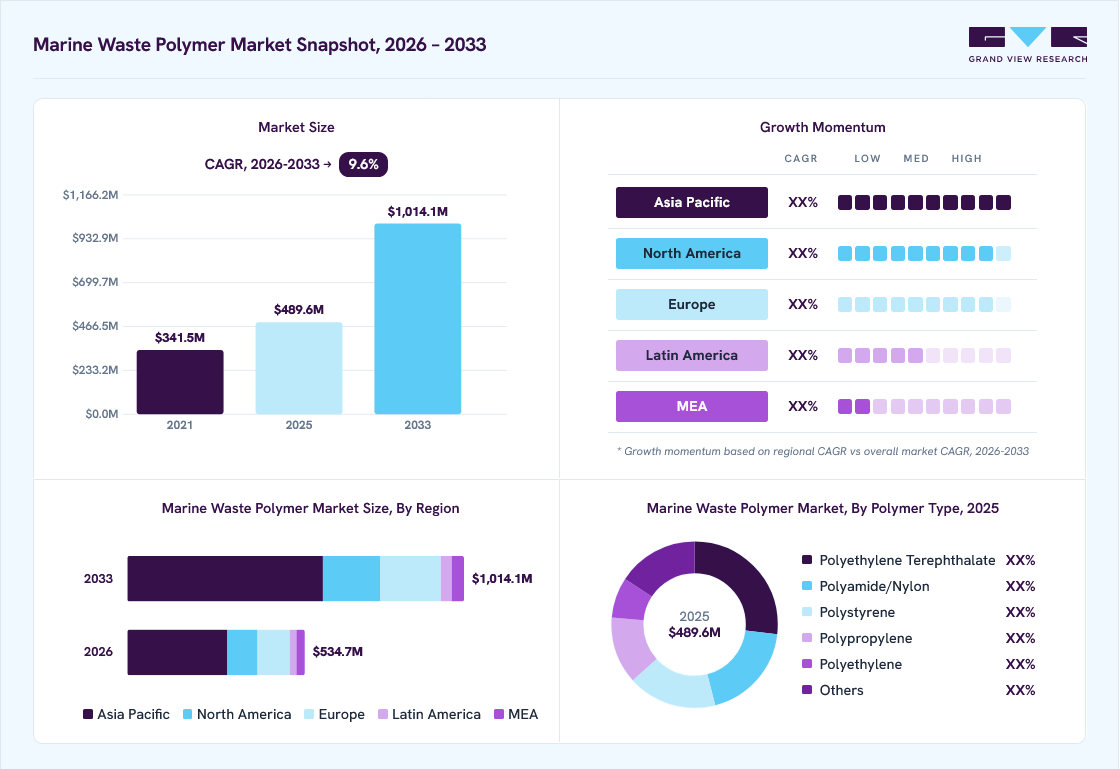
The global marine waste polymer market size was valued at USD 489.6 million in 2025 and is projected to grow from USD 534.7 million in 2026 to USD 1,014.1 million by 2033, at a CAGR of 9.6% from 2026 to 2033. Asia Pacific dominated the market, accounting for a revenue share of 56.1% in 2025. Rising demand for recycled polymers in packaging, textiles, automotive, footwear, and consumer goods is increasing downstream consumption.
 Source: Grand View Research, IR Documents, Primary Interviews, Paid DatabasesTo learn more about this report,
 Download Free Sample Report
 Key Market Trends & Insights
- By polymer type: Polystyrene segment is anticipated to grow at a CAGR of 10.2% from 2026 to 2033.
- By end use: Automotive segment is expected to grow at a 10.3% CAGR in revenue from 2026 to 2033.
Regional Highlights
- Largest regional market: Asia Pacific (56.1% revenue share, 2025)
- Fastest-growing regional market: Asia Pacific (highest CAGR, 2026-2033)
- By country: China held the largest share in 2025
Market Size & Forecast
- Market Size in 2025: USD 489.6 Million
- Estimated Market Size in 2026: USD 534.7 Million
- Projected Market Size by 2033: USD 1,014.1 Million
- CAGR (2026 - 2033): 9.6%
Three ways to get this report
Buy it, customize it, or ask a question.Ask an Analyst
A direct answer, usually in 1 working day
- AccessReport author, directly
- Reply timeWithin 1 working day
- No sales callDirect answer only
- FormatEmail reply
- CostFree, no cost
Get the Full Report
What the study covers
- FormatsPDF · Excel · Dashboard
- Timeline2026–2033 annual, 2025 base
- Coverage20+ countries, 5 regions
- Companies10+ key players profiled
Customize the Report
20% free customization
- IncludeCountries, segments, points
- TailorTo your product definition
- ExtendDeeper competitor detail
- OrA fully bespoke study
- Turnaround5–10 working days
Stricter plastic waste regulations, corporate sustainability commitments, recycled-content targets, and circular economy initiatives are further encouraging manufacturers to incorporate polymers recovered from marine waste into commercial products. The marine waste polymer market is shifting from basic waste recovery toward traceable, closed-loop polymer systems. Fishing nets and other durable marine plastics are receiving greater attention because they can provide identifiable polymer streams for recycling. Regulatory initiatives are also encouraging circular fishing gear design, repair, reuse, and end-of-life recyclability. This is increasing the importance of material traceability, polymer sorting, and consistent feedstock preparation across collection networks and recycling facilities.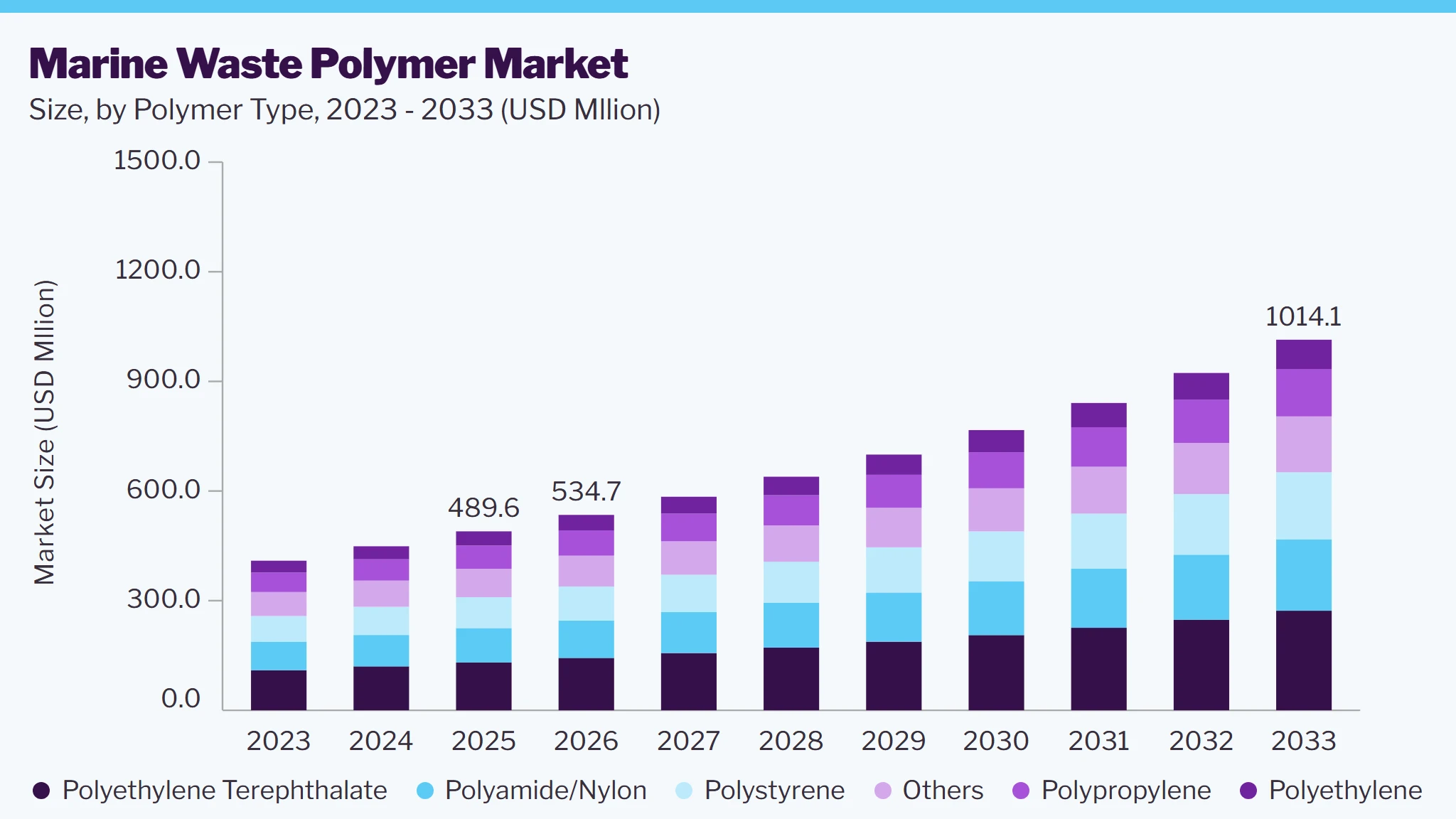 To learn more about this report, Download Free Sample Report
 Market Dynamics
Regulatory pressure to improve the collection and recycling of plastic-containing fishing gear is strengthening the feedstock base for marine waste polymers. Policies addressing abandoned, lost, or discarded fishing gear are encouraging ports, fisheries, manufacturers, and waste operators to establish structured collection and recovery systems. Extended producer responsibility frameworks can further transfer waste management obligations toward producers, improving funding for collection, sorting, transportation, and mechanical recycling activities.
Recycled-content requirements for plastic products are also creating downstream demand for polymers recovered from marine waste. These regulations encourage manufacturers to incorporate secondary materials into packaging, consumer products, automotive components, textiles, and other applications. As compliance requirements expand, polymer processors are gaining greater incentives to develop technologies that remove contaminants, improve material consistency, and convert recovered marine plastics into commercially viable recycled polymer grades.
Feedstock quality remains a major limitation because marine plastics often contain sand, salt, organic matter, coatings, mixed polymers, and degraded material. Collection is also dispersed across beaches, ports, fishing grounds, and coastal communities, increasing transportation and preprocessing costs. These conditions can reduce polymer yield and complicate quality control. Inconsistent waste composition further limits the ability of recyclers to maintain stable specifications, particularly for applications requiring predictable mechanical, thermal, or aesthetic performance.
A significant opportunity exists in converting recovered marine polymers into higher-value products rather than low-grade recycled materials. Polyamide from fishing nets and polyester from selected marine waste streams can support applications in textiles, molded components, industrial products, and consumer goods after appropriate purification. Advanced mechanical and chemical recycling can further improve material consistency and expand end-use suitability. Integrated collection, sorting, certification, and recycling models can therefore improve both feedstock value and market scalability.
Market Concentration & Characteristics
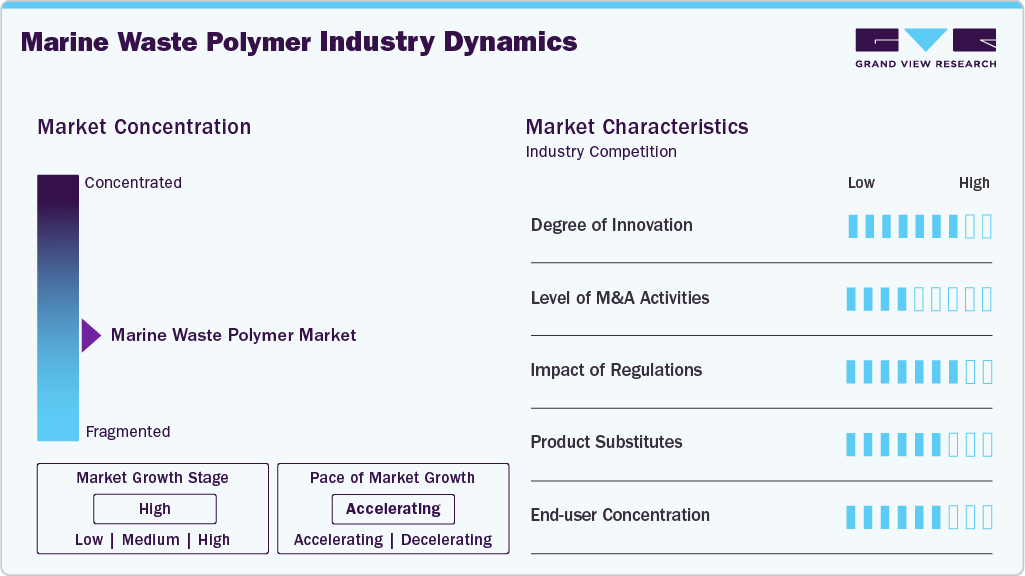
The market growth stage is high, and growth is accelerating. The market exhibits fragmentation, with key players dominating the industry landscape. Major companies such as Waterhaul, Ravago Manufacturing, Aquafil, RebornPlas, Bureo, SEAQUAL INITIATIVE, Global Green Materials, Gravity Wave, Ocean Material, 4ocean and others play a significant role in shaping the market dynamics. These leading players often drive innovation in the market by introducing new products, technologies, and materials to meet the industry's evolving demands.
High innovation intensity is emerging across the marine waste polymer value chain, particularly in recovery, sorting, and advanced recycling. Current projects are testing recycled polyamide from discarded fishing nets for new fishing components, while chemical recycling and enzymatic approaches are being developed for degraded marine plastics. Port-based sorting and conditioning systems are also improving feedstock quality. Granule-fed 3D printing is enabling direct conversion of recovered marine plastics into components, reducing dependence on conventional tooling.
 To learn more about this report, Download Free Sample Report
 Regulation is becoming a major structural influence on the marine waste polymer market by strengthening collection systems and improving feedstock availability. In the European Union, producers of plastic-containing fishing gear are subject to extended producer responsibility requirements covering collection, transport, treatment, and awareness activities. Member States with marine waters must also establish minimum annual collection rates for recycling. Circular-design standards for fishing gear further support repair, reuse, and end-of-life recyclability, creating a stronger policy framework for recycled marine polymers.
Analyst Perspective
Over the next 5-10 years, the marine waste polymer market will shift from volume-driven recycling to a value-led, specification-driven circular market. Growing demand from fashion, packaging, automotive, and consumer goods sectors is driving the need for verified, traceable recycled materials. Regulatory mandates-such as Extended Producer Responsibility for fishing gear and stricter recycled-content requirements-are set to improve collection and processing economics. Technological innovation will focus on advanced sorting, chemical depolymerization, and closed-loop recycling to deliver higher-purity PET, nylon, and mixed plastics. Successful market leaders will differentiate themselves through integrated operations, robust certification, tailored compounding, and reliable feedstock access. However, growth and profit margins remain challenged by contamination, fragmented collection networks, high logistics costs, and virgin plastic price competition. Ultimately, long-term competitive advantage will belong to companies leveraging superior technology, material quality, and proven product performance over simple waste volume.
Polymer Type Insights
The polyethylene terephthalate (PET) dominated the market across polymer type segmentation in terms of revenue, accounting for 26.8% market share in 2025, and is forecast to grow at a 9.6% CAGR from 2026 to 2033. PET is gaining importance as a recoverable marine polymer because beverage bottles are a visible and recurring component of coastal plastic waste. According to Ocean Conservancy, volunteers collected more than 1.33 million plastic beverage bottles during its 2025 global cleanup. This creates an identifiable feedstock stream for PET recycling. According to EU legislation, PET beverage bottles must contain at least 25% recycled plastic from 2025, increasing to 30% for beverage bottles from 2030. This strengthens demand for recovered PET materials.
The polystyrene segment is expected to expand at a 10.2% CAGR in the marine waste polymer market over the forecast period. Polystyrene is supported by growing efforts to capture EPS and XPS before further fragmentation in marine environments. OSPAR identifies these foamed materials among the leading items found on European beaches and has introduced measures covering fish boxes, pontoons, and buoys. Their low density makes them difficult and costly to collect, increasing the value of dedicated compaction and recycling systems. As port management improves, recovered polystyrene can be consolidated into denser feedstock, improving transport economics and supporting secondary material production.
End Use Insights
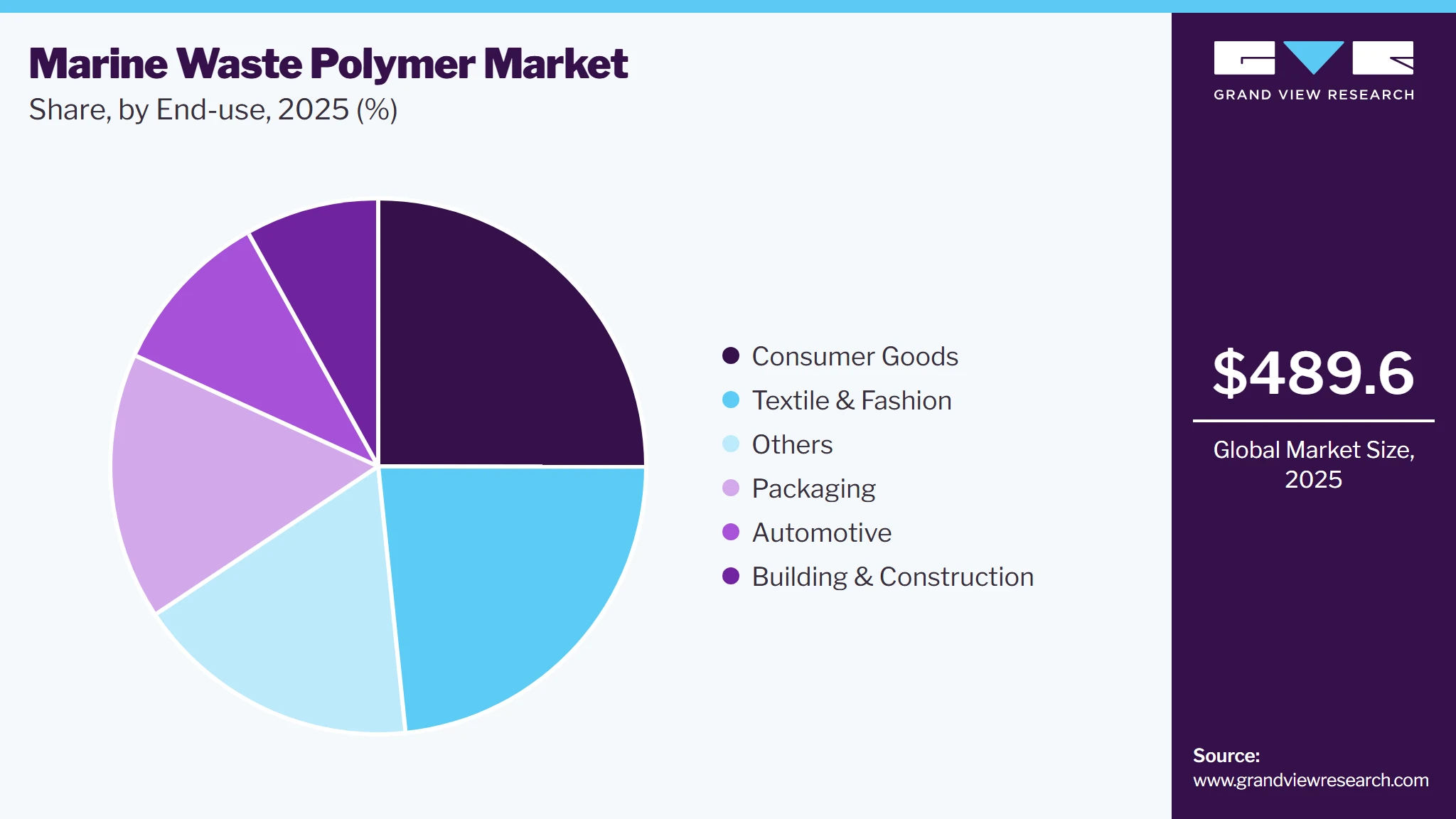
The consumer goods segment led the market by end-use, accounting for 25.0% of revenue in 2025, and is projected to grow at a 9.6% CAGR from 2026 to 2033. Consumer goods are a strong demand outlet because marine-derived polymers can be incorporated into visible, non-critical products where sustainability credentials influence purchasing decisions. Recycled marine PET, PP, and PA6 are already positioned for bottles, bags, footwear, kayaks, accessories, and household products. This broad application base allows producers to use marine waste content without the qualification burden associated with safety-critical components. Traceability also adds commercial value. It enables brands to communicate the recovery origin of materials directly to consumers while supporting differentiated sustainable product positioning.
 To learn more about this report, Download Free Sample Report
 The automotive segment is expected to grow at the fastest CAGR of 10.3% over the forecast period. Automotive demand is rising as manufacturers seek recycled materials that can meet durability requirements while reducing virgin polymer use. Marine-derived PET can be converted into fibers for carpets, acoustic components, and decorative textiles, while recycled PP and PA6 can serve injection-molded and interior applications. Current material offerings demonstrate use in automotive seating, interior panels, trims, bumpers, and related components. The sector therefore creates demand for cleaner, traceable recycled polymers with stable mechanical properties, particularly as vehicle manufacturers expand circular-material adoption across vehicle interiors.
Regional Insights
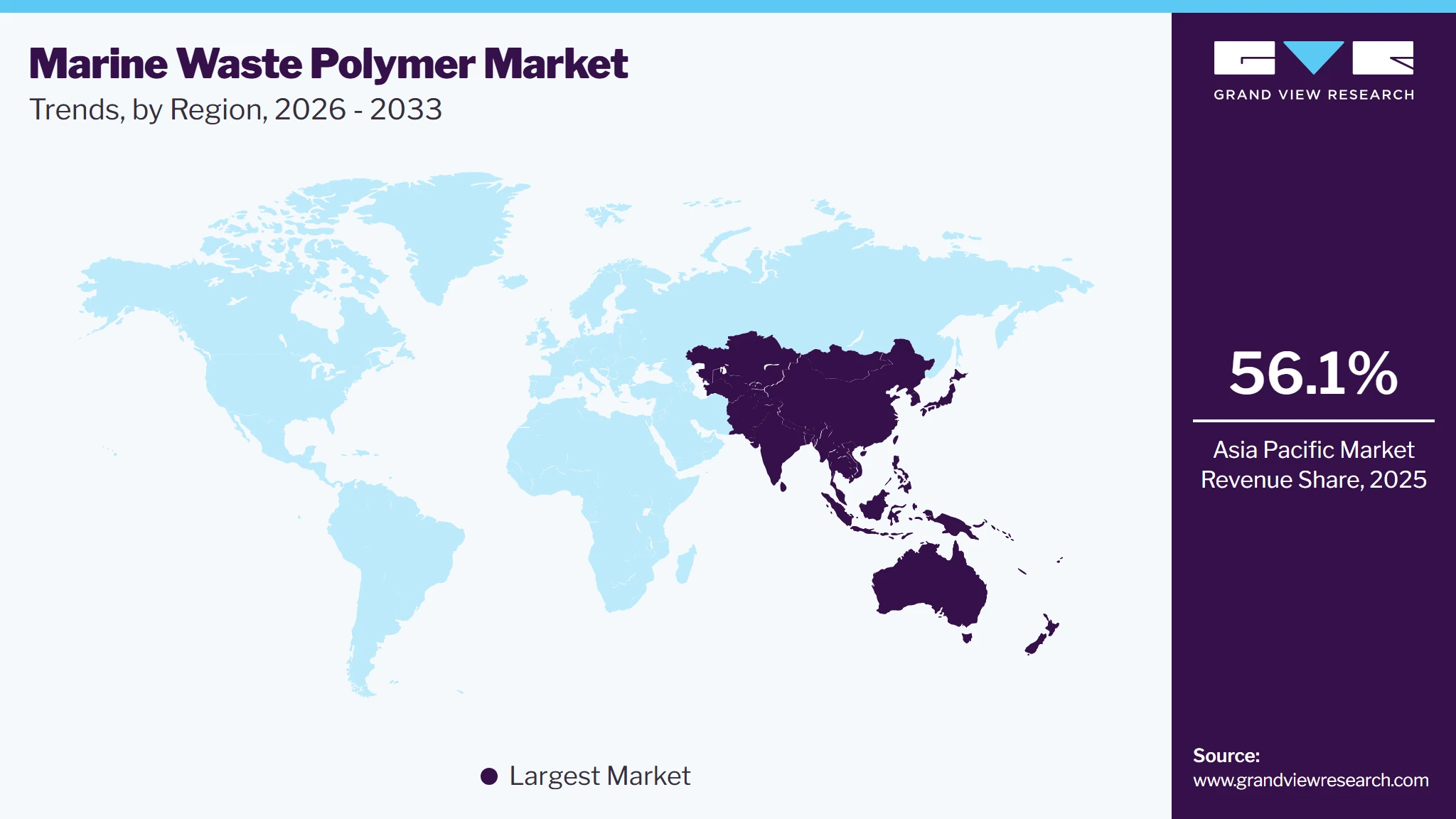
The Asia Pacific marine waste polymer industry held the largest revenue share of 56.1% in 2025. The region is expected to grow at a CAGR of 10.0% over the forecast period. Asia Pacific is being supported by expanding regional plastic circularity programs and stronger investment in collection, sorting, and recycling infrastructure. ASEAN’s SEA-MaP program is supporting harmonized policies, recycling capacity, innovation platforms, and private-sector partnerships across Southeast Asia. The region’s fragmented waste systems create substantial plastic leakage into waterways, making recovery commercially relevant. Regional initiatives increasingly connect marine litter prevention with recycling and value-chain development, supporting demand for recovered PET, PP, PE, and fishing-gear polymers.
 To learn more about this report, Download Free Sample Report
 China Marine Waste Polymer Market Trends
China’s marine waste polymer market is being supported by localized, technology-enabled collection models. Zhejiang’s Blue Circle system links coastal collection stations with recycling facilities and uses IoT and blockchain to trace material from collection through processing. The model now covers plastic bottles, fishing nets, and aquaculture gear and has expanded to other coastal regions. This integrated approach improves feedstock traceability and supports higher-value applications in textiles, electronics, consumer products, and other manufactured goods.
North America Marine Waste Polymer Market Trends
North America is benefiting from cross-border programs that convert recovered fishing gear into recyclable feedstock. The North American Net Collection Initiative diverted 636,800 pounds of fishing gear, including more than 523,700 pounds of end-of-life nets sent for recycling. Coordinated activity across the United States, Canada, and Mexico is strengthening collection networks and preprocessing capabilities. These systems improve aggregation of marine polymers and create more reliable material streams for recyclers serving consumer, industrial, and specialty applications.
The U.S. market is being shaped by stronger federal coordination on marine debris recovery, monitoring, and recycling. According to NOAA, its Marine Debris Program removed 12.7 million pounds of debris in 2025 and provided USD 36 million through 40 newly funded projects. Remote shoreline recovery programs are also testing different recycling routes and material-handling methods. This activity is improving knowledge of polymer composition, contamination, logistics, and recovery economics, which can strengthen domestic sourcing of recycled marine plastics.
Europe Marine Waste Polymer Market Trends
Europe has a strong structural driver in regulatory integration between marine litter prevention and recycling. The EU requires extended producer responsibility systems for plastic-containing fishing gear and national minimum collection rates for waste fishing gear. The European Commission also published updated reporting on single-use plastics and fishing gear in April 2026. These measures are strengthening collection infrastructure and improving the availability of identifiable post-use marine polymer feedstock, particularly from fishing gear, while reinforcing demand for recycled-content materials across European manufacturing.
Latin America Marine Waste Polymer Market Trends
Latin America is seeing greater emphasis on city-level circular economy systems that intercept plastics before they reach marine environments. A UNEP-backed regional program is supporting regulatory frameworks, collection systems, recycling networks, and private-sector innovation across cities in Colombia, Jamaica, and Panama. In 2026, regional initiatives continued promoting stronger inter-city cooperation on plastics circularity. These efforts can expand the supply of recoverable PET, PE, PP, and mixed marine plastics while improving commercial links between collection, processing, and end-use markets.
Middle East and Africa Marine Waste Polymer Market Trends
Middle East and Africa are gaining market potential from the need to reduce high levels of plastic leakage into coastal environments and strengthen resource recovery. According to the World Bank, Middle East and Africa generates over 155 million tons of waste annually, while less than 10% is recycled and more than two-thirds is mismanaged. In Africa, programs are expanding sorting, recycling, and marine-litter management. These conditions create scope for collection infrastructure, recycling investments, and conversion of recovered plastics into secondary polymer feedstock.
Key Marine Waste Polymer Company Insights
Some of the key players operating in the market include Ravago Manufacturing and Aquafil
-
Ravago Manufacturing has a strong position in marine waste polymers through its HYLON OCEAN portfolio, which uses post-consumer nylon recovered from discarded fishing nets. Its extensive recycling and compounding infrastructure supports material customization for multiple applications. Global manufacturing capabilities across North America, Europe, Asia, and other regions strengthen its ability to commercialize ocean-derived recycled polymers at scale.
-
Aquafil maintains a broad marine waste polymer footprint through its ECONYL regenerated nylon, produced from waste streams including discarded fishing nets. Its chemical recycling platform converts nylon waste into regenerated PA6 for fibers, polymers, and engineering applications. The established global supply chain and extensive brand adoption support its role in expanding circular nylon consumption across multiple industries.
Waterhaul and RebornPlas are some of the emerging participants in the marine waste polymer market.
-
Waterhaul has developed a specialized marine waste polymer platform centered on recovering fishing gear from UK coastlines and ports. Its Traceable Marine Plastic portfolio includes recycled polypropylene and HDPE pellets produced through mechanical recycling, with source-level traceability. Commercial availability to external manufacturers expands its presence beyond finished consumer products into industrial polymer applications.
-
RebornPlas focuses on converting discarded fishing nets and other nylon waste into recycled PA6, PA66, and composite materials. Its vertical integration across material sourcing, pellet production, modification, and application development supports consistent product performance. Ocean-reclaimed nylon is increasingly positioned for automotive, electronics, industrial, and other engineering applications requiring recycled content with documented traceability.
Key Marine Waste Polymer Companies
The following key companies have been profiled for this study on the marine waste polymer market.
-
Waterhaul
-
Ravago Manufacturing
-
Aquafil
-
RebornPlas
-
Bureo
-
SEAQUAL INITIATIVE
-
Global Green Materials
-
Gravity Wave
-
Ocean Material
-
4ocean
Company Categorization
Operating Strategies
Competitive Edge
Weakness
Mature Players: Ravago Manufacturing, Aquafil, Bureo, SEAQUAL INITIATIVE, 4ocean
- Maintain established marine polymer recovery, recycling, compounding, and material certification platforms focused on fishing nets, ocean-bound plastics, and post-consumer marine waste.
- Expand recycled PA6, PP, HDPE, PET, and other polymer grades across textiles, footwear, automotive, packaging, consumer products, and industrial applications.
- Strengthen collection networks, traceability systems, processing capacity, brand partnerships, and closed-loop supply chains across major coastal markets.
- Established recycling infrastructure and collection networks support reliable conversion of marine waste into commercially usable polymer feedstocks.
- Broad downstream relationships enable integration of recycled marine polymers into textiles, engineering plastics, consumer products, and industrial applications.
- Global or multi-regional operations, material certification, and traceability capabilities improve customer qualification and support recycled-content requirements.
- Collection, sorting, cleaning, and processing of marine waste can increase costs compared with conventional recycled feedstocks.
- Material quality and polymer composition can vary because marine waste originates from heterogeneous and contaminated sources.
- Scaling collection infrastructure across geographically dispersed coastal areas requires significant logistics, partnerships, and processing investment.
Emerging Players: Waterhaul, RebornPlas, Global Green Materials, Gravity Wave, Ocean Material
- Focus on specialized recovery of fishing nets, ocean-bound plastics, and coastal waste, converting these streams into recycled polymer pellets, compounds, and application-specific materials.
- Develop traceable and customized polymer grades emphasizing recycled content, material consistency, mechanical performance, and application suitability.
- Expand through regional collection partnerships, contract manufacturing, brand collaborations, distributors, and penetration of specialized consumer, textile, industrial, and engineering applications.
- Focused business models enable rapid development of traceable marine-derived materials and application-specific recycled polymers.
- Specialized collection networks can improve feedstock traceability and strengthen connections with coastal communities, fisheries, ports, and waste-management partners.
- Flexible operating structures support customized material development and partnerships with brands seeking verified marine-waste content.
- Comparatively smaller processing capacity and geographic footprints can constrain supply consistency and large-volume customer coverage.
- Dependence on localized collection networks can create variability in feedstock availability, quality, and logistics costs.
- Limited scale and downstream qualification experience can create barriers when entering high-volume automotive, engineering, packaging, and other demanding applications.
Recent Developments
-
In May 2025, Nofir, Aquafil, AKVA Group Egersund Net, Grieg Seafood, and Hampiðjan deployed full-scale aquaculture cages made from 100% recycled nylon in Norwegian waters. The project used regenerated ECONYL® nylon from discarded nets and fishing gear, demonstrating commercial validation of circular marine-polymer applications in aquaculture.
-
In October 2025, South Africa launched its first harbour-based fishing-net recycling facility at Cape Town’s V&A Waterfront. The containerized recycling unit can process up to 100 kg of end-of-life fishing nets per hour through shredding, washing, drying, and densification, creating recycled plastic feedstock for manufacturing applications.
Marine Waste Polymer Market Report Scope
Report Attribute
Details
Market size in 2025
USD 489.6 million
Estimated market size in 2026
USD 534.7 million
Projected market size by 2033
USD 1,014.1 million
Growth rate
CAGR of 9.6% from 2026 to 2033
Historical data
2021 - 2025
Forecast period
2026 - 2033
Quantitative units
Revenue in USD million/billion, volume in Kilotons, and CAGR from 2026 to 2033
Report coverage
Revenue & volume forecast, competitive landscape, growth factors, and trends
Segments covered
Polymer type, end use, region
Regional scope
North America; Europe; Asia Pacific; Latin America; Middle East & Africa
Country scope
U.S.; Canada; Mexico; Europe; Germany; UK; France; Italy; Spain; China; India; Japan; South Korea; Australia; Brazil; Argentina; Saudi Arabia; UAE; South Africa
Key companies profiled
Waterhaul; Ravago Manufacturing; Aquafil; RebornPlas; Bureo; SEAQUAL INITIATIVE; Global Green Materials; Gravity Wave; Ocean Material; 4ocean
Customization scope
Free report customization (equivalent to up to 8 analyst working days) with purchase. Addition or alteration to country, regional & segment scope
Pricing and purchase options
Avail customized purchase options to meet your exact research needs. Explore purchase options
Global Marine Waste Polymer Market Report Segmentation
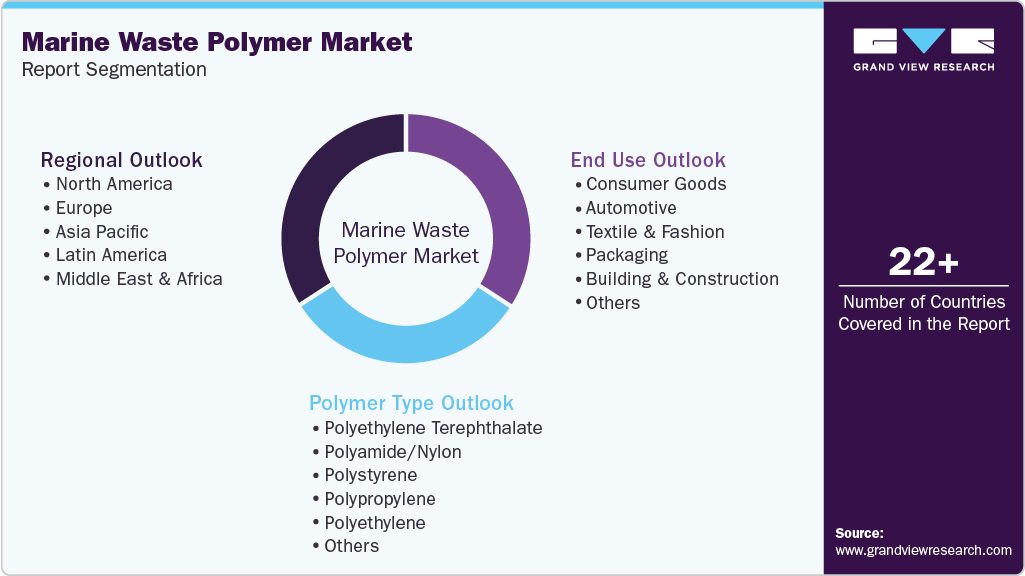
This report forecasts revenue growth at the global, regional, and country levels and provides an analysis of the latest industry trends across sub-segments from 2021 to 2033. For this study, Grand View Research has segmented the global marine waste polymer market report based on polymer type, end use, and region:
 To learn more about this report, Download Free Sample Report
 -
Polymer Type Outlook (Volume, Kilotons; Revenue, USD Million, 2021 - 2033)
-
Polyethylene Terephthalate
-
Polyamide/Nylon
-
Polystyrene
-
Polypropylene
-
Polyethylene
-
Others
-
-
End Use Outlook (Volume, Kilotons; Revenue, USD Million, 2021 - 2033)
-
Consumer Goods
-
Automotive
-
Textile & Fashion
-
Packaging
-
Building & Construction
-
Others
-
-
Regional Outlook (Volume, Kilotons; Revenue, USD Million, 2021 - 2033)
-
North America
-
U.S.
-
Canada
-
Mexico
-
-
Europe
-
Germany
-
UK
-
France
-
Italy
-
Spain
-
-
Asia Pacific
-
China
-
India
-
Japan
-
South Korea
-
Australia
-
-
Latin America
-
Brazil
-
Argentina
-
-
Middle East & Africa
-
Saudi Arabia
-
UAE
-
South Africa
-
-
Research Methodology
The marine waste polymer market figures in this report are based on a proven research process that combines executive interviews with secondary research from proprietary databases, company filings, and recognized regulatory and institutional sources. Market size is built through value-chain sizing-reconciling supply-side and demand-side estimates-and triangulated with bottom-up and top-down approaches. Every estimate passes multiple levels of expert validation before publication, with each marine waste polymer segment quantified using the revenue-capture definitions in the table below.
Segment Definition
Segment - Polymer Type
Revenue capture definition
Polyethylene Terephthalate
Revenue is captured through marine waste PET processed into recycled flakes, pellets, fibers, and compounds for textiles, packaging, consumer products, and specialty applications. Demand is supported by recovery of PET bottles and fishing-related waste from coastal environments. Manufacturers evaluate recycled PET based on purity, intrinsic viscosity, color, contamination, and recycled content requirements. Growing demand for recycled polyester and circular packaging supports marine-derived PET consumption.
Polyamide/Nylon
Revenue is generated through marine waste nylon, particularly discarded fishing nets, converted into recycled pellets, yarns, fibers, and engineering compounds. Demand is supported by applications requiring durability, flexibility, abrasion resistance, and high-performance recycled content. Manufacturers select grades based on polymer purity, molecular weight, mechanical properties, and processing compatibility. Increasing use of recycled nylon in textiles, footwear, automotive components, and consumer products supports market development.
Polystyrene
Revenue is captured through marine-recovered polystyrene processed into recycled pellets, compounds, and specialty materials for selected packaging, consumer, and industrial applications. Demand depends on effective collection and contamination control because marine polystyrene waste is often lightweight and fragmented. Manufacturers assess material quality based on purity, melt flow, density, color, and processing performance. Improved collection and recycling of marine foam and rigid plastic waste can support segment expansion.
Polypropylene
Revenue is generated through marine waste PP recovered from fishing gear, ropes, containers, and other coastal plastic streams and converted into recycled pellets, compounds, and molded products. Demand is supported by PP’s broad application base and favorable mechanical and chemical resistance. Manufacturers evaluate recycled grades based on contamination, melt flow, stiffness, impact performance, and color. Expanding fishing-gear recovery and demand for recycled-content products support consumption.
Polyethylene
Revenue is captured through marine waste PE, including HDPE and LDPE, processed into flakes, pellets, compounds, films, and molded products. Feedstock includes fishing gear, containers, packaging, and other coastal plastic waste. Manufacturers select recycled PE based on density, melt flow, contamination, mechanical strength, and processing consistency. Increasing demand for recycled-content packaging, consumer products, and construction materials supports marine-derived PE utilization.
Others
Revenue is generated through marine waste polymers such as ABS, polycarbonate, polyurethane, and mixed or specialty polymer streams recovered from coastal and marine environments. Applications depend on feedstock quality, separation efficiency, and polymer-specific processing requirements. Manufacturers focus on material purity, mechanical performance, compatibility, and traceability. Advancements in sorting, chemical recycling, and polymer separation can expand recovery opportunities across specialized applications.
Segment - End-use
Revenue capture definition
Consumer Goods
Revenue is captured through marine waste polymers used in footwear, accessories, furniture, household products, sporting goods, and durable consumer items. Demand is supported by brands seeking recycled content, traceable feedstocks, and circular-material solutions. Manufacturers select recycled polymers based on appearance, mechanical performance, processing characteristics, durability, and recycled-content requirements. Increasing consumer and brand focus on plastic waste reduction supports adoption in consumer-facing products.
Automotive
Revenue is generated through marine waste polymers used in interior components, trim, underbody parts, molded components, and selected technical applications. Demand is supported by lightweighting, recycled-content targets, and increasing use of circular materials in automotive supply chains. Manufacturers evaluate recycled polymers based on impact resistance, thermal stability, stiffness, surface quality, odor, and processing consistency. Qualification requirements remain important for broader automotive adoption.
Textile & Fashion
Revenue is captured through marine waste polymers converted into recycled fibers, yarns, fabrics, footwear materials, and fashion components. Discarded fishing nets provide an important feedstock for recycled nylon, while marine-recovered PET can support recycled polyester production. Manufacturers prioritize polymer purity, fiber performance, color consistency, traceability, and recycled content. Increasing demand for circular textiles and sustainability-linked product claims supports marine-derived polymer consumption.
Packaging
Revenue is generated through marine waste polymers used in bottles, containers, films, trays, closures, and flexible or rigid packaging components. Demand is driven by recycled-content requirements, circular packaging initiatives, and efforts to reduce dependence on virgin polymers. Manufacturers evaluate recycled materials based on purity, barrier properties, food-contact suitability, melt performance, mechanical strength, and appearance. Higher-quality recovered feedstocks can expand use in value-added packaging applications.
Building & Construction
Revenue is captured through marine waste polymers used in pipes, profiles, panels, flooring, insulation-related components, coatings, and other construction products. Demand is supported by durability requirements and growing interest in recycled materials for selected building applications. Manufacturers assess recycled polymers based on mechanical strength, dimensional stability, weather resistance, moisture resistance, and processing consistency. Adoption remains dependent on material certification, performance standards, and reliable supply.
Others
Revenue is generated through marine waste polymers used in electronics, industrial products, agriculture, marine equipment, filtration, and specialty components. Demand varies according to polymer type, feedstock quality, processing requirements, and application-specific performance criteria. Manufacturers develop recycled materials based on mechanical properties, chemical resistance, durability, purity, and traceability. Expansion of advanced sorting, compounding, and recycling technologies can create additional applications beyond established end-use markets.
Estimation Model
Layer Name
Key Question
Description
Top-Down Marine Waste Polymer Demand Assessment Layer
What defines overall market demand?
Establishes global demand for polymers recovered from marine waste, including PET, polyamide/nylon, PP, PE, polystyrene, and other polymer streams. The layer assesses consumption based on availability of fishing gear, marine litter, ocean-bound plastics, recycling capacity, material quality, and demand for recycled-content products across packaging, textiles, automotive, consumer goods, and construction.
End-use Demand Validation Layer
Where is demand concentrated?
Maps marine waste polymer demand across consumer goods, automotive, textile & fashion, packaging, building & construction, and other applications. The assessment considers recycled-content requirements, material performance, traceability, sustainability targets, processing compatibility, durability, and application-specific specifications. Demand is validated through recycled polymer consumption, brand adoption, manufacturing activity, and circular-material procurement programs.
Consumption-to-Revenue Conversion Layer
How is demand monetized?
Converts marine waste polymer consumption into market revenue using polymer type, recycled content, purity, processing technology, material quality, application requirements, production scale, and prevailing recycled polymer prices. The layer evaluates price differences between standard and specialty grades, including certified, traceable, high-purity, compounded, and application-specific materials. Premiums associated with verified marine origin, consistent quality, and advanced processing are also assessed.
Regional Demand Verification Layer
Where is demand validated?
Validates demand across North America, Europe, Asia Pacific, Latin America, and Middle East & Africa, with country-level assessment for major recycling and consumption markets. The analysis considers marine plastic availability, fishing activity, collection infrastructure, recycling capacity, circular-economy regulations, recycled-content mandates, textile and packaging production, automotive manufacturing, and trade flows influencing regional consumption.
Delivered Customizations
This report has been delivered with the following In-depth customizations
Client Request
Customization Delivered
Value Adds
Regional Segmentation
Marine waste polymer demand analyzed across key regions and major country markets based on waste availability, recycling infrastructure, regulations, and end-use demand.
Identifies regional growth pockets and supports geographic market prioritization.
Competitive Benchmarking
Key participants benchmarked by marine-waste collection capabilities, recycled polymer portfolio, processing capacity, geographic presence, partnerships, and downstream applications.
Enables comparison of competitive positioning, market reach, and strategic capabilities.
Opportunity Assessment
Opportunities evaluated across recycled PA, PP, HDPE, PET, and other marine-derived polymers, with emphasis on textiles, automotive, packaging, consumer products, and engineering applications.
Identifies high-potential applications and areas for capacity expansion, product development, and market entry.
About the Author(s)
Plastics, Polymers & Resins Research Team
Bulk Chemicals · Plastics, Polymers & ResinsThis report was authored by the plastics, polymers & resins research team at Grand View Research - comprising two research analysts, one senior research analyst, and one industry expert - with specialized expertise in the plastics, polymers & resins segment of the bulk chemicals industry. All findings are based on proprietary bulk chemicals databases, executive interviews, and regulatory analysis, subject to internal peer review prior to publication.
Last Updated:
Speak to Analyst

Customize this report to your needs - add regions, segments, or data points, with 20% free customization.
Or view our licence options:


ISO 9001:2015 & 27001:2022 Certified
We are GDPR and CCPA compliant! Your transaction & personal information is safe and secure. For more details, please read our privacy policy.


