
- Home
- »
- Plastics, Polymers & Resins
- »
-
Medical Polymers Market Size & Share Report, 2026-2033GVR Report cover

Medical Polymers Market (2026 - 2033)
Size, Share & Trends Analysis Report By Product (Fibers & Resins, Medical Elastomers), By Application (Medical Device Packaging, Tooth Implants, Wound Care), By Region, And Segment Forecasts
Market Size, 2025
$25.1BMarket Estimate, 2026
$27.1BMarket Forecast, 2033
$47.1BCAGR, 2026–2033
8.2%Medical Polymers Market Summary
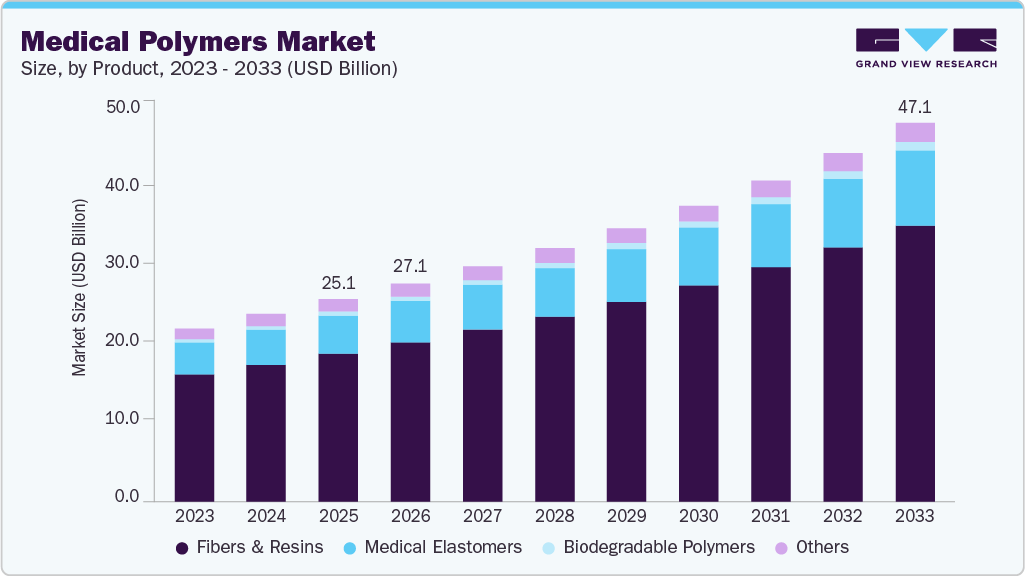
The global medical polymers market size was valued at USD 25.1 billion in 2025 and is projected to grow from USD 27.1 billion in 2026 to USD 47.1 billion by 2033, at a CAGR of 8.2% from 2026 to 2033. The market in North America dominated with a revenue share of 42.3% in 2025. Factors, such as increasing demand from the medical industry are anticipated to fuel the demand for medical-grade polymers.
 Source: Grand View Research, IR Documents, Primary Interviews, Paid DatabasesTo learn more about this report,
 Download Free Sample Report
 Key Market Trends & Insights
- By product: Fibers & resins segment held the largest market share of 73.1% in 2025.
- By application: Medical components segment held the largest market share of 43.0% in 2025.
Regional Highlights
- Largest regional market: North America (42.3% revenue share, 2025)
- Fastest-growing regional market: Asia Pacific (highest CAGR, 2026-2033)
- By country: U.S. held the largest market share in 2025
Market Size & Forecast
- Market size in 2025: USD 25.1 Billion
- Estimated market size in 2026: USD 27.1 Billion
- Projected market size by 2033: USD 47.1 Billion
- CAGR (2026-2033): 8.2%
Three ways to get this report
Buy it, customize it, or ask a question.Ask an Analyst
Analyst response in 1 business day
- AccessReport author, directly
- Reply timeWithin 1 working day
- No sales callDirect answer only
- FormatEmail reply
- CostFree, no cost
Get the Full Report
What the study covers
- FormatsPDF · Excel · Dashboard
- Timeline2026–2033 annual, 2025 base
- Coverage20+ countries, 5 regions
- Companies10+ key players profiled
Customize the Report
20% free customization
- IncludeCountries, segments, points
- TailorTo your product definition
- ExtendDeeper competitor detail
- OrA fully bespoke study
- Turnaround5–10 working days
Polymers are classified as synthetic and natural polymers based on raw materials. Naturally occurring polymers include bio-based polymers, wood, and natural rubber, whereas synthetic polymers include thermosets & thermoplastic resins, elastomers, and fibers.The market encompasses a range of specialized polymers engineered for use in healthcare applications, including medical devices, implants, disposables, surgical instruments, and packaging. These polymers are selected for properties such as biocompatibility, sterility, chemical resistance, flexibility, and mechanical performance, which are critical in environments where patient safety and device reliability are non-negotiable.
 To learn more about this report, Download Free Sample Report
 Furthermore, market is propelled by expanding healthcare infrastructure globally, driven by rising chronic disease incidence, increasing surgical and diagnostic procedures, and a growing emphasis on minimally invasive and personalized medical solutions. Demand is boosted by heightened infection control standards and the adoption of single-use polymeric devices in hospitals and clinics, which reduce contamination risk and improve patient outcomes. Regions such as North America and Europe lead in consumption due to advanced healthcare systems, while Asia-Pacific is emerging rapidly with expanding medical device manufacturing and rising healthcare spending.
Market Dynamics
The medical polymers market is being driven by increasing utilization of advanced polymer materials across medical devices, pharmaceutical packaging, diagnostic systems, surgical instruments, implants, and wearable healthcare technologies. Medical polymers offer critical performance advantages, including biocompatibility, resistance to sterilization, chemical stability, flexibility, lightweight properties, and cost-efficient processability. The expansion of modern healthcare infrastructure and rising global healthcare expenditure continue to strengthen long-term demand for specialty medical-grade polymer systems.
A highly market-specific growth driver for the industry is the rapid expansion of minimally invasive procedures and single-use medical device manufacturing. Hospitals and healthcare providers are increasingly shifting toward disposable syringes, catheters, IV systems, drug delivery devices, diagnostic cartridges, and infection-control products to reduce contamination risks and improve patient safety. This transition is significantly increasing demand for high-purity medical polymers that meet strict sterilization, biocompatibility, and regulatory performance requirements.
One of the most significant restraints affecting the medical polymers market is the highly regulated nature of healthcare material approvals and product qualification processes. Medical polymers used in implantable devices, pharmaceutical packaging, and diagnostic systems must comply with strict biocompatibility, sterilization, toxicity, and performance standards established by global regulatory agencies. Product validation and certification procedures are often lengthy and expensive, increasing commercialization timelines and development costs for manufacturers.
Market Concentration & Characteristics
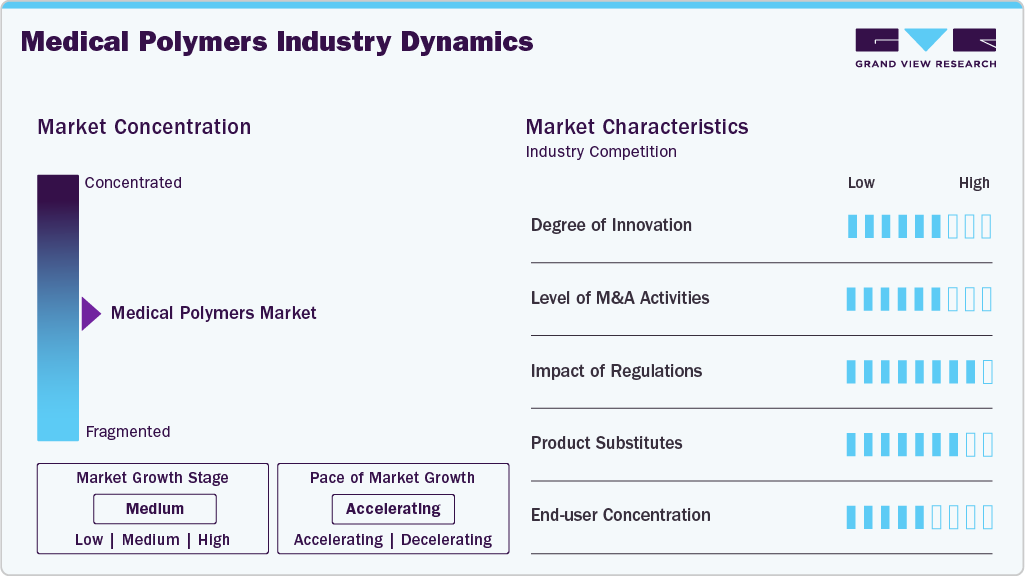
The medical polymer industry is currently in a medium growth stage, exhibiting an accelerating pace of growth. The market exhibits a high degree of innovation, particularly in the development of high-performance materials such as bioresorbable polymers, advanced thermoplastics like PEEK, and multifunctional compound systems that support minimally invasive devices, drug delivery carriers, and regenerative medicine. Ongoing research is expected to push polymer formulations that meet increasing demanding clinical specifications for strength, biocompatibility, and sterilization resilience.
M&A activity in the medical polymer industry is moderate but strategically focused, with large chemical and materials companies acquiring specialty polymer technology developers or forging partnerships to expand high-value portfolios, particularly in biocompatible and bioresorbable materials. Such strategic initiatives often integrate novel polymer platforms into broader medical device supply chains or accelerating entry into emerging applications like 3D-printable polymers and sustainable bio-derived materials.
 To learn more about this report, Download Free Sample Report
 Regulations exert a significant impact on the medical polymer industry dynamics, as compliance with stringent standards for biocompatibility, toxicity, and sterilization directly affects product approval timelines and development costs. Regulatory scrutiny ensures patient safety and device efficacy, but also raises barriers to rapid innovation, especially for novel materials with limited historical safety data. In addition, emerging regulations targeting medical waste management and environmental safety are shaping material selection and pushing suppliers toward sustainable alternatives.
Medical polymers experience high competition from alternative materials such as metals, ceramics, and glass, particularly in applications where extreme strength, rigidity, and temperature resistance are required. While polymers often offer weight, cost, and process advantages, substitutes retain advantages in durability and long-term performance in some specialized clinical cases.
End use demand in the medical polymer industry is concentrated among healthcare providers, medical device manufacturers, and surgical centers, with the largest volume stemming from single-use disposables, diagnostic equipment, and therapeutic devices. This buyer base is highly influenced by healthcare infrastructure, reimbursement policies, and clinical adoption trends, and concentrated purchasing can exert significant pricing and specification pressures on polymer suppliers, particularly for high-volume consumables.
Product Insights
Fibers & resins across the product segmentation dominated the market in 2025 with a share of 73.1% in terms of revenue owing to the high chemical & electrical resistance offered by resins such as polypropylene (PP) and polyethylene (PE). Furthermore, polycarbonate polymer resins offer heat resistance, strength, and toughness, which enables them to replace metal and glass in many medical products. Optical clarity is a vital characteristic in clinical and diagnostic contexts where blood, tissues, and other fluids must be visible.
Extrusion of medical polymers can result in monofilaments, which are single threadlike synthetic fibers. These medical-grade monofilaments can be used in magnetic resonance imaging (MRI) as an alternative to metal filaments. Also, medical polymer fibers exhibit a high strength-to-weight ratio, making them an ideal choice for many minimally invasive devices and medical clothing.
Biodegradable polymers are expected to grow at the fastest CAGR of 10.2% over the forecast period. The segment includes polylactic acid (PLA), polyglycolic acid (PGA), polycaprolactone (PCL), and polyhydroxyalkanoates (PHA) which are increasingly used in the market due to their ability to safely degrade into non‑toxic byproducts within the body. These materials are applied in sutures, drug‑delivery systems, orthopedic implants, and tissue engineering scaffolds, where controlled degradation eliminates the need for surgical removal and supports natural healing.
Application Insights
The medical components led the market across the application segmentation in terms of revenue, accounting for a market share of 43.0% in 2025. Polymers such as polypropylene, polyethylene, and polycarbonate are integral to medical components including syringes, catheters, IV bags, and diagnostic devices. Their biocompatibility, chemical resistance, and lightweight properties make them ideal for disposable and reusable products. Advances in polymer engineering also enable precision molding and miniaturization, supporting the growth of minimally invasive medical technologies.
Wound care is projected to grow at a significant CAGR of 8.7% throughout the forecast period. Medical polymers play a critical role in dressings, bandages, hydrogels, and films designed for wound management. They offer moisture control, antimicrobial protection, and controlled drug release, accelerating healing while reducing infection risks. Innovations in biodegradable and bioactive polymer systems are enabling advanced wound care solutions that integrate sustainability with therapeutic effectiveness.
 To learn more about this report, Download Free Sample Report
 In orthopedics, polymers are used in braces, supports, prosthetic liners, and cushioning materials. Their flexibility, durability, and ability to mimic soft tissue provide comfort and functional support for patients recovering from injuries or surgeries. Emerging biodegradable and high‑performance elastomers are enhancing patient compliance and long‑term wearability in orthopaedic applications.
Medical polymers are widely used in sterile packaging solutions such as blister packs, trays, and pouches. Their durability, transparency, and barrier properties ensure protection against contamination, moisture, and oxygen, while maintaining compliance with stringent healthcare regulations. Increasing demand for single‑use and recyclable packaging is driving innovation in polymer formulations tailored for medical safety and sustainability.
Regional Insights
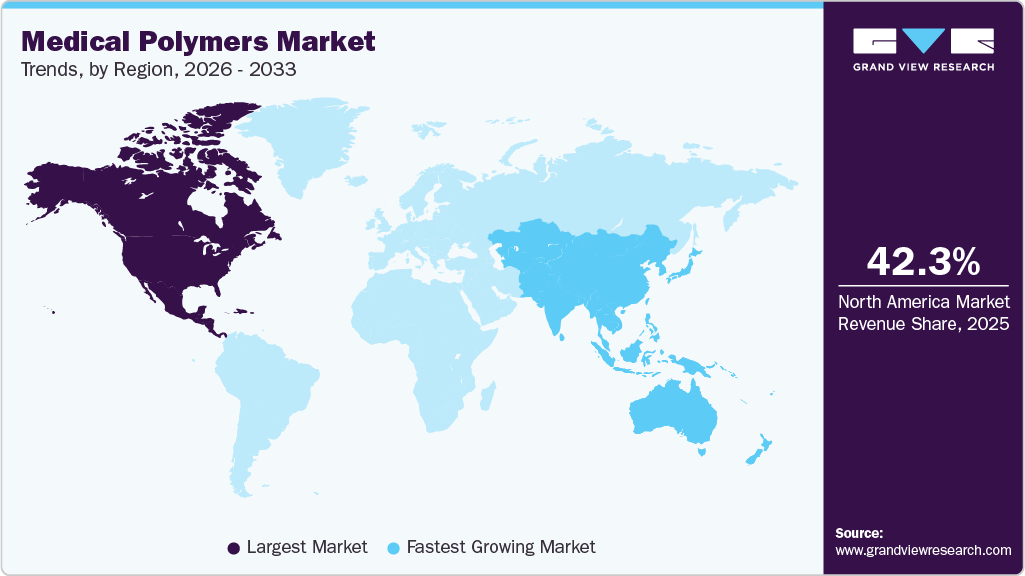
North America medical polymers industry held the largest share of 42.3% in terms of revenue in 2025. The rising demand for medical polymers in pharmaceutical packaging applications and the rapid growth of pharmaceutical industries in Mexico and Canada is expected to further fuel the growth. For instance, the repealing of stringent regulations by the Mexican government that restricted the establishment of new manufacturing units has resulted in the establishment of new pharmaceutical manufacturing facilities by major companies such as Takeda and Astellas in Mexico.
 To learn more about this report, Download Free Sample Report
 U.S. Medical Polymers Market Trends
The medical polymer industry in the U.S. is anticipated to grow at a significant CAGR over the forecast period. The presence of key government initiatives such as the Affordable Care Act (ACA) and Medicaid has enabled a large percentage of the population to gain access to healthcare facilities and services in the U.S. This has further boosted the demand for branded drugs, medical devices, and healthcare services, thereby driving the need for medical polymers in the country, primarily in applications such as medical components, packaging, and wound care.
Europe Medical Polymers Market Trends
Europe medical polymer industry represents the second largest market globally, backed by advanced healthcare systems, stringent quality and regulatory standards, and a strong pharmaceutical and medical device manufacturing base. The region’s demand is bolstered by high usage of polymer components in diagnostic equipment, sterile packaging, and surgical devices, while sustainability and biodegradable polymer adoption trends are gaining traction under evolving environmental policies.
Germany medical polymer industry is a leading national market within Europe, anchored by its robust medical device manufacturing ecosystem, deep chemical engineering expertise, and strong demand for high-grade polymer materials in implantables, diagnostic, and hospital-use products. German manufacturers emphasize compliance with EU standards and advanced polymer innovation, positioning the country at the forefront of European medical polymer consumption and technology adoption.
Asia Pacific Medical Polymers Market Trends
Asia Pacific medical polymer industry is anticipated to be the fastest-growing region with a CAGR of 8.8% over the forecast period, driven by rapidly expanding healthcare infrastructure and rising surgical procedures across China, India, Japan, and South Korea. High population density, growth in disposable medical device production, and expanding demand for diagnostic and implantable polymer products further contribute to strong regional momentum.
China medical polymers industry stands out as a major growth engine within the Asia Pacific market, supported by extensive healthcare modernization initiatives and strategic expansion of local polymer processing capabilities. Government policy focus on domestic healthcare capacity and partnership with global polymer producers is fueling rapid adoption of biocompatible and high-performance medical polymers across a range of device applications.
Latin America Medical Polymers Market Trends
The Latin America medical polymer industry is projected to grow over the forecast period owing to increased medical device production and rising government healthcare expenditure across countries such as Brazil, Mexico, Argentina, and Chile. While overall regional share remains smaller compared to APAC and Europe, increased foreign investment and public-health initiatives are strengthening demand for polymer-based medical products and sterile packaging solutions.
Middle East & Africa Medical Polymers Market Trends
The medical polymer industry in the Middle East and Africa is expected to steadily expand, supported by growing healthcare spending, hospital construction, and adoption of polymer-based devices and sterile consumables in countries such as the UAE, South Africa, Egypt, and Morocco. GDP growth and demographic shifts are driving increased demand for modern healthcare materials, even as overall regional consumption remains a smaller portion of the global market.
Saudi Arabia medical polymer industry is one of the key markets within the Middle East, propelled by significant healthcare infrastructure investment, population growth, and national programs aimed at expanding access to advanced medical services. The country’s increasing adoption of disposable medical devices, hospital consumables, and polymer-based diagnostic components supports ongoing demand for medical polymers, making it an important expanding market in the region.
Key Medical Polymers Company Insights
The competitive landscape of the medical polymer industry is characterized by a mix of large multinational chemical and materials companies alongside specialized polymer suppliers and regional players, all vying to serve the rapidly growing healthcare and medical device sectors. Industry leaders maintain strong positions through extensive product portfolios of high-performance, biocompatible polymers tailored for medical devices, diagnostic equipment, packaging, and advanced applications.
These major players differentiate based on innovation in polymer chemistry, regulatory compliance capabilities, global manufacturing footprints, and deep ties with medical device OEMs, making material performance and safety as crucial competitive factors as price.
Key Medical Polymers Companies:
The following are the leading companies in the medical polymers market. These companies collectively hold the largest market share and dictate industry trends.
- BASF SE
- NatureWorks LLC
- Covestro AG
- Celanese Corporation
- Eastman Chemical Corporation
- Evonik Industries AG
- Dow Inc.
- Exxon Mobil Corporation
- Arkema
- Koninklijke DSM NV
- Formosa Plastics Corporation
- Foryou Medical
- KRATON CORPORATION
- SABIC
- Trinseo S.A.
Competitive Benchmarking
Operating Strategies
Competitive Edge
Weakness
Mature Players: BASF SE; Covestro AG; Celanese Corporation
- Broad portfolios of medical-grade engineering plastics, biocompatible polymers, pharmaceutical packaging materials, and specialty healthcare compounds.
- Significant investment in bio-based polymers, sterilization-resistant materials, and advanced healthcare material technologies.
- Integrated manufacturing infrastructure and global regulatory compliance capabilities supporting medical-grade production.
- Strong polymer science expertise and advanced medical material development capabilities.
- Established global manufacturing footprint and diversified healthcare industry penetration.
- Large-scale production capabilities improve supply reliability and regulatory consistency.
- High regulatory compliance and product validation costs associated with medical-grade materials.
- Significant exposure to specialty raw material and healthcare certification requirements.
- Long commercialization timelines due to regulatory approvals and clinical qualification processes.
Emerging Players: NatureWorks LLC; Foryou Medical; KRATON CORPORATION
- Focus on specialty medical polymers, sustainable healthcare materials, and customized medical-grade formulations.
- Expansion into biodegradable polymers, wearable healthcare applications, and single-use medical device materials.
- Flexible manufacturing strategies supporting niche healthcare applications and regional medical demand.
- Greater flexibility in specialty polymer customization and emerging healthcare applications.
- Strong positioning in sustainable medical materials and niche healthcare technologies.
- Faster responsiveness to evolving healthcare innovation trends and customer-specific requirements.
- Smaller global manufacturing and regulatory infrastructure compared with multinational polymer producers.
- Limited economies of scale in medical-grade resin production and certification processes.
- Higher dependence on selected healthcare segments and regional market conditions.
Recent Developments
-
On October 2025, AlchemPro announced that LyondellBasell expanded its Purell medical‑grade polyolefin portfolio to North America, enhancing local access to trusted materials for healthcare and pharmaceutical applications. Previously established in Europe, the Purell line is known for its regulatory compliance, traceability, and supply reliability, and the expansion underscores LyondellBasell’s commitment to advancing healthcare innovation and customer collaboration while strengthening its footprint in the North American medical polymers market.
-
On July 2025, Evonik announced that IMCD has become the new distributor for its RESOMER portfolio of bioresorbable polymers used in medical devices and pharmaceutical applications. The partnership will strengthen Evonik’s global distribution network, ensuring broader access to RESOMER materials that are widely applied in drug delivery, orthopedic implants, and tissue engineering. By leveraging IMCD’s expertise in specialty chemicals distribution, Evonik aims to enhance customer support, streamline supply chains, and accelerate innovation in the medical polymer industry.
Medical Polymers Market Report Scope
Report Attribute
Details
Market size in 2025
USD 25.1 billion
Estimated market size in 2026
USD 27.1 billion
Projected market size by 2033
USD 47.1 billion
Growth rate
CAGR of 8.2% from 2026 to 2033
Historical data
2021 - 2025
Forecast period
2026 - 2033
Quantitative units
Revenue in USD million/billion, Volume in Kilotons, and CAGR from 2026 to 2033
Report coverage
Revenue & volume forecast, competitive landscape, growth factors, and trends
Segments covered
Product, application, region
Regional scope
North America; Europe; Asia Pacific; Latin America; Middle East & Africa
Country Scope
U.S., Canada; Mexico; Germany; UK; France; Italy; Spain, China; India; Japan; Malaysia, Singapore, Oceania, Brazil; Argentina, Saudi Arabia, South Africa, UAE
Key companies profiled
BASF SE; Celanese Corporation; SABIC; Dow Inc.; NatureWorks LLC.; Exxon Mobil Corporation; Covestro AG; Eastman Chemical Corporation; Evonik Industries AG; Arkema; koninklijke DSM NV; Formosa Plastic Corporation; Foryou medical; KRATON CORPORATION; Trinseo S.A.
Customization scope
Free report customization (equivalent up to 8 analyst’s working days) with purchase. Addition or alteration to country, regional & segment scope
Pricing and purchase options
Avail customized purchase options to meet your exact research needs. Explore purchase options
Global Medical Polymers Market Report Segmentation
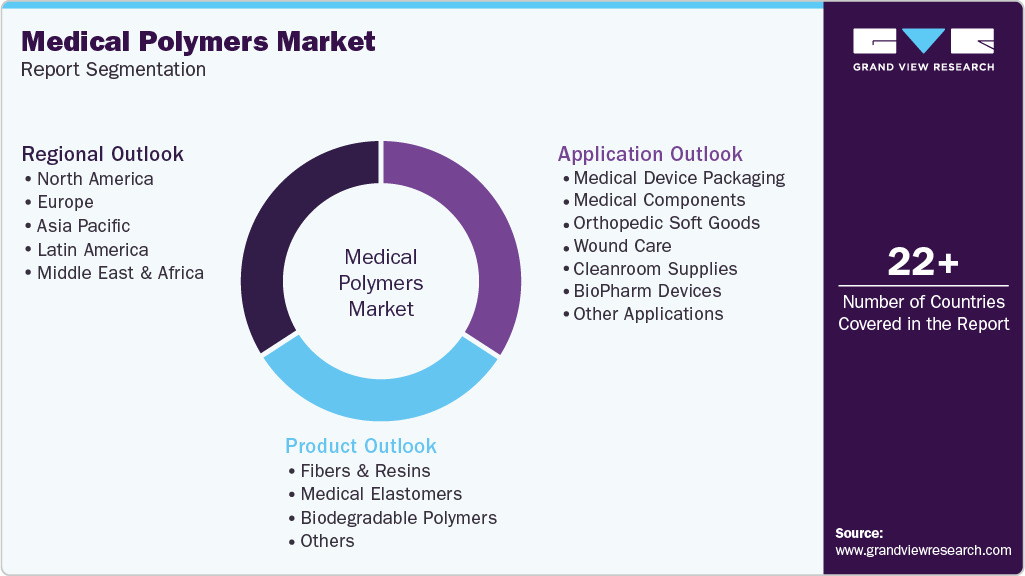
This report forecasts revenue & volume growth at the global, regional, and country levels and provides an analysis of the latest industry trends in each of the sub-segments from 2021 to 2033. For this study, Grand View Research has segmented the global medical polymers market report based on product, application, and region:
 To learn more about this report, Download Free Sample Report
 -
Product Outlook (Volume, Kilotons; Revenue, USD Million, 2021 - 2033)
-
Fibers & Resins
-
Medical Elastomers
-
Biodegradable Polymers
-
Polylactic Acid (PLA)
-
Polyhydroxyalkanoate (PHA)
-
-
Others
-
-
Application Outlook (Volume, Kilotons; Revenue, USD Million, 2021 - 2033)
-
Medical Device Packaging
-
Medical Components
-
Orthopedic Soft Goods
-
Wound Care
-
Cleanroom Supplies
-
BioPharm Devices
-
Mobility Aids
-
Sterilization & Infection Prevention
-
Tooth Implants
-
Denture-based Materials
-
Other Implants
-
Others
-
-
Regional Outlook (Volume, Kilotons; Revenue, USD Million, 2021 - 2033)
-
North America
-
U.S.
-
Canada
-
Mexico
-
-
Europe
-
Germany
-
UK
-
France
-
Italy
-
Spain
-
-
Asia Pacific
-
China
-
India
-
Japan
-
Malaysia
-
Singapore
-
Oceania
-
-
Latin America
-
Brazil
-
Argentina
-
-
Middle East & Africa
-
Saudi Arabia
-
South Africa
-
UAE
-
-
Delivered Customizations
This report has been delivered with the following In-depth customizations
Client Request
Customization Delivered
Value Adds
Regional Segmentation
Delivered comprehensive regional analysis across North America, Europe, Asia Pacific, Latin America, and the Middle East & Africa. The assessment evaluated healthcare infrastructure investments, medical device manufacturing concentration, pharmaceutical packaging demand, aging population trends, healthcare expenditure growth, and regional regulatory frameworks influencing medical polymer consumption patterns.
Supported region-specific expansion and healthcare investment planning. Identified high-growth medical manufacturing hubs and emerging healthcare polymer demand centers. Improved understanding of regional supply-demand dynamics and regulatory adoption trends. Enabled optimized commercialization, production, and distribution strategies for medical-grade polymer products.
Opportunity Assessment
Conducted detailed opportunity assessment across minimally invasive medical devices, wearable healthcare systems, drug delivery technologies, pharmaceutical packaging, biodegradable medical materials, and advanced diagnostic applications. The study analyzed high-growth product categories, evolving healthcare technology trends, regulatory developments, and emerging polymer innovation opportunities across global healthcare markets.
Supported strategic investment prioritization and product portfolio expansion planning. Identified high-value application segments and emerging healthcare material opportunities. Improved understanding of future demand trends across medical devices, diagnostics, and pharmaceutical packaging sectors. Enabled targeted commercialization and long-term growth strategy development.
Trade Assessment
Conducted trade assessment covering global export-import flows of medical-grade polymers, pharmaceutical packaging materials, specialty healthcare resins, sterilization-compatible plastics, and diagnostic material systems. The study analyzed regional manufacturing concentration, healthcare supply chain dependencies, regulatory trade barriers, logistics patterns, and geopolitical influences affecting international market competitiveness.
Supported procurement optimization and healthcare supply chain risk management. Identified strategic sourcing regions and major global trade corridors within the medical polymer value chain. Improved understanding of import dependence, export competitiveness, and regulatory-driven trade risks. Enabled proactive planning against supply disruptions, certification challenges, and regional healthcare policy changes.
Frequently Asked Questions About This Report
The global medical polymers market size was valued at USD 25.1 billion in 2025 and is estimated at USD 27.1 billion for 2026.
The global medical polymers market is expected to grow at a CAGR of 8.2% from 2026 to 2033, reaching USD 47.1 billion.
Fibers & resins segment led with a 73.1% revenue share in 2025, while biodegradable polymers is the fastest-growing segment.
Key factors that are driving the medical polymer market growth include the high adoption of polymers for implants due to chemical inertness and superior fatigue resistance.
Medical components segment led with a 43.0% revenue share in 2025.
North America dominated with a 42.3% revenue share in 2025.
Asia Pacific is the fastest-growing region over the forecast period.
Key players include BASF SE, Bayer Material Science AG, Celanese Corporation, DSM N.V., and Exxon Mobil Corporation.
About the Author(s)
Plastics, Polymers & Resins Research Team
Bulk Chemicals · Plastics, Polymers & ResinsThis report was authored by the plastics, polymers & resins research team at Grand View Research - comprising two research analysts, one senior research analyst, and one industry expert - with specialized expertise in the plastics, polymers & resins segment of the bulk chemicals industry. All findings are based on proprietary bulk chemicals databases, executive interviews, and regulatory analysis, subject to internal peer review prior to publication.
Last Updated:
Speak to Analyst

Customize this report to your needs - add regions, segments, or data points, with 20% free customization.
Or view our licence options:


ISO 9001:2015 & 27001:2022 Certified
We are GDPR and CCPA compliant! Your transaction & personal information is safe and secure. For more details, please read our privacy policy.


