
- Home
- »
- Healthcare IT
- »
-
Middle East AI In Oncology Market, Industry Report, 2033GVR Report cover
![Middle East AI In Oncology Market Size, Share & Trends Report]()
Middle East AI In Oncology Market (2025 - 2033) Size, Share & Trends Analysis Report By Component (Software Solutions, Hardware), By Cancer Type (Breast Cancer, Lung Cancer), By Application, By End-use, By Country, And Segment Forecasts
- Report ID: GVR-4-68040-715-3
- Number of Report Pages: 100
- Format: PDF
- Historical Range: 2021 - 2024
- Forecast Period: 2025 - 2033
- Industry: Healthcare
- Report Summary
- Table of Contents
- Segmentation
- Methodology
- Download FREE Sample
-
 Download Sample Report
Middle East AI in Oncology Market Trends
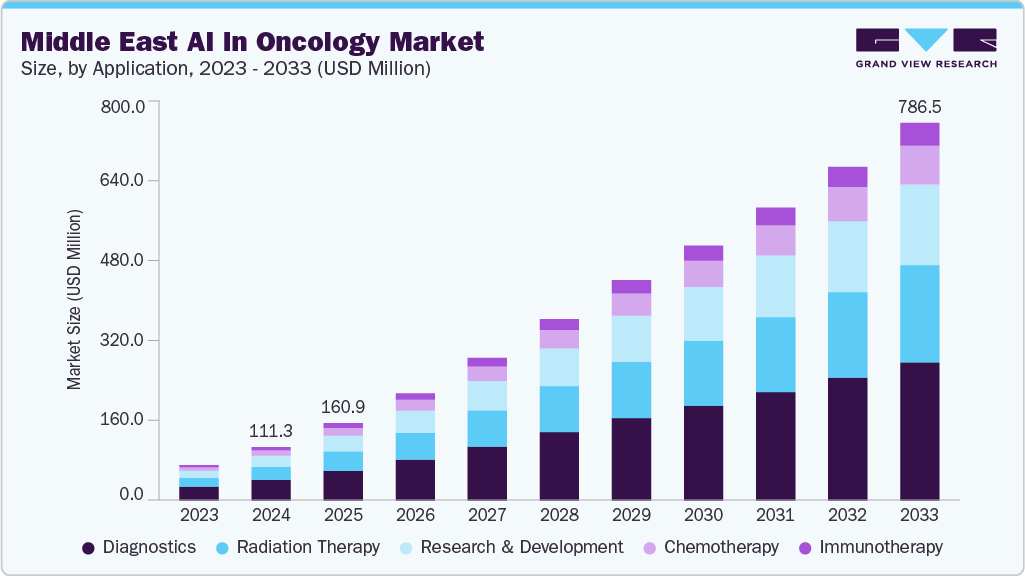
The Middle East AI in oncology market size was estimated at USD 111.33 million in 2024 and is projected to grow at a CAGR of 21.94% from 2025 to 2033. The rising prevalence of cancer, growing government initiatives, and technological advancements are significant factors contributing to market growth. Increasing cancer prevalence and growing awareness are boosting the demand for integrating AI-powered algorithms in their solutions. The incidence of cancer is rapidly increasing owing to various factors such as a sedentary lifestyle, poor eating habits, and physical inactivity. Rapid advancements in digital technology, owing to partnerships between government, industry players, and other investors in the healthcare ecosystem, are boosting the growth of the AI in oncology industry in Middle East.
For instance, according to an American Society of Clinical Oncology article published in January 2024, around 27,885 new cancer cases were reported in Saudi Arabia in 2020, and this figure is projected to surge to 60,429 by 2040, marking a significant increase of 116.7%. This sharp rise emphasizes the growing cancer burden in the country, driven by factors such as population growth and aging.
Number of New Cases of Cancer, By Country
Country
Number of New Cases, by Country, GLOBOCAN (2022)
Saudi Arabia
28,113
UAE
5,526
Kuwait
4,347
Oman
4,045
Qatar
1,733
Source: GLOBOCAN 2022, Grand View Research
In addition, significant investments in healthcare infrastructure modernization across the Middle East bolster market growth. Governments in key countries such as Saudi Arabia, the UAE, and Kuwait, under the Saudi Vision 2030 and the UAE Vision 2031, are prioritizing healthcare system upgrades, expanding hospital capacity, and integrating advanced medical technologies to improve the quality of care.
Furthermore, collaborations between technology companies, healthcare providers, and research institutions contribute to the development and implementation of AI solutions in oncology.
-
In November 2023, Jameel Clinic collaborated with King Faisal Specialist Hospital and Research Centre (KFSH&RC) and introduced Mirai, an AI tool that has the capability of detecting breast cancer up to 5 years earlier.
-
In July 2023, Lunit announced that it had signed a commercial contract with Cloud Solutions, which is a subsidiary of Dr. Sulaiman Al Habib Medical Group (HMG) in Saudi Arabia. As a part of this agreement, Lunit would supply Lunit INSIGHT MMG its AI solution for mammography analysis to Dr. Sulaiman Al Habib Medical Group for 3 years.
Market Concentration & Characteristics
The chart below illustrates the relationship between industry concentration, industry characteristics, and industry participants. The x-axis represents the level of industry concentration, ranging from low to high. The y-axis represents various industry characteristics, including industry competition, level of partnerships & collaboration activities, degree of innovation, impact of regulations, and regional expansion. The degree of innovation and the impact of regulations on the industry are high. However, the level of merger & acquisition activities and the regional expansion of the industry is moderate.
The Middle East AI in oncology market experiences a high degree of innovation. Companies are investing in developing new therapies to enhance patient care. For instance, the Rakovina-NanoPalm joint venture combines AI-driven drug discovery with precision lipid nanoparticle delivery to advance oncology therapeutics. It initially focuses on KT-3283, a dual PARP-HDAC inhibitor. Aligned with Saudi Arabia’s 2040 biotech strategy, the partnership leverages local infrastructure and USD 3.9 billion in R&D investments.
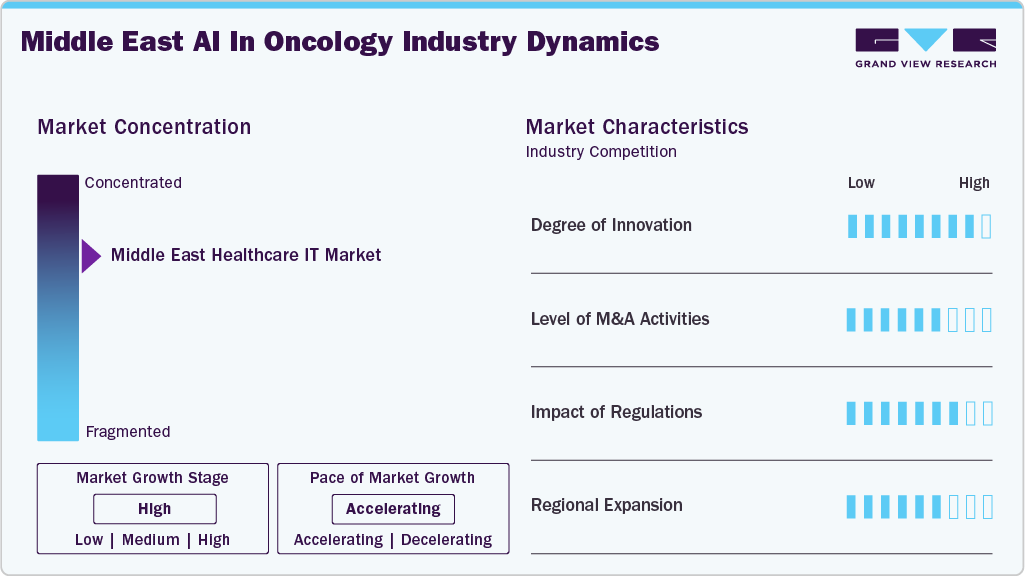
The industry is experiencing a moderate level of merger and acquisition activities undertaken by several key players. This is due to the desire to gain a competitive advantage in the industry, enhance technological capabilities, and consolidate in a rapidly growing market.
The regulatory framework for the Middle East AI in oncology industry is evolving, with governments and health authorities working to balance innovation with patient safety and compliance. Countries such as the United Arab Emirates (UAE) and Saudi Arabia are leading efforts by introducing structured frameworks for digital health and AI-based medical technologies. In the UAE, the Ministry of Health and Prevention (MOHAP) and the Dubai Health Authority (DHA) oversee approvals, ensuring AI tools meet international medical device standards such as ISO and IEC guidelines. Similarly, Saudi Arabia’s Saudi Food and Drug Authority (SFDA) regulates AI-driven solutions under its medical device framework, aligning with global standards from the U.S. FDA and European MDR.
The industry is witnessing moderate geographical expansion. Companies within the Middle East AI in oncology industry seek geographic expansion strategies to maintain their foothold in the markets and attract customers from this region. For instance, in March 2025, Lunit secured a multi-year contract with Abu Dhabi Health Services Company (SEHA), the UAE's largest healthcare network, to deploy its AI-powered mammography analysis solution, Lunit INSIGHT MMG.
Component Insights
The hardware segment led the Middle East AI in oncology market with the largest revenue share of 39.91% in 2024. Medical device manufacturers use artificial intelligence and machine learning technologies to innovate products to help healthcare providers enhance patient care. One of the major advantages of AI-ML in medical devices is its capability to learn from real-world data and experience and improve its performance. Hence, several key players are investing in launching and advancing AI-based cancer therapy solutions.
The software solutions segment is expected to grow at the fastest CAGR during the forecast period. The increasing adoption of AI software solutions by healthcare providers operating in oncology is one of the major factors fueling the segment’s growth. The software solutions are highly effective at predicting various types of cancer, including brain, breast, liver, lung, and prostate cancer, offering better accuracy compared to traditional diagnostic practices. Hence, numerous key players are focusing on developing & launching new tools and platforms, increasing the competition in the market.
Cancer Type Insights
The breast cancer segment dominated the Middle East AI in oncology industry with the largest share of 20.33% in 2024. This growth is attributed to the increasing prevalence of breast cancer in the region. In addition, supportive government initiatives further contribute to market growth. For instance, in July 2024, Lunit implemented its AI-powered breast cancer detection solution, Lunit INSIGHT MMG, in Qatar’s national “Screen for Life” breast and bowel cancer screening program starting June 2024. This marks the first nationwide adoption of AI in a national breast screening workflow in the Middle East, aiming to improve early cancer detection, reduce missed diagnoses, and enhance survival rates.
The prostate cancer segment is expected to register growth at the fastest CAGR over the forecast period. AI algorithms for prostate cancer treatment use dynamic statistical tools, which improve with the amount of data introduced into the system. Moreover, the increasing prevalence of prostate cancer drives market growth further. For instance, according to the GLOBOCAN 2022 data, the prevalence of prostate cancer in the UAE accounted for 11.9% of the total cancer cases.
Application Insights
The diagnostics segment accounted for the largest revenue share of 38.53% in 2024. AI technologies are being applied to imaging modalities such as radiology, pathology, and endoscopy to improve early detection, tumor characterization, and staging. Governments across the Middle East are prioritizing early diagnosis initiatives, creating a favorable environment for the adoption of AI, and thereby propelling market growth. Moreover, demand for precision medicine and personalized oncology care further enhances the adoption of AI-driven diagnostics.
The research and development segment is anticipated to grow at a significant CAGR from 2025 to 2033.While developing and testing a new drug, an extensive volume of data, ranging from terabytes to petabytes, is generated at each phase. Analyzing these huge datasets necessitates complex mathematical operations, a domain in which machine learning, a fundamental component of contemporary AI, demonstrates exceptional proficiency. Hence, key players are undertaking several initiatives to integrate AI into the process to accelerate drug development in the oncology field. For instance, Kite, a Gilead Company, research cell therapies for blood cancers, pioneering genetically reengineered immune cells to target cancer. As part of Saudi Vision 2030, Kite supports local workforce development and partners with Saudi hospitals to expand access to CAR T-cell therapy, aiming to improve outcomes amid rising cancer incidence in the region.
End-use Insights
The hospitals segment led the Middle East AI in oncology market with the largest share of 47.78% in 2024. In addition, this segment is expected to grow at the fastest CAGR during the forecast period. Technological advancements in the healthcare sector have increased over recent years. Digitalizing processes and implementing AI, virtual reality, and immersive technologies are key examples that changed healthcare institutions’ diagnostic, treatment, and data collection processes, including hospitals.
Integrating AI-powered algorithms in cancer diagnostics and therapeutics is anticipated to drive the market growth. For instance, in June 2025, Lunit’s AI solution, Lunit INSIGHT CXR, was deployed by the Saudi Government and Seha Virtual Hospital for large-scale screening during the 2025 Hajj season. The AI analyzed thousands of chest X-rays to detect respiratory diseases like tuberculosis, pneumonia, and MERS among over 2 million pilgrims.
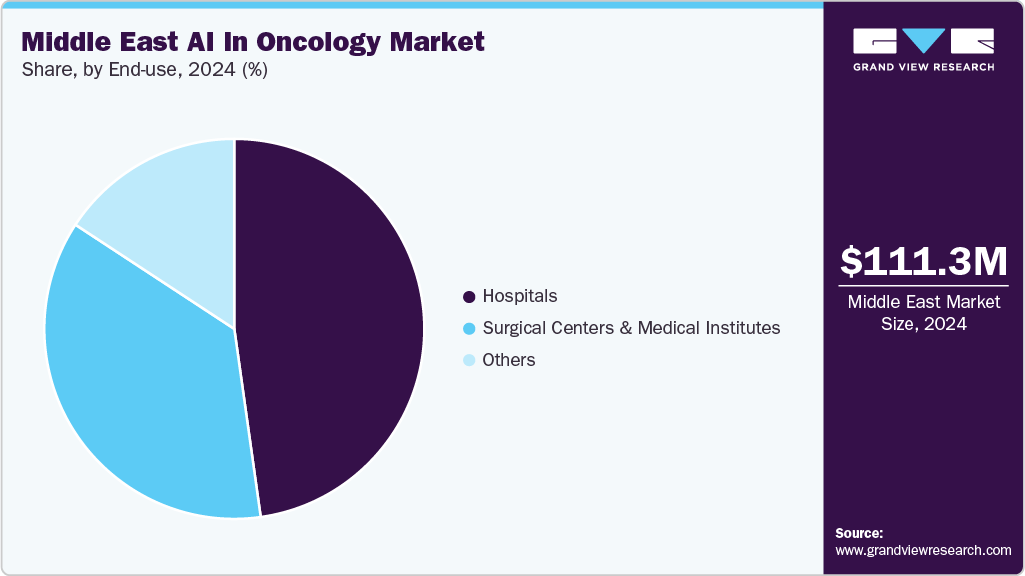
The surgical centers & medical institutes segment is anticipated to grow significantly from 2025 to 2033.In surgical centers, AI and machine learning are useful in the preoperative planning of cancer surgeries, such as brain surgery, dermatoscopy, and robotic-assisted surgery. Medical institutes utilize these platforms for training and assessment of students. Hence, these factors are increasing the adoption of AI-powered platforms by surgical centers and medical institutes.
Country Insights
Kuwait AI In Oncology Market Trends
The AI in oncology market inKuwait is expected to grow significantly over the forecast period. This growth is attributed to various factors, including technological advancements, an increasing number of cancer cases, government initiatives, research collaborations, and the growing adoption of AI technologies by healthcare institutions. A surge in cancer cases underscores the urgency for innovative approaches, aligning with government initiatives that prioritize healthcare technology. For instance, in October 2023, the Kuwait Health Ministry announced its plan to adopt advanced cancer detection and treatment methods. The methods might utilize AI-based solutions to accelerate cancer diagnosis and treatments.
UAE AI In Oncology Market Trends
The AI in oncology market in UAE is expected to grow at the fastest CAGR of 22.82% from 2025 to 2033. Research institutes play a crucial role in driving the growth by contributing to advancements in AI technology and its application in the field of oncology. Through extensive R&D activities, these institutes work on refining AI algorithms, analyzing large datasets, and developing innovative solutions that can enhance cancer therapy. Hospitals are adopting AI technologies for cancer detection, diagnosis, treatment planning, and patient management. Moreover, market players undertake business initiatives, such as collaborations and partnerships, to advance cancer therapy by launching AI-based solutions. For instance, in February 2023, Sonrai Analytics partnered with Alliance Care Technologies (ACT), based in the UAE, to introduce AI solutions in biomarker discovery and enhance cancer detection.
“UAE's diverse population makes it uniquely situated for universal population health research. Sonrai provides the ideal platform for collaborative research across omics medicine, biotech and pharma. Alliance Care Technologies is excited to announce Sonrai's arrival in the Gulf Cooperation Council (GCC) and the opportunity to support the region's growth in global health.”
-Michele Tarnow, CEO, Alliance Care Technologies
Key Middle East AI in Oncology Company Insights
Key players operating in the Middle East AI in oncology market are undertaking various initiatives to strengthen their market presence and increase the reach of their products and services. Strategies such as new product launches and partnerships play a key role in propelling market growth.
Key Middle East AI in Oncology Companies:
- Lunit Inc.
- Siemens Healthineers AG
- GE HealthCare
- NVIDIA Corporation
- Roche
- Insilico Medicine
- Oracle
- Intel Corporation
Recent Developments
-
In August 2025, Rakovina Therapeutics Inc. and Saudi-based NanoPalm Ltd. partnered to form a joint venture focused on developing AI-discovered oncology drug candidates.
-
In August 2023, MBZUAI generated an AI model for accurate few-shot tissue image generation to recognize various cancer tissues.
-
In May 2023, Cleveland Clinic Abu Dhabi introduced the Fatima bint Mubarak Center. The center uses Ethos adaptive radiotherapy, an AI-ML-based cancer treatment technology.
-
In February 2022, Prognica Labs collaborated with the Advanced Care Oncology Center to enhance breast cancer diagnosis using AI-based technology.
Middle East AI In Oncology Market Report Scope
Report Attribute
Details
Market size value in 2025
USD 160.86 million
Revenue forecast in 2033
USD 786.46 million
Growth rate
CAGR of 21.94% from 2025 to 2033
Actual data
2021 - 2024
Forecast period
2025 - 2033
Quantitative units
Revenue in USD million, and CAGR from 2025 to 2033
Report coverage
Revenue forecast, company ranking, competitive landscape, growth factors, and trends
Segments covered
Component, cancer type, application, end-use, country
Regional scope
Middle East
Country scope
Saudi Arabia; UAE; Qatar; Oman; Kuwait
Key companies profiled
Lunit Inc.; Siemens Healthineers AG; GE HealthCare; NVIDIA Corporation; Roche; Insilico Medicine; Oracle; Intel Corporation
Customization scope
Free report customization (equivalent up to 8 analysts working days) with purchase. Addition or alteration to country, regional & segment scope.
Pricing and purchase options
Avail customized purchase options to meet your exact research needs. Explore purchase options
Middle East AI In Oncology Market Report Segmentation
This report forecasts revenue growth at regional and country levels and provides an analysis of the latest industry trends in each of the sub-segments from 2021 to 2033. For this study, Grand View Research has segmented the Middle East AI in oncology market report based on component, cancer type, application, end-use, and region:
-
Component Outlook (Revenue, USD Million, 2021 - 2033)
-
Software Solutions
-
Hardware
-
Services
-
-
Cancer Type Outlook (Revenue, USD Million, 2021 - 2033)
-
Breast Cancer
-
Lung Cancer
-
Prostate Cancer
-
Colorectal Cancer
-
Brain Tumor
-
Other
-
-
Application Outlook (Revenue, USD Million, 2021 - 2033)
-
Diagnostics (Pathology, Cancer Radiology)
-
Radiation therapy (Radiotherapy)
-
Research & Development (Drug design, development process, etc.)
-
Chemotherapy
-
Immunotherapy
-
-
End-use Outlook (Revenue, USD Million, 2021 - 2033)
-
Hospitals
-
Surgical Centers & Medical Institutes
-
Others (Pharmaceutical companies, Research institutes & training centers)
-
-
Country Outlook (Revenue, USD Million, 2021 - 2033)
-
Saudi Arabia
-
UAE
-
Kuwait
-
Qatar
-
Oman
-
Frequently Asked Questions About This Report
b. The Middle East AI in oncology market size was estimated at USD 111.33 million in 2024 and is expected to reach USD 160.86 million in 2025.
b. The Middle East AI in oncology market is expected to grow at a compound annual growth rate of 21.94% from 2025 to 2033 to reach USD 786.46 billion by 2033.
b. The hardware segment held the largest market share of 39.91% in 2024.
b. Some key players operating in the Middle East AI in oncology market include Lunit Inc.; Siemens Healthineers AG; GE HealthCare; NVIDIA Corporation; Roche; Insilico Medicine; Oracle; Intel Corporation.
b. Key factors that are driving the Middle East AI in oncology market are . rising prevalence of cancer, growing government initiatives, and technological advancements.


Share this report with your colleague or friend.
Need a Tailored Report?
Customize this report to your needs — add regions, segments, or data points, with 20% free customization.


ISO 9001:2015 & 27001:2022 Certified
We are GDPR and CCPA compliant! Your transaction & personal information is safe and secure. For more details, please read our privacy policy.
Trusted market insights - try a free sample
See how our reports are structured and why industry leaders rely on Grand View Research. Get a free sample or ask us to tailor this report to your needs.













