
- Home
- »
- Advanced Interior Materials
- »
-
Middle East Battery Metals Market Size & Share Report, 2033GVR Report cover

Middle East Battery Metals Market (2025 - 2033) Size, Share & Trends Analysis Report By Metal (Lithium, Nickel, Cobalt), By Application (EVs, Electronic Devices, Stationary Battery Energy Storage, SLI), And Segment Forecasts
Middle East Battery Metals Market Summary
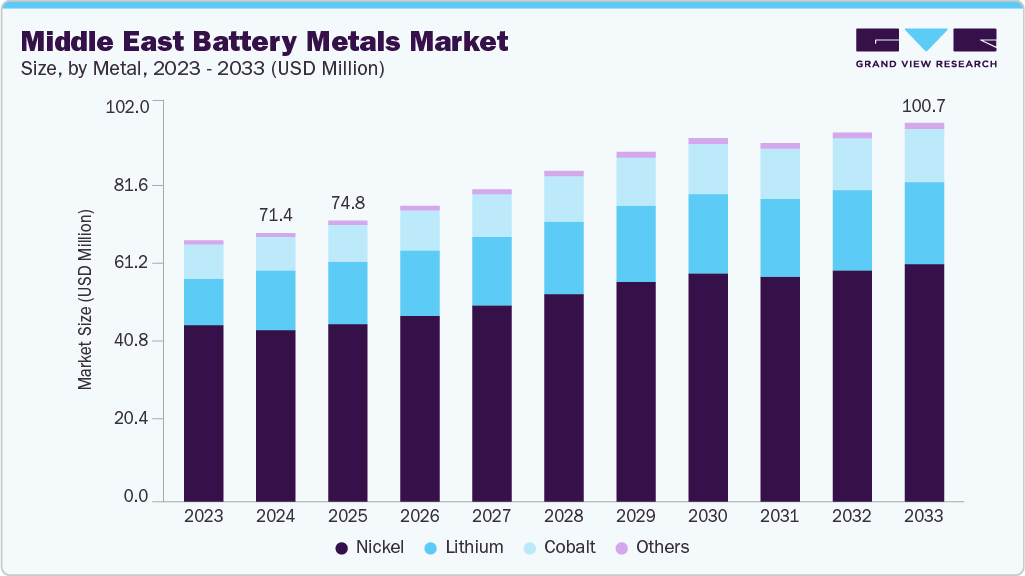
The Middle East battery metals market size was estimated at USD 71.4 million in 2024 and is projected to reach USD 100.7 million by 2033, growing at a CAGR of 3.8% from 2025 to 2033. Market growth is driven by the rising demand for battery metals such as lithium, cobalt, nickel, and graphite, essential for energy storage, electric vehicles, and renewable energy applications.
Key Market Trends & Insights
- The battery metals market in the Middle East is expected to grow at a significant CAGR of 3.8% from 2025 to 2033.
- By metal, the cobalt segment led the market with the largest revenue share of 63.90% in 2024.
- By application, the electric vehicles segment is anticipated to register the fastest CAGR of 4.4% from 2025 to 2033.
Market Size & Forecast
- 2024 Market Size: USD 71.4 Million
- 2033 Projected Market Size: USD 100.7 Million
- CAGR (2025-2033): 3.8%
GVR research-powered AIAsk Prism AI about the middle east battery metals marketGet cited answers from GVR research on market growth, segments, regulations and forecasts.Start with✓ Source-linked answers ✓ Market-specific context ✓ Traceable figuresExplore Prism AI ↗
The increasing adoption of electric mobility, grid storage solutions, and clean energy initiatives across the Middle East further propels the market. Battery metals are critical for producing high-performance lithium-ion batteries used in electric vehicles, stationary energy storage systems, and portable electronics, positioning the region as an emerging hub for battery metals consumption and investment.Battery metals such as lithium, cobalt, nickel, and graphite are becoming increasingly critical across the Middle East due to rising adoption of electric vehicles (EVs), renewable energy storage, and industrial applications. In 2024, government initiatives targeting net-zero emissions and circular economy strategies fuelled demand for battery metals in the region. Key hubs like the UAE and Saudi Arabia are expanding infrastructure for EV charging and energy storage systems, driving high-purity lithium and nickel consumption for battery production and storage solutions.
 Source: Grand View Research, IR Documents, Primary Interviews, Paid DatabasesTo learn more about this report,
 Download Free Sample Report
 The Middle East is emerging as a growing consumer and re-export hub in the automotive sector, particularly for high-performance and electric vehicles. The GCC luxury car market, supported by rising disposable incomes and EV incentives in countries like the UAE and Saudi Arabia, is driving imports of EVs from Tesla, BMW, Porsche, and NIO. These vehicles increasingly incorporate battery metals in motor assemblies, battery connectors, and energy management systems. This trend creates opportunities for regional suppliers and specialized aftermarket service providers to handle advanced battery components.
The renewable energy and industrial sectors are also key pillars of battery metals demand in the Middle East. Utility-scale solar and wind projects in Saudi Arabia, the UAE, and Oman rely on lithium-ion and other advanced battery technologies for grid storage and energy stabilization. In addition, industrial applications ranging from robotics and heavy machinery to aerospace are increasing the procurement of cobalt, nickel, and graphite for high-performance batteries. These developments drive steady demand for battery metals, while encouraging local and regional players to invest in sourcing, refining, and recycling capabilities.
Drivers, Opportunities & Restraints
The Middle East battery metals industry is driven by the rapid adoption of electric vehicles (EVs) and renewable energy infrastructure. Countries like Saudi Arabia and the UAE are investing heavily in battery energy storage systems to support their renewable energy goals, with projects targeting over 11GWh storage in Saudi Arabia and a 19GWh solar-plus-battery project in Abu Dhabi. Strategic investments in lithium production, such as Saudi Aramco’s partnership with Ma’aden to achieve commercial lithium production by 2027, further propel the market. Government initiatives under Vision 2030 and related economic diversification programs encourage private and foreign investments in battery metals and associated technologies.
The region offers significant opportunities for growth through technological innovation and infrastructure development. Companies and national oil firms are exploring lithium extraction from oilfield brines, which could reduce dependence on conventional mining and meet growing EV demand. In addition, expanding battery recycling infrastructure and establishing regional battery manufacturing hubs can help the Middle East become a major player in the global supply chain, create jobs, and foster technological advancements while supporting a circular economy.
However, certain restraints could limit market expansion. High capital investment is required to establish lithium extraction facilities, battery manufacturing plants, and recycling units, making economic feasibility dependent on long-term returns. Environmental and regulatory challenges, particularly for brine-based lithium extraction, could affect project timelines and sustainability. Moreover, geopolitical tensions and market volatility in global battery metals supply chains may expose the region to risks, emphasizing the need for careful planning and strategic partnerships to ensure stable growth.
Metal Insights
The cobalt segment led the market with the largest revenue share of 63.90% in 2024. Cobalt is a critical component in the cathodes of lithium-ion batteries, offering high electrical conductivity and stable structural performance across multiple charge-discharge cycles. Its extensive use in EV batteries, energy storage systems, and industrial applications in the Middle East continues to drive market growth, particularly as the region ramps up EV adoption and renewable energy integration.
The lithium segment is expected to grow at the fastest CAGR over the forecast period. Rising demand for lithium-ion batteries from the automotive and consumer electronics sectors drives this growth. Global battery manufacturers, including LG Chem, BYD, NorthVolt, and CATL, are expanding lithium-ion cell production capacities. The Middle East is increasingly a consumption and re-export hub for premium EVs. These developments are expected to boost regional demand for lithium and other battery metals significantly.
Application Insights
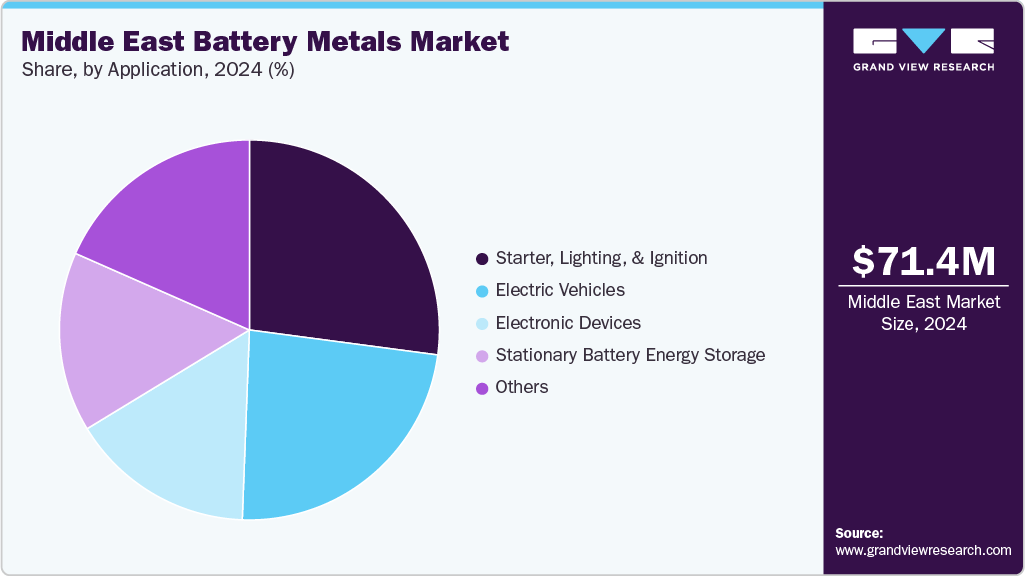
The starter, lighting, and ignition (SLI) segment led the market with the largest revenue share of 27.1% in 2024. SLI batteries are used in conventional vehicles to start engines and provide short bursts of electricity, requiring a high power density of around 300 amperes for a few seconds. However, this segment is expected to witness the slowest growth over the forecast period due to declining demand for conventional vehicles, which are gradually being replaced by electric cars across the GCC and broader Middle East.
 To learn more about this report, Download Free Sample Report
 The electric vehicles (EVs) segment is anticipated to grow at the fastest CAGR during the forecast period. EVs, including hybrid, plug-in hybrid, full EVs, and commercial vehicles, require large battery capacities, with full EVs relying entirely on lithium-ion and nickel-metal hydride batteries. The region’s growing EV adoption, driven by government incentives, rising disposable incomes, and luxury car demand in countries like the UAE and Saudi Arabia, is fuelling significant demand for high-performance battery metals.
The stationary battery energy storage (BES) segment is also witnessing rapid growth in the Middle East. BES systems are critical in balancing supply and demand for electricity generated from renewable sources like solar and wind. Lithium polymer batteries are predominantly used for these applications, allowing energy storage for periods when sunlight or wind is unavailable. Expanding renewable energy capacity in Saudi Arabia, the UAE, and Oman further drives demand for BES systems, positioning battery metals as a key component in the region’s transition toward clean energy.
Country Insights
The Middle East battery metals market is witnessing steady growth, driven by expanding electric vehicle (EV) adoption, renewable energy projects, and strategic investments in battery production and recycling. Regional economic diversification programs and sustainability initiatives create strong demand for high-performance battery metals such as lithium, cobalt, nickel, and graphite, which are critical for EVs, stationary energy storage, and industrial applications.
Saudi Arabia Battery Metals Market Trends
Saudi Arabia dominated the Middle East battery metals market with the largest revenue share of 43.9% in 2024. The Saudi Arabia market is supported by Vision 2030 initiatives, which emphasize clean energy, advanced manufacturing, and local EV production. Investments in lithium production in partnership with Ma’aden and plans to develop lithium-ion battery supply chains by 2027 are expected to boost domestic battery metals consumption. The Kingdom’s push for EV adoption and large-scale renewable energy storage systems, including solar and wind projects, further drives demand for lithium, cobalt, and nickel for batteries and energy storage systems.
UAE Battery Metals Market Trends
The battery metals market in the UAE is anticipated to grow at the fastest CAGR during the forecast period. In the UAE, market growth is underpinned by the country’s role as a hub for EV imports, re-exports, and renewable energy deployment. Expanding EV adoption, luxury car imports, and government incentives for electric mobility are increasing regional demand for high-performance lithium-ion and nickel-metal hydride batteries. In addition, large-scale solar-plus-battery projects and initiatives to develop battery recycling infrastructure are expected to enhance the UAE’s consumption of battery metals over the coming years, supporting the region’s transition toward a sustainable energy ecosystem.
Key Middle East Battery Metals Company Insight
Some of the key players operating in the market include Ma’aden, Middle East Battery Company, and others.
-
Ma’aden is a Saudi Arabia-based mining and metals company involved in lithium, gold, and phosphate production. The company invests in lithium extraction from brine and other sources to support the growing EV and energy storage markets. Ma’aden focuses on sustainable mining practices and aims to strengthen the Middle East’s battery metals supply chain.
-
Middle East Battery Company (MEBCO) is a Dammam-based manufacturer of automotive and industrial batteries. The company produces high-performance sealed maintenance-free (SMF) batteries for vehicles and energy storage applications. MEBCO is recognized for its quality manufacturing standards and contribution to the region’s growing battery metals market.
-
Elemental Group operates across the Middle East, specializing in recovering and recycling lithium-ion and other battery metals from end-of-life batteries. The company supports sustainable resource management by providing environmentally friendly battery recycling solutions to industrial, automotive, and energy storage sectors. Elemental Group is known for its advanced processing technologies and commitment to circular economic principles.
Key Middle East Battery Metals Companies:
- BASF SE
- Elemental Group
- Emirates Global Aluminium (EGA)
- Gulf Mining Group
- LG Chem
- Ma’aden
- Middle East Battery Company (MEBCO)
- Panasonic Corporation
- Qatar Mining Company (QM)
- Saudi Aramco
Recent Development
-
In April 2024, Statevolt announced plans to invest USD 3.2 billion in a state-of-the-art battery gigafactory in Ras Al Khaimah, UAE. The facility will focus on producing semi-solid-state lithium-ion battery cells to enhance safety and longevity for electric vehicles and energy storage systems.
-
In June 2025, NextSource Materials shifted its battery anode facility plans to the Middle East, targeting prospective sites in Saudi Arabia and the UAE. This strategic move aims to accelerate growth by leveraging streamlined permitting processes and proximity to global electric vehicle manufacturers.
-
In March 2025, Saudi Aramco and Abu Dhabi National Oil Company (ADNOC) announced a joint initiative to explore lithium extraction from brine in their oilfields. This collaboration is part of broader economic diversification efforts to capitalize on the growing electric vehicle market and reduce reliance on traditional oil revenues.
Middle East Battery Metals Market Report Scope
Report Attribute
Details
Market size value in 2025
USD 74.8 million
Revenue forecast in 2033
USD 100.7 million
Growth rate
CAGR of 3.8% from 2025 to 2033
Base year for estimation
2024
Historical data
2021 - 2023
Forecast period
2025 - 2033
Quantitative units
Revenue in USD million/billion, Volume in kilotons, and CAGR from 2025 to 2033
Report coverage
Volume forecast, revenue forecast, competitive landscape, growth factors, and trends
Segments covered
Metal, application, country
Regional scope
Middle East
Country scope
Saudi Arabia; UAE; Qatar; Oman
Key companies profiled
BASF SE; Elemental Group; Emirates Global Aluminium (EGA); Gulf Mining Group; LG Chem; Ma’aden; Middle East Battery Company (MEBCO); Panasonic Corporation; Qatar Mining Company (QM); Saudi Aramco
Customization scope
Free report customization (equivalent up to 8 analysts working days) with purchase. Addition or alteration to country, regional & segment scope.
Pricing and purchase options
Avail customized purchase options to meet your exact research needs. Explore purchase options
Middle East Battery Metals Market Report Segmentation
This report forecasts revenue and volume growth at regional and country levels and provides an analysis of the latest industry trends in each of the sub-segments from 2021 to 2033. For this study, Grand View Research has segmented the Middle East battery metals market report based on metal, application, and country:
-
Metal Outlook (Volume, Kilotons; Revenue, USD Million, 2021 - 2033)
-
Lithium
-
Nickel
-
Cobalt
-
Other Metals
-
-
Application Outlook (Volume, Kilotons; Revenue, USD Million, 2021 - 2033)
-
Starter, Lighting, and Ignition
-
Electric Vehicles
-
Electronic Devices
-
Stationary Battery Energy Storage
-
Other Applications
-
-
Regional Outlook (Volume, Kilotons; Revenue, USD Million, 2021 - 2033)
-
Middle East
-
Saudi Arabia
-
UAE
-
Qatar
-
Oman
-
-
Frequently Asked Questions About This Report
The Middle East battery metals market size was estimated at USD 71.4 million in 2024 and is expected to reach USD 74.8 million in 2025.
The Middle East battery metals market is expected to grow at a compound annual growth rate of 3.8% from 2025 to 2033 to reach USD 100.7 million by 2033.
By Metal, the cobalt segment accounted for the largest market revenue share of over 63.0% in 2024.
Some key players in the Middle East battery metals market are BASF SE, Elemental Group, Emirates Global Aluminium (EGA), Gulf Mining Group, LG Chem, Ma’aden, Middle East Battery Company (MEBCO), Panasonic Corporation, Qatar Mining Company (QM), and Saudi Aramco.
The growth of the Middle East battery metals market is driven by the rising demand for hard metals and alloys in automotive, aerospace, defense, and industrial machinery applications. This demand is owing to tungsten’s exceptional hardness, high melting point, and superior durability.
About the Author(s)
Advanced Interior Materials Research Team
Advanced Materials · Advanced Interior MaterialsThis report was authored by the advanced interior materials research team at Grand View Research - comprising two research analysts, one senior research analyst, and one industry expert - with specialized expertise in the advanced interior materials segment of the advanced materials industry. All findings are based on proprietary advanced materials databases, executive interviews, and regulatory analysis, subject to internal peer review prior to publication.
Last Updated:
Speak to Analyst

Customize this report to your needs - add regions, segments, or data points, with 20% free customization.
Or view our licence options:


ISO 9001:2015 & 27001:2022 Certified
We are GDPR and CCPA compliant! Your transaction & personal information is safe and secure. For more details, please read our privacy policy.


