Middle East Brazed Plate Heat Exchanger Market Summary
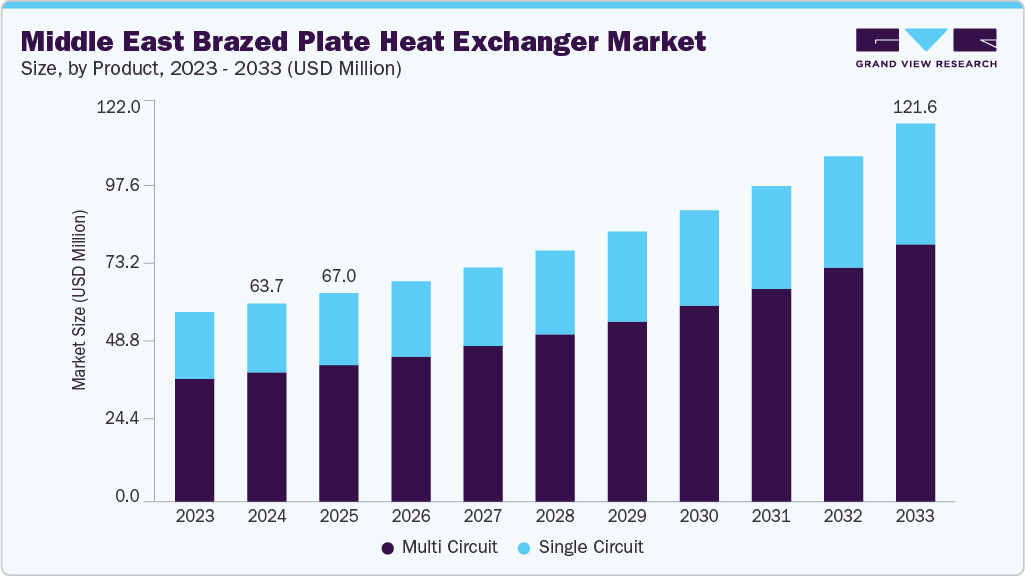
The Middle East brazed plate heat exchanger market size was estimated at USD 63.7 million in 2024 and is projected to reach USD 121.6 million by 2033, growing at a CAGR of 7.7% from 2025 to 2033. Rising utilization of brazed plate heat exchangers in HVAC systems, district cooling, and industrial processes across the Middle East is expected to drive regional market growth.
Key Market Trends & Insights
- The brazed plate heat exchanger market in Saudi Arabia is expected to grow at a substantial CAGR of 8.3% from 2025 to 2033.
- By product, the multi-circuit segment is expected to grow at a considerable CAGR of 8.2% from 2025 to 2033 in terms of revenue.
- By application, the food & beverage segment is expected to grow at a considerable CAGR of 8.6% from 2025 to 2033 in terms of revenue.
Market Size & Forecast
- 2024 Market Size: USD 63.7 Million
- 2033 Projected Market Size: USD 121.6 Million
- CAGR (2025-2033): 7.7%
The region’s increasing investments in infrastructure, energy-efficient technologies, and large-scale commercial developments, especially in countries like the UAE, Saudi Arabia, and Qatar, are creating strong demand for compact and efficient heat exchange solutions.
Additionally, the push for sustainability and energy conservation, driven by national visions such as Saudi Vision 2030 and UAE Energy Strategy 2050, is encouraging the adoption of environmentally friendly technologies, including brazed plate heat exchangers. Harsh climatic conditions and the need for efficient cooling solutions in the Gulf countries further contribute to the market expansion in the region.
Market Concentration & Characteristics
The Middle East brazed plate heat exchanger industry is moderately fragmented, with a mix of regional and international players competing across various segments. Numerous firms in the market offer specialized products like fire-resistant coatings, cladding, and sealants. Local manufacturers cater to price-sensitive projects, while global brands focus on premium offerings and compliance with international standards.
In the Middle East, the brazed plate heat exchanger market is experiencing focused innovation aimed at meeting the region’s unique industrial and environmental demands. Manufacturers are enhancing thermal efficiency, durability against harsh operating conditions, and corrosion resistance, particularly for applications in oil & gas, petrochemicals, and district cooling. There is also growing interest in compact and space-saving designs to support urban infrastructure projects and retrofitting in existing facilities.
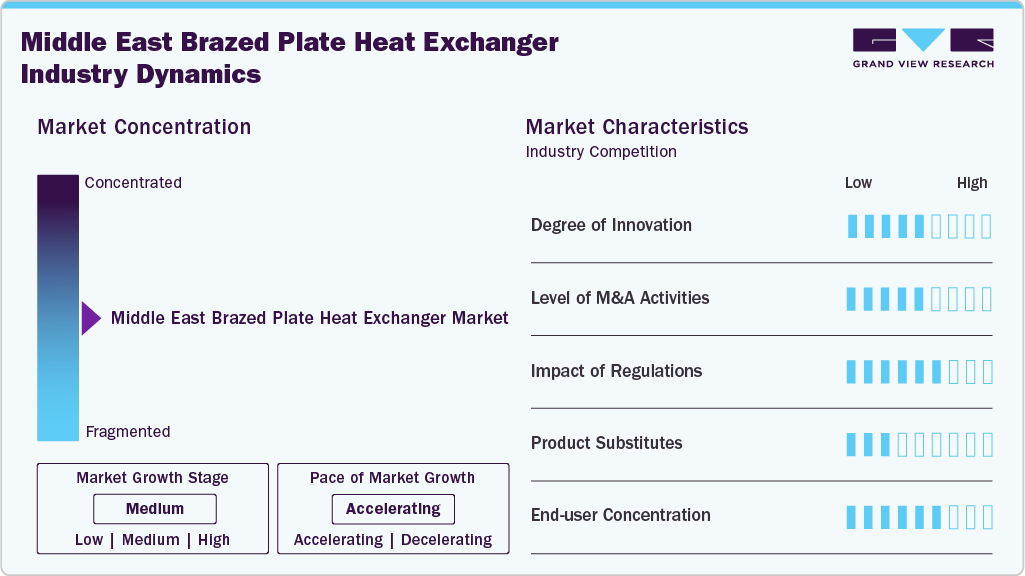
Mergers and acquisitions in the brazed plate heat exchanger sector are largely driven by international players seeking to strengthen their foothold in the region. These strategic moves allow companies to tap into high-growth markets like Saudi Arabia, the UAE, and Qatar, where demand for advanced HVAC, industrial cooling, and energy systems is rising. Acquisitions also help companies expand service capabilities, localize production, and align more closely with government-led initiatives for energy efficiency and sustainable industrial development.
Environmental regulations in the Middle East, while varying by country, are increasingly emphasizing energy efficiency and emissions reduction, particularly in alignment with global climate commitments and national visions such as Saudi Vision 2030 and the UAE Net Zero 2050 initiative. These policies are pushing manufacturers and end-users to adopt brazed plate heat exchangers that support eco-friendly refrigerants, improved energy performance, and compliance with safety and pressure handling standards, driving innovation and market growth across the region.
Drivers, Opportunities & Restraints
In the Middle East, a major driver for the brazed plate heat exchangers market is the rising demand for energy-efficient and space-saving thermal systems, particularly in HVAC and industrial cooling applications. With extreme temperatures and growing urbanization, countries like Saudi Arabia, the UAE, and Qatar are investing heavily in advanced cooling technologies for residential, commercial, and infrastructure projects. Brazed plate heat exchangers are increasingly favored for their high thermal efficiency and compact design, making them ideal for integration into district cooling systems, commercial buildings, and industrial plants where space and energy efficiency are critical.
An emerging opportunity in the Middle East brazed plate heat exchanger market lies in the growing deployment of renewable energy systems and large-scale district cooling networks. As Gulf countries diversify their energy mix and invest in sustainable infrastructure such as solar-powered facilities, waste heat recovery, and geothermal systems, demand is rising for heat exchangers that can support efficient thermal management in these applications.
However, a key challenge in the Middle East is the performance of brazed plate heat exchangers in applications involving high-fouling fluids or corrosive environments, such as in the oil & gas and desalination sectors. The region's harsh operating conditions, including high salinity and sand exposure, can limit the effectiveness and longevity of standard units.
Product Insights
Multi-circuit dominated the Middle East brazed plate heat exchanger industry in 2024, with the highest revenue share at 65.3%. This can be attributed to its suitability for large-scale applications such as district cooling, industrial refrigeration, and centralized HVAC systems. The region’s focus on high-performance, energy-efficient infrastructure, particularly in rapidly developing urban centers like Riyadh, Dubai, and Doha, has significantly boosted demand for multi-circuit units. These systems offer superior energy efficiency, lower carbon emissions, and cost-effective operation, aligning well with the sustainability goals of national strategies such as Saudi Vision 2030 and the UAE Energy Strategy 2050.
The single circuit segment is expected to grow at a considerable CAGR of 6.7% from 2025 to 2033 in terms of revenue. The single circuit segment of the Middle East brazed plate heat exchanger industry is anticipated to expand steadily, supported by rising demand in residential and light commercial HVAC and refrigeration systems. Its compact design, affordability, and efficient thermal transfer make it ideal for smaller installations such as villas, retail outlets, and mid-sized commercial buildings. As governments promote energy efficiency in building codes and retrofitting projects, the adoption of single-circuit exchangers is expected to increase.
Application Insights
The HVAC-R segment dominated the Middle East brazed plate heat exchanger market in 2024, holding the largest revenue share at 24.2%. The segment’s dominance can be attributed to the region’s growing need for energy-efficient cooling systems across residential, commercial, and industrial developments. With extreme temperatures and rapid urbanization in countries like Saudi Arabia, the UAE, and Qatar, there is a strong focus on modernizing HVAC systems to reduce energy consumption and meet environmental targets set by national sustainability initiatives such as Saudi Vision 2030 and the UAE Net Zero 2050 strategy.
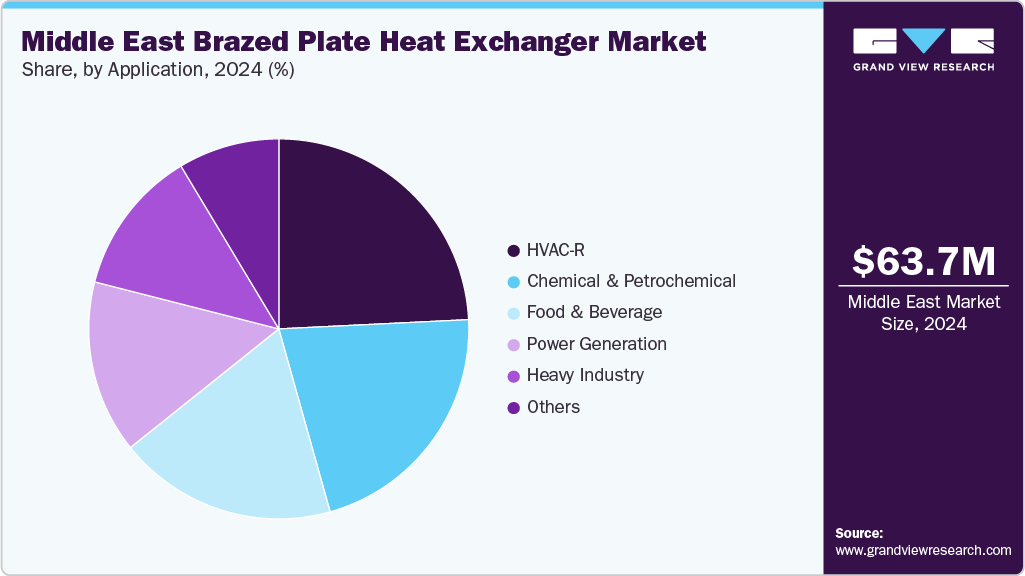
The food & beverage segment is expected to grow at a considerable CAGR of 8.6% from 2025 to 2033 in terms of revenue. The food & beverage segment in the Middle East brazed plate heat exchanger industry is also showing steady growth in demand for brazed plate heat exchangers, fueled by the region's expanding food processing industry and rising investments in local production. Countries are increasingly prioritizing food security and domestic manufacturing, leading to the establishment of advanced processing plants that require precise temperature control, hygienic heat transfer, and energy efficiency.
Country Insights
Saudi Arabia Brazed Plate Heat Exchanger Market Trends
Saudi Arabia dominated the Middle East brazed plate heat exchanger market over the forecast period, accounting for 40.3% share in 2024, due to large-scale infrastructure projects under Vision 2030, rising demand for energy-efficient HVAC systems, and expanding industrial sectors. Investment in district cooling, food processing, and renewable energy will drive adoption, supported by environmental regulations and the push for sustainable, high-performance thermal solutions.
UAE Brazed Plate Heat Exchanger Market Trends
The brazed plate heat exchanger market in the UAE is expected to grow at a CAGR of 8.1%from 2025 to 2033. driven by smart city developments, retrofitting of HVAC systems, and increased demand for sustainable building technologies. The country's strong emphasis on green building standards, energy efficiency, and expanding food and beverage manufacturing will support growth, alongside the rising integration of heat exchangers in solar and district cooling applications.
Key Middle East Brazed Plate Heat Exchanger Company Insights
Some of the key players operating in the market include Alfa Laval, Danfoss, and SWEP International AB.
-
Alfa Laval is a global provider of specialized products and engineering solutions, focusing on heat transfer, separation, and fluid handling. The company designs and manufactures brazed plate heat exchangers used in HVAC, refrigeration, power generation, and industrial applications. With a strong presence in various markets, Alfa Laval emphasizes energy efficiency, sustainability, and performance reliability.
-
Danfoss develops energy-efficient technologies and components used in refrigeration, air conditioning, heating, and industrial automation. Its brazed plate heat exchangers are designed to deliver high thermal performance with minimal space requirements, making them suitable for a wide range of applications, including HVAC systems and renewable energy installations.
Key Middle East Brazed Plate Heat Exchanger Companies:
- Alfa Laval
- Danfoss
- SWEP International AB
- Xylem Inc.
- AIC
- GEA Group Aktiengesellschaft
- Mersen Corporate Services SAS
- Dover Corporation
- General Electric Company (GE Vernova)
- Johnson Controls Inc.
Recent Developments
-
In May 2025, Danfoss launched the new CO₂/Water brazed heat exchanger (H48T-CH) using Micro Plate Technology, designed for CO₂ transcritical systems. Ideal for heat recovery in supermarkets and hypermarkets, it offers efficient, single-phase thermal performance tailored for sustainable refrigeration solutions.
-
In April 2025, SWEP International AB introduced brazed plate heat exchangers made from CO₂-reduced steel, offering a more sustainable option for customers aiming to lower the carbon footprint of their heating systems. This launch supports environmentally conscious manufacturing and energy-efficient operations.
Middle East Brazed Plate Heat Exchanger Market Report Scope
|
Report Attribute
|
Details
|
|
Market size in 2025
|
USD 67.0 million
|
|
Revenue forecast in 2033
|
USD 121.6 million
|
|
Growth rate
|
CAGR of 7.7% from 2025 to 2033
|
|
Historical data
|
2021 - 2023
|
|
Forecast period
|
2025 - 2033
|
|
Quantitative units
|
Revenue in USD million, and CAGR from 2025 to 2033
|
|
Report coverage
|
Revenue forecast, company market position analysis, competitive landscape, growth factors, and trends
|
|
Segments covered
|
Product, application, country
|
|
Country scope
|
Saudi Arabia; UAE; Oman ;Qatar; Kuwait; Israel
|
|
Key companies profiled
|
Alfa Laval; Danfoss; SWEP International AB; Xylem Inc.; AIC; GEA Group Aktiengesellschaft; Mersen Corporate Services SAS; Dover Corporation; General Electric Company (GE Vernova); Johnson Controls Inc.
|
|
Customization scope
|
Free report customization (equivalent up to 8 analysts working days) with purchase. Addition or alteration to country, regional & segment scope.
|
|
Pricing and purchase options
|
Avail customized purchase options to meet your exact research needs. Explore purchase options
|
Middle East Brazed Plate Heat Exchanger Market Report Segmentation
This report forecasts revenue growth at the regional and country level and provides an analysis on the industry trends in each of the sub-segments from 2021 to 2033. For this study, Grand View Research has segmented the Middle East brazed plate heat exchanger market report based on product, application, and country:
-
Product Outlook (Revenue, USD Million, 2021 - 2033)
-
Single Circuit
-
Multi Circuit
-
Application Outlook (Revenue, USD Million, 2021 - 2033)
-
HVAC-R
-
Chemical & Petrochemical
-
Food & Beverage
-
Power Generation
-
Heavy Industry
-
Others
-
Country Outlook (Revenue, USD Million, 2021 - 2033)
-
Saudi Arabia
-
UAE
-
Oman
-
Qatar
-
Kuwait
-
Israel
Frequently Asked Questions About This Report
b. The Middle East brazed plate heat exchanger market size was estimated at USD 63.7 million in 2024 and is expected to reach USD 67.0 million in 2025.
b. The Middle East brazed plate heat exchanger market, in terms of revenue, is expected to grow at a compound annual growth rate of 7.7% from 2025 to 2033, reaching USD 121.6 million by 2033.
b. Multi Circuit dominated the market in 2024, accounting for the highest revenue share at 65.3%. Brazed plate heat exchanger demand is expected to increase due to economic effectiveness, reduced carbon footprints, and increased energy efficiency, especially in applications for refrigeration, air conditioning, chillers, and heat pumps.
b. Some of the key players operating in the Middle East brazed plate heat exchanger market include Alfa Laval, Danfoss, SWEP International AB, Xylem Inc., AIC, GEA Group Aktiengesellschaft, Mersen Corporate Services SAS, Dover Corporation, General Electric Company (GE Vernova), and Johnson Controls Inc.
b. Key factors driving the Middle East brazed plate heat exchanger market include rising demand for energy-efficient HVAC systems, rapid urbanization, industrial growth, district cooling expansion, renewable energy projects, and government initiatives promoting sustainability and reduced carbon emissions across the region.

 Download Sample Report
















