Middle East Ferrous Scrap Recycling Market Summary
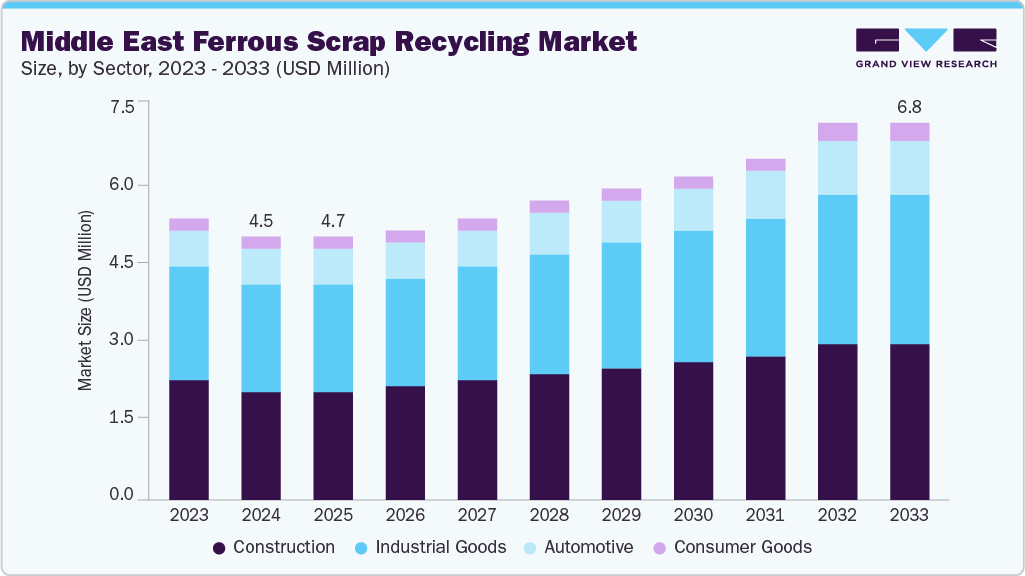
The Middle East ferrous scrap recycling market size was valued at USD 4.5 million in 2024 and is projected to reach USD 6.8 million by 2033, growing at a CAGR of 4.8% from 2025 to 2033. Market growth is driven by regional steel manufacturers’ increasing focus on reducing carbon emissions.
Key Market Trends & Insights
- The ferrous scrap recycling market in the Middle East is expected to grow at a substantial CAGR of 4.8% from 2025 to 2033.
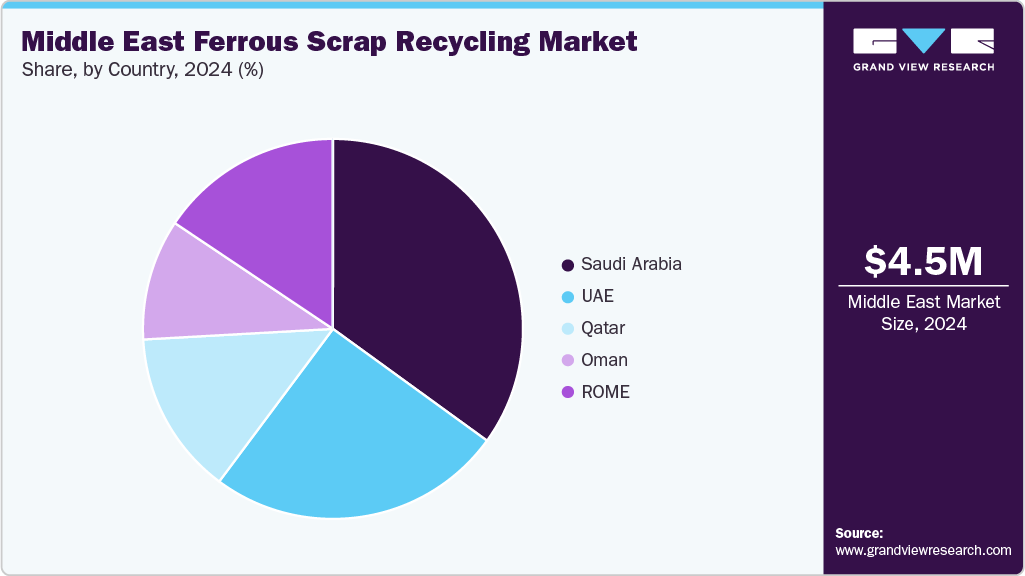
- Saudi Arabia dominated the revenue share of over 35.0% the Middle East Ferrous Scrap Recycling market.
- By sector, the consumer goods segment is anticipated to register the fastest CAGR of 5.8% from 2025 to 2033.
Market Size & Forecast
- 2024 Market Size: USD 4.5 Million
- 2033 Projected Market Size: USD 6.8 Million
- CAGR (2025-2033): 4.8%
The use of recycled steel is rising as it requires less processing for reuse, while the adoption of electric arc furnaces (EAFs) is increasing, cutting carbon emissions by around 70%. These sustainability initiatives are expected to continue supporting the market’s growth in the Middle East.
The Middle East's ferrous scrap recycling market is experiencing significant growth, driven by economic benefits and a strong emphasis on reducing carbon emissions. Steel is among the most recycled materials in the region, contributing to job creation and environmental sustainability.
Recent global trade and policy developments are positively impacting the ferrous scrap recycling market. For instance, the U.S. has implemented a 25% tariff on all steel and aluminum imports, eliminating previous exemptions. This move mandates that qualifying steel must be "melted and poured" and aluminum "smelted and cast" within the U.S., aiming to curb the influx of carbon-intensive materials and bolster domestic production.
In the Middle East, steelmakers are increasingly investing in Electric Arc Furnace (EAF) technology to reduce carbon emissions. EAFs, which utilize recycled steel, are gaining popularity due to their lower environmental impact compared to traditional blast furnaces. For example, a green steel producer in the UAE is planning to establish a facility with a production capacity of 6 million tons per year of crude steel. This project is currently at the stage of approval, reflecting the region's commitment to sustainable steel production.
Additionally, the Middle East and North Africa (MENA) region is actively participating in international dialogues on green steel. The MENA Green Steel Summit 2024, held in Dubai, brought together professionals from the iron and steel industry to discuss trends and developments in green steel, highlighting the region's role in the global transition towards sustainable steel production.
Drivers, Opportunities & Restraints
The Middle East ferrous scrap recycling market is being driven by the increasing adoption of Electric Arc Furnace (EAF) technology and strong government support for sustainable steel production. EAFs, which primarily use recycled steel, help significantly reduce carbon emissions compared to traditional blast furnaces. For example, a green steel producer in the UAE is planning a facility with a production capacity of 6 million tonnes per year of crude steel, reflecting the region’s focus on low-emission steel production. Regional policies promoting recycling infrastructure and waste management further strengthen market growth and attract investment.
The market also presents significant opportunities due to rapid urbanization and growing construction activities, which generate substantial ferrous scrap for recycling. Technological advancements, such as automated sorting and shredding, are improving processing efficiency, reducing operational costs, and enhancing the quality of recycled materials. These developments allow recycling companies to optimize output and profitability while supporting environmental sustainability, positioning the Middle East as a key player in the green steel transition.
However, the market faces certain restraints that may limit growth. High initial capital investment required for modern recycling facilities can deter smaller enterprises from entering the sector. Additionally, fluctuating global metal prices create uncertainty, affecting the financial stability of recycling operations. Despite these challenges, ongoing investments in EAF technology and sustainability-focused initiatives indicate that the Middle East ferrous scrap recycling market is poised for steady growth in the coming years.
Sector Insights
The construction sector dominated the Middle East ferrous scrap recycling market in 2024, accounting for over 45% of the regional revenue. Building demolitions generate substantial scrap due to the extensive use of steel in beams, reinforcement bars, and other structural components. For example, major urban redevelopment projects in cities like Dubai and Riyadh are generating significant quantities of steel scrap, which are being systematically collected and recycled to support sustainability goals and reduce environmental impact.
The automotive sector was the second-largest segment in 2024, driven by the growing emphasis on circular economy practices. Several companies in the region are expanding their recycling operations for end-of-life vehicles (ELVs) and batteries. For instance, the UAE and Saudi Arabia have initiated pilot projects to recycle retired vehicles and lithium-ion batteries, aiming to process tens of thousands of ELVs annually while generating economic value and reducing carbon emissions. These initiatives align with the region’s commitment to green mobility and sustainable industrial practices.
The consumer goods sector is expected to witness the fastest growth during the forecast period. Rising e-waste volumes from electronics, appliances, and other consumer products are creating opportunities for scrap collection and recycling. With rapid urbanization and increasing electronics adoption across the Middle East, the consumer segment contributes significantly to the ferrous scrap supply chain. This trend presents strong potential for investment in e-waste recycling facilities and technologies to enhance material recovery while promoting environmental sustainability.
Country Insights
The growth of the Middle East ferrous scrap recycling market is being driven by increasing government initiatives aimed at creating a circular economy and achieving net-zero greenhouse gas emissions by 2050. Countries in the region are implementing policies and sustainability frameworks to promote recycling, particularly in the steel and automotive sectors. These measures are expected to support steady market expansion and attract investments in recycling infrastructure and technologies.
Saudi Arabia Ferrous Scrap Recycling Market Trends
Saudi Arabia is witnessing significant growth in ferrous scrap recycling, driven by industrial modernization and sustainability goals. The market is benefitting from technological advancements such as automated scrap sorting and Electric Arc Furnace (EAF) adoption, which help reduce carbon emissions while improving production efficiency. Large-scale urban development and construction projects are also generating substantial scrap, creating opportunities for collection and processing businesses.
UAE Ferrous Scrap Recycling Market Trends
The UAE ferrous scrap recycling market is emerging as a regional hub for ferrous scrap recycling, with growing participation from automotive and industrial sectors. Automotive companies are increasingly investing in regional recycling centers to manage end-of-life vehicles (ELVs) and battery recycling. For example, several UAE-based initiatives in 2024-25 aim to dismantle and recycle thousands of ELVs annually, supporting both sustainability goals and the circular economy. These efforts, along with expanding industrial recycling capacities, are expected to further strengthen the UAE’s position in the regional ferrous scrap recycling market.
Key Middle East Ferrous Scrap Recycling Company Insights
Some of the key players operating in the market include Al Qaryan Group, PGI Group, and others.
-
Al Qaryan Group was founded in 1980 and is headquartered in Dammam. The company operates over 24 recycling facilities and specializes in recovering and processing ferrous and non-ferrous metals. In 2024, Al Qaryan Group expanded its operations by commissioning a new state-of-the-art shredding and sorting plant, increasing its annual processing capacity to over 1 million tons of scrap.
-
PGI Group was established in 1975 and is headquartered in Sharjah. It operates multiple scrap yards and recycling facilities covering over 220,000 sq. ft., focusing on both ferrous and non-ferrous metals. In 2023, PGI Group enhanced its recycling operations with automated sorting technology, improving efficiency and recovery rates for steel and aluminum scrap across the region.
-
ARM Metal Recycling was founded in 1992 and is headquartered in the UAE. The company processes over 120,000 tons of shredded ferrous scrap annually and deals with non-ferrous metals. In 2024, ARM Metal Recycling invested in a high-capacity shredder and metal separation system, strengthening its processing capabilities and supporting sustainable recycling initiatives in the Middle East.
Key Middle East Ferrous Scrap Recycling Companies:
- Al Ahmadi General Trading
- Al Qaryan Group
- ARM Metal Recycling
- Boudal Incorporate
- Middle East Scrap Co.
- PGI Group
- Sharif Metals International
- SJ Iron & Metals Co.
- Toronto Metals Trading LLC
- WaterLink Corp.
Recent Developments
-
In March 2024, Al Qaryan Group commissioned a new state-of-the-art shredding and sorting plant, increasing its annual processing capacity to over 1 million tons of ferrous and non-ferrous scrap. This expansion strengthens the company’s position as a leading recycler in the region.
-
In July 2024, PGI Group upgraded its recycling operations by integrating automated sorting technology across its multiple facilities. The enhancement improved efficiency and recovery rates for steel and aluminum scrap, supporting sustainability goals in the Middle East.
-
In January 2025, ARM Metal Recycling invested in a high-capacity shredder and an advanced metal separation system. The investment is aimed at boosting processing capabilities and increasing the volume of recycled ferrous scrap to meet growing regional demand.
Middle East Ferrous Scrap Recycling Market Report Scope
|
Report Attribute
|
Details
|
|
Market size value in 2025
|
USD 4.7 million
|
|
Revenue forecast in 2033
|
USD 6.8 million
|
|
Growth rate
|
CAGR of 4.8% from 2025 to 2033
|
|
Base year for estimation
|
2024
|
|
Historical data
|
2021 - 2023
|
|
Forecast period
|
2025 - 2033
|
|
Quantitative Units
|
Volume in kilotons, revenue in USD million, CAGR from 2025 to 2033
|
|
Report coverage
|
Volume forecast, revenue forecast, company ranking, competitive landscape, growth factors, and trends
|
|
Segments covered
|
Sector, country
|
|
Regional scope
|
Middle East
|
|
Country scope
|
Saudi Arabia; UAE; Oman; Qatar; Iran
|
|
Key companies profiled
|
Al Ahmadi General Trading; Al Qaryan Group; ARM Metal Recycling; Boudal Incorporate; Middle East Scrap Co.; PGI Group; Sharif Metals International; SJ Iron & Metals Co.; Toronto Metals Trading LLC; WaterLink Corp
|
|
Customization scope
|
Free report customization (equivalent up to 8 analysts working days) with purchase. Addition or alteration to country, regional & segment scope.
|
|
Pricing and purchase options
|
Avail customized purchase options to meet your exact research needs. Explore purchase options
|
Middle East Ferrous Scrap Recycling Market Report Segmentation
This report forecasts revenue growth at the regional and country levels and provides an analysis of the latest trends in each of the sub-segments from 2021 to 2033. For this study, Grand View Research has segmented the Middle East ferrous scrap recycling report on the basis of sector and country.
-
Sector Outlook (Revenue, USD Million; Volume, Kilotons; 2021 - 2033)
-
Construction
-
Automotive
-
Consumer Goods
-
Industrial Goods
-
Country Outlook (Revenue, USD Million; Volume, Kilotons; 2021 - 2033)
-
Saudi Arabia
-
UAE
-
Oman
-
Qatar
-
Iran
Frequently Asked Questions About This Report
b. The Middle East ferrous scrap recycling market size was estimated at USD 4.5 million in 2024 and is expected to reach USD 4.7 million in 2025.
b. The Middle East ferrous scrap recycling market is expected to grow at a compound annual growth rate of 4.8% from 2025 to 2033 to reach USD 6.8 million by 2033.
b. By sector, the consumer goods segment is anticipated to register the fastest CAGR of 5.8% from 2025 to 2033.
b. Some of the key vendors in the Middle East ferrous scrap recycling market are Al Ahmadi General Trading, Al Qaryan Group, ARM Metal Recycling, Boudal Incorporate, Middle East Scrap Co., PGI Group, Sharif Metals International, SJ Iron & Metals Co., Toronto Metals Trading LLC, and WaterLink Corp.
b. The Middle East ferrous scrap recycling market is growing rapidly, driven by large-scale construction, infrastructure, and automotive projects. Sustainability goals and expanding steel production are further boosting demand for recycled scrap.

 Download Sample Report
















