
- Home
- »
- Advanced Interior Materials
- »
-
Middle East Germanium Market Size, Industry Report, 2033GVR Report cover
![Middle East Germanium Market Size, Share & Trends Report]()
Middle East Germanium Market (2025 - 2033) Size, Share & Trends Analysis Report By Type (Germanium Ingot, Germanium Tetrachloride), By Application (PET, Electronics & Solar), By Country, And Segment Forecasts
- Report ID: GVR-4-68040-733-9
- Number of Report Pages: 90
- Format: PDF
- Historical Range: 2021 - 2023
- Forecast Period: 2025 - 2033
- Industry: Advanced Materials
- Report Summary
- Table of Contents
- Segmentation
- Methodology
- Download FREE Sample
-
 Download Sample Report
Middle East Germanium Market Summary
The Middle East germanium market size was estimated at USD 13.5 million in 2024 and is projected to reach USD 18.7 million by 2033, growing at a CAGR of 3.6% from 2025 to 2033. The demand in the Middle East is primarily driven by its critical role in high-tech applications, including fiber optics, infrared (IR) optics, and high-efficiency solar cells.
Key Market Trends & Insights
- The germanium market in the Middle East is expected to grow at a substantial CAGR of 3.6% from 2025 to 2033.
- By type, germanium ingot segment dominated the market with a revenue share of over 34.0% in 2024.
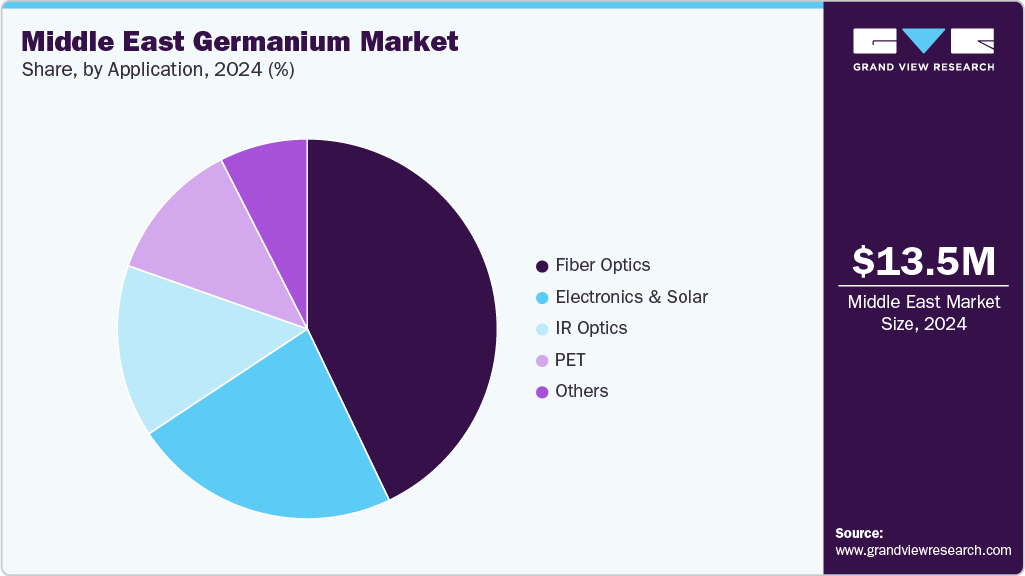
- The fiber optics segment held the largest share of over 43.0% of germanium revenue in 2024.
Market Size & Forecast
- 2024 Market Size: USD 13.5 million
- 2033 Projected Market Size: USD 18.7 million
- CAGR (2025-2033): 3.6%
As the region accelerates investments in 5G networks, renewable energy projects, and advanced defense systems, the adoption of germanium-based technologies is rising rapidly. Its unique properties, optical clarity, high electron mobility, and infrared sensitivity make it indispensable for sectors requiring precision, performance, and long-term reliability. Germanium components hold a significant share of the advanced materials market in the Middle East due to their superior semiconductor properties, infrared transparency, and critical role in high-performance technologies. Their ability to enable high-speed data transmission, precision optics, and solar energy conversion makes them indispensable across defense, aerospace, telecommunications, and renewable energy sectors. Applications include satellite solar cells, thermal imaging systems, and fiber optic networks, where precision, efficiency, and reliability are essential.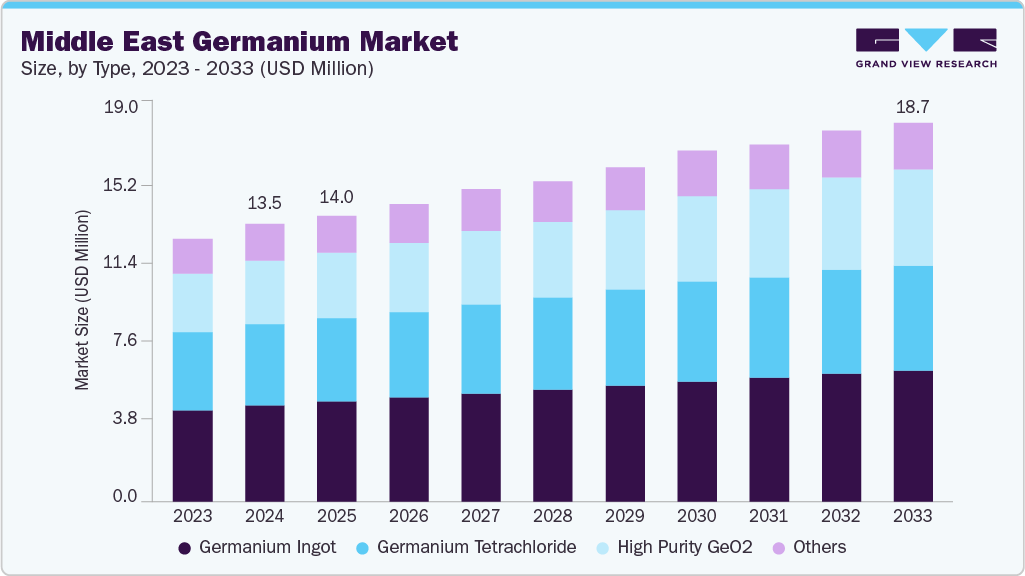
Rising investments in digital infrastructure, 5G deployment, innovative city initiatives, and space and defense programs are accelerating demand for germanium in the region. Its high efficiency in multi-junction solar cells and infrared technologies has made it a key material for satellite missions, aerospace projects, and advanced surveillance systems. In a market driven by technological advancement and strategic resource planning, germanium is a critical raw material offering high performance and long-term value for next-generation industrial applications.
Drivers, Opportunities & Restraints
The demand for germanium in the Middle East is primarily driven by its indispensable role in high-tech applications such as fiber optics, infrared (IR) optics, high-efficiency solar cells, and advanced electronics. The region is witnessing rapid deployment of 5G networks, expansion of innovative city projects, and increased investments in defense and aerospace systems, all accelerating the adoption of germanium-based technologies. Its unique properties, optical clarity, high electron mobility, and infrared sensitivity make germanium a critical material for applications requiring precision, high-speed data transmission, thermal imaging, and reliable performance under demanding conditions. Countries in the GCC and Israel are increasingly integrating germanium into high-tech solutions to support digital connectivity, surveillance, and space technology initiatives.
Significant opportunities exist in expanding telecommunications infrastructure, regional space and satellite programs, and renewable energy projects. The Middle East’s push toward smart cities, IoT integration, and advanced surveillance systems is creating a growing market for germanium-based components, particularly fiber optic networks, infrared sensors, and satellite-based solar cells. Moreover, developing local refining, recycling, and supply partnerships could reduce reliance on imported germanium and stabilize supply chains while creating economic opportunities within the region. Strategic collaborations with global germanium producers could further enhance regional capabilities in high-tech manufacturing and sustainable energy applications.
However, the market faces several restraints that could limit its growth. The Middle East’s dependence on imports from China, Europe, and North America exposes it to supply chain disruptions and geopolitical uncertainties. Germanium is a rare material, and its high cost, driven by scarcity and the need for high-purity processing, can restrict adoption in specific industries. Moreover, ongoing research into alternative materials, such as advanced silicon-based semiconductors, could partially reduce dependence on germanium for some applications. Volatility in global production and pricing, combined with export controls and trade restrictions, may also impact the region’s ability to secure consistent and affordable supplies, posing challenges for long-term planning in high-tech and defense sectors.
Type Insights
The demand for ingots in the Middle East is primarily driven by their extensive use in producing semiconductor wafers and infrared (IR) optics. These ingots are the foundational material for manufacturing infrared optical lenses, which are widely deployed in thermal imaging systems across defense, security, automotive, and industrial sectors. The growing adoption of thermal imaging technologies for border security, surveillance, and military applications in the region has accelerated the need for ingots, reflecting increasing investments in advanced IR systems by governments and defense organizations.
High-purity germanium dioxide (GeO₂) is the fastest-growing sub-segment in the Middle East due to its increasing use in optical fibers and solar energy applications. Its high infrared transparency makes it essential for producing precision optical lenses and high-speed fiber optic systems, which are critical for the region’s expanding telecommunications infrastructure. The rollout of 5G networks across the GCC and other Middle Eastern countries is boosting demand for broadband connectivity, thereby driving the adoption of optical fibers and high-purity GeO₂.
In addition, high-purity GeO₂ is increasingly applied in high-efficiency solar cells, aligning with the Middle East’s ambitious renewable energy goals and large-scale solar power projects, particularly in Saudi Arabia, the UAE, and Israel. With the region accelerating its transition toward cleaner energy sources and advanced communication technologies, the demand for germanium ingots and high-purity GeO₂ is expected to rise steadily, supporting applications where performance, durability, and precision are essential.
Application Insights
The fiber optics segment in the Middle East is driven by the rapid rollout of 5G networks and rising demand for high-speed data transmission. Germanium tetrachloride, a key material used in fiber optic cables, enhances the transmission capabilities of optical fibers, making it critical for telecom infrastructure. Regional telecom operators such as Etisalat (UAE) and STC (Saudi Arabia) are investing heavily in expanding fiber optic networks to meet growing digital connectivity needs. Governments in the region are also supporting this growth through initiatives to extend broadband coverage and develop smart city infrastructure, further fueling demand for germanium-based materials.
The electronics and solar energy segments are emerging as the fastest-growing applications in the Middle East germanium market. Germanium is highly valued for its exceptional electron mobility and thermal conductivity, making it a vital material for high-frequency, high-speed, and radiation-resistant semiconductors. These properties are particularly crucial for aerospace electronics, satellite systems, and defense-grade communication devices, where traditional silicon-based components may underperform.
With the region accelerating its adoption of next-generation technologies, including 5G networks, quantum computing projects, autonomous systems, and advanced defense programs, germanium’s role in semiconductor and chip development is becoming increasingly strategic. The growing focus on high-performance, reliable, and durable components ensures that germanium remains critical in supporting the Middle East’s technological ambitions and innovative infrastructure projects.
Middle Eastern countries, such as Saudi Arabia, the UAE, and Israel, are investing heavily in renewable energy and satellite programs, which are directly driving demand for germanium-based solar technologies. Large-scale solar initiatives, including the NEOM solar project in Saudi Arabia and Masdar City in the UAE, are exploring advanced photovoltaic solutions where germanium-based cells can enhance performance and longevity.
Country Insights
The Middle East germanium market is witnessing steady growth, driven by rising demand across defense, aerospace, telecommunications, and renewable energy sectors. Fiber optics, infrared (IR) optics, and high-efficiency solar cells are the primary applications propelling this growth. The region’s focus on advanced technology adoption, innovative city initiatives, and satellite programs creates significant opportunities for germanium-based components.
Saudi Arabia Germanium Market Trends
Saudi Arabia germanium market is emerging as a key market within the Middle East, fueled by large-scale investments in renewable energy and space technology. Multi-junction germanium-based solar cells are considered for high-efficiency concentrated solar power (CSP) projects and satellite applications. In addition, the rapid deployment of 5G infrastructure and the expansion of fiber optic networks are boosting demand for germanium tetrachloride and optical fibers. Strategic initiatives to secure critical minerals and partnerships with global technology providers further strengthen the country’s position in the regional germanium market.
UAE Germanium Market Trends
Germanium market in the UAE is also witnessing increased adoption of germanium technologies, supported by government-backed innovative city projects, renewable energy initiatives such as Masdar City, and satellite programs. The UAE’s focus on high-tech innovation and growing investments in advanced defense and surveillance systems drive demand for germanium in infrared optics, high-performance semiconductors, and fiber optic infrastructure. Collaborations with international suppliers and ongoing R&D initiatives are helping the UAE enhance its technological capabilities and reduce dependency on imported critical materials.
Key Middle East Germanium Company Insights
Some of the key players operating in the market include 5N Plus Inc., AXT Inc., and others.
-
5N Plus Inc. is a leading global specialty semiconductor and performance materials producer. The company develops and manufactures advanced materials that are core components of customers' products. 5N Plus's expertise in refining and recycling processes ensures the delivery of high-purity materials essential for various high-tech applications. In 2024, the U.S. Department of Defense awarded 5N Plus USD 14.4 million to enhance its manufacturing capabilities for space-qualified germanium substrates, underscoring its role in supporting critical infrastructure.
-
AXT Inc. is a material science company specializing in developing and manufacturing high-performance compound and single-element semiconductor wafer substrates, including germanium. These substrates are crucial for semiconductor and optoelectronic devices where silicon wafers do not meet performance requirements. AXT's products are integral to telecommunications, fiber optics, and infrared technologies applications.
-
Teck Resources Limited is one of the largest integrated germanium producers. Germanium-bearing concentrates are processed at their integrated lead/zinc refinery in Trail, British Columbia. Teck produces a wide range of high-quality germanium products; many developed in collaboration with customers. The company maintains a Quality Management System for Germanium Products that complies with ISO 9001:2015 standards.
Key Middle East Germanium Companies:
- 5N Plus Inc.
- AXT Inc.
- China Germanium Co., Ltd. (CNGE)
- Indium Corporation
- JSC Germanium
- Materion Advanced Materials
- Noah Chemicals
- Teck Resources Limited
- Umicore
- Yunnan Chihong Zinc & Germanium Co., Ltd.
- Yunnan Germanium
Recent Developments
-
In May 2024, Umicore, a global materials technology and recycling group, entered into a long-term partnership with STL, a subsidiary of Gécamines in the Democratic Republic of Congo (DRC). This collaboration focuses on extracting germanium from the Big Hill tailings site in Lubumbashi. Umicore likely to provide technical support to STL's newly established hydrometallurgical facility, optimizing the refining process to produce high-purity germanium for use in high-tech applications such as fiber optics, solar cells, and electronics.
-
In October 2024, the DRC achieved a significant milestone by exporting its first batch of locally produced germanium concentrates. These concentrates were processed at STL's hydrometallurgical plant in Lubumbashi, with technical support from Umicore. The shipment, marking the first "Made-in-DRC" germanium export, was sent to Umicore's facilities in Belgium for further processing and application in high-tech industries. This development underscores the DRC's growing role in the global supply chain for critical minerals.
-
The partnership between Umicore and STL is set to enhance the DRC's capacity to process and recycle germanium domestically. STL's new hydrometallurgical facility in Lubumbashi, established in 2023, is central to this initiative. With Umicore's expertise in refining and recycling, STL aims to optimize the facility's operations, ensuring consistent germanium outputs while adhering to stringent environmental, social, and governance (ESG) standards.
Middle East Germanium Market Report Scope
Report Attribute
Details
Market size value in 2025
USD 14.0 million
Revenue forecast in 2033
USD 18.7 million
Growth rate
CAGR of 3.6% from 2025 to 2033
Base year for estimation
2024
Historical data
2021 - 2023
Forecast period
2025 - 2033
Quantitative units
Volume in tons, revenue in USD million/billion, and CAGR from 2025 to 2033
Report coverage
Volume forecast, revenue forecast, competitive landscape, growth factors, and trends
Segments covered
Type, application, country
Regional scope
Middle East
Country scope
Saudi Arabia; UAE; Oman; Qatar
Key companies profiled
5N Plus Inc.; AXT Inc.; China Germanium Co., Ltd. (CNGE); Indium Corporation; JSC Germanium; Materion Advanced Materials; Noah Chemicals; Teck Resources Limited; Umicore; Yunnan Chihong Zinc & Germanium Co., Ltd.; Yunnan Germanium
Customization scope
Free report customization (equivalent up to 8 analysts working days) with purchase. Addition or alteration to country, regional & segment scope.
Pricing and purchase options
Avail customized purchase options to meet your exact research needs. Explore purchase options
Middle East Germanium Market Report Segmentation
This report forecasts revenue and volume growth at the country and regional levels and provides an analysis of the latest trends in each of the sub-segments from 2021 to 2033. For this study, Grand View Research has segmented the Middle East germanium market report based on type, application, and country.
-
Type Outlook (Volume, Tons; Revenue, USD Million, 2021 - 2033)
-
Germanium Ingot
-
Germanium Tetrachloride
-
High Purity GeO2
-
Others
-
-
Application Outlook (Volume, Tons; Revenue, USD Million, 2021 - 2033)
-
PET
-
Electronics & Solar
-
Fiber Optics
-
IR Optics
-
Others
-
-
Country Outlook (Volume, Tons; Revenue, USD Million, 2021 - 2033)
-
Middle East
-
Saudi Arabia
-
UAE
-
Qatar
-
Oman
-
-
Frequently Asked Questions About This Report
b. By type, germanium ingot dominated the market with a revenue share of over 34.0% in 2024.
b. Some of the key vendors in the Middle East germanium market are 5N Plus Inc., AXT Inc., China Germanium Co., Ltd. (CNGE), Indium Corporation, JSC Germanium, Materion Advanced Materials, Noah Chemicals, Teck Resources Limited, Umicore, Yunnan Chihong Zinc & Germanium Co., Ltd., and Yunnan Germanium.
b. Key factors driving the Middle East germanium market include the growing adoption of fiber optics for expanding telecom infrastructure, increasing demand for infrared optics in defense and security applications, and rising use of germanium in high-efficiency solar cells for renewable energy projects.
b. The Middle East germanium market size was estimated at USD 13.5 million in 2024 and is expected to reach USD 14.0 million in 2025.
b. The Middle East germanium market is expected to grow at a compound annual growth rate of 3.6% from 2025 to 2033 to reach USD 18.7 million by 2033.


Share this report with your colleague or friend.
Need a Tailored Report?
Customize this report to your needs — add regions, segments, or data points, with 20% free customization.


ISO 9001:2015 & 27001:2022 Certified
We are GDPR and CCPA compliant! Your transaction & personal information is safe and secure. For more details, please read our privacy policy.
Trusted market insights - try a free sample
See how our reports are structured and why industry leaders rely on Grand View Research. Get a free sample or ask us to tailor this report to your needs.













