Middle East Lithium-ion Battery Solvent Market Summary
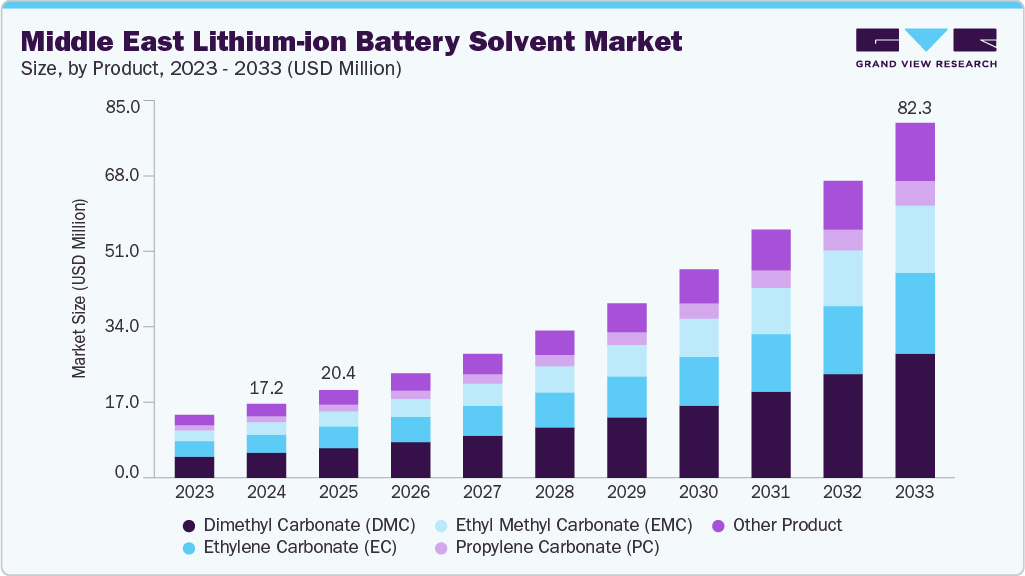
The Middle East lithium-ion battery solvent market size was estimated at USD 17.2 million in 2024 and is projected to reach USD 82.3 million by 2033, growing at a CAGR of 19.1% from 2025 to 2033. Rapid EV adoption, large-scale renewable energy deployment, and nascent domestic battery initiatives are accelerating Middle East demand for lithium-ion battery solvents.
Key Market Trends & Insights
- Saudi Arabia dominated the Middle East lithium-ion battery solvent industry with the largest revenue share of 40.6% in 2024.
- By product, the dimethyl carbonate (DMC) segment led the market with the largest revenue share of 33.9% in 2024.
- By end-use, the electric vehicles segment led the market with the largest revenue share of 48.8% in 2024.
Market Size & Forecast
- 2024 Market Size: USD 17.2 Million
- 2033 Projected Market Size: USD 82.3 Million
- CAGR (2025-2033): 19.1%
Government investment like KEZAD-Titan lithium processing plant and petrochemical capacity expansion favors local supply, reducing import dependence and improving cost competitiveness while incentivizing upstream integration across the battery value chain and manufacturing capabilities rapidly.
Market growth is driven primarily by rising electric vehicle penetration and utility-scale storage projects that require large-format cells and high electrolyte volumes. Consumer electronics remain steady but constitute a declining share as automotive and grid applications scale faster. Local petrochemical players, attracted by vertical integration prospects, are expanding solvent production and blending capabilities. Favorable regulations, subsidies for renewables, and EV incentives accelerate adoption, while increasing cell manufacturing investments in Saudi Arabia and the UAE create clustered demand.
On the demand side, technical trends-fast charging, high-nickel cathodes, and silicon-enhanced anodes-push adoption of low-viscosity linear carbonates and specialty high-volatility suppressing solvents. However, the market faces hurdles: high purity requirements, stringent qualification cycles, and safety regulations that extend time-to-market and raise capital intensity. Supply chain resilience remains critical.
Localized high-purity manufacturing, strategic partnerships with cell makers, and investment in specialty solvents tailored for fast-charge and high-voltage chemistries. Recycling infrastructure and solvent reclamation services can reduce feedstock costs and align with circular economy goals, particularly for GCC countries seeking domestic value-addition. Public-private collaboration to streamline qualification standards, safety testing, and incentives for domestic cell assembly will shorten go-to-market timelines. However, success requires substantial CAPEX, skilled chemical engineers, and rigorous environmental compliance. Companies that combine technical formulation expertise with regional supply networks will lead, capturing margin premiums from custom blends and long-term contracts.
Product Insights
The dimethyl carbonate (DMC) segment led the market with the largest revenue share of 33.9% in 2024, reflecting its critical role as a low-viscosity solvent that enhances ionic conductivity in lithium-ion batteries. Its comparatively lower toxicity, cost efficiency, and wide availability make it a preferred choice for electrolyte formulations across electric vehicles and consumer electronics. Moreover, its compatibility with other carbonate solvents positions it as a key enabler of large-scale battery adoption, particularly in cost-sensitive, high-volume applications.
The ethyl methyl carbonate (EMC) segment is anticipated to grow at the fastest CAGR of 20.5% during the forecast period, driven by increasing demand for high-energy density and fast-charging batteries. Its low viscosity and high voltage stability make it particularly suitable for modern cathode chemistries and advanced EV applications. As automakers and energy storage developers pursue improved performance and cycle life, EMC’s role in optimizing electrolyte blends will expand, boosting its market penetration significantly over the coming decade.
End-use Insights
The electric vehicles (EV) segment led the market with the largest revenue share of 48.8% in 2024, underpinned by the accelerating adoption of EVs across the Middle East and strong government incentives supporting electrification. Demand for high-capacity lithium-ion batteries, requiring substantial volumes of high-purity solvents, has surged as automakers expand local assembly and import programs. Coupled with rapid deployment of charging infrastructure and emissions reduction commitments, EVs are emerging as the primary driver of solvent consumption in the region.
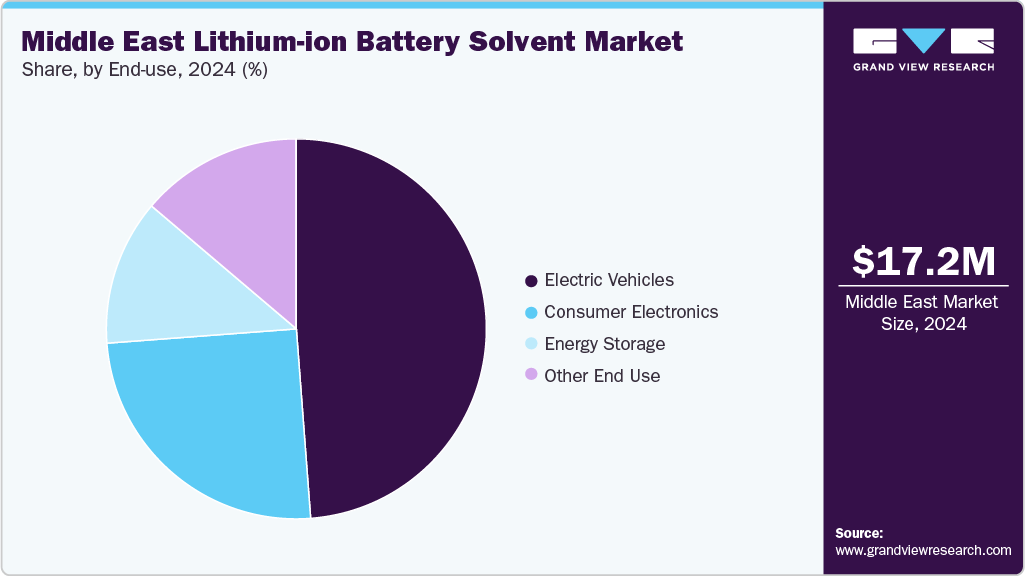
The consumer electronics segment is projected to expand at the fastest CAGR of 16.9% from 2025 to 2033, fueled by rising regional demand for smartphones, laptops, and wearable devices. Growth is supported by increasing digital penetration, younger demographics, and greater adoption of portable devices requiring compact yet efficient lithium-ion batteries. As manufacturers push for lighter designs with higher energy density, solvent innovation becomes critical, ensuring stable performance and safety, which boosts solvent demand in electronics applications.
Country Insights
Saudi Arabia dominated the Middle East lithium-ion battery solvents market with the largest revenue share of 40.6% in 2024, supported by its strong petrochemical base, growing EV ambitions, and large-scale renewable energy projects. Government initiatives under Vision 2030 have spurred investments in battery materials, energy storage, and localized manufacturing. With abundant industrial capacity and strategic projects like the Yanbu Battery Chemicals Complex, the Kingdom has positioned itself as the region’s anchor market for solvent demand and supply chain growth.
UAE lithium-ion Battery Solvents Market Trends
The lithium-ion battery solvents market in the UAE is projected to expand at the fastest CAGR of 19.5% from 2025 to 2033, driven by its rapid push toward electrification, advanced infrastructure, and government-backed investment in EV and battery projects. Initiatives such as the KEZAD-Titan lithium processing plant highlight the country’s ambition to establish itself as a hub for advanced materials. Combined with strong EV adoption, grid-scale storage, and emphasis on sustainable manufacturing, the UAE is emerging as a high-growth market for lithium-ion solvents.
Key Middle East Lithium-ion Battery Solvent Company Insights
Key players operating in the market include Orbia Fluor & Energy Materials and BASF.
-
Orbia Fluor & Energy Materials is a regional chemical company based in the UAE that focuses on advanced fluorinated and carbonate-based chemicals. Its operations include the development of electrolyte components for lithium-ion batteries, emphasizing high performance and stability. The company’s local presence and technical capabilities enable it to contribute to the development of the battery ecosystem across the Middle East.
-
BASF SE is a global chemical company with a strong presence in the Middle East, particularly in the UAE. The company specializes in high-performance chemical solutions, including carbonate-based solvents for lithium-ion batteries. BASF’s expertise in chemical synthesis and advanced manufacturing processes allows it to provide reliable and high-quality materials that support the growing battery industry in the region.
Key Middle East Lithium-ion Battery Solvent Companies:
- EV Metals Group
- Mitsubishi Chemical Corporation
- UBE Corporation
- BASF SE
- Orbia Fluor & Energy Materials
- Gadiv Petrochemical Industries
- SABIC
- Dow
Recent Developments
-
In October 2024, China’s Hithium and Saudi firm MANAT announced a joint venture to establish a 5 GWh battery energy storage system (BESS) manufacturing facility in Saudi Arabia. The facility will produce desert-tailored energy storage solutions with enhanced dust storm protection and robust temperature performance, supporting Saudi Arabia's Vision 2030 renewable energy goals.
-
In June 2025, United Industrial Chemicals Factory (UICF) inaugurated Saudi Arabia's first gel battery production facility in Dammam. This milestone reduces import dependency, supports Vision 2030 goals, and enhances energy resilience. Designed for extreme heat, the batteries are ideal for solar, telecom, and industrial backup applications.
Middle East Lithium-ion Battery Solvent Market Report Scope
|
Report Attribute
|
Details
|
|
Market size value in 2025
|
USD 20.4 million
|
|
Revenue forecast in 2033
|
USD 82.3 million
|
|
Growth rate
|
CAGR of 19.1% from 2025 to 2033
|
|
Base year for estimation
|
2024
|
|
Historical data
|
2021 - 2023
|
|
Forecast period
|
2025 - 2033
|
|
Quantitative units
|
Revenue in USD million/billion, volume in kilotons and CAGR from 2025 to 2033
|
|
Report coverage
|
Revenue forecast, company ranking, competitive landscape, growth factors, and trends
|
|
Segments covered
|
product, end-use, country
|
|
Regional scope
|
Middle East
|
|
Country scope
|
Saudi Arabia; Qatar; UAE; Oman; Israel; Kuwait; Bahrain
|
|
Key companies profiled
|
EV Metals Group; Mitsubishi Chemical Corporation; UBE Corporation; BASF SE; Orbia Fluor & Energy Materials; Gadiv Petrochemical Industries; SABIC; Dow.
|
|
Customization scope
|
Free report customization (equivalent up to 8 analysts’ working days) with purchase. Addition or alteration to country, regional & segment scope.
|
|
Pricing and purchase options
|
Avail customized purchase options to meet your exact research needs. Explore purchase options
|
Middle East Lithium-ion Battery Solvent Market Report Segmentation
This report forecasts revenue growth at the country level and analyzes the latest industry trends in each sub-segment from 2021 to 2033. For this study, Grand View Research has segmented the Middle East lithium-ion battery solvent market report based on product, end-use, and country.
-
Product Outlook (Volume, Kilotons; Revenue, USD Million, 2021 - 2033)
-
End-use Outlook (Volume, Kilotons; Revenue, USD Million, 2021 - 2033)
-
Electric Vehicles
-
Consumer Electronics
-
Energy Storage
-
Other End Use
-
Country Outlook (Volume, Kilotons; Revenue, USD Million, 2021 - 2033)
-
Saudi Arabia
-
UAE
-
Qatar
-
Oman
-
Israel
-
Kuwait
-
Bahrain
Frequently Asked Questions About This Report
b. The Middle lithium-ion battery solvent market size was estimated at USD 17.2 million in 2024 and is expected to reach USD 20.4 million in 2025.
b. The Middle East lithium-ion battery solvent market is expected to grow at a compound annual growth rate of 19.1% from 2025 to 2033 to reach USD 82.3 million in 2033.
b. Saudi Arabia dominated the Middle East lithium-ion battery solvent market with a market share of 40.6% in 2024, supported by its strong petrochemical base, growing EV ambitions, and large-scale renewable energy projects. Government initiatives under Vision 2030 have spurred investments in battery materials, energy storage, and localized manufacturing.
b. Some key players operating in the Middle East lithium-ion battery solvent market include EV Metals Group, Mitsubishi Chemical Corporation, UBE Corporation, BASF SE, Orbia Fluor & Energy Materials, Gadiv Petrochemical Industries, SABIC, Dow.
b. Rapid EV adoption, large-scale renewable energy deployment, and nascent domestic battery initiatives are accelerating Middle East demand for lithium-ion battery solvents. Government investment like KEZAD–Titan lithium processing plant and petrochemical capacity expansion favors local supply, reducing import dependence and improving cost competitiveness while incentivizing upstream integration across the battery value chain and manufacturing capabilities rapidly

 Download Sample Report
















