
- Home
- »
- Advanced Interior Materials
- »
-
Middle East RF Filters Market Size, Industry Report, 2033GVR Report cover
![Middle East RF Filters Market Size, Share & Trends Report]()
Middle East RF Filters Market (2025 - 2033) Size, Share & Trends Analysis Report By End Use (Telecommunications, Automotive, Military & Defense, Consumer Electronics), By Type, By Region, And Segment Forecasts
- Report ID: GVR-4-68040-744-5
- Number of Report Pages: 101
- Format: PDF
- Historical Range: 2021 - 2023
- Forecast Period: 2025 - 2033
- Industry: Advanced Materials
- Report Summary
- Table of Contents
- Segmentation
- Methodology
- Download FREE Sample
-
 Download Sample Report
Middle East RF Filters Market Summary
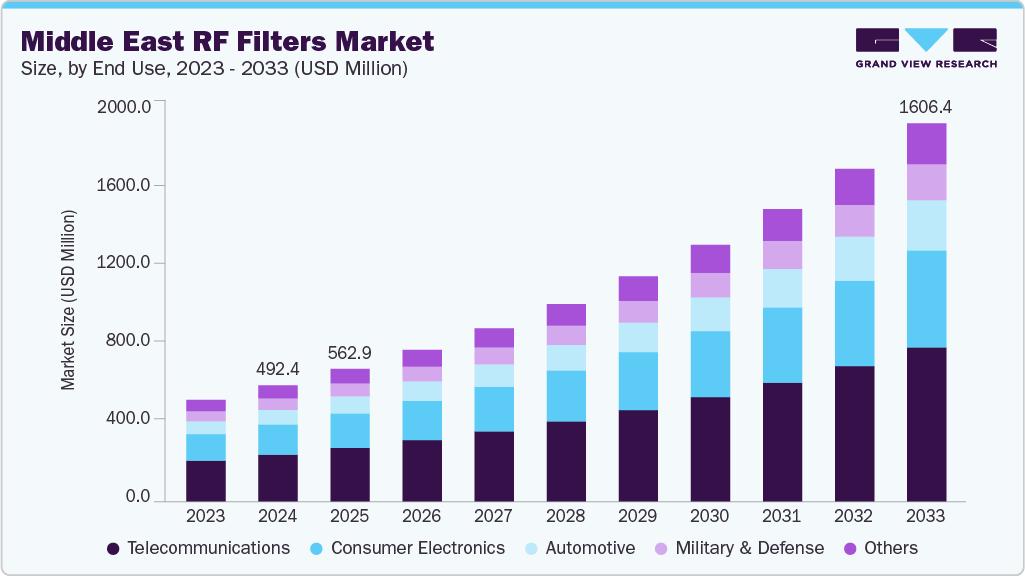
The global Middle East RF filters market size was estimated at USD 492.4 million in 2024 and is projected to reach USD 1606.4 million by 2033, growing at a CAGR of 14.0% from 2025 to 2033. The growth is driven by the rapid expansion of telecommunications infrastructure across the region.
Key Market Trends & Insights
- By end use, the automotive segment is expected to grow at the fastest CAGR of 14.5% from 2025 to 2033.
- By type, the BAW (Bulk Acoustic Wave) filters segment is expected to grow at the fastest CAGR of 14.3% from 2025 to 2033.
- The Egypt RD filters market is expected to grow at the fastest CAGR of 14.6% from 2025 to 2033.
Market Size & Forecast
- 2024 Market Size: USD 492.4 Million
- 2033 Projected Market Size: USD 1606.4 Million
- CAGR (2025-2033): 14.0%
- Egypt: Largest market in 2024
The ongoing rollout of 5G networks and the steady growth of 4G and LTE technologies are creating a strong demand for efficient RF filters to ensure high-quality signal transmission. Governments and telecom operators are investing heavily in expanding mobile connectivity to both urban and remote areas, which in turn fuels the requirement for advanced filtering technologies to manage increasing data traffic and minimize interference.Defense and aerospace modernization programs are also contributing to the growth of the Middle East RF filters industry. Several countries in the region are strengthening their military communication systems, radar technologies, and satellite-based communication networks. RF filters play a critical role in ensuring secure and interference-free communications in these advanced defense applications. National initiatives aimed at boosting indigenous defense manufacturing further enhance the demand for specialized RF filters in the regional market.
Another key driver is the rising adoption of consumer electronics and smart devices. The Middle East has witnessed a surge in smartphone penetration, alongside increasing usage of smart wearables, connected home devices, and IoT-enabled solutions. These devices require reliable RF filters to maintain signal integrity, reduce noise, and ensure seamless performance. The growing trend of digitalization, supported by younger demographics and increasing internet penetration, continues to amplify the need for RF filters in consumer technology applications.
Market Concentration & Characteristics
The Middle East RF filters market demonstrates a moderate to high degree of innovation, primarily driven by advancements in 5G technology, IoT integration, and the growing need for high-frequency bands to support expanding communication networks. Leading manufacturers are investing in R&D to develop compact, energy-efficient, and high-performance filters tailored for telecom, aerospace, and defense applications. Mergers, acquisitions, and strategic collaborations are becoming increasingly common as global and regional players seek to enhance their technological capabilities, expand their product portfolios, and strengthen their market presence. This consolidation trend allows companies to leverage economies of scale and address diverse application needs more effectively.
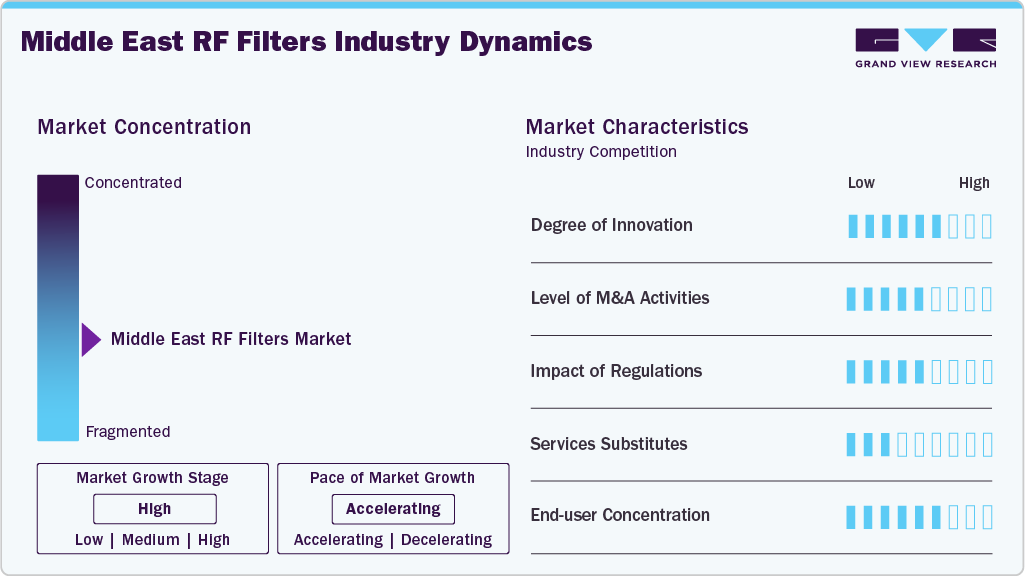
Regulatory frameworks also play a crucial role in shaping market dynamics. Spectrum allocation policies, telecommunication standards, and government mandates for secure communication directly impact the design and adoption of RF filters. Service substitutes remain limited, as RF filters are highly specialized components critical for reducing interference and ensuring reliable performance across multiple frequency bands. End-user concentration is relatively diverse, spanning from telecommunications operators and consumer electronics manufacturers to defense organizations and industrial enterprises. However, telecom operators and mobile device manufacturers account for the largest share, as the rapid digital transformation across the Middle East continues to accelerate demand in these segments.
End Use Insights
The telecommunications segment dominated the Middle East RF filters market with the largest revenue share of 40.3% in 2024, driven by the rapid rollout of 4G and 5G networks, alongside increasing mobile data consumption across the region. Telecom operators are investing heavily in upgrading network infrastructure to support high-speed connectivity and growing user demand. RF filters are essential in minimizing interference and enhancing signal clarity, thereby ensuring reliable communication services. Government-backed initiatives for digital transformation and smart city projects are further accelerating demand in this segment.
The automotive segment is expected to grow at the fastest CAGR of 15.5% over the forecast period, driven by the rising integration of advanced connectivity features in vehicles, including infotainment systems, navigation, and vehicle-to-everything (V2X) communication. The Middle East automotive industry is increasingly aligning with global trends in connected and electric vehicles, creating demand for RF filters to ensure reliable in-vehicle communication. Safety features such as collision avoidance, radar-based systems, and telematics also rely on efficient RF filtering technologies. As regional governments promote smart mobility and intelligent transport systems, the use of RF filters in automotive applications is expected to expand. This trend positions the automotive segment as a growing contributor to market growth.
Type Insights
The SAW (Surface Acoustic Wave) filters segment dominated the Middle East RF filters industry with the largest revenue share of 58.2% in 2024, driven by their cost-effectiveness and suitability for lower-frequency applications such as smartphones, IoT devices, and wireless communication modules. The Middle East’s high smartphone penetration rate and growing use of smart wearables and consumer electronics amplify the need for SAW filters. Their compact size, high performance in low-to-mid frequency bands, and relatively low production costs make them attractive for mass-market adoption. The growing IoT ecosystem, supported by smart city initiatives, is further boosting the integration of SAW filters across diverse applications. These factors reinforce SAW filters’ strong position in the regional RF filters market.
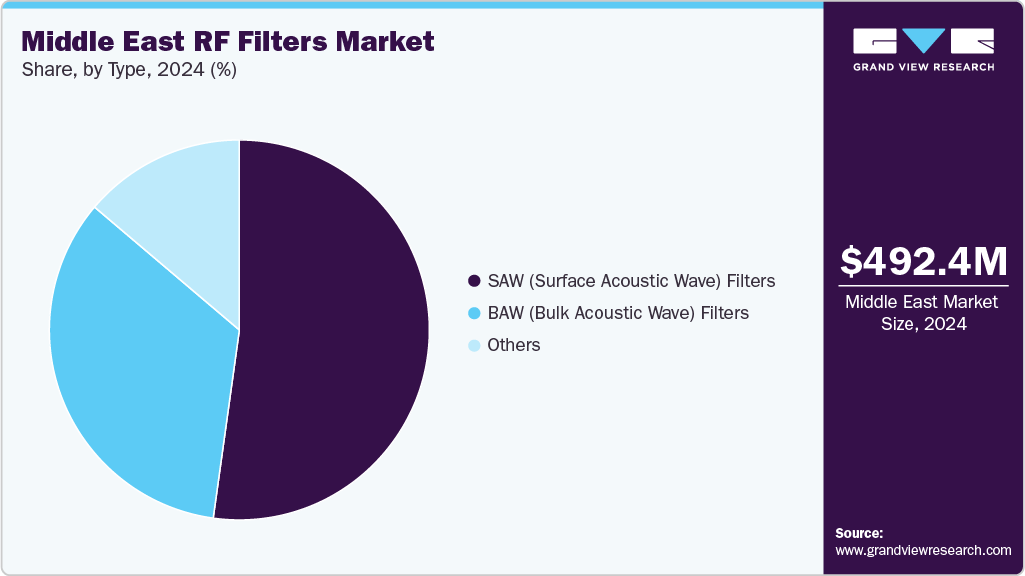
The BAW (Bulk Acoustic Wave) filters segment is expected to grow at the fastest CAGR of 14.3% over the forecast period, driven by the increasing demand for high-frequency performance required in 4G, 5G, and Wi-Fi 6 networks. BAW filters provide superior filtering capabilities for complex, high-data applications, making them indispensable in advanced telecommunications infrastructure. The Middle East’s push for next-generation connectivity and the proliferation of high-performance devices such as smartphones and routers directly support BAW filter adoption. Their reliability in managing interference across crowded frequency bands makes them critical in defense and aerospace applications as well. With rising demand for premium connectivity, the BAW filters segment is gaining strong traction in the region.
Country Insights
Saudi Arabia RF Filters Market Trends
In Saudi Arabia, the RF filters market growth is primarily driven by the Kingdom’s ambitious digital transformation goals under Vision 2030. The government’s strong focus on 5G network expansion, smart city projects like NEOM, and nationwide broadband penetration is creating substantial demand for advanced RF filtering technologies. Telecom operators are rapidly upgrading infrastructure to support high-speed connectivity, which requires efficient RF filters to reduce signal interference. Furthermore, the defense sector, with its large-scale modernization programs, is increasingly integrating advanced RF systems into communication, radar, and surveillance technologies. These developments collectively strengthen the growth prospects of the RF filters market in Saudi Arabia.
UAE RF Filters Market Trends
In the UAE, the RF filters industry’s growth is fueled by the country’s position as a leading hub for smart technologies and connected ecosystems in the Middle East. Large-scale smart city initiatives, widespread IoT adoption, and early 5G deployment strategies are accelerating the integration of RF filters in telecom and consumer electronics. The UAE’s thriving aviation and defense industries also require high-performance RF components to enhance secure communication and radar systems. Moreover, the government’s focus on building a digital economy and enabling autonomous transport solutions adds to the need for robust RF filtering technologies. This strong alignment with futuristic infrastructure makes the UAE one of the most dynamic markets for RF filters in the region.
Egypt RF Filters Market Trends
In Egypt, the RF filters market growth is driven by ongoing efforts to expand telecom coverage and digital connectivity across urban and rural areas. The government’s investments in ICT infrastructure, coupled with the rapid growth of mobile internet penetration, have significantly increased demand for RF filters. Egypt is also witnessing rising adoption of affordable smartphones and connected devices, which further supports market growth. Additionally, international collaborations in telecommunications and defense modernization are boosting the requirement for advanced RF filtering solutions. The country’s role as a growing technology hub in North Africa positions its RF filters market for steady development.
Qatar RF Filters Market Trends
In Qatar, the demand for RF filters is strongly linked to the country’s investments in advanced communication networks and digital services. The successful nationwide rollout of 5G networks and preparation for next-generation connectivity solutions have created opportunities for filter manufacturers. Smart city developments, such as Lusail, are integrating IoT, AI, and connected infrastructure that require reliable RF components to ensure seamless connectivity. The defense and aerospace sectors are also expanding, with RF filters being critical in secure communications and surveillance technologies. Qatar’s long-term strategy to diversify its economy through technological innovation provides a solid foundation for sustained market growth.
Kuwait RF Filters Market Trends
In Kuwait, the RF filters market growth is being driven by efforts to enhance the quality and reach of telecommunications infrastructure. The country has been steadily deploying 5G services to improve mobile internet speeds and support growing data consumption. Consumer electronics adoption is also on the rise, creating higher demand for devices that integrate RF filters to ensure optimal performance. Additionally, Kuwait is strengthening its defense sector with advanced communication systems, which further supports the market. Government-led digital initiatives, along with private sector investments in ICT, are fostering increased opportunities for RF filter adoption across various industries.
Key Middle East RF Filters Company Insights
Some of the key market players include Qualcomm Technologies, Inc. and Broadcom Inc.
-
Qualcomm Technologies, Inc. is a global player in wireless technology innovations and plays a pivotal role in the RF filters market through its advanced mobile communication solutions. The company offers integrated RF front-end modules and filter technologies designed to support 4G, 5G, and IoT-enabled devices, ensuring efficient spectrum usage and reduced interference in modern communication networks.
-
Broadcom Inc. provides a comprehensive range of RF solutions for the telecommunications and electronics sectors. Its portfolio includes high-performance bulk acoustic wave (BAW) and surface acoustic wave (SAW) filters, which are widely used in smartphones, wireless infrastructure, and satellite communication systems to enhance signal quality and minimize interference.
Qorvo, Inc. andSkyworks Solutions, Inc. are some of the emerging participants in the Middle East RF filters market.
-
Qorvo, Inc. specializes in RF solutions that power advanced wireless connectivity. The company delivers RF filters as part of its broad RF front-end modules, catering to applications in mobile devices, Wi-Fi systems, defense communications, and infrastructure. Qorvo’s products focus on ensuring high reliability and efficient performance across multiple frequency bands.
-
Skyworks Solutions, Inc. is a key player providing RF solutions that enable seamless connectivity in mobile, IoT, and infrastructure applications. Its product offerings include RF filters and filter-integrated front-end modules designed to meet the demands of 5G and Wi-Fi 6 networks, delivering low power consumption and improved signal clarity.
Key Middle East RF Filters Companies:
- Qualcomm Technologies, Inc.
- Broadcom Inc.
- Qorvo, Inc.
- Murata Manufacturing Co., Ltd.
- Skyworks Solutions, Inc.
- TDK Corporation
- Wainwright Instruments
- STMicroelectronics N.V.
- Texas Instruments Incorporated
Middle East RF Filters Market Report Scope
Report Attribute
Details
Market size value in 2025
USD 562.9 million
Revenue forecast in 2033
USD 1,606.4 million
Growth rate
CAGR of 14.0% from 2025 to 2033
Base year for estimation
2024
Historical data
2021 - 2023
Forecast period
2025 - 2033
Quantitative units
Revenue in USD million and CAGR from 2025 to 2033
Report coverage
Revenue forecast, company ranking, competitive landscape, growth factors, and trends
Segments covered
End use, type, region
Region scope
Middle East
Country scope
Saudi Arabia; UAE; Egypt; Qatar; Kuwait
Key companies profiled
Qualcomm Technologies, Inc.; Broadcom Inc.; Qorvo, Inc.; Murata Manufacturing Co., Ltd.; Skyworks Solutions, Inc.; TDK Corporation; Wainwright Instruments; STMicroelectronics N.V.; Texas Instruments Incorporated
Customization scope
Free report customization (equivalent up to 8 analysts’ working days) with purchase. Addition or alteration to country, regional & segment scope.
Pricing and purchase options
Avail customized purchase options to meet your exact research needs. Explore purchase options
Middle East RF Filters Market Report Segmentation
This report forecasts revenue growth at the regional and country levels and provides an analysis of the latest industry trends in each of the sub-segments from 2021 to 2033. For this study, Grand View Research has segmented the Middle East RF filters market report based on end use, type, and region:
-
End Use Outlook (Revenue, USD Million, 2021 - 2033)
-
Telecommunications
-
Automotive
-
Military & Defense
-
Consumer Electronics
-
Others
-
-
Type Outlook (Revenue, USD Million, 2021 - 2033)
-
SAW (Surface Acoustic Wave) Filters
-
BAW (Bulk Acoustic Wave) Filters
-
Others
-
-
Regional Outlook (Revenue, USD Million; 2021-2033)
-
Middle East
-
Saudi Arabia
-
UAE
-
Egypt
-
Qatar
-
Kuwait
-
-
Frequently Asked Questions About This Report
b. The Middle East RF filters market size was estimated at USD 492.4 million in 2024 and is expected to reach USD 562.9 million in 2025.
b. The Middle East RF filters market is expected to grow at a compound annual growth rate of 14.0% from 2025 to 2033 to reach USD 1,606.4 million by 2033.
b. SAW (Surface Acoustic Wave) filters segment dominated the market and accounted for the largest revenue share of 58.2% in 2024, driven by their cost-effectiveness and suitability for lower-frequency applications such as smartphones, IoT devices, and wireless communication modules.
b. Some of the prominent companies in the Middle East RF filters market include Qualcomm Technologies, Inc., Broadcom Inc., Qorvo, Inc., Murata Manufacturing Co., Ltd., Skyworks Solutions, Inc., TDK Corporation, Wainwright Instruments, STMicroelectronics N.V., Texas Instruments Incorporated.
b. Key factors driving the Middle East RF filters market include the rapid expansion of 4G and 5G networks, increasing adoption of smartphones and IoT devices, growth in defense and aerospace communication systems, rising demand for connected vehicles, and advancements in SAW and BAW filter technologies to support high-frequency applications.


Share this report with your colleague or friend.
Need a Tailored Report?
Customize this report to your needs — add regions, segments, or data points, with 20% free customization.


ISO 9001:2015 & 27001:2022 Certified
We are GDPR and CCPA compliant! Your transaction & personal information is safe and secure. For more details, please read our privacy policy.
Trusted market insights - try a free sample
See how our reports are structured and why industry leaders rely on Grand View Research. Get a free sample or ask us to tailor this report to your needs.













