
- Home
- »
- Advanced Interior Materials
- »
-
RF Filters Market Size, Share, Growth, Industry Report, 2033GVR Report cover
![RF Filters Market Size, Share & Trends Report]()
RF Filters Market (2025 - 2033) Size, Share & Trends Analysis Report By Filter Type (SAW (Surface Acoustic Wave) Filters, BAW (Bulk Acoustic Wave) Filters), By End-use (Telecommunications, Automotive, Military & Defense), By Region, And Segment Forecasts
- Report ID: GVR-4-68040-699-3
- Number of Report Pages: 107
- Format: PDF
- Historical Range: 2021 - 2023
- Forecast Period: 2025 - 2033
- Industry: Advanced Materials
- Report Summary
- Table of Contents
- Interactive Charts
- Methodology
- Download FREE Sample
-
 Download Sample Report
RF Filters Market Summary
The global RF filters market size was estimated at USD 16.17 billion in 2024 and is projected to reach USD 62.45 billion by 2033, growing at a CAGR of 16.2% from 2025 to 2033. The demand for radio frequency (RF) filters is rising due to the explosive growth in wireless communication technologies, including 5G, IoT, and satellite-based systems.
Key Market Trends & Insights
- Asia Pacific dominated the RF filters market with the largest revenue share of 39.8% in 2024.
- China RF filter market is expanding rapidly due to heavy investments in self-reliance for telecom components and aggressive 5G deployment.
- By filter type, the BAW (bulk acoustic wave) filters segment is expected to grow at the fastest CAGR of 16.5% over the forecast period.
- By end use, the automotive segment is expected to grow at the fastest CAGR of 16.7% over the forecast period.
Market Size & Forecast
- 2024 Market Size: USD 16.17 Billion
- 2033 Projected Market Size: USD 62.45 Billion
- CAGR (2025-2033): 16.2%
- Asia Pacific: Largest market in 2024
As mobile data traffic surges and spectrum becomes increasingly crowded, Radio frequency filters are essential to isolate and manage signal frequencies efficiently. Their role in preventing signal interference and ensuring clear transmission is critical across devices, networks, and industries. With the global rollout of 5G networks, the number of bands and antennas per device has increased, pushing demand for advanced and miniaturized RF filters. This trend is also extending to autonomous vehicles, defense communication systems, and wearable electronics.Several key factors are driving demand in the radio frequency filters market. Firstly, the global shift to 5G networks is necessitating higher frequency filtering and multiplexing solutions, particularly SAW and BAW filters. Secondly, the rise in connected devices and IoT applications across healthcare, industrial, and smart home sectors is propelling demand for efficient frequency management. In addition, growing investments in defense and aerospace communications, satellite-based internet services, and the expansion of LTE and Wi-Fi 6 technologies are creating opportunities for RF filter deployment. Miniaturization of components in smartphones and high-performance electronics also makes advanced filters more crucial than ever.
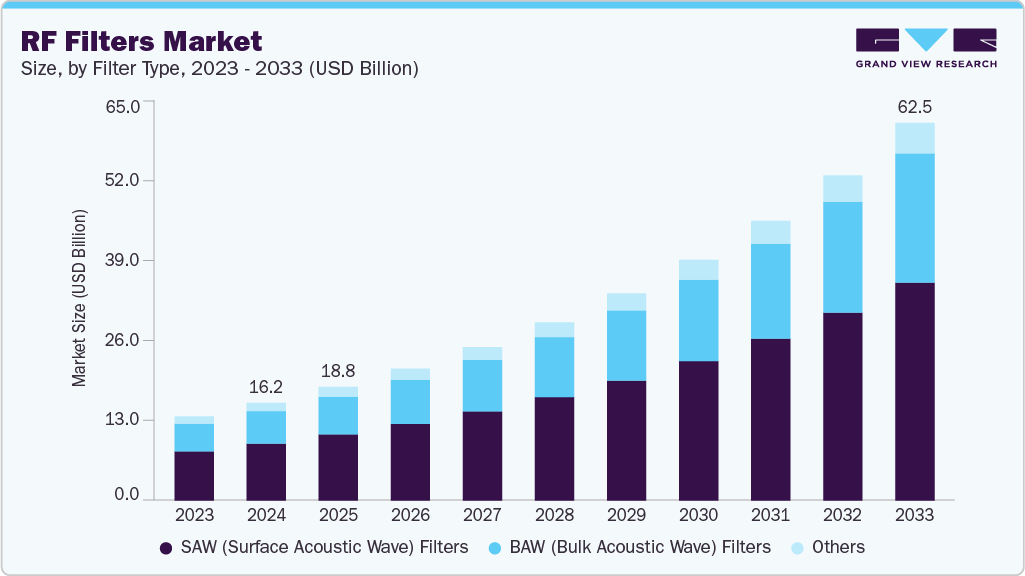
The RF filters industry is witnessing rapid innovation, particularly in the development of bulk acoustic wave (BAW) filters for high-frequency applications and tunable RF filters to support multi-band and adaptive networks. There is a trend toward the integration of filters into multi-function RF modules to save board space and power in compact devices. Moreover, AI and machine learning are being used in RF design automation and performance prediction. Companies are also exploring materials such as lithium tantalate and lithium niobate for improved filtering efficiency. The development of filters that support mmWave and ultra-wideband frequencies is gaining traction as well.
Market Concentration & Characteristics
The radio frequency filters market is moderately consolidated, with a few large players dominating due to their technological capabilities and patent portfolios. Companies such as Broadcom, Qorvo, and Murata Manufacturing command significant shares, especially in the BAW and SAW filter segments. These firms benefit from strong supply chains, long-term contracts with OEMs, and extensive R&D infrastructure. However, regional manufacturers and startups are emerging in Asia-Pacific and North America, driven by government funding and rising domestic demand, which is introducing competitive pressure at the lower and mid-tier levels.
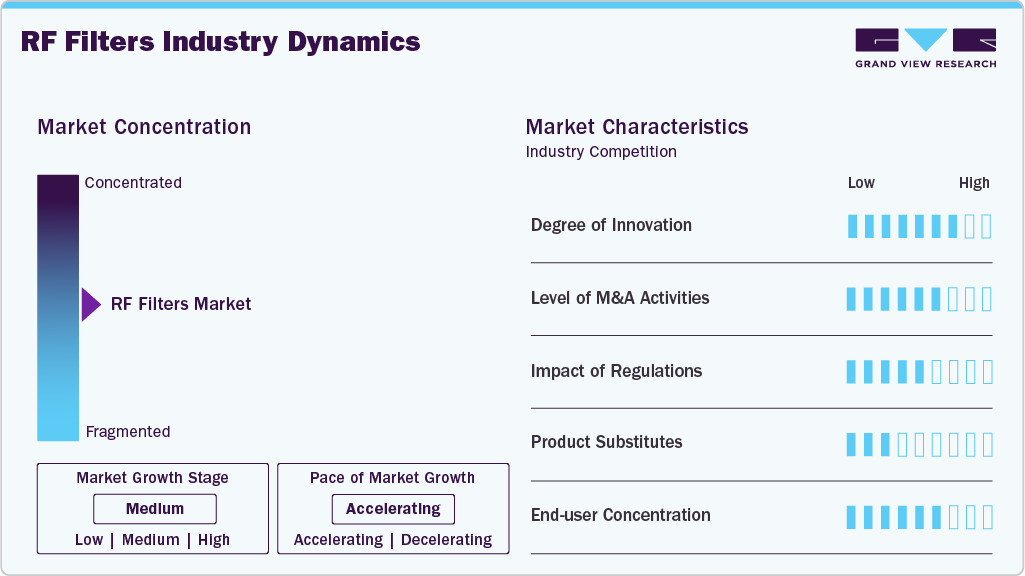
The threat of substitutes in the RF filters market is relatively low, as few technologies can perform the core function of filtering unwanted frequencies with the same precision and efficiency. However, advances in digital signal processing (DSP) and software-defined radios (SDR) offer partial substitution in specific contexts, particularly in software-intensive applications. In addition, integration of filtering functionalities into system-on-chip (SoC) designs can potentially reduce the need for discrete RF filters in some devices. Nonetheless, for high-frequency and high-power applications, traditional RF filters remain indispensable.
Filter Type Insights
SAW (Surface Acoustic Wave) filters segment held the largest revenue market share of 58.2% in 2024, especially in low-to-mid frequency applications such as mobile handsets, GPS systems, and wireless communication modules. Their advantages include lower cost, ease of integration, and suitability for frequencies below 2.5 GHz, making them ideal for mass-market devices. SAW filters are widely used in smartphones, especially for Wi-Fi, Bluetooth, and LTE bands, due to their small size and mature manufacturing process. Their popularity is reinforced by strong supplier ecosystems in Asia and continued demand for legacy wireless technologies and IoT devices.
BAW (Bulk Acoustic Wave) filters segment is expected to grow at the fastest CAGR of 16.5% over the forecast period, especially in high-frequency 5G and mmWave applications. BAW filters perform better than SAW filters at higher frequencies (typically above 3 GHz) due to superior thermal stability, lower insertion loss, and better power handling capabilities. With the global rollout of 5G NR bands especially in mid-band and high-band spectrum-BAW filter adoption is accelerating in smartphones, base stations, and high-performance wireless modules. Leading companies are investing heavily in BAW innovation to meet the complex demands of next-generation wireless systems.
End Use Insights
The telecommunication segment held the largest revenue market share of 40.3% in 2024, largely due to the exponential growth in mobile data usage, smartphone penetration, and deployment of 4G and 5G networks worldwide. RF filters are critical in telecom infrastructure, enabling signal clarity, minimizing interference, and supporting high-frequency data transmission across various bands. With telecom operators continuously upgrading networks to handle increased data traffic and improve call quality, the demand for advanced RF filters such as SAW and BAW has surged. Additionally, the rollout of 5G has further amplified this trend, as it requires multiple filters per device to support diverse frequency bands and MIMO architectures.
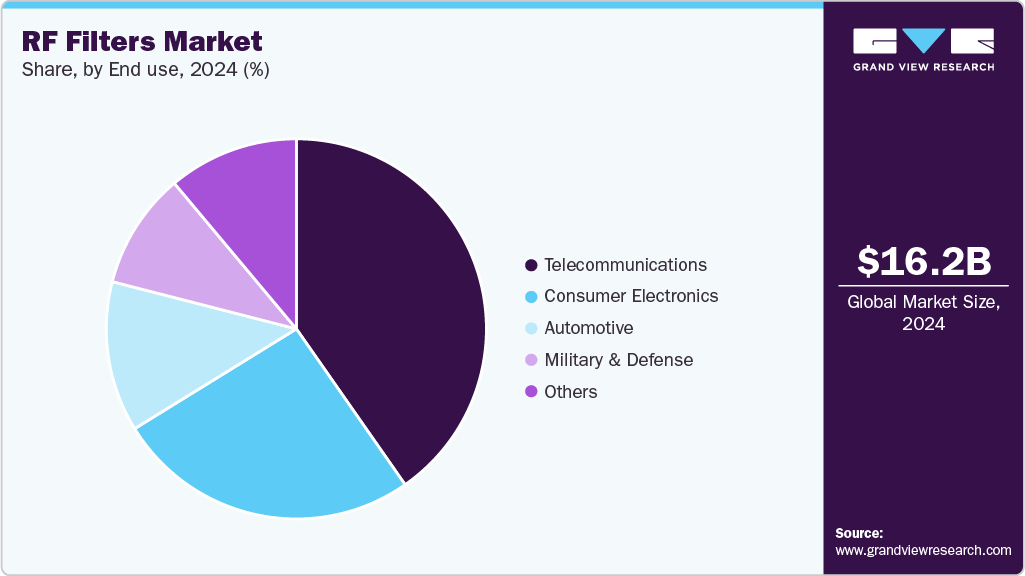
The automotive segment is expected to grow at the fastest CAGR of 16.7% over the forecast period. Modern vehicles increasingly adopt connected technologies such as vehicle-to-everything (V2X) communication, advanced driver-assistance systems (ADAS), and in-car infotainment, all requiring robust RF filtering solutions. The shift toward electric and autonomous vehicles has further accelerated the integration of RF components to ensure seamless connectivity and real-time data exchange. As automotive OEMs push for smarter, safer, and more connected vehicles, the demand for high-performance, miniaturized RF filters is expected to grow rapidly in this sector.
Regional Insights
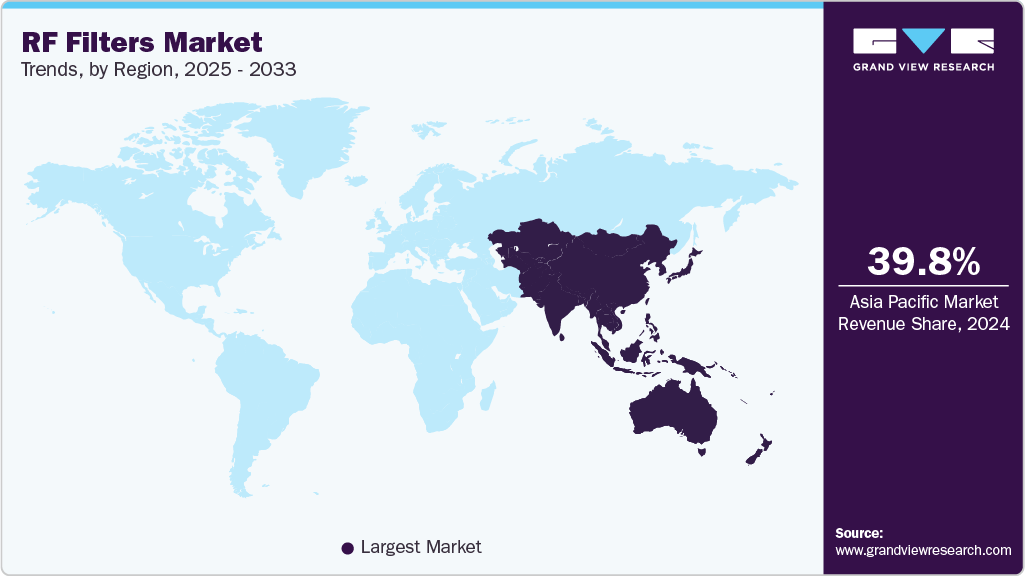
Asia Pacific RF filters market dominated the global market and accounted for the largest revenue share of 39.8% in 2024, due to its extensive electronics manufacturing ecosystem, especially in countries like China, South Korea, Taiwan, and Japan. High mobile phone penetration, rapid 5G rollouts, and strong presence of OEMs and semiconductor foundries have driven demand for radio frequency filters. Government-backed 5G infrastructure spending and rising domestic innovation capabilities are solidifying the region's leadership. Furthermore, increasing exports of mobile and wireless communication devices from APAC contribute to consistent volume growth.
China RF Filter Market Trends
China RF filter market is expanding rapidly due to heavy investments in self-reliance for telecom components and aggressive 5G deployment. Chinese tech giants and OEMs are reducing dependence on Western suppliers by building in-house capabilities or partnering with local filter manufacturers. The government’s push for indigenization of semiconductor components and backing of R&D in RF design and materials science is further strengthening the local supply chain. Demand is also spurred by growth in connected infrastructure and defense communication programs.
North America RF Filters Market Trends
North America, especially the U.S., is witnessing robust demand for RF filters due to rapid 5G adoption, high defense spending, and early innovation in mmWave technologies. The region hosts major RF filter producers with advanced R&D capabilities and patent strengths. The market also benefits from early commercial deployment of 5G and private LTE networks across industries. Growing emphasis on reshoring and building secure telecom supply chains has led to increased local investments in filter manufacturing and semiconductor packaging.
In the U.S., demand for RF filters is particularly high in defense, aerospace, and telecom sectors. Government initiatives to support 5G, including spectrum auctions and infrastructure grants, have spurred equipment demand. The U.S. also remains a hub for cutting-edge RF filter innovation, particularly in BAW filter development for high-frequency applications. Supply chain diversification and strengthening domestic semiconductor capacity are gaining importance, encouraging local filter production.
Europe RF Filters Market Trends
Europe’s RF filters market is supported by widespread 5G rollout, automotive connectivity innovations, and increasing defense modernization programs. Germany, France, and the UK are leading regional demand due to robust telecom infrastructure and OEM presence. European Union initiatives for digital sovereignty and semiconductor investments under the Chips Act are expected to bolster the RF components ecosystem. Demand is also growing from aerospace firms and smart manufacturing deployments.
Germany’s RF filters market is driven by its strong automotive electronics sector, increasing 5G integration in industrial automation, and research in RF materials and design. German companies are also collaborating with telecom giants to improve local 5G networks and production lines. Defense upgrades and advanced manufacturing practices like Industry 4.0 are reinforcing the need for robust RF components, including filters that support high-speed, low-latency communication.
Central & South America RF Filters Market Trends
Central & South America is an emerging market for RF filters, primarily led by Brazil and Mexico. The region is seeing incremental telecom upgrades, and mobile network operators are beginning 5G trials and small-scale rollouts. Import dependence is high, but partnerships with Asian filter suppliers are helping meet the demand. Growth in smartphone usage and smart city initiatives is expected to drive future adoption, though regulatory and infrastructure barriers remain.
Middle East & Africa RF Filters Market Trends
The RF filters market in the Middle East & Africa is gradually growing, fueled by telecom modernization, smart city projects, and digital transformation initiatives in GCC countries. UAE and Saudi Arabia are leading in 5G investments, and their focus on building high-tech industrial zones is spurring RF infrastructure demand. In Africa, market growth is slower but gaining traction through expanded mobile services and international telecom collaborations. Import-heavy reliance continues due to lack of local production.
Key RF Filters Company Insights
Some of the key players operating in the market include Broadcom Inc., Skyworks Solutions, Inc.
-
Broadcom is a global leader in semiconductor technologies, renowned for its FBAR-based RF filters used in premium smartphones, 5G devices, and Wi-Fi solutions. Its advanced filters are critical in handling high-bandwidth communication and ensuring signal clarity across multiple frequency bands.
-
Skyworks is a key U.S.-based provider of integrated RF front-end modules and filters, serving smartphones, IoT, automotive, and infrastructure markets. The company’s RF solutions support advanced wireless connectivity, including 5G, Wi-Fi 6E, and satellite applications.
Qorvo, Inc. and Taiyo Yuden Co., Ltd. are some of the emerging market participants in the RF filters market.
-
Qorvo offers a broad portfolio of BAW and SAW filters for high-frequency wireless systems. Known for its expertise in RF front-end modules, Qorvo supplies components for smartphones, base stations, aerospace, and defense applications globally.
-
Based in Japan, Taiyo Yuden specializes in miniaturized SAW filters and multilayer ceramic components. Its RF filters are widely used in smartphones, wireless modules, and compact consumer electronics requiring high reliability and performance.
Key RF Filters Companies:
The following are the leading companies in the RF filters market. These companies collectively hold the largest market share and dictate industry trends.
- Broadcom Inc.
- Murata Manufacturing Co., Ltd.
- Qorvo, Inc.
- Skyworks Solutions, Inc.
- TDK Corporation
- Kyocera AVX Components Corporation
- Taiyo Yuden Co., Ltd.
- Tai-Saw Technology Co., Ltd.
- Akoustis Technologies Inc.
- Mitsubishi Electric Corporation
Recent Developments
-
In June 2023, Broadcom introduced FiFEM, the world’s first wi-fi RF fem with filter integration optimized for wi-fi 7 access points.
-
In Early 2024, Skyworks acquired the remaining interest in its filter joint venture with Panasonic.
-
In June 2025, Qorvo launched compact high‑rejection BAW filters (QPQ3550) for 5G infrastructure.
RF Filters Market Report Scope
Report Attribute
Details
Market size value in 2025
USD 18.79 billion
Revenue forecast in 2033
USD 62.45 billion
Growth rate
CAGR of 16.2% from 2025 to 2033
Base year for estimation
2024
Actual estimates/Historical data
2021 - 2023
Forecast period
2025 - 2033
Quantitative units
Revenue in USD million/billion and CAGR from 2025 to 2033
Report coverage
Revenue forecast, company ranking, competitive landscape, growth factors, and trends
Segments covered
Filter type, end use, region
Regional scope
North America; Europe; Asia Pacific; Central & South America; MEA
Country scope
U.S.; Canada; Mexico; Germany; UK; France; Spain; China; Japan; India; South Korea; Brazil; South Africa; Morocco
Key companies profiled
Broadcom Inc.; Murata Manufacturing Co. Ltd.; Qorvo, Inc.; Skyworks Solutions, Inc.; TDK Corporation; Kyocera AVX Components Corporation; Taiyo Yuden Co., Ltd.; Tai-Saw Technology Co., Ltd.; Akoustis Technologies Inc.; Mitsubishi Electric Corporation
Customization scope
Free report customization (equivalent up to 8 analysts working days) with purchase. Addition or alteration to country, regional & segment scope.
Pricing and purchase options
Avail customized purchase options to meet your exact research needs. Explore purchase options
Global RF Filters Market Report Segmentation
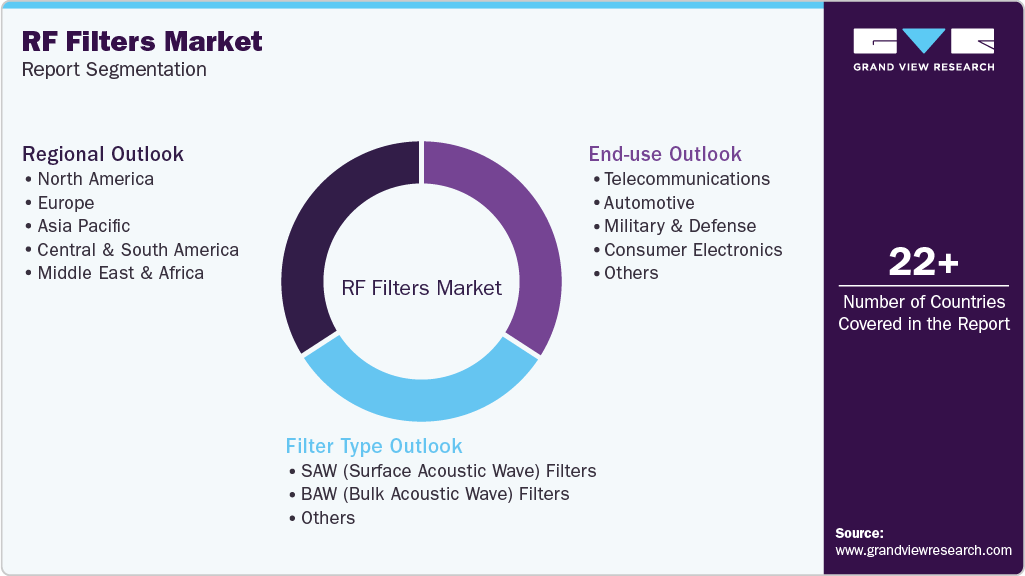
This report forecasts revenue growth at regional & country levels and provides an analysis on the industry trends in each of the sub-segments from 2021 to 2033. For this study, Grand View Research has segmented the global RF filters market report based on filter type, end use, and region:
-
Filter Type Outlook (Revenue, USD Million, 2021 - 2033)
-
SAW (Surface Acoustic Wave) Filters
-
BAW (Bulk Acoustic Wave) Filters
-
Others
-
-
End Use Outlook (Revenue, USD Million, 2021 - 2033)
-
Telecommunications
-
Automotive
-
Military & Defense
-
Consumer Electronics
-
Others
-
-
Regional Outlook (Revenue, USD Million, 2021 - 2033)
-
North America
-
U.S.
-
Canada
-
Mexico
-
-
Europe
-
UK
-
Germany
-
France
-
Spain
-
-
Asia Pacific
-
China
-
Japan
-
India
-
South Korea
-
-
Central & South America
-
Brazil
-
-
Middle East & Africa
-
South Africa
-
Morocco
-
-
Frequently Asked Questions About This Report
b. The global RF filters market size was estimated at USD 16.2 billion in 2024 and is expected to reach USD 18.8 billion in 2025.
b. The global RF filters market is expected to grow at a compound annual growth rate of 16.2% from 2025 to 2033 to reach USD 62.45 billion by 2033.
b. SAW (Surface Acoustic Wave) filters segment held the highest revenue market share of 58.2% in 2024, especially in low-to-mid frequency applications such as mobile handsets, GPS systems, and wireless communication modules.
b. Some of the key players operating in the RF filters market include Broadcom Inc., Murata Manufacturing Co., Ltd., Qorvo, Inc., Skyworks Solutions, Inc., TDK Corporation, Kyocera AVX Components Corporation, Taiyo Yuden Co., Ltd., Tai-Saw Technology Co., Ltd., Akoustis Technologies, Inc., and Mitsubishi Electric Corporation.
b. Rising demand for 5G connectivity, IoT devices, advanced automotive electronics, and high-speed wireless communication is driving the RF filters market.


Share this report with your colleague or friend.
Need a Tailored Report?
Customize this report to your needs — add regions, segments, or data points, with 20% free customization.


ISO 9001:2015 & 27001:2022 Certified
We are GDPR and CCPA compliant! Your transaction & personal information is safe and secure. For more details, please read our privacy policy.
Trusted market insights - try a free sample
See how our reports are structured and why industry leaders rely on Grand View Research. Get a free sample or ask us to tailor this report to your needs.













