
- Home
- »
- Advanced Interior Materials
- »
-
Middle East Waste Sorting Equipment Market Report, 2033GVR Report cover

Middle East Waste Sorting Equipment Market (2025 - 2033) Size, Share & Trends Analysis Report By Waste Type (Plastic Waste, Paper & Cardboard, Metal Waste, Organic Waste, Glass), By Operation Mode, By Technology, By Application, By Country, And Segment Forecasts
Middle East Waste Sorting Equipment Market Summary
The Middle East waste sorting equipment market size was estimated at USD 27.5 million in 2024 and is projected to reach USD 52.4 million by 2033, growing at a CAGR of 7.5% from 2025 to 2033. The demand for waste sorting equipment is anticipated to be driven by rising urbanization, increasing waste generation, and the government's focus on sustainable waste management.
Key Market Trends & Insights
- The waste sorting equipment in the UAE is expected to grow at a substantial CAGR of 8.3% from 2025 to 2033.
- By waste type, organic waste segments are expected to grow at a considerable CAGR of 8.0% from 2025 to 2033 in terms of revenue.
- By operation mode, semi-automatic segment is expected to grow at a considerable CAGR of 8.0% from 2025 to 2033 in terms of revenue.
- By technology, sensor-based sorting segment is expected to grow at a considerable CAGR of 7.7% from 2025 to 2033 in terms of revenue.
Market Size & Forecast
- 2024 Market Size: USD 27.5 Million
- 2033 Projected Market Size: USD 52.4 Million
- CAGR (2025-2033): 7.5%
Three ways to get this report
Buy it, customize it, or ask a question.Ask an Analyst
Analyst response in 1 business day
- AccessReport author, directly
- Reply timeWithin 1 working day
- No sales callDirect answer only
- FormatEmail reply
- CostFree, no cost
Get the Full Report
What the study covers
- FormatsPDF · Excel · Dashboard
- Timeline2025–2033 annual, 2024 base
- Coverage20+ countries, 5 regions
- Companies10+ key players profiled
Customize the Report
20% free customization
- IncludeCountries, segments, points
- TailorTo your product definition
- ExtendDeeper competitor detail
- OrA fully bespoke study
- Turnaround5–10 working days
National visions like Saudi Vision 2030 and the UAE’s circular economy initiatives are driving investments in advanced sorting technologies to improve recycling rates, reduce landfill dependency, and support environmental sustainability across residential, commercial, and industrial sectors.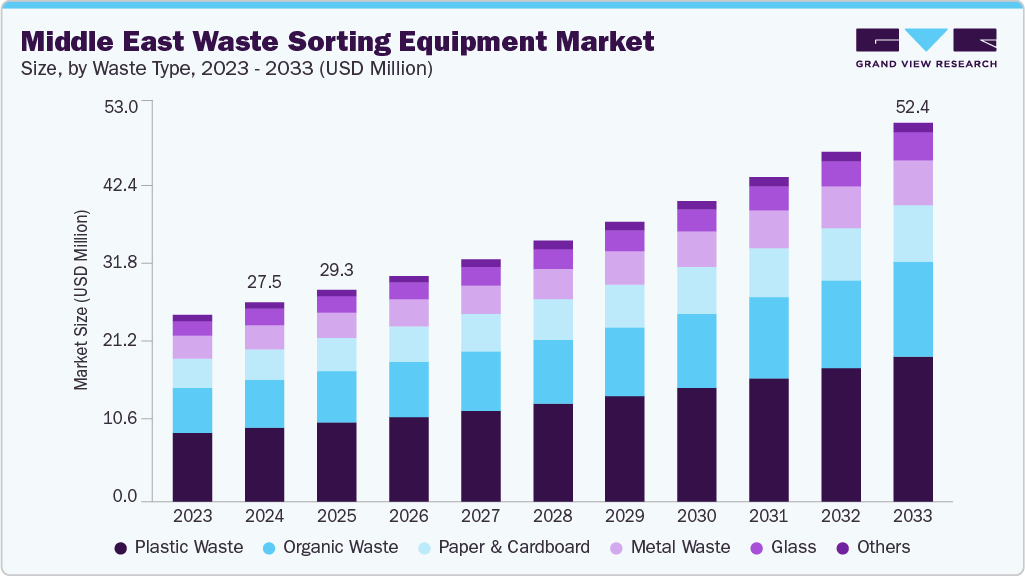 Source: Grand View Research, IR Documents, Primary Interviews, Paid DatabasesTo learn more about this report,
 Download Free Sample Report
 Another key factor driving the market is the growing adoption of automation and smart technologies. Governments and private sectors are increasingly integrating AI, IoT, and robotics to enhance sorting efficiency, reduce labor dependency, and align with sustainability goals. These technologies support regional efforts to modernize waste management and boost recycling rates.
Market Concentration & Characteristics
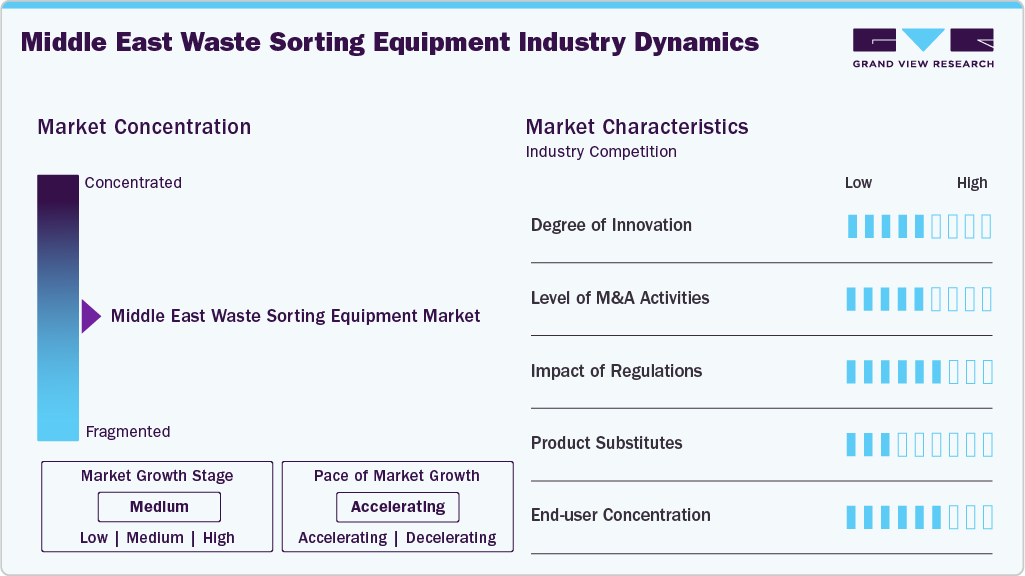
The waste sorting equipment market in the Middle East is moderately fragmented. This fragmentation is driven by increasing government focus on sustainability, growing urban populations, and varied industrial waste needs. While major infrastructure projects are underway, they typically involve multiple stakeholders, allowing room for competition. This encourages innovation, diverse product offerings, and price competitiveness. It also reflects the evolving nature of the market, which is steadily expanding.
The market is witnessing increasing innovation, driven by the integration of AI, robotics, IoT, and sensor-based systems. Smart bins, electric waste vehicles, and real-time monitoring are enhancing recycling efficiency. These technological advancements are helping the region shift from traditional waste handling methods to smarter, more sustainable solutions aligned with circular economy goals.
 To learn more about this report, Download Free Sample Report
 The market is experiencing selective consolidation through mergers and strategic partnerships. Country leaders are acquiring specialized waste management firms to expand capabilities and coverage. Joint ventures between local and international players are also on the rise, aiming to introduce advanced sorting technologies and strengthen infrastructure. These moves indicate a growing trend of collaboration to boost operational scale and technological expertise.
Governments across the Middle East are strengthening environmental regulations, driving demand for better waste sorting technologies. Initiatives include nationwide recycling programs, zero-waste-to-landfill targets, and stricter compliance standards. These policies are encouraging investments in automated and efficient sorting equipment, ensuring that both public and private sectors meet sustainability goals while improving overall waste management efficiency across urban and industrial zones.
Drivers, Opportunities & Restraints
Rapid urbanization and population growth across the Middle East are significantly increasing municipal and industrial waste volumes. Cities are under pressure to manage rising waste sustainably, driving the demand for advanced waste sorting equipment. Governments are investing in waste infrastructure to reduce landfill dependency, creating a strong push for automated, efficient sorting technologies that can handle complex waste streams and improve recycling rates.
The shift toward smart city development presents a major opportunity for the market. Integrating AI, robotics, and IoT into sorting systems can boost efficiency, reduce labor costs, and support real-time data tracking. As nations prioritize digital transformation and sustainability, equipment manufacturers have the chance to introduce intelligent, sensor-driven solutions that align with environmental targets and circular economy initiatives.
One of the key challenges in the Middle East waste sorting equipment market is the high capital investment required for advanced machinery. Maintenance, skilled labor, and technology upgrades add to operational expenses. Smaller municipalities and private operators may struggle with adoption, delaying large-scale deployment. Additionally, inconsistent recycling practices and limited public awareness hinder the effective use of modern sorting systems in some areas.
Waste Type Insights
The plastic waste segment held the largest share in the market and accounted for a share of 37.3% in 2024 due to rising concerns over pollution and increasing regulations targeting single-use plastics. Governments are pushing recycling initiatives, driving demand for advanced plastic sorting technologies. Investments in infrastructure and public-private partnerships are also enhancing capabilities for efficient plastic segregation and recycling across urban and industrial areas.
Organic wastes are expected to be the fastest-growing segment in the market, as food waste and agricultural byproducts surge alongside urban expansion. Governments are promoting composting and biogas production, encouraging the adoption of sorting equipment tailored to organic materials. The focus on landfill reduction and sustainable waste processing is accelerating demand for efficient technologies that separate and process biodegradable waste streams.
Operation Mode Insights
The automatic segment held the largest share in the market and accounted for a share of 52.4% in 2024 due to increasing adoption of advanced technologies like AI, robotics, and sensors. These systems offer higher efficiency, accuracy, and speed, attracting large-scale waste management facilities and smart cities focused on sustainable practices and reducing labor costs.
The semi-automatic segment is projected to grow steadily as it offers a balance between cost and efficiency. It appeals to small and medium-sized waste management operators seeking improved sorting capabilities without the high investment of full automation, especially in regions where skilled labor is available to support semi-automated processes.
Technology Insights
Sensor-based segment held a significant share of the market and accounted for a share of 36.1% in 2024 due to its precision in detecting and categorizing different types of waste. Advanced sensors improve sorting accuracy, reduce contamination, and enhance recycling rates. Growing environmental regulations and demand for efficient waste management solutions are driving adoption, especially in smart city projects and large-scale waste facilities aiming to optimize operations and resource recovery.
Robotic sorting in the Middle East waste sorting market is poised for rapid growth due to its ability to automate complex sorting tasks with high speed and accuracy. Robots equipped with AI and machine learning can adapt to diverse waste streams, improving operational efficiency and reducing human labor risks. Increasing investments in automation, coupled with rising labor costs and sustainability goals, are fueling the adoption of robotic sorting technologies in the region.
Application Insights
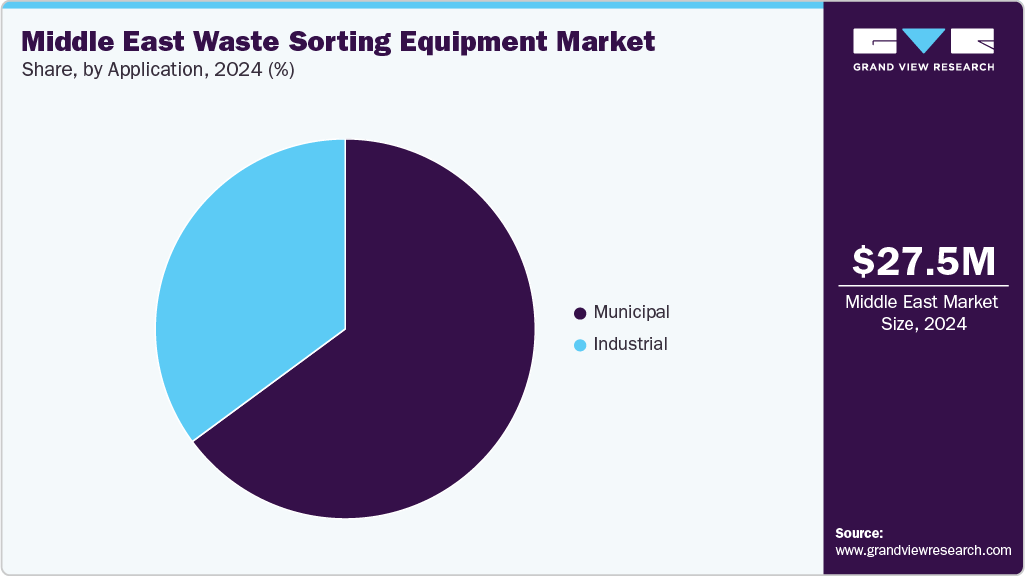
The municipal segment held a significant share of the market and accounted for a share of 64.9% in 2024 as cities face increasing pressure to manage rising urban waste efficiently. Governments are investing in modern waste sorting infrastructure to improve recycling rates and reduce landfill dependency. Growing public awareness, stricter environmental policies, and initiatives to promote circular economy principles are driving the adoption of advanced sorting technologies in municipal waste management.
 To learn more about this report, Download Free Sample Report
 The industrial segment is projected to expand due to increasing industrial activities generating large volumes of waste. Industries such as manufacturing, construction, and oil & gas require efficient sorting systems to comply with environmental regulations and minimize disposal costs. Adoption of automated and sensor-based sorting technologies is rising to improve operational efficiency, resource recovery, and sustainable waste management practices within industrial facilities.
Country Insights
Saudi Arabia Waste Sorting Equipment Market Trends
Saudi Arabia waste sorting equipment market is projected to grow at a 7.9% CAGR during the forecast period driven by the government’s Vision 2030 initiatives focused on sustainability and waste management reforms. Increased investments in smart city projects and infrastructure development are promoting advanced sorting technologies. Strict regulations on waste segregation and growing environmental awareness among citizens and industries further propel demand, making Saudi Arabia a key market for innovative waste sorting solutions in the Middle East.
UAE Waste Sorting Equipment Market Trends
The UAE waste sorting equipment market is expected to grow rapidly due to its ambitious sustainability goals and extensive infrastructure projects. Government-led initiatives promoting the circular economy and smart waste management systems are accelerating the adoption of automated sorting technologies. High urbanization rates and a focus on reducing landfill waste are driving investments in advanced equipment, positioning the UAE as a regional leader in modern, efficient waste sorting and recycling solutions.
Key Middle East Waste Sorting Equipment Companies Insights
Key players operating in the Middle East waste sorting equipment market are undertaking various initiatives to strengthen their presence and increase the reach of their products and services. Strategies such as expansion activities and partnerships are key in propelling the market growth.
Key Middle East Waste Sorting Equipment Companies:
- TOMRA Systems ASA
- Bühler Group
- Key Technology.
- Satake Corporation.
- BHS-Sonthofen
- ZenRobotics
- Suez Group
- Al Shirawi Equipment Co. LLC
- Mil-tek Middle East
- Solwearth Ecotech
Recent Developments
-
In October 2024, TOMRA acquired an 80% stake in c-trace GmbH, a German company specializing in digital waste management solutions that combine software and hardware to improve waste operations. This acquisition expands TOMRA’s digital capabilities and supports its strategy to diversify revenue streams and enhance recycling infrastructure globally.
-
In February 2024, ZenRobotics unveiled its fourth-generation waste sorting robots, ZenRobotics 4.0, featuring enhanced AI capabilities and improved design for optimized recycling operations. The Heavy Picker 4.0 is equipped with the compact ZenBrain recognition system, boosting efficiency by 60-100% and enabling identification of over 500 waste categories.
Middle East Waste Sorting Equipment Market Report Scope
Report Attribute
Details
Market size value in 2025
USD 29.3 million
Revenue forecast in 2033
USD 52.4 million
Growth rate
CAGR of 7.5% from 2025 to 2033
Historical data
2021 - 2024
Forecast period
2025 - 2033
Quantitative units
Revenue in USD million/billion and CAGR from 2025 to 2033
Report coverage
Revenue forecast, company ranking, competitive landscape, growth factors, and trends
Segments covered
Application, waste type, operation mode, technology, country
Country scope
Saudi Arabia; UAE; Qatar; Oman; Kuwait; Israel
Key companies profiled
TOMRA Systems ASA; Bühler Group; Key Technology; Satake Corporation; BHS-Sonthofen; ZenRobotics; Suez Group; Al Shirawi Equipment Co. LLC; Mil-tek Middle East; Solwearth Ecotech
Customization scope
Free report customization (equivalent up to 8 analysts working days) with purchase. Addition or alteration to country, regional & segment scope.
Pricing and purchase options
Avail customized purchase options to meet your exact research needs. Explore purchase options
Middle East Waste Sorting Equipment Market Report Segmentation
This report forecasts revenue growth at the regional and country levels and provides an analysis of the latest industry trends in each of the sub-segments from 2021 to 2033. For this study, Grand View Research has segmented the Middle East waste sorting equipment market report based on application, waste type, operation mode, technology, and country:
-
Waste Type Outlook (Revenue, USD Million, 2021 - 2033)
-
Plastic Waste
-
Paper & Cardboard
-
Metal Waste
-
Organic Waste
-
Glass
-
Others
-
-
Operation Mode Outlook (Revenue, USD Million, 2021 - 2033)
-
Automatic
-
Manual
-
Semi-Automatic
-
-
Technology Outlook (Revenue, USD Million, 2021 - 2033)
-
Sensor-Based Sorting
-
Magnetic Separation
-
Mechanical Sorting
-
Robotic Sorting
-
Others
-
-
Application Outlook (Revenue, USD Million, 2021 - 2033)
-
Municipal
-
Industrial
-
-
Country Outlook (Revenue, USD Million, 2021 - 2033)
-
Saudi Arabia
-
UAE
-
Qatar
-
Oman
-
Kuwait
-
Israel
-
Frequently Asked Questions About This Report
The Middle East waste sorting equipment market size was estimated at USD 27.5 million in 2024 and is expected to be USD 29.3 million in 2025.
The Middle East waste sorting equipment market, in terms of revenue, is expected to grow at a compound annual growth rate of 7.5% from 2025 to 2033 to reach USD 52.4 million by 2033.
Plastic segment led the market and accounted for 37.3% in 2024 due to rising concerns over pollution and increasing regulations targeting single-use plastics. Governments are pushing recycling initiatives, driving demand for advanced plastic sorting technologies. Investments in infrastructure and public-private partnerships are also enhancing capabilities for efficient plastic segregation and recycling across urban and industrial areas.
Some of the key players operating in the Middle East waste sorting equipment market include TOMRA Systems ASA, Bühler Group, Key Technology, Satake Corporation, BHS-Sonthofen, ZenRobotics, Suez Group, Al Shirawi Equipment Co. LLC, Mil-tek Middle East, Solwearth Ecotech
Key factor driving the market is the advancement and adoption of automation and smart technologies. Incorporating artificial intelligence, Internet of Things (IoT), and robotics into sorting equipment improves the precision and speed of separating recyclable materials, while minimizing the need for manual labor. These technological improvements enhance the quality and efficiency of waste processing.
About the Author(s)
Advanced Interior Materials Research Team
Advanced Materials · Advanced Interior MaterialsThis report was authored by the advanced interior materials research team at Grand View Research - comprising two research analysts, one senior research analyst, and one industry expert - with specialized expertise in the advanced interior materials segment of the advanced materials industry. All findings are based on proprietary advanced materials databases, executive interviews, and regulatory analysis, subject to internal peer review prior to publication.
Last Updated:
Speak to Analyst

Customize this report to your needs - add regions, segments, or data points, with 20% free customization.
Or view our licence options:


ISO 9001:2015 & 27001:2022 Certified
We are GDPR and CCPA compliant! Your transaction & personal information is safe and secure. For more details, please read our privacy policy.


