
- Home
- »
- Advanced Interior Materials
- »
-
Waste Sorting Equipment Market Size & Share Report, 2033GVR Report cover

Waste Sorting Equipment Market (2026 - 2033)
Size, Share & Trends Analysis Report By Waste Type (Plastic Waste, Paper & Cardboard), By Operation Mode (Automatic, Manual, Semi-Automatic), By Technology, By Application (Municipal, Industrial), By Region, And Segment Forecasts
Market Size, 2025
$1.0BMarket Estimate, 2026
$1.1BMarket Forecast, 2033
$1.8BCAGR, 2026–2033
7.2%Waste Sorting Equipment Market Summary
The global waste sorting equipment market size was valued at USD 1.0 billion in 2025 and is projected to grow from USD 1.1 billion in 2026 to USD 1.8 billion by 2033, at a CAGR of 7.2% from 2026 to 2033. Europe dominated the market, accounting for a revenue share of 33.4% in 2025. The demand for waste sorting equipment is anticipated to be driven by the growing environmental concerns and stricter government regulations focused on sustainable waste management.
 Source: Grand View Research, IR Documents, Primary Interviews, Paid DatabasesTo learn more about this report,
 Download Free Sample Report
 Key Market Trends & Insights
- By operation mode: The automatic segment led the market with the largest revenue share of 61.3% in 2025.
- By technology: The sensor-based sorting segment led the market with the largest revenue share of 45.4% in 2025.
- By waste type: The plastic waste segment led the market with the largest revenue share of 35.3% in 2025.
- By application: The municipal segment led the market with the largest revenue share of 64.4% in 2025.
Regional Highlights
- Largest regional market: Europe (33.4% revenue share, 2025)
- Fastest-growing regional market: Asia Pacific (highest CAGR, 2026-2033)
- By country: UK held the largest market share in 2025.
Market Size & Forecast
- Market size in 2025: USD 1.0 Billion
- Estimated market size in 2026: USD 1.1 Billion
- Projected market size by 2033: USD 1.8 Billion
- CAGR (2026-2033):7.2%
Three ways to get this report
Buy it, customize it, or ask a question.Ask an Analyst
A direct answer, usually in 1 working day
- AccessReport author, directly
- Reply timeWithin 1 working day
- No sales callDirect answer only
- FormatEmail reply
- CostFree, no cost
Get the Full Report
What the study covers
- FormatsPDF · Excel · Dashboard
- Timeline2026–2033 annual, 2025 base
- Coverage20+ countries, 5 regions
- Companies10+ key players profiled
Customize the Report
20% free customization
- IncludeCountries, segments, points
- TailorTo your product definition
- ExtendDeeper competitor detail
- OrA fully bespoke study
- Turnaround5–10 working days
With increasing urbanization and population expansion, the volume of waste generated is rising, prompting governments to implement policies that encourage recycling and reduce landfill dependency. Another key factor driving the market is the advancement and adoption of automation and smart technologies. Incorporating artificial intelligence, Internet of Things (IoT), and robotics into sorting equipment improves the precision and speed of separating recyclable materials, while minimizing the need for manual labor. Additionally, the global shift toward a circular economy model, which prioritizes resource recovery and waste reduction, is encouraging investments in innovative sorting solutions, particularly in regions such as Europe, North America, and the rapidly developing Asia Pacific markets.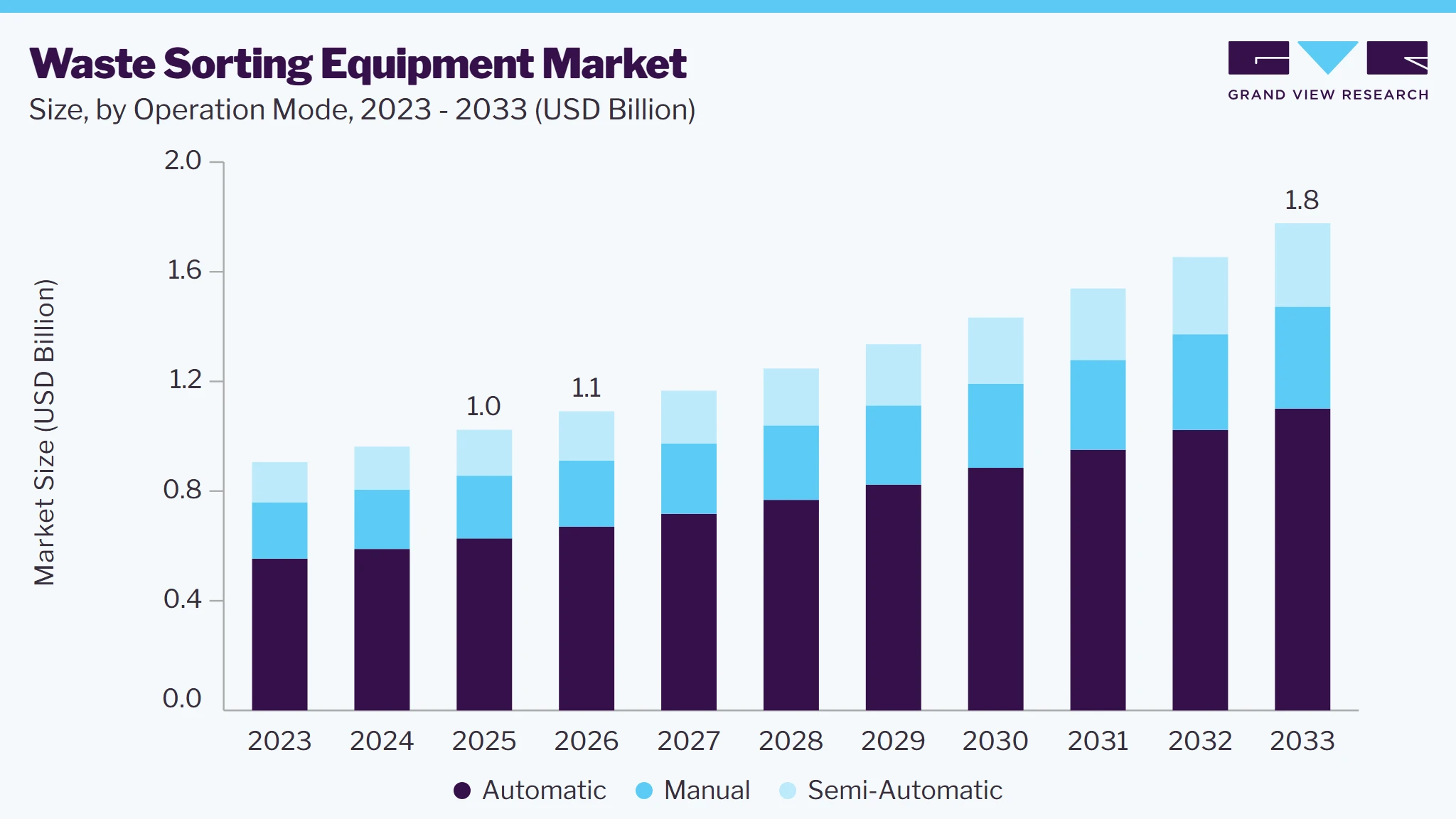 To learn more about this report, Download Free Sample Report
 The global trade landscape for waste sorting equipment is influenced by a combination of environmental regulations, technology advancements, and regional waste management priorities. Developed regions such as Europe and North America are net exporters of advanced waste sorting technologies, driven by stringent recycling mandates and mature manufacturing ecosystems. Conversely, emerging economies in Asia Pacific, Latin America, and parts of the Middle East are major importers, seeking to upgrade infrastructure in line with growing urban waste volumes and sustainability targets. Trade flows are also impacted by government incentives, import duties, and bilateral agreements related to circular economy initiatives.
Market Dynamics
The waste sorting equipment market is expected to grow due to increasing waste generation, stringent environmental regulations, and rising investments in recycling infrastructure. Governments and municipalities are promoting waste segregation and circular economy initiatives, driving demand for advanced sorting technologies. Automation, artificial intelligence, and sensor-based systems are improving sorting efficiency and material recovery rates. However, high capital investment and maintenance costs may restrain market growth. Expanding recycling facilities and smart waste management projects present significant opportunities for equipment manufacturers worldwide.
Governments are implementing stringent waste management regulations and encouraging material recovery to reduce landfill disposal and conserve natural resources. Rising municipal solid waste generation and increasing investments in recycling facilities are accelerating the adoption of automated sorting equipment. Advanced technologies improve sorting accuracy, operational efficiency, and recovery of valuable recyclable materials, supporting sustainable waste management across residential, commercial, and industrial sectors.
Advanced sorting systems equipped with optical sensors, robotics, artificial intelligence, and automated conveyors require substantial capital expenditure. Installation, maintenance, software upgrades, and skilled operators further increase operational costs. Small recycling facilities and municipalities with limited budgets may delay investments in modern sorting technologies. These financial challenges can slow equipment adoption, particularly in developing regions with limited waste management infrastructure.
The increasing adoption of artificial intelligence, robotics, and sensor-based sorting technologies presents significant opportunities for the waste sorting equipment market. Smart sorting systems improve material identification, increase recovery rates, reduce manual labor, and enhance processing efficiency. Growing investments in smart cities, recycling infrastructure, and waste-to-resource initiatives are accelerating demand for automated solutions. In addition, stricter environmental regulations and corporate sustainability goals are encouraging industries and municipalities to invest in advanced waste sorting equipment, creating long-term growth opportunities.
Market Concentration & Characteristics
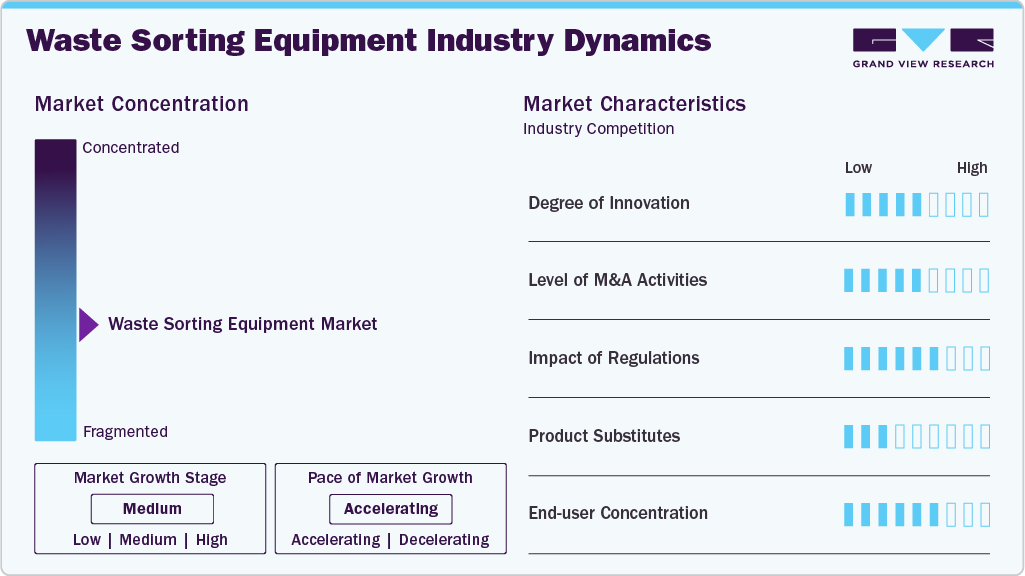
The waste sorting equipment market is moderately fragmented, with several regional and global players competing based on technology, efficiency, and cost-effectiveness. Key players such as TOMRA Systems ASA, Bühler Group, Satake Corporation focus on advancing AI-powered and sensor-based sorting systems to improve recycling accuracy and throughput. These companies are investing in R&D, forming partnerships, and expanding into emerging markets to strengthen their positions. The moderate fragmentation reflects a dynamic competitive environment with room for smaller players to thrive alongside established industry leaders.
Regulations play a critical role in shaping the waste sorting equipment market by setting mandatory recycling targets, landfill diversion goals, and material recovery standards. Policies such as the European Union’s Waste Framework Directive, Extended Producer Responsibility (EPR) schemes, and bans on landfilling recyclable materials push public and private sectors to invest in advanced sorting technologies. These regulations create a stable demand for automated, AI-driven, and sensor-based systems to ensure compliance. As environmental standards become more stringent globally, manufacturers must innovate continuously to meet legal requirements and support circular economy goals.
 To learn more about this report, Download Free Sample Report
 While opportunities are abundant maintenance and operational costs are significant restraints in the waste sorting equipment market. These systems often involve complex machinery and advanced technologies like robotics, sensors, and AI, which require regular upkeep to maintain performance and avoid breakdowns. Skilled technicians are needed for operation and troubleshooting, adding to labor expenses. In addition, the energy consumption of automated equipment, especially in large-scale facilities, can be substantial. These ongoing costs can strain the budgets of smaller companies or municipalities, making it harder to justify the investment.
Analyst Perspective
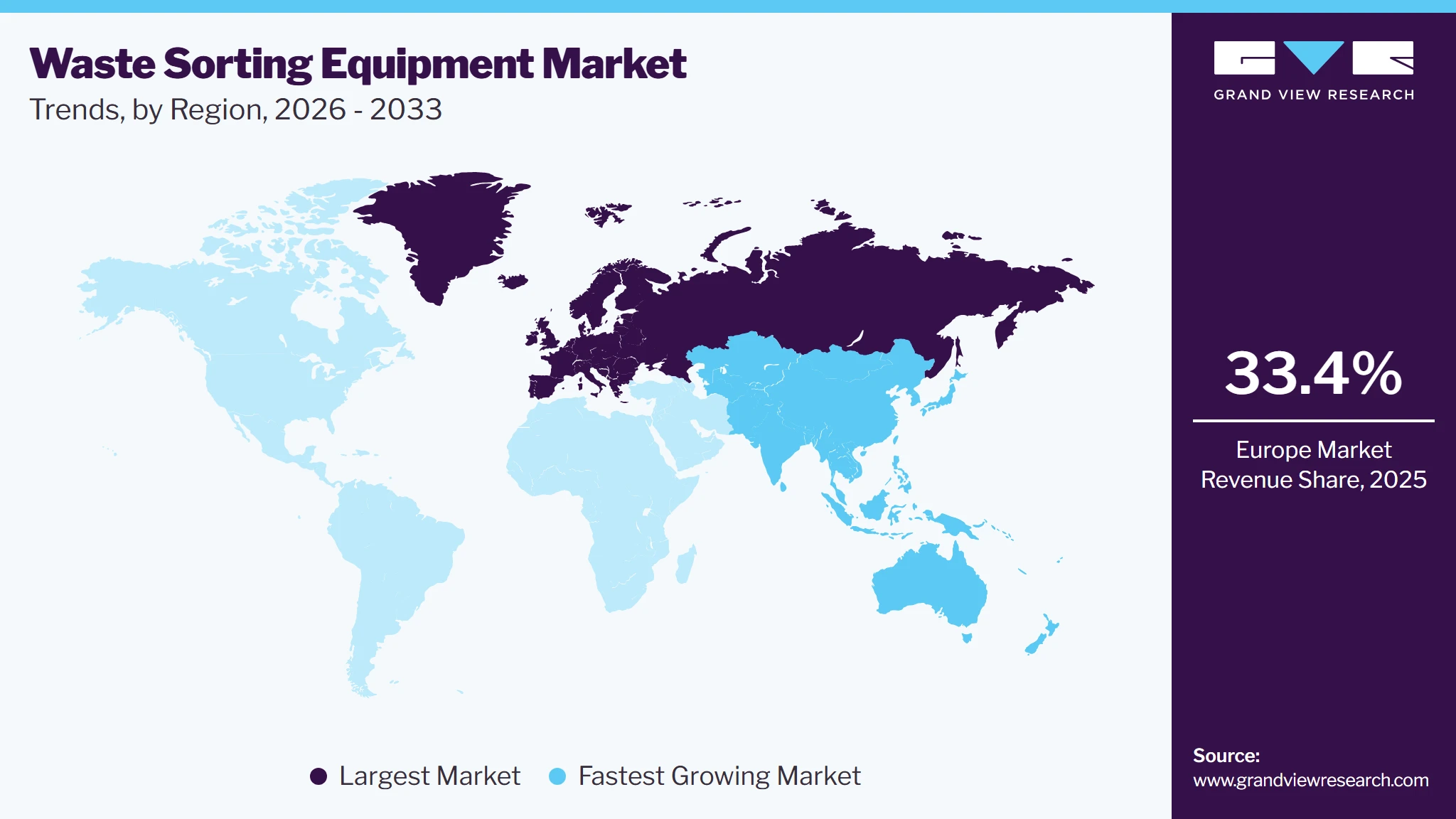
The waste sorting equipment market is expected to witness robust growth, driven by increasing waste generation, stricter environmental regulations, and rising investments in recycling infrastructure. Adoption of AI-enabled, sensor-based, and robotic sorting technologies is improving material recovery efficiency and reducing operational costs. Governments worldwide are promoting circular economy initiatives, further supporting market expansion. Europe is expected to lead technology adoption, while Asia Pacific is anticipated to experience the fastest growth due to rapid urbanization, expanding waste management infrastructure, and increasing recycling investments.
Waste Type Insights
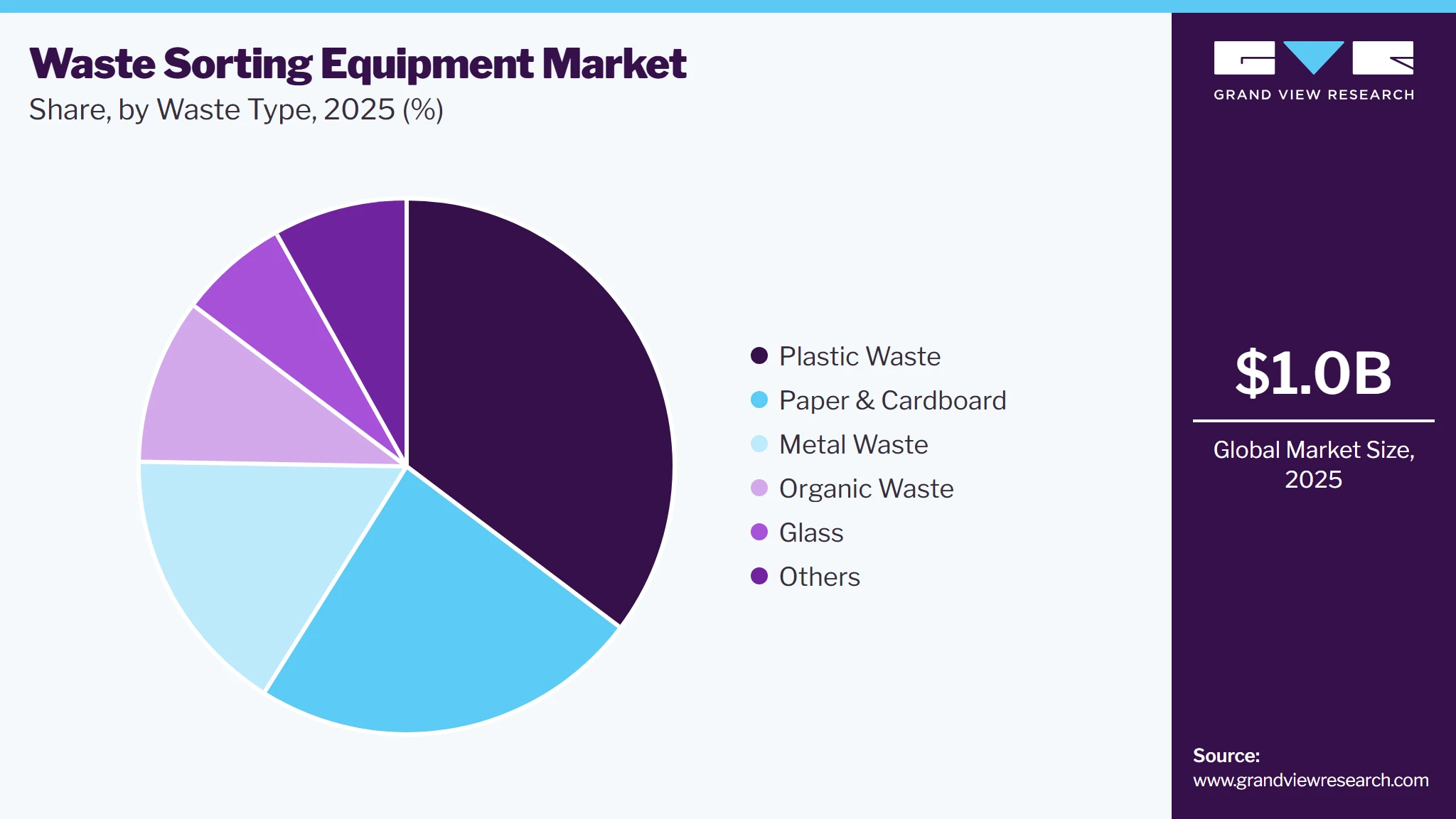
Based on waste type, the plastic waste segment led the market with the largest revenue share of 35.3% in 2025. The widespread use of plastics, particularly single-use items, combined with growing environmental concerns, has driven governments and industries to adopt advanced sorting technologies to enhance recycling efficiency. This segment sees significant growth in regions such as Asia Pacific, where rapid industrialization and supportive policies are encouraging better plastic waste management.
 To learn more about this report, Download Free Sample Report
 Organic waste represents the fastest-growing segment in the market, driven by increased focus on sustainable waste handling and renewable energy production methods such as composting and anaerobic digestion. Awareness about the environmental impact of organic waste and government incentives for bio-waste recycling are accelerating the deployment of specialized sorting equipment designed to handle organic materials effectively.
Operation Mode Insights
Based on operation mode, the automatic segment led the market with the largest revenue share of 61.3% in 2025 owing to its high efficiency, accuracy, and ability to handle large volumes of waste with minimal human intervention. Automated systems, equipped with advanced sensors and AI technology, provide faster sorting speeds and improved material recovery rates, making them the preferred choice for large-scale waste management facilities and municipalities.
The semi-automatic segment is the fastest-growing in the market, driven by its balance between cost-effectiveness and operational efficiency. Semi-automatic systems offer enhanced control and flexibility compared to fully manual operations, making them ideal for small to medium-sized enterprises and regions where full automation is not yet feasible. This growth is fueled by increasing demand for scalable solutions that improve sorting accuracy while managing investment costs.
Technology Insights
Based on technology, the sensor-based sorting segment led the market with the largest revenue share of 45.4% in 2025. Sensor-based sorting technology holds the largest share in the global waste sorting equipment market because of its ability to quickly and accurately differentiate materials. Utilizing various sensors like optical, near-infrared, X-ray, and electromagnetic types, this technology efficiently sorts waste based on characteristics such as color, size, and material composition. Its widespread use in industries like recycling and food processing helps reduce manual effort and operational expenses, contributing to its dominant position.
Robotic sorting is the fastest growing segment, driven by innovations in AI, machine learning, and computer vision. These robotic systems enable automated, precise sorting of a wide variety of waste materials in real time. Increasing demands for higher sorting efficiency, lower labor costs, and adherence to environmental standards are fueling the rapid adoption of robotic sorting technologies, particularly in municipal and industrial waste management sectors.
Application Insights
Based on application, the municipal segment led the market with the largest revenue share of 64.4% in 2025. The municipal segment dominates the global waste sorting equipment market due to the increasing volume of municipal solid waste generated by urban populations worldwide. Governments and municipalities are investing heavily in advanced sorting technologies to improve waste segregation, recycling rates, and landfill diversion, driven by stringent environmental regulations and sustainability goals. This segment benefits from the growing demand for efficient public waste management infrastructure in both developed and developing regions.
The industrial segment is the fastest-growing application area, fueled by rising industrialization and the increasing need for sustainable waste disposal in manufacturing, chemical, and processing industries. Heightened regulatory pressure to manage hazardous and non-hazardous industrial waste responsibly is driving adoption of sophisticated sorting equipment. In addition, industries are focusing on resource recovery and cost reduction, which further accelerates the demand for automated and specialized sorting solutions in this sector.
Regional Insights
Europe dominated the waste sorting equipment market with the largest revenue share of 33.4% in 2025. Europe’s waste sorting equipment market is expanding rapidly, driven by strong environmental regulations and policies that promote recycling and waste reduction. Initiatives focused on creating a circular economy encourage the adoption of advanced sorting technologies to enhance recycling efficiency and minimize landfill usage. Growing emphasis on e-waste management and increased automation are also contributing to market growth across the region.
 To learn more about this report, Download Free Sample Report
 Germany waste sorting equipment market is expected to grow at a CAGR of 6.9% over the forecast period. Germany holds a dominant position in the European waste sorting equipment market, largely due to its highly developed waste management system that emphasizes waste prevention, reuse, and recycling. The country boasts one of the highest municipal recycling rates globally, supported by stringent regulations such as the Green Dot System that require manufacturers to ensure their packaging is recyclable
The waste sorting equipment market in the UK held the largest share in the Europe region in 2025 over the forecast period driven by ongoing efforts to reduce landfill use and increase recycling rates. The UK’s commitment to achieving a circular economy and net-zero emissions by 2050 is prompting investments in advanced sorting technologies. In addition, labor shortages post-Brexit are encouraging industries to adopt automation in sorting processes, further accelerating market expansion in the region.
Asia Pacific Waste Sorting Equipment Market Trends
Asia Pacific region is growing due to rapid urbanization, industrialization, and increasing waste generation. Governments and private sectors in this region are investing heavily in modernizing waste management infrastructure and adopting advanced sorting technologies to improve recycling rates and reduce environmental impact.
China waste sorting equipment market held a significant share in the Asia Pacific marketdriven by its extensive industrial base and well-established infrastructure, which together enable efficient production and supply chain integration. Strong government support through policies and investments encourages the adoption of innovative technologies and sustainable waste management practices.
The waste sorting equipment market in the India is projected to grow at a CAGR of 8.6% from 2026 to 2033 and is propelled by its expanding urban population and rising consumption patterns. Government programs focused on cleanliness and resource efficiency, such as the Swachh Bharat Mission, play a crucial role in promoting better waste segregation and recycling. The country’s informal waste sector also contributes significantly by recovering recyclable materials, while growing environmental concerns and policy reforms encourage the adoption of modern waste processing technologies.
North America Waste Sorting Equipment Market Trends
North America waste sorting equipment market is driven by strong investments in waste management infrastructure and stringent environmental regulations. The United States dominates the regional market with widespread adoption of advanced sorting technologies and government initiatives focused on sustainability.
U.S. Waste Sorting Equipment Waste Market Trends
The waste sorting equipment market in the U.S. is expected to grow at a CAGR of 7.5% from 2026 to 2033. U.S. holds the largest share of the waste sorting equipment market in North America due to its advanced waste management systems and significant investments in automation technologies for both residential and commercial applications. Growing urban populations and increasing amounts of municipal solid waste create a strong need for efficient sorting solutions.
Latin America Waste Sorting Equipment Market Trends
Latin America waste sorting equipment market is driven by increasing urbanization and industrial activities, which contribute to higher waste generation. Growing environmental awareness and government regulations promoting sustainable waste practices further support this expansion. Investments in advanced collection and recycling technologies, along with a rising focus on circular economy models, are also key contributors to the market’s progress
Brazil waste sorting equipment market leads Latin America due to strong government initiatives such as the National Basic Sanitation Plan aimed at improving waste collection and recycling rates nationwide. Increasing urbanization and waste volumes create demand for efficient waste management solutions, including waste-to-energy technologies. In addition, private sector involvement, regulatory support, and growing environmental consciousness among consumers and businesses are accelerating market development
Middle East & Africa Waste Sorting Equipment Market Trends
Middle East and Africa region is experiencing steady growth in waste management driven by rapid urbanization, population increase, and expanding industrial activities. Government initiatives promoting recycling, waste-to-energy projects, and stricter environmental regulations are key factors supporting this growth. In addition, technological advancements such as smart waste collection systems and public-private partnerships are enhancing operational efficiency and sustainability efforts across the region.
UAE waste sorting equipment market is projected to grow at 7.2% of CAGR during the forecast period driven by rapid urbanization, industrial expansion, and strong government commitment to sustainability. Strategic initiatives like the UAE Vision 2021 and Dubai’s Clean Energy Strategy 2050 emphasize waste reduction, increased recycling, and waste-to-energy projects. Investments in advanced technologies and regulatory frameworks targeting landfill diversion and hazardous waste management further propel market development, making the UAE a regional leader in innovative waste management solutions.
Key Waste Sorting Equipment Company Insights
Some of the key players operating in the market include TOMRA Systems ASA, Bühler Group, and Satake Corporation.
-
TOMRA Systems ASA is a leading provider of sensor-based sorting solutions for industries including recycling, food processing, and mining. The company integrates advanced AI and machine learning technologies to enhance sorting accuracy and operational efficiency. TOMRA is known for its innovative reverse vending machines and waste management solutions that support circular economy initiatives, making it a dominant and continuously growing player in the global market.
-
Bühler Group specializes in optical sorting technology primarily for the food industry, focusing on ensuring food safety and quality. Their high-precision sorting equipment is designed to be energy-efficient and sustainable, addressing the needs of food processors and grain millers worldwide. Bühler invests heavily in R&D and collaborates with industry partners to advance digitalization and automation in sorting processes, maintaining a strong global presence.
Key Waste Sorting Equipment Companies:
The following key companies have been profiled for this study on the waste sorting equipments market.
-
TOMRA Systems ASA
-
Bühler Group
-
Key Technology.
-
Satake Corporation.
-
Steinert GmbH
-
MSWsorting
-
Beston (Henan) Machinery Co., Ltd.
-
CP Manufacturing Inc
-
REDWAVE
-
Fazzini Meccanica
-
BHS-Sonthofen
-
Wastequip, LLC
-
KK Balers Limited
Competitive Benchmarking
Category
Operating Strategies
Competitive Edge
Weakness
Established Players (e.g. TOMRA Systems ASA; Bühler Group; Key Technology, Inc.; Satake Corporation; Steinert GmbH; REDWAVE; CP Manufacturing Inc)
- Focus on expanding comprehensive waste sorting equipment portfolios covering sensor-based sorting, magnetic separation, robotic sorting, optical sorting, and mechanical sorting systems for municipal and industrial waste applications.
- Invest in artificial intelligence, machine vision, automation, digital monitoring, and energy-efficient sorting technologies to improve material recovery rates and operational efficiency.
- Strengthen partnerships with municipalities, recycling companies, waste management operators, engineering contractors, and material recovery facilities (MRFs) to support large-scale recycling and waste processing projects.
- Strong engineering expertise in automated waste sorting, recycling technologies, and material recovery systems.
- Broad product portfolios with advanced automation capabilities, high sorting accuracy, and compliance with international environmental and recycling standards.
- Well-established global manufacturing, distribution, and after-sales service networks with strong brand recognition and long-term customer relationships.
- High manufacturing, installation, and product development costs associated with advanced automated waste sorting technologies.
- Dependence on government recycling initiatives, waste management investments, and environmental regulations.
- High capital investment requirements and long project implementation cycles may delay purchasing decisions.
Emerging & Regional Players (e.g MSWsorting; Beston (Henan) Machinery Co., Ltd.; Fazzini Meccanica; BHS-Sonthofen; Wastequip, LLC; KK Balers Limited)
- Focus on specialized and application-specific waste sorting equipment tailored for municipal recycling facilities, industrial waste processing, construction and demolition waste, and regional recycling requirements.
- Expand market presence through customized equipment development, regional dealer networks, and partnerships with local recycling companies and waste management service providers.
- Emphasize cost-effective designs, operational flexibility, modular systems, and simplified maintenance to serve small and medium-sized recycling facilities.
- Competitive pricing and greater flexibility in providing customized waste sorting solutions.
- Ability to address regional waste streams, local recycling regulations, and customer-specific material recovery requirements.
- Agile operations enabling faster response to changing environmental regulations, recycling technologies, and customer demands.
- Limited financial resources for large-scale research, technology development, and international expansion.
- Smaller manufacturing capacity, distribution networks, and after-sales service capabilities compared to global market leaders.
- Lower participation in large municipal recycling and integrated waste management projects due to limited global presence and production capacity.
Recent Developments
-
In October 2024: TOMRA acquired an 80% stake in c-trace GmbH, a German company specializing in digital waste management solutions that combine software and hardware to improve waste operations. This acquisition expands TOMRA’s digital capabilities and supports its strategy to diversify revenue streams and enhance recycling infrastructure globally.
-
In February 2024: ZenRobotics unveiled its fourth-generation waste sorting robots, ZenRobotics 4.0, featuring enhanced AI capabilities and improved design for optimized recycling operations. The Heavy Picker 4.0 is equipped with the compact ZenBrain recognition system, boosting efficiency by 60-100% and enabling identification of over 500 waste categories.
Waste Sorting Equipment Market Report Scope
Report Attribute
Details
Market size value in 2025
USD 1.0 billion
Estimated market size in 2026
USD 1.1 billion
Projected market size by 2033
USD 1.8 billion
Growth rate
CAGR of 7.2% from 2026 to 2033
Base year for estimation
2025
Historical data
2021 - 2024
Forecast period
2026 - 2033
Quantitative units
Revenue in USD billion and CAGR from 2026 to 2033
Report coverage
Revenue forecast, company ranking, competitive landscape, growth factors, and trends
Segments covered
Application, waste type, operation mode, technology, region
Regional scope
North America; Europe; Asia Pacific; Latin America; Middle East & Africa
Country scope
U.S., Canada, Mexico, Germany, France, UK, Italy, Spain, China, India, Japan, South Korea, Australia, Brazil, Argentina, South Africa, Saudi Arabia, UAE
Key companies profiled
TOMRA Systems ASA; Bühler Group; Key Technology.; Satake Corporation.; Steinert GmbH; MSWsorting; Beston (Henan) Machinery Co., Ltd.; CP Manufacturing Inc; REDWAVE; Fazzini Meccanica; BHS-Sonthofen; Wastequip, LLC; KK Balers Limited
Customization scope
Free report customization (equivalent up to 8 analysts' working days) with purchase. Addition or alteration to country, regional & segment scope.
Pricing and purchase options
Avail customized purchase options to meet your exact research needs. Explore purchase options
Global Waste Sorting Equipment Market Report Segmentation
This report forecasts revenue growth at global, regional, and country levels and provides an analysis of the latest industry trends in each of the sub-segments from 2021 to 2033. For this study, Grand View Research has segmented the global waste sorting equipment market report based on application, waste type, operation mode, technology, and region.
-
Waste Type Outlook (Revenue, USD Million, 2021 - 2033)
-
Plastic Waste
-
Paper & Cardboard
-
Metal Waste
-
Organic Waste
-
Glass
-
Others
-
-
Operation Mode Outlook (Revenue, USD Million, 2021 - 2033)
-
Automatic
-
Manual
-
Semi-Automatic
-
-
Technology Outlook (Revenue, USD Million, 2021 - 2033)
-
Sensor-Based Sorting
-
Magnetic Separation
-
Mechanical Sorting
-
Robotic Sorting
-
Others
-
-
Application Outlook (Revenue, USD Million, 2021 - 2033)
-
Municipal
-
Industrial
-
-
Regional Outlook (Revenue, USD Million, 2021 - 2033)
-
North America
-
U.S.
-
Canada
-
Mexico
-
-
Europe
-
Germany
-
France
-
Italy
-
Spain
-
UK
-
-
Asia Pacific
-
China
-
India
-
Japan
-
South Korea
-
Australia
-
-
Latin America
-
Brazil
-
Argentina
-
-
Middle East and Africa
-
Saudi Arabia
-
UAE
-
South Africa
-
-
Research Methodology
The waste sorting equipment market figures in this report are based on a proven research process that combines executive interviews with secondary research from proprietary databases, company filings, and recognized regulatory and institutional sources. Market size is built through value-chain sizing-reconciling supply-side and demand-side estimates-and triangulated with bottom-up and top-down approaches. Every estimate passes multiple levels of expert validation before publication, with each waste sorting equipment segment quantified using the revenue-capture definitions in the table below.
Segment Definition
Segment - Waste Type
Revenue Capture Definition
Plastic Waste
Revenue is generated from the sale of waste sorting equipment used to identify, separate, and recover plastic waste in recycling and waste processing facilities.
Paper & Cardboard
Revenue is generated from the sale of waste sorting equipment used to separate paper and cardboard waste for recycling and material recovery operations.
Metal Waste
Revenue is generated from the sale of waste sorting equipment used to recover ferrous and non-ferrous metals from municipal and industrial waste streams.
Organic Waste
Revenue is generated from the sale of waste sorting equipment used to separate organic and biodegradable waste for composting and biogas production facilities.
Glass
Revenue is generated from the sale of waste sorting equipment used to identify, separate, and recover glass waste for recycling and remanufacturing applications.
Other
Revenue is generated from the sale of waste sorting equipment used to process textiles, electronic waste, wood, rubber, construction debris, and other recyclable materials.
Segment - Operation Mode
Revenue Capture Definition
Automatic
Revenue generated from automatic waste sorting equipment used for advanced sorting facilities.
Manual
Revenue is generated from the sale of manually operated waste sorting equipment used in small-scale recycling facilities and waste management operations.
Semi-Automatic
Revenue is generated from the sale of semi-automatic waste sorting equipment combining automated systems with manual waste handling processes.
Segment - Technology
Revenue Capture Definition
Sensor-Based Sorting
Revenue is generated from the sale of sensor-based waste sorting equipment utilizing optical, infrared, X-ray, and laser technologies for material identification.
Magnetic Separation
Revenue is generated from the sale of magnetic separation equipment used to recover ferrous metals from mixed municipal and industrial waste streams.
Mechanical Sorting
Revenue is generated from the sale of mechanical sorting equipment including trommels, screens, conveyors, and air classifiers for waste separation.
Robotic Sorting
Revenue is generated from the sale of robotic waste sorting equipment utilizing artificial intelligence and robotic arms for automated material recovery.
Others
Revenue is generated from the sale of waste sorting equipment employing eddy current separators, electrostatic separators, and other advanced sorting technologies.
Segment - Application
Revenue Capture Definition
Municipal
Revenue is generated from the sale of waste sorting equipment used in municipal solid waste management, recycling, and material recovery facilities.
Industrial
Revenue is generated from the sale of waste sorting equipment used in manufacturing, construction, mining, and commercial facilities for industrial waste management and recycling.
Estimation Model
Layer Name
Key Question
Description
Waste Generation and Recycling Infrastructure Layer
Which sectors generate demand for waste sorting equipment?
The estimation begins by evaluating municipal solid waste, industrial waste, commercial waste, construction and demolition waste, and recyclable material generation. Demand is supported by rising waste volumes, urbanization, government recycling initiatives, circular economy policies, expansion of recycling infrastructure, and increasing investments in waste management facilities.
Equipment Type and Sorting Technology Layer
Which equipment types drive market demand?
This layer refines demand by assessing the adoption of sensor-based sorting, magnetic separation, mechanical sorting, robotic sorting, and other waste sorting technologies across automatic, semi-automatic, and manual operation modes. Automation trends, material recovery efficiency, artificial intelligence adoption, and technological advancements influence equipment installations.
End-user and Equipment Deployment Layer
What determines waste sorting equipment installations?
Market demand is estimated through the deployment of waste sorting equipment across municipal recycling facilities, material recovery facilities (MRFs), industrial manufacturing plants, waste processing centers, recycling companies, and commercial waste management operations. Increasing recycling targets, waste segregation regulations, facility modernization, equipment replacement, and investments in resource recovery further support equipment installations.
Revenue Layer
How is total market revenue calculated?
Revenue is estimated by aggregating sales of waste sorting equipment across waste types, operation modes, technologies, applications, and regional markets. Waste generation volumes, recycling investments, equipment pricing, automation adoption, replacement demand, government waste management policies, and manufacturer revenues are incorporated to validate the total market size.
Delivered Customizations
This report has been delivered with the following In-depth customizations
Client Request
Customization Delivered
Value Adds
Regional Segmentation
Detailed regional analysis covered North America, Europe, Asia Pacific, Latin America, and the Middle East & Africa, with country-level assessment of key markets. The study evaluated municipal and industrial waste generation, recycling rates, government waste management policies, investments in recycling and material recovery facilities, circular economy initiatives, urbanization trends, and demand from municipalities, recycling companies, manufacturing industries, and waste management operators influencing waste sorting equipment demand.
Helped identify high-growth regions, country-specific opportunities, and evolving waste management trends, supporting market entry strategies, regional expansion planning, and identification of emerging recycling and resource recovery hubs.
Competitive Benchmarking
Comprehensive benchmarking assessed major participants based on product portfolio, waste sorting technologies, automation capabilities, sensor-based and AI-driven sorting systems, manufacturing strength, sorting efficiency, regional presence, pricing strategies, aftermarket services, and distribution networks. The study also compared established and emerging players operating in the waste sorting equipment market.
Assisted clients in evaluating competitor positioning, technological capabilities, and market gaps while supporting strategic planning, partnership opportunities, product differentiation, and investment decisions across municipal recycling, industrial waste processing, and material recovery applications.
Opportunity Assessment
In-depth opportunity assessment analyzed circular economy initiatives, recycling infrastructure expansion, smart waste management projects, automation adoption, government sustainability policies, investments in material recovery facilities, and industrial waste recycling programs. The study identified emerging opportunities in AI-enabled waste sorting equipment, robotic sorting systems, sensor-based material recovery technologies, and automated recycling solutions designed to improve sorting accuracy, operational efficiency, and resource recovery rates.
Enabled clients to identify high-growth investment areas, prioritize regional expansion, and evaluate future revenue opportunities while supporting product development, technology adoption, and long-term growth strategies in the waste sorting equipment market.
Frequently Asked Questions About This Report
The automatic segment led the market with the largest revenue share of 61.3% in 2025.
The sensor-based sorting segment dominated the market with the largest revenue share of 45.4% in 2025.
The plastic waste segment led the market with the largest revenue share of 35.3% in 2025.
The global waste sorting equipment market is expected to grow at a CAGR of 7.2% from 2026 to 2033 to reach USD 1.8 billion by 2033.
The municipal segment dominated the market with the largest revenue share of 64.4% in 2025.
The global waste sorting equipment market size was valued at 1.0 billion in 2025 and is estimated at USD 1.1 billion in 2026.
Europe dominated the market, accounting for a revenue share of 33.4% in 2025.
Some of the key players operating in the global waste sorting equipment market include TOMRA Systems ASA; Bühler Group; Key Technology.; Satake Corporation.; Steinert GmbH; MSWsorting; Beston (Henan) Machinery Co., Ltd.; CP Manufacturing Inc; REDWAVE; Fazzini Meccanica; BHS-Sonthofen; Wastequip, LLC; KK Balers Limited.
Key factor driving the market is the advancement and adoption of automation and smart technologies. Incorporating artificial intelligence, Internet of Things (IoT), and robotics into sorting equipment improves the precision and speed of separating recyclable materials, while minimizing the need for manual labor.
About the Author(s)
Advanced Interior Materials Research Team
Advanced Materials · Advanced Interior MaterialsThis report was authored by the advanced interior materials research team at Grand View Research - comprising two research analysts, one senior research analyst, and one industry expert - with specialized expertise in the advanced interior materials segment of the advanced materials industry. All findings are based on proprietary advanced materials databases, executive interviews, and regulatory analysis, subject to internal peer review prior to publication.
Last Updated:
Speak to Analyst

Customize this report to your needs - add regions, segments, or data points, with 20% free customization.
Or view our licence options:


ISO 9001:2015 & 27001:2022 Certified
We are GDPR and CCPA compliant! Your transaction & personal information is safe and secure. For more details, please read our privacy policy.


