
- Home
- »
- Next Generation Technologies
- »
-
Military Antenna Market Size & Share, Industry Report, 2033GVR Report cover

Military Antenna Market (2025 - 2033) Size, Share & Trends Analysis Report By Type (Reflectors, FEED Horns), By Frequency, By Platform (Airborne, Marine), By Application (Surveillance, SATCOM, Telemetry), By End-use (OEM, Aftermarket), By Region, And Segment Forecasts
Market Size, 2024
$4.3BMarket Estimate, 2026
$4.6BMarket Forecast, 2033
$7.6BCAGR, 2025–2033
6.4%Military Antenna Market Summary
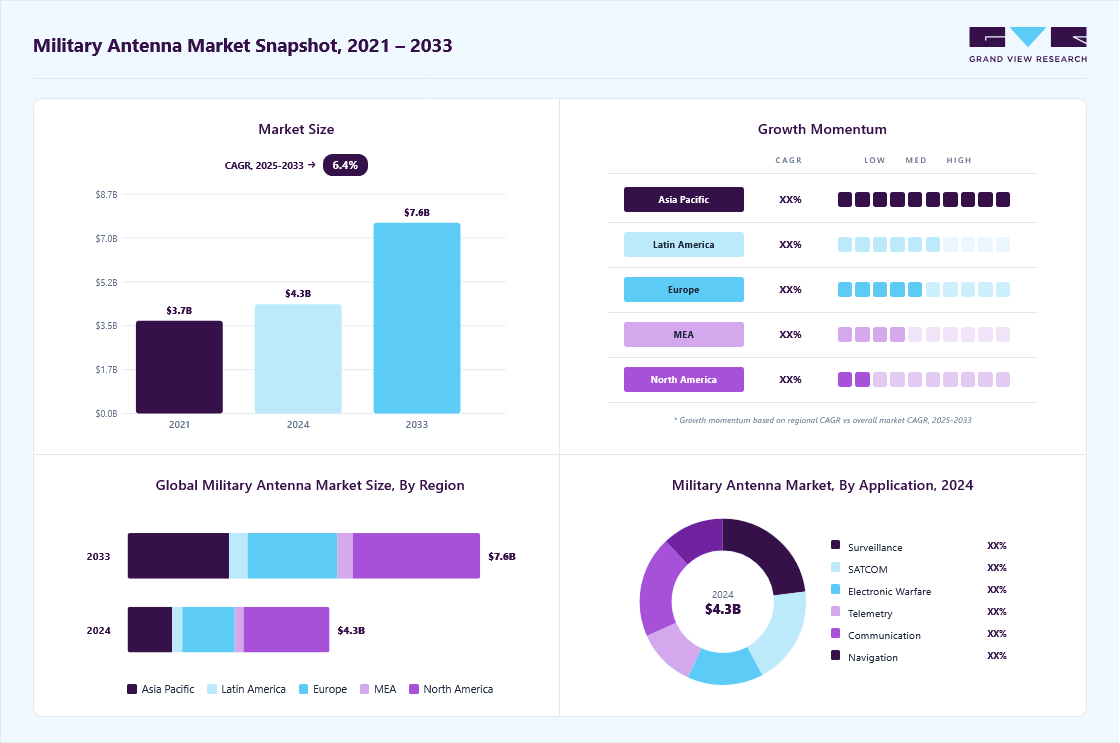
The global military antenna market size was estimated at USD 4.33 billion in 2024 and is projected to reach USD 7.56 billion by 2033, growing at a CAGR of 6.4% from 2025 to 2033. The military antenna market is growing rapidly, driven by the increasing demand for robust and secure signal transmission, growing investments in electronic warfare and satellite communication infrastructure, and the expanding deployment of unmanned and autonomous defense systems.
 Source: Grand View Research, IR Documents, Primary Interviews, Paid DatabasesTo learn more about this report,
 Download Free Sample Report
 Key Market Trends & Insights
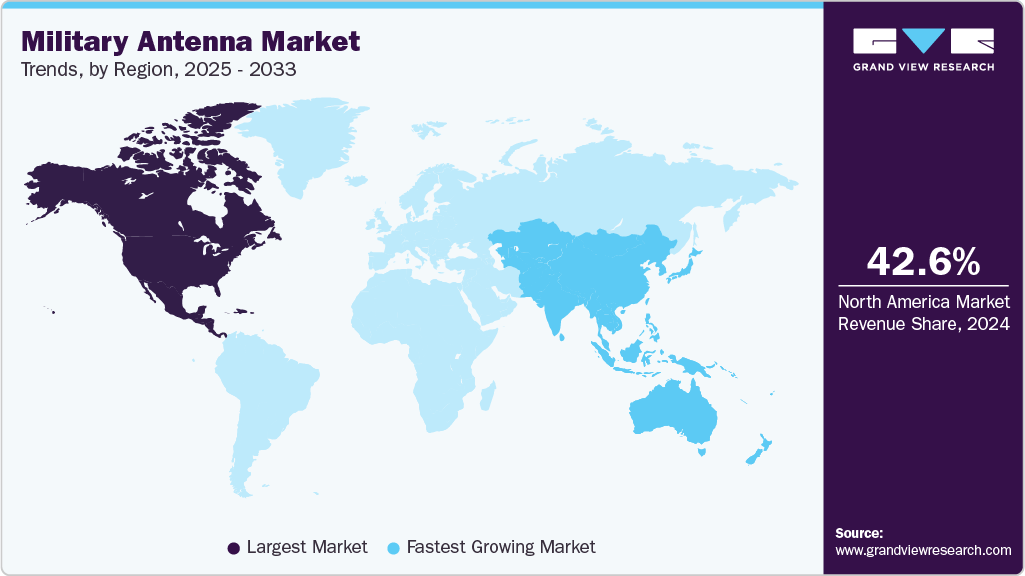
- North America dominated the global Military antenna market with the largest revenue share of 42.6% in 2024.
- The U.S. military antenna market dominated the market with a share of over 77% in 2024.
- By type, the reflectors segment led the market and accounted for 33.2% of the global revenue in 2024.
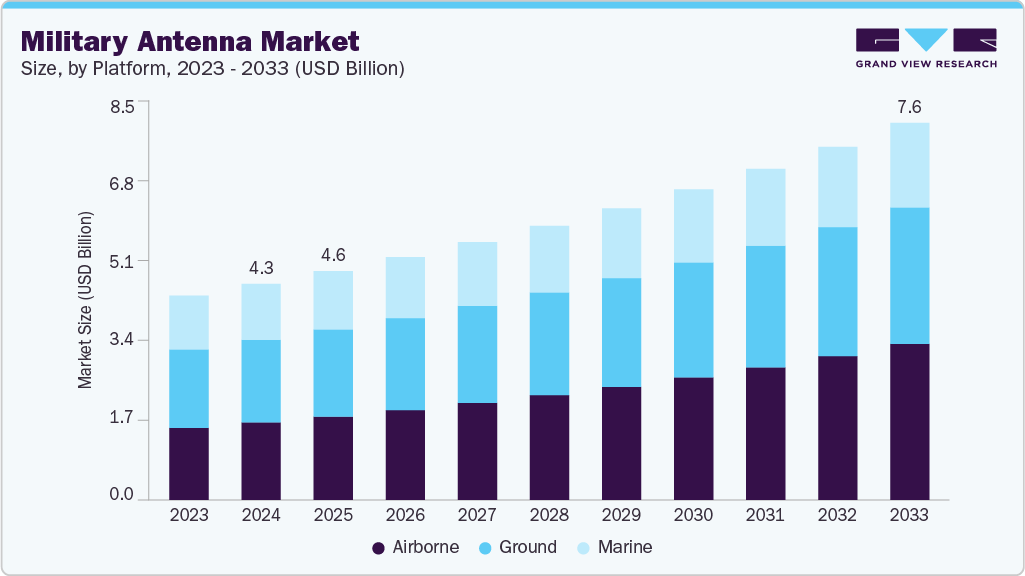
- By platform, the ground segment held the dominant position in the market and accounted for the leading revenue share of 38.2% in 2024.
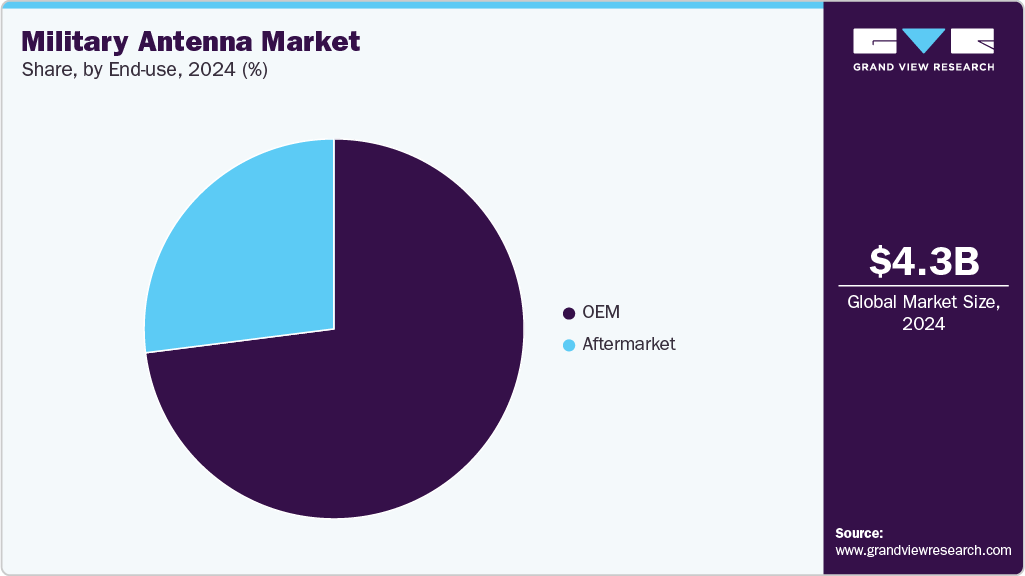
- By end-use, OEM segment accounted for the largest market revenue share in 2024.
Market Size & Forecast
- 2024 Market Size: USD 4.33 Billion
- 2033 Projected Market Size: USD 7.56 Billion
- CAGR (2025-2033): 6.4%
- North America: Largest market in 2024
- Asia Pacific: Fastest growing market
Three ways to get this report
Buy it, customize it, or ask a question.Ask an Analyst
Analyst response in 1 business day
- AccessReport author, directly
- Reply timeWithin 1 working day
- No sales callDirect answer only
- FormatEmail reply
- CostFree, no cost
Get the Full Report
What the study covers
- FormatsPDF · Excel · Dashboard
- Timeline2025–2033 annual, 2024 base
- Coverage20+ countries, 5 regions
- Companies10+ key players profiled
Customize the Report
20% free customization
- IncludeCountries, segments, points
- TailorTo your product definition
- ExtendDeeper competitor detail
- OrA fully bespoke study
- Turnaround5–10 working days
The increasing demand for real-time, secure battlefield communication is significantly boosting the adoption of advanced military antenna systems. Modern warfare increasingly relies on network-centric operations, which require high-frequency, multi-band antennas for uninterrupted data transmission. Armed forces are upgrading communication infrastructure to support secure voice, video, and data exchange across command units. The integration of military-grade software-defined radios (SDRs) is further reinforcing the need for adaptable and interference-resistant antennas. As a result, next-gen antenna systems are becoming critical components for maintaining battlefield connectivity and operational superiority.The growth in satellite communication capabilities for defense is accelerating the adoption of mobile and electronically steerable military antennas. Militaries are expanding their use of SATCOM systems for secure long-range command, control, and reconnaissance missions. With the rise of LEO and MEO constellations, there is a shift toward SATCOM-on-the-move (SOTM) antennas that deliver high-bandwidth, low-latency connectivity. Flat-panel and phased-array antennas are gaining traction for their ability to maintain links with fast-moving satellites. These advanced systems are essential for enabling global connectivity in remote or hostile operational zones.
 To learn more about this report, Download Free Sample Report
 The growing demand for modernized military infrastructure is encouraging investment in multi-functional and SWaP-optimized antenna systems. Global defense modernization programs are phasing out legacy RF systems in favor of compact, integrated antenna units. These solutions combine communications, radar, and signal intelligence in a single platform, reducing logistical complexity and operational weight. Militaries seek antennas that offer enhanced interoperability and mission flexibility across different environments. This shift is fostering the development of scalable systems with plug-and-play compatibility for next-generation defense networks.
Type Insights
The reflectors segment led the market and accounted for 33.2% of the global revenue in 2024. The growing demand for high-gain, long-range communication systems in defense operations is driving the adoption of reflector antennas in the military antenna industry. Reflector antennas are favored for their ability to focus radio waves into narrow beams, making them ideal for satellite communications, radar systems, and long-distance terrestrial links. Their robust directional performance and relatively low cost make them a preferred choice for ground stations and fixed military installations. As militaries expand their SATCOM infrastructure and deploy systems requiring precise signal targeting, reflector antennas are experiencing increased deployment across various platforms.
The low noise block converters (LNBS) segment is expected to register the fastest CAGR of over 8% from 2025 - 2033, primarily driven by the need for enhanced control, service consistency, and compliance, the in-house military antenna industry is witnessing steady growth. Organizations in sensitive sectors such as healthcare, education, and government increasingly prefer internal teams to ensure stricter oversight and tailored service delivery. This approach enables quicker decision-making, better alignment with institutional goals, and improved accountability. Moreover, the adoption of digital tools and automation is making it more feasible for in-house teams to manage complex facilities efficiently without relying on outsourced providers.
Frequency Insights
The ultra-high frequency segment accounted for the largest market revenue share in 2024, The increasing demand for reliable, beyond-line-of-sight (BLOS) communication in complex and rugged terrains is driving growth in the Ultra High Frequency (UHF) segment of the military antenna market. UHF antennas are highly valued for their ability to penetrate through buildings, foliage, and other obstacles, making them ideal for tactical ground operations and urban warfare scenarios. They support secure voice and data transmission, particularly for handheld radios and vehicle-mounted communication systems. The frequency band’s resilience to interference and ability to function in harsh environments enhances mission-critical connectivity. As armed forces emphasize mobility and real-time coordination in field operations, the demand for durable and efficient UHF antennas continues to rise.
The extremely high frequency (EHF) segment is predicted to foresee significant growth in the forecast period. driven by the need for high-capacity data transmission and secure line-of-sight communication, the segment is gaining momentum in the military antenna market. EHF antennas enable ultra-fast communication links essential for advanced applications like satellite-based surveillance, missile guidance, and secure video transmission. Their high directional precision and resistance to interception make them suitable for strategic and intelligence operations. However, EHF signals are more susceptible to atmospheric attenuation, requiring advanced antenna technologies to ensure reliability. As defense forces invest in space-based assets and high-bandwidth systems, the deployment of EHF antennas is expected to accelerate.
Platform Insights
The ground segment accounted for the largest market revenue share of 38.2% in 2024. driven by the growing need for secure and high-speed satellite communications, the ground segment of the military antenna industry is experiencing notable expansion. Defense forces are increasingly adopting electronically steerable and phased-array antennas in ground stations to support multi-orbit operations with low latency and high reliability. These systems enable real-time data exchange critical for SATCOM, surveillance, and missile tracking missions. The trend toward mobile, modular, and software-defined ground infrastructure is also enhancing deployment flexibility and operational readiness in contested environments.
The airborne segment is predicted to foresee significant growth in the forecast period, driven by the increasing demand for seamless connectivity and real-time situational awareness in dynamic operational environments, the airborne segment of the military antenna industry is undergoing significant growth. Modern military aircraft, including UAVs and fighter jets, are equipped with advanced multi-band, low-profile antennas that support high-speed data transmission, radar, and electronic warfare capabilities. These antennas are engineered to withstand extreme conditions while maintaining aerodynamic efficiency and low detectability. As air-based defense strategies evolve, the integration of lightweight, high-gain antenna systems is becoming essential for mission success across surveillance, communication, and combat operations.
Application Insights
The surveillance segment accounted for the largest market revenue share in 2024, owing to the increasing need for real-time situational awareness and threat monitoring, the surveillance segment is experiencing strong growth in the military antenna market. Surveillance antennas are essential for capturing and transmitting data from radar systems, UAVs, and satellite platforms. They enable continuous monitoring across vast and remote areas, supporting intelligence gathering and early warning capabilities. As modern conflicts demand faster and more accurate information, the adoption of high-performance surveillance antennas is accelerating globally.
The SATCOM segment is predicted to foresee significant growth in the forecast period, owing to the rising reliance on secure and high-bandwidth communication across global military operations, the SATCOM segment is witnessing robust growth in the military antenna market. SATCOM antennas enable seamless connectivity for command, control, and intelligence sharing, even in remote and hostile environments. The adoption of SATCOM-on-the-move (SOTM) systems and integration with LEO/MEO satellite constellations is further driving demand for compact, high-gain antenna solutions. These systems are critical for supporting real-time battlefield coordination, ISR missions, and mobile operations. As defense forces modernize communication infrastructure, SATCOM antenna deployments are becoming a strategic priority.
End-use Insights
The OEM segment accounted for the largest market revenue share in 2024, owing to the increasing demand for integrated, mission-specific communication systems, the OEM segment is gaining strong traction in the military antenna market. Original Equipment Manufacturers (OEMs) are focusing on developing custom-designed antennas that meet stringent military requirements for performance, durability, and size. This includes antennas tailored for specific platforms such as fighter jets, naval vessels, armored vehicles, and UAVs. The growing need for seamless integration with advanced electronics and defense systems is pushing OEMs to innovate in miniaturization, multi-functionality, and frequency agility. As defense procurement shifts toward platform-specific solutions, OEMs are playing a critical role in driving next-generation antenna development.
 To learn more about this report, Download Free Sample Report
 The aftermarket segment is projected to grow significantly over the forecast period. The increasing demand for upgrading legacy defense systems and maintaining operational readiness is driving growth in the aftermarket segment of the military antenna market. Armed forces are investing in retrofitting older platforms with modern antenna technologies to enhance communication, surveillance, and electronic warfare capabilities. The need for cost-effective solutions, extended system lifecycles, and compatibility with evolving military standards is fueling aftermarket services such as antenna replacements, enhancements, and maintenance. This trend is especially prominent in regions with aging military infrastructure and budget-conscious modernization efforts. As a result, the aftermarket segment is emerging as a vital contributor to sustained defense antenna capability.
Regional Insights
North America military antenna market dominated and accounted for 42.6% share in 2024, primarily driven by advanced defense modernization programs and heavy investments in next-gen warfare systems, North America remains a leading market for military antennas. The region is witnessing strong demand for high-frequency, multi-functional antennas integrated into sophisticated platforms like stealth aircraft, naval fleets, and UAVs. The emphasis on network-centric operations and strategic satellite communication infrastructure further reinforces market growth.
 To learn more about this report, Download Free Sample Report
 U.S. Military Antenna Market Trends
The U.S. military antenna market dominated the market with a share of over 77% in 2024, primarily driven by its dominant defense budget and continuous technological advancements, the U.S. is spearheading innovation in military antenna systems. The country is rapidly deploying SATCOM, EW, and ISR-capable antennas across land, air, and space-based platforms. Ongoing initiatives in hypersonics, AI-enabled battlefield systems, and space defense continue to generate strong antenna demand.
Europe Military Antenna Market Trends
Europe military antenna market is witnessing increasing growth in the Military antenna market, Owing to rising geopolitical tensions and cross-border defense collaborations, Europe is witnessing steady growth in military antenna adoption. Nations are upgrading legacy communication systems and increasing investments in joint defense initiatives like the EU's PESCO and NATO programs. The shift towards integrated communication and radar systems is fueling demand for high-performance antennas.
Germany military antenna market is witnessing increasing growth in the market, driven by defense digitization and expanded military roles within NATO, Germany is investing in secure and agile antenna technologies. The country is focusing on upgrading its armored vehicles, UAVs, and satellite systems with compact, multi-band antennas. Local defense manufacturers are also accelerating innovation in rugged and frequency-agile antenna platforms.
Military antenna market in UK is witnessing increasing growth in the market. The increasing demand for multi-domain defense capabilities is propelling the military antenna industry in the UK Key initiatives like the Future Combat Air System (FCAS) and space-based surveillance projects are driving investments in advanced communication and EW antennas. The UK’s strategic focus on maritime security and global deployments further supports antenna system upgrades.
Asia Pacific Military Antenna Market Trends
Asia Pacific military antenna market is expected to grow at the fastest CAGR of 9.7% from 2025 to 2033, Owing to heightened regional security concerns and a push for indigenous defense capabilities, Asia Pacific is experiencing rapid growth in military antenna demand. Countries are expanding their ISR, UAV, and missile defense systems, which require advanced and reliable antennas. The region's dynamic shift toward next-generation electronic warfare and battlefield communication platforms is creating significant market opportunities.
China military antenna market is witnessing increasing growth in the market, primarily driven by large-scale military modernization and assertive defense expansion, China is heavily investing in high-end antenna systems. The nation is deploying advanced radar and communication antennas across naval fleets, missile systems, and surveillance satellites. Its growing emphasis on AI, space warfare, and electronic countermeasures is further accelerating antenna innovation.
Military antenna market in Japan is witnessing increasing growth in the market. The increasing demand for enhanced defense communication systems and homeland security is fueling Japan’s military antenna market. The country is focusing on radar, SATCOM, and mobile communication antennas to support its ballistic missile defense and maritime surveillance programs. Japan’s participation in regional security alliances is also boosting integration of interoperable and secure antenna technologies.
Key Military Antenna Company Insights
-
L3Harris Technologies, Inc. is a global defense and aerospace leader, specializing in secure communication systems and advanced tactical radios. The company offers a wide range of high-performance military antennas for ground, airborne, and maritime platforms. Its antennas are known for multi-band capabilities, rugged construction, and compatibility with modern battlefield systems. L3Harris plays a crucial role in enabling real-time data sharing and command communications in highly contested environments.
-
Lockheed Martin Corporation is a major defense contractor that integrates cutting-edge antenna technologies into its extensive portfolio of fighter jets, naval vessels, and satellite systems. The company specializes in phased-array, stealth-compatible, and radar antennas tailored for mission-critical operations. Its innovations are central to programs like the F-35 and space-based missile defense initiatives. Lockheed Martin continues to lead in developing next-generation antenna solutions that support multi-domain defense strategies.
Southwest Antennas, and MTI Wireless Edge are some of the emerging market participants in the space debris monitoring and removal market.
-
Southwest Antennas is a U.S.-based company that has rapidly expanded its presence by offering rugged and high-performance RF antennas for tactical communication systems. It specializes in solutions for handheld radios, UAVs, and soldier-wearable systems, particularly in the UHF and L/S-band ranges. The company is known for its rapid customization and responsive product development tailored to end-user needs. Its strong focus on military-grade durability and field adaptability makes it a rising name in tactical antenna solutions.
-
MTI Wireless Edge is an Israel-based firm that is gaining attention for its reliable and innovative military antenna systems, especially in SATCOM and radar applications. The company produces flat-panel, directional, and omni-directional antennas with robust performance in harsh conditions. MTI’s growing global defense partnerships reflect its ability to deliver cost-effective and technically advanced solutions. Its agility and expertise in RF design are helping it expand into new military communication and surveillance programs.
Key Military Antenna Companies:
The following are the leading companies in the military antenna market. These companies collectively hold the largest market share and dictate industry trends.
- L3Harris Technologies, Inc.
- Lockheed Martin Corporation
- Cobham Limited
- Amphenol Corporation
- Comrod Communication AS
- Rohde & Schwarz
- Alaris Holdings Limited
- Antenna Products Corporation
- Southwest Antennas
- MTI Wireless Edge
Recent Developments
-
In June 2025, Kymeta unveiled a next-generation electronically steerable Ku/Ka-band antenna designed for seamless roaming across multiple satellite networks. The antenna supports four simultaneous beams over GEO and LEO constellations, delivering robust connectivity in contested environments. Its compact, low-power design enhances mobility while improving anti-jamming resilience and reducing thermal and electromagnetic signatures for tactical advantage.
-
In March 2025, Orbit Communication Systems unveiled the OrBeam MIL, a next-generation electronically steerable satellite communication antenna at SATELLITE DC 2025. Designed for military and enterprise applications, the flat-panel antenna supports Ka- and Ku-band operations across LEO, MEO, and GEO satellites, offering seamless "make-before-break" satellite handovers. Its low power consumption, lightweight design, and multi-platform compatibility position it as a robust solution for modern defense and mobility requirements.
-
In February 2025, ATLAS Space Operations partnered with HawkEye 360 to expand global RF data collection by integrating ground stations in Australia and New Zealand. This collaboration enhances HawkEye 360’s coverage and network resilience, particularly in mid-latitude regions. By leveraging ATLAS’s Freedom software and high-speed X-band links, the partnership ensures faster, more reliable delivery of critical RF geospatial intelligence.
Military Antenna Market Report Scope
Report Attribute
Details
Market size value in 2025
USD 4.59 billion
Revenue forecast in 2033
USD 7.56 billion
Growth rate
CAGR of 6.4% from 2025 to 2033
Base year for estimation
2024
Historical data
2021 - 2023
Forecast period
2025 - 2033
Quantitative units
Revenue in USD million/billion and CAGR from 2025 to 2033
Report coverage
Revenue forecast, company ranking, competitive landscape, growth factors, and trends
Segments covered
Type, frequency, platform, application, end-use, region
Regional scope
North America; Europe; Asia Pacific; Latin America; MEA
Country scope
U.S.; Canada; Mexico; UK; Germany; France; China; Japan; India; South Korea; Australia; Brazil; KSA; UAE; South Africa
Key companies profiled
L3Harris Technologies, Inc.; Lockheed Martin Corporation; Cobham Limited; Amphenol Corporation; Comrod Communication AS; Rohde & Schwarz; Alaris Holdings Limited; Antenna Products Corporation; Southwest Antennas; MTI Wireless Edge
Customization scope
Free report customization (equivalent up to 8 analysts working days) with purchase. Addition or alteration to country, regional & segment scope.
Pricing and purchase options
Avail customized purchase options to meet your exact research needs. Explore purchase options
Global Military Antenna Market Report Segmentation
This report forecasts revenue growth at global, regional, and country levels and provides an analysis of the latest industry trends in each of the sub-segments from 2021 to 2033. For this study, Grand View Research has segmented the global military antenna market report based on type, frequency, platform, application, end-use, and region.
-
Type Outlook (Revenue, USD Million, 2021 - 2033)
-
Reflectors
-
FEED Horns
-
FEED Networks
-
LOW Noise Block Converters (LNBS)
-
Others
-
-
Frequency Outlook (Revenue, USD Million, 2021 - 2033)
-
High Frequency
-
Ultra-High Frequency
-
Super High Frequency
-
Extremely High Frequency
-
-
Platform Outlook (Revenue, USD Million, 2021 - 2033)
-
Airborne
-
Marine
-
Ground
-
-
Application Outlook (Revenue, USD Million, 2021 - 2033)
-
Surveillance
-
SATCOM
-
Electronic Warfare
-
Telemetry
-
Communication
-
Navigation
-
-
End-use Outlook (Revenue, USD Million, 2021 - 2033)
-
OEM
-
Aftermarket
-
-
Regional Outlook (Revenue, USD Million, 2021 - 2033)
-
North America
-
U.S.
-
Canada
-
Mexico
-
-
Europe
-
UK
-
Germany
-
France
-
-
Asia Pacific
-
China
-
Japan
-
India
-
South Korea
-
Australia
-
-
Latin America
-
Brazil
-
-
Middle East and Africa (MEA)
-
KSA
-
UAE
-
South Africa
-
-
Frequently Asked Questions About This Report
The global military antenna market size was estimated at USD 4.33 billion in 2024 and is expected to reach USD 4.59 billion in 2025.
The global military antenna market is expected to grow at a compound annual growth rate of 6.4% from 2025 to 2033 to reach USD 7.56 billion by 2033.
North America dominated the military antenna market with a share of 42.6% in 2024, primarily driven by advanced defense modernization programs and heavy investments in next-gen warfare systems, North America remains a leading market for military antennas. The region is witnessing strong demand for high-frequency, multi-functional antennas integrated into sophisticated platforms like stealth aircraft, naval fleets, and UAVs.
Some key players operating in the military antenna market include L3Harris Technologies, Inc., Lockheed Martin Corporation, Cobham Limited, Amphenol Corporation, Comrod Communication AS, Rohde & Schwarz, Alaris Holdings Limited, Antenna Products Corporation, Southwest Antennas, and MTI Wireless Edge.
Key factors that are driving the market growth include increasing demand for secure and resilient communication systems, rising adoption of advanced radar and electronic warfare technologies, and growing defense modernization programs globally.
About the Author(s)
Next Generation Technologies Research Team
Technology · Next Generation TechnologiesThis report was authored by the next generation technologies research team at Grand View Research - comprising two research analysts, one senior research analyst, and one industry expert - with specialized expertise in the next generation technologies segment of the technology industry. All findings are based on proprietary technology databases, executive interviews, and regulatory analysis, subject to internal peer review prior to publication.
Last Updated:
Speak to Analyst

Customize this report to your needs - add regions, segments, or data points, with 20% free customization.
Or view our licence options:


ISO 9001:2015 & 27001:2022 Certified
We are GDPR and CCPA compliant! Your transaction & personal information is safe and secure. For more details, please read our privacy policy.


