
- Home
- »
- Advanced Interior Materials
- »
-
Mining Waste Management Market Size, Growth Report, 2026-2033GVR Report cover
![Mining Waste Management Market (2026 - 2033)Report]()
Mining Waste Management Market (2026 - 2033)
Size, Share & Trends Analysis Report By Mining Method (Surface Mining, Underground Mining), By Metals/Minerals (Thermal Coal, Coking Coal, Iron Ore, Gold, Copper, Lead, Zinc), By Waste, By Region and Segment Forecasts
Market Size, 2025
$249.6BMarket Estimate, 2026
$260.3BMarket Forecast, 2033
$364.0BCAGR, 2026–2033
4.9%Mining Waste Management Market Summary
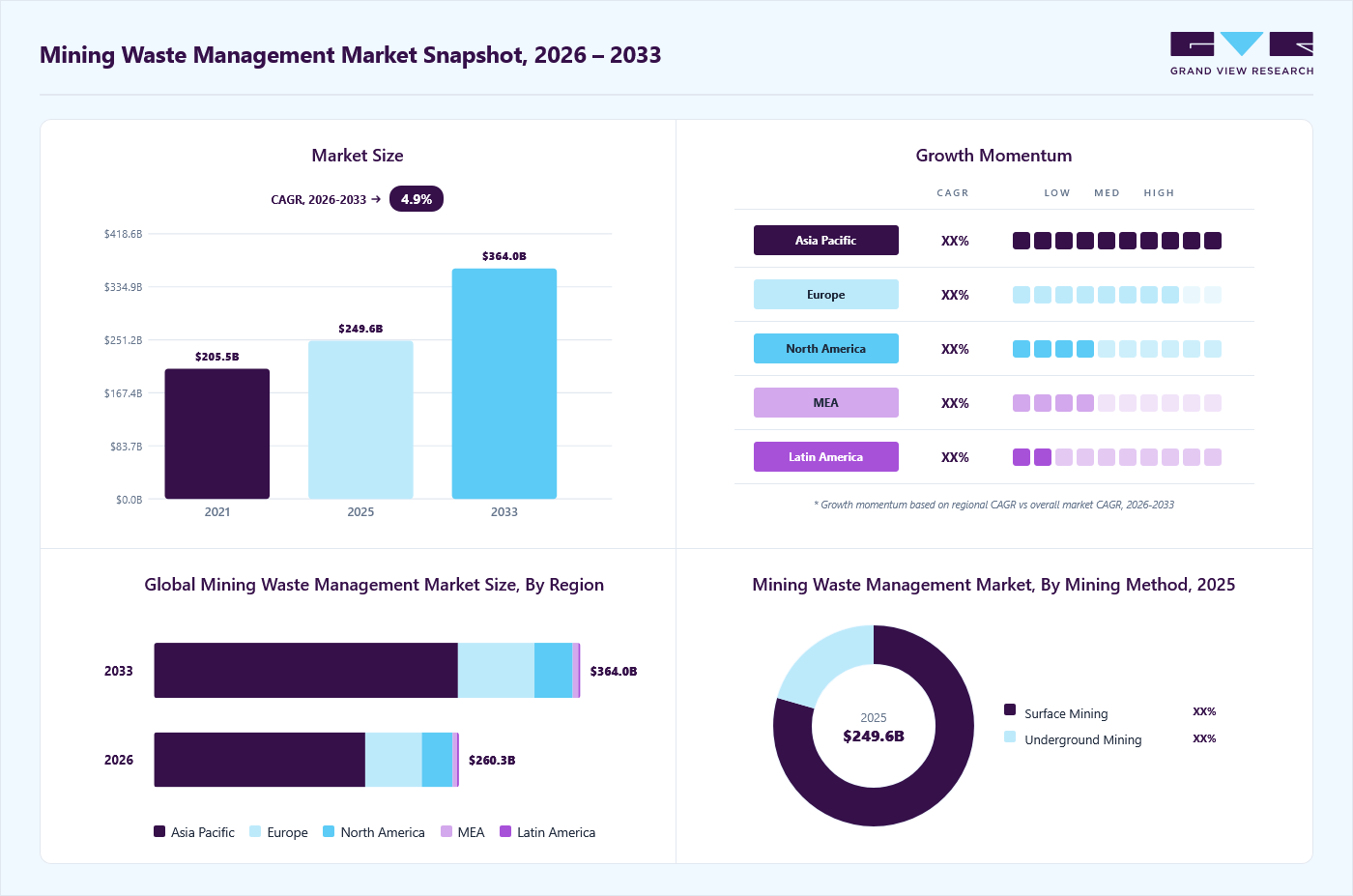
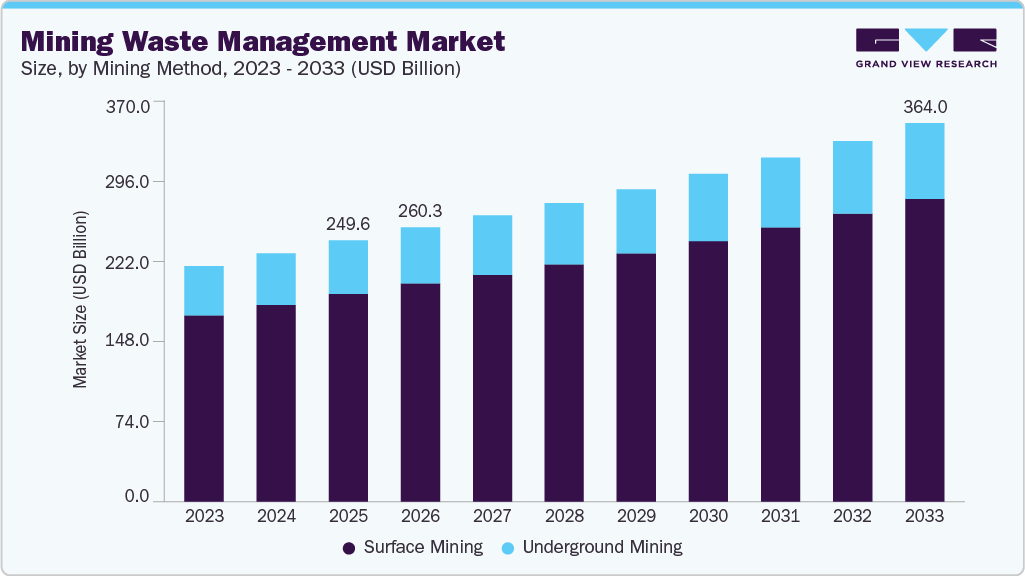
The global mining waste management market size was valued at USD 249.6 billion in 2025 and is projected to grow from USD 260.3 billion in 2026 to USD 364.0 billion by 2033, at a CAGR of 4.9% from 2026 to 2033. Asia Pacific dominated the global market, accounting for the largest revenue share of 69.0% in 2025. The growing demand for minerals and energy resources is a major driver of the market.
Key Market Trends & Insights
- By mining method: Surface mining segment led the market and held the largest revenue share of 79.4% in 2025.
- By waste: Tailings segment is anticipated to register notable growth, with a projected CAGR of 5.2% from 2026 to 2033.
Regional Highlights
- Largest regional market: Asia Pacific (69.0% revenue share, 2025)
- By country: The India mining waste management industry is a major contributor to the global market.
Market Size & Forecast
- Market size in 2025: USD 249.6 Billion
- Estimated market size in 2026: USD 260.3 Billion
- Projected market size by 2033: USD 364.0 Billion
- CAGR (2026-2033): 4.9%
As industries expand and infrastructure projects increase, mining activity continues to rise, leading to higher volumes of waste, including overburden, tailings, and mine water. Rapid population growth and expanding industrial activity across sectors like manufacturing, automotive, and oil & gas are increasing the demand for metals and machinery, which in turn is driving higher mining activity, especially for iron and steel ores.
This rise in mining leads to significant generation of hazardous waste, including heavy metals, metalloids, acidic mine water, and even radioactive materials. Managing this waste safely is essential to prevent contamination of land and water resources, as improper disposal can disrupt ecosystems and pose serious health risks. As a result, there is a growing need for effective waste management solutions that control the release of harmful substances into the environment, which is supporting the overall growth of the mining waste management industry.
Market Concentration & Characteristics
The mining waste management market is fragmented. Although a few large global service providers handle major and complex projects, a significant share of the market is served by regional and specialized players. This is largely due to the location-specific nature of mining operations, which often require customized waste management solutions based on site conditions and regulations. As a result, local contractors and niche technology providers play an important role, leading to a competitive landscape with no single player dominating the market.
The industry is seeing a steady rise in innovation, mainly driven by the need to improve safety, efficiency, and environmental performance. Companies are adopting advanced solutions such as dry tailings storage, automated monitoring systems, and real-time data analytics to manage waste more effectively. There is also growing interest in technologies that enable resource recovery from waste, including reprocessing of tailings to extract residual metals.
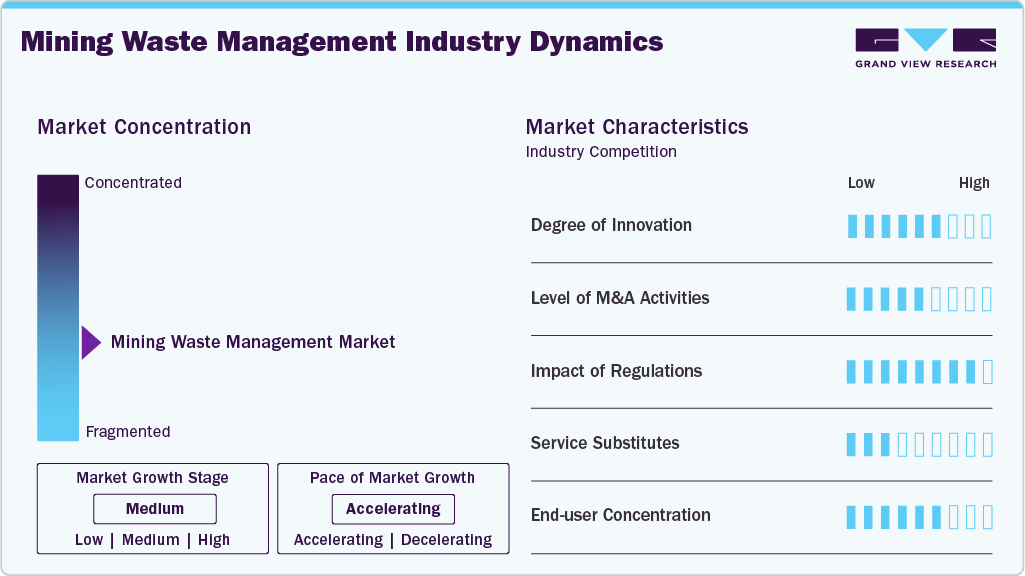
Regulation plays a strong role in shaping this market. Governments and environmental agencies across the world are enforcing stricter rules related to waste disposal, water treatment, and land rehabilitation. Following several high-profile environmental incidents, there has been increased focus on tailings dam safety and long-term environmental monitoring. Compliance with these regulations is no longer optional; mining companies are required to invest in improved waste management systems to meet evolving standards.
In terms of end users, the market shows moderate concentration, with large mining companies accounting for a significant share of demand. Major mining firms typically operate multiple large-scale sites and require comprehensive waste management services, making them key customers. At the same time, many small- and mid-sized mining operators contribute to overall demand but often rely on localized or cost-effective solutions. This mix of large and smaller end users creates a balanced demand structure, where both high-value contracts and smaller, site-specific projects coexist.
Drivers, Opportunities & Restraints
The market is mainly driven by the steady rise in mining activity and the increasing volume of waste generated from lower-grade ores. As more material needs to be processed to extract usable metals, the amount of overburden, tailings, and mine water continues to grow. At the same time, stricter environmental regulations and a greater safety focus are pushing mining companies to invest in more effective waste-handling and treatment systems. Concerns around water contamination, land degradation, and tailings dam failures are also encouraging the adoption of improved waste management practices, supporting overall market growth.
There are significant opportunities emerging from the shift toward sustainable, resource-efficient mining. Technologies that enable the reuse of waste, the recovery of valuable minerals from tailings, and advanced water recycling are gaining traction. In addition, digital solutions such as remote monitoring and automation are improving operational efficiency and risk management. Growing interest in circular economy practices and mine site rehabilitation is opening new avenues for service providers, especially in regions with strict environmental policies and active mining operations.
However, the market also faces certain restraints. High initial investment costs for advanced waste management systems can be challenging, particularly for small- and mid-sized mining companies. In addition, managing mining waste is complex due to variations in waste composition, site conditions, and regulatory requirements across regions. Economic uncertainty and fluctuations in commodity prices can also affect mining activity, which, in turn, can affect demand for waste management services.
Mining Method Insights
The surface mining segment dominated the market in 2025, largely because it produces significantly higher volumes of waste than underground methods. Techniques such as open-pit mining require the removal of large amounts of overburden and waste rock to access mineral deposits. This approach is widely used across the globe for extracting metals and minerals due to its cost efficiency, simpler operations, and lower labor and equipment requirements, which further contribute to higher waste generation and the need for effective management solutions.
The underground mining segment is projected to grow at a steady pace, with a CAGR of around 4.5% over the forecast period, supported by rising investments in deep mineral extraction. This method is commonly used for hard minerals such as gold, copper, zinc, and lead, employing techniques such as room-and-pillar and block caving. Although underground mining generates less overall waste compared to surface mining, it produces tailings that are more complex to manage, especially in terms of secure storage and preventing contamination of surrounding water sources.
Metals/Minerals Insights
The thermal coal segment held a significant share of the mining waste management market in 2025, accounting for around 31.3% of total revenue. Thermal coal, commonly used for power generation, remains a key energy source globally, making it one of the most widely mined resources. Demand remains especially strong in the Asia Pacific region, where countries such as China and India rely heavily on coal-fired power generation. This sustained dependence is expected to support ongoing thermal coal mining activities, leading to continued generation of mining waste over the forecast period.
The copper segment is expected to grow steadily, with a projected CAGR of around 5.2% over the forecast period. Increasing demand for copper in electrical and electronic applications is driving higher extraction of copper ores such as cuprite, malachite, and azurite. As industries continue to expand and electrification trends accelerate, copper mining activity is likely to rise, in turn driving greater volumes of mining waste and the need for efficient waste management solutions.
Waste Insights
The overburden/waste rock segment dominated the mining waste management market and accounted for 53.3% share in 2025, primarily due to the large volumes generated during surface mining activities. Removing soil and rock layers to access mineral deposits results in substantial waste, making its management a key operational requirement. Proper handling is essential not only for regulatory compliance but also for minimizing environmental impact. In many cases, overburden/waste rock is reused for applications such as land reclamation, site leveling, and construction purposes, which helps reduce disposal challenges.
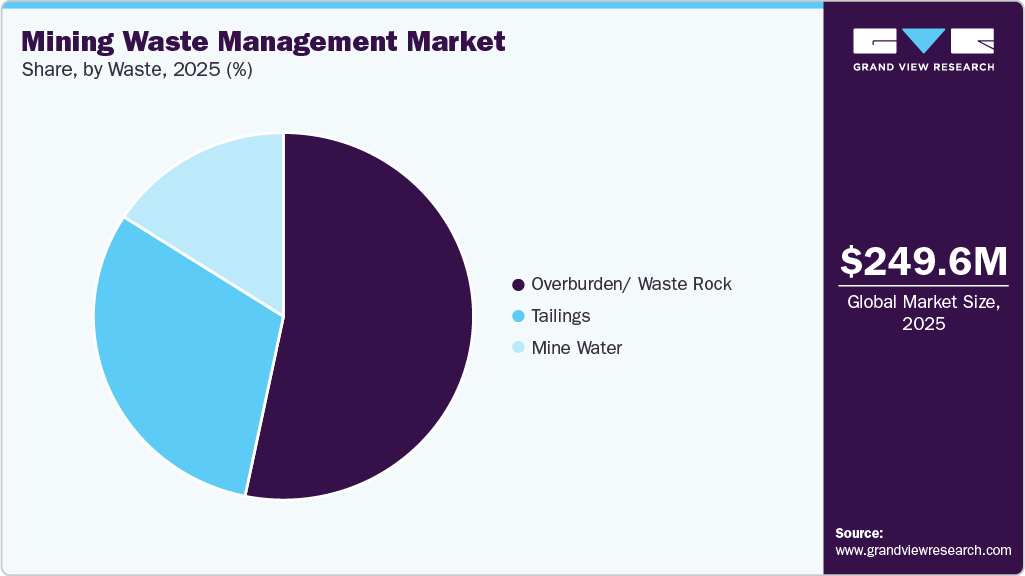
The tailings segment is expected to be the fastest-growing over the forecast period, driven by increasing concerns about environmental safety and stricter regulations. Tailings, formed after mineral processing, are finer in nature and often contain residual chemicals, making them more complex to manage. As a result, mining companies are investing in advanced solutions such as dewatering, dry stacking, and improved storage systems to reduce risks such as water contamination and dam failures, thereby supporting strong growth in this segment.
Regional Insights
The North America mining waste management industry is witnessing steady growth driven by advanced mining operations and a strong regulatory framework. The region focuses heavily on improving tailings safety, mine water treatment, and site reclamation. Increasing investments in sustainable mining practices and the adoption of digital monitoring technologies are helping operators manage waste more efficiently while meeting strict environmental standards.
U.S. Mining Waste Management Market Trends
The mining waste management industry in the U.S. leads the North America market, supported by the scale of its mining activities and a well-established regulatory framework. Data from the U.S. Energy Information Administration shows that coal production reached 512.5 million short tons (MMst) in 2024, while total mine capacity stood at 832.8 MMst, highlighting the significant operational base. Such large-scale production generates substantial quantities of waste materials, including overburden, tailings, and mine water, driving the need for effective waste-handling and treatment solutions. Ongoing compliance requirements and environmental standards further encourage the adoption of improved waste management practices.
The Canada mining waste management industry is showing steady growth, supported by increasing mining activity across key resources such as oil sands, gold, and base metals. The country places strong emphasis on responsible mining and environmental protection, leading to greater focus on efficient tailings management, water treatment, and site restoration. As operators continue to invest in reducing environmental impact and improving operational efficiency, the demand for advanced and sustainable waste management solutions is expected to rise.
Europe Mining Waste Management Market Trends
The mining waste management industry in Europe is largely driven by stringent environmental regulations and sustainability goals. Mining activities are relatively moderate compared to other regions, but there is a strong emphasis on safe disposal, waste reduction, and circular economy practices. Companies are increasingly investing in technologies that enable the reuse of mining waste and minimize environmental impact, aligning with the region’s strict compliance standards.
The Germany mining waste management industry holds a leading position in the European market, supported by its ongoing lignite mining activities and well-defined environmental framework. As per the International Energy Agency, the country recorded total coal production of 823,725 TJ in 2024, indicating continued mining operations despite the broader energy transition. These activities generate considerable volumes of overburden and mine water, creating a steady need for effective waste-handling, treatment, and land rehabilitation solutions aligned with strict regulatory standards.
The mining waste management industry in the UK is emerging as a growing market, driven mainly by efforts to manage legacy mining sites and improve environmental conditions. Although active large-scale mining is limited, there is increasing attention on treating mine water, stabilizing old waste deposits, and restoring previously used land. Supportive regulations and sustainability initiatives are encouraging investments in modern waste management practices, contributing to gradual market expansion.
Asia Pacific Mining Waste Management Market Trends
The mining waste management industry in the Asia Pacific led the global market and accounted for 69.0% share in 2025, supported by large-scale mining operations and strong demand for coal, iron ore, and base metals. Countries such as China, India, and Australia continue to expand extraction to meet energy and infrastructure needs, resulting in substantial waste generation. Governments across the region are also tightening environmental norms, pushing mining companies to adopt better waste handling, water treatment, and land rehabilitation practices, which further strengthens market demand.

The China mining waste management industry leads the Asia Pacific market, supported by its vast mining sector and continued reliance on coal and metals for industrial output. Large-scale extraction activities generate significant volumes of overburden, tailings, and mine water, creating strong demand for waste handling and treatment solutions. In addition, tighter environmental controls and increased focus on sustainable mining practices are encouraging the adoption of improved waste management systems across the country.
The mining waste management industry in India is the fastest-growing market in the region, driven by rising energy demand and expanding mining activity. According to the Ministry of Coal, coal production reached 997.8 million tonnes in 2023-24 and increased to 1,047.5 million tonnes in 2024-25, reflecting a growth of 4.98%. This steady rise in output is leading to greater mining waste generation, particularly from surface mining operations, thereby increasing the need for efficient waste management, land restoration, and water treatment solutions.
Latin America Mining Waste Management Market Trends
The mining waste management industry in Latin America is emerging as a high-growth region due to its rich reserves of copper, gold, and iron ore. Expanding mining activities in countries like Chile, Peru, and Brazil are generating significant volumes of waste, creating strong demand for effective management solutions. Regulatory frameworks are gradually evolving, encouraging mining companies to improve waste storage, water management, and environmental protection measures.
The Brazil mining waste management industry is emerging as a key growth market in Latin America, supported by its large reserves of iron ore, gold, and other minerals. Expanding mining activities are leading to increased volumes of overburden and tailings, creating strong demand for efficient waste management solutions. In addition, greater focus on environmental safety and stricter oversight following past tailings incidents are encouraging investments in improved waste storage, monitoring, and rehabilitation practices, contributing to steady market growth.
Middle East & Africa Mining Waste Management Market Trends
The mining waste management industry in the Middle East & Africa region is experiencing gradual growth, supported by increasing mining exploration and development activities, particularly in Africa. Countries rich in minerals such as gold, diamonds, and phosphates are expanding operations, leading to rising waste generation. While infrastructure and regulatory frameworks are still developing in some areas, growing awareness of environmental impacts is encouraging the adoption of improved waste management practices.
The South Africa mining waste management industry is a key growth market in the Middle East & Africa region, supported by its well-established mining sector focused on gold, platinum, and other minerals. Ongoing mining activities are generating substantial volumes of tailings and mine water, increasing the need for effective waste management solutions. In addition, rising emphasis on environmental protection, stricter compliance requirements, and efforts to rehabilitate legacy mining sites are encouraging the adoption of improved waste treatment, storage, and land restoration practices, contributing to steady market expansion.
Key Mining Waste Management Company Insights
Some of the key players operating in the market include Veolia, Hatch Ltd., and Tetra Tech, Inc, among others.
-
Veolia is a global provider of environmental solutions focused on water, waste, and energy management across industrial sectors. The company offers integrated services encompassing waste treatment, recycling, and resource recovery, as well as advanced water and wastewater management systems. In the mining waste management market, it supports operations through solutions such as tailings treatment, mine water management, and recovery of valuable materials from waste streams. Its emphasis on sustainability and circular economy practices helps mining companies reduce environmental impact while meeting regulatory requirements.
-
Hatch Ltd. is a global engineering and project delivery company that provides consulting, design, and construction management services across the mining, energy, and infrastructure sectors. The firm supports mining companies throughout the project lifecycle, including feasibility studies, mine design, process optimization, and operational support. It also offers specialized capabilities such as backfill systems, tailings handling, and mine water management, helping improve efficiency and environmental performance. With strong expertise in both surface and underground mining, Hatch plays an important role in the mining waste management market by enabling safer waste disposal, resource recovery, and compliance with evolving environmental standards.
Key Mining Waste Management Companies:
The following key companies have been profiled for this study on the mining waste management market.
- Veolia
- Hatch Ltd.
- Tetra Tech, Inc
- EnviroServ Waste Management Ltd.
- Interwaste Holdings Limited
- Cleanaway Waste Management Limited
- Stantec
- SRK Consulting
- Metso
- Orica Limited
- Séché
- Ausenco Pty Ltd
- Tetronics Technologies Limited
- Ramboll Group
- Averda
Recent Developments
-
In September 2025, The Weir Group announced a partnership with MINEXXT to advance sustainable tailings management solutions for the mining industry. This collaboration focuses on integrating innovative technologies and expertise to improve tailings handling, reduce environmental risks, and enhance operational efficiency.
-
In June 2025, Veolia announced a major expansion of its hazardous waste treatment capacity, adding 530,000 tonnes annually by 2030, supported by multiple acquisitions across the U.S., Japan, and Brazil. This move strengthens its position in handling complex industrial and mining waste streams and aligns with growing global demand for advanced waste treatment solutions.
Mining Waste Management Market Report Scope
Report Attribute
Details
Market size in 2025
USD 249.6 billion
Estimated Market size in 2026
USD 260.3 billion
Projected Market size by 2033
USD 364.0 billion
Growth rate
CAGR of 4.9% from 2026 to 2033
Base year for estimation
2025
Historical data
2021 - 2024
Forecast period
2026 - 2033
Quantitative units
Revenue in USD million/billion and CAGR from 2026 to 2033
Report coverage
Revenue forecast, company market position analysis, competitive landscape, growth factors, and trends
Segments covered
Mining method, metals/minerals, waste, region
Regional scope
North America; Europe; Asia Pacific; Latin America; Middle East & Africa
Country Scope
U.S.; Canada; Mexico; UK; Italy; Germany; Spain; Russia; China; India; Japan; South Korea; Australia; Brazil; Argentina; Saudi Arabia; South Africa
Key companies profiled
Veolia; Hatch Ltd.; Tetra Tech, Inc.; EnviroServ Waste Management Ltd.; Interwaste Holdings Limited; Cleanaway Waste Management Limited; Stantec; SRK Consulting; Metso; Orica Limited; Séché; Ausenco Pty Ltd; Tetronics Technologies Limited; Ramboll Group; Averda.
Customization scope
Free report customization (equivalent up to 8 analysts working days) with purchase. Addition or alteration to country, regional & segment scope.
Pricing and purchase options
Avail customized purchase options to meet your exact research needs. Explore purchase options
Global Mining Waste Management Market Report Segmentation
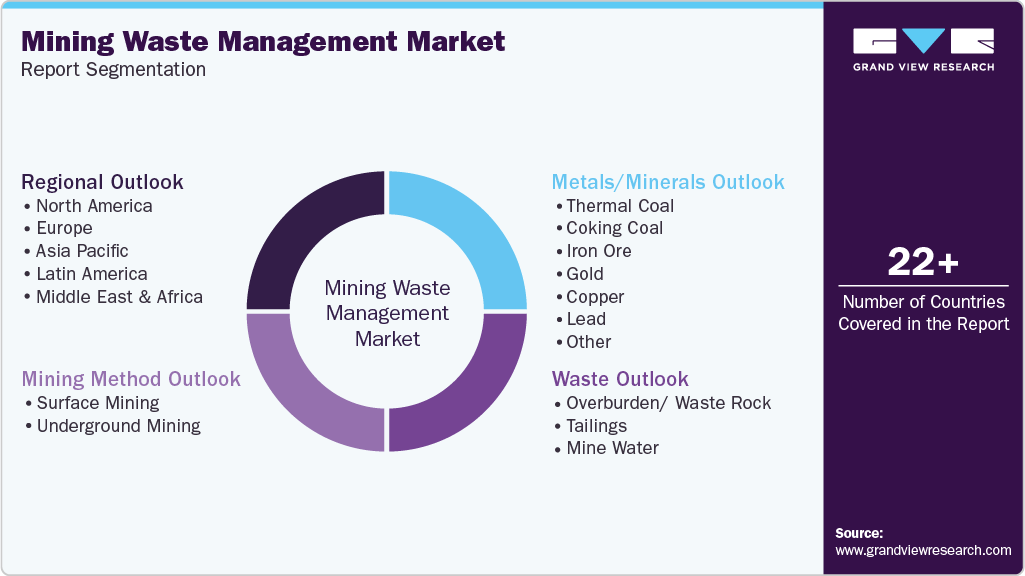
This report forecasts revenue growth at global, regional & country levels and provides an analysis on the industry trends in each of the sub-segments from 2021 to 2033. For this study, Grand View Research has segmented the global mining waste management market report on the basis of mining method, metals/minerals, waste, and region:
-
Mining Method Outlook (Revenue, USD Billion, 2021 - 2033)
-
Surface Mining
-
Underground Mining
-
-
Metals/Minerals Outlook (Revenue, USD Billion, 2021 - 2033)
-
Thermal Coal
-
Coking Coal
-
Iron Ore
-
Gold
-
Copper
-
Lead
-
Zinc
-
Other
-
-
Waste Outlook (Revenue, USD Billion, 2021 - 2033)
-
Overburden/ Waste Rock
-
Tailings
-
Mine Water
-
-
Regional Outlook (Revenue, USD Billion, 2021 - 2033)
-
North America
-
U.S.
-
Canada
-
Mexico
-
-
Europe
-
UK
-
Italy
-
Germany
-
Spain
-
Russia
-
-
Asia Pacific
-
China
-
India
-
Japan
-
South Korea
-
Australia
-
-
Latin America
-
Brazil
-
Argentina
-
-
Middle East & Africa
-
Saudi Arabia
-
South Africa
-
-
Frequently Asked Questions About This Report
The surface mining segment led with a 79.4% revenue share in 2025.
Overburden/waste rock segment led with a 53.3% revenue share in 2025, while tailings is the fastest-growing waste.
The thermal coal segment accounted for the largest revenue share of 31.3% in 2025.
The global mining waste management market size was valued at USD 249.6 billion in 2025 and is estimated at USD 260.3 billion for 2026.
Asia Pacific led the mining waste management market and accounted for 69.0% share in 2025, supported by large-scale mining operations and strong demand for coal, iron ore, and base metals. Countries like China, India, and Australia continue to expand extraction to meet energy and infrastructure needs, resulting in substantial waste generation.
Key players include Veolia; Hatch Ltd.; Tetra Tech, Inc.; EnviroServ Waste Management Ltd.; Interwaste Holdings Limited; Cleanaway Waste Management Limited; Stantec; SRK Consulting; Metso; Orica Limited; Séché; Ausenco Pty Ltd; Tetronics Technologies Limited; Ramboll Group; Averda.
The mining waste management market is driven by rising mining activities and increasing waste generation due to declining ore grades. At the same time, stricter environmental regulations and growing focus on sustainability are pushing companies to adopt advanced waste treatment, recycling, and safe disposal solutions.
The global mining waste management market is expected to grow at a CAGR of 4.9% from 2026 to 2033, reaching USD 364.0 billion by 2033.
About the Author(s)
Advanced Interior Materials Research Team
Advanced Materials · Advanced Interior MaterialsThis report was authored by the advanced interior materials research team at Grand View Research - comprising two research analysts, one senior research analyst, and one industry expert - with specialized expertise in the advanced interior materials segment of the advanced materials industry. All findings are based on proprietary advanced materials databases, executive interviews, and regulatory analysis, subject to internal peer review prior to publication.
Last Updated:
Speak to Analyst


Customize this report to your needs — add regions, segments, or data points, with 20% free customization.
Or view our licence options:


ISO 9001:2015 & 27001:2022 Certified
We are GDPR and CCPA compliant! Your transaction & personal information is safe and secure. For more details, please read our privacy policy.


