
- Home
- »
- Advanced Interior Materials
- »
-
Nano Precipitated Calcium Carbonate Market Report, 2033GVR Report cover

Nano Precipitated Calcium Carbonate Market (2026 - 2033)
Size, Share & Trends Analysis Report By Grade (Pharmaceutical Grade, Food Grade, Industrial Grade), By Application (Automotive, Building & Construction, Pharmaceutical), By Region, And Segment Forecasts
Market Size, 2025
$134.4MMarket Estimate, 2026
$145.1MMarket Forecast, 2033
$281.4MCAGR, 2026–2033
9.9%Nano Precipitated Calcium Carbonate Market Summary
The global nano precipitated calcium carbonate market size was valued at USD 134.4 million in 2025 and is projected to grow from USD 145.1 million in 2026 to USD 281.4 million by 2033, at a CAGR of 9.9% from 2026 to 2033. Asia Pacific dominated the market with the highest revenue share of 42.4% in 2025. This growth is underpinned by rising demand across several high-impact sectors where product performance, purity, and efficiency are becoming critical to formulation standards.
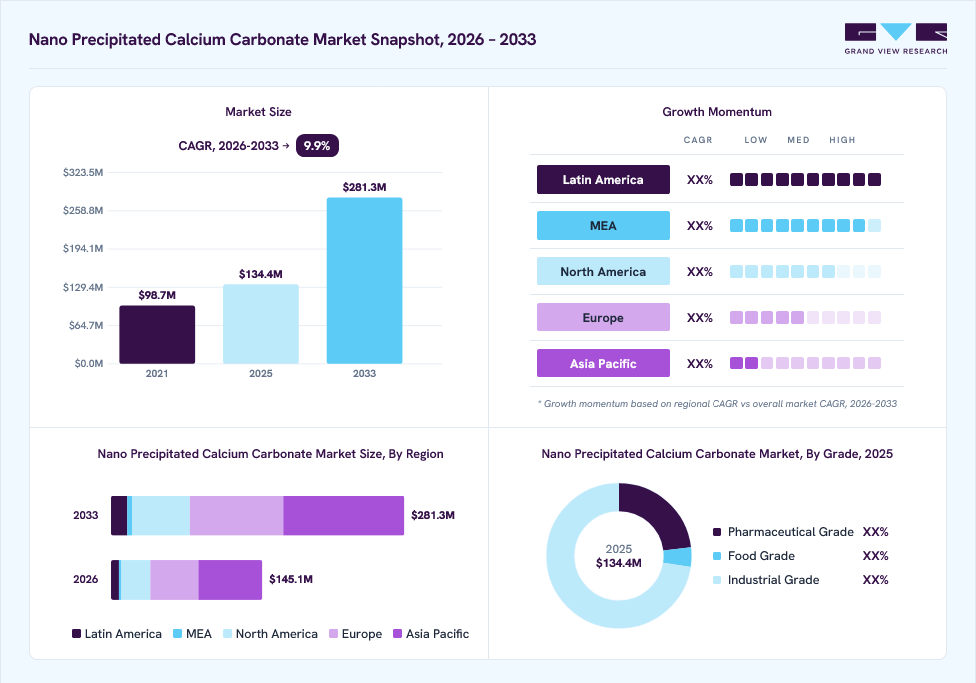 Source: Grand View Research, IR Documents, Primary Interviews, Paid DatabasesTo learn more about this report,
 Download Free Sample Report
Key Market Trends & Insights
- By grade: Industrial grade held a dominant position, contributing 55.2% of total revenue in 2025.
- By application: Pharmaceutical segment held the dominant position with revenue shahre of 34.3% in 2025
Regional Highlights
- Largest regional market: Asia Pacific (42.4% revenue share, 2025)
- By country: China held the largest market share in 2025
Market Size & Forecast
- Market Size in 2025: USD 134.4 Million
- Estimated Market Size in 2026: USD 145.1 Million
- Projected Market Size in 2033: USD 281.4 Million
- CAGR (2026-2033): 9.9%
Prism AI by Grand View Research Free to tryAsk a question about the nano precipitated calcium carbonate marketTry asking✓Every figure cited from GVR research Prefer the report? Download free sample →
As end-use industries seek advanced materials that support improved structural, chemical, and functional outcomes, Nano PCC has emerged as a preferred filler and additive due to its enhanced properties and consistent quality.Pharmaceutical manufacturing has become a key contributor to market expansion. The growing consumption of solid oral dosage forms, particularly tablets and capsules, has increased the need for pharmaceutical-grade calcium-based excipients that ensure high bioavailability, uniform distribution, and chemical stability. Nano PCC aligns well with global pharmacopoeial standards and offers advantages in both active ingredient delivery and formulation consistency. This demand is further driven by the rapid increase in healthcare infrastructure, generic drug production, and nutritional supplement usage in both developed and emerging economies.
 To learn more about this report, Download Free Sample Report
Plastics and rubber manufacturing continue to account for significant demand due to Nano PCC’s functional benefits in material reinforcement and processing. Nano PCC is increasingly incorporated into thermoplastics, rubber compounds, films, and sheets to enhance strength, flexibility, and surface smoothness while lowering polymer content. As manufacturers focus on reducing material weight and improving product lifecycle performance, Nano PCC serves as a critical additive that meets these goals without significantly increasing costs. The rising demand for high-efficiency packaging, automotive components, and consumer durables continues to stimulate consistent growth in this segment.
In addition to industrial applications, food processing and agriculture are emerging as important demand generators. Nano PCC is used in food fortification, primarily as a calcium source and anticaking agent in powdered products. Its compliance with food safety standards and micronutrient content makes it suitable for nutritional enhancement. In agriculture, the material is adopted in specialty fertilizers and pH-adjusting agents that support soil conditioning and plant health. As global focus intensifies on food security and sustainable farming practices, the utility of Nano PCC in essential crop management and food production is anticipated to further accelerate market expansion.
Market Dynamics
The nano precipitated calcium carbonate (NPCC) market is experiencing steady growth, supported by increasing demand for high-performance functional fillers across multiple end-use industries. Manufacturers are increasingly adopting NPCC to enhance mechanical strength, dispersion, opacity, and surface properties in plastics, coatings, adhesives, paper, and construction materials while reducing overall formulation costs. Growing emphasis on lightweight materials in automotive production and advanced construction solutions further supports market expansion. In the pharmaceutical and food sectors, rising demand for high-purity nano calcium carbonate as an excipient, dietary calcium source, and specialty additive is creating new avenues for premium-grade products. Technological advancements in nanoparticle synthesis and surface modification are enabling producers to develop customized grades tailored to specific industrial requirements, strengthening product differentiation. However, the market faces challenges related to energy-intensive manufacturing processes, stringent quality standards, and fluctuating raw material and production costs. Despite these constraints, continued investment in sustainable manufacturing technologies, capacity expansion, and application-specific product innovation is expected to sustain long-term market growth across developed and emerging economies.
The increasing adoption of nano precipitated calcium carbonate (NPCC) as a high-performance functional filler is a major driver supporting market growth. Owing to its nano-scale particle size, high surface area, and superior dispersion characteristics, NPCC significantly enhances the mechanical strength, stiffness, opacity, and surface finish of end products. Manufacturers across plastics, rubber, paints, coatings, adhesives, and sealants are incorporating NPCC to improve product performance while optimizing raw material utilization and production efficiency. Its ability to deliver enhanced functionality without substantially increasing formulation costs has made it an attractive material for industrial processing.
Industries are placing greater emphasis on developing lightweight, durable, and sustainable materials that meet evolving performance standards. NPCC contributes to improved processing characteristics, better dimensional stability, and enhanced durability in engineered materials, making it increasingly valuable for automotive, construction, and packaging applications. Continuous advancements in nanoparticle engineering and surface treatment technologies are further expanding the range of commercial applications, encouraging manufacturers to invest in premium-grade nano calcium carbonate products that deliver higher value and support long-term market expansion.
The nano precipitated calcium carbonate market is constrained by the high production costs associated with manufacturing nano-sized, high-purity materials. Producing NPCC requires sophisticated processing technologies, precise control over particle size distribution, advanced surface modification techniques, and stringent quality assurance systems to ensure consistent product performance. These specialized manufacturing requirements result in significant capital investment, elevated operational expenses, and higher energy consumption compared with conventional precipitated calcium carbonate production. Maintaining uniform nanoparticle characteristics at commercial production volumes presents technical challenges that can affect manufacturing efficiency and product consistency. The need to comply with rigorous quality and regulatory standards, particularly for pharmaceutical and food-grade applications, further increases production complexity and certification costs. These factors contribute to premium product pricing, which may limit adoption among cost-sensitive end users and restrict market penetration in price-competitive regions, especially where lower-cost conventional mineral fillers remain readily available.
The growing utilization of nano precipitated calcium carbonate in pharmaceutical and healthcare applications presents a significant growth opportunity for market participants. High-purity NPCC is increasingly used as a pharmaceutical excipient, calcium supplement ingredient, and formulation aid due to its excellent biocompatibility, controlled particle size, and consistent chemical composition. Rising pharmaceutical production, expanding nutraceutical consumption, and increasing healthcare expenditure across both developed and emerging economies are creating favorable conditions for the adoption of specialized NPCC grades.
The ongoing research into nanotechnology-enabled drug delivery systems and advanced biomedical formulations is expected to broaden the commercial potential of NPCC. Manufacturers are investing in high-purity production technologies and stringent quality control processes to meet regulatory requirements for pharmaceutical-grade materials. As demand for precision formulations and value-added healthcare products continues to rise, suppliers capable of delivering customized, high-performance nano calcium carbonate solutions will be well positioned to capitalize on emerging opportunities and strengthen their presence in premium application segments.
Market Concentration & Characteristics
The nano precipitated calcium carbonate industry is consolidated, with a limited number of players holding a significant portion of the global market share. This structure is shaped by the technical complexity involved in Nano PCC production, which requires controlled synthesis processes, high-purity raw materials, and advanced equipment. Market entry barriers remain high due to capital-intensive infrastructure and the need to meet stringent quality standards, especially in regulated applications such as pharmaceuticals and food. As a result, established manufacturers with vertically integrated operations and strong distribution networks dominate supply across key regions, creating a competitive environment that favors scale, consistency, and long-term client relationships.
The nano precipitated calcium carbonate industry is also characterized by strong customer alignment and application-specific formulations. Buyers, particularly in the pharmaceutical, plastic, and packaging sectors, prioritize long-term quality assurance and performance stability over price, leading to a preference for trusted suppliers with proven track records.
 To learn more about this report, Download Free Sample Report
Product differentiation is achieved through customization based on particle size, surface treatment, and purity levels tailored to end-use requirements. Furthermore, the supply chain is shaped by regional production clusters, proximity to raw material sources such as limestone, and strategic partnerships with end-use industries. While innovation in this space is incremental, manufacturers focus heavily on process optimization and capacity expansion to ensure consistent delivery and cost efficiency. Overall, the market exhibits traits of moderate innovation, high entry barriers, and strong supplier-buyer integration, all of which reinforce its consolidated structure.
Analyst Perspective
The nano precipitated calcium carbonate market driven by increasing demand for high-performance functional materials across industrial and specialty applications. Rising adoption in pharmaceuticals, advanced polymers, and construction materials is accelerating the shift toward premium nano-grade products with enhanced performance characteristics. Technological advancements in particle engineering and surface modification are enabling manufacturers to differentiate their product portfolios and address application-specific requirements. Asia-Pacific continues to be the key production and consumption hub, supported by robust industrialization and expanding manufacturing capacity. Companies that invest in process innovation, quality enhancement, and high-value application development are expected to strengthen their competitive position and capture long-term growth opportunities.
Grade Insights
By grade, industrial grade held a dominant position, contributing 55.2% of total revenue in 2025. This is attributed to its widespread application in plastics, rubber, paints and coatings, where it functions as a cost-effective performance enhancer. Industries use Nano PCC to improve the strength, surface finish, opacity, and thermal resistance of products while reducing resin consumption. Its consistent particle size and dispersion properties make it ideal for high-volume production. Demand is further supported by rapid construction and automotive manufacturing activities, particularly in the Asia Pacific. The availability of lower-cost industrial-grade options also strengthens its commercial viability across bulk-use industries.
The pharmaceutical grade segment is expected to grow at the fastest CAGR of 9.8% from 2025 to 2033, driven by rising demand for high-purity excipients in solid oral dosage forms like tablets and capsules. Nano PCC offers high bioavailability, controlled particle morphology, and chemical stability, crucial for consistent drug formulation. The increasing prevalence of chronic diseases, expanding access to healthcare, and growth in generic drug manufacturing globally are boosting demand for pharmaceutical-grade materials. Regulatory compliance and safety standards in developed markets also favor high-grade Nano PCC use. In addition, consumer trends toward calcium-based dietary supplements further contribute to this segment’s accelerated growth.
Application Insights
The pharmaceutical segment held the dominant position in the market, with a revenue share of 34.3% in 2025. This leadership is due to Nano PCC’s critical role as a pharmaceutical excipient used in tablets, capsules, and calcium supplements. Its nano-scale particle size enhances absorption and bioavailability, making it ideal for controlled drug delivery systems. Growing healthcare expenditure, rising prevalence of lifestyle-related illnesses, and aging populations in both developed and emerging regions are increasing demand for high-quality formulations. Regulatory emphasis on excipient safety and consistency further supports adoption. In addition, the expansion of generic pharmaceutical production and consumer preference for mineral-based supplements continues to reinforce the strong revenue contribution of the pharmaceutical application segment.
 To learn more about this report, Download Free Sample Report
The automotive application segment is expected to grow at the fastest CAGR of 11.0% from 2025 to 2033. This projected growth is driven by the rising need for lightweight, high-strength materials to improve vehicle efficiency and reduce emissions. Nano PCC is increasingly used in automotive plastics, rubbers, and coatings to enhance mechanical properties, dimensional stability, and thermal resistance. Its role in cost reduction by minimizing polymer usage makes it attractive in large-scale automotive manufacturing. The shift toward electric vehicles (EVs), which require improved component performance and thermal management, further boosts demand. As regulatory pressure on fuel efficiency and sustainability grows globally, automakers are adopting advanced filler materials like Nano PCC to meet performance and environmental targets.
Regional Insights
The North America nano precipitated calcium carbonate market is a significant regional segment, characterized by strong demand from pharmaceuticals, high-performance plastics, and advanced packaging. Its substantial value share reflects the premium placed on ultra-pure and highly consistent Nano PCC grades, required for tablet excipients, sustainable packaging materials, and specialty coatings. Manufacturers in the U.S. and Canada remain focused on regulatory compliance and quality assurance, reinforcing the reliance on trusted suppliers. The region’s clean-label consumer preferences and emphasis on environmental standards further support market growth, particularly in healthcare and food-related applications where safety and performance are critical.
U.S. Nano Precipitated Calcium Carbonate Market Trends
The nano precipitated calcium carbonate market in the U.S. is a key regional hub, driven by strong demand in pharmaceuticals, consumer electronics, and specialty packaging. High regulatory and safety expectations in healthcare and food-grade applications have elevated the adoption of ultra-pure Nano PCC. In packaging, manufacturers rely on Nano PCC to enhance barrier properties and reduce material usage, aligned with sustainability goals. The electronics sector employs Nano PCC in coatings and composites for thermal and dielectric performance. Local supply chains and advanced production infrastructure support consistent quality and innovation. Growing interest in lightweight automotive components and eco-friendly consumer products further bolsters Nano PCC penetration in the U.S. market.
Asia Pacific Nano Precipitated Calcium Carbonate Market Trends
Asia Pacific dominated the nano precipitated calcium carbonate market with the highest revenue share of 42.4% in 2025, driven by strong industrial growth, abundant raw material availability, and a well-established manufacturing base in countries like China and India. The region’s expanding plastics, rubber, pharmaceutical, and construction sectors generate substantial demand for Nano PCC as a functional filler and performance enhancer. Favorable government policies supporting domestic manufacturing, lower production costs, and rising consumer demand for high-quality products further contribute to market expansion. In addition, rapid urbanization and infrastructure development in Southeast Asia continue to boost application opportunities, reinforcing Asia Pacific’s leading position in the global market. China dominated the Asia Pacific with a revenue share of 44.4% nano precipitated calcium carbonate market in 2025.
 To learn more about this report, Download Free Sample Report
The nano precipitated calcium carbonate market in China led the market with the largest revenue share of 44.8% in 2024, driven by its expansive industrial manufacturing ecosystem and well-integrated supply chain. The country’s strong presence in rubber, plastics, pharmaceuticals, and construction materials continues to fuel consistent demand for Nano PCC as a functional filler and performance additive. Rapid urbanization, infrastructure development, and the scale of domestic production further strengthen its position. Local manufacturers are also heavily investing in product refinement and capacity expansion to meet growing quality standards. In addition, favorable policies supporting advanced materials and low-cost manufacturing give China a competitive edge in both the production and consumption of Nano PCC.
Europe Nano Precipitated Calcium Carbonate Market Trends
The nano precipitated calcium carbonate market in Europe accounted for the largest market revenue share of 31.7% in 2024, supported by a mature industrial base, strict regulatory standards, and strong demand for high-performance, sustainable materials. The region’s well-developed pharmaceutical, automotive, and plastics industries consistently utilize Nano PCC for its purity, stability, and reinforcement capabilities. Increased focus on lightweight materials for emissions reduction, along with the push for eco-friendly packaging solutions, continues to drive adoption. In addition, research-backed product development and the presence of technologically advanced manufacturing facilities further support market stability and innovation across Western and Central European countries.
Middle East & Africa Nano Precipitated Calcium Carbonate Market Trends
The nano precipitated calcium carbonate market in the Middle East & Africa represents a burgeoning regional sector, propelled by growing construction, pharmaceutical, and packaging industries. Rapid urban development and infrastructure expansion have increased demand for filler materials in paints, sealants, and building products. In parallel, rising healthcare access across Gulf nations has stimulated need for high‑purity Nano PCC in supplements and pharma formulations. Packaging growth in the region’s food and cosmetics sectors further drives premium-grade material uptake. Favorable industrial policies, increasing investment in manufacturing, and emerging consumer demand for high-performance materials continue to support the acceleration of Nano PCC utilization across MEA markets.
Latin America Nano Precipitated Calcium Carbonate Market Trends
The nano precipitated calcium carbonate market in Latin America is steadily expanding, supported by growing demand from regional construction, agriculture, and pharmaceutical industries. The construction sector drives the use of paints, sealants, and PVC-based products, while agriculture adopts Nano PCC for soil conditioning and micronutrient delivery. Increasing availability of food-grade Nano PCC supports calcium fortification in processed foods and supplements. Despite still-emerging industrial infrastructure, manufacturers increasingly seek performance additives to improve product quality. Mexico and Brazil lead demand, with others following. Favorable trade policies, rising investment in local production, and growing awareness of advanced material benefits are strengthening Nano PCC adoption across the region.
Key Nano Precipitated Calcium Carbonate Company Insights
Some of the key players operating in the nano precipitated calcium carbonate industry include Changzhou Calcium Carbonate Co., Ltd., and Imerys
-
Changzhou Calcium Carbonate Co., Ltd. manufactures and supplies nano precipitated calcium carbonate (NPCC), offering high-performance materials engineered for diverse industrial applications. With a strong presence in China and expanding global reach, the company serves various industries, including plastics, rubber, paints and coatings, adhesives and sealants, inks, paper, and pharmaceuticals. Leveraging advanced production technologies and strict quality control, Changzhou Calcium Carbonate Co., Ltd. delivers nano-scale PCC products with superior whiteness, controlled particle size distribution, high surface area, and excellent dispersion properties.
-
Imerys is a global leader in the nano precipitated calcium carbonate industry, recognized for its expertise in mineral-based solutions and advanced performance materials. Operating in over 40 countries, Imerys offers a diverse and innovative portfolio of NPCC products under trusted brands such as ImerSeal, ImerCarb, and ImerCal, designed to meet the evolving needs of industries ranging from plastics and rubber to paints, coatings, and adhesives.
Shandong Useen Calcium Co., Ltd., and Nordkalk (SigmaRoc plc) are emerging market participants in the nano precipitated calcium carbonate industry.
-
Shandong Useen Calcium Co., Ltd. is a global manufacturer in the nano calcium carbonate and specialty inorganic materials industry, with a strong foothold in the Nano Precipitated Calcium Carbonate (NPCC) market. Harnessing advanced proprietary technologies and a vertically integrated production process, Useen produces a diverse portfolio of high-purity NPCC products tailored for various applications, including plastics, rubber, paints & coatings, adhesives & sealants, inks, paper, and pharmaceuticals. The company emphasizes sustainability and environmental responsibility by utilizing low-carbon processes and optimizing energy efficiency. Useen’s NPCC is characterized by its ultrafine particle size, narrow particle size distribution, controlled morphology, and high surface area, enabling enhanced mechanical, rheological, and barrier properties in end-use formulations. The company offers specialized grades of nano calcium carbonate designed to meet the evolving performance demands of modern polymer and composite materials.
Key Nano Precipitated Calcium Carbonate Companies
The following key companies have been profiled for this study on the nano precipitated calcium carbonate market.
-
Changzhou Calcium Carbonate Co. LTD
-
Imerys
-
Omya Group
-
Chememan Public Company Limited.
-
Minerals Technologies Inc.
-
Shiraishi Group (Shiraishi Kogyo Kaisha, Ltd.)
-
FIMATEC LTD.
-
FUJIAN SANMU NANO CALCIUM CARBONATE CO., LTD.
-
Shandong Useen Calcium Co., Ltd.
-
Nordkalk (SigmaRoc plc)
Competitive Benchmarking
Category
Operating Strategies
Competitive Edge
Weakness
Established Players (Imerys, Omya Group, Minerals Technologies Inc., Chememan Public Company Limited, Nordkalk (SigmaRoc plc), Shiraishi Group (Shiraishi Kogyo Kaisha, Ltd.))
- Invest in capacity expansion and modernization of manufacturing facilities to serve global demand.
- Focus on developing high-value nano-grade and application-specific products through continuous R&D.
- Strengthen long-term supply agreements and regional distribution networks to ensure reliable product availability.
- Emphasize sustainability through energy-efficient production, process optimization, and compliance with international environmental standards.
- Well-established global brands with diversified customer portfolios across multiple end-use industries.
- Advanced production technologies capable of delivering consistent particle size, purity, and product quality.
- Strong financial resources supporting innovation, acquisitions, and global expansion initiatives.
- Comprehensive technical support and customized product development capabilities for industrial customers.
- Higher operating costs associated with maintaining large-scale manufacturing and regulatory compliance.
- Slower decision-making due to complex organizational structures and extensive approval processes.
- Greater exposure to fluctuations in global energy and logistics costs.
- Limited flexibility to rapidly address niche or highly localized market opportunities compared to smaller competitors.
Emerging Players (Changzhou Calcium Carbonate Co. LTD, FIMATEC LTD., FUJIAN SANMU NANO CALCIUM CARBONATE CO., LTD., Shandong Useen Calcium Co., Ltd.)
- Expand regional manufacturing capacity to strengthen domestic and export market presence.
- Compete through cost-efficient production and flexible manufacturing operations.
- Focus on specialized nano calcium carbonate grades targeting selected industrial applications.
- Build strategic partnerships with local distributors and downstream manufacturers to increase market penetration.
- Competitive pricing supported by lean manufacturing and regional raw material availability.
- Faster response to changing customer specifications and evolving application requirements.
- Strong presence in rapidly growing regional markets, particularly across Asia-Pacific.
- Operational agility enables quicker commercialization of customized product offerings.
- Limited international distribution networks and comparatively lower global brand recognition.
- Smaller R&D budgets restrict development of advanced specialty formulations.
- Dependence on regional demand increases exposure to localized economic fluctuations.
- Lower production scale may reduce economies of scale and bargaining power within the supply chain.
Recent Developments
-
Minerals Technologies Inc. (MTI) has expanded its presence in the nano precipitated calcium carbonate industry by signing long-term PCC supply agreements with major paper companies in China and India. These agreements will add over 180,000 metric tons/year of PCC capacity through new on-site satellite plants. The move reflects growing NPCC demand in the paper and packaging sectors, driven by MTI's patented, sustainable technologies like NewYield LO PCC.
-
Omya’s investment in new PCC plants in China and Indonesia, with a combined capacity of 260,000 tonnes per year, reflects growing demand for advanced fillers like nano precipitated calcium carbonate in the Asia Pacific paper and board industry. These expansions support market growth by enhancing local supply, promoting cost efficiency, and meeting rising quality requirements for printability, gloss, and opacity
Nano Precipitated Calcium Carbonate Market Report Scope
Report Attribute
Details
Market size value in 2025
USD 134.4 million
Market size value in 2026
USD 145.1 million
Revenue forecast in 2033
USD 281.4 million
Growth rate
CAGR of 9.9% from 2026 to 2033
Base year for estimation
2025
Historical data
2021 - 2024
Forecast period
2026 - 2033
Quantitative units
Revenue in USD million, volume in kilotons and CAGR from 2026 to 2033
Report coverage
Revenue forecast, company ranking, competitive landscape, growth factors, and trends
Segments covered
Grade, application, region
Regional scope
North America; Europe; Asia Pacific; Latin America; MEA
Country scope
U.S.; Canada; Mexico; UK; Germany; UK; France; Italy; Spain; China; India; Japan; South Korea; Brazil; Argentina; Saudi Arabia; South Africa
Key companies profiled
Changzhou Calcium carbonate Co. LTD; Imerys; Omya Group; Chememan Public Company Limited; Minerals Technologies Inc.; Shiraishi Group (Shiraishi Kogyo Kaisha, Ltd.); FIMATEC LTD.; FUJIAN SANMU NANO CALCIUM CARBONATE CO., LTD.; Shandong Useen Calcium Co., Ltd; Nordkalk (SigmaRoc plc)
Customization scope
Free report customization (equivalent up to 8 analysts' working days) with purchase. Addition or alteration to country, regional & segment scope.
Pricing and purchase options
Avail customized purchase options to meet your exact research needs. Explore purchase options
Global Nano Precipitated Calcium Carbonate Market Report Segmentation
This report forecasts revenue growth at global, regional, and country levels and provides an analysis of the latest industry trends in each of the sub-segments from 2023 to 2033. For this study, Grand View Research has segmented the global nano precipitated calcium carbonate market report based on grade, application, and region.
 To learn more about this report, Download Free Sample Report
-
Grade Outlook (Volume, Kilotons; Revenue, USD Million, 2023 - 2033)
-
Pharmaceutical Grade
-
Food Grade
-
Industrial Grade
-
-
Application Outlook (Volume, Kilotons; Revenue, USD Million, 2023 - 2033)
-
Automotive
-
Building & Construction
-
Pharmaceutical
-
Agriculture
-
Pulp & Paper
-
Other Applications
-
-
Regional Outlook (Volume, Kilotons; Revenue, USD Million, 2023 - 2033)
-
North America
-
U.S.
-
Canada
-
Mexico
-
-
Europe
-
Germany
-
UK
-
France
-
Italy
-
Spain
-
-
Asia Pacific
-
China
-
India
-
Japan
-
South Korea
-
-
Latin America
-
Brazil
-
Argentina
-
-
Middle East & Africa
-
Saudi Arabia
-
South Africa
-
-
Research Methodology
The nano precipitated calcium carbonate market figures in this report are based on a proven research process that combines executive interviews with secondary research from proprietary databases, company filings, and recognized regulatory and institutional sources. Market size is built through value-chain sizing-reconciling supply-side and demand-side estimates-and triangulated with bottom-up and top-down approaches. Every estimate passes multiple levels of expert validation before publication, with each nano precipitated calcium carbonate segment quantified using the revenue-capture definitions in the table below.
Segment Definition
Segment – Grade
Revenue capture definition
Pharmaceutical Grade
Income attributable to high-purity nano precipitated calcium carbonate incorporated into pharmaceutical formulations as excipients, calcium supplements, tablet compression aids, and controlled-release ingredients manufactured under stringent regulatory specifications.
Food Grade
Earnings generated from nano precipitated calcium carbonate supplied to food and nutraceutical manufacturers for mineral fortification, acidity control, anti-caking functions, and other approved food processing applications meeting food safety requirements.
Industrial Grade
Market value created through the commercial supply of nano precipitated calcium carbonate for plastics, elastomers, coatings, paper, adhesives, sealants, and construction materials, where it enhances product functionality, processing efficiency, and physical performance.
Segment – Application
Revenue capture definition
Automotive
Sales generated from nano precipitated calcium carbonate integrated into vehicle components, engineered polymers, elastomeric parts, protective coatings, and composite systems to improve strength, weight optimization, and finishing quality.
Building & Construction
Market earnings associated with nano precipitated calcium carbonate incorporated into cement-based materials, architectural coatings, sealants, grouts, and construction compounds to enhance structural integrity, durability, and application characteristics.
Pharmaceutical
Commercial proceeds derived from nano precipitated calcium carbonate utilized in prescription medicines, over-the-counter products, nutraceutical formulations, and advanced healthcare applications requiring exceptional purity and particle uniformity
Agriculture
Revenue contribution from nano precipitated calcium carbonate employed in soil enhancement products, livestock nutrition, fertilizer formulations, and agricultural additives designed to improve nutrient efficiency and overall crop productivity.
Pulp & Paper
Business income arising from nano precipitated calcium carbonate consumed by paper producers to improve sheet brightness, opacity, print performance, surface smoothness, and manufacturing productivity across multiple paper grades.
Other Applications
Financial returns generated through the use of nano precipitated calcium carbonate in ceramics, cosmetics, personal care, environmental technologies, electronics, textiles, and other specialty sectors requiring advanced nano-material performance characteristics.
Estimation Model
Layer No.
Layer Name
Key Question
Description
01
Production & Supply Layer
What forms the supply base?
Assess the global manufacturing ecosystem for nano precipitated calcium carbonate by evaluating limestone availability, lime production, carbon dioxide supply, chemical processing infrastructure, nanoparticle synthesis technologies, surface modification capabilities, purification systems, quality certifications, production capacities, and regional manufacturing hubs that collectively support commercial supply across diverse industries.
02
Technology, Product & Application Adoption Layer
Where is nano precipitated calcium carbonate utilized?
Evaluate the distribution of nano precipitated calcium carbonate across pharmaceutical, food, and industrial grades, followed by its utilization in automotive, building & construction, pharmaceuticals, agriculture, pulp & paper, and other specialized applications. The assessment considers performance requirements, particle size specifications, purity standards, formulation compatibility, regulatory compliance, and evolving end-user preferences influencing adoption across global markets.
03
Consumption Intensity Layer
How much nano precipitated calcium carbonate is consumed?
Analyze material utilization by measuring application-specific loading rates, incorporation levels within formulations, production output across end-use sectors, manufacturing activity, infrastructure development, healthcare demand, agricultural input requirements, paper production volumes, and regional industrial expansion to estimate annual consumption patterns.
04
Revenue Layer
How is market revenue generated?
Market revenue is derived from the commercial sale of pharmaceutical-grade, food-grade, and industrial-grade nano precipitated calcium carbonate supplied to manufacturers operating in automotive, construction, healthcare, agriculture, pulp & paper, plastics, coatings, adhesives, rubber, personal care, and other specialty industries requiring high-performance nano-scale mineral additives.
Delivered Customizations
This report has been delivered with the following In-depth customizations
Client Request
Customization Delivered
Value Adds
Regional Segmentation
The study examined country-level demand for pharmaceutical, food, and industrial grades while evaluating consumption across major applications including automotive, building & construction, pharmaceutical, agriculture, pulp & paper, and other specialty industries. It also analyzed manufacturing capacity, regulatory frameworks, and end-user demand across key markets.
Provides detailed insight into regional consumption patterns, production landscapes, and country-level growth prospects. Supports market entry strategies, capacity planning, and identification of high-potential geographic opportunities.
Cross-Segmentation Analysis
The relationship between product grade and end-use application was analyzed to evaluate adoption trends across pharmaceutical, food, and industrial grades. The assessment examined utilization patterns within automotive, construction, healthcare, agriculture, pulp & paper, and specialty sectors to identify the most attractive market combinations based on performance requirements, quality standards, and commercial demand.
Helps identify the most profitable grade-application combinations, emerging demand clusters, and competitive positioning opportunities. Supports portfolio optimization, targeted product development, and strategic investment decisions.
Opportunity Assessment
Emerging growth opportunities were assessed across high-purity pharmaceutical formulations, nutraceutical ingredients, advanced polymer composites, lightweight automotive materials, sustainable construction products, specialty paper manufacturing, and surface-modified nano calcium carbonate technologies. The analysis also evaluated opportunities arising from expanding industrialization, technological innovation, and increasing demand for high-performance functional additives.
Enables prioritization of high-growth application areas and innovation-focused investments. Supports product diversification, technology development, and long-term business expansion in premium market segments.
Frequently Asked Questions About This Report
With a revenue share of 34.3% in 2025, the pharmaceutical segment held the dominant position in the market. Its leadership is attributed to the increasing use of high-purity precipitated calcium carbonate as a pharmaceutical excipient, tablet filler, calcium supplement ingredient, and formulation aid in a wide range of healthcare products.
Asia Pacific dominated the nano precipitated calcium carbonate market with the highest revenue share of 42.4% in 2025. The region's leadership is driven by its strong manufacturing base, abundant raw material availability, expanding industrial production, and growing demand from the construction, plastics, paper, and pharmaceutical sectors.
Mexico is the fastest growing region with a CAGR of 10.9% in the forecast period. Mexico's rapid growth is driven by expanding manufacturing activities, increasing investments in pharmaceuticals and construction, and rising demand for high-performance mineral additives across industrial and specialty applications.
Pharmaceutical grade is the fastest growing grade segment with a CAGR of 10.0% in the forecast period. Increasing demand for high-purity excipients, calcium supplements, and advanced pharmaceutical formulations, supported by expanding global pharmaceutical manufacturing and stringent quality requirements, is accelerating the growth of this segment.
By grade, industrial grade held a dominant position, contributing 55.2% of total revenue in 2025. Its market leadership is supported by extensive utilization as a performance-enhancing filler across plastics, rubber, coatings, adhesives, paper, and construction materials, where it improves mechanical properties and processing efficiency.
Some of the key players operating in the global nano PCC market include Changzhou Calcium carbonate Co. LTD; Imerys; Omya Group; Chememan Public Company Limited; Minerals Technologies Inc. and others.
The precipitated calcium carbonate market is driven by rising demand for high-performance functional fillers across plastics, paper, paints & coatings, adhesives, rubber, and construction materials to enhance product performance and cost efficiency. Growth in pharmaceutical and food applications, coupled with advancements in precipitation technologies and increasing industrial manufacturing activities, is further supporting market expansion.
The global nano precipitated calcium carbonate market size was estimated at USD 134.4 million in 2025 and is expected to reach USD 145.1 million in 2026.
The global nano precipitated calcium carbonate market is expected to grow at a compound annual growth rate (CAGR) of 9.9% from 2026 to 2033, reaching USD 281.4 million by 2033.
About the Author(s)
Advanced Interior Materials Research Team
Advanced Materials · Advanced Interior MaterialsThis report was authored by the advanced interior materials research team at Grand View Research - comprising two research analysts, one senior research analyst, and one industry expert - with specialized expertise in the advanced interior materials segment of the advanced materials industry. All findings are based on proprietary advanced materials databases, executive interviews, and regulatory analysis, subject to internal peer review prior to publication.
Last Updated:
Speak to Analyst

Customize this report to your needs - add regions, segments, or data points, with 20% free customization.
Or view our licence options:


ISO 9001:2015 & 27001:2022 Certified
We are GDPR and CCPA compliant! Your transaction & personal information is safe and secure. For more details, please read our privacy policy.


