
- Home
- »
- Next Generation Technologies
- »
-
Natural Disaster Management Market Size, Growth Report, 2026-2033GVR Report cover

Natural Disaster Management Market (2026 - 2033)
Size, Share, & Trend Analysis By Component (Solution and Services), By Communication System (First Responder Tools, Vehicle-ready Gateways), By Application, By End Use, By Region, And Segment Forecasts
Market Size, 2025
$73.1BMarket Estimate, 2026
$81.5BMarket Forecast, 2033
$185.8BCAGR, 2026–2033
12.5%Natural Disaster Management Market Summary
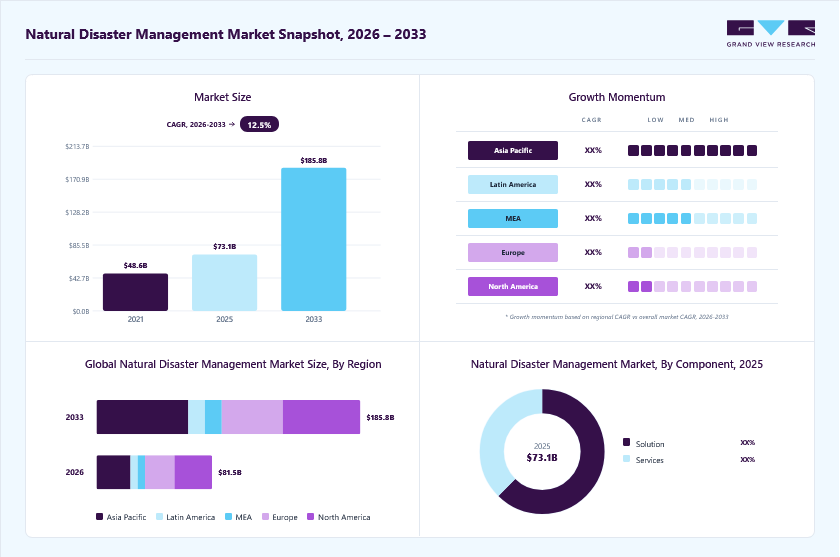
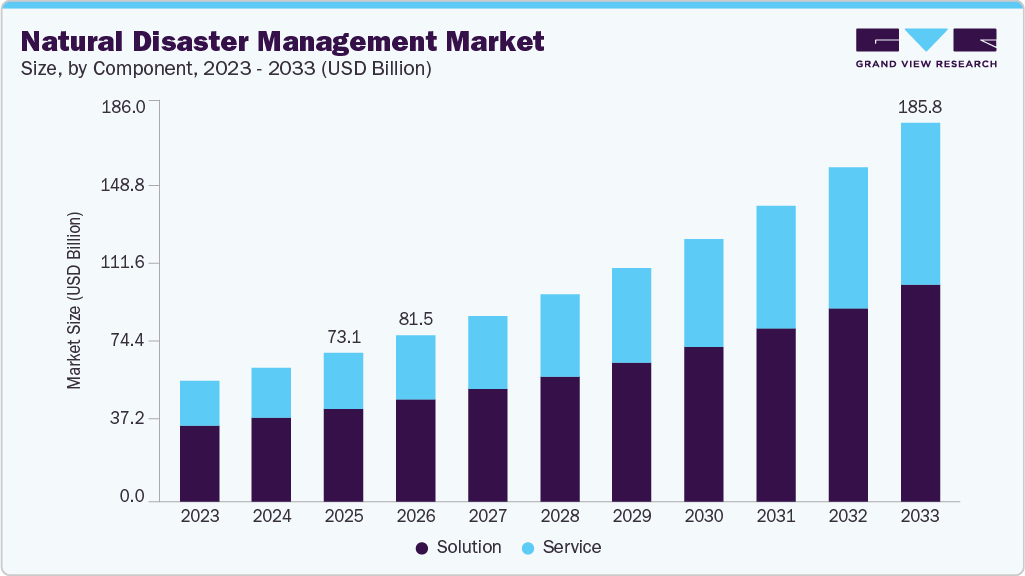
The global natural disaster management market size was valued at USD 73.1 billion in 2025 and is projected to grow from USD 81.5 billion in 2026 to USD 185.8 billion by 2033, at a CAGR of 12.5% from 2026 to 2033. North America dominated the global market, accounting for the largest revenue share of 33.0% in 2025. The market comprises comprehensive solutions aimed at preparing for, responding to, and recovering from events such as floods, wildfires, earthquakes, and storms.
 Source: Grand View Research, IR Documents, Primary Interviews, Paid DatabasesTo learn more about this report,
 Download Free Sample Report
 Key Market Trends & Insights
- By component: Solution segment led the market with the largest revenue share of 62.3% in 2025.
- By communication system: Satellite-assisted communication system segment accounted for the largest market revenue share in 2025.
- By application: Flood detection & management segment accounted for the largest market revenue share in 2025
Regional Highlights
- Largest regional market: North America (33.0% revenue share, 2025)
- Fastest-growing regional market: Asia Pacific (highest CAGR, 2026-2033)
- By country: The Germany natural disaster management industry is a major contributor to the global market.
Market Size & Forecast
- Market size in 2025: USD 73.1 Billion
- Estimated market size in 2026: USD 81.5 Billion
- Projected market size by 2033: USD 185.8 Billion
- CAGR (2026-2033): 12.5%
Three ways to get this report
Buy it, customize it, or ask a question.Ask an Analyst
Analyst response in 1 business day
- AccessReport author, directly
- Reply timeWithin 1 working day
- No sales callDirect answer only
- FormatEmail reply
- CostFree, no cost
Get the Full Report
What the study covers
- FormatsPDF · Excel · Dashboard
- Timeline2026–2033 annual, 2025 base
- Coverage20+ countries, 5 regions
- Companies10+ key players profiled
Customize the Report
20% free customization
- IncludeCountries, segments, points
- TailorTo your product definition
- ExtendDeeper competitor detail
- OrA fully bespoke study
- Turnaround5–10 working days
It integrates advanced technologies, including early warning systems, real-time monitoring tools, and resilient infrastructure planning, to minimize human and economic losses.
Within the broader disaster relief and preparedness system markets, organizations across governments, the private sector, and communities are adopting these frameworks to build long-term preparedness and rapid-response capabilities. Growing global awareness of environmental vulnerabilities has positioned this market as essential for safeguarding lives and assets in an increasingly unpredictable world. As a result, the sector continues to evolve into a proactive ecosystem that emphasizes prevention over mere reaction.
 To learn more about this report, Download Free Sample Report
 Several key factors drive the expansion of the natural disaster management industry, with climate change standing out as a primary influence. The rising frequency and severity of extreme weather events create an urgent demand for sophisticated prediction and mitigation tools. Technological advancements in areas such as artificial intelligence, Internet of Things sensors, and data analytics further enhance monitoring accuracy and response efficiency. Supportive government policies and increased funding for resilience programs also accelerate adoption across regions. Collectively, these elements foster a robust environment for innovation and investment in disaster preparedness solutions.
Moreover, increasing collaboration between academic institutions and industry stakeholders is further accelerating innovation. For instance, in February 2026, Rice University and Lehigh University's collaboration through the Consortium for Enhancing Resilience and Catastrophe Modeling is advancing catastrophe modeling by integrating artificial intelligence and physics-based approaches. This initiative strengthens risk assessment, supports infrastructure resilience, and enhances decision-making capabilities, reflecting growing demand for advanced analytics and collaborative innovation across the natural disaster management landscapes.
In conclusion, the natural disaster management industry stands at a pivotal juncture, offering substantial opportunities for stakeholders committed to resilience and innovation. Ongoing integration of technology with policy support will likely sustain its upward trajectory amid evolving global challenges. Organizations that embrace these solutions can achieve not only effective crisis handling but also long-term sustainability in risk-prone environments. Ultimately, this sector plays a vital role in fostering safer communities and more robust economies worldwide. As priorities shift toward prevention and preparedness, sustained growth and strategic advancements appear inevitable.
Component Insights
The solution segment led the market with the largest revenue share of 62.3% in 2025, driven by strong growth across the disaster relief market and disaster preparedness system market, as organizations increasingly adopt advanced digital platforms to enhance preparedness, response, and recovery capabilities. This segment includes early warning systems, risk modeling and analytics platforms, GIS and geospatial monitoring systems, and disaster recovery software, all of which enable real-time data collection, predictive insights, and coordinated decision-making. In addition, multilateral organizations are increasingly introducing digital platforms to strengthen disaster risk assessment and regional resilience. For instance, in November 2025, the Inter-American Development Bank Group launched RiskMONITOR and RiskHUB to enhance disaster risk assessment and response using artificial intelligence and data analytics. In collaboration with Google and the World Meteorological Organization, these initiatives strengthen regional resilience, reflecting rising adoption of advanced digital solutions in the global industry.
The service segment is expected to grow at the fastest CAGR during the forecast period. This segment includes consulting, system integration, and training & simulation services, which support governments and enterprises in strengthening preparedness and response capabilities. A key driving factor is the rising exposure of countries such as India to floods, cyclones, and landslides, where limited infrastructure and coordination challenges create a strong demand for professional consulting and capacity-building services. In addition, the need to integrate advanced technologies like GIS, AI-based analytics, and early warning systems into existing frameworks further accelerates the demand for skilled service providers.
Communication System Insights
The satellite-assisted communication system segment accounted for the largest market revenue share in 2025. These systems enable uninterrupted communication between emergency responders, government agencies, and affected communities, supporting real-time data exchange, coordination, and decision-making during disasters such as floods, cyclones, and earthquakes. A key driver is the increasing frequency of climate-related disasters in countries like India, where infrastructure vulnerability in remote and rural regions necessitates reliable backup communication solutions.
Government initiatives focused on strengthening disaster resilience and investments in space-based technologies. As a result, satellite-assisted communication systems are becoming an indispensable component of the broader disaster management ecosystem, enhancing response efficiency and contributing to more effective disaster mitigation and recovery outcomes.
The vehicle-ready gateway segment is expected to grow at the fastest CAGR during the forecast period. These systems, typically installed in emergency response vehicles, enable seamless data transmission, real-time coordination, and connectivity in areas where conventional communication networks are disrupted. A key driving factor is the rising frequency of floods, cyclones, and landslides in countries such as India, where diverse terrain and infrastructure gaps often hinder rapid response efforts. Government initiatives like the modernization of disaster response fleets and investments in resilient communication technologies are further supporting adoption within the global industry.
In addition, the integration of satellite communication and IoT-based monitoring enhances situational awareness for first responders. As a result, the vehicle-ready gateway segment is expected to play a crucial role in strengthening on-ground communication capabilities, thereby improving response efficiency and overall disaster resilience across the global market.
Application Insights
The flood detection & management segment accounted for the largest market revenue share in 2025, driven by the increasing frequency and severity of flood events worldwide. Governments and disaster response agencies are adopting advanced technologies, such as real-time monitoring systems, remote sensing, and predictive analytics, to enhance early warning capabilities and minimize damage. A key driver is the growing vulnerability of countries like India, where rapid urbanization, inadequate drainage infrastructure, and heavy monsoon rainfall significantly elevate flood risks, prompting strong investment in integrated flood management solutions.
In addition, rising awareness of climate change impacts and the need for resilient infrastructure are further accelerating adoption across both developed and developing regions. As a result, this segment is expected to witness steady growth, playing a vital role in strengthening preparedness and response strategies within the broader natural disaster management industry and the evolving disaster preparedness system market.
The forest fire/wildfire detection segment is expected to grow at the fastest CAGR during the forecast period, driven by the increasing frequency and intensity of wildfires due to climate change, prolonged dry seasons, and expanding human activity in forested regions. Governments and environmental agencies are increasingly deploying advanced technologies, such as satellite-based monitoring, AI-powered early warning systems, and IoT-enabled sensors, to detect fires at an early stage and minimize damage. A key driving factor for this segment is the urgent need for real-time surveillance and rapid response capabilities, particularly in high-risk regions where wildfires pose significant threats to the ecosystem, infrastructure, and human lives.
In addition, rising investments in smart forest management and cross-border collaborations are further accelerating adoption within the industry. In conclusion, the wildfire detection segment is expected to witness steady growth as stakeholders prioritize proactive disaster mitigation strategies, making it an essential component of the broader market.
End Use Insights
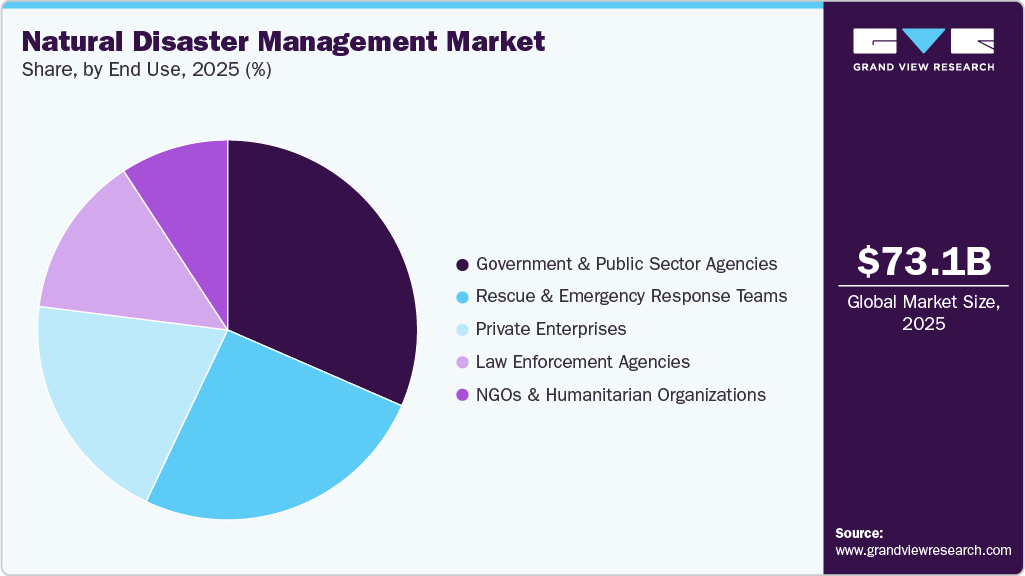
The government & public sector agencies segment accounted for the largest market revenue share in 2025, as these entities are primarily responsible for planning, coordinating, and executing disaster preparedness, response, and recovery operations at national and regional levels. The increasing frequency and intensity of climate-related disasters have compelled governments to invest heavily in advanced technologies, such as early warning systems, GIS-based monitoring, and real-time communication platforms, to enhance resilience and minimize losses. A key driver of this segment is the growing emphasis on integrated disaster management frameworks and smart governance initiatives, particularly in developing economies like India, where population density and infrastructure vulnerabilities amplify disaster risks.
 To learn more about this report, Download Free Sample Report
 In addition, rising public safety concerns and regulatory mandates are accelerating the adoption of data-driven decision-making tools across agencies. As a result, the government and public sector segment is expected to remain a cornerstone of the global market, driving sustained demand for innovative solutions and long-term market growth.
The private enterprises segment is expected to register the fastest CAGR during the forecast period. This segment includes industries such as energy, manufacturing, logistics, insurance, and telecommunications, all of which are investing in advanced risk assessment tools, predictive analytics, and business continuity solutions to enhance resilience. A key driving factor is the growing financial impact of natural disasters on corporate performance, prompting organizations to adopt proactive disaster management strategies and integrate them into enterprise risk management frameworks.
In addition, rising pressure from stakeholders, insurers, and regulatory bodies is encouraging private firms to implement a robust monitoring and response system. As a result, the private entities segment is expected to witness steady growth, playing an increasingly important role in the global market by complementing public sector efforts and driving demand for innovative, technology-driven solutions.
Regional Insights
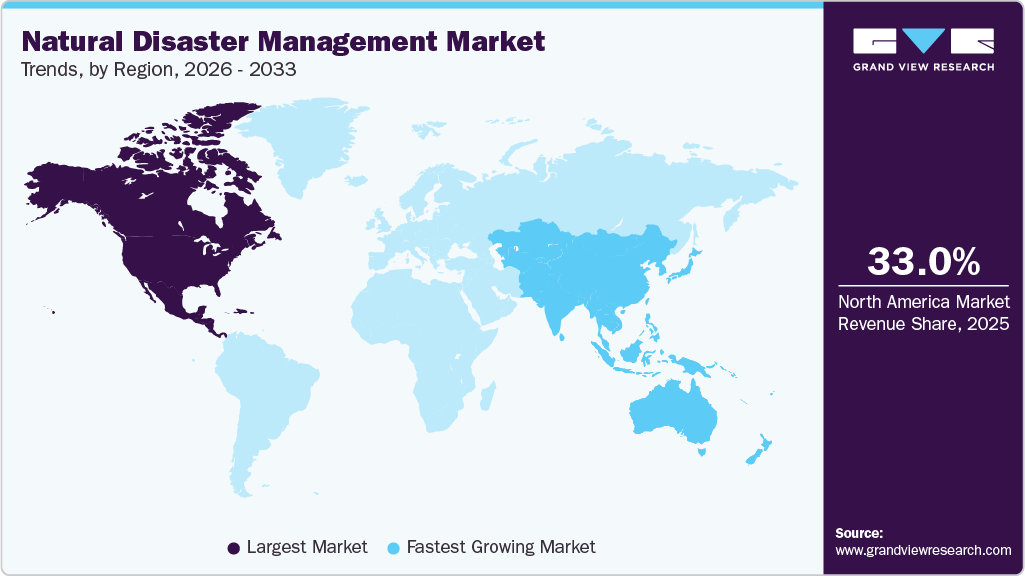
North America dominated the global natural disaster management market with the largest revenue share of 33.0% in 2025, supported by strong technological infrastructure, high awareness, and substantial government funding for disaster preparedness and response systems. The region frequently faces diverse natural hazards such as hurricanes, wildfires, floods, and earthquakes, which have driven continuous investment in advanced solutions, including predictive analytics, satellite-based monitoring, and integrated emergency response platforms. In addition, well-established frameworks and collaborations between public agencies and private technology providers are accelerating innovation across both markets. As a result, North America is expected to maintain its dominance, driven by ongoing technological advancements and a proactive approach to disaster resilience.
 To learn more about this report, Download Free Sample Report
 U.S. Natural Disaster Management Market Trends
The natural disaster management market in the U.S. accounted for the largest market revenue share in North America in 2025. A key driving factor in the U.S. market is the increasing frequency and economic impact of climate-related disasters, with recent years showing a sharp rise in high-cost events compared to historical averages. This has accelerated the adoption of advanced technologies such as satellite-based monitoring, predictive analytics, and an integrated emergency response system to enhance real-time decision-making and disaster resilience. In addition, strong regulatory frameworks and the active role of agencies such as FEMA continue to support market growth. In conclusion, the U.S. market is expected to maintain steady expansion, driven by continuous innovation, high disaster exposure, and sustained government focus on risk mitigation and infrastructure resilience across disaster relief market.
Europe Natural Disaster Management Market Trends
The natural disaster management market in Europe is anticipated to register at a significant CAGR from 2026 to 2033, driven by the region’s increasing exposure to climate-related hazards such as floods, wildfires, heatwaves, and droughts, which have intensified in both frequency and severity over recent years. Europe is considered the fastest-warming continent, leading to rising economic losses, infrastructure damage, and pressure on the emergency response system, thereby accelerating investments in advanced disaster preparedness and response solutions. As a result, the Europe market is expected to expand consistently, supported by policy-driven investments, technological innovation, and a region-wide shift toward proactive and integrated disaster resilience strategies.
The UK natural disaster management market held a significant share in Europe in 2025, driven by the country’s increasing exposure to climate-related risks, particularly flooding and coastal hazards. Flooding remains the most significant natural threat in the region, with a substantial proportion of properties already at risk and projections indicating a continued rise due to climate change, rising sea levels, and more intense rainfall patterns. This has led to significant investments in flood defense infrastructure, early warning systems, and geospatial risk modeling solutions, forming a key growth driver for the natural disaster management industry.
The natural disaster management market in France is poised for accelerated growth from 2026 to 2033, supported by the country’s strong institutional framework and increasing exposure to climate-related hazards such as floods, heatwaves, storms, and wildfires. France experiences frequent flooding along its major river systems and rising incidents of extreme heat and drought, which are intensifying due to climate change and placing pressure on public infrastructure and emergency response systems. In addition, the presence of a well-established state-backed insurance mechanism (CatNat scheme) further supports risk mitigation and recovery efforts, encouraging investments in resilience and disaster preparedness solutions. As a result, the French market is expected to witness consistent growth, driven by increasing government initiatives, technological adoption, and a proactive approach toward climate risk management within the broader industry.
Asia Pacific Natural Disaster Management Market Trends
The natural disaster management market in the Asia Pacific is expected to register at the fastest CAGR of 15.2% from 2026 to 2033, driven by the region’s high exposure to diverse natural hazards such as floods, earthquakes, cyclones, and tsunamis. Countries including China, India, and Japan are particularly vulnerable due to dense populations, rapid urbanization, and expanding infrastructure in high-risk zones, which significantly increase disaster impact and economic losses. In addition, increasing government initiatives toward smart cities, resilient infrastructure development, and regional collaboration frameworks are accelerating the adoption of integrated disaster management solutions. In summary, the Asia Pacific market is expected to maintain rapid expansion, supported by continuous technological advancements and growing awareness of disaster resilience.
The China natural disaster management market held a dominant share in the Asia Pacific in 2025, driven by the country’s high exposure to diverse and frequent natural hazards such as floods, earthquakes, typhoons, and landslides across almost all regions. Due to its complex geography and monsoon-influenced climate, China experiences one of the highest frequencies of natural disasters globally, resulting in substantial economic and human losses each year. Moreover, continuous policy evolution and strong government involvement in disaster risk governance are accelerating the adoption of advanced technologies and integrated response frameworks.
The natural disaster management market in India is poised for rapid expansion from 2026 to 2033, driven by its status as one of the most disaster-prone countries globally due to diverse geo-climatic conditions and dense population exposure. A large proportion of the country is vulnerable to multiple hazards, including floods, cyclones, earthquakes, and droughts, with nearly 27 states and union territories facing recurring disaster risks, and climate change further intensifying their frequency and impact. A key driving factor for the natural disaster management industry in India is the increasing economic and human losses caused by frequent flooding and extreme weather events, which have significantly impacted infrastructure, agriculture, and urban areas, prompting a stronger government focus on early warning system, risk analytics, and resilient infrastructure development.
Key Natural Disaster Management Company Insights
Key players in the natural disaster management industry include Atos SE, Esri, Inc., Motorola Solutions, Inc., and others. Companies are focusing on various strategic initiatives, including new product development, partnerships & collaborations, and agreements to gain a competitive advantage over their rivals.
Key Natural Disaster Management Companies:
The following key companies have been profiled for this study on the natural disaster management market.
- Atos SE
- Cisco Systems, Inc.
- Esri
- Everbridge, Inc.
- Hexagon AB
- Honeywell International Inc.
- IBM Corporation
- Jacobs Engineering Group Inc.
- Lockheed Martin Corporation
- Motorola Solutions, Inc.
- NEC Corporation
- Siemens AG
- Tetra Tech, Inc.
- Trimble Inc.
Recent Development
-
In September 2025, Vaisala launched advanced hail forecasting within its Xweather Protect platform, combining radar, lightning data, and artificial intelligence to deliver precise early warnings. The solution enables automated protection of solar assets, highlighting the growing demand for predictive analytics and real-time monitoring solutions in the natural disaster management industry.
-
In March 2025, Hexagon AB acquired Septentrio, which strengthens high-precision positioning and navigation capabilities for mission-critical applications. This development enhances disaster monitoring, emergency response, and autonomous operations, reflecting increasing integration of advanced positioning technologies to improve accuracy, resilience, and operational efficiency in the global industry.
-
In November 2024, Riskonnect partnered with Everbridge to integrate risk management and emergency communication platforms. This collaboration enhances real-time alerts, incident response, and business continuity, highlighting the growing demand for unified, technology-driven solutions to improve coordination and resilience in the global market.
Natural Disaster Management Market Report Scope
Report Attribute
Details
Market size in 2025
USD 73.1 billion
Estimated Market size in 2026
USD 81.5 billion
Projected Market size by 2033
USD 185.8 billion
Growth rate
CAGR of 12.5% from 2026 to 2033
Base year for estimation
2025
Historical data
2021 - 2024
Forecast period
2026 - 2033
Quantitative units
Revenue in USD million/billion, and CAGR from 2026 to 2033
Report coverage
Revenue forecast, company share, competitive landscape, growth factors, and trends
Segments covered
Component, communication system, application, end use, region
Regional scope
North America; Europe; Asia Pacific; Latin America; Middle East & Africa
Country scope
U.S.; Canada; Mexico; UK; Germany; France; China; India; Japan; Australia; South Korea; Brazil; UAE; Saudi Arabia; South Africa
Key companies profiled
Atos SE; Cisco Systems, Inc.; Esri; Everbridge, Inc.; Hexagon AB; Honeywell International Inc.; IBM Corporation; Jacobs Engineering Group Inc.; Lockheed Martin Corporation; Motorola Solutions, Inc.; NEC Corporation; Siemens AG; Tetra Tech, Inc.; Trimble Inc.
Customization scope
Free report customization (equivalent to 8 analysts working days) with purchase. Addition or alteration to country, regional & segment scope.
Pricing and purchase options
Avail customized purchase options to meet your exact research needs. Explore purchase options
Global Natural Disaster Management Market Report Segmentation
This report forecasts revenue growth at global, regional, and country levels and provides an analysis of the latest industry trends in each of the sub-segments from 2021 to 2033. For this study, Grand View Research has segmented the global natural disaster management market report based on component, communication system, application, end use, and region:
-
Component Outlook (Revenue, USD Million, 2021 - 2033)
-
Solution
-
Early Warning System
-
Risk Modeling & Analytics Platforms
-
GIS & Geospatial Monitoring Systems
-
Disaster Recovery Software
-
Others
-
-
Service
-
Consulting
-
Integration
-
Training & Simulation
-
-
-
Communication System Outlook (Revenue, USD Million, 2021 - 2033)
-
First Responder Tools
-
Satellite-Assisted Communication System
-
Vehicle-ready Gateways
-
Emergency Response Radar System
-
-
Application Outlook (Revenue, USD Million, 2021 - 2033)
-
Flood Detection & Management
-
Earthquake Detection
-
Forest Fire / Wildfire Detection
-
Landslide Detection
-
Volcano Detection
-
Hurricane / Cyclone Tracking
-
Tsunami Monitoring
-
Weather Monitoring
-
Others
-
-
End Use Outlook (Revenue, USD Million, 2021 - 2033)
-
Private Enterprises
-
Government & Public Sector Agencies
-
Law Enforcement Agencies
-
Rescue & Emergency Response Teams
-
NGOs & Humanitarian Organizations
-
-
Regional Outlook (Revenue, USD Million, 2021 - 2033)
-
North America
-
U.S.
-
Canada
-
Mexico
-
-
Europe
-
UK
-
Germany
-
France
-
-
Asia Pacific
-
China
-
India
-
Japan
-
South Korea
-
Australia
-
-
Latin America
-
Brazil
-
-
Middle East & Africa
-
UAE
-
Saudi Arabia
-
South Africa
-
-
Frequently Asked Questions About This Report
North America dominated with a 33.0% revenue share in 2025.
Asia Pacific is the fastest-growing region over the forecast period.
Key players include Atos SE; Cisco Systems, Inc.; Esri; Everbridge, Inc.; Hexagon AB; Honeywell International Inc.; IBM Corporation; Jacobs Engineering Group Inc.; Lockheed Martin Corporation; Motorola Solutions, Inc.; NEC Corporation; Siemens AG; Tetra Tech, Inc.; Trimble Inc.
The satellite-assisted communication system segment held the largest revenue share in 2025, while vehicle-ready gateway is the fastest-growing system.
The flood detection & management segment held the largest revenue share in 2025, while forest fire/wildfire detection is the fastest-growing application.
Government & public sector agencies segment held the largest share in 2025, while private enterprises is the fastest-growing segment.
The global natural disaster management market size was valued at USD 73.1 billion in 2025 and is estimated at USD 81.5 billion for 2026.
The global natural disaster management market is expected to grow at a CAGR of 12.5% from 2026 to 2033, reaching USD 185.8 billion by 2033.
The solution segment accounted for the largest revenue share of 62.3% in the global natural disaster management market in 2025, driven by strong growth across the disaster relief market and disaster preparedness system market, as organizations increasingly adopt advanced digital platforms to enhance preparedness, response, and recovery capabilities.
Factors such as rising frequency and severity of extreme weather events that create urgent demand for sophisticated prediction and mitigation tools are driving the growth of the natural disaster management market.
About the Author(s)
Next Generation Technologies Research Team
Technology · Next Generation TechnologiesThis report was authored by the next generation technologies research team at Grand View Research - comprising two research analysts, one senior research analyst, and one industry expert - with specialized expertise in the next generation technologies segment of the technology industry. All findings are based on proprietary technology databases, executive interviews, and regulatory analysis, subject to internal peer review prior to publication.
Last Updated:
Speak to Analyst

Customize this report to your needs - add regions, segments, or data points, with 20% free customization.
Or view our licence options:


ISO 9001:2015 & 27001:2022 Certified
We are GDPR and CCPA compliant! Your transaction & personal information is safe and secure. For more details, please read our privacy policy.


