
- Home
- »
- Renewable Chemicals
- »
-
Natural Surfactants Market Size, Share, Industry Report 2033GVR Report cover
![Natural Surfactants Market Size, Share & Trends Report]()
Natural Surfactants Market (2025 - 2033) Size, Share & Trends Analysis Report By Product (Anionic, Nonionic), By Application (Detergents, Industrial & Institutional Cleaning), By Region, And Segment Forecasts
- Report ID: GVR-4-68040-642-6
- Number of Report Pages: 80
- Format: PDF
- Historical Range: 2018 - 2023
- Forecast Period: 2025 - 2033
- Industry: Specialty & Chemicals
- Report Summary
- Table of Contents
- Interactive Charts
- Methodology
- Download FREE Sample
-
 Download Sample Report
Natural Surfactants Market Summary
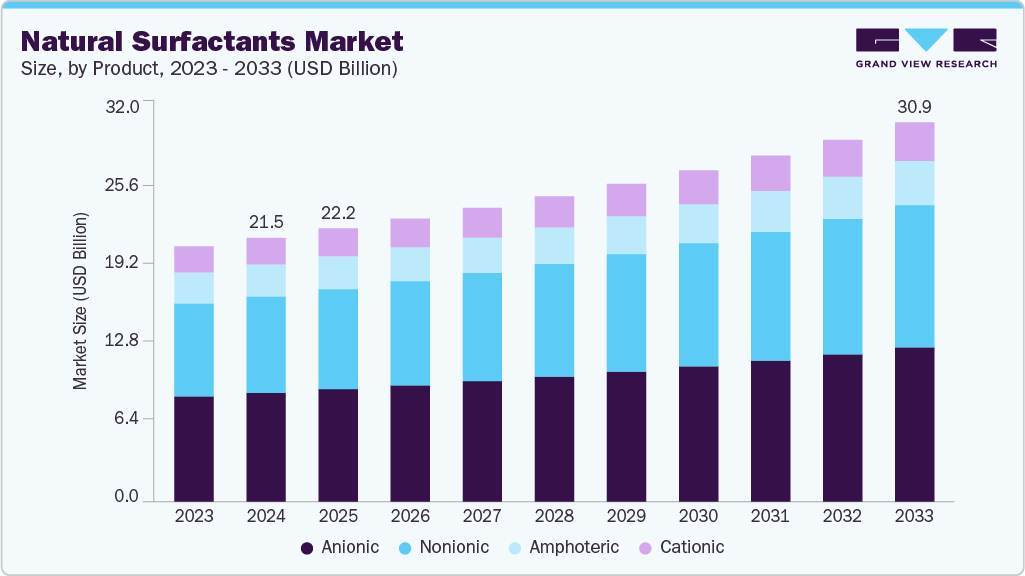
The global natural surfactants market size was estimated at USD 21,485.6 million in 2024 and is projected to reach USD 30,880.9 million by 2033, growing at a CAGR of 4.2% from 2025 to 2033. The market's growth is mainly fueled by rising consumer demand for eco-friendly and sustainable products, stricter environmental regulations, and increasing awareness of synthetic surfactants' health and environmental impacts.
Key Market Trends & Insights
- Europe dominated the global natural surfactants market with the largest revenue share of 38.6% in 2024.
- Natural surfactants market in Germany is propelled by stringent domestic chemical regulations and rising environmental awareness.
- By product, the nonionic segment is expected to grow at a considerable CAGR of 4.5% from 2025 to 2033 in terms of revenue.
- By application, the personal care segment is expected to grow at a considerable CAGR of 4.6% from 2025 to 2033 in terms of revenue.
Market Size & Forecast
- 2024 Market Size: USD 21,485.6 Million
- 2033 Projected Market Size: USD 30,880.9 Million
- CAGR (2025-2033): 4.2%
- Europe: Largest market in 2024
- Asia Pacific: Fastest growing market
Growing environmental consciousness and increasing regulatory pressure against synthetic and petroleum‑derived surfactants catalyze transitions toward plant‑based and microbial biosurfactants. Technological advances in extraction and fermentation processes have reduced costs and improved product efficacy, enhancing competitiveness. The surge in the personal care and cosmetics industry, particularly clean‑beauty formulations, has fueled demand for gentle yet effective surfactants in shampoos, cleansers, and body washes. Finally, expanding organic agriculture and agro-tech usage support the demand for natural surfactants in agrochemicals and industrial cleaners.Despite its momentum, the market faces significant cost and supply chain constraints that limit broader adoption. Natural surfactants are derived from plant or microbial sources and incur higher production costs due to complex extraction, purification, and specialized equipment. Inconsistent availability of raw inputs such as coconut, palm, or biotech feedstocks introduces volatility in pricing and supply, exacerbated by agricultural risks and climate variability. Formulating natural molecules into stable, multifunctional products also remains technologically demanding, often requiring additional capital investment and R&D. Allergy concerns and regulatory hurdles in certifying natural blends can also delay market entry and add compliance burdens.
Despite strong growth potential, the natural surfactants market faces challenges such as fluctuating raw material prices and limited availability of high-quality inputs, affecting production costs. Compatibility issues between admixtures and certain types of cement or aggregates can lead to performance inconsistencies. Moreover, small-scale contractors in developing regions may lack technical know-how or willingness to adopt high-performance admixtures. Regulatory barriers and concerns about long-term durability or chemical interactions in complex mix designs may also restrain broader market penetration.
Substantial growth opportunities abound as the market shifts towards greener chemistries and circular bioeconomies. Emerging biosurfactants produced via microbial fermentation offer scalable, low‑toxicity, biodegradable alternatives with expanding industrial, agricultural, and cleaning applications. Innovation focuses on multifunctional compounds (foaming, emulsifying, wetting), enabling formulation consolidation and performance gains and meeting cost and sustainability objectives. Finally, government incentives for bio‑based products and increasing corporate ESG commitments encourage investment in R&D and production capacity, reinforcing long‑term market expansion.
Market Concentration & Characteristics
The global natural surfactants market is distinctly consolidated, with a small cohort of major specialty chemical firms commanding the majority of revenue. Industry titans such as Croda International Plc, Croda International, Clariant AG, The Dow Chemical Company and others, lead the competitive landscape. These corporations boast extensive global production networks, formulated through strategic mergers, acquisitions, and partnerships to enhance their biosurfactants portfolios while securing economies of scale. While a few mid‑tier and regional players exist, they occupy narrow niches based on specialty applications or geographic focus. This high concentration enables tight control over pricing, supply chain integration, and technological innovation, posing significant entry hurdles for smaller or new-market entrants seeking substantial market share.
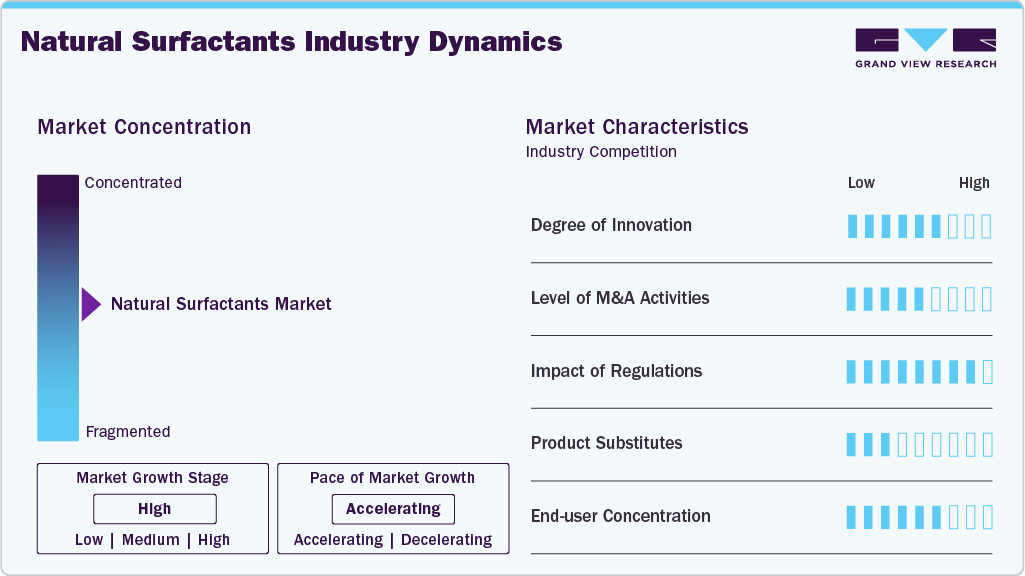
The market is characterized by rising demand for eco‑conscious, biodegradable ingredients derived from renewable feedstocks such as plant oils and microbial fermentation. Due to their strong cleansing, foaming, and emulsifying properties, anionic surfactants dominate product portfolios, particularly those derived from fatty acid sulfates and glucosides. Application-wise, the market spans diverse sectors such as personal care, household detergents, industrial cleaning, agriculture, and oilfield chemistry, though personal care leads to growth owing to rising clean-label trends. Europe and Asia‑Pacific as the largest and fastest expanding regions, respectively, driven by regulatory support, sustainability policies, and industrial expansion.
Product Insights
The anionic segment led the market and accounted for the largest revenue share of 41.2% in 2024. This growth is driven by its superior cleansing, foaming, and emulsifying properties, which are ideal for household detergents and industrial cleaners. These surfactants, primarily derived from fatty acid sulfates and sulfonates using plant-based feedstocks like coconut and palm oils, combine performance with biodegradability, responding to clean-label trends and regulatory pressure against synthetic chemicals. Their cost-effectiveness and ease of large-scale production further reinforce market preference, especially in mass-market cleaning products. Technological refinements in oleochemical extraction have improved purity and yield, reinforcing the segment’s leadership in revenue share and continued growth momentum.
The nonionic segment is expected to grow at the fastest CAGR of 4.5% from 2025 to 2033 during the forecast period. This segment is propelled by its gentle characteristics and broad functional versatility across personal care, industrial cleaning, and agrochemical sectors. Nonionic surfactants often sourced from sugar-based (e.g., glucosides) or fatty alcohol derivatives are prized for mildness, low irritation, and compatibility with sensitive skin and fragrance systems, meeting rising consumer demand in clean beauty and hypoallergenic formulations. Advances in green bioprocessing have lowered costs and enhanced performance, making them attractive alternatives in emulsions, creams, and specialty cleansers. Their multifunctional attributes support formulation consolidation, reducing ingredient counts while ensuring performance, positioning nonionics as one of the fastest expanding product categories.
Application Insights
The detergents segment led the market and accounted for the largest revenue share of 45.1% in 2024. This growth is driven by escalating demand for eco-friendly laundry and dishwashing solutions. As consumers prioritize biodegradable and low-toxic ingredients, natural anionic surfactants derived from oleochemical sources deliver effective grease and stain removal while supporting sustainability goals. Widespread adoption of washing machines and household cleaning routines globally underpins stable volumes. In addition, increased regulation curbing phosphates and synthetic surfactants in detergent formulations boosts natural alternatives. Manufacturers are reformulating natural blends to meet performance standards and environmental certifications, reinforcing detergents as the most significant revenue-generating application.
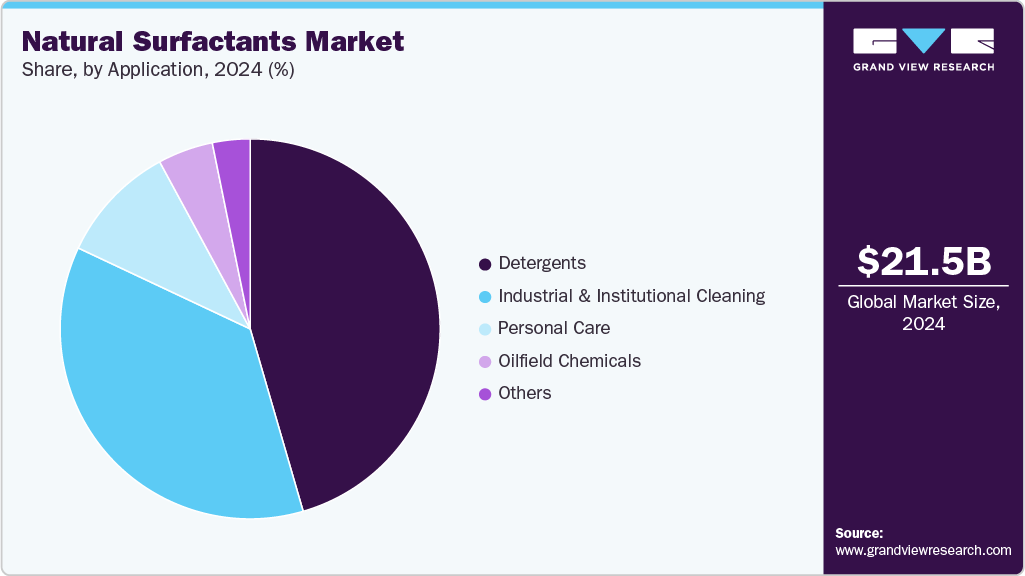
The personal care segment is expected to grow at the fastest CAGR of 4.6% from 2025 to 2033 during the forecast period. This growth is driven by the surge in clean-label moisturizers, hair care, and cleansing products formulated with gentle natural surfactants. Consumers increasingly seek formulations free from sulfates and synthetic chemicals, favoring plant-derived or sugar-based nonionic and amphoteric surfactants for their mildness and low irritancy. These ingredients also enhance eco-certification compliance and appeal to sustainability-minded brands, further fueling rapid adoption. Continued research into bio-based extraction and multifunctional profiles supports premium and mass-market segments alike, reinforcing personal care as the fastest-growing application category.
Regional Insights
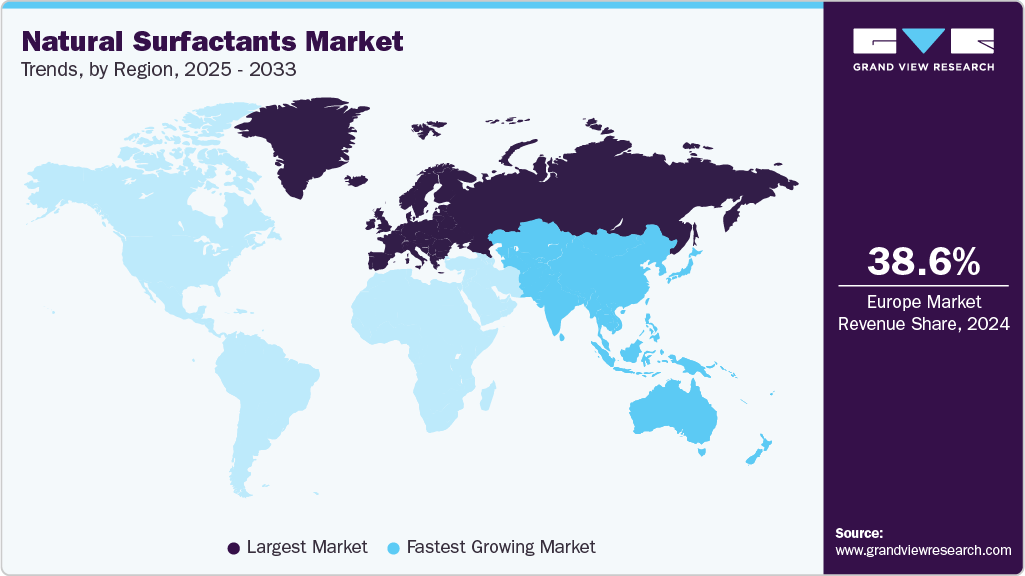
Europe natural surfactants market dominated the global landscape with a revenue share of 38.6% in 2024. This is primarily attributed to the region's robust growth driven by strong environmental regulations, widespread adoption of green chemistry, and consumer preference for eco-certified products. The region's strong industrial base in personal care, textiles, and automotive sectors invests in biodegradable solutions. Germany stands out with strict EU chemical policies and a growing clean‑label trend, boosting natural surfactant use in household and personal care. Continuous innovation in bio‑based surfactants and expansive R&D infrastructure reinforce Europe's dominance. High merger and acquisition activity among leading firms further consolidates regional market power and accelerates product development.
Germany Natural Surfactants Market
Natural surfactants market in Germany is propelled by stringent domestic chemical regulations and rising environmental awareness. Leading companies like Croda International Plc and Evonik drive growth through sustainable bio‑based R&D designed to meet EU standards. Domestic demand from personal care and household cleaning sectors further fuels adoption, as consumers prefer biodegradable alternatives. Germany's pharmaceutical and chemical industries also utilize natural surfactants for greener formulations. Strategic investments in industrial biotech and fermentation platforms support local production capacities and cost efficiency, reinforcing Germany's role as a key innovator and consumer in the broader European market.
Asia Pacific Natural Surfactants Market Trends
The Asia Pacific market is expected to grow at the fastest CAGR of 4.5% during the forecast period. It is experiencing rapid growth, fueled by rising industrialization, urban expansion, and the increased use of eco‑friendly cleaning and personal care products. Countries such as India, China, Japan, South Korea, and Australia are embracing natural alternatives amid concerns over petroleum-based surfactants. Expanding agricultural use and industrial cleansing needs further boost growth. Technological advancements in production techniques and strong R&D investment enhance scalability and reduce costs, align with the region’s sustainability goals, and support widespread adoption in diverse end-use sectors.
China's natural surfactants market is propelled by fast-paced urbanization, a growing middle class, and heightened demand for premium hygiene and personal care products. Industrial modernization and government support for green chemicals encourage sustainable surfactant production. Local manufacturers are scaling bio-based extraction and fermentation processes to meet the domestic demand. Technological upgrading in formulation and increased consumer willingness to pay for eco-labels further fuel market momentum, reinforcing China's central role in regional growth.
North American Natural Surfactants Market Trends
North America accounted for the revenue share of 31.6% in 2024. North America contributes roughly one‑third of global natural surfactant revenues, underpinned by growth in personal care, household, and industrial applications. Strong infrastructure development increases demand for surfactants in concrete, coatings, and manufacturing. Environmental concerns and U.S. Environmental Protection Agency (EPA) regulations encourage bio-based surfactant adoption. Consumer preferences for safe and eco‑friendly cleaning and beauty products further drive regional expansion, with manufacturers innovating to meet regulatory and consumer expectations.
U.S. natural surfactants market growth is driven by consumer demand for eco‑friendly household and personal care products, combined with supportive EPA and U.S. Department of Agriculture (USDA) policies promoting bio‑based chemicals. Major brands and retailers increasingly shift to label claims highlighting green surfactants, tapping into consumer willingness to pay for sustainability. Innovation via biotechnology and fermentation, along with R&D collaboration across academia and industry, accelerates the development of high‑performance bio‑surfactants. This convergence of regulation, consumer preference, and technological progress is steering robust U.S. sector expansion.
Latin America Natural Surfactants Market Trends
Latin America is a steadily expanding market for natural surfactants, supported by robust demand in home care, personal care, and agriculture. The region’s surfactant market features multinational players like Croda International Plc and Dow, indicating growing adoption. Drivers include increasing consumer awareness of sustainability, rising industrial investments, and expanding agrochemical applications. While market consolidation remains limited, increasing regulatory emphasis on biodegradability and eco-labeling encourages broader acceptance of biobased solutions this combination of sectoral demand and sustainability trends positions Latin America as an emerging yet promising region.
Middle East & Africa Natural Surfactants Market Trends
Natural surfactant adoption in the Middle East and Africa is steadily rising, particularly in water treatment, agriculture, and industrial cleaning sectors. Growing awareness of hygiene, coupled with expanding crop protection needs, drives demand for biodegradable surfactants. Urban population growth and infrastructure development further broaden industrial applications. Major chemical firms like Croda International Plc and Clariant are establishing regional production and partnerships. Though the market base remains smaller, steady investments and adoption of sustainable agricultural surfactants signal future growth potential, supported by public and private sector initiatives.
Key Natural Surfactants Company Insights
Some of the key players operating in the market include BASF, Evonik Industries AG, Croda International plc, CLARIANT, and others
-
Evonik Industries AG, headquartered in Essen, Germany, is a specialty chemicals company with a legacy in coal and mining. The company operates through Custom Solutions and Smart Materials divisions, focusing on additives, polymers, and bio-based products. Its innovation pipeline supports sustainability and performance materials across health, nutrition, and industrial applications. Evonik’s natural surfactants portfolio includes mild, plant-derived ingredients used in personal care and cleaning, supporting biodegradable, sulfate-free, and eco-friendly formulations aligned with consumer and regulatory expectations.
-
Croda International plc, based in the United Kingdom, is a science-driven innovator in specialty chemicals. The company emphasizes sustainable chemistry, offering functional and active ingredients across personal care, crop protection, life sciences, and polymer applications. Its purpose-led strategy focuses on climate, land, and people while driving global decentralization and customer-centric R&D. Croda maintains robust partnerships with biotechnology and life science firms to expand its portfolio of naturally derived solutions. Croda’s natural surfactants include bio-based emulsifiers and solubilizers sourced from renewable materials, widely used in cosmetics, pharmaceuticals, and agrochemicals for enhanced safety, biodegradability, and product performance.
Inolex, Inc., WHEATOLEO, Kao Corporation, and GALAXY are some of the emerging market participants in the natural surfactants market industry.
- Inolex, based in Philadelphia, is an independent manufacturer of sustainable ingredients serving the personal care and cosmetics industries. The company combines natural chemistry with innovation, offering silicone alternatives, functional emollients, and preservation systems that comply with global safety and environmental standards. It has transitioned from a broader industrial base to a full focus on personal care, supported by strong technical service and regulatory expertise. Inolex’s product philosophy aligns with consumer demand for transparency and clean-label formulations. Inolex’s natural surfactants are palm-free, biodegradable, and designed for use in shampoos, facial cleansers, and body washes, emphasizing safety, performance, and responsible sourcing.
Key Natural Surfactants Companies:
The following are the leading companies in the natural surfactants market. These companies collectively hold the largest market share and dictate industry trends.
- BASF
- Croda International Plc
- Evonik Industries AG
- Dow
- CLARIANT
- Kao Corporation
- WHEATOLEO
- SEPPIC (Air Liquide Healthcare)
- Indorama Ventures
- GALAXY
- Stepan Company
- Inolex, Inc.
Recent Development
-
In June 2023, BASF revealed plans to increase its manufacturing capabilities for bio-based alkyl polyglucosides (APGs) across the Asia-Pacific and North American regions. The goal is to strengthen its global leadership in APG production by establishing additional lines at its Bangpakong site in Thailand and Cincinnati, Ohio. This move is intended to address the rising demand for environmentally friendly, non-ionic surfactants used in personal care, home and industrial cleaning, and agricultural formulations while enhancing regional supply resilience and minimizing long-distance logistics.
-
In February 2022, Clariant launched its Vita range of surfactants and polyethylene glycols (PEGs), fully derived from renewable, plant-based carbon sources. The aim is to accelerate the shift from fossil-based ingredients by offering chemically identical yet low-carbon alternatives for personal care, agriculture, industrial lubricants, and home care applications. Produced using fully segregated bio-ethanol from sugarcane or corn, these ingredients are designed to support sustainable formulation and drastically reduce carbon emissions across global supply chains.
Natural Surfactants Market Report Scope
Report Attribute
Details
Market size value in 2025
USD 22,243.9 million
Revenue forecast in 2033
USD 30,880.9 million
Growth rate
CAGR of 4.2% from 2025 to 2033
Base year for estimation
2024
Historical data
2018 - 2023
Forecast period
2025 - 2033
Quantitative units
Volume in kilotons, Revenue in USD million/billion, and CAGR from 2025 to 2033
Report coverage
Revenue forecast, volume forecast, competitive landscape, growth factors, and trends
Segments covered
Product, application, region
Regional scope
North America; Europe; Asia Pacific; Latin America; and Middle East & Africa
Country scope
U.S.; Canada; Mexico; Germany; UK; France; Italy; Spain; China; India; Japan; South Korea; Brazil; Argentina; Saudi Arabia; South Africa
Key companies profiled
BASF; Croda International Plc; Evonik Industries AG; Dow; CLARIANT; Kao Corporation; WHEATOLEO; SEPPIC (Air Liquide Healthcare); Indorama Ventures; GALAXY; Stepan Company; Inolex, Inc.
Customization scope
Free report customization (equivalent up to 8 analyst’s working days) with purchase. Addition or alteration to country, regional, and segment scope.
Pricing and purchase options
Avail customized purchase options to meet your exact research needs. Explore purchase options
Global Natural Surfactants Market Report Segmentation
This report forecasts volume & revenue growth at a global level and provides an analysis of the latest industry trends in each of the sub-segments from 2018 to 2033. For this study, Grand View Research has segmented the global natural surfactants market report based on product, application, and region:
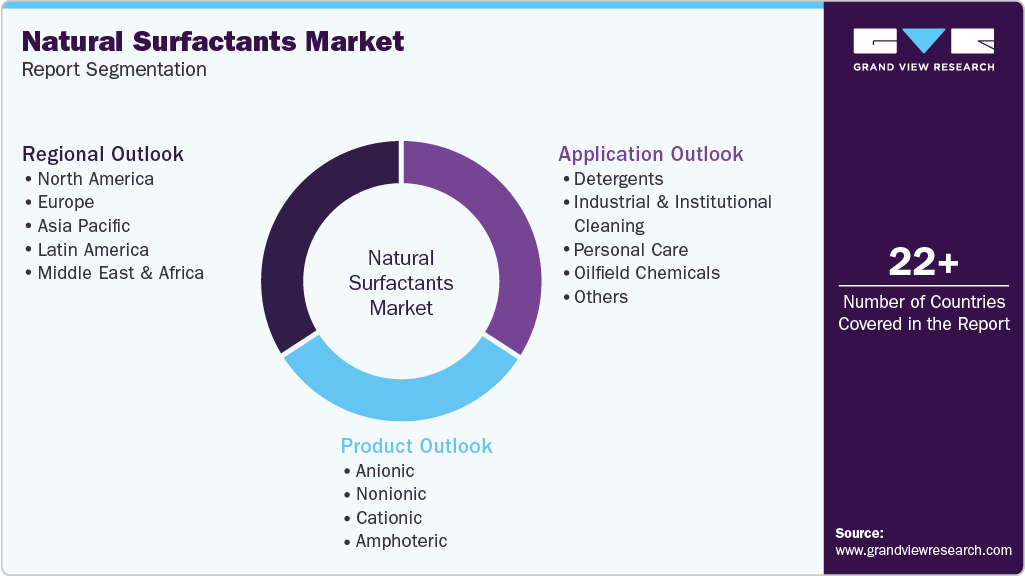
Product Outlook (Volume, Kilotons; Revenue, USD Million, 2018 - 2033)
-
Anionic
-
Nonionic
-
Cationic
-
Amphoteric
Application Outlook (Volume, Kilotons; Revenue, USD Million, 2018 - 2033)
-
Detergents
-
Industrial & Institutional Cleaning
-
Personal Care
-
Oilfield Chemicals
-
Others
Region Outlook (Volume, Kilotons; Revenue, USD Million, 2018 - 2033)
-
North America
-
U.S.
-
Canada
-
Mexico
-
-
Europe
-
Germany
-
UK
-
France
-
Italy
-
Spain
-
-
Asia Pacific
-
China
-
India
-
Japan
-
South Korea
-
-
Latin America
-
Brazil
-
Argentina
-
-
Middle East & Africa
-
Saudi Arabia
-
South Africa
-
Frequently Asked Questions About This Report
b. The global natural surfactants market size was estimated at USD 21,485.6 million in 2024 and is expected to reach USD 22,243.9 million in 2025.
b. The global natural surfactants market is expected to grow at a compound annual growth rate of 4.2% from 2025 to 2033 to reach USD 30,880.9 million in 2033.
b. Europe dominated the global landscape with a revenue share of 38.6% in 2024. The region led the global market due to strict environmental regulations, strong demand for eco-certified products, and widespread green chemistry adoption. Key industries like personal care and automotive drive biodegradable surfactant use, with Germany at the forefront. Robust R&D, clean-label trends, and active mergers further strengthen the region’s dominance in natural surfactants.
b. Some key players operating in the natural surfactants market include BASF, Croda International Plc, Evonik Industries AG, Dow, CLARIANT, Kao Corporation, WHEATOLEO, SEPPIC (Air Liquide Healthcare), Indorama Ventures, GALAXY, Evonik Industries AG, Stepan Company, Inolex, Inc.
b. The market is experiencing strong growth due to the rising demand for sustainable products, stricter environmental norms, and growing awareness of synthetic surfactant risks. Innovative, cost-effective, and high-performance natural alternatives are also boosting the market.


Share this report with your colleague or friend.
Need a Tailored Report?
Customize this report to your needs — add regions, segments, or data points, with 20% free customization.


ISO 9001:2015 & 27001:2022 Certified
We are GDPR and CCPA compliant! Your transaction & personal information is safe and secure. For more details, please read our privacy policy.
Trusted market insights - try a free sample
See how our reports are structured and why industry leaders rely on Grand View Research. Get a free sample or ask us to tailor this report to your needs.













