
- Home
- »
- Plastics, Polymers & Resins
- »
-
Non-Recyclable Polystyrene Packaging Market Report, 2033GVR Report cover

Non-Recyclable Polystyrene Packaging Market (2026 - 2033)
Size, Share & Trends Analysis Report By Packaging Technology (Expanded Polystyrene (EPS), Extruded Polystyrene (XPS), Coated or Laminated Polystyrene), By Packaging Format, By Application, By Region, And Segment Forecasts
Market Size, 2025
$2.0BMarket Estimate, 2026
$2.1BMarket Forecast, 2033
$3.0BCAGR, 2026–2033
5.1%Non-Recyclable Polystyrene Packaging Market Summary
The global non-recyclable polystyrene packaging market size was valued at USD 2.0 billion in 2025 and is projected to grow from USD 2.1 billion in 2026 to USD 3.0 billion by 2033, at a CAGR of 5.1% from 2026 to 2033. Asia Pacific dominated the market, accounting for a revenue share of 42.7% in 2025. The market driven by increasing demand for food service, e-commerce, consumer goods, electronics, healthcare, and industrial shipping, where lightweight construction, thermal insulation, shock absorption, and low production costs support their use. Market boundaries depend on the definition of non-recyclability, as some polystyrene products can technically be recycled where suitable collection and processing systems exist.
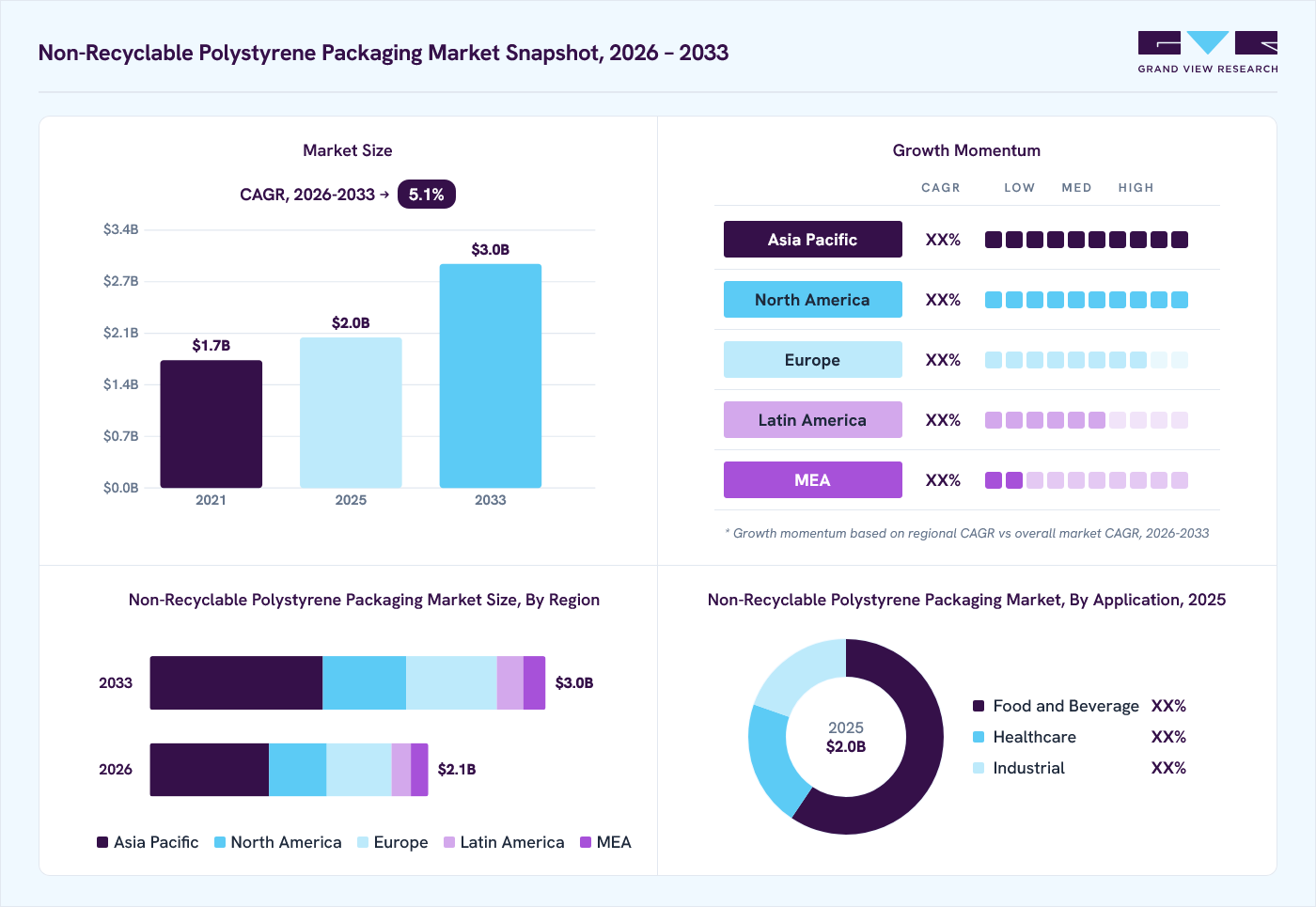 Source: Grand View Research, IR Documents, Primary Interviews, Paid DatabasesTo learn more about this report,
 Download Free Sample Report
Key Market Trends & Insights
- By packaging technology: Expanded polystyrene (EPS) segment dominated the market, with a revenue share of 61.6% in 2025.
- By packaging format: Rigid segment held the largest market share of 73.1% in 2025.
- By application: Food and beverage segment held the largest revenue share of 41.9% in 2025.
Regional Highlights
- Largest regional market: Asia Pacific (42.7% revenue share, 2025)
- By country: China held the largest market share in 2025.
Market Size & Forecast
- Market size in 2025: USD 2.0 Billion
- Estimated market size in 2026: USD 2.1 Billion
- Projected market size by 2033: USD 3.0 Billion
- CAGR (2026-2033): 5.1%
Three ways to get this report
Buy it, customize it, or ask a question.Ask an Analyst
Analyst response in 1 business day
- AccessReport author, directly
- Reply timeWithin 1 working day
- No sales callDirect answer only
- FormatEmail reply
- CostFree, no cost
Get the Full Report
What the study covers
- FormatsPDF · Excel · Dashboard
- Timeline2026–2033 annual, 2025 base
- Coverage20+ countries, 5 regions
- Companies10+ key players profiled
Customize the Report
20% free customization
- IncludeCountries, segments, points
- TailorTo your product definition
- ExtendDeeper competitor detail
- OrA fully bespoke study
- Turnaround5–10 working days
Demand is influenced by the need to protect fragile products during transportation, maintain food temperature, reduce product damage, and manage packaging costs. Polystyrene packaging offers a high strength-to-weight ratio, moisture resistance, and cushioning performance, making it useful for appliances, electronics, temperature-sensitive goods, and selected food applications. However, the market faces increasing pressure from restrictions on certain single-use foam products, extended producer responsibility requirements, and corporate packaging sustainability targets. These developments are encouraging packaging buyers to assess alternative materials, redesign formats, and improve material recovery wherever feasible.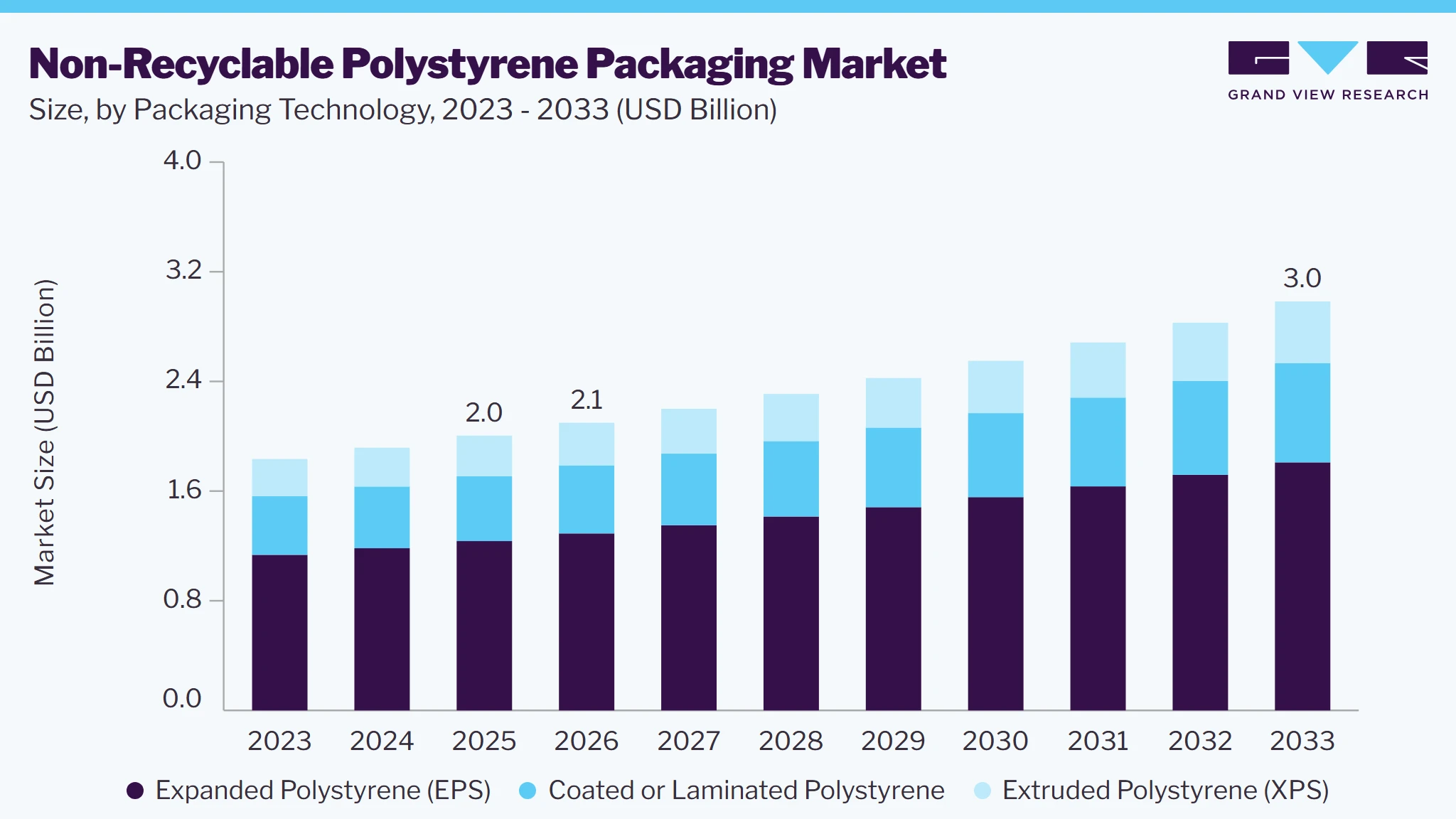 To learn more about this report, Download Free Sample Report
Government policies and packaging regulations influence product availability, manufacturing decisions, and end-use adoption. Regulatory approaches include restrictions on selected expanded polystyrene food-service products, minimum recycled-content requirements where applicable, packaging waste collection targets, producer responsibility schemes, and product-design requirements. The impact varies by country and product category, as not every polystyrene packaging format is prohibited or classified as non-recyclable. Manufacturers and packaging users must therefore assess local regulations, product composition, intended application, and disposal infrastructure when selecting packaging solutions.
Technological developments focus on lightweight packaging design, material reduction, improved protective performance, alternative cushioning systems, and the development of packaging materials with better end-of-life characteristics. Advances in densification and compaction can reduce the volume of collected EPS waste, improving transport and handling economics, while specialized recycling processes can recover polystyrene from suitable waste streams. Paper-based protective packaging, molded fiber, corrugated inserts, and selected reusable packaging systems are also gaining consideration as alternatives in applications where performance and cost requirements can be met. These changes are reshaping competition between conventional polystyrene packaging and alternative protective packaging solutions.
Market Dynamics
The market is shaped by the balance between the functional and economic advantages of polystyrene packaging and the growing requirements for improved packaging recovery, waste reduction, and regulatory compliance. Demand differs by end-use industry, product s, and geography, depending on packaging performance requirements, availability of substitutes, waste-management infrastructure, and the regulatory treatment of specific products.
Polystyrene packaging remains useful in applications requiring lightweight cushioning, impact resistance, and thermal insulation. EPS packaging protects electronics, household appliances, furniture components, and other fragile goods during storage and transportation. Its cellular structure absorbs impact while adding relatively little weight, helping packaging users reduce product damage and associated replacement or return costs. These performance characteristics support continued use in applications where product protection is a priority and alternative materials may require additional material or design modifications.
The expansion of e-commerce, parcel delivery, and cross-border goods movement increases the need for protective packaging that can accommodate different product sizes and transportation conditions. Polystyrene inserts and molded components can be designed around specific product geometries, providing close-fitting protection for delicate or high-value items. Demand is also supported by temperature-control requirements in selected food, pharmaceutical, and healthcare logistics applications. Adoption nevertheless depends on local restrictions, customer sustainability policies, and the availability of technically suitable alternative materials.
Restrictions on selected polystyrene food-service products and increasing scrutiny of persistent packaging waste limit demand in several markets. Lightweight foam packaging can be difficult to collect economically because of its low density and high volume, while food contamination can complicate sorting and recycling. Where collection systems and dedicated processing facilities are limited, packaging may be directed toward disposal rather than material recovery. These conditions increase pressure on manufacturers, distributors, and end users to reconsider packaging specifications and end-of-life management.
Investment in collection, densification, sorting, and specialized recycling infrastructure presents an opportunity to improve the recovery of suitable polystyrene packaging waste. Densification can reduce the volume of discarded foam, making storage and transportation more practical for recyclers and waste-management operators. Where contamination is controlled and sufficient material volumes are available, recovered polystyrene may be processed into feedstock for selected applications. Partnerships between packaging manufacturers, retailers, logistics providers, recyclers, and local waste-management organizations can help establish more efficient collection systems.
Market Concentration & Characteristics
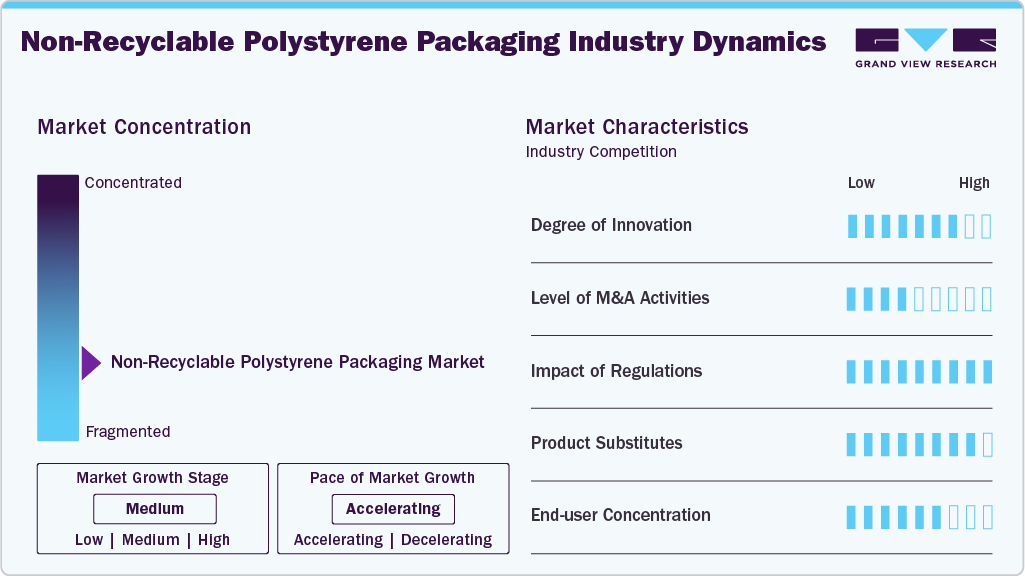
The non-recyclable polystyrene packaging market comprises petrochemical producers, polystyrene resin manufacturers, foam converters, molded packaging manufacturers, distributors, and specialized packaging suppliers. Competition varies by product type and end-use application, with manufacturers differentiating themselves through molding capabilities, customized designs, cushioning performance, production scale, and customer-specific packaging solutions. Regional converters often serve local industrial and commercial customers, while larger packaging groups benefit from established supply relationships and broader manufacturing networks. The market is also influenced by resin price fluctuations, conversion costs, regulatory requirements, and the availability of alternative materials. As sustainability requirements increase, competition increasingly includes the ability to redesign packaging, support waste recovery, and offer alternatives that meet customer performance and cost expectations.
 To learn more about this report, Download Free Sample Report
The market faces substitution from corrugated cardboard, molded fiber, paper-based cushioning, flexible air cushions, polyethylene foam, starch-based protective materials, and reusable plastic packaging. Corrugated cardboard and molded fiber are suitable for several protective packaging applications, particularly where customers prioritize fiber-based materials and established recovery systems. Flexible air cushions and other lightweight protective materials can reduce shipping weight and accommodate different product shapes, while polyethylene foam offers cushioning properties comparable to polystyrene in selected applications. Reusable packaging systems may be preferred in repeated industrial and closed-loop logistics operations. The threat of substitution is high where packaging performs a straightforward protective function and alternatives meet cost, durability, and product-safety requirements.
Packaging Technology Insights
Based on packaging technology, the expanded polystyrene (EPS) segment led the non-recyclable polystyrene packaging market with the largest revenue share of 61.6%in 2025. This is due to its lightweight structure, cushioning properties, thermal insulation, and cost-effective manufacturing. EPS is widely used in protective inserts, foam boxes, trays, and insulated packaging for electronics, appliances, food distribution, and industrial goods. Its ability to absorb impact and accommodate customized product shapes supports demand across diverse applications. Established manufacturing capabilities and its suitability for large-volume packaging requirements further strengthen its market position.
The coated or laminated polystyrene segment is expected to grow at the fastest CAGR of 5.6% during the forecast period. Coatings and laminated structures can enhance the functional properties of polystyrene packaging for selected food, consumer goods, and specialized applications. Demand is influenced by requirements for packaging durability and product protection, although growth depends on material costs, regulatory compliance, and the compatibility of multilayer structures with available recycling and disposal systems.
Packaging Format Insights
Based on packaging format, rigid segment accounted for the largest revenue share of 73.1%in 2025. These formats provide structural support, impact resistance, and protection against damage during storage and transportation. Demand from consumer electronics, household appliances, food distribution, and industrial applications supports segment adoption. The ability to manufacture rigid polystyrene packaging in customized shapes and dimensions further strengthens its position across applications requiring dependable product protection.
The flexible segment is projected to register the fastest CAGR of 5.7% from 2026 to 2033. Thin-gauge polystyrene structures and applicable coated or laminated formats can support specific containment, presentation, and protective requirements. Demand is influenced by packaging design optimization, reduced material consumption, and requirements across selected food and consumer goods applications. However, growth depends on the availability of suitable polystyrene-based flexible formats and their competitiveness against established alternatives, including polyethylene films and paper-based packaging.
Application Insights
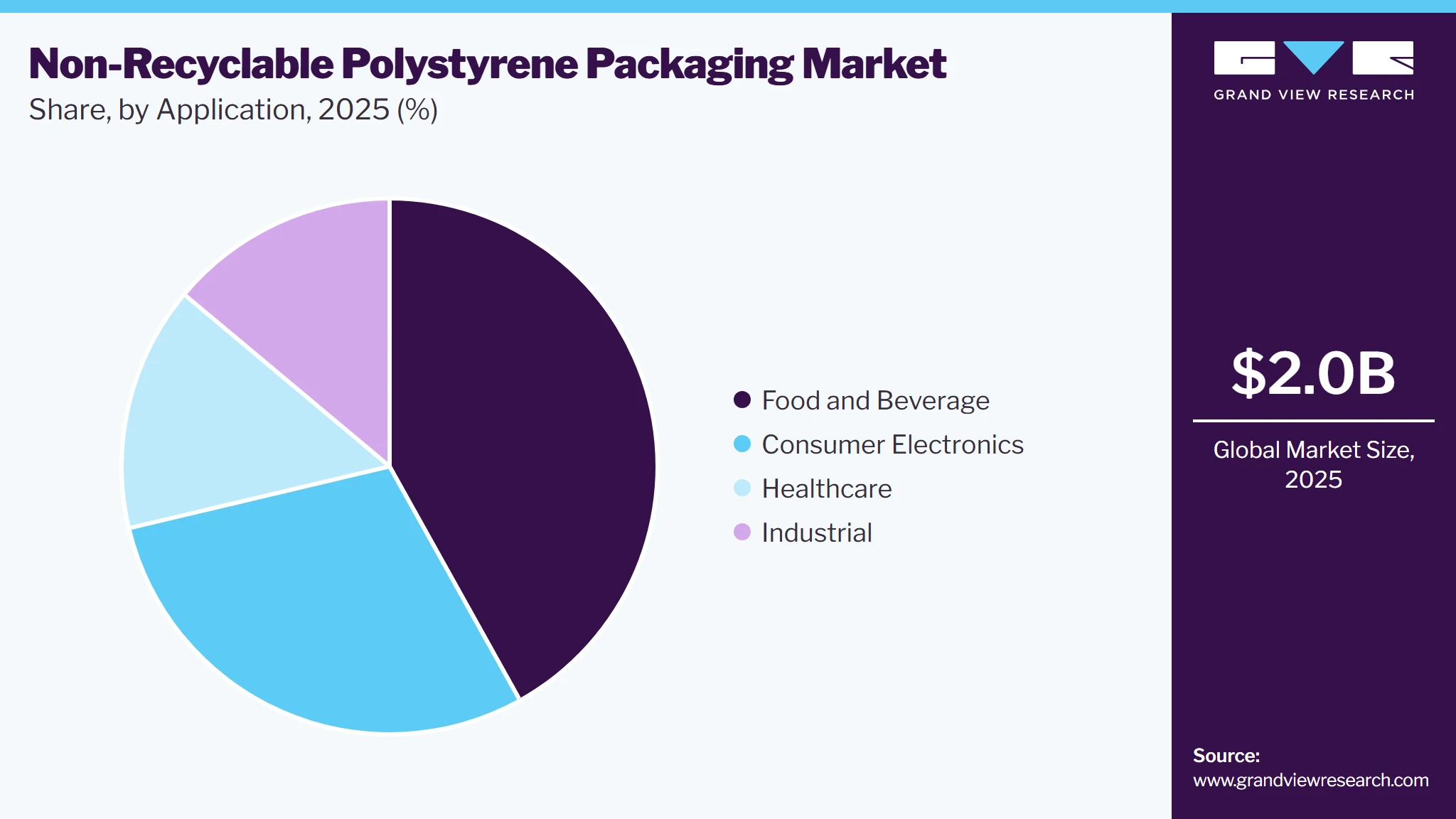
Based on application, food and beverage segment held the largest revenue share of 41.9% in 2025. This is due to the use of polystyrene packaging in selected food trays, takeaway containers, cups, insulated boxes, and temperature-sensitive distribution applications. Its lightweight construction, thermal insulation, moisture resistance, and economical production support its use in food handling and transportation. Demand is influenced by food-service activity, distribution requirements, and the need to maintain product condition. However, restrictions on specified single-use polystyrene food packaging in several jurisdictions may limit demand for affected product categories.
 To learn more about this report, Download Free Sample Report
The healthcare segment is projected to record the fastest growth, with a 6.1% CAGR from 2026 to 2033. This segment is expected to experience strong growth as demand increases for protective and insulated packaging used in diagnostic products, laboratory supplies, medical materials, and temperature-sensitive healthcare shipments. Polystyrene packaging can provide cushioning, dimensional stability, and protection during storage and transportation, depending on the application. Growth is supported by expanding healthcare distribution networks and requirements for reliable product handling. Adoption remains dependent on product compatibility, applicable safety and packaging requirements, and competition from alternative materials designed for specialized healthcare logistics.
Regional Insights
North America has an established protective packaging industry serving electronics, appliances, healthcare-related distribution, food logistics, and e-commerce. Polystyrene packaging remains relevant in applications where lightweight construction, customized molding, cushioning, and thermal insulation support product protection. Market demand is shaped by packaging performance standards, transportation costs, customer procurement policies, and regional differences in waste collection and recycling access. Businesses face increasing pressure to reduce packaging waste and evaluate materials with established recovery pathways. This encourages competition among conventional foam packaging suppliers, fiber-based packaging manufacturers, and alternative cushioning providers, while demand for specialized protective solutions continues to depend on technical requirements and total delivered cost.
U.S. Non-Recyclable Polystyrene Packaging Market Trends
The U.S. market is supported by extensive parcel delivery networks, consumer goods distribution, industrial manufacturing, and demand for protective packaging for fragile and temperature-sensitive products. Polystyrene foam is used in selected molded inserts, shipping protection, and insulation-oriented packaging applications. State and local regulations create a varied compliance environment for foam food-service products and other packaging formats, influencing procurement and product availability. Businesses also consider collection economics, contamination, recycling access, and disposal costs when selecting materials. Packaging suppliers are responding through product redesign, alternative material development, and customer-specific solutions that maintain cushioning performance while meeting evolving purchasing and regulatory requirements.
Europe Non-Recyclable Polystyrene Packaging Market Trends
The Europe non-recyclable polystyrene packaging market is shaped by packaging waste reduction targets, circular economy policies, producer responsibility requirements, and restrictions on selected single-use plastic packaging formats. These policies encourage businesses to assess packaging necessity, recyclability, material composition, and the availability of alternative solutions. Conventional polystyrene packaging continues to have relevance in selected protective and industrial applications, subject to applicable requirements. Manufacturers and end users are increasingly evaluating paper-based cushioning, molded fiber, reusable packaging, and improved waste recovery systems. Differences in national implementation, recycling infrastructure, manufacturing capabilities, and end-use demand influence market conditions across the region. The regulatory environment is a key factor in determining which products remain commercially viable.
Germany has a developed packaging and manufacturing ecosystem, supported by automotive components, machinery, electronics, household appliances, and industrial distribution. Polystyrene packaging is used in selected protective applications where molded shapes and impact resistance help prevent damage during transportation. Packaging decisions are influenced by waste separation systems, producer responsibility requirements, packaging design obligations, and customer sustainability policies. Manufacturers must assess the suitability of conventional foam against alternatives such as corrugated cardboard, molded fiber, and reusable transport packaging.
The UK non-recyclable polystyrene packaging market is increasingly shaped by restrictions on selected single-use polystyrene food and drink containers, packaging producer responsibility obligations, and demand for more sustainable packaging formats. In England, the supply of specified single-use food and drink containers made from expanded or extruded polystyrene is prohibited, while other packaging formats may be subject to different requirements. These measures are encouraging food-service operators, retailers, and packaging suppliers to consider paper-based, molded-fiber, and reusable alternatives. Protective polystyrene packaging for industrial and consumer goods remains subject to the relevant product requirements, with material selection increasingly influenced by waste management, compliance, and customer sustainability objectives.
Asia Pacific Non-Recyclable Polystyrene Packaging Market Trends
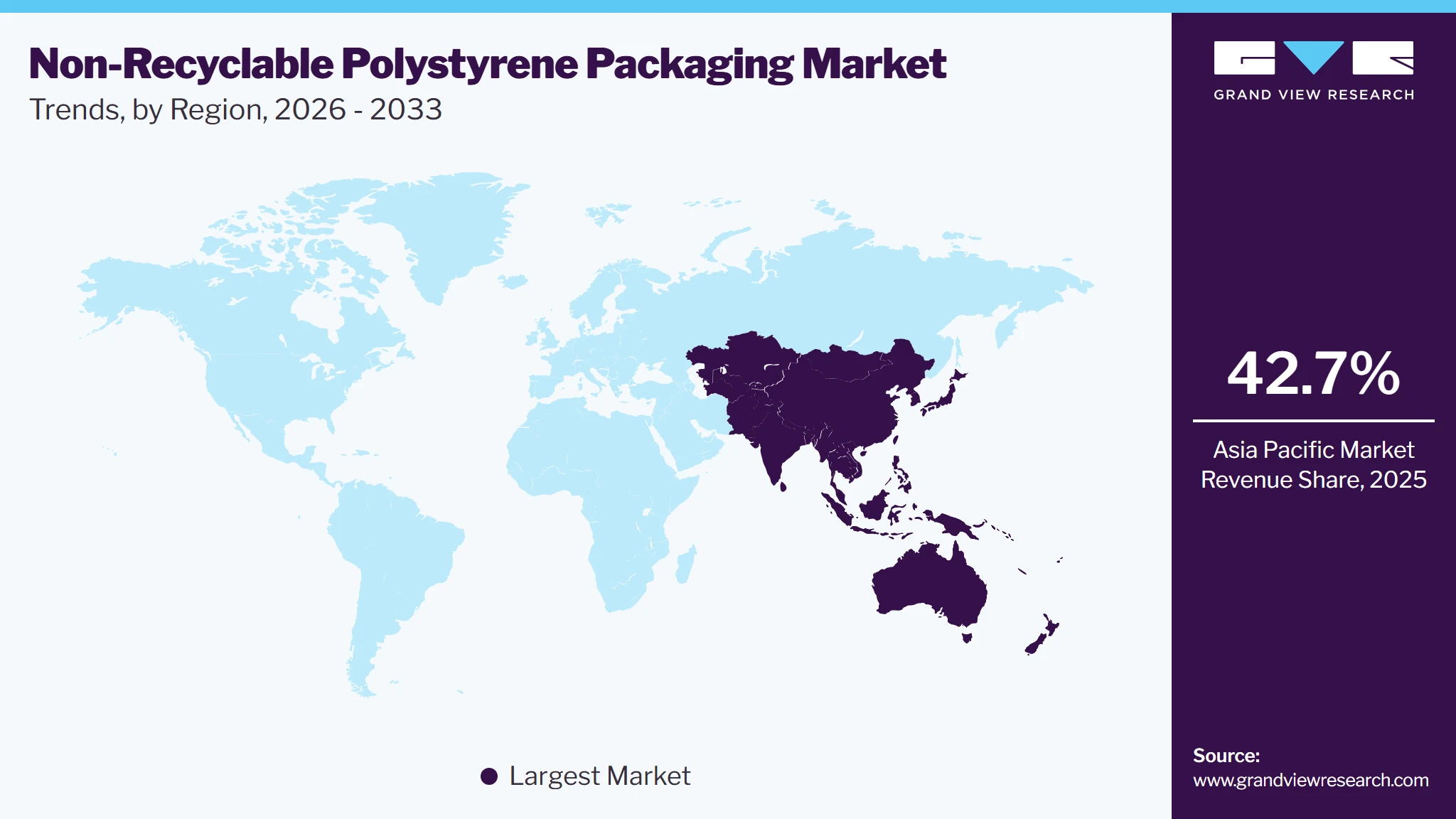
Asia Pacific accounted for 42.7% of global revenue in 2025 and projected to register the fastest CAGR of 5.5% from 2026 to 2033. The region benefits from established polymer production, foam conversion capabilities, and cost-efficient manufacturing networks. Demand is supported by the need for protective packaging in domestic distribution and export-oriented supply chains. Market conditions vary considerably across countries according to waste collection infrastructure, recycling capacity, regulatory enforcement, and the availability of alternative materials. Manufacturers are increasingly required to balance the functional advantages of foam packaging with customer sustainability targets and evolving packaging waste policies.
 To learn more about this report, Download Free Sample Report
China benefits from a substantial plastics processing industry and a large manufacturing base for electronics, appliances, consumer products, and industrial goods. Polystyrene packaging is used for protective inserts, molded cushioning, and packaging components designed to minimize damage during storage and transportation. Demand is influenced by domestic consumption, export manufacturing, e-commerce distribution, and the cost competitiveness of local converters. Waste-management requirements and restrictions on selected disposable plastic products are encouraging businesses to assess material efficiency, recovery options, and alternative packaging formats.
India market is influenced by expanding e-commerce, packaged food distribution, electronics manufacturing, and demand for economical protective packaging. EPS packaging is used to cushion appliances, consumer electronics, and fragile products during storage and transportation. At the same time, restrictions on specified single-use plastic products, including certain polystyrene formats, are encouraging businesses to reassess packaging designs and material choices. The trend is toward application-specific alternatives, improved waste collection, and more efficient recovery systems, although demand for protective polystyrene packaging depends on the product category and applicable regulations.
Latin America Non-Recyclable Polystyrene Packaging Market Trends
The Latin America non-recyclable polystyrene packaging market is projected to grow steadily, its market presents demand opportunities through food distribution, retail, consumer goods manufacturing, electronics distribution, and industrial logistics. Polystyrene packaging is used in selected protective and temperature-sensitive applications because of its low weight, insulation properties, and relatively economical production. Market development depends on manufacturing activity, purchasing power, the availability of local converters, and the cost of competing materials. Waste collection and recycling capabilities differ across countries and municipalities, affecting the practical recovery of foam packaging. Regulatory developments and corporate sustainability commitments are encouraging greater consideration of packaging alternatives, improved waste handling, and product redesign, although adoption remains dependent on cost and local infrastructure.
Brazil's non-recyclable polystyrene packaging market is influenced by demand from food distribution, food service, consumer goods, and e-commerce, alongside growing attention to packaging waste and reverse logistics. Lightweight EPS packaging remains relevant for protecting appliances, electronics, and temperature-sensitive products, while restrictions in certain municipalities and improvements in waste recovery are encouraging converters to consider alternative materials and more efficient packaging designs. The implementation of national packaging recovery obligations is also increasing the importance of collection systems and producer responsibility.
The Argentina non-recyclable polystyrene packaging market is shaped by demand for affordable food packaging, agricultural distribution, consumer goods, and protective packaging for appliances and electronics. Polystyrene packaging offers cushioning, insulation, and low-weight handling benefits, particularly for products transported across domestic supply chains. Growing attention to packaging waste is encouraging businesses to assess collection, recycling, and material substitution options. Market trends are influenced by packaging costs, local waste-management infrastructure, regulatory developments, and the availability of commercially viable alternatives, with adoption varying across applications and regions.
Middle East & Africa Non-Recyclable Polystyrene Packaging Market Trends
The Middle East & Africa non-recyclable polystyrene packaging market is expected to expand in 2026 to 2033, influenced by food distribution, retail, construction-related supply chains, industrial activity, and growing demand for protective packaging. Polystyrene products are used where lightweight cushioning and insulation are important, including selected electronics, appliances, and temperature-sensitive goods. Market conditions differ according to manufacturing capacity, packaging imports, waste collection systems, and national environmental policies. Businesses are evaluating alternative materials and improved waste management as sustainability requirements become more prominent. The commercial viability of substitutes depends on local availability, transportation costs, product protection requirements, and access to suitable recovery infrastructure.
Key Non-Recyclable Polystyrene Packaging Company Insights
The market is characterized by specialized polystyrene packaging manufacturing, application-specific product designs, protective performance, and cost-efficient production capabilities. Key participants are focusing on expanding EPS and XPS packaging portfolios, customized molded packaging solutions, and products for food and beverage, consumer electronics, healthcare, and industrial applications. Manufacturers are also adapting their offerings to address evolving requirements related to cushioning, thermal insulation, moisture resistance, lightweight packaging, and product protection during transportation. Increasing regulatory scrutiny and sustainability expectations are encouraging market participants to explore material reduction, improved waste recovery, and alternative packaging solutions while maintaining performance and cost competitiveness.
-
BEWI is a European manufacturer of packaging, components, and insulation solutions, with capabilities spanning raw material production, product manufacturing, and recycling. Its packaging portfolio includes expanded polystyrene (EPS) fish boxes, food containers, produce boxes, pharmaceutical containers, insulated shipping boxes, and customized protective packaging. The company serves food and beverage, healthcare, pharmaceutical, horticulture, and industrial applications, offering packaging solutions designed for cushioning, thermal insulation, and product protection.
-
Pactiv Evergreen is a food and beverage packaging manufacturer serving foodservice operators, supermarkets, retailers, food processors, and consumer markets across North America. Its product portfolio includes food containers, plates, bowls, cups, lids, wraps, cutlery, and meat and poultry trays. The company has offered foam polystyrene packaging for foodservice and fresh-food applications, where lightweight construction, product containment, and protection support food handling and distribution.
Key Non-Recyclable Polystyrene Packaging Companies
Some of the prominent players operating in the non-recyclable polystyrene packaging market
-
BEWI
-
Pactiv Evergreen
-
NPX ONE
-
Plastilite Corporation
-
East India Technologies
-
KR Thermopack
-
Polyfab Foams India
-
Shri Srinivasa Polymers
-
Kamaksha Thermocol
-
Coastal Polymers
-
Dart Container Corporation
-
Genpak
Company Categorization
Category
Operating Strategies
Competitive Edge
Weakness
Established Players (BEWI; Pactiv Evergreen; NPX ONE; Plastilite Corporation; Dart Container Corporation; Genpak)
Focus on large-scale manufacturing of EPS packaging, foam food containers, protective inserts, trays, and customized packaging solutions. Emphasize production efficiency, product customization, established distribution networks, and supply relationships across food service, retail, electronics, and industrial applications.
Established manufacturing capabilities, broad product portfolios, technical expertise in molded polystyrene packaging, established customer relationships, and the ability to serve high-volume requirements provide competitive advantages.
Exposure to polystyrene resin price fluctuations, regulatory restrictions on selected foam packaging products, and increasing competition from alternative materials can affect profitability. Dependence on specialized manufacturing equipment and packaging formats may also increase adaptation costs.
Emerging & Specialized Players (East India Technologies; KR Thermopack; Polyfab Foams India; Shri Srinivasa Polymers; Kamaksha Thermocol; Coastal Polymers)
Concentrate on customized EPS packaging, molded thermocol components, insulated boxes, and application-specific packaging for food, healthcare, electronics, appliances, and industrial products. Strengthen market presence through customer-specific designs, regional distribution, flexible production, and specialized protective packaging solutions.
Focused product expertise, customization capabilities, regional customer relationships, and flexibility in meeting specific packaging requirements support competitiveness in targeted applications. Local manufacturing and customer proximity can also support responsive service and cost-effective supply.
Comparatively limited geographic reach, narrower product portfolios, and lower production scale can restrict access to large multinational customers. Dependence on specific end-use industries, resin price fluctuations, and investment requirements for alternative materials and waste-management solutions may also constrain expansion.
Recent Development:
-
In February 2026, BEWI opened Norway’s first EPS recycling facility at its production site in Fredrikstad, with an annual processing capacity of up to 3,500 tonnes. The facility uses sorting and recycling technology to process collected EPS packaging and insulation waste into raw material for new products, including GreenLine EPS and Terra XPS insulation solutions.
-
In April 2024, BEWI introduced new EPS raw-material grades and fish boxes made using recycled feedstock under its GreenLine product range. The products use Circulum Balance, a recycled-feedstock-based EPS material developed through a mass-balance approach, and were reported to offer up to a 60% lower carbon footprint compared with the relevant conventional alternatives.
Non-Recyclable Polystyrene Packaging Market Report Scope
Report Attribute
Details
Market size in 2025
USD 2.0 billion
Estimated market size in 2026
USD 2.1 billion
Projected market size by 2033
USD 3.0 billion
Growth Rate
CAGR of 5.1% from 2026 to 2033
Base year for estimation
2025
Historical data
2021 – 2024
Forecast period
2026 – 2033
Quantitative units
Revenue in USD Million/Billion and CAGR from 2026 to 2033
Report coverage
Revenue forecast, company ranking, competitive landscape, growth factors, and trends
Segments covered
Packaging technology, packaging format, application, region
Regional Scope
North America, Europe, Asia Pacific, Latin America, Middle East & Africa
Country Scope
U.S.; Canada; Mexico; Germany; France; UK; Italy; Spain; China; India; Japan; South Korea; Australia; Brazil; Argentina; Saudi Arabia; UAE; South Africa
Key companies profiled
BEWI, Pactiv Evergreen, NPX ONE, Plastilite Corporation, East India Technologies, KR Thermopack, Polyfab Foams India, Shri Srinivasa Polymers, Kamaksha Thermocol, Coastal Polymers, ISTA Non-Recyclable Polystyrene Packaging, Genpak.
Customization scope
Free report customization (equivalent up to 8 analysts working days) with purchase. Addition or alteration to country, regional & segment scope.
Pricing and purchase options
Avail of customized purchase options to meet your exact research needs. Explore purchase options
Global Non-Recyclable Polystyrene Packaging Market Report Segmentation
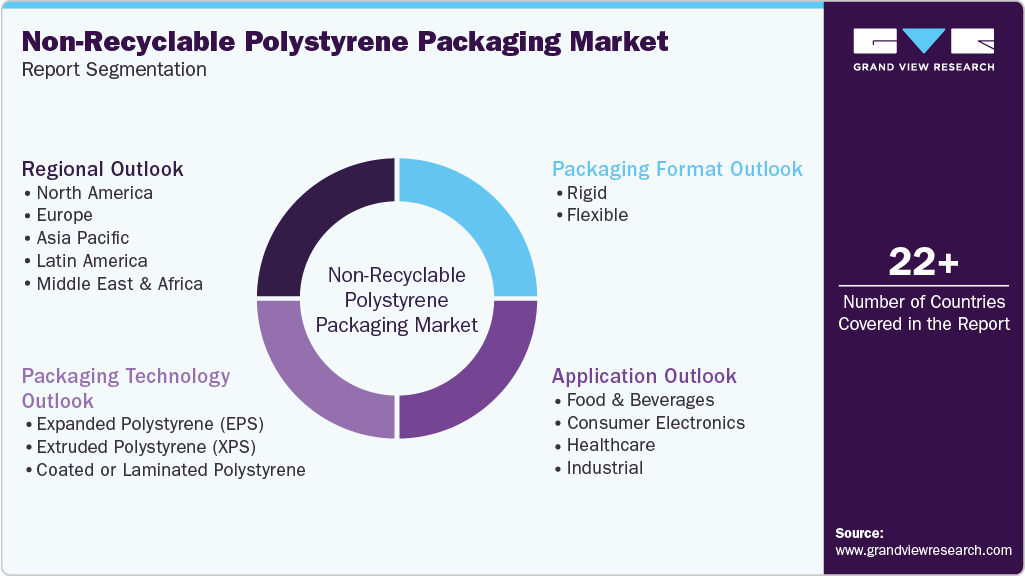
This report forecasts revenue growth at the regional, and country levels and provides an analysis on the latest industry trends and opportunities in each of the sub-segments from 2021 to 2033. For the purpose of this study, Grand View research has segmented the non-recyclable polystyrene packaging market report on the basis of packaging technology, packaging format, application, and region:
 To learn more about this report, Download Free Sample Report
-
Packaging Technology Outlook (Revenue, USD Million, 2021 – 2033)
-
Expanded Polystyrene (EPS)
-
Extruded Polystyrene (XPS)
-
Coated or Laminated Polystyrene
-
-
Packaging Format Outlook (Revenue, USD Million, 2021 – 2033)
-
Rigid
-
Flexible
-
-
Application Outlook (Revenue, USD Million, 2021 - 2033)
-
Food & Beverages
-
Consumer Electronics
-
Healthcare
-
Industrial
-
-
Regional Outlook (Revenue, USD Million, 2021 - 2033)
-
North America
-
U.S.
-
Canada
-
Mexico
-
-
Europe
-
Germany
-
France
-
UK
-
Italy
-
Spain
-
-
Asia Pacific
-
China
-
India
-
Japan
-
South Korea
-
Australia
-
-
Latin America
-
Brazil
-
Argentina
-
-
Middle East & Africa
-
Saudi Arabia
-
UAE
-
South Africa
-
-
Research Methodology
The non-recyclable polystyrene packaging market figures in this report are based on a proven research process that combines executive interviews with secondary research from proprietary databases, company filings, and recognized regulatory and institutional sources. Market size is built through value-chain sizing-reconciling supply-side and demand-side estimates-and triangulated with bottom-up and top-down approaches. Every estimate passes multiple levels of expert validation before publication, with each non-recyclable polystyrene packaging segment quantified using the revenue-capture definitions in the table below.
Segment Definition
Packaging Technology
Revenue capture definition
Expanded Polystyrene (EPS)
Revenue from non-recyclable expanded polystyrene packaging, including foam boxes, molded inserts, protective cushioning, food containers, trays, and insulated shipping containers. Covers packaging used for impact protection, thermal insulation, moisture resistance, and temperature-sensitive transportation.
Extruded Polystyrene (XPS)
Revenue from non-recyclable extruded polystyrene packaging, including foam trays, thin-walled containers, and specialized insulated packaging. Covers packaging applications requiring thermal insulation, moisture resistance, dimensional stability, and protection of temperature-sensitive products.
Coated or Laminated Polystyrene
Revenue from non-recyclable coated or laminated polystyrene packaging, including packaging structures incorporating paper, plastic films, barrier layers, or surface coatings. Covers rigid containers, trays, and specialty packaging designed to improve moisture resistance, barrier performance, printability, sealing, and product protection.
Packaging Format
Revenue capture definition
Rigid
Revenue from non-recyclable rigid polystyrene packaging, including molded foam boxes, trays, containers, protective inserts, and insulated packaging. Covers packaging designed to maintain structural integrity, protect products from impact, and support storage and transportation.
Flexible
Revenue from non-recyclable flexible or thin-gauge polystyrene packaging, including thin-walled thermoformed packaging, lightweight liners, and applicable polystyrene-based film structures. Covers packaging designed for product containment, lightweight protection, and selected food and consumer goods applications.
Application
Revenue capture definition
Food & Beverages
Revenue from non-recyclable polystyrene packaging used for food containers, trays, cups, takeaway packaging, seafood boxes, and insulated food transportation. Covers packaging that provides lightweight handling, moisture resistance, cushioning, and thermal insulation for food storage and distribution.
Consumer Electronics
Revenue from non-recyclable polystyrene packaging used for molded inserts, protective corners, cushioning components, and custom-fitted packaging for electronic devices and appliances. Covers packaging designed to absorb impact, prevent surface damage, and protect products during storage, handling, and transportation.
Healthcare
Revenue from non-recyclable polystyrene packaging used for medical supplies, diagnostic products, laboratory materials, and temperature-sensitive healthcare shipments. Covers protective inserts, insulated containers, and packaging components designed to support product integrity during storage and distribution.
Industrial
Revenue from non-recyclable polystyrene packaging used for machinery components, automotive parts, precision instruments, and other industrial products. Covers customized molded packaging, protective blocks, cushioning inserts, and shipping containers designed to reduce handling damage and improve transportation efficiency.
Estimation Model
Layer No.
Layer Name
Key Question
Description
01
Application Layer
What drives packaging demand?
Estimate demand for non-recyclable polystyrene packaging across food & beverage, consumer electronics, healthcare, and industrial applications, considering product protection, thermal insulation, cushioning, moisture resistance, transportation requirements, and packaging cost.
02
Packaging Adoption Layer
Where is polystyrene packaging used?
Assess the adoption of expanded polystyrene (EPS), extruded polystyrene (XPS), and coated or laminated polystyrene across rigid and flexible packaging formats, considering structural requirements, product compatibility, protective performance, and the availability of alternative materials.
03
Packaging Consumption Layer
Which packaging products generate demand?
Evaluate demand for molded inserts, protective cushioning, foam boxes, trays, containers, insulated shipping packaging, and specialized packaging components across end-use industries. Assess consumption based on shipment volumes, packaging requirements, product characteristics, and the suitability of alternative packaging solutions.
04
Revenue Layer
How is revenue generated?
Revenue is generated through the manufacture and sale of non-recyclable polystyrene packaging products, including EPS and XPS packaging, coated or laminated polystyrene formats, protective inserts, molded components, trays, and insulated containers. Revenue capture considers packaging technology, format, application, product specifications, and sales to manufacturers, distributors, food-service operators, electronics companies, healthcare suppliers, and industrial customers.
Delivered Customizations
We have successfully delivered the following deep-dive customizations:
Client Request
Customization Delivered
Value Adds
Competitive Benchmarking
Comparative assessment of key Non-Recyclable Polystyrene Packaging manufacturers based on product portfolio, EPS and XPS packaging capabilities, manufacturing capacity, end-use coverage, geographic presence, pricing strategies, regulatory compliance, alternative material offerings, and strategic developments.
Enables evaluation of competitive positioning, product differentiation, manufacturing capabilities, customer reach, and strategies for addressing regulatory changes and substitute materials.
Cross-Segmentation Analysis
Detailed assessment of market opportunities across combinations of Packaging Format (Rigid, Flexible), Packaging Technology (Expanded Polystyrene (EPS), Extruded Polystyrene (XPS), Coated or Laminated Polystyrene), Application (Food and Beverage, Consumer Electronics, Healthcare, Industrial), and regional markets.
Helps identify high-value segment combinations, application-specific demand patterns, material preferences, and emerging opportunities for targeted market strategies.
Opportunity Assessment
Evaluation of emerging opportunities arising from protective packaging demand, e-commerce distribution, temperature-sensitive transportation, lightweight packaging designs, improved polystyrene waste collection and recovery, material reduction, and the development of alternative packaging materials.
Supports identification of attractive application areas, underserved customer requirements, regional expansion opportunities, and product development priorities while accounting for regulatory restrictions and substitution risks.
About the Author(s)
Plastics, Polymers & Resins Research Team
Bulk Chemicals · Plastics, Polymers & ResinsThis report was authored by the plastics, polymers & resins research team at Grand View Research - comprising two research analysts, one senior research analyst, and one industry expert - with specialized expertise in the plastics, polymers & resins segment of the bulk chemicals industry. All findings are based on proprietary bulk chemicals databases, executive interviews, and regulatory analysis, subject to internal peer review prior to publication.
Last Updated:
Speak to Analyst

Customize this report to your needs - add regions, segments, or data points, with 20% free customization.
Or view our licence options:


ISO 9001:2015 & 27001:2022 Certified
We are GDPR and CCPA compliant! Your transaction & personal information is safe and secure. For more details, please read our privacy policy.


