
- Home
- »
- Renewable Chemicals
- »
-
North America Foodservice And Restaurant Botanical Ingredients Market Report 2033GVR Report cover

North America Foodservice And Restaurant Botanical Ingredients Market (2026 - 2033)
Size, Share & Trends Analysis Report By Ingredients Type (Whole & Cut Botanicals, Milled & Powdered Botanicals, Botanical Extracts, Oleoresins), By Country, And Segment Forecasts
Market Size, 2025
$6.8BMarket Estimate, 2026
$7.1BMarket Forecast, 2033
$10.5BCAGR, 2026–2033
5.6%North America Foodservice And Restaurant Botanical Ingredients Market Summary
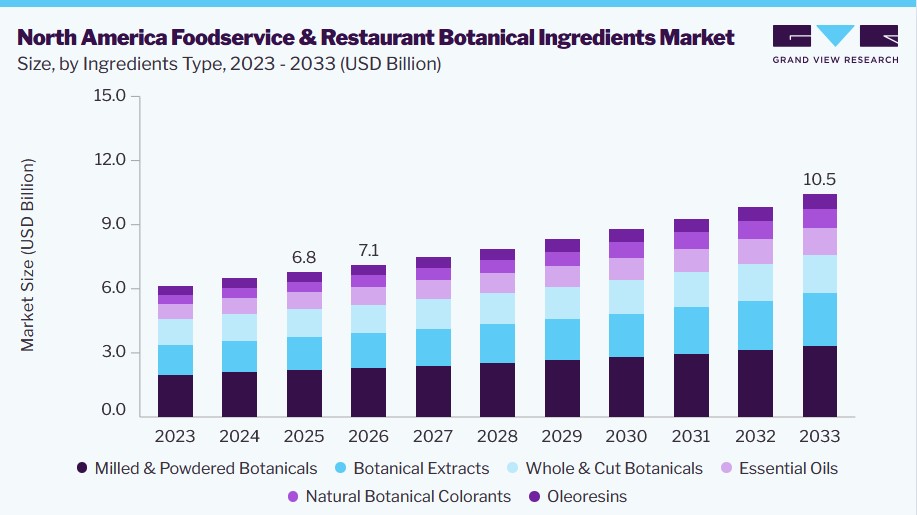
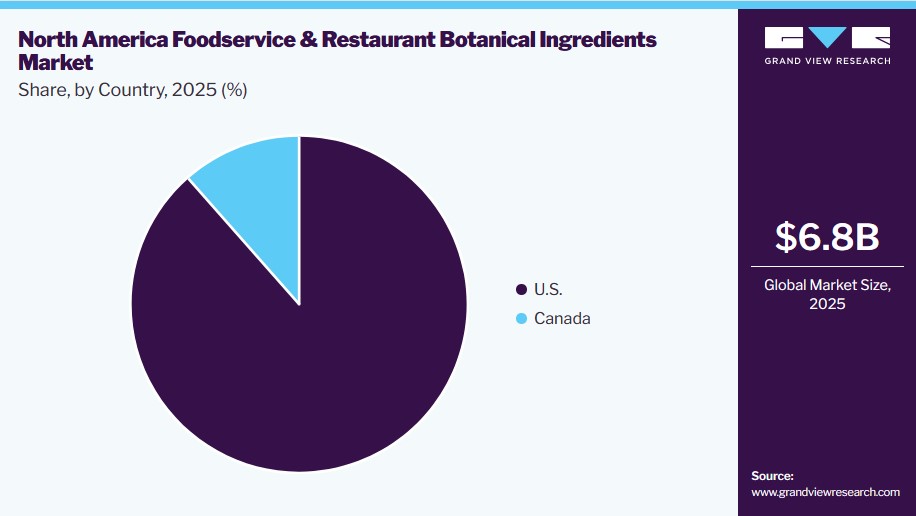
The North America foodservice and restaurant botanical ingredients market size was valued at USD 6.8 billion in 2025 and is projected to grow from USD 7.1 billion in 2026 to USD 10.5 billion by 2033, at a CAGR of 5.6% from 2026 to 2033. U.S. dominated the market, accounting for the largest revenue share of 80.5% in 2025. The increasing incorporation of natural, plant-based, and clean-label ingredients across restaurant and foodservice menus is driving demand for botanical ingredients such as herbs, spices, extracts, essential oils, oleoresins, and natural colorants.
Key Market Trends & Insights
- By ingredients type: Milled & powdered botanicals segment held the dominating revenue share of 32.2% in 2025.
Market Size & Forecast
- Market size in 2025: USD 6.8 Billion
- Estimated market size in 2026: USD 7.1 Billion
- Projected market size by 2033: USD 10.5 Billion
- CAGR (2026-2033): 5.6%
Three ways to get this report
Buy it, customize it, or ask a question.Ask an Analyst
Analyst response in 1 business day
- AccessReport author, directly
- Reply timeWithin 1 working day
- No sales callDirect answer only
- FormatEmail reply
- CostFree, no cost
Get the Full Report
What the study covers
- FormatsPDF · Excel · Dashboard
- Timeline2026–2033 annual, 2025 base
- Coverage20+ countries, 5 regions
- Companies10+ key players profiled
Customize the Report
20% free customization
- IncludeCountries, segments, points
- TailorTo your product definition
- ExtendDeeper competitor detail
- OrA fully bespoke study
- Turnaround5–10 working days
Restaurants are increasingly using these ingredients to deliver natural flavor, aroma, color, and product differentiation across sauces, seasonings, beverages, and prepared foods, supporting sustained demand for botanical ingredient inputs.North America is supported by the growing incorporation of flavors, regionally authentic recipes, and differentiated culinary profiles across restaurant menus. The National Restaurant Association's 2026 What's Hot Culinary Forecast, based on input from nearly 300 culinary professionals and operators, identifies global comfort foods, local sourcing, and cleaner, less-processed menu items among the major trends shaping the U.S. restaurant industry. This broadens applications for different botanical ingredient types: whole & cut botanicals such as basil, rosemary, and bay leaves are suited to Mediterranean sauces, roasted dishes, and soups, milled & powdered botanicals including turmeric, ginger, and paprika support curries, rubs, marinades, and seasoning systems; while botanical extracts, essential oils, and oleoresins enable concentrated flavor delivery in beverages, sauces, dressings, and other standardized preparations.
 Source: Grand View Research, IR Documents, Primary Interviews, Paid DatabasesTo learn more about this report,
 Download Free Sample Report
 USDA Economic Research Service data further indicate that growing consumer diversity has contributed to demand for spices and imported gourmet products, reflecting the expanding culinary base available to ingredient suppliers. This diversification of restaurant menus provides a broad platform for the use of botanical ingredients, rather than limiting demand to traditional herb and spice uses.
North American restaurants face persistent cost pressures while increasingly investing in technologies and solutions that improve operational efficiency. The National Restaurant Association projects U.S. restaurant-industry sales of USD 1.55 trillion in 2026, as operators continue to manage uneven traffic and rising operating costs and invest in efficiency-enhancing capabilities. This creates an opportunity for botanical ingredient suppliers to provide formats that reduce preparation requirements and deliver reproducible flavor performance across multiple locations. Whole & cut botanicals can be supplied in cleaned, dried, and standardized cut sizes for direct culinary use; milled powders can simplify bulk seasoning and recipe preparation; and extracts, essential oils, and oleoresins can provide controlled intensity where smaller dosages and uniform distribution are required.
Market Dynamics
The North America foodservice & restaurant botanical ingredients market is shaped by rising demand for natural and clean-label ingredients, expanding use of herbs, spices, extracts, essential oils, oleoresins, and natural colorants across restaurant food and beverage preparation, and growing consumer interest in premium, functional, and plant-based offerings.
The North American foodservice and restaurant industry is experiencing a significant shift towards plant-based and botanical-focused menu development. This change comes as consumers increasingly seek meals made with natural, recognizable, and minimally processed ingredients. Botanical ingredients, including herbs, spices, botanical extracts, essential oils, oleoresins, and natural colorants, are becoming essential for restaurants creating plant-forward menus. These ingredients provide authentic flavor, aroma, color, and functional benefits without the use of artificial additives.
Quick-service restaurants (QSRs), fast-casual chains, institutional foodservice providers, and premium dining establishments are investing in botanical ingredient solutions to develop unique menu offerings that align with evolving consumer preferences for wellness, sustainability, and ingredient transparency. This transition is expanding procurement opportunities for botanical ingredient manufacturers serving the foodservice sector.
Consumer purchasing patterns continue to support the trend toward plant-based foods. According to the Good Food Institute (GFI), the U.S. plant-based food retail market reached USD 8.1 billion in 2024, more than doubling from USD 3.9 billion in 2017. This reflects a long-term shift toward plant-derived food products. And about 60% of U.S. households purchased plant-based foods in 2025, showing that plant-based eating has become mainstream rather than just a niche market.
The North America foodservice and restaurant botanical ingredients market faces increasing challenges related to the availability and pricing of botanical raw materials, such as herbs, spices, essential oils, and plant extracts. Many high-value botanicals commonly used in commercial foodservice, like basil, oregano, rosemary, turmeric, black pepper, and paprika, are sourced through global agricultural supply chains. These supply chains are susceptible to adverse weather events, crop diseases, geopolitical disruptions, and transportation bottlenecks. As a result, these factors create uncertainty in procurement, making it difficult for ingredient manufacturers and restaurant operators to maintain stable ingredient costs and a reliable supply.
The effects of climate variability have become increasingly significant for botanical cultivation. According to the U.S. Department of Agriculture (USDA), extreme weather events, such as droughts, floods, hurricanes, and heat stress, are raising production risks across agricultural supply chains. These events lead to lower crop yields and greater price volatility for agricultural commodities. Such disruptions not only impact domestic specialty crop production but also affect imported botanicals that North American ingredient suppliers depend on, increasing their exposure to fluctuating procurement costs and inventory shortages.
Growing consumer interest in natural, clean-label, plant-based, and functional food and beverage options is creating opportunities for botanical ingredient suppliers in North American foodservice. Restaurants and foodservice operators are increasingly incorporating herbs, spices, botanical extracts, essential oils, oleoresins, and natural colorants into beverages, sauces, dressings, desserts, and specialty menu offerings.
The opportunity is particularly relevant for higher-value concentrated ingredients and natural colorants, which can support consistent flavor, aroma, functionality, and visual appeal while meeting demand for naturally derived ingredients. Suppliers offering application-specific formulations, customized blends, and traceable botanical sourcing can address evolving requirements from restaurant chains and foodservice buyers.
Market Concentration & Characteristics
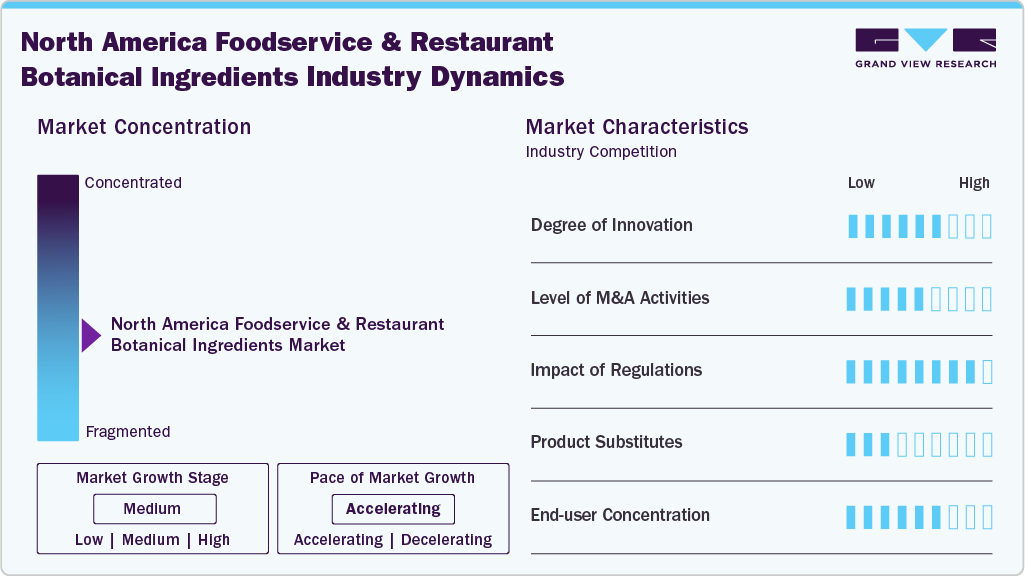
The North America foodservice & restaurant botanical ingredients market is characterized by the presence of global ingredient manufacturers, specialty botanical suppliers, spice and herb processors, and regional ingredient companies serving restaurants, foodservice operators, and foodservice manufacturers. The market includes both standardized commodity botanicals and higher-value extracts, essential oils, oleoresins, and natural colorants, creating varying levels of competition across ingredient categories.
 To learn more about this report, Download Free Sample Report
 Market concentration varies by ingredient type, with larger suppliers generally having stronger capabilities in processed, standardized, and specialized botanical ingredients, while numerous regional suppliers compete in whole, cut, milled, and powdered botanicals. Supplier differentiation is primarily influenced by product quality, ingredient consistency, sourcing capabilities, certifications, customization, application support, and geographic distribution.
Analyst Perspective
The North America foodservice & restaurant botanical ingredients market is positioned for continued expansion as restaurants and foodservice operators increasingly incorporate natural, clean-label, functional, and premium botanical ingredients into food and beverage offerings. Demand is expected to remain strongest for widely used herbs and spices while higher-value extracts, essential oils, oleoresins, and natural botanical colorants create opportunities for suppliers through product differentiation, formulation support, and customized ingredient solutions.
Ingredients Type Insights
The milled & powdered botanicals segment accounted for 32.2% of the North America foodservice & restaurant botanical ingredients market revenue in 2025, because they provide uniform dispersion, convenient portioning, longer storage stability, and consistent flavor and color compared with fresh botanicals. They are used in seasoning blends, marinades, sauces, soups, curries, meat and poultry rubs, seafood preparations, fries, vegetables, dressings, bakery products, and ethnic and fusion dishes. Herbs and spices are fundamental to seasoning formulations because they allow chefs and food manufacturers to steer the taste profile of a dish, while their application portfolio specifically covers seasoning blends, meat and poultry, and other savory food applications.
Natural botanical colorants is the fastest-growing form segment, with a CAGR of 7.8% from 2026 to 2033, supported by increasing demand for naturally derived, clean-label coloring ingredients in restaurant foods and beverages. Foodservice operators are increasingly incorporating botanical colorants such as annatto, turmeric, paprika, and beet-derived colors to enhance product appearance while aligning with consumer preferences for recognizable and naturally sourced ingredients.
Country Insights
U.S. Foodservice And Restaurant Botanical Ingredients Market Trends
The U.S. market is projected to grow at a revenue CAGR of 5.5% during the forecast period. According to the U.S. Department of Agriculture (USDA), consumer demand for greater variety and convenience, combined with increasing ethnic diversity, has contributed to the growing presence of spices and imported gourmet products in the U.S. food basket. USDA data also indicates that a significant share of the country’s herb and spice supply is sourced through net imports, while domestic production includes products such as mustard seed and dried chili peppers. This combination of globally sourced raw materials and domestic production and processing provides a broad ingredient base for the U.S. foodservice sector, supporting applications ranging from whole and visible culinary herbs to standardized botanical extracts and other concentrated ingredient solutions.
 To learn more about this report, Download Free Sample Report
 Canada Foodservice & Restaurant Botanical Ingredients Market Trends
Canada’s expanding restaurant base and multicultural consumer profile are supporting demand for a diverse range of botanical ingredients across foodservice applications. Whole and cut botanicals such as basil, rosemary, and bay leaves are widely suited to Mediterranean, European, and herb-forward preparations, while milled and powdered botanicals such as turmeric, ginger, paprika, cumin, and chili powders support South Asian, Middle Eastern, Mexican, and other international cuisines.
Mexico Foodservice & Restaurant Botanical Ingredients Market Trends
Expansion of restaurants, quick-service outlets, cafés, and other organized foodservice formats in Mexico is supporting demand for standardized botanical ingredients. These establishments require consistent herbs, spices, extracts, and concentrated botanical ingredients for repeatable flavor and quality across multiple locations.
Key North America Foodservice And Restaurant Botanical Ingredients Company Insights
Leading companies in the North America foodservice & restaurant botanical ingredients market are focusing on broadening botanical ingredient portfolios, developing natural and clean-label solutions, expanding application capabilities, and strengthening supply and distribution networks to serve restaurant and foodservice customers. Competition spans conventional herbs and spices as well as higher-value botanical extracts, essential oils, oleoresins, and natural colorants, with suppliers differentiating through product consistency, sourcing capabilities, customization, certifications, and technical support.
-
Veolia has a strong position in the North America foodservice & restaurant botanical ingredients ecosystem through its integrated water, waste, and energy management capabilities for chemical and petrochemical facilities. Its offering includes industrial waste optimization, hazardous-waste management, solvent recycling, and recovery of industrial by-products, enabling manufacturers to reduce disposal volumes while returning materials into productive use.
-
SUEZ participates through industrial waste management, recycling, resource recovery, and circular-economy solutions that help manufacturers convert waste streams into secondary materials and energy. Its capabilities increasingly combine waste prevention, advanced sorting, recycling, recovery, and digital technologies, supporting chemical producers in improving material utilization and reducing dependence on virgin resources.
Key North America Foodservice And Restaurant Botanical Ingredients Companies
-
Givaudan
-
Sensient Technologies Corporation
-
Döhler(Denmark)
-
Kalsec, Inc.
-
McCormick & Company, Inc.
-
Synthite Industries
-
MartinBauer Group
-
Bio-Botanica, Inc.
-
International Flavors & Fragrances (IFF)
-
Archer Daniels Midland Company
Competitive Benchmarking
Operating Strategies
Competitive Edge
Weaknesses
Mature Players: Givaudan, Sensient Technologies Corporation, Döhler, Kalsec, Inc., McCormick & Company, Inc., MartinBauer Group, International Flavors & Fragrances (IFF), Archer Daniels Midland Company (ADM)
- Mature players generally pursue portfolio diversification, geographic expansion, vertically integrated sourcing and processing, application-specific product development, and strategic customer partnerships. Their strategies combine botanical ingredients with broader flavor, color, extraction, and formulation capabilities to serve large food manufacturers, foodservice operators, and restaurant customers. McCormick, for example, specifically operates flavor solutions for food manufacturers, foodservice operations, and restaurants, while ADM combines botanical extracts, flavors, colors, and formulation systems.
- Their competitive edge comes from broad product portfolios, established customer relationships, global sourcing networks, technical and formulation capabilities, regulatory expertise, manufacturing scale, and strong distribution infrastructure. They can supply multiple botanical formats and combine them with complementary flavor, color, and functional ingredient systems. ADM, for example, offers botanical extracts alongside naturally derived color solutions and customized formulations, while Kalsec combines spice/herb extracts with natural colors and sensory solutions.
- The broader operating structure of diversified companies can result in greater portfolio complexity and less specialization in individual botanical categories. Their large-scale business models may also expose them to longer development cycles and competition across multiple ingredient categories. In highly specialized applications, focused botanical suppliers may offer more targeted customization or plant-specific expertise.
Emerging Players: Synthite Industries, Bio-Botanica, Inc.
- Specialist players generally focus on deep botanical expertise, specialized extraction technologies, customized formulations, quality differentiation, and niche ingredient applications rather than maintaining the same breadth of product categories as diversified multinational suppliers. Bio-Botanica emphasizes cold extraction and customized botanical extracts, while Synthite's positioning is centered on spice extraction and related specialty ingredients.
- Their competitive edge is primarily specialized botanical knowledge, focused product portfolios, customization, extraction expertise, and responsiveness to specific formulation requirements. This can allow them to compete effectively in specialized botanical applications where customers require particular plant sources, extraction methods, formats, or documentation. Bio-Botanica, for instance, offers 500+ botanical extracts and plant-specific extraction formats.
- Specialist players generally face lower scale, narrower geographic reach, more concentrated product portfolios, and comparatively lower ability to bundle botanical ingredients with broad flavor, color, and formulation systems. This can make it more challenging to compete for large multinational foodservice accounts requiring broad portfolios, high-volume supply, and multi-region support.
Recent Developments
-
In July 2026, Kalsec opened a new Spice Processing Center (SPC) at its global headquarters in Kalamazoo, Michigan, representing a significant investment in manufacturing capabilities. The facility is designed to process raw spice ingredients with enhanced safety, efficiency, and quality standards while increasing production capacity to meet growing customer demand. The expansion strengthens Kalsec’s ability to supply consistent natural spice and sensory solutions to North American foodservice and restaurant applications.
-
In June 2026, Döhler significantly expanded its Cartersville, Georgia facility, upgrading hydroethanolic extraction capabilities for botanicals and increasing liquid flavor production capacity and batch sizes. The investment also expands reaction chemistry capabilities for sweet reaction flavors, pyrazines, and natural chemistry, while strengthening product development and commercialization across North America. The enhanced botanical extraction and customization capabilities support foodservice and restaurant customers seeking natural, clean-label, and differentiated flavor solutions.
North America Foodservice And Restaurant Botanical Ingredients Market Report Scope
Report Attribute
Details
Market Definition
The North America Foodservice & Restaurant Botanical Ingredients Market refers to the revenue generated from the sale of botanical-derived ingredients used in the preparation and formulation of food and beverages across restaurants and foodservice establishments in the U.S. and Canada. The market includes whole and cut botanicals, milled and powdered botanicals, botanical extracts, essential oils, oleoresins, and natural botanical colorants supplied for applications such as beverages, sauces, dressings, seasonings, bakery products, desserts, marinades, and prepared foods. The market captures ingredient-level supplier revenue and excludes the value of finished food and beverages sold by restaurants and foodservice operators..
Market size in 2025
USD 6.8 billion
Estimated market size in 2026
USD 7.1 billion
Projected market size by 2033
USD 10.5 billion
Growth rate
CAGR of 5.6% from 2026 to 2033
Base year for estimation
2025
Historical data
2021 - 2024
Forecast period
2026 - 2033
Quantitative units
Revenue in USD million/billion and CAGR from 2026 to 2033
Report coverage
Revenue forecast, company ranking, competitive landscape, growth factors, and trends
Segments covered
Ingredients type, country
Country scope
U.S.; Canada; Mexico
Key companies profiled
Givaudan; Sensient Technologies Corporation; Döhler; Kalsec, Inc.; McCormick & Company, Inc.; MartinBauer Group; International Flavors & Fragrances (IFF); Archer Daniels Midland Company (ADM); Synthite Industries; Bio-Botanica, Inc.
Customization scope
Free report customization (equivalent up to 8 analysts’ working days) with purchase. Addition or alteration to country, regional & segment scope.
Pricing and purchase options
Avail customized purchase options to meet your exact research needs. Explore purchase options
North America Foodservice And Restaurant Botanical Ingredients Market Report Segmentation
This report forecasts revenue growth at country levels and provides an analysis of the latest industry trends in each of the sub-segments from 2021 to 2033. For this study, Grand View Research has segmented the North America foodservice & restaurant botanical ingredients market report based on ingredients type and country:
-
Ingredients Type Outlook (Revenue, USD Million, 2021 - 2033)
-
Whole & Cut Botanicals
-
Milled & Powdered Botanicals
-
Botanical Extracts
-
Essential Oils
-
Oleoresins
-
Natural Botanical Colorants
-
-
Country Outlook (Revenue, USD Million, 2021 - 2033)
-
U.S.
-
Canada
-
Mexico
-
Research Methodology
The North America foodservice and restaurant botanical ingredients market figures in this report are based on a proven research process that combines executive interviews with secondary research from proprietary databases, company filings, and recognized regulatory and institutional sources. Market size is built through value-chain sizing-reconciling supply-side and demand-side estimates-and triangulated with bottom-up and top-down approaches. Every estimate passes multiple levels of expert validation before publication, with each North America foodservice and restaurant botanical ingredients segment quantified using the revenue-capture definitions in the table below.
Segment Definition
Segment - Ingredients Type
Revenue capture definition
Whole & Cut Botanicals
Revenue generated from the sale of whole, dried, fresh, or cut botanical plant materials supplied to foodservice operators and restaurant ingredient processors, where the botanical retains its recognizable plant form. Includes ingredients such as basil leaves, rosemary, thyme, bay leaves, mint, and other whole or cut herbs, spices, leaves, flowers, roots, seeds, and similar plant materials.
Milled & Powdered Botanicals
Revenue generated from the sale of ground, milled, crushed, or powdered botanical ingredients used in food and beverage preparation by restaurants and foodservice operators. Includes products such as turmeric powder, ginger powder, paprika powder, cinnamon powder, chili powder, and other powdered herbs and spices.
Botanical Extracts
Revenue generated from the sale of concentrated botanical fractions obtained by extracting specific soluble or functional constituents from plant materials for use in food and beverage formulations. Includes dry extracts, liquid extracts, water-based extracts, hydroalcoholic extracts, and other standardized or non-standardized botanical extracts. FDA regulations recognize plant-derived extracts/extractives as food ingredient forms, while the exact regulatory status depends on the ingredient and intended use.
Essential Oils
Revenue generated from the sale of volatile, aromatic oils obtained from botanical raw materials and supplied as food-grade ingredients for flavoring or aroma applications in foodservice and restaurant products. Includes essential oils such as lemon, orange, peppermint, basil, rosemary, and other botanical oils. Essential oils are recognized as a distinct botanical-derived ingredient form in U.S. food regulations.
Oleoresins
Revenue generated from the sale of concentrated botanical extracts containing both volatile and non-volatile constituents, typically obtained from spices and other plant materials, for use primarily in flavor, color, and seasoning applications. Includes black pepper, capsicum, paprika, turmeric, ginger, and other spice oleoresins. Oleoresins are recognized separately from essential oils because they retain non-volatile components of the source botanical.
Natural Botanical Colorants
Revenue generated from the sale of plant-derived coloring ingredients used to impart, restore, or enhance color in food and beverage preparations supplied to foodservice and restaurant applications. Includes annatto, turmeric-derived colors, paprika color, beet extract, anthocyanin-rich botanical extracts, and other botanical color preparations. FDA identifies plant-derived ingredients such as annatto extract, paprika oleoresin, grape-skin extract, and vegetable/fruit-derived colors among food color ingredients.
Estimation Model
Layer Name
Key Question
Description
North America Market Baseline
What is the total revenue generated by botanical ingredients supplied to foodservice and restaurant applications in North America?
Establishes the 2025 North America market baseline in USD, covering revenues from botanical ingredients supplied for food and beverage preparation across full-service restaurants, limited-service restaurants, cafeterias, caterers, institutional foodservice, and other relevant foodservice establishments in the U.S. and Canada. The baseline considers supplier/manufacturer revenues, foodservice ingredient demand, botanical ingredient consumption, restaurant and foodservice activity, ingredient pricing, and company/product-level industry disclosures.
Country-Level Market Assessment
How is botanical ingredient revenue distributed between the U.S. and Canada?
Develops country-level market estimates by assessing foodservice industry size, restaurant and foodservice sales, foodservice establishment activity, botanical ingredient usage, food and beverage preparation volumes, ingredient purchasing patterns, and supplier/company activity in each country. Country revenues are calibrated against the relative scale of the U.S. and Canadian foodservice markets and the use of botanical ingredients across foodservice applications.
Ingredients Type Allocation
How is North American botanical ingredient revenue distributed across ingredient types?
Allocates the market across Whole & Cut Botanicals; Milled & Powdered Botanicals; Botanical Extracts; Essential Oils; Oleoresins; and Natural Botanical Colorants. Allocation is based on the relative use and adoption of each ingredient form in foodservice and restaurant food and beverage preparation, including ingredient consumption, application breadth, supplier activity, product availability, purchasing patterns, and revenue generated by botanical ingredient suppliers.
Ingredient Type × Country Assessment
How does each botanical ingredient type contribute to revenue across the U.S. and Canada?
Further distributes each ingredient-type market between the U.S. and Canada to identify country-level demand for Whole & Cut Botanicals, Milled & Powdered Botanicals, Botanical Extracts, Essential Oils, Oleoresins, and Natural Botanical Colorants. The allocation considers country-level foodservice scale, ingredient usage patterns, restaurant and foodservice purchasing behavior, product availability, and supplier presence.
Delivered Customizations
This report has been delivered with the following In-depth customizations
Client Request
Customization Delivered
Value Adds
Regional Customization
The analysis provides a detailed assessment of the U.S. and Canada, covering foodservice industry scale, restaurant and foodservice activity, botanical ingredient demand, ingredient usage patterns, supplier presence, product availability, pricing dynamics, and market development across both countries.
Provides visibility into country-level market size, demand concentration, growth opportunities, ingredient adoption, and supplier activity, supporting geographic prioritization, market-entry planning, customer targeting, and expansion strategies across North America.
Competitive Benchmarking
Leading botanical ingredient manufacturers and suppliers are benchmarked based on ingredient portfolio, botanical formats, product applications, foodservice focus, manufacturing capabilities, geographic presence, distribution footprint, certifications, customer industries, partnerships, product launches, investments, and recent strategic developments.
Helps identify portfolio strengths, product gaps, competitive differentiation, geographic positioning, foodservice capabilities, and strategic partnerships, supporting competitor assessment, portfolio development, customer acquisition, and market-expansion decisions.
Opportunity Assessment
Growth opportunities are assessed across the six Ingredient Types Whole & Cut Botanicals, Milled & Powdered Botanicals, Botanical Extracts, Essential Oils, Oleoresins, and Natural Botanical Colorants with additional evaluation across major foodservice channels and food and beverage preparation applications.
Supports identification of priority ingredient categories, high-growth demand areas, emerging botanical applications, underserved foodservice requirements, and attractive geographic opportunities, enabling informed decisions on product development, capacity expansion, customer targeting, partnerships, and regional expansion.
Frequently Asked Questions About This Report
U.S. held the largest revenue share of 80.5% in 2025.
The North America foodservice and restaurant botanical ingredients market size valued was USD 6.8 billion in 2025 and is estimated at USD 7.1 billion by 2026.
The North America foodservice and restaurant botanical ingredients market is expected to grow at a CAGR of 5.6% from 2026 to 2033, reaching USD 10.5 billion by 2033.
The milled & Powdered Botanicals dominated with a share of 32.2% in 2025, while natural botanical colorants is the fastest-growing segment.
The increasing incorporation of natural, plant-based, and clean-label ingredients across restaurant and foodservice menus is driving demand for botanical ingredients such as herbs, spices, extracts, essential oils, oleoresins, and natural colorants. Restaurants are increasingly using these ingredients to deliver natural flavor, aroma, color, and product differentiation across sauces, seasonings, beverages, and prepared foods, supporting sustained demand for botanical ingredient inputs.
Key players include Givaudan, Sensient Technologies Corporation, Döhler, Kalsec, Inc., McCormick & Company, Inc., MartinBauer Group, International Flavors & Fragrances (IFF), Archer Daniels Midland Company (ADM), Synthite Industries, Bio-Botanica, Inc.
About the Author(s)
Renewable Chemicals Research Team
Specialty & Chemicals · Renewable ChemicalsThis report was authored by the renewable chemicals research team at Grand View Research - comprising two research analysts, one senior research analyst, and one industry expert - with specialized expertise in the renewable chemicals segment of the specialty & chemicals industry. All findings are based on proprietary specialty & chemicals databases, executive interviews, and regulatory analysis, subject to internal peer review prior to publication.
Last Updated:
Speak to Analyst

Customize this report to your needs - add regions, segments, or data points, with 20% free customization.
Or view our licence options:


ISO 9001:2015 & 27001:2022 Certified
We are GDPR and CCPA compliant! Your transaction & personal information is safe and secure. For more details, please read our privacy policy.


