
- Home
- »
- Healthcare IT
- »
-
Oncology Information Systems Market, Industry Report 2033GVR Report cover
![Oncology Information Systems Market Size, Share & Trends Report]()
Oncology Information Systems Market (2026 - 2033) Size, Share & Trends Analysis Report By Products & Services (Solutions, Professional Services), By Application (Medical, Surgical), By End Use, By Region, And Segment Forecasts
- Report ID: GVR-3-68038-036-1
- Number of Report Pages: 120
- Format: PDF
- Historical Range: 2021 - 2024
- Forecast Period: 2026 - 2033
- Industry: Healthcare
- Report Summary
- Table of Contents
- Interactive Charts
- Methodology
- Download FREE Sample
-
 Download Sample Report
Oncology Information Systems Market Summary
The global oncology information systems market size was estimated at USD 3.2 billion in 2025 and is projected to reach USD 6.0 billion by 2033, growing at a CAGR of 8.3% from 2026 to 2033. The increasing burden of cancer cases and the growing need for precision oncology drive the adoption of oncology information systems (OIS).
Key Market Trends & Insights
- North America oncology information systems market dominated the global market in 2025 and accounted for the largest revenue share of 39.7%.
- The Asia Pacific market is anticipated to register the fastest growth rate during the forecast period.
- Based on products & services, the solutions segment held the largest revenue share of 73.9% in 2025.
- Based on application, the medical oncology segment held the largest revenue share of 61.7% in 2025.
- Based on end use, the hospitals & diagnostic imaging centers segment held the largest revenue share of 47.6% in 2025.
Market Size & Forecast
- 2025 Market Size: USD 3.2 Billion
- 2033 Projected Market Size: USD 6.0 Billion
- CAGR (2026-2033): 8.3%
- North America: Largest market in 2025
- Asia Pacific: Fastest growing market
In addition, the shift toward artificial intelligence (AI)-driven treatment planning and real-time patient monitoring is transforming oncological workflows by enhancing accuracy and efficiency.
Market Drivers & Dynamics
Increasing Prevalence of Cancer
The rising global burden of cancer is a key market growth driver. According to the WHO, cancer remains a leading cause of mortality globally, accounting for approximately one in every six deaths. In addition, the Global Cancer Statistics 2022 reported 19.96 million new cancer cases and 9.73 million deaths, with lung, colorectal, liver, and breast cancers contributing to the highest mortality rates. The growing number of cancer cases demands efficient patient data management, treatment planning, and precision oncology solutions, further fueling the adoption of OIS.

Growing Investments and Advancements in Cancer Diagnostics and Radiology
Growing investments and advancements in cancer diagnostics and radiology are further supporting OIS adoption. Initiatives such as India’s cervical cancer elimination program, backed by the Indian Council of Medical Research (ICMR), aim to improve screening, early diagnosis, and treatment access, areas where OIS helps streamline data and workflows.
Similarly, key companies and investors are allocating substantial funds for technology upgrades and enhancing cancer care. For instance, in January 2026, VieCure raised USD 43 million in funding led by Mitch Rales (Danaher co-founder) and Northpond Ventures to expand its AI-powered Halo Intelligence platform for community oncology care. The platform delivers real-time clinical decision support, integrating AI informatics, inference engines, and oncology EMRs. Moreover, research projects such as Johns Hopkins University’s USD 20.9 million Cancer Moonshot initiative and the Accuray-Limbus AI partnership for AI-based auto-contouring are also enhancing OIS capabilities in treatment planning and radiotherapy.
Technological Advancements
The integration of artificial intelligence (AI) and machine learning (ML) is transforming OIS functionality. AI-enabled OIS platforms process data from electronic health records, genomic profiles, and medical imaging to automate patient management, predict treatment outcomes, and improve tumor detection. For instance, in July 2025, the FDA granted Breakthrough Device Designation to Artera's ArteraAI Prostate software, the first AI-powered risk stratification tool for localized prostate cancer.
“This designation is a powerful validation of our software's potential to transform how we treat cancer. We’re proud that the FDA has recognized our innovative technology platform, and we’re excited to be advancing the frontier of oncology by delivering differentiated and clinically relevant tools that can help save more lives.” - Andre Esteva, CEO of Artera.
Market Concentration & Characteristics
The chart below illustrates the relationship between market concentration, industry characteristics, and industry participants. The x-axis represents the level of industry concentration, ranging from low to high. The y-axis represents various industry characteristics, including industry competition, impact of regulations, level of partnerships & collaborations activities, degree of innovation, and regional expansion. For instance, the oncology information system industry is slightly fragmented, with many product & service providers entering the market. The degree of innovation, the level of partnerships & collaboration activities, and the impact of regulations on the industry are high. However, the regional expansion observes moderate growth.
The degree of innovation in the industry is high. The market is experiencing significant innovation as numerous players introduce new AI-integrated products to simplify hospital workflows and enhance patient care. For instance, in October 2024, GE Healthcare launched CareIntellect. This AI-powered cloud-based oncology application allows healthcare providers to assess disease progression and identify deviations from the treatment plan, helping them make informed decisions regarding future treatment regimes. This application also helps assess clinical trial eligibility and tracks adherence to treatment protocols.
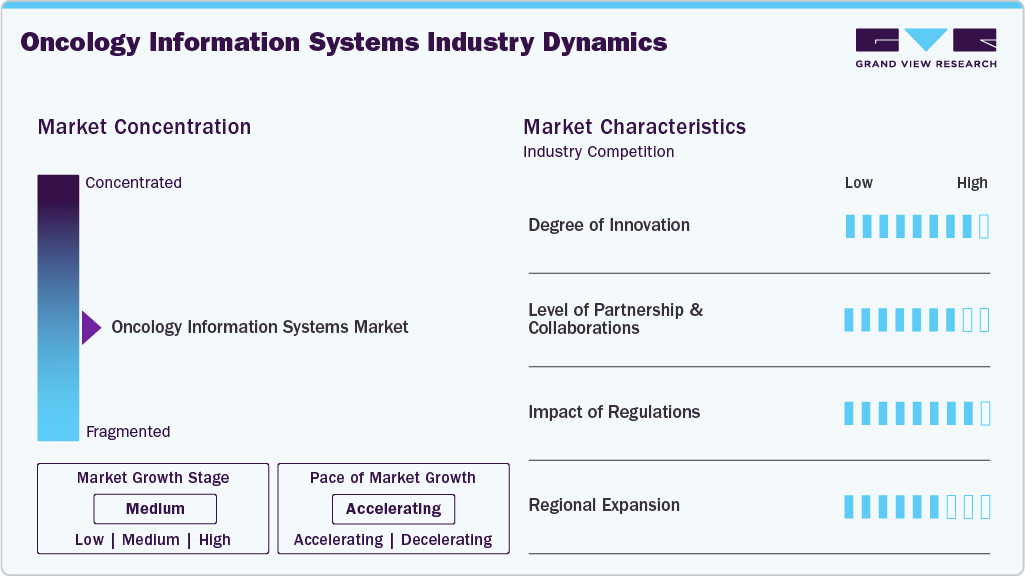
The level of partnerships & collaboration activities by key players in the industry is high to increase their capabilities, expand product portfolios, and improve competencies. For instance, in June 2022, Accuray Incorporated and Limbus AI Inc. entered a strategic partnership to amalgamate Limbus’ AI-powered auto-contouring algorithms with Accuray’s adaptive radiotherapy capabilities.
"Accuray is focused on improving the care of patients undergoing radiation therapy. Providing practical adaptive solutions for clinics of any size, in any location, is one approach, and the software offered by Limbus AI will play a big role in making this goal a reality. The partnership with Limbus represents another step forward for Accuray in the development of innovative artificial intelligence (AI)-driven solutions that meet the needs of providers and enable them to deliver personalized patient care, such as with our Synchrony AI-driven real-time target tracking with dynamic delivery technology, on both the Radixact and CyberKnife Systems."
- Joshua H. Levine, chief executive officer of Accuray.
The impact of regulations on the market is high. Oncology information systems are considered under healthcare information systems. The regulations for Healthcare Information Systems in the U.S. are primarily focused on protecting Personal Health Information (PHI) and ensuring secure data exchange. Moreover, in Europe, the European Medicines Agency (EMA) oversees the regulation of medical devices and software under the Medical Device Regulation (MDR). Regulations such as the Health Insurance Portability and Accountability Act (HIPAA) in the U.S. and the General Data Protection Regulation (GDPR) in Europe impose strict requirements on data privacy and security for software that handles sensitive patient information.
The level of regional expansion in the industry is moderate. Increasing demand for oncology information systems in developing countries, owing to the robust investments in healthcare IT. For instance, in February 2022, Elekta announced the establishment of an office in Manila, Philippines, to expand its business presence and product offerings in Southeast Asian markets. Through this business establishment, Elekta will address the gap in the Philippines’ radiation therapy market and patient accessibility.
Products & Services Insights
Solutions dominated the market with a revenue share of 73.9% in 2025 and is expected to grow at the fastest CAGR during the forecast period. The software solutions used in OIS help maintain patient records, predict treatment results, and plan treatment regimes for cancer patients. These software solutions facilitate the exchange of patient information across healthcare organizations to create a bridge between practitioners and radiology centers, which helps in improving the safety and efficiency of cancer treatment. In addition, these software solutions also help physicians and surgeons select a suitable treatment, which, in turn, helps improve the survival rates of cancer patients. For instance, in December 2024, Varian, a Siemens Healthineers company, received 510(k) clearance from the U.S. FDA to sell its RapidArc Dynamic treatment planning solution.
“RapidArc Dynamic is the latest example of Varian’s sustained investment in innovation, and ushers in a radical transformation in radiotherapy planning and delivery designed to bring flexibility to care teams using arc therapy.”
-said Sasa Mutic, PhD, President, Radiation Oncology Solutions for Varian.
Moreover, the professional services segment is expected to grow significantly over the forecast period, as these services are increasingly outsourced. As hospitals and clinics lack in-house resources and skills required for deployment of OIS software, these services are outsourced. Outsourcing can be a short-term project or a long-term contract.
Application Insights
Medical oncology accounted for the largest revenue share of 61.7% in 2025 and is projected to grow at the fastest CAGR from 2026 to 2033. Medical oncology is a modality of cancer treatment that involves the use of immunotherapy, chemotherapy, hormonal therapy, and targeted therapy. This modality offers a comprehensive and efficient approach to treating cancer. Furthermore, the increasing prevalence of cancer is expected to drive market growth. Increasing usage of the above therapies for effective treatment of cancer is expected to drive market growth.
The surgical oncology and radiation oncology segments are also expected to witness significant growth during the forecast years. Cancer care has evolved rapidly over the decades. Surgery is no longer the treatment for most solid malignancies, but the combination of surgery and multi-modal therapies, mostly focused on radiotherapy, targeted molecular therapies, and chemotherapy, is the preferred treatment. As a result, surgeons must communicate with different specialists for treatment and have to work with a multidisciplinary team. Thus, increasing complexity in surgical treatments for solid malignancies is expected to drive the growth of the surgical oncology OIS market.
End Use Insights
Hospitals & diagnostic imaging centers held the largest revenue share of 47.6% in 2025. Hospitals increasingly adopt OIS to streamline workflows, integrate multidisciplinary data, and enhance treatment planning. By connecting oncologists, radiologists, and pathologists, OIS enables comprehensive patient data management, reducing errors and improving efficiency. In addition, the integration with EHRs minimizes redundant testing and optimizes resource utilization. As hospitals expand radiation oncology services and seek cost-effective cancer care solutions, the demand for OIS is expected to grow, driving market expansion and innovation in oncology treatment.

The ablation care centers and cancer care centers segment is anticipated to grow at the fastest CAGR from 2026 to 2033, driven by the rising adoption of minimally invasive cancer therapies. These centers utilize OIS to integrate real-time imaging, ablation devices, and patient data for precise tumor targeting. These centers utilize OIS to integrate real-time imaging, ablation devices, and patient data for precise tumor targeting. For instance, RaySearch Laboratories’ RayCare OIS supports liver ablation workflows by automating treatment planning and tracking procedural outcomes, enhancing efficiency in clinics.
Regional Insights
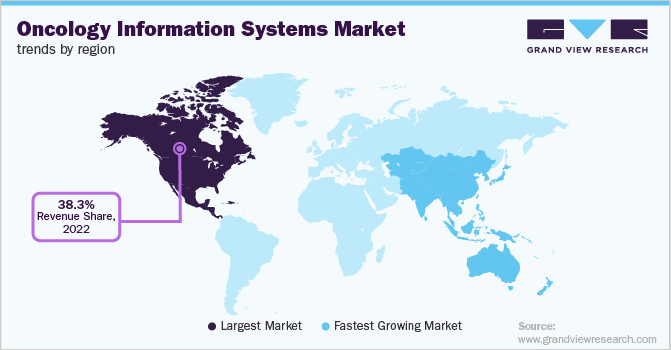
North America oncology information systems market held the largest revenue share of 39.7% in 2025. The use of oncology information systems for cancer patients is on the rise, driven by the need for efficient, precise, and advanced cancer treatment and care methods. In addition, the availability of advanced healthcare infrastructure and cancer research institutions, substantial healthcare spending, high patient disposable incomes, and a well-established reimbursement framework all contribute to the increased implementation of oncology information systems.
U.S. Oncology Information Systems Market Trends
The U.S. oncology information system market held the largest revenue share in 2025. The growing prevalence of cancer among various demographics and the rising demand for advanced innovative oncology information systems are some of the driving factors for the U.S. For instance, according to an article published in the PubMed Journal in January 2024, 2 million new cancer cases were expected to be diagnosed in the U.S. in 2024, with 611,720 cancer deaths. Moreover, an increase in investments in cancer research by companies is driving industry growth. A wide range of novel technologies are being developed, which have the potential to drastically change the treatment regime.
Europe Oncology Information Systems Market Trends
The oncology information systems market in Europe is anticipated to grow significantly over the forecast period. The primary factor driving this demand is the rising prevalence of cancer in European countries. In addition, a shift from conventional cancer care to advanced treatment solutions is contributing to the increased demand for oncology information systems. For instance, in October 2025, Leo Cancer Care introduced Grace, its upright photon therapy system compatible with RaySearch Laboratories' RayCare oncology information system. Moreover, EU policymakers are promoting various digital health programs, which are expected to boost market growth during the forecast period. For instance, the European Federation for Cancer Images (EUCAIM) project is a significant initiative funded by the Digital EU Program (DIGITAL) as part of Europe’s Beating Cancer Plan.
The UK oncology information systems marketis expected to grow significantly over the forecast period. An increasing number of initiatives, including the development of integrated care systems for digital health and eHealth, is expected to drive the UK market. For instance, the NHS in England has allocated USD 22.8 million to 64 NHS trusts. This funding is aimed at deploying artificial intelligence tools specifically designed to expedite the diagnostic process for lung cancer.
The oncology information systems market in Germany dominated Europe with the largest share in 2025. Increase in the significance of IT due to efficient utilization of resources, improvement in workflow & delivery of services, and enhanced patient centricity are significant factors contributing to the growing adoption of these technologies in hospitals. Furthermore, the initiatives taken by the market players are further propelling market growth. For instance, in 2024, the Partex Group, through its companies Innoplexus AG and Amrit AG, presented results from a pilot project at the German Cancer Congress 2024 in Berlin. This project was conducted in collaboration with the German Cancer Society’s Working Group for Internal Oncology (AIO) and aimed to explore the feasibility and effectiveness of modern AI-supported technologies in oncology.
Asia Pacific Oncology Information Systems Market Trends
The oncology information systems market in the Asia Pacific is expected to witness the fastest growth over the forecast period. The region experiences high demand for oncology information systems due to the rising prevalence of cancer and an increase in government spending on healthcare. Furthermore, this region’s market growth can also be attributed to R&D investments in artificial intelligence, producing technologically advanced healthcare solutions. Moreover, developing healthcare infrastructure in Asia Pacific countries, such as Indonesia, China, & India, is expected to propel market growth.
China oncology information systems market held the largest share in 2025. The country’s growing geriatric population and associated increase in disease burden, along with improving healthcare facilities & growing healthcare expenditure, are anticipated to propel the market. The Strengthening Information Society Research Capacity Alliance program states that the State Council requires hospitals to invest at least 5% of their annual revenue in healthcare information systems that include OIS. Thus, such systems are being widely used in large hospitals in China and are being adopted in other healthcare setups.
The oncology information systems market in Indiais expected to grow significantly over the forecast period. The Indian market is driven by the growing geriatric population, increasing burden of chronic diseases, and government initiatives supporting the country’s eHealth scenario. In addition, efforts to improve healthcare infrastructure are likely to boost the market. The Government of India has undertaken various initiatives to support digital health. Significant investments have been made to develop healthcare IT infrastructure.
Latin America Oncology Information Systems Market Trends
The oncology information systems market in Latin America is anticipated to grow significantly. Countries’ steps into digital health have taken various forms, ranging from adopting telemedicine solutions to implementing more extensive standards, such as the government’s approach to applying SNOMED to its medical data systems to accomplish future integration. The advent of 5G technology has opened new avenues for telemedicine, particularly in the field of oncology.
Middle East & Africa Oncology Information Systems Market Trends
The oncology information systems market in MEA is expected to grow significantly over the forecast period. Market growth in this region can be attributed to the steady development of healthcare facilities in emerging economies and an increase in healthcare expenditure. Some of the key countries in the region, such as Saudi Arabia and the UAE, have exhibited significant growth & major changes in healthcare facilities. Furthermore, the growing demand for healthcare IT services, along with the increasing use of blockchain technology in oncology information systems, is anticipated to drive market growth.
Key Oncology Information Systems Company Insights
The market is highly fragmented, with many small and large players operating in this space. This leads to intense competition between smaller players to sustain their position. Strategies such as new product launches and partnerships are playing a key role in propelling the market growth.
Key Oncology Information Systems Companies:
The following key companies have been profiled for this study on the oncology information systems market.
- Accuray Incorporated
- Elekta
- BrainLab
- Prowess, Inc.
- DOSIsoft SA
- FLATIRON HEALTH
- RaySearch Laboratories
- Oracle
- Koninklijke Philips N.V.
- Varian Medical Systems, Inc. (Siemens Healthineers).
Recent Developments
-
In February 2026, Flatiron Health launched AI-powered Panoramic prostate cancer datasets covering nearly 400,000 patients across the US, UK, and Germany. Built on a unified common data model, these datasets aggregate structured and unstructured EHR data, including PSMA-PET scans, PSA values, 19 HRR genes, recurrence, and progression details.
“Flatiron is not just adding more data; we are building the singular destination for global oncology intelligence. By unifying fragmented global records into a single evidence platform, we are fundamentally changing how our customers develop therapies and-most importantly-when patients can access them.”
- Kate Estep, Chief Product Officer at Flatiron Health.
-
In September 2025, RaySearch Laboratories released RayIntelligence v2025, an update to its cloud-based oncology analytics platform. Key enhancements include customizable dashboards and charts for plan quality trends, machine utilization, protocol adherence, and outcome analysis.
-
In June 2025, RaySearch Laboratories released RayCare v2025, its next-generation oncology information system. Key enhancements include Microsoft Word integration for patient documentation within charts, DICOM Modality Worklist for automated imaging workflows, HL7 inbound scheduling from hospital systems, and automatic AJCC 8th edition cancer staging.
-
In May 2025, GE HealthCare expanded its radiation oncology portfolio at ESTRO 2025 with AI-enabled MR Contour DL for organ-at-risk segmentation from MR images. It plans to integrate Spectronic Medical’s MRI Planner for MR-only radiotherapy workflows, thereby enhancing treatment planning precision in the head and neck and pelvic regions.
-
In August 2024, the Connecticut Proton Therapy Center integrated RaySearch Laboratories AB’s oncology information system, RayCare, and the IBA ProteusONE compact proton therapy system as its treatment platform.
“We are happy to welcome yet another RayCare customer. For our installed base of RayStation customers, the selection of RayCare as an oncology information system will enhance efficiency and user experience, both in the treatment planning process and treatment delivery.”
-Johan Löf, founder and CEO, RaySearch
-
In July 2024, MIT and ETH Zurich developed an AI model to detect stages of Ductal Carcinoma in Situ (DCIS) from breast tissue images, helping to accelerate diagnosis and reduce complex testing. These advancements are making OIS essential for delivering data-driven, personalized cancer care and improving patient outcomes.
-
In January 2024, RaySearch Laboratories launched RayStation 2024A, enhancing clinical workflows in treatment planning. RayStation 2024A also integrates with the oncology analytics system RayIntelligence.
Oncology Information Systems Market Report Scope
Report Attribute
Details
Market size value in 2026
USD 3.4 billion
Revenue forecast in 2033
USD 6.0 billion
Growth rate
CAGR of 8.3% from 2026 to 2033
Actual data
2021 - 2024
Forecast period
2026 - 2033
Quantitative units
Revenue in USD million/billion and CAGR from 2026 to 2033
Report coverage
Revenue forecast, company ranking, competitive landscape, growth factors, and trends
Segments covered
Products & services, application, end use, region
Regional scope
North America; Europe; Asia Pacific; Latin America; MEA
Country scope
U.S.; Canada; Mexico; Germany; UK; France; Italy; Spain; Norway; Denmark; Sweden; China; Japan; India; South Korea; Australia; Thailand; Brazil; Argentina; Saudi Arabia; South Africa; UAE; Kuwait
Key companies profiled
Accuray Incorporated; Elekta; Prowess, Inc.; BrainLab; DOSIsoft SA; FLATIRON HEALTH; RaySearch Laboratories; Oracle (Cerner Corporation); Koninklijke Philips N.V.; Varian Medical Systems, Inc. (Siemens Healthineers)
Customization scope
Free report customization (equivalent up to 8 analysts working days) with purchase. Addition or alteration to country, regional & segment scope.
Pricing and purchase options
Avail customized purchase options to meet your exact research needs. Explore purchase options
Global Oncology Information Systems Market Report Segmentation
This report forecasts revenue growth at global, regional, and country levels and provides an analysis of the latest industry trends in each of the sub-segments from 2021 to 2033. For this study, Grand View Research has segmented the global oncology information systems market report based on products & services, application, end use, and region:

-
Products & Services Outlook (Revenue, USD Million, 2021 - 2033)
-
Solutions
-
Patient Information Systems
-
Treatment Planning Systems
-
-
Professional Services
-
-
Application Outlook (Revenue, USD Million, 2021 - 2033)
-
Medical Oncology
-
Radiation Oncology
-
Surgical Oncology
-
-
End Use Outlook (Revenue, USD Million, 2021 - 2033)
-
Hospitals and Diagnostic Imaging Centers
-
Ablation Care Centers and Cancer Care Centers
-
Government Institutions
-
Research Facilities
-
-
Regional Outlook (Revenue, USD Million, 2021 - 2033)
-
North America
-
U.S.
-
Canada
-
Mexico
-
-
Europe
-
UK
-
Germany
-
France
-
Italy
-
Spain
-
Denmark
-
Sweden
-
Norway
-
-
Asia Pacific
-
China
-
Japan
-
India
-
South Korea
-
Australia
-
Thailand
-
-
Latin America
-
Brazil
-
Argentina
-
-
Middle East and Africa (MEA)
-
South Africa
-
Saudi Arabia
-
UAE
-
Kuwait
-
-
Frequently Asked Questions About This Report
The global oncology information systems market size was estimated at USD 3.2 billion in 2025 and is expected to reach USD 3.4 billion in 2026.
The global oncology information systems market is expected to grow at a compound annual growth rate of 8.3% from 2026 to 2033 to reach USD 6.0 billion by 2033.
The medical oncology segment dominated the global oncology information systems market and accounted for the largest revenue share of 61.7% in 2025.
Solutions dominated the OIS market with a share of 73.9% in 2025. This is attributable to the ability of these software solutions to facilitate the exchange of patient information across healthcare organizations, creating a bridge between practitioners and radiology centers, which helps improve the safety and efficiency of cancer treatment.
North America dominated the global oncology information systems market and accounted for the largest revenue share of 39.7% in 2025.
About the authors:
Author: GVR Healthcare IT Research Team | Last Updated:


Share this report with your colleague or friend.
Need a Tailored Report?
Customize this report to your needs — add regions, segments, or data points, with 20% free customization.


ISO 9001:2015 & 27001:2022 Certified
We are GDPR and CCPA compliant! Your transaction & personal information is safe and secure. For more details, please read our privacy policy.












