
- Home
- »
- Electronic Devices
- »
-
Passive Optical Network Market Size Report, 2024-2030GVR Report cover

Passive Optical Network Market (2024 - 2030)
Size, Share & Trends Analysis Report By Structure, By Component, By Application (FTTx, Mobile Backhaul), By Region, And Segment Forecasts
Market Size, 2023
$15.1BMarket Estimate, 2026
$21.7BMarket Forecast, 2030
$37.1BCAGR, 2024–2030
13.9%Passive Optical Network Market Summary
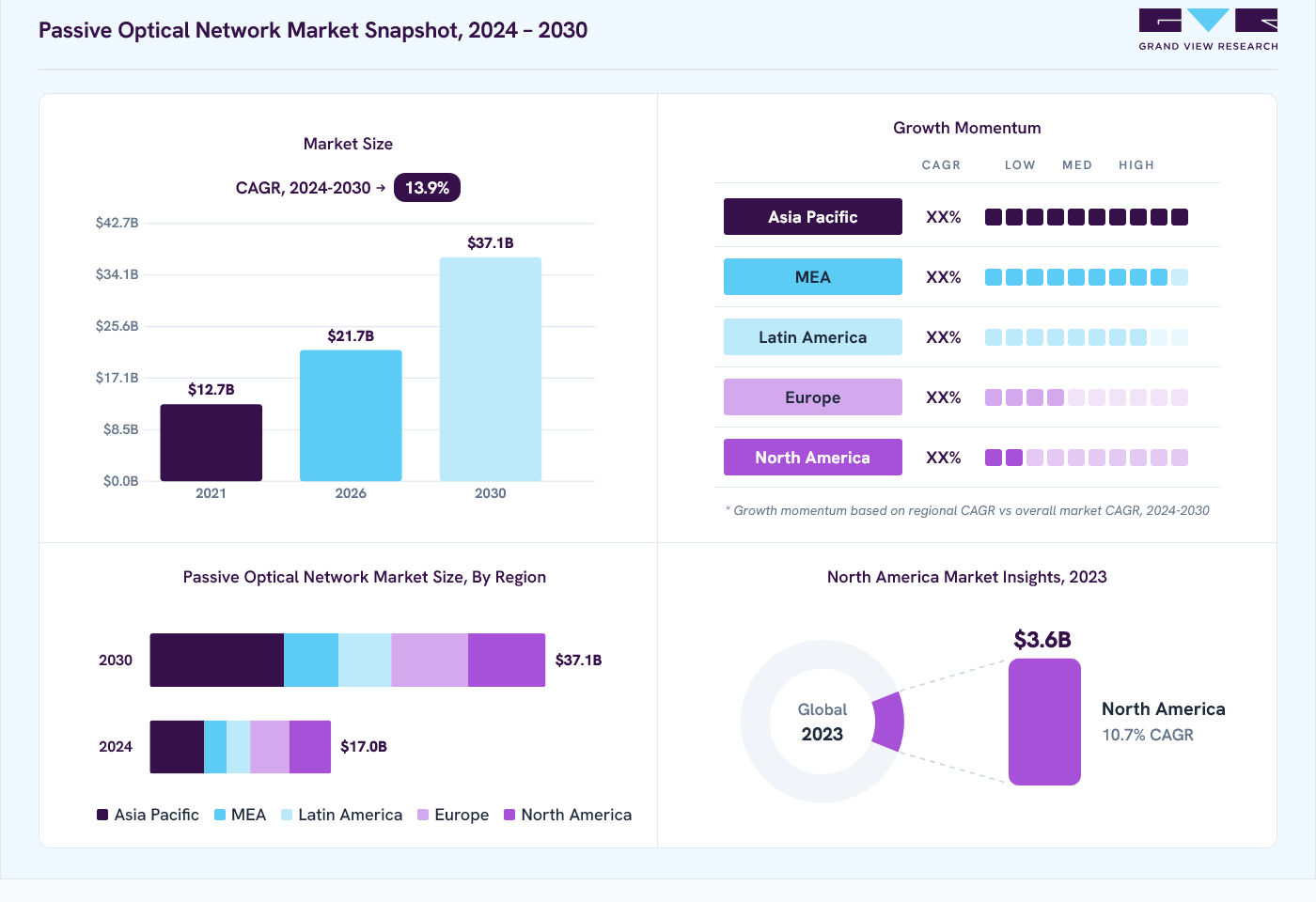
The global passive optical network market size was valued at USD 15.1 billion in 2023 and is projected to grow from USD 21.7 billion in 2026 to USD 37.1 billion by 2030, at a CAGR of 13.9% from 2024 to 2030. The market in Asia Pacific dominated with a revenue share of 29.5% in 2023. With the proliferation of bandwidth-intensive applications, such as streaming services, online gaming, and cloud computing, consumers and businesses require faster and more reliable broadband connections.
 Source: Grand View Research, IR Documents, Primary Interviews, Paid DatabasesTo learn more about this report,
 Download Free Sample Report
 Key Market Trends & Insights
- Asia Pacific passive optical network market accounted for the largest market revenue share of 29.5% in 2023.
- The U.S. passive optical network market accounted for the largest market revenue share in North America.
- By structure, gigabyte passive optical network (GPON) dominated the market and accounted for a share of 44.2% in 2023.
- By component, optical cables accounted for the largest market revenue share in 2023.
- By application, the FTTx segment accounted for the largest market revenue share in 2023.
Market Size & Forecast
- 2023 Market Size: USD 15.12 Billion
- 2030 Projected Market Size: USD 37.1 Billion
- CAGR (2024-2030): 13.9%
- Asia Pacific: Largest market in 2023
- Middle East & Africa: Fastest growing market
Three ways to get this report
Buy it, customize it, or ask a question.Ask an Analyst
Analyst response in 1 business day
- AccessReport author, directly
- Reply timeWithin 1 working day
- No sales callDirect answer only
- FormatEmail reply
- CostFree, no cost
Get the Full Report
What the study covers
- FormatsPDF · Excel · Dashboard
- Timeline2024–2030 annual, 2023 base
- Coverage20+ countries, 5 regions
- Companies10+ key players profiled
Customize the Report
20% free customization
- IncludeCountries, segments, points
- TailorTo your product definition
- ExtendDeeper competitor detail
- OrA fully bespoke study
- Turnaround5–10 working days
With their ability to deliver high data rates and low latency, PON technologies are well-positioned to meet this growing need for seamless connectivity. As cities and communities expand, there is a greater need for robust and scalable broadband networks that can support high data transfer rates and future growth. PON systems are well-suited for these applications because they can support multiple users through a single optical fiber. The global shift towards fiber-to-the-home (FTTH) and fiber-to-the-premises (FTTP) deployments is driving investments in PON infrastructure, as these solutions provide an efficient means to extend high-speed internet access to underserved areas and support the digital transformation of various sectors. To learn more about this report, Download Free Sample Report
 Innovations such as Gigabit Passive Optical Networks (GPON), XG-PON (10-Gigabit PON), and NG-PON2 (Next-Generation PON2) have significantly enhanced the capabilities of PON systems. These advanced technologies offer higher bandwidth, increased efficiency, and better performance than previous generations. The development of these next-generation PON solutions is encouraging ISPs and telecommunications companies to invest in PON technology as they seek to offer higher-speed services and meet their customers' evolving needs.
Structure Insights
Gigabyte Passive Optical Network (GPON) dominated the market and accounted for a share of 44.2% in 2023. As consumers and businesses increasingly rely on high-definition video streaming, online gaming, and cloud-based applications, there is a pressing need for network solutions to deliver higher bandwidth and faster speeds. GPON technology effectively addresses this demand with its capability to provide gigabit speeds to end-users. It offers a scalable solution that supports up to 2.5 Gbps downstream and 1.25 Gbps upstream, enhancing the service offerings and accommodating the ever-growing data needs of its customers.
Ethernet Passive Optical Network (EPON) is expected to register the fastest CAGR of 15.1% during the forecast period. EPON leverages standard Ethernet protocols and passive optical components, which helps reduce initial deployment and long-term operational costs compared to alternative optical networking technologies. The simplicity of the EPON architecture, which uses passive optical splitters to distribute the optical signal, further contributes to its cost efficiency. EPON’s ability to support many users with minimal additional infrastructure investments makes it a scalable solution for expanding existing networks and deploying new ones.
Component Insights
Optical cables accounted for the largest market revenue share in 2023. The expansion of 5G networks and the ongoing evolution of wireless technologies have amplified the need for robust and high capacity backhaul networks. Optical cables are pivotal in providing the bandwidth and low latency required to support the seamless connectivity and data transfer demands of 5G infrastructure. As the deployment of 5G continues to gain momentum globally, the demand for optical cables within the PON market is expected to experience significant growth.
The Optical Network Terminal (ONT) is expected to register the fastest CAGR during the forecast period. Applications such as 4K video streaming, online gaming, virtual reality (VR), and telecommuting require high bandwidth and low latency. ONTs are crucial components in PON networks that deliver high-speed internet to end-users. They convert the optical signal from the fiber network into an electrical signal that can be used by end-user devices.
Application Insights
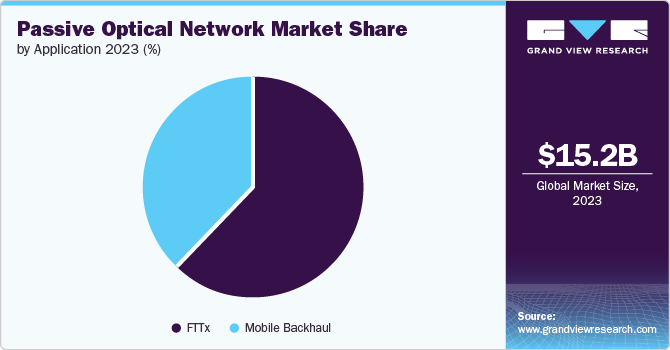
The FTTx segment accounted for the largest market revenue share in 2023. FTTx solutions offer a scalable and future-proof infrastructure as businesses and service providers seek to build resilient networks that support future growth and technological advancements. FTTx networks are designed to accommodate increased data traffic and integrate new technologies as they become available, providing a long-term solution for high-speed internet connectivity. Furthermore, FTTx technologies provide the necessary infrastructure to support smart city initiatives and IoT applications, offering high-bandwidth and low-latency connections.
 To learn more about this report, Download Free Sample Report
 The mobile backhaul segment is anticipated to grow at the fastest CAGR over the forecast period. As fiber optic networks extend to new locations, there is an increasing need for mobile backhaul solutions to leverage this expanding infrastructure. PON technology provides a cost-effective and scalable solution for mobile backhaul, allowing service providers to utilize existing fiber optic networks to connect mobile base stations and improve network coverage.
Regional Insights
North America passive optical network market held a substantial market share in 2023. Government initiatives and funding programs aimed at expanding broadband access drive the market in North America. Programs such as the Federal Communications Commission’s (FCC) Rural Digital Opportunity Fund (RDOF) and the Infrastructure Investment and Jobs Act (IIJA) provide financial support for the deployment of high-speed internet infrastructure, especially in underserved and rural areas. These initiatives focus on improving broadband accessibility and bridging the digital divide by funding the installation of fiber optic networks.
U.S. Passive Optical Network Market Trends
The U.S. passive optical network market accounted for the largest market revenue share in North America. Advancements in fiber optic technology have been instrumental in fueling the growth of the PON market in the U.S. Wavelength Division Multiplexing (WDM) and passive optical splitters have enhanced the efficiency and performance of PON systems, enabling higher data transmission rates over longer distances. These technological advancements have made PON networks more reliable, scalable, and cost-effective, driving their adoption across various industry verticals.
Europe Passive Optical Network Market Trends
Europe passive optical market was identified as a lucrative region in 2023. As European consumers and businesses continue to embrace data-intensive applications such as ultra-high-definition video streaming, online gaming, and remote work, the demand for faster and more reliable internet connections is growing. PON technologies, including GPON (Gigabit Passive Optical Network) and XG-PON (10-Gigabit Passive Optical Network), offer the high-speed, high-bandwidth solutions necessary to meet these evolving demands.
The UK passive optical market is anticipated to grow significantly over the forecast period. The UK telecommunications sector is increasingly focused on expanding FTTH networks to improve broadband service quality and compete in the market. The shift towards FTTH as a preferred broadband solution reflects a broader trend towards investing in fiber optic infrastructure to provide future-proof internet services. This growing emphasis on FTTH deployments supports the expansion of the PON market in the UK.
Asia Pacific Passive Optical Network Market Trends
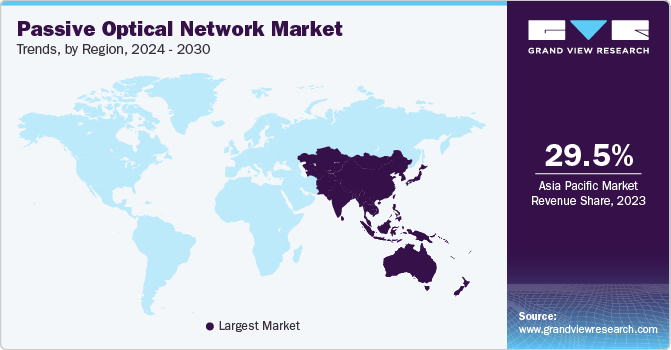
Asia Pacific passive optical network market accounted for the largest market revenue share of 29.5% in 2023. The rapid urbanization and increasing population density in the Asia Pacific are contributing to the expansion of PON networks. As urban areas become more densely populated, the demand for high-speed internet and advanced communication services escalates, creating a favorable environment for adopting PON technology. In addition, the growing number of residential and commercial construction projects in urban areas is driving the deployment of fiber-based PON solutions to meet the escalating connectivity needs.
 To learn more about this report, Download Free Sample Report
 China passive optical network market is anticipated to grow significantly over the forecast period. The increasing adoption of cloud services and data-intensive applications drives the need for higher bandwidth capacities in China. PON technology offers bandwidth efficiency and scalability advantages compared to traditional copper-based networks. As businesses and consumers continue embracing cloud computing and streaming services, the demand for PON solutions is expected to grow.
Middle East & Africa Passive Optical Network Market Trends
Middle East & Africa passive optical network market is anticipated to register the fastest CAGR over the forecast period. Government initiatives and national broadband strategies drive the growth of the PON market in the Middle East and Africa. Many countries in the region have launched plans to improve their telecommunications infrastructure. For instance, Saudi Arabia’s Vision 2030 includes expanding fiber-optic networks as a critical component of its digital transformation goals. Similarly, South Africa’s National Broadband Policy aims to enhance internet coverage and access through increased investment in broadband infrastructure.
Key Passive Optical Network Company Insights
Some of the key companies in the passive optical network market include Adtran, Calix, Inc., Huawei Technologies Co., Ltd., ZTE Corporation, Mitsubishi Electric Corporation, and others. Organizations are focusing on increasing their customer base to gain a competitive edge in the industry. Therefore, key players are taking several strategic initiatives.
-
ZTE Corporation offers a range of products to meet different requirements in a PON system. This involves smart OLTs managing data flow at the central office, ONTs at customer premises with Wi-Fi and VoIP capabilities, and passive splitters effectively dividing the signal for multiple users.
-
Adtran provides various passive optical network (PON) solutions specifically designed for the core network equipment. The company offers software-defined optical line terminals (SDX 6000 Series), which are flexible and open devices. These OLTs provide options for different PON standards, such as GPON, XGS-PON, and Combo PON (GPON and XGS-PON).
Key Passive Optical Network Companies:
The following are the leading companies in the passive optical network market. These companies collectively hold the largest market share and dictate industry trends.
- Adtran
- Calix, Inc.
- Huawei Technologies Co., Ltd.
- Mitsubishi Electric Corporation
- ZTE Corporation
- Fujitsu
- NXP Semiconductors
- TP-LINK CORPORATION PTE. LTD.
- Luna Innovations Incorporated
- Silixa Ltd
Recent Developments
-
In October 2023, ZTE Corporation launched the industry’s first Tbit all-optical access platform, ZXA10 C600E. This platform is designed to meet the increasing demand for high-bandwidth and low-latency services in the era of 5G and cloud computing.
Passive Optical Network Market Report Scope
Report Attribute
Details
Market size in 2023
USD 15.1 billion
Estimated market size in 2026
USD 21.7 billion
Projected market size by 2030
USD 37.1 billion
Growth Rate
CAGR of 13.9% from 2024 to 2030
Base year for estimation
2023
Historical data
2017 - 2022
Forecast period
2024 - 2030
Report updated
September 2024
Quantitative units
Revenue in USD billion/million and CAGR from 2024 to 2030
Report coverage
Revenue forecast, company ranking, competitive landscape, growth factors, and trends
Segments covered
Structure, component, application, region
Regional scope
North America; Europe; Asia Pacific; Latin America; MEA
Country scope
U.S.; Canada; Mexico; Germany; UK; France; China; Japan; India; South Korea; Australia; Brazil; South Africa; UAE; South Africa
Key companies profiled
Adtran; Calix, Inc.; Huawei Technologies Co., Ltd.; Mitsubishi Electric Corporation; ZTE Corporation; Fujitsu; NXP Semiconductors; TP-LINK CORPORATION PTE. LTD.; Luna Innovations Incorporated; Silixa Ltd.
Customization scope
Free report customization (equivalent up to 8 analysts working days) with purchase. Addition or alteration to country, regional & segment scope.
Pricing and purchase options
Avail customized purchase options to meet your exact research needs. Explore purchase options
Global Passive Optical Network Market Report Segmentation
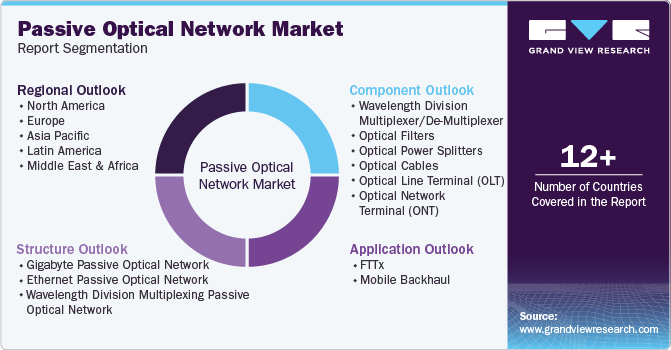
This report forecasts revenue growth at global, regional, and country levels and provides an analysis of the latest industry trends in each of the sub-segments from 2017 to 2030. For this study, Grand View Research has segmented the global passive optical network market report based on structure, component, application, and region:
 To learn more about this report, Download Free Sample Report
 -
Structure Outlook (Revenue, USD Million, 2017 - 2030)
-
Gigabyte Passive Optical Network (GPON)
-
Ethernet Passive Optical Network (EPON)
-
Wavelength Division Multiplexing Passive Optical Network (WDM-PON)
-
-
Component Outlook (Revenue, USD Million, 2017 - 2030)
-
Wavelength Division Multiplexer/De-Multiplexer
-
Optical Filters
-
Optical Power Splitters
-
Optical Cables
-
Optical Line Terminal (OLT)
-
Optical Network Terminal (ONT)
-
-
Application Outlook (Revenue, USD Million, 2017 - 2030)
-
FTTx
-
Mobile Backhaul
-
-
Regional Outlook (Revenue, USD Million, 2017 - 2030)
-
North America
-
U.S.
-
Canada
-
Mexico
-
-
Europe
-
Germany
-
UK
-
France
-
-
Asia Pacific
-
China
-
Japan
-
India
-
South Korea
-
Australia
-
-
Latin America
-
Brazil
-
-
Middle East and Africa (MEA)
-
Saudi Arabia
-
UAE
-
South Africa
-
-
Frequently Asked Questions About This Report
Key players include Adtran; Calix, Inc.; Huawei Technologies Co., Ltd.; Mitsubishi Electric Corporation; ZTE Corporation; Fujitsu; NXP Semiconductors; TP-LINK CORPORATION PTE. LTD.; Luna Innovations Incorporated; Silixa Ltd.
With the proliferation of bandwidth-intensive applications, such as streaming services, online gaming, and cloud computing, consumers and businesses require faster and more reliable broadband connections.
The global passive optical network market size was valued at USD 15.1 billion in 2023 and is estimated at USD 21.7 billion for 2026.
The global passive optical network market is expected to grow at a CAGR of 13.9% from 2024 to 2030, reaching USD 37.1 billion by 2030.
Asia Pacific dominated with a 29.5% revenue share in 2023.
About the Author(s)
Electronic Devices Research Team
Semiconductors & Electronics · Electronic DevicesThis report was authored by the electronic devices research team at Grand View Research - comprising two research analysts, one senior research analyst, and one industry expert - with specialized expertise in the electronic devices segment of the semiconductors & electronics industry. All findings are based on proprietary semiconductors & electronics databases, executive interviews, and regulatory analysis, subject to internal peer review prior to publication.
Last Updated:
Speak to Analyst

Customize this report to your needs - add regions, segments, or data points, with 20% free customization.
Or view our licence options:


ISO 9001:2015 & 27001:2022 Certified
We are GDPR and CCPA compliant! Your transaction & personal information is safe and secure. For more details, please read our privacy policy.


