
- Home
- »
- Catalysts & Enzymes
- »
-
Phase-transfer Catalyst Market Share Analysis, Industry Report, 2026-2033GVR Report cover
![Phase-transfer Catalyst Market (2026 - 2033)Report]()
Phase-transfer Catalyst Market (2026 - 2033)
Size, Share & Trends Analysis Report By Type (Ammonium Salts, Potassium Salts), By End-use (Pharmaceuticals, Agriculture, Chemical), By Region (North America, Europe, Asia Pacific, Central and South America), And Segment Forecasts
Market Size, 2025
$1.2BMarket Estimate, 2026
$1.3BMarket Forecast, 2033
$1.9BCAGR, 2026–2033
6.3%Phase-transfer Catalyst Market Summary
The global phase-transfer catalyst market was valued at USD 1.2 billion in 2025 and is projected to grow from USD 1.3 billion in 2026 to USD 1.9 billion in 2033, at a CAGR of 6.3% from 2026 to 2033. The North America market dominated with a revenue share of approximately 27.0% in 2025. Growth is driven by the widespread use of phase-transfer catalysts (PTCs) in organic synthesis across the chemical, pharmaceutical, polymer, agrochemical, food, and cosmetics industries.
Key Market Trends & Insights
- By type: The ammonium salts segment held the largest market share of around 48.0% in 2025.
- By end-use: The pharmaceuticals segment held the largest market share in 2025.
Regional Highlights
- Largest regional market: North America (More than 27.0% revenue share, 2025)
- Fastest-growing regional market: Asia Pacific (highest CAGR, 2026-2033)
- The U.S. phase-transfer catalyst market held a significant position within the North American region.
Market Size & Forecast
- Market size in 2025: USD 1.2 Billion
- Estimated market size in 2026: USD 1.3 Billion
- Projected market size by 2033: USD 1.9 Billion
- CAGR (2026-2033): 6.3%
Three ways to get this report
Buy it, customize it, or ask a question.Ask an Analyst
A direct answer, usually in 1 working day
- AccessReport author, directly
- Reply timeWithin 1 working day
- No sales callDirect answer only
- FormatEmail reply
- CostFree, no cost
Get the Full Report
What the study covers
- FormatsPDF · Excel · Dashboard
- Timeline2026–2033 annual, 2025 base
- Coverage20+ countries, 5 regions
- Companies10+ key players profiled
Customize the Report
20% free customization
- IncludeCountries, segments, points
- TailorTo your product definition
- ExtendDeeper competitor detail
- OrA fully bespoke study
- Turnaround5–10 working days
PTCs enhance reaction speed under milder conditions, improve process flexibility and reliability, and allow safer, cost-effective bases such as sodium hydroxide instead of expensive, hazardous organic bases. The pharmaceutical industry is a major end user of phase transfer catalysts, which are widely used to synthesize pharmaceutical ingredients and intermediates. They are employed across various essential chemical reactions, including alkylation, nucleophilic substitution, esterification and amidation, Hofmann elimination, asymmetric synthesis, and microwave-assisted reactions. The catalysts commonly used in these processes are crown ethers, quaternary ammonium salts, sulfonium salts, and phosphine oxides, selected based on compatibility with specific solvents and reactants used in pharmaceutical synthesis.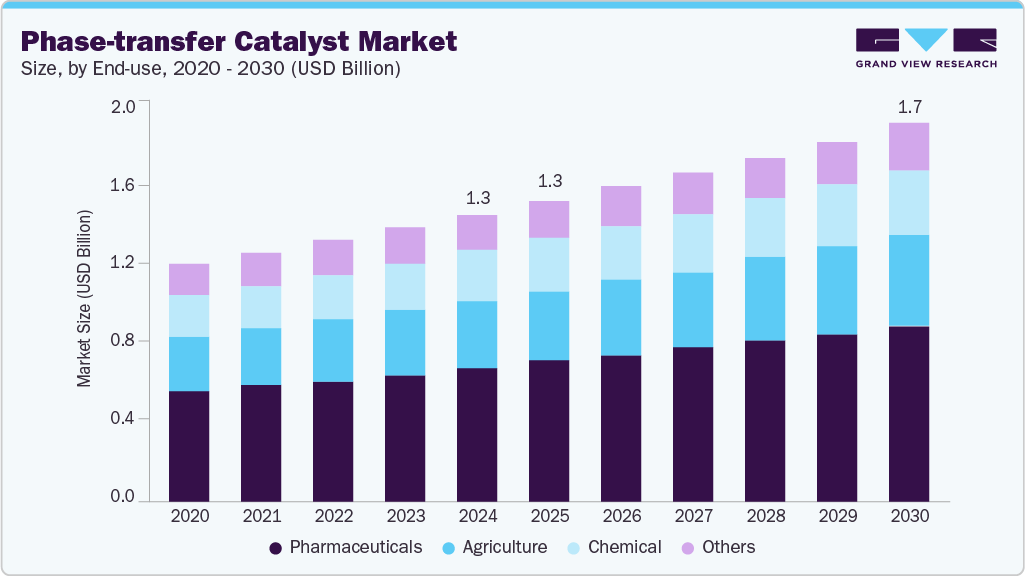
The growing reliance on PTCs in pharmaceutical manufacturing contributes to increased product innovation and improved process efficiency. By enabling reactions between immiscible phases such as aqueous and organic solutions, PTCs reduce the need for harmful solvents and support cleaner synthesis pathways. This enhances the conversion efficiency of active compounds and reduces chemical waste generation. In addition, maintaining better control over reaction conditions helps achieve higher selectivity and yield, which drives steady adoption of PTCs within the pharmaceutical segment.
Analyst Perspective
The phase-transfer catalyst market is significantly growing, driven by rising demand from the pharmaceutical, agrochemical, specialty chemical, and polymer industries. Phase-transfer catalysts are used by manufacturers to reduce environmental impact and increase production cost efficiency, owing to their ability to facilitate chemical reactions more efficiently and scalable processed under milder conditions.
As manufacturers are increasingly using green chemistry practices, the phase-transfer catalyst market is witnessing increased adoption of the phase-transfer catalysts. In addition, innovation in phase-transfer catalyst market and growing importance of environmentally sustainable production processes are resulting in the growth of the market.
Type Insights
The ammonium salts segment accounted for the largest revenue share of more than 48.0% in 2025. This growth is driven by their extensive use in alkylation and nucleophilic substitution reactions across the chemical and polymer industries. Tetra-n-butylammonium Bromide (TBAB), a widely used quaternary ammonium salt, is a PTC in various industrial processes. It plays a key role in the Williamson ether synthesis, a reaction essential for producing ethers, surfactants, and pharmaceutical intermediates. The rising demand for TBAB is closely linked to the expanding pharmaceutical and agrochemical sectors, which require efficient and scalable synthesis methods. It is also impelled by supportive government initiatives. In March 2026, the API Innovation Center announced the expansion of strategic partnership with U.S. Department of Health and Human Services (HHS) to boost domestic manufacturing of critical medicines and support the U.S. pharmaceutical supply chain. These salts also facilitate anion transfer in chemical processes and monomer transfer in polymer synthesis, underscoring their importance in enabling cleaner, safer, and more efficient production systems within the phase-transfer catalyst industry.
The potassium salts segment is expected to grow notably during the forecast period. Potassium salt-based PTCs are commonly used in halogenation and esterification reactions because they form stable, water-soluble complexes. These salts are vital in producing herbicides, insecticides, and pest control formulations in the agrochemical sector. Their effectiveness in enabling selective and environmentally safer reactions continues to drive demand across chemical and agricultural applications.
End Use Insights
The pharmaceuticals segment dominated the market in 2025. The pharmaceutical industry utilizes PTCs in synthesis, drug formulation, research and development, and other laboratory applications. Stringent regulations in Europe and North America regarding harmful compounds have driven higher adoption of PTCs, as they reduce reliance on organic solvents and toxic reactants, aligning with stricter environmental and safety standards. The phase-transfer catalyst industry continues to benefit from this regulatory shift, particularly in pharmaceutical manufacturing, where cleaner, more efficient processes are prioritized.
The agriculture segment is expected to grow at a significant rate over the forecast period. This growth is driven by the role of PTCs in enhancing the efficiency and control of chemical reactions used in agrochemical synthesis. PTCs enable reactions under mild conditions with simplified work-up processes, making them suitable for large-scale industrial applications. One notable use is in synthesizing specialty agrochemicals, including extracting and separating compounds such as crown ethers from aqueous solutions.
Regional Insights
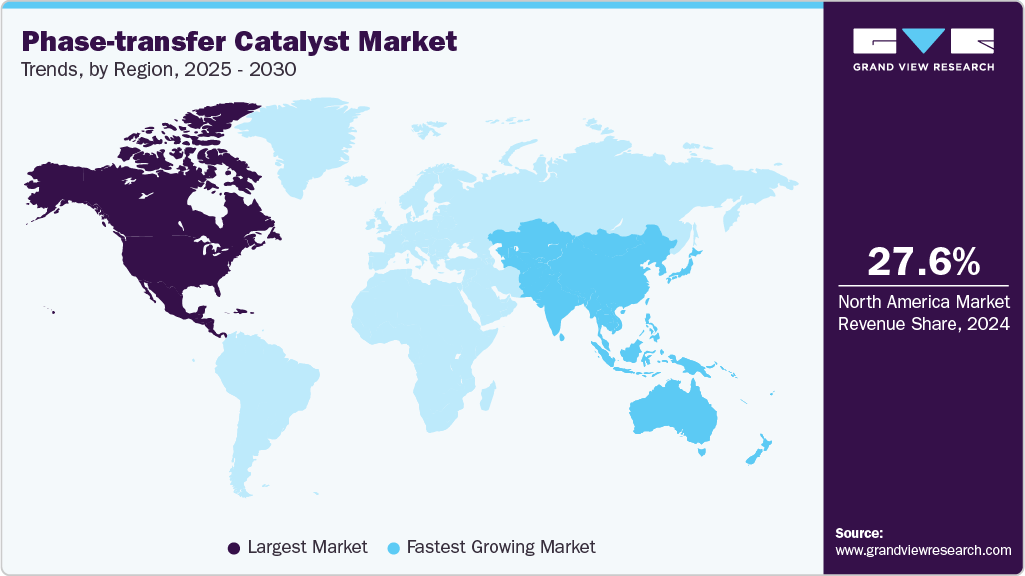
North America phase-transfer catalysts market dominated the global market with more than 27.0% share in 2025. This leadership is attributable to the presence of large end-user industries in the region, such as pharmaceuticals and agriculture, and supportive government regulations.
U.S. Phase-transfer Catalyst Market Trends
The U.S. phase-transfer catalyst market held a significant position within the North American region, driven by increasing demand from key sectors such as pharmaceuticals, chemicals, and agrochemicals. PTCs are highly valued for enhancing reaction efficiency, enabling cost-effective production, and supporting greener chemical processes. Continuous investments and regulatory initiatives that support sustainable and efficient chemical manufacturing further enhance the strong market position. In April 2025, Clariant with Technip Energies launched StyroMax UL-100. This newly developed new catalyst is designed for styrene production, enabling high energy efficiency with low steam to oil ratios.
Moreover, innovations in catalyst formulations and an emphasis on sustainable manufacturing contribute to market growth. The Environmental Protection Agency’s (EPA) Green Chemistry Challenge Awards highlight technologies that minimize hazardous chemicals, water usage, and emissions—benefits that are closely associated with PTCs. These advancements propel the U.S. market forward by encouraging the adoption of advanced PTC technologies.
Europe Phase-transfer Catalyst Market Trends
Europe phase-transfer catalyst market accounted for a significant share of the overall market in 2025. PTCs are widely used in processes such as the production of resins, plastics, and other petrochemical products, contributing to higher product yields and reduced waste. In addition, Europe is a major producer of specialty chemicals for industries such as coatings, adhesives, and cosmetics. The phase-transfer catalyst industry benefits from the region’s emphasis on sustainability and process efficiency, as PTCs help improve product quality while minimizing the use of hazardous reagents. This aligns with stringent environmental regulations and growing demand for greener chemical processing solutions across the continent.
Asia Pacific Phase-transfer Catalyst Market Trends
Asia Pacific phase-transfer catalysts market is expected to grow at the fastest CAGR, driven by rapid industrial growth and an expanding chemical manufacturing sector. Rising demand from pharmaceuticals, agrochemicals, and specialty chemicals fuels this expansion. PTCs are used to enhance reaction efficiency, lower production costs, and support greener, more sustainable chemical processes. This growth is supported by government initiatives and increasing investments to strengthen domestic production capacities. In India, the government introduced the Production-linked Incentive (PLI) scheme to boost the manufacturing of pharmaceuticals. This initiative is expected to strengthen the industry's competitiveness and drive greater adoption of PTCs. With ongoing investments in advanced manufacturing and R&D, the use of PTCs is steadily increasing in the region. Moreover, tightening environmental regulations and a stronger focus on eco-friendly technologies accelerate PTC adoption, as these catalysts help reduce hazardous waste and energy consumption. These factors make Asia Pacific a key contributor to the global growth of the phase-transfer catalyst industry.
China phase-transfer catalyst market held a major share of the Asia Pacific market, driven by its large-scale chemical manufacturing base and rapidly evolving industrial ecosystem. With growing demand across pharmaceuticals, agrochemicals, and specialty chemicals, the country is experiencing a steady rise in the adoption PTCs to enhance process efficiency and reduce production costs. Government-led initiatives such as “Made in China 2025” further support this trend by promoting industrial upgrades and driving the adoption of environmentally sustainable technologies. As regulatory standards tighten and the focus on cleaner production intensifies, chemical manufacturers are increasingly turning to PTCs for their ability to minimize hazardous waste and energy usage. Combined with robust investments in R&D and capacity expansion, these factors reinforce China's role as a key contributor to regional and global growth.
Key Phase-transfer Catalyst Companies Insights
The phase-transfer catalyst industry features a range of global, regional, and local players, making it a competitive market. The world’s leading companies are using partnerships, collaborations, acquisitions, mergers, and agreements as strategies to withstand the intense competition and increase their market share.
Key Phase-transfer Catalyst Companies
The following key companies have been profiled for this study on the phase-transfer catalyst market:
-
SACHEM, INC.
-
Tokyo Chemical Industry Co., Ltd.
-
Nippon Chemical Industrial Co., Ltd.
-
Pat Impex India
-
Tatva Chintan Pharma Chem Limited
-
Central Drug House
-
Volant-Chem Corp.
-
Pacific Organics Pvt Ltd
-
Otto Chemie Pvt. Ltd.
Phase-transfer Catalyst Market Report Scope
Report Attribute
Details
Market size in 2025
USD 1.2 billion
Estimated market size in 2026
USD 1.3 billion
Projected market size by 2033
USD 1.9 billion
Growth rate
CAGR of 6.3% from 2026 to 2033
Base year for estimation
2025
Actual data
2021 – 2024
Forecast period
2026 – 2033
Quantitative units
Revenue in USD billion, and CAGR from 2026 to 2033
Report coverage
Revenue forecast, company ranking, competitive landscape, growth factors, and trends
Segments covered
Type, end use, and region
Regional Scope
North America, Europe, Asia Pacific, Central & South America, Middle East & Africa
Country Scope
U.S.; Canada; Mexico; Germany; UK; France; Italy; Spain; China; India; Japan; Brazil; Argentina; Saudi Arabia; South Africa.
Key companies profiled
SACHEM, INC.; Tokyo Chemical Industry Co., Ltd.; Nippon Chemical Industrial Co., Ltd.; Pat Impex India; Tatva Chintan Pharma Chem Limited; Central Drug House; Volant-Chem Corp.; Pacific Organics Pvt Ltd; Otto Chemie Pvt. Ltd..
Customization scope
Free report customization (equivalent up to 8 analysts working days) with purchase. Addition or alteration to country, regional & segment scope.
Pricing and purchase options
Avail of customized purchase options to meet your exact research needs. Explore purchase options
Global Phase-transfer Catalyst Market Report Segmentation
This report forecasts revenue growth at global, regional, and country levels and provides an analysis of the latest industry trends and opportunities in each of the sub-segments from 2021 to 2033. For the purpose of this study, Grand View Research has segmented the global phase-transfer catalyst market report based on type, end use, and region:

-
Type Outlook (Volume, Revenue, USD Million, 2021 - 2033)
-
Ammonium Salts
-
Potassium Salts
-
Others
-
-
End-Use Outlook (Revenue, USD Million, 2021 - 2033)
-
Pharmaceuticals
-
Agriculture
-
Chemical
-
Others
-
-
Regional Outlook (Volume, Revenue, USD Million, 2021 - 2033)
-
North America
-
U.S.
-
Canada
-
Mexico
-
-
Europe
-
Germany
-
UK
-
France
-
Italy
-
Spain
-
-
Asia Pacific
-
China
-
India
-
Japan
-
-
Central & South America
-
Brazil
-
Argentina
-
-
Middle East & Africa
-
Saudi Arabia
-
South Africa
-
-
Frequently Asked Questions About This Report
The ammonium salts phase-transfer catalyst segment accounted for the largest revenue share of over 48.0% in 2025
The global phase-transfer catalyst market was valued at USD 1.2 billion in 2025 and is projected to grow from USD 1.3 billion in 2026
The global phase-transfer catalyst market is expected to grow at a CAGR of 6.3% from 2026 to 2033, reaching USD 1.9 billion
North America dominated the global market with largest revenue share of more than 27.0% in 2025.
Key players in the market include SACHEM, INC., Tokyo Chemical Industry Co., Ltd., Nippon Chemical Industrial Co., Ltd., Pat Impex India, Tatva Chintan Pharma Chem Limited, Central Drug House, and others
The pharmaceutical industry is a key end-user of phase transfer catalysts in facilitating reactions for the synthesis of pharma ingredients and intermediates. PTCs are used in several types of reactions in the pharma industry such as alkylation, nucleophilic substitution, esterification and amidations, Hofmann elimination, asymmetric synthesis, and microwave-assisted reactions.
About the Author(s)
Catalysts & Enzymes Research Team
Specialty & Chemicals · Catalysts & EnzymesThis report was authored by the catalysts & enzymes research team at Grand View Research - comprising two research analysts, one senior research analyst, and one industry expert - with specialized expertise in the catalysts & enzymes segment of the specialty & chemicals industry. All findings are based on proprietary specialty & chemicals databases, executive interviews, and regulatory analysis, subject to internal peer review prior to publication.
Last Updated:
Speak to Analyst


Customize this report to your needs - add regions, segments, or data points, with 20% free customization.
Or view our licence options:


ISO 9001:2015 & 27001:2022 Certified
We are GDPR and CCPA compliant! Your transaction & personal information is safe and secure. For more details, please read our privacy policy.


