
- Home
- »
- Advanced Interior Materials
- »
-
Plastic Injection Molding Machine Market Report, 2026-2033GVR Report cover

Plastic Injection Molding Machine Market (2026 - 2033)
Size, Share & Trends Analysis Report By Technology (Hydraulic, Electric, Hybrid), By End-use (Automotive, Electronics, Packaging, Construction, Consumer Goods, Medical), By Region, And Segment Forecasts
Market Size, 2025
$13.5BMarket Estimate, 2026
$14.2BMarket Forecast, 2033
$19.7BCAGR, 2026–2033
4.8%Plastic Injection Molding Machine Market Summary
The global plastic injection molding machine market size was valued at USD 13.5 billion in 2025 and is projected to grow from USD 14.2 billion in 2026 to USD 19.7 billion by 2033, at a CAGR of 4.8% from 2026 to 2033. Asia Pacific dominated the market, accounting for a revenue share of 40.0% in 2025. The adoption of injection-molded components is anticipated to increase across a variety of industries, including automotive, electronics, consumer products, packaging, and others, due to rapid technological advancements and growing awareness of sustainable manufacturing.
Key Market Trends & Insights
- By technology: The hydraulic technology segment held the largest market share of around 50.0% in 2025.
- By end use: The automotive segment held the largest market share of around 30.0% in 2025.
Regional Highlights
- Largest regional market: Asia Pacific (40.0% revenue share, 2025)
- Fastest-growing regional market: Central & South America (highest CAGR, 2026-2033)
Market Size & Forecast
- Market size in 2025: USD 13.5 Billion
- Estimated market size in 2026: USD 14.2 Billion
- Projected market size by 2033: USD 19.7 Billion
- CAGR (2026-2033): 4.8%
Three ways to get this report
Buy it, customize it, or ask a question.Ask an Analyst
A direct answer, usually in 1 working day
- AccessReport author, directly
- Reply timeWithin 1 working day
- No sales callDirect answer only
- FormatEmail reply
- CostFree, no cost
Get the Full Report
What the study covers
- FormatsPDF · Excel · Dashboard
- Timeline2026–2033 annual, 2025 base
- Coverage20+ countries, 5 regions
- Companies10+ key players profiled
Customize the Report
20% free customization
- IncludeCountries, segments, points
- TailorTo your product definition
- ExtendDeeper competitor detail
- OrA fully bespoke study
- Turnaround5–10 working days
Manufacturers are focusing on developing plastic injection molding machines that can reduce production costs, provide greater production flexibility, reduce scrap and maintenance needs, shorten production cycle time, and improve efficiency. New plastic injection molding processes, such as foam injection molding, co-injection molding, gas-assisted injection molding, and multiple-component injection molding, are driving high demand for injection-molded materials. This technological advancement has driven the adoption of plastic injection molding machines across industries such as medical, electronics, construction, aerospace, and defense. Moreover, factors such as quiet operation, energy savings, reduced material waste, and lower power requirements are expected to boost demand for plastic injection molding machines.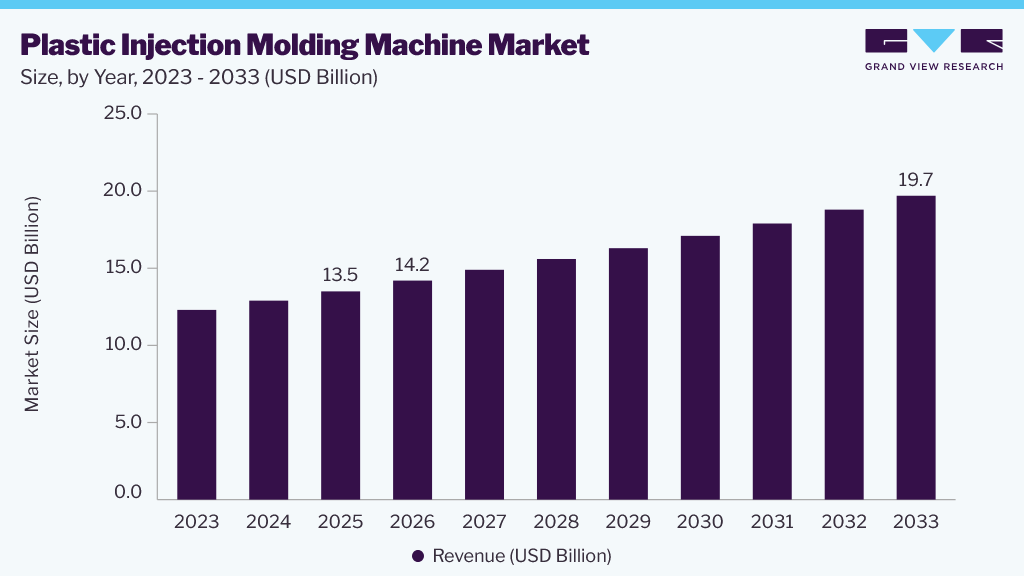 Source: Grand View Research, IR Documents, Primary Interviews, Paid DatabasesTo learn more about this report,
 Download Free Sample Report
 Factors such as easy access to new and advanced technologies in the EV industry, the availability of a highly skilled workforce, advanced processing capabilities, and increased R&D initiatives have boosted the penetration of electric vehicles in the U.S. Favorable government regulations and initiatives, such as tax rebates and subsidies, have further fueled demand for electric vehicles in the U.S. The rising demand for plastic injection-molded components in conventional and electric vehicles for various interior and exterior parts is expected to support market growth.
The growing demand for on-the-go packaged products, driven by rising purchasing power and a busy lifestyle in the U.S., is expected to boost the packaging industry's growth in the country. A plastic injection molding machine is used to manufacture various packaging products, including containers, bottles, caps & closures, and covers. Growth in the packaging industry, coupled with rising adoption of plastic injection molding machines for packaging product manufacturing, is expected to drive market growth in the country.
Analyst Perspective
The global plastic injection molding machine industry is transitioning toward highly automated, energy-efficient, sustainable, and precision manufacturing systems as industries increasingly demand complex, lightweight, and cost-effective plastic components. Market growth is supported by rising adoption across the automotive, medical, packaging, electronics, and consumer goods sectors, where manufacturers require greater production flexibility, shorter cycle times, and improved product quality. Technological advancements, particularly in all-electric and hybrid injection molding machines, are further promoting sustainable manufacturing by reducing energy consumption, material waste, and operating costs. High initial investment costs and volatility in raw material prices remain key challenges for the market. In addition, ongoing product innovations, capacity expansions, and increasing investments in advanced manufacturing facilities are expected to strengthen market growth and create new opportunities through the forecast period.
Technology Insights
The hydraulic technology segment led the market with the largest revenue share of about 50.0% in 2025. The segment is expected to grow due to factors such as the ability to produce large quantities of parts, intricate parts for the automotive industry, lower initial costs, production of precise molds, higher wear and tear resistance of hydraulic parts, and widespread use in the automotive, marine, and aerospace industries, where heavy force is required. For instance, in November 2025, Shibaura Machine Co., Ltd. showcased its S-GenXt 180-7A Hydraulic Injection Molding Machine, featuring proprietary binary injection technology designed to improve precision, reduce cycle times, enable IIoT monitoring, and lower production costs. This development highlights continuous innovation and demand for hydraulic injection molding solutions in high-volume manufacturing applications.
The electric plastic injection molding machine is anticipated to grow at the fastest CAGR of around 5.0% from 2026 to 2033. These machines are highly efficient and require less start-up time and runtime than their hydraulic equivalents. Electric injection molding machines can reduce energy consumption by approximately 30% to 70% compared with conventional hydraulic machines, depending on machine configuration and production conditions. These machines are driven by digitally controlled servo motors, enabling precise, faster, cleaner, more energy-efficient, and repeatable operations. The plastic injection molding process is predictable and can be replicated consistently, thereby providing high-quality components. Furthermore, the need for labor has decreased as automation has increased, lowering labor costs and increasing profit margins. For instance, in June 2025, The Japan Steel Works, Ltd. (JSW) launched the world’s first 4,000-ton electric injection molding machine, the J4000F-22000H. This machine extends the capabilities of all-electric molding technology for large-scale automotive and EV component production while offering energy efficiency and high precision.
End Use Insights
The automotive segment led the market with the largest revenue share of around 30.0%. in 2025. The increasing demand for lightweight automotive components and rising automotive production are expected to propel market growth. In the automotive industry, plastic injection molding machines play a vital role in manufacturing complex, high-precision components that require consistent quality, durability, and dimensional accuracy. These machines enable the large-scale production of lightweight plastic parts that help improve vehicle performance, fuel efficiency, and design flexibility. Plastic injection molding is widely used to produce a broad range of automotive components, including dashboards, bumpers, exterior body panels, electrical housings, door panels, door trims, grilles, wheel arches, fenders, mudguards, trunk trims, floor rails, and sensor holders. The ability of injection molding technology to manufacture complex, lightweight shapes with high repeatability and cost efficiency is expected to contribute to the segment growth in the forecast period.
The medical segment is anticipated to grow at the fastest CAGR of around 6.0% over the forecast period. Plastic injection molding machines are used in the medical industry to manufacture small, complex items such as dental implants, prosthetic replacements, endoscopic instruments, tweezers, scissors, implantable components, orthopedic devices, and drug-delivery equipment. The increasing demand for medical disposables, technological advancements, and rising plastic consumption in healthcare applications are driving growth in the plastic injection molding machine industry. For instance, in June 2025, Netstal Maschinen AG. announced the next-generation Elion MED all-electric injection molding machine for medical technology applications. The machine was specifically developed to improve production efficiency, precision, and process reliability for manufacturing medical components such as autoinjector housings, reflecting the increasing adoption of advanced injection molding technologies in the healthcare sector.
Regional Insights
The plastic injection molding machine market in North America accounted for a significant share in 2025. The growing demand for on-the-go packaged products, driven by increasing purchasing power and a busy lifestyle, is expected to positively impact the packaging industry growth in North America. A plastic injection molding machine is used to manufacture various packaging products, including containers, bottles, caps & closures, and covers. Growth in the packaging industry, coupled with the rising adoption of plastic injection molding machines in this region for the manufacture of packaging products, is expected to drive market growth. For instance, in March 2025, ENGEL opened a new production facility in Querétaro, Mexico, to expand regional manufacturing capacity for injection molding machines and automation solutions. The expansion is intended to improve machine availability and delivery times across the Americas, highlighting increasing investments in plastic injection molding infrastructure within the region.
Asia Pacific Plastic Injection Molding Machine Market Trends
Asia Pacific dominated the global plastic injection molding machine market with the largest revenue share of around 40.0% in 2025, owing to massive investments by governments across the region in public infrastructure development and residential construction expansion. Furthermore, global awareness of energy conservation is rising, which is expected to support market demand further. For instance, in November 2025, ROSTI Group inaugurated a new state-of-the-art injection molding and contract manufacturing facility in Chennai, India, expanding its footprint in Asia to meet growing demand across the industrial, medical, and consumer sectors. Such expansion strategies reflect continued investments in injection molding manufacturing capacity across the region.
 To learn more about this report, Download Free Sample Report
 Europe Plastic Injection Molding Machine Market Trends
The plastic injection molding machine market in Europe held the second-largest revenue share in the market in 2025. The flourishing electronics sector has expanded the scope of applications in the region, driven by the growing adoption of flexible electronics in Europe. The plastic injection molding machine is used to manufacture electronic components, including sensors, meters, testing equipment, electronic connectors, and processing equipment.
Central and South America Plastic Injection Molding Machine Market Trends
The plastic injection molding machine market in Central and South America is expected to grow at the fastest CAGR of approximately 5.0% from 2026 to 2033. Demand for plastic injection molding machines is expected to grow substantially, driven by the expansion of manufacturing facilities in emerging economies across the region. This is projected to have a positive impact on industrial construction, thereby boosting the industry demand over the forecast period.
Key Plastic Injection Molding Machine Company Insights
The manufacturers adopt several strategies, including geographic expansion, product launches, and mergers & acquisitions, to enhance market penetration and meet evolving technological requirements across applications such as automotive, consumer goods, packaging, and others.
Key Plastic Injection Molding Machine Companies
The following key companies have been profiled for this study on the global plastic injection molding machine market:
-
Arburg GmbH + Co. KG
-
HAITIAN INTERNATIONAL
-
KraussMaffei
-
Milacron
-
NISSEI PLASTIC INDUSTRIAL CO., LTD.
-
ENGEL AUSTRIA GmbH
-
Chen Hsong Holdings Limited
-
UBE Machinery Inc.
-
Husky Technologies
-
WITTMANN Technology GmbH
Recent Developments
- In October 2025, Dr. Boy introduced a new series of all-electric injection molding machines featuring redesigned injection units and electromechanical drive systems. The launch enhances process precision, energy efficiency, and automation capabilities, thereby strengthening the company’s offering in the growing all-electric molding machine segment.
- In October 2025, Tederic Machinery Co., Ltd. launched a new INNOVA electro-hydraulic injection molding machine series. Developed specifically for packaging applications, the new platform expands the company’s global machine portfolio and thereby supports future market growth.
- In October 2025, UBE Machinery Corporation, Ltd. announced the launch of the 5500emIII, the world’s largest electric injection molding machine with a clamping force of 5,500 metric tons. The new machine was developed to meet demand for large plastic components while delivering the precision and energy efficiency.
- In October 2025, Arburg GmbH + Co KG launched its new Allrounder Trend injection molding machine series at K 2025. The machine range was designed to enable cost-effective operation, simplified maintenance, and seamless integration with automation, thereby making advanced injection molding technology more accessible to manufacturers.
- In September 2024, Dr. Boy GmbH & Co. KG expanded its Electric series by introducing the Boy 35 Electric, Boy 50 Electric, and Boy 80 Electric injection molding machines. The new models feature redesigned drive systems, inverter technology, electromechanical injection, and dosing units. The launch highlights ongoing innovation in electric and hybrid-electric injection molding technologies, supporting the market growth.
Plastic Injection Molding Machine Market Report Scope
Report Attribute
Details
Market size in 2025
USD 13.5 billion
Estimated market size in 2026
USD 14.2 billion
Projected market size by 2033
USD 19.7 billion
Growth rate
CAGR of 4.8% from 2026 to 2033
Base year for estimation
2025
Historical data
2021 – 2024
Forecast period
2026 – 2033
Quantitative units
Revenue in USD million/billion, and CAGR from 2026 to 2033
Report coverage
Revenue forecast, company ranking, competitive landscape, growth factors, and trends
Segments covered
Technology, end-use, region
Regional scope
North America; Europe; Asia Pacific; Central & South America; Middle East & Africa
Country scope
U.S.; Canada; Mexico; Germany; France; Italy; UK; China; India; Japan; Australia; Brazil; Argentina; Saudi Arabia; South Africa
Key companies profiled
Arburg GmbH + Co KG; HAITIAN INTERNATIONAL; KraussMaffei; Milacron; NISSEI PLASTIC INDUSTRIAL CO, LTD.; ENGEL AUSTRIA GmbH; Hsong Holdings Limited; UBE Machinery Inc.; Husky Technologies; WITTMANN Technology GmbH
Customization scope
Free report customization (equivalent up to 8 analysts working days) with purchase. Addition or alteration to country, regional & segment scope.
Pricing and purchase options
Avail of customized purchase options to meet your exact research needs. Explore purchase options
Global Plastic Injection Molding Machine Market Report Segmentation
This report forecasts revenue growth at the global, regional, and country levels and provides an analysis of the latest trends in each sub-segment from 2021 to 2033. For this study, Grand View Research has segmented the global plastic injection molding machine market report based on technology, end-use, and region:
- Technology Outlook (Revenue, USD Billion, 2021 - 2033)
- Hydraulic
- Electric
- Hybrid
- End Use Outlook (Revenue, USD Billion, 2021 - 2033)
- Automotive
- Consumer Goods
- Packaging
- Electronics
- Construction
- Medical
- Others
- Regional Outlook (Revenue, USD Billion, 2021 - 2033)
- North America
- U.S.
- Canada
- Mexico
- Europe
- Germany
- France
- Italy
- UK
- Asia Pacific
- China
- India
- Japan
- Australia
- Central & South America
- Brazil
- Argentina
- Middle East & Africa
- Saudi Arabia
- South Africa
- North America
Frequently Asked Questions About This Report
The global plastic injection molding machine market size was valued at USD 13.5 billion in 2025 and is estimated at USD 14.2 billion for 2026.
The global plastic injection molding machine market is expected to grow at a CAGR of 4.8% from 2026 to 2033, reaching USD 19.7 billion.
Asia Pacific dominated with a 40.0% revenue share in 2025.
Key players in the market include Arburg GmbH + Co KG, HAITIAN INTERNATIONAL, KraussMaffei, Milacron, NISSEI PLASTIC INDUSTRIAL CO., LTD., ENGEL AUSTRIA GmbH, Hsong Holdings Limited, UBE Machinery Inc., Husky Technologies, and WITTMANN Technology GmbH.
The hydraulic plastic injection molding machine segment accounted for the largest revenue share of approximately 50.0% in 2025.
About the Author(s)
Advanced Interior Materials Research Team
Advanced Materials · Advanced Interior MaterialsThis report was authored by the advanced interior materials research team at Grand View Research - comprising two research analysts, one senior research analyst, and one industry expert - with specialized expertise in the advanced interior materials segment of the advanced materials industry. All findings are based on proprietary advanced materials databases, executive interviews, and regulatory analysis, subject to internal peer review prior to publication.
Last Updated:
Speak to Analyst

Customize this report to your needs - add regions, segments, or data points, with 20% free customization.
Or view our licence options:


ISO 9001:2015 & 27001:2022 Certified
We are GDPR and CCPA compliant! Your transaction & personal information is safe and secure. For more details, please read our privacy policy.


