
- Home
- »
- Organic Chemicals
- »
-
Polyester Hot Melt Adhesives Market Size Report, 2026-2033GVR Report cover
![Polyester Hot Melt Adhesives Market (2026 - 2033)Report]()
Polyester Hot Melt Adhesives Market (2026 - 2033)
Size, Share & Trends Analysis Report By Application (Packaging, Textiles and Fabrics, Automotive, Electrical & electronics), By Region (North America, Europe, Asia Pacific, Latin America, Middle East & Africa) And Segment Forecasts
Market Size, 2025
$559.3MMarket Estimate, 2026
$623.7MMarket Forecast, 2033
$1,324.6MCAGR, 2026–2033
11.4%Polyester Hot Melt Adhesives Market Summary
The global polyester hot melt adhesives market size was valued at USD 559.3 million in 2025 and is projected to grow from USD 623.7 million in 2026 to USD 1324.6 million by 2033, at a CAGR of 11.4% from 2026 to 2033. The market in Asia Pacific dominated with a revenue share of 44.1% in 2025. The growth is primarily driven by rising demand across textiles & fabrics, packaging, automotive, and electronics applications, where strong adhesion, thermal stability, and durability are essential.

Key Market Trends & Insights
- By application: The textiles & fabrics segment led the market with the largest revenue share of 33.7% in 2025.
- By application: The packaging segment is expected to grow at the fastest CAGR of 12.3% during the forecast period.
Regional Highlights
- Largest regional market: Asia Pacific (44.1% revenue share, 2025)
- The polyester hot melt adhesives industry in the China held the largest revenue share in 2025.
Market Size & Forecast
- Market size in 2025: USD 559.3 Million
- Estimated market size in 2026: USD 623.7 Million
- Projected market size by 2033: USD 1324.6 Million
- CAGR (2026-2033): 11.4%
Increasing adoption of polyester hot melt adhesives in lamination, bonding, and assembly processes, along with the growing focus on sustainable, solvent-free adhesive solutions, is further supporting market expansion.A key factor driving the growth of the global polyester hot melt adhesives industry is its widespread application across high-demand sectors such as textiles & fabrics, packaging, automotive, and electronics, where bonding strength, durability, and thermal resistance are critical. These applications often require polyester hot melt adhesives with enhanced characteristics, including strong adhesion to diverse substrates, heat stability, flexibility, and consistent performance to ensure product quality and operational efficiency. With increasing focus on improving production efficiency, product durability, and end-use performance, manufacturers are investing in advanced polyester hot melt adhesive formulations and specialty grades to meet evolving industry requirements.
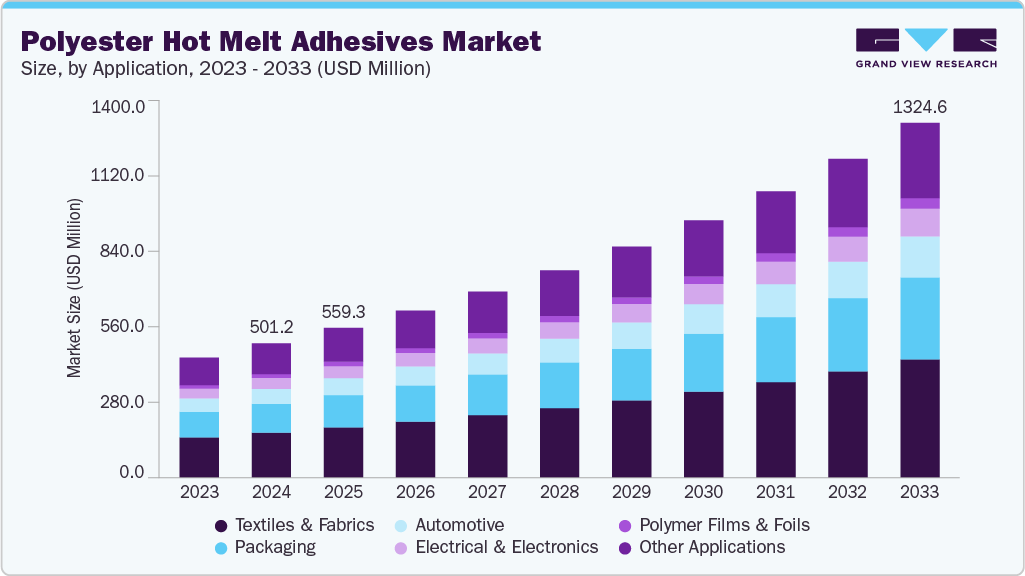
Rising awareness of sustainability, eco-friendly materials, and solvent-free adhesive technologies, along with the growing adoption of polyester hot melt adhesives in emerging applications such as high-performance packaging and technical textiles, is further supporting market expansion. However, challenges such as volatility in raw material prices, complex formulation requirements, and stringent environmental regulations continue to influence the competitive dynamics of the global market.
Market Concentration & Characteristics
The global polyester hot melt adhesives industry is moderately fragmented, with market share distributed among leading adhesive manufacturers, specialty producers, and regional suppliers. Key participants, including major players such as The 3M Company, Arkema (Bostik), Dow Chemical, H.B. Fuller Company, Henkel Corporation, and Avery Dennison Corporation, play a significant role in shaping the competitive landscape. These companies leverage strong research and development capabilities, proprietary adhesive formulations, integrated manufacturing operations, and extensive distribution networks, enabling them to meet the rising demand across applications such as textiles & fabrics, packaging, automotive, and electronics.
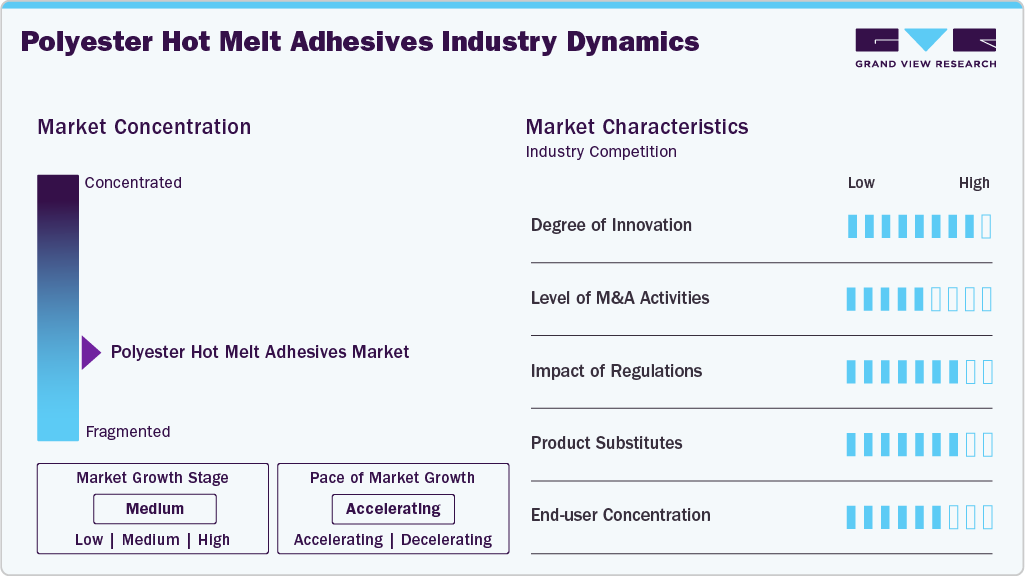
At the same time, emerging players in Asia Pacific, Latin America, and the Middle East & Africa are steadily expanding their presence in the global polyester hot melt adhesives industry by leveraging cost-efficient manufacturing, growing industrial infrastructure, and rising regional demand across textiles & fabrics, packaging, and automotive applications. These regional suppliers are supported by strategic investments in advanced adhesive formulations, research and development capabilities, and robust quality control systems to enhance product performance and consistency.
Application Insights
The textiles & fabrics segment led the market with the largest revenue share of 33.7% in 2025. The segment’s dominance is supported by the widespread use of polyester hot melt adhesives in fabric lamination, seam bonding, and interlining applications, where properties such as strong adhesion, flexibility, and wash resistance are critical. Rising demand for technical textiles, apparel manufacturing, and nonwoven products is further driving segment growth.
The packaging segment is expected to grow at the fastest CAGR of 12.3% during the forecast period. The growing demand for high-performance adhesive solutions that offer fast setting time, strong bonding, and compatibility with diverse substrates is driving adoption in flexible packaging, labeling, and carton sealing applications. In addition, innovations in advanced, sustainable adhesive formulations are enabling improved efficiency and performance to meet modern packaging requirements.
Regional Insights
Asia Pacific dominated the global polyester hot melt adhesives market with the largest revenue share of 44.1% in 2025 and is projected to grow at the fastest CAGR during the forecast period, driven by strong demand from textiles & fabrics, packaging, and automotive applications across the region. The market benefits from rapidly expanding manufacturing infrastructure, growing industrial output, and the increasing adoption of advanced adhesive formulations to enhance bonding performance, durability, and processing efficiency. The presence of both established and emerging manufacturers, along with the growing adoption of high-performance solutions in technical textiles, flexible packaging, and electronics, continues to support substantial growth across the region.
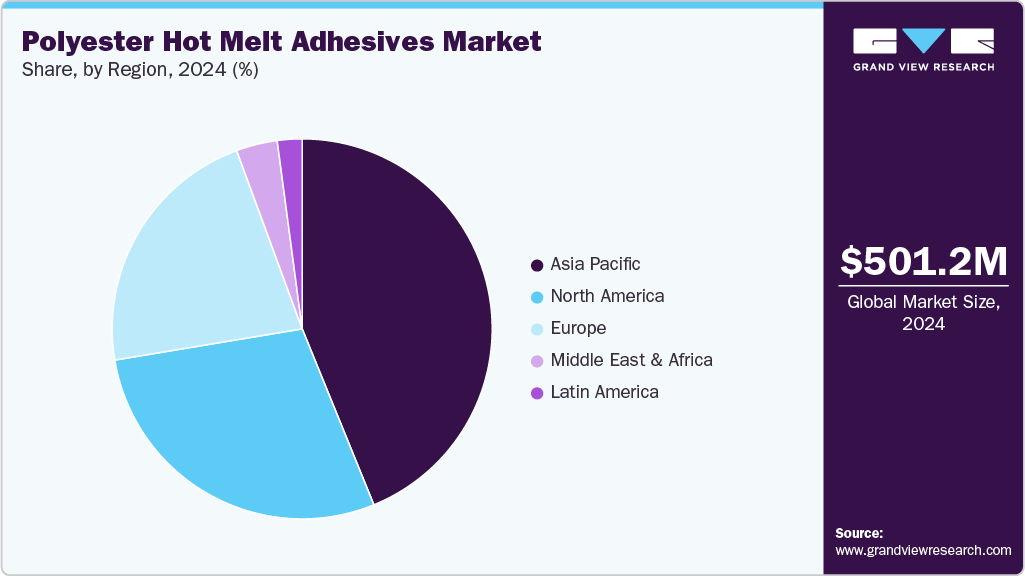
The polyester hot melt adhesives market in China accounted for the largest market revenue share in Asia Pacific in 2025, driven by strong demand from textiles & fabrics, packaging, and electronics applications. The country’s expanding manufacturing base, rising industrial investments, and focus on high-performance, sustainable adhesive solutions continue to support growth. Both domestic manufacturers and international technology providers are actively developing advanced, multifunctional formulations to meet evolving performance requirements and industry standards across key applications.
North America Polyester Hot Melt Adhesives Market Trends
The polyester hot melt adhesives market in North America is driven by strong demand from packaging, automotive, and electronics applications, supported by well-established manufacturing infrastructure, technological advancements, and high adoption of performance-oriented adhesive solutions. The increasing emphasis on durability, bonding efficiency, and eco-friendly formulations is accelerating the adoption of advanced polyester hot melt adhesives across key applications, including flexible packaging, product assembly, and specialty laminations. Manufacturers are increasingly leveraging high-performance and multifunctional formulations to enhance product performance, operational efficiency, and sustainability.
U.S. Polyester Hot Melt Adhesives Market Trends
The polyester hot melt adhesives market in the U.S. held a significant share in North America in 2025, underpinned by high demand in packaging, automotive, and electronics applications. Growth is supported by mature manufacturing infrastructure, strong technological capabilities, and a well-established distribution network. The increasing adoption of innovative, high-performance adhesive formulations is enabling manufacturers to deliver enhanced bonding strength, thermal stability, and multifunctional performance across applications. In addition, ongoing investments in R&D and sustainable adhesive technologies are helping companies address evolving market requirements and maintain a competitive edge in both domestic and export markets.
Europe Polyester Hot Melt Adhesives Market Trends
The polyester hot melt adhesives market in Europe is driven by growing demand for high-performance adhesive solutions across packaging, automotive, and electronics applications, supported by a mature manufacturing ecosystem and a strong focus on innovation and product quality. The rising adoption of eco-friendly, multifunctional formulations is driving growth across sectors such as automotive, construction, and industrial assembly, where durability, bonding efficiency, and sustainability are key priorities.
The Germany polyester hot melt adhesives market is a key country-level market within Europe, driven by robust demand from automotive, industrial manufacturing, and packaging sectors. Growth is supported by the country’s focus on technological innovation, high-quality production, and compliance with strict environmental standards. Manufacturers are increasingly adopting advanced polyester hot-melt adhesive formulations to improve bonding strength, durability, and performance across applications such as vehicle components, industrial assembly, and high-performance packaging, reinforcing Germany’s position as a leading market in the region.
Latin America Polyester Hot Melt Adhesives Market Trends
The polyester hot melt adhesives market in Latin America is experiencing robust growth, driven by rising demand for high-performance adhesive solutions in packaging, automotive, and industrial applications. The expansion of industrial infrastructure, adoption of advanced adhesive technologies, and increased focus on bonding efficiency, durability, and multifunctional performance are supporting regional market development. The region is also witnessing steady growth in product adoption, with demand for polyester hot melt adhesives expected to grow rapidly from 2026 to 2033. Key countries with expanding manufacturing capabilities and industrial activities are creating new opportunities for specialty and high-performance adhesive applications.
Middle East and Africa Polyester Hot Melt Adhesives Market Trends
The polyester hot melt adhesives market in the Middle East & Africa is witnessing steady growth, driven by increasing demand for high-performance adhesive solutions across packaging, construction, and industrial applications. The rising adoption of polyester hot melt adhesives, known for their strong bonding strength, durability, and environmental resistance, particularly in construction and industrial assembly, is fueling regional market expansion. Furthermore, ongoing investments in manufacturing capabilities, advanced adhesive technologies, and distribution networks are supporting broader market penetration and strengthening the region’s position in the global industry.
Key Polyester Hot Melt Adhesives Company Insights
The global polyester hot melt adhesives industry features a mix of established manufacturers, specialty adhesive producers, and advanced materials technology providers. Leading participants focus on developing high-performance, multifunctional adhesive solutions while incorporating sustainable manufacturing practices. Companies are increasingly investing in advanced formulations, innovative processing technologies, and eco-friendly materials to enhance competitiveness and comply with evolving industry standards and regulations.
Prominent players in the market include The 3M Company, Arkema (Bostik), Dow Chemical, H.B. Fuller Company, Henkel Corporation, and among others. These companies leverage extensive R&D capabilities, global manufacturing networks, and advanced technological expertise to deliver eco-friendly, high-performance polyester hot melt adhesives across applications such as textiles & fabrics, packaging, automotive, and electronics worldwide.
Key Polyester Hot Melt Adhesives Companies:
The following key companies have been profiled for this study on the polyester hot melt adhesives market.
- The 3M Company
- Arkema (Bostik)
- Dow Chemical
- H.B. Fuller Company
- Henkel Corporation
- Avery Dennison Corporation
- Sika India
- Evonik Industries
- TEX YEAR INDUSTRIES INC.
- Jowat SE
- Paramelt
- Palmetto Adhesives
Recent Developments
-
In May 2025, Arkema’s Bostik invested USD 27 million in its Middleton, Massachusetts, facility to enhance the capacity and reliability of high molecular weight polyester production. Such expansions support rising demand for high-performance polyester hot melt adhesives across key applications. In addition, the focus on sustainability aligns with evolving industry regulations, driving innovation and overall market growth.
-
In October 2024, Palmetto Adhesives acquired the assets of AccuBond Corporation, a Pennsylvania-based adhesive manufacturer. This acquisition strengthens its manufacturing presence in the Northeastern U.S. and expands its hot melt adhesive portfolio, including polyester-based formulations. The move enhances production capacity, broadens regional reach, and improves its ability to offer customized adhesive solutions, supporting growth in the market across North America.
Polyester Hot Melt Adhesives Market Report Scope
Report Attribute
Details
Market size in 2025
USD 559.3 million
Estimated market size in 2026
USD 623.7 million
Projected market size by 2033
USD 1,324.6 million
Growth rate
CAGR of 11.4% from 2026 to 2033
Base year for estimation
2025
Historical data
2021 - 2024
Forecast period
2026 - 2033
Quantitative units
Revenue in USD million/billion, Volume in Kilotons, and CAGR from 2026 to 2033
Report coverage
Revenue forecast, company ranking, competitive landscape, growth factors, and trends
Segments covered
Product, application, region
Regional scope
North America; Europe; Asia Pacific; Middle East & Africa; Latin America
Country scope
U.S.; Canada; Mexico; Germany; UK; France; Italy; Spain; China; India; Japan; South Korea; Brazil; Argentina; South Africa; Saudi Arabia
Key companies profiled
The 3M Company; Arkema (Bostik); Dow Chemical; H.B. Fuller Company; Henkel Corporation; Avery Dennison Corporation; Sika India; Evonik Industries; TEX YEAR INDUSTRIES INC.; Jowat SE; Paramelt; Palmetto Adhesive
Customization scope
Free report customization (equivalent up to 8 analysts’ working days) with purchase. Addition or alteration to country, regional & segment scope.
Pricing and purchase options
Avail customized purchase options to meet your exact research needs. Explore purchase options
Global Polyester Hot Melt Adhesives Market Report Segmentation
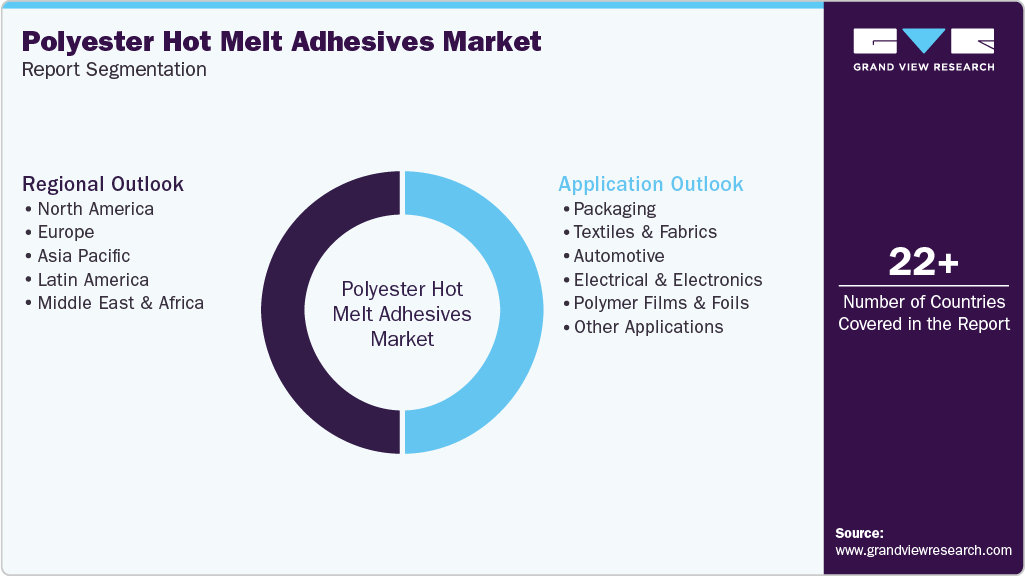
This report forecasts revenue growth at global, regional, and country levels and provides an analysis of the latest industry trends in each of the sub-segments from 2021 to 2033. For this study, Grand View Research has segmented the global polyester hot melt adhesives market report based on application, and region.
-
Application Outlook (Volume, Kilotons; Revenue, USD Million, 2021 - 2033)
-
Packaging
-
Textiles & fabrics
-
Automotive
-
Electrical & electronics
-
Polymer films & foils
-
Other Applications
-
-
Regional Outlook (Volume, Kilotons; Revenue, USD Million, 2021 - 2033)
-
North America
-
U.S.
-
Canada
-
Mexico
-
-
Europe
-
Germany
-
UK
-
France
-
Italy
-
Spain
-
-
Asia Pacific
-
China
-
India
-
Japan
-
South Korea
-
-
Latin America
-
Brazil
-
Argentina
-
-
Middle East & Africa
-
Saudi Arabia
-
South Africa
-
-
Frequently Asked Questions About This Report
The global polyester hot melt adhesives market size was estimated at USD 559.3 million in 2025 and is expected to reach USD 623.7 million in 2026.
The global polyester hot melt adhesives market is expected to grow at a compound annual growth rate of 11.4% from 2026 to 2033 to reach USD 1324.6 million by 2033.
The textiles & fabrics segment led with a 33.7% revenue share in 2025.
Asia Pacific dominated with a 44.1% revenue share in 2025.
The saturated polyester hot melt adhesives segment held the largest share of 67.6% in 2025 within the global polyester hot melt adhesives market. This dominant position is largely due to its excellent thermal stability, strong adhesion properties, and consistent performance across diverse substrates. Widespread use of saturated polyester hot melt adhesives in applications such as textiles & fabrics, packaging, and automotive continues to sustain its strong market presence.
Some of the key players operating in the global polyester hot melt adhesives market include The 3M Company, Arkema (Bostik), Dow Chemical, H.B. Fuller Company, Henkel Corporation, Avery Dennison Corporation, Sika India, Evonik Industries, TEX YEAR INDUSTRIES INC., Jowat SE, Paramelt, and Palmetto Adhesives.
Key factors driving the growth of the global polyester hot melt adhesives market include increasing demand for high-performance adhesive solutions across textiles & fabrics, packaging, automotive, and electronics applications, along with a growing emphasis on enhancing bonding strength, durability, and functional performance. Rising adoption of advanced polyester hot melt adhesive formulations, offering properties such as thermal stability, flexibility, and strong substrate compatibility, is further supporting market expansion.
About the Author(s)
Organic Chemicals Research Team
Bulk Chemicals · Organic ChemicalsThis report was authored by the organic chemicals research team at Grand View Research - comprising two research analysts, one senior research analyst, and one industry expert - with specialized expertise in the organic chemicals segment of the bulk chemicals industry. All findings are based on proprietary bulk chemicals databases, executive interviews, and regulatory analysis, subject to internal peer review prior to publication.
Last Updated:
Speak to Analyst


Customize this report to your needs — add regions, segments, or data points, with 20% free customization.
Or view our licence options:


ISO 9001:2015 & 27001:2022 Certified
We are GDPR and CCPA compliant! Your transaction & personal information is safe and secure. For more details, please read our privacy policy.


