PEEK 3D Printing Materials Market Summary
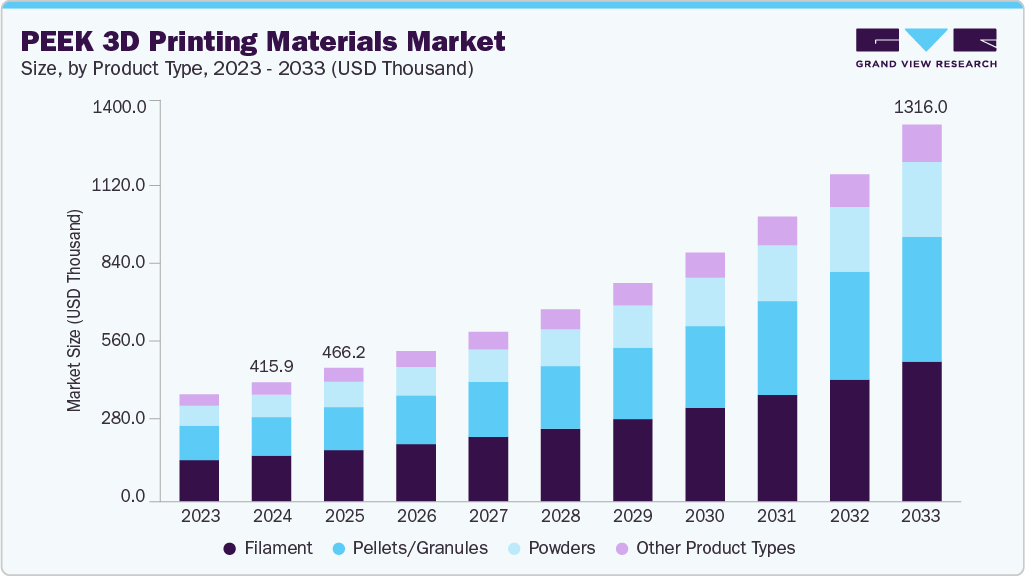
The global PEEK 3D printing materials market size was estimated at USD 415.9 thousand in 2024 and is projected to reach USD 1,316.0 thousand by 2033, growing at a CAGR of 13.9% from 2025 to 2033. Growing demand for lightweight and high-performance materials in aerospace and automotive manufacturing is driving the use of PEEK in 3D printing.
Key Market Trends & Insights
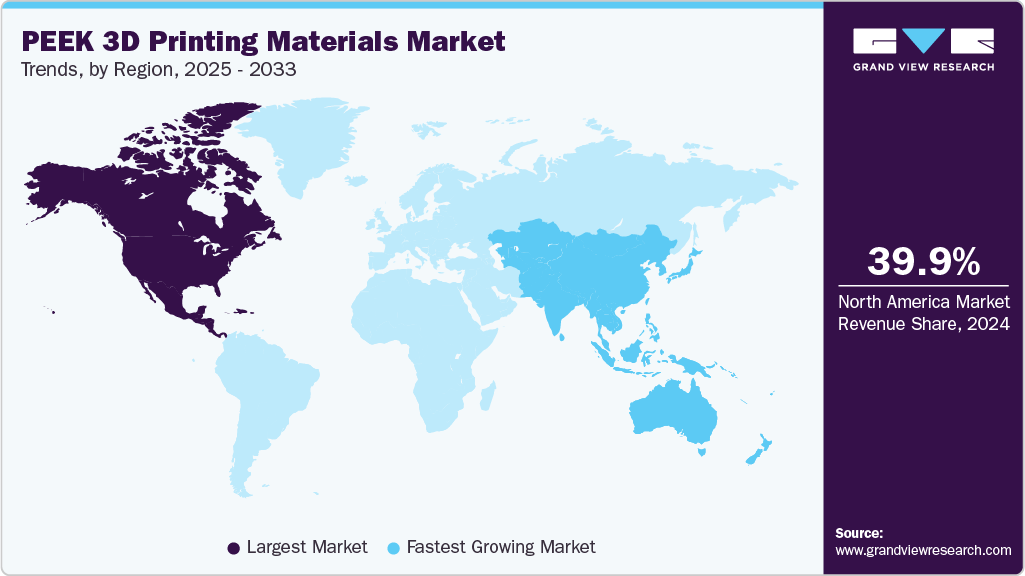
- North America held the largest share of 39.92% in terms of revenue of the PEEK 3D printing materials market in 2024 and is expected to grow at the fastest CAGR of 14.1% over the forecast period.
- U.S. was the leading the PEEK 3D printing materials market in the North America region and captured around 75% of the revenue market share in 2024 in this region.
- By product type, the filament dominated the PEEK 3D printing materials market across the product type segmentation in terms of revenue, accounting for a market share of 38.44% in 2024.
- By end-use, the aerospace & defense segment dominated the PEEK 3D printing materials market across the application segmentation in terms of revenue, accounting for a market share of 33.90% in 2024.
Market Size & Forecast
- 2024 Market Size: USD 415.9 Thousand
- 2033 Projected Market Size: USD 1,316.0 Thousand
- CAGR (2025-2033): 13.9%
- North America: Largest market in 2024
- Asia Pacific: Fastest growing market
The material’s ability to deliver strength and thermal stability at lower weight supports energy efficiency and design optimization goals. PEEK is moving from prototyping toward qualified production in sectors that demand high performance parts. Manufacturers in aerospace, medical and advanced automotive increasingly specify printed PEEK for functional components where complex geometry or weight reduction matters. This movement is driven by suppliers’ work on process control and by case studies showing parity with conventional manufacturing for selected use cases. Market forecasts and industry reports record stronger adoption of engineering polymers in production applications, supporting this shift.
Drivers, Opportunities & Restraints
PEEK’s combination of high strength, thermal stability and chemical resistance gives it a clear technical advantage over standard thermoplastics. Engineers are using PEEK to replace metal in load bearing and high-temperature locations, or to consolidate multi-piece assemblies into single printed components. This reduces part count and secondary machining while improving service temperature and corrosion resilience. Such technical gains directly translate into procurement and life-cycle cost benefits for OEMs.
Additive manufacturing with PEEK opens revenue streams from on-demand spares, low-volume custom parts and patient-specific implants. Medical suppliers can leverage PEEK’s biocompatibility to produce bespoke implants and surgical instruments with shorter lead times. Aerospace and defence supply chains can localize production of legacy or low-volume components, reducing inventory and compressing lead times. These business models allow material and service providers to capture higher value beyond commodity filament sales.
PEEK raw material costs are substantially higher than commodity filaments. Printing it reliably requires high-temperature extrusion, heated build chambers and stringent thermal management to avoid warpage and inconsistent crystallinity. These capital and process barriers raise the total cost of ownership for adopters and complicate qualification for safety critical parts. As a result, adoption remains concentrated among buyers with high performance requirements or well-resourced supply chains.
Market Concentration & Characteristics
The market growth stage of the PEEK 3D printing materials market is high, and the pace is accelerating. The market exhibits consolidation, with key players dominating the industry landscape. Major companies like Victrex plc, Evonik Industries AG, Solvay S.A., Arkema S.A., Ensinger GmbH, Lehvoss Group, Jiangsu Junhua High Performance Specialty Engineering Plastics, and others play a significant role in shaping the market dynamics. These leading players often drive innovation within the market, introducing new products, technologies, and applications to meet evolving industry demands.
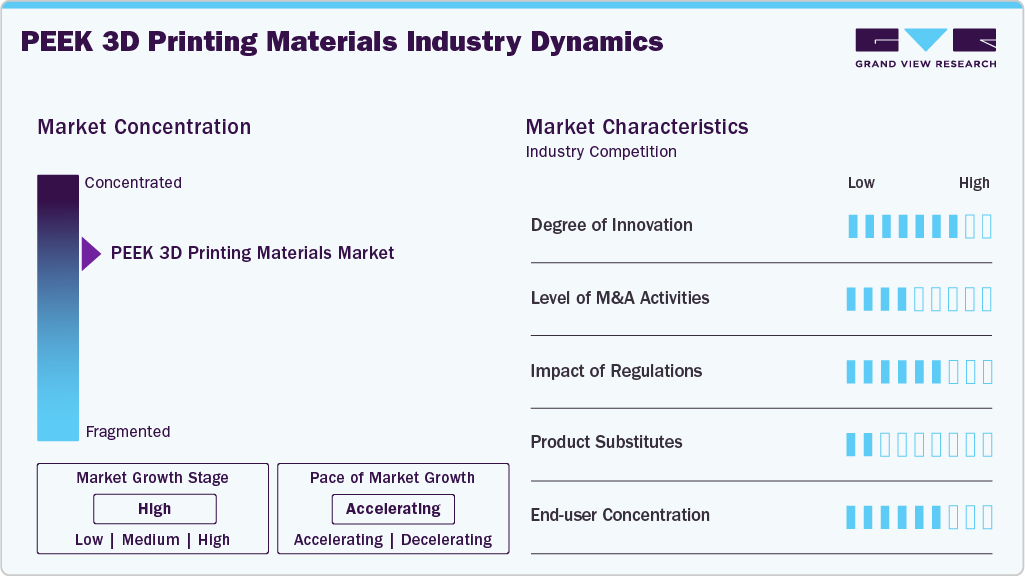
PEEK 3D printing is shifting from material-focused tweaks to system-level integration. Manufacturers and material houses are delivering tailored PAEK grades, carbon-fibre filled variants and powders optimized for specific AM platforms. Process innovations include tighter thermal control, in-situ monitoring and hybrid workflows that combine printing with post-processing to improve crystallinity and repeatability. These advances reduce qualification cycles for OEMs and make PEEK viable for more end-use, safety-conscious applications.
PEKK and PEI (Ultem) are the nearest technical substitutes, offering similar thermal and mechanical performance while sometimes easing printability or cost pressures. PPSU, PPA and reinforced nylon grades compete where chemical resistance or toughness is prioritized over maximum temperature capability. Metal and composite replacements remain relevant for the highest load applications but carry trade-offs in weight, cost and lead time that keep polymer options attractive. Market selection increasingly reflects a balance of certification pathways, part function and total lifecycle cost.
Product Type Insights
Filament dominated the PEEK 3D printing materials market across the product type segmentation in terms of revenue, accounting for a market share of 38.44% in 2024. Faster qualification and grade diversification are widening filament adoption. Manufacturers now offer PAEK filaments formulated for reliable extrusion, improved interlayer bonding and predictable crystallinity. This reduces trial cycles for industrial printers and shortens supplier qualification timelines for OEMs. Growth in filament-focused supply chains and reported market expansion underscore rising commercial interest in production-grade filaments.
The powder segment is anticipated to grow at the fastest CAGR of 14.5% through the forecast period. Advances in powder chemistry and laser-compatible PEEK blends are enabling broader use of powder bed fusion. Researchers and material houses report modified PEEK powders with tailored particle size and reinforced fillers to improve sintering stability and mechanical consistency. These developments lower refresh rates and improve recyclability in PBF workflows, making powder routes more viable for low-volume production. Industrial reports and academic studies highlight growing momentum for PEEK powders in precision manufacturing.
End-use Insights
Aerospace & defense dominated the polyetheretherketone (PEEK) 3D printing materials market across the application segmentation in terms of revenue, accounting for a market share of 33.90% in 2024 and is forecasted to grow at 14.7% CAGR from 2025 to 2033. The sector is pushing PEEK adoption for lightweight structural and thermal management components. Airframers and tier suppliers cite design consolidation and fuel efficiency gains as primary drivers for replacing metal or multi-part assemblies with printed PEEK. Qualification programs focus on process control and traceability to meet stringent certification requirements. Industry case studies and supplier white papers show increasing specification of printed PAEK materials in tooling, ducts and non-critical flight hardware.
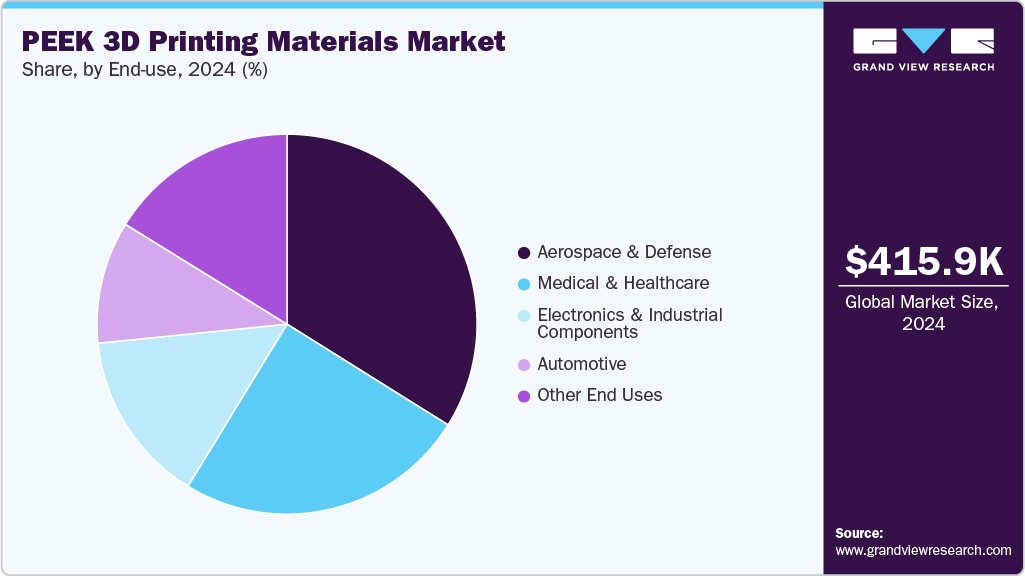
The medical & healthcare segment is expected to expand at a substantial CAGR of 14.2% through the forecast period. Regulatory clearance and clinical validation are opening high-value pathways for PEEK implants and instruments. Patient-specific cranial implants and surgical devices have reached formal approvals and cleared production workflows, creating repeatable clinical supply chains. Material biocompatibility and radiolucency make PEEK attractive where metal alternatives are problematic. As approval pathways mature, manufacturers see a clear route to scale customized and on-demand medical parts.
Regional Insights
North America held the largest share of 39.92% in terms of revenue of the PEEK 3D printing materials market in 2024 and is expected to grow at the fastest CAGR of 14.1% over the forecast period. Aerospace and defense demand is a primary driver for PEEK in the region. Airframers and tier suppliers are specifying PEEK for structural, thermal and tooling applications to cut weight and improve fuel efficiency. Program-level qualification efforts and investments in process control are reducing risk for printed PEEK components. This creates prioritized procurement pipelines for high-performance polymers across the region.
A mature additive manufacturing ecosystem is accelerating commercial PEEK uptake. A dense network of service bureaus, material houses and advanced-printer OEMs shortens time-to-market for industrial users. Public and private reshoring initiatives are also localizing production of critical spares and reducing lead times. These factors concentrate purchasing power and technical capability in North America.
U.S. PEEK 3D Printing Materials Market Trends
Regulatory clearances and clinical case evidence are driving medical use of Polyetheretherketone (PEEK) in the U.S. FDA filings and permitted 3D-printed PEEK cranial implants have validated clinical workflows. Hospitals and medical device makers are adopting on-demand and patient-specific supply chains. This regulatory acceptance lowers commercial risk and raises procurement interest in PEEK-based production.
Europe PEEK 3D Printing Materials Market Trends
Automotive electrification and strict emissions rules are pushing OEMs toward lightweight, high-temperature polymers. European carmakers seek materials that enable part consolidation and thermal stability in battery and powertrain systems. Tier suppliers are qualifying printed PEEK for underhood and thermal-management components. The alignment of regulatory pressure and OEM targets is speeding material specification cycles.
Asia Pacific PEEK 3D Printing Materials Market Trends
Rapid expansion of localized manufacturing and healthcare investment is lifting demand for PEEK in Asia Pacific. Strong growth in regional 3D printing markets, combined with rising clinical adoption, creates immediate use cases for high-performance polymers. Material vendors and printer OEMs in China, Japan and India are scaling supply and validation services to meet local industrial and medical demand. This dynamic accelerates commercial projects and adoption rates across the region.
Key PEEK 3D Printing Materials Company Insights
The PEEK 3D printing materials market is highly competitive, with several key players dominating the landscape. Major companies include Victrex plc, Evonik Industries AG, Solvay S.A., Arkema S.A., Ensinger GmbH, Lehvoss Group, and Jiangsu Junhua High Performance Specialty Engineering Plastics. The PEEK 3D printing materials market is characterized by a competitive landscape with several key players driving innovation and market growth. Major companies in this sector are investing heavily in research and development to enhance the performance, cost-effectiveness, and sustainability of their types.
Key PEEK 3D Printing Materials Companies:
The following are the leading companies in the PEEK 3d printing materials market. These companies collectively hold the largest market share and dictate industry trends.
- Victrex plc
- Evonik Industries AG
- Solvay S.A.
- Arkema S.A.
- Ensinger GmbH
- Lehvoss Group
- Jiangsu Junhua High Performance Specialty Engineering Plastics
Recent Developments
-
In October 2023, Evonik introduced carbon-fibre reinforced PEEK filaments for medical implants. The VESTAKEEP iC4612 and iC4620 grades offer 12% and 20% carbon content respectively, targeting stronger, metal-free patient-specific implant applications.
-
In March 2023, Invibio launched an implantable-grade PEEK filament for FDM/FFF 3D printing. The PEEK-OPTIMA AM filament brings trusted implantable PEEK into a 1.75 mm filament form to support medical device OEMs and point-of-care production.
PEEK 3D Printing Materials Market Report Scope
|
Report Attribute
|
Details
|
|
Market size value in 2025
|
USD 466.2 thousand
|
|
Revenue forecast in 2033
|
USD 1,316.0 thousand
|
|
Growth rate
|
CAGR of 13.9% from 2025 to 2033
|
|
Historical data
|
2021 - 2023
|
|
Forecast period
|
2025 - 2033
|
|
Quantitative units
|
Revenue in USD thousand, volume in tons, and CAGR from 2025 to 2033
|
|
Report coverage
|
Revenue forecast, competitive landscape, growth factors, and trends
|
|
Global Transparent Plastic Market Report Segmentation
|
Product type, end-use, region
|
|
Regional scope
|
North America; Europe; Asia Pacific; Latin America; Middle East & Africa
|
|
Country Scope
|
U.S.; Canada; Mexico; Germany; France; UK; Spain; Italy; China; Japan; India; South Korea; Brazil; Argentina; Saudi Arabia; South Africa; UAE
|
|
Key companies profiled
|
Victrex plc; Evonik Industries AG; Solvay S.A.; Arkema S.A.; Ensinger GmbH; Lehvoss Group; Jiangsu Junhua High Performance Specialty Engineering Plastics
|
|
Customization scope
|
Free report customization (equivalent up to 8 analyst’s working days) with purchase. Addition or alteration to country, regional & segment scope
|
|
Pricing and purchase options
|
Avail customized purchase options to meet your exact research needs. Explore purchase options
|
Global PEEK 3D Printing Materials Market Report Segmentation
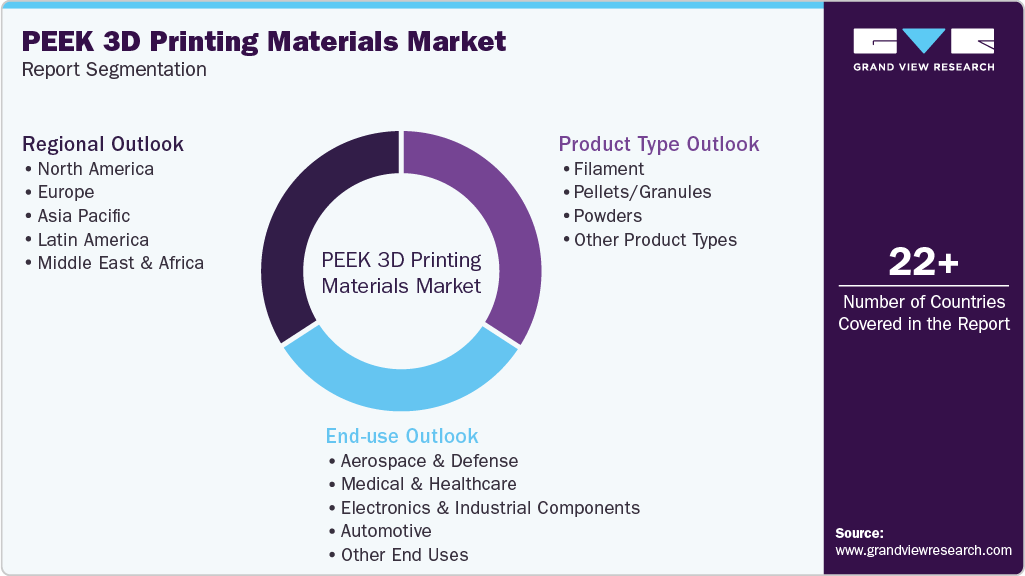
This report forecasts revenue growth at the global, regional, and country levels and provides an analysis of the latest industry trends in each of the sub-segments from 2021 to 2033. For the purpose of this study, Grand View Research has segmented the global PEEK 3D printing materials market report on the basis of product type, end use, and region:
-
Product Type Outlook (Revenue, USD Thousand; Volume, Tons; 2021 - 2033)
-
Filament
-
Pellets/Granules
-
Powders
-
Other Product Types
-
End-use Outlook (Revenue, USD Thousand; Volume, Tons; 2021 - 2033)
-
Regional Outlook (Revenue, USD Thousand; Volume, Tons; 2021 - 2033)
-
North America
-
Europe
-
Germany
-
UK
-
France
-
Italy
-
Spain
-
Asia Pacific
-
China
-
India
-
Japan
-
South Korea
-
Latin America
-
Middle East & Africa
-
Saudi Arabia
-
South Africa
-
UAE

 Download Sample Report
















