
- Home
- »
- Plastics, Polymers & Resins
- »
-
Polyetherketoneketone Filaments Market Report, 2025-2033GVR Report cover

Polyetherketoneketone Filaments Market (2025 - 2033)
Size, Share & Trends Analysis Report By Product (Carbon Fiber Reinforced PEKK Filament, Unfilled PEKK Filament, Glass Fiber Reinforced PEKK Filament), By Application (Aerospace, Automotive, Medical Devices), By Region, And Segment Forecasts
Market Size, 2024
$215.3MMarket Estimate, 2026
$297.2MMarket Forecast, 2033
$961.2MCAGR, 2025–2033
18.2%Polyetherketoneketone Filaments Market Summary
The global polyetherketoneketone filaments market size was valued at USD 215.3 million in 2024 and is projected to grow from USD 297.2 million in 2026 to USD 961.2 million by 2033, at a CAGR of 18.2% from 2025 to 2033. North America dominated the market, accounting for a revenue share of 42.0% in 2024. The market is driven by the rising demand for high-performance 3D printing materials in aerospace, automotive, and medical industries due to their superior thermal, chemical, and mechanical resistance.
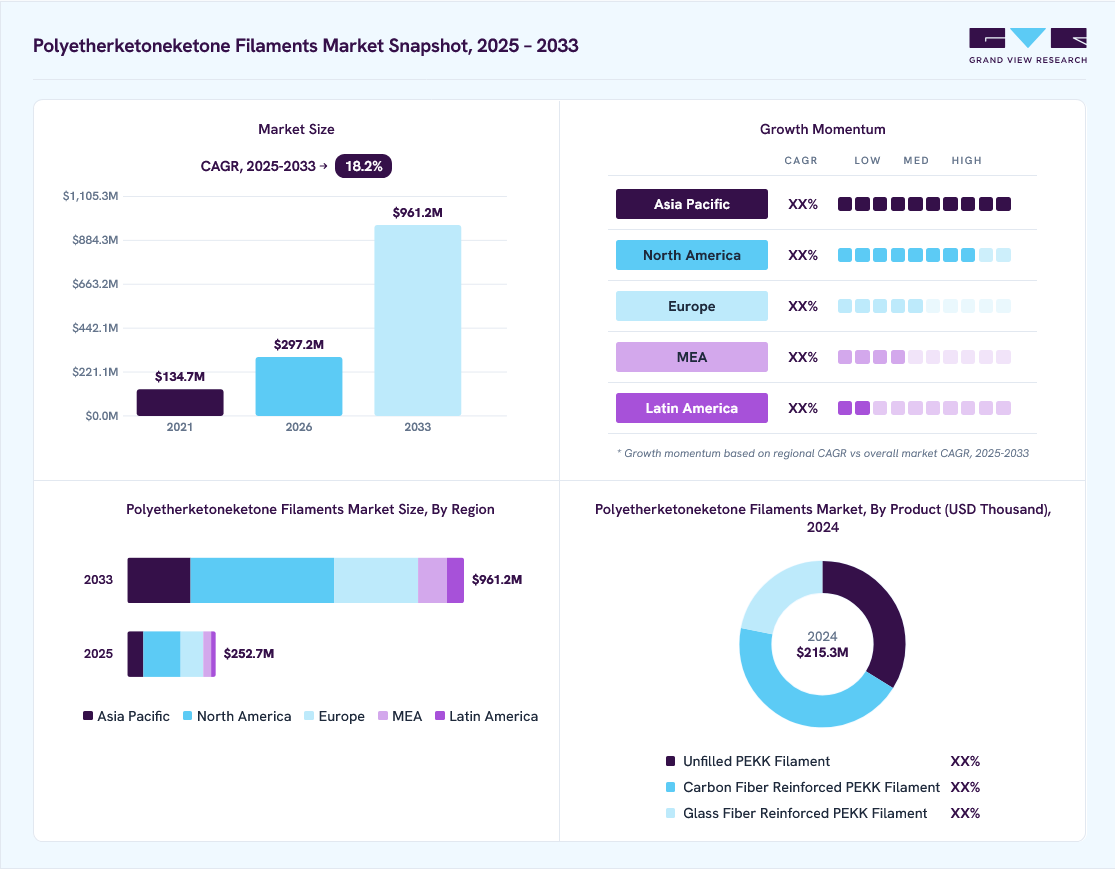 Source: Grand View Research, IR Documents, Primary Interviews, Paid DatabasesTo learn more about this report,
 Download Free Sample Report
Key Market Trends & Insights
- The U.S. medical device industry is leveraging PEKK filaments for implants and surgical tools due to their biocompatibility and durability.
- By product, the carbon fiber reinforced PEKK filament segment recorded the largest market revenue share of over 44.0% in 2024 and is expected to grow at the fastest CAGR of 19.0% during the forecast period.
- By application, the aerospace segment recorded the largest market share of over 41.0% in 2024.
Market Size & Forecast
- 2024 Market Size: USD 215.3 Million
- 2033 Projected Market Size: USD 961.2 Million
- CAGR (2025-2033): 18.2%
- North America: Largest market
- Asia Pacific: Fastest-growing market
Prism AI by Grand View Research Free to tryAsk a question about the polyetherketoneketone filaments marketTry asking✓Every figure cited from GVR research Prefer the report? Download free sample →
In addition, increasing adoption of additive manufacturing for lightweight and complex components boosts PEKK filament usage. Polyetherketoneketone (PEKK) filaments offer exceptional mechanical strength, thermal stability (up to 250-300°C), and chemical resistance, making them ideal for critical structural components. For example, aerospace companies are increasingly adopting PEKK filaments for 3D-printed aircraft interior parts, brackets, and ducts to reduce weight without compromising performance. Similarly, automotive OEMs and suppliers are using PEKK filaments for under-the-hood components, battery housing for EVs, and other high-temperature applications where conventional polymers fail.The growth of additive manufacturing is another key driver, as PEKK filaments are extensively used in high-end 3D printing applications. Industries such as defense, healthcare, and electronics are increasingly shifting from traditional manufacturing to additive techniques to enable faster prototyping, customization, and small-batch production. PEKK’s ability to be processed in FDM (Fused Deposition Modeling) and other 3D printing methods allows manufacturers to create complex geometries that are otherwise difficult or expensive to produce. For instance, defense contractors are using Poly-ether-ketone-ketone (PEKK) filaments to produce lightweight drone components and tactical gear, leveraging the material’s superior strength-to-weight ratio.
 To learn more about this report, Download Free Sample Report
Global trends toward light weighting and sustainable manufacturing are driving PEKK filament adoption. Industries are under pressure to reduce carbon emissions, fuel consumption, and material wastage. PEKK filaments enable lightweight alternatives to metals such as aluminum and titanium while maintaining durability, thereby supporting sustainability goals. For example, replacing metal brackets in aerospace with PEKK components can reduce aircraft weight by up to 30%, improving fuel efficiency and lowering operational costs. This combination of performance and sustainability makes PEKK a preferred choice in sectors aiming to achieve environmental compliance and efficiency.
Ongoing R&D and the expansion of PEKK filament production capacity are facilitating market growth. Manufacturers are introducing high-quality, easy-to-process PEKK filaments with enhanced thermal and mechanical properties suitable for industrial 3D printing. Companies such as Solvay and Arkema are investing in specialty grades optimized for 3D printing and industrial applications, increasing accessibility and reducing processing challenges. In addition, advancements in printer technology, such as high-temperature FDM printers, have expanded PEKK filament usability across industries. The synergy of improved material performance and printer capability is accelerating adoption in aerospace, automotive, medical devices, and industrial tooling.
Market Concentration & Characteristics
The PEKK filaments market is highly specialized due to the advanced material properties and specific industrial applications. Unlike general-purpose filaments such as PLA or ABS, PEKK caters mainly to high-performance sectors such as aerospace, defense, automotive, medical, and electronics. This makes the industry relatively small in volume but high in value, with a focus on premium pricing justified by the material’s mechanical strength, chemical resistance, and thermal stability.
Regulations significantly influence PEKK filament adoption, especially in aerospace, medical, and defense. Compliance with standards such as FAA, ISO, and ASTM is mandatory for critical applications. Regulatory compliance is a key driver of high-quality material production and limits low-cost substitutes.
 To learn more about this report, Download Free Sample Report
PEKK faces competition from other high-performance polymers such as PEEK, PPSU, and Ultem. While substitutes exist, PEKK offers a unique balance of thermal stability, chemical resistance, and mechanical performance, giving it an edge in high-end industrial applications. Substitutes mainly affect price-sensitive or non-critical applications.
Product Insights
The carbon fiber reinforced PEKK filament segment recorded the largest market revenue share of over 44.0% in 2024 and is expected to grow at the fastest CAGR of 19.0% during the forecast period. CFR PEKK filaments combine the high thermal and chemical resistance of PEKK with the superior mechanical strength and stiffness of carbon fibers. The addition of carbon fibers improves dimensional stability, reduces warping during 3D printing, and enhances the load-bearing capacity of the printed parts. The growth of CFR PEKK filaments is driven by the increasing demand for lightweight, high-strength components in aerospace, defense, and automotive sectors.
Unfilled PEKK filaments are pure PEKK materials without reinforcement. These filaments retain the inherent high-performance properties of PEKK, including exceptional thermal resistance, chemical resistance, and dimensional stability. They are typically used in medical devices, electronics housings, and chemical-resistant parts, where the material’s intrinsic properties are more critical than mechanical reinforcement. Unfilled PEKK allows for easier post-processing and offers better surface finish in 3D-printed parts, making it suitable for applications requiring both precision and high-performance durability.
Application Insights
The aerospace segment recorded the largest market share of over 41.0% in 2024.PEKK filaments are highly valued in the aerospace industry due to their exceptional thermal stability, high strength-to-weight ratio, and chemical resistance. These properties make PEKK ideal for manufacturing lightweight structural components, engine parts, brackets, and interior panels for aircraft. For example, Airbus has explored PEKK-based composites to reduce aircraft weight and improve fuel efficiency without compromising safety. The aerospace segment is driven by the demand for lightweight, high-performance materials that reduce fuel consumption and greenhouse gas emissions.
 To learn more about this report, Download Free Sample Report
The automotive segment is projected to grow at the fastest CAGR of 18.7% during the forecast period.In the automotive sector, Polyetherketoneketone filaments are used for high-performance engine components, transmission parts, brackets, and interior parts that require high thermal and chemical resistance. PEKK’s lightweight nature contributes to vehicle weight reduction, which is essential for improving fuel efficiency and meeting emissions regulations. The primary drivers are the growing focus on lightweighting for EVs, emission regulations, and the increasing use of advanced manufacturing technologies such as 3D printing for rapid prototyping and low-volume production.
Region Insights
North America dominated the market and accounted for the largest revenue share of over 42.0% in 2024. This positive outlook is due to high investments in aerospace, defense, and automotive industries where lightweight, high-strength materials are critical. The U.S., in particular, has a mature additive manufacturing ecosystem, with companies like Stratasys and 3D Systems integrating PEKK filaments into industrial 3D printing applications. Aerospace companies such as Boeing and Lockheed Martin use PEKK filaments for lightweight, heat-resistant components, which significantly drives the regional market.
 To learn more about this report, Download Free Sample Report
Moreover, the U.S. medical device industry is leveraging PEKK filaments for implants and surgical tools due to their biocompatibility and durability. Government-funded initiatives supporting research in advanced materials and 3D printing accelerate innovation and adoption. The combination of strong industrial demand, technological infrastructure, and supportive policies makes the U.S. a leading country of the North America PEKK filaments market.
Europe Polyetherketoneketone Filaments Market Trends
Europe’s PEKK filaments market is driven by stringent regulations on emissions and environmental sustainability, prompting aerospace and automotive manufacturers to adopt lightweight, high-performance materials. Germany, UK,andFrance are key contributors, with Germany leading due to its strong automotive sector. German automotive OEMs such as BMW and Audi use PEKK filaments for components in EVs and lightweight structural parts, driving significant market demand. The region’s focus on precision engineering and high-quality manufacturing further boosts the use of PEKK filaments.
Asia Pacific Polyetherketoneketone Filaments Market Trends
Asia Pacific is expected to grow at the fastest CAGR of 18.7% during the forecast period. This outlook is due to its rapidly expanding industrial and manufacturing sectors. Countries such as China, Japan,andSouth Korea are investing heavily in advanced materials for aerospace, automotive, and electronics applications. The region benefits from a strong supply chain ecosystem for high-performance polymers and growing adoption of additive manufacturing technologies, which is driving demand for PEKK filaments. In addition, government initiatives supporting Industry 4.0 and smart manufacturing have accelerated the adoption of advanced polymer materials.
Key Polyetherketoneketone Filaments Company Insights
The competitive environment of the PEKK filaments market is moderately consolidated, dominated by a mix of established polymer manufacturers and specialized high-performance filament producers. Key players focus on technological innovation, strategic partnerships, and geographic expansion to gain an edge, particularly in aerospace, automotive, and medical applications where material performance is critical.
Companies are increasingly investing in R&D to enhance thermal stability, mechanical strength, and processability of PEKK filaments, while also exploring collaborations with 3D printing solution providers to expand end-use adoption. In addition, the market faces moderate pressure from potential substitutes such as PEEK and PPS filaments, and regulatory compliance in aerospace and medical industries further shape competitive strategies.
-
In November 2024, Avient Corporation launched its Colorant Chromatics Transcend Biocompatible PEEK Pre-Colored Compounds at MEDICA 2024 in Düsseldorf. These ISO 10993-tested compounds are designed for healthcare applications, offering heat and chemical resistance, mechanical strength, and dimensional stability for devices such as surgical robots, dental scalers, and cardiac monitors. Pre-colored for functionality and aesthetics, they support reusable medical devices and sustainability, backed by Avient’s global manufacturing and technical support.
-
In June 2024, Arkema and Markforged partnered to launch VEGA, a PEKK-based ultra-high-performance filament for Markforged’s FX20 3D printer. VEGA delivers aluminum-like strength, thermal stability, chemical resistance, and a smooth matte finish, ideal for aerospace and other demanding applications, showcasing both companies’ commitment to advanced, sustainable 3D printing materials.
Key Polyetherketoneketone Filaments Companies:
The following are the leading companies in the polyetherketoneketone filaments market. These companies collectively hold the largest market share and dictate industry trends.
- Solvay
- Ensinger
- 3DXTech
- Essentium
- ARMOR GROUP
- IEMAI 3D
- Shandong Kaisheng New Materials Co., Ltd.
- Lehmann & Voss
- INTAMSYS Technology Co. Ltd.
- DELRAY Systems
Polyetherketoneketone Filaments Market Report Scope
Report Attribute
Details
Market size in 2024
USD 215.3 million
Estimated market size in 2026
USD 297.2 million
Projected market size by 2033
USD 961.2 million
Growth rate
CAGR of 18.2% from 2025 to 2033
Historical data
2021 - 2023
Forecast period
2025 - 2033
Quantitative units
Revenue in USD million/billion, volume in tons, and CAGR from 2025 to 2033
Report coverage
Revenue forecast, volume forecast, competitive landscape, growth factors, and trends
Segments covered
Product, application, region
States scope
North America; Europe; Asia Pacific; Latin America; Middle East & Africa
Country scope
U.S.; Canada; Mexico; Germany; UK; France; Spain; Italy; China; India; Japan; Australia; South Korea; Brazil; Argentina; Saudi Arabia; UAE; South Africa
Key companies profiled
Solvay; Ensinger; 3DXTech; Essentium; ARMOR GROUP; IEMAI 3D; Shandong Kaisheng New Materials Co., Ltd.; Lehmann & Voss; INTAMSYS Technology Co. Ltd.; DELRAY Systems
Customization scope
Free report customization (equivalent up to 8 analyst’s working days) with purchase. Addition or alteration to country, regional, and segment scope.
Pricing and purchase options
Avail customized purchase options to meet your exact research needs. Explore purchase options
Global Polyetherketoneketone Filaments Market Report Segmentation
This report forecasts revenue growth at a global level and provides an analysis of the latest industry trends in each of the sub-segments from 2021 to 2033. For this study, Grand View Research has segmented the global polyetherketoneketone filaments market report based on product, application, and region:
 To learn more about this report, Download Free Sample Report
-
Product Outlook (Volume, Tons; Revenue, USD Million, 2021 - 2033)
-
Carbon Fiber Reinforced PEKK Filament
-
Unfilled PEKK Filament
-
Glass Fiber Reinforced PEKK Filament
-
-
Application Outlook (Volume, Tons; Revenue, USD Million, 2021 - 2033)
-
Aerospace
-
Automotive
-
Medical Devices
-
Industrial Components
-
Other Applications
-
-
Region Outlook (Volume, Tons; Revenue, USD Million, 2021 - 2033)
-
North America
-
U.S.
-
Canada
-
Mexico
-
-
Europe
-
Germany
-
France
-
UK
-
Italy
-
Spain
-
-
Asia Pacific
-
China
-
India
-
Japan
-
Australia
-
South Korea
-
-
Latin America
-
Brazil
-
Argentina
-
-
Middle East & Africa
-
South Africa
-
Saudi Arabia
-
UAE
-
-
Frequently Asked Questions About This Report
The aerospace segment dominates the PEKK filaments market due to the material’s ability to withstand extreme temperatures, resist chemicals, and meet stringent Flame, Smoke, and Toxicity (FST) standards.
The key players in the PEKK filaments market include Solvay, Ensinger, 3DXTech, Essentium, ARMOR GROUP, IEMAI 3D, Shandong Kaisheng New Materials Co., Ltd., Lehmann & Voss, INTAMSYS Technology Co. Ltd., and DELRAY Systems.
An increasing adoption of additive manufacturing for lightweight and complex components boosts PEKK filament usage.
The global polyetherketoneketone filaments market size was valued at USD 215.3 million in 2024 and is estimated at USD 297.2 million for 2026.
The global polyetherketoneketone filaments market is expected to grow at a CAGR of 18.2% from 2025 to 2033, reaching USD 961.2 million by 2033.
About the Author(s)
Plastics, Polymers & Resins Research Team
Bulk Chemicals · Plastics, Polymers & ResinsThis report was authored by the plastics, polymers & resins research team at Grand View Research - comprising two research analysts, one senior research analyst, and one industry expert - with specialized expertise in the plastics, polymers & resins segment of the bulk chemicals industry. All findings are based on proprietary bulk chemicals databases, executive interviews, and regulatory analysis, subject to internal peer review prior to publication.
Last Updated:
Speak to Analyst

Customize this report to your needs - add regions, segments, or data points, with 20% free customization.
Or view our licence options:


ISO 9001:2015 & 27001:2022 Certified
We are GDPR and CCPA compliant! Your transaction & personal information is safe and secure. For more details, please read our privacy policy.


