
- Home
- »
- Plastics, Polymers & Resins
- »
-
Polyethylene Packaging Market Size Report, 2026-2033GVR Report cover

Polyethylene Packaging Market (2026 - 2033)
Size, Share & Trends Analysis Report By Material (High-Density Polyethylene (HDPE), Linear Low-Density Polyethylene (LLDPE), By Product Type, By Packaging Format, By End-use Industry, By Region, And Segment Forecasts
Market Size, 2025
$33.5BMarket Estimate, 2026
$35.2BMarket Forecast, 2033
$52.1BCAGR, 2026–2033
5.8%Polyethylene Packaging Market Summary
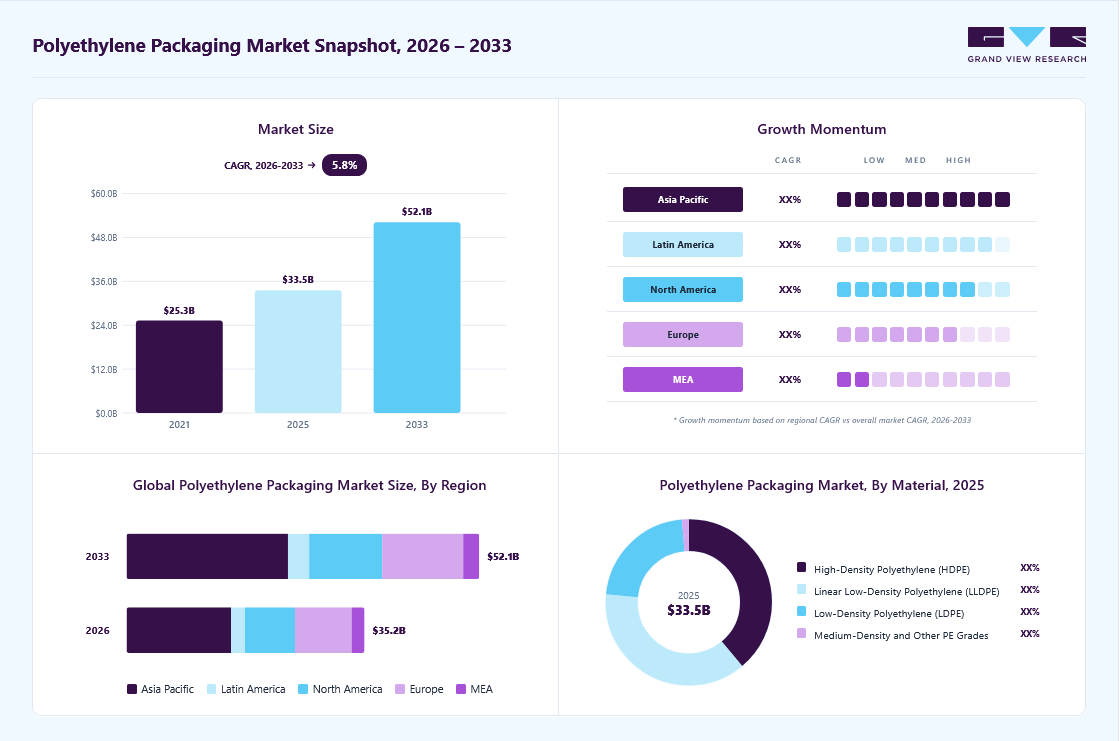
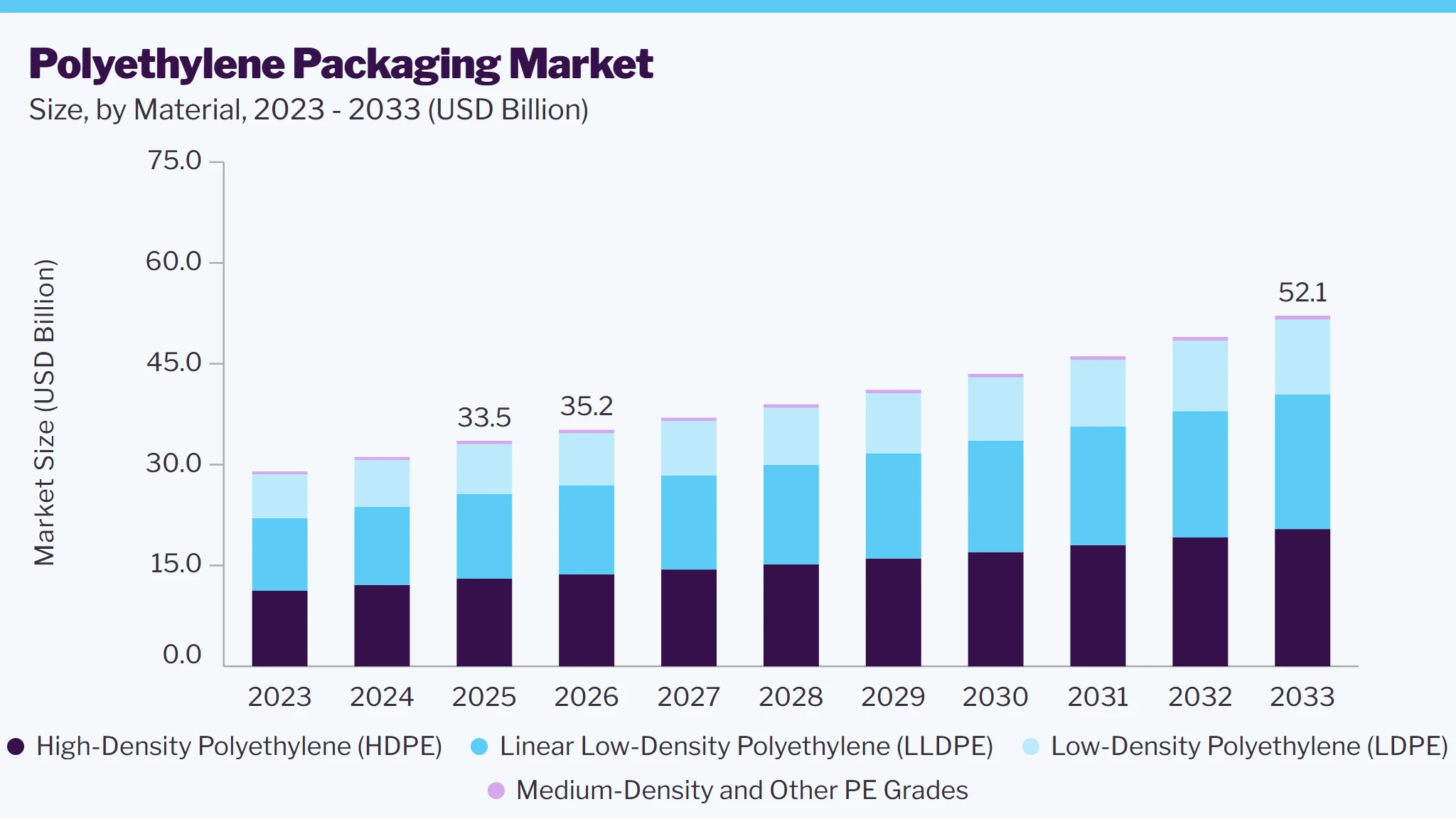
The global polyethylene packaging market size was valued at USD 33.5 billion in 2025 and is projected to grow from USD 35.2 billion in 2026 to USD 52.1 billion by 2033, at a CAGR of 5.8% from 2026 to 2033. Asia Pacific dominated the market, accounting for a revenue share of 43.6% in 2025. The market is primarily driven by the growing demand for flexible packaging formats, including films, pouches, bags, liners, and wraps, across food & beverage, consumer goods, healthcare, and industrial applications.
 Source: Grand View Research, IR Documents, Primary Interviews, Paid DatabasesTo learn more about this report,
 Download Free Sample Report
Key Market Trends & Insights
- By material: High-density polyethylene (HDPE) segment dominated the market, accounting for 38.9% of revenue in 2025.
- By packaging format: Flexible packaging segment dominated the market, accounting for 58.3% of revenue in 2025.
- By product type: Films and sheets segment held the largest revenue share of 28.9% in 2025.
- By end-use industry: Food & beverage segment dominated the market, accounting for 36.9% of revenue in 2025.
Regional Highlights
- Largest regional market: Asia Pacific (43.6% revenue share, 2025)
- By country: China held the largest market share in 2025
Market Size & Forecast
- Market size in 2025 : USD 33.5 Billion
- Estimated market size in 2026: USD 35.2 billion
- Projected market size by 2033 : USD 52.1 Billion
- CAGR (2026-2033): 5.8%
Prism AI by Grand View Research Free to tryAsk a question about the polyethylene packaging marketTry asking✓Every figure cited from GVR research Prefer the report? Download free sample →The polyethylene packaging market is driven by the growing demand for lightweight, flexible, and cost-effective packaging solutions across food and beverage, personal care, healthcare, household products, and industrial applications. Polyethylene materials, including high-density polyethylene (HDPE), low-density polyethylene (LDPE), and linear low-density polyethylene (LLDPE), are widely used in films, bags, pouches, bottles, containers, and protective packaging due to their moisture resistance, durability, flexibility, and ease of processing. The expansion of packaged food consumption, organized retail, and e-commerce distribution is further supporting demand for polyethylene packaging, particularly flexible formats that help reduce packaging weight, protect products, and improve transportation efficiency. HDPE accounted for the largest material share in 2025, supported by its strength and suitability for rigid packaging, while LLDPE is expected to grow faster as demand increases for flexible films and packaging requiring puncture resistance and stretchability.
 To learn more about this report, Download Free Sample Report
An increasing focus on product protection, shelf life, and packaging performance is expected to support market growth in the coming years. Food and beverage manufacturers rely on polyethylene packaging for moisture protection, sealing performance, and maintaining product freshness, while healthcare, pharmaceutical, personal care, and household chemical producers use it for packaging products that require reliable containment and resistance to leakage. The material's adaptability across different packaging formats allows manufacturers to develop solutions for varied product sizes, storage conditions, and distribution requirements. In addition, the growth of healthcare and pharmaceutical packaging and e-commerce logistics is creating further demand for polyethylene-based packaging that combines protective performance with lightweight handling. According to the provided market estimates, healthcare and pharmaceuticals and e-commerce/logistics are projected to record relatively strong growth among the end-use segments through 2033.
Sustainability initiatives and the transition toward circular packaging systems are also influencing the polyethylene packaging market. A defining trend is the growing emphasis on recyclable packaging designs, the incorporation of recycled polyethylene where technically and legally suitable, and the development of packaging that uses material more efficiently. Manufacturers are exploring downgauging, mono-material flexible structures, improved recyclability, and reusable packaging formats to reduce material consumption and improve end-of-life management. These initiatives are particularly relevant to polyethylene because many common packaging applications use PE as a primary material, although recycling performance depends on packaging design, collection systems, sorting infrastructure, and the quality requirements of the intended application.
For instance, packaging manufacturers and resin producers are increasingly focusing on designs that improve the compatibility of flexible packaging with existing recycling streams, alongside efforts to expand the use of recycled polymers in suitable applications. Such developments can support the transition toward more resource-efficient polyethylene packaging by reducing reliance on virgin resin and improving material recovery. However, the pace of adoption will depend on the availability and quality of recycled feedstock, processing requirements, food-contact regulations, and the economics of recycling compared with virgin polyethylene.
Market Dynamics
The polyethylene packaging market is experiencing steady growth, supported by rising demand for lightweight, durable, and cost-efficient packaging across food and beverage, healthcare, personal care, household products, industrial goods, and e-commerce. Polyethylene's moisture resistance, flexibility, impact resistance, and ease of processing make it suitable for a broad range of applications, from flexible films and pouches to rigid bottles, containers, and drums. Market expansion is further supported by the versatility of HDPE, LDPE, and LLDPE in meeting different packaging performance requirements. At the same time, growing scrutiny of plastic waste and increasing emphasis on circularity are encouraging manufacturers to improve material efficiency, recyclability, and the use of recycled polyethylene.
The growing use of flexible packaging across food, personal care, household products, and e-commerce is a key driver of the polyethylene packaging market. Polyethylene films, bags, liners, and pouches offer lightweight protection against moisture and contamination while providing flexibility in packaging design and efficient use of material. Their suitability for high-speed converting, heat sealing, and varied product sizes makes them attractive to manufacturers seeking reliable packaging that can support large-volume production and distribution.
The expansion of packaged food consumption, online retail, and modern distribution networks is further increasing demand for polyethylene-based packaging. HDPE supports applications requiring rigidity and strength, including bottles and containers, while LDPE and LLDPE are widely suited to flexible films and bags that require sealing performance, stretchability, and resistance to tearing or puncture. As indicated by the provided market estimates, HDPE held the largest share among material categories in 2025, while LLDPE is projected to grow
A major restraint for the polyethylene packaging market is the growing environmental concern associated with plastic waste and the challenges of recovering and recycling used packaging. Flexible films, multilayer structures, mixed-material components, inks, and adhesives can complicate sorting and recycling, reducing the quality and economic viability of recovered materials. In addition, evolving regulations on packaging waste, recyclability, and recycled content are encouraging manufacturers to redesign products and adapt production processes, potentially increasing compliance and operational costs. The limited availability of consistent, high-quality recycled polyethylene can further constrain its adoption in applications requiring specific performance, hygiene, and product-safety standards.
A key opportunity for the polyethylene packaging market lies in the development of recyclable packaging structures and the increased use of recycled polyethylene in suitable applications. Manufacturers are exploring mono-material designs, lightweighting, downgauging, and simplified packaging components to improve material efficiency and compatibility with existing recycling systems. Collaboration among resin producers, packaging converters, brand owners, and recycling companies can also help strengthen recycled-material supply chains and support circular packaging initiatives. As demand grows for packaging with improved environmental performance, companies that combine recyclability, material efficiency, and reliable protective properties can strengthen their competitive position across flexible and rigid polyethylene packaging applications.
Market Concentration & Characteristics
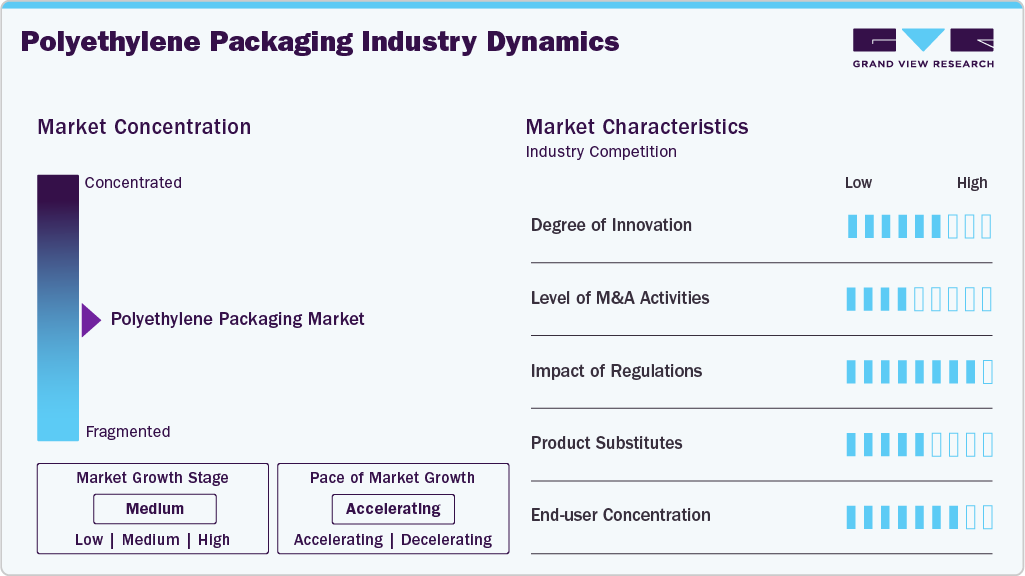
The polyethylene packaging market is characterized by its broad application base, high-volume production, and strong emphasis on material efficiency and cost competitiveness. The industry serves diverse end-use sectors, including food and beverage, healthcare and pharmaceuticals, personal care, household chemicals, agriculture, and e-commerce logistics. Manufacturers rely on HDPE, LDPE, and LLDPE to produce packaging formats such as films, sheets, bags, pouches, bottles, containers, drums, and closures. Production strategies focus on resin utilization, extrusion and molding efficiency, lightweighting, and high-speed converting processes to maintain consistent quality and competitive pricing. Companies such as Amcor, Berry Global, Sealed Air, and Mondi compete through packaging design capabilities, product customization, manufacturing scale, and solutions tailored to specific end-use requirements.
 To learn more about this report, Download Free Sample Report
A defining characteristic of the industry is the versatility of polyethylene resins across flexible and rigid packaging applications. HDPE is widely suited to bottles, containers, and other applications requiring stiffness and strength, whereas LDPE and LLDPE are commonly used in films, liners, bags, and pouches that require flexibility, sealing performance, and resistance to tearing or puncture. This adaptability enables converters to select resin grades according to product protection, processing requirements, and distribution conditions. However, the market is increasingly influenced by environmental concerns and the transition toward circular packaging systems. Greater attention to recyclable mono-material structures, recycled polyethylene content, downgauging, and improved waste collection is reshaping product development and investment priorities. Differences in recycling infrastructure, recycled resin availability, packaging performance requirements, and regulatory expectations across regions continue to influence the pace of adoption.
Material Insights
High-density polyethylene (HDPE) led the market, accounting for the largest revenue share of 38.9% in 2025. HDPE is widely used in rigid packaging applications, including bottles, containers, jerrycans, drums, and closures, due to its strength, stiffness, chemical resistance, and moisture-barrier properties. Its durability and ability to withstand handling and transportation make it suitable for packaging food products, household chemicals, personal care products, and industrial liquids. The material also supports efficient processing through blow molding and injection molding, enabling manufacturers to produce packaging in different shapes and sizes. Its established use across consumer and industrial applications, combined with reliable protective performance and cost-efficient manufacturing, supports its leading position in the market.
The linear low-density polyethylene (LLDPE) segment is expected to grow at the fastest CAGR of 6.1% during the forecast period. LLDPE is widely used in flexible packaging applications such as stretch films, liners, bags, pouches, and protective wraps because of its flexibility, tensile strength, puncture resistance, and sealing performance. These properties allow manufacturers to produce thinner packaging films while maintaining the durability needed for product protection, storage, and transportation. Increasing demand for flexible packaging across food and beverage, e-commerce, logistics, and industrial applications is supporting segment growth. In addition, LLDPE's suitability for film extrusion and its ability to improve packaging strength at reduced material thickness make it an attractive option for manufacturers seeking efficient and lightweight packaging solutions.
Product Type Insights
Films and Sheets held the industry with the largest revenue share of 28.9% in 2025. Polyethylene films and sheets are widely used in food packaging, protective wraps, industrial liners, agricultural films, and product overwraps due to their flexibility, moisture resistance, lightweight structure, and sealing properties. These formats help protect products from contamination and external exposure while supporting efficient storage, handling, and transportation. Their compatibility with high-speed extrusion and converting processes enables manufacturers to produce packaging in different thicknesses and dimensions for diverse applications. Continued demand for flexible packaging across food and beverage, retail, and logistics, along with the need for cost-efficient material use and reliable product protection, supports the segment's leading market position.
The pouches and sachets segment is expected to grow at the fastest CAGR of 6.4% during the forecast period. Polyethylene-based pouches and sachets are gaining traction in applications such as food products, personal care items, household liquids, and selected healthcare products because they offer lightweight construction, flexible designs, and effective heat-sealing performance. Their ability to accommodate different product volumes and formats makes them suitable for single-use packs, refill packaging, and portion-controlled applications. Growing demand for convenient packaging, efficient product distribution, and reduced packaging weight is supporting segment growth. In addition, advances in flexible packaging structures and increasing interest in material-efficient designs are creating opportunities for polyethylene-based pouches and sachets, particularly where packaging performance and compatibility with recycling systems can be maintained.
Packaging Format Insights
Flexible packaging led the market with a revenue share of 58.3% in 2025. Polyethylene is widely used in flexible packaging applications, including films, bags, pouches, liners, and wraps, due to its lightweight structure, flexibility, moisture resistance, and heat-sealing properties. These characteristics make it suitable for packaging food and beverages, personal care products, household goods, and industrial materials while supporting product protection and efficient transportation. Flexible polyethylene packaging also allows manufacturers to optimize material consumption and adapt packaging dimensions to different product requirements. Its broad applicability across consumer and industrial sectors, combined with cost-efficient production and demand for lightweight packaging, supports the segment's leading market position.
The rigid packaging segment is expected to grow at a CAGR of 5.5% during the forecast period. Polyethylene is widely used in rigid packaging formats, including bottles, containers, jerrycans, drums, and closures, owing to its strength, durability, chemical resistance, and moisture protection. These properties make rigid polyethylene packaging suitable for food and beverage products, household chemicals, personal care items, and industrial liquids that require secure containment during storage and transportation. Segment growth is supported by demand for durable, leak-resistant packaging and the need for reliable product protection across consumer and industrial applications. HDPE, in particular, is well suited to rigid packaging due to its stiffness and resistance to impact and chemicals, supporting its continued use in applications requiring structural integrity and handling durability.
End-use Industry Insights
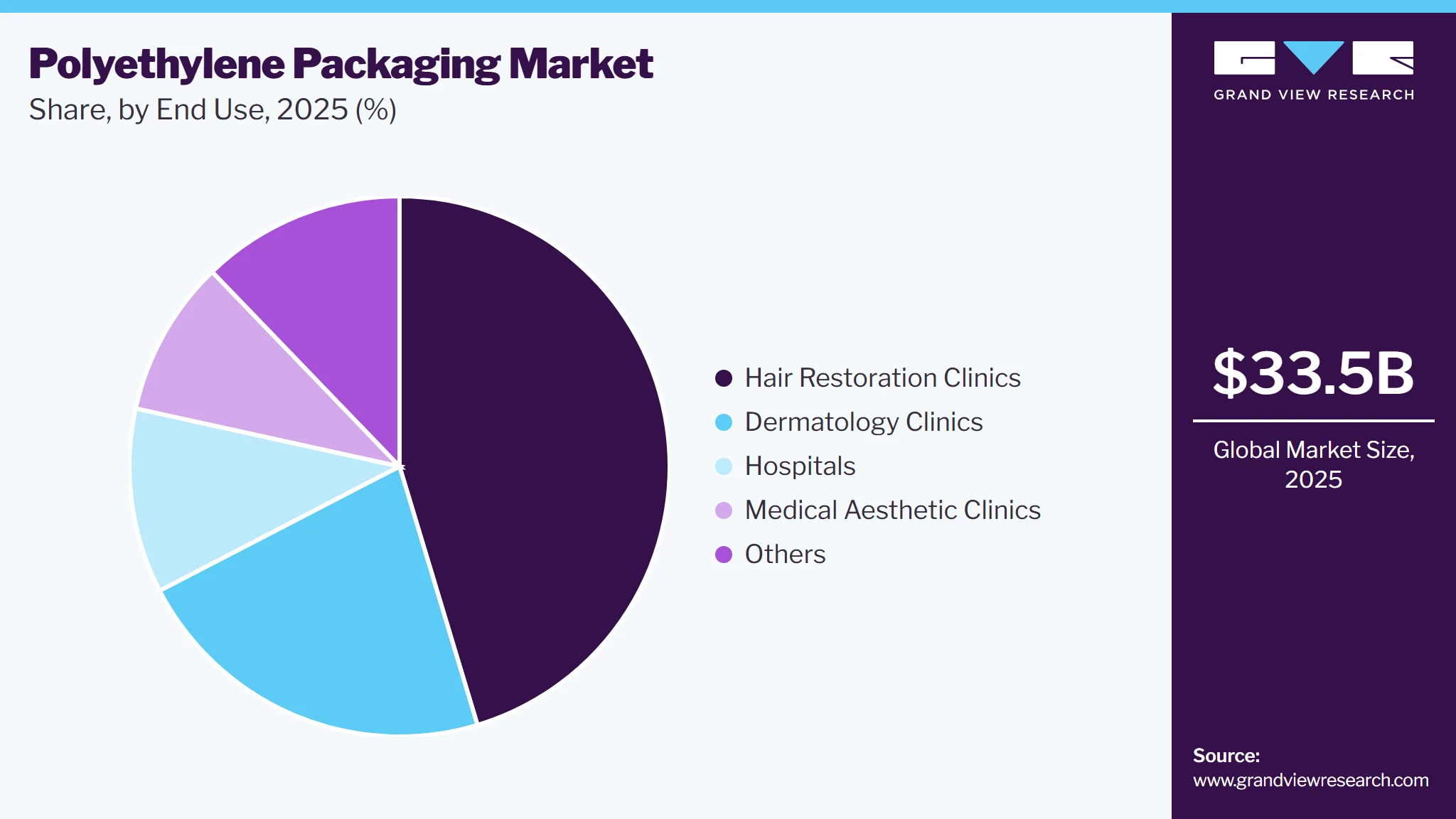
Food & Beverage dominated accounting for the largest revenue share of 36.9% in 2025. Polyethylene is widely used in food and beverage packaging for films, bags, pouches, bottles, caps, and closures due to its moisture resistance, heat-sealing properties, flexibility, and ability to protect products during storage and distribution. Its applications range from fresh and frozen food packaging to bread bags, liquid containers, liners, and overwraps. The material's lightweight structure and suitability for high-volume manufacturing make it attractive to food processors and packaging converters seeking cost-efficient solutions that maintain product quality and handling convenience. Continued demand for packaged foods, ready-to-eat products, and convenient retail packaging supports the segment's leading position.
 To learn more about this report, Download Free Sample Report
The E-commerce and Logistics segment is expected to grow at the fastest CAGR of 6.3% during the forecast period The expansion of online retail and parcel distribution is increasing demand for polyethylene packaging materials such as courier bags, protective films, stretch wraps, liners, and flexible mailers. These formats offer low weight, moisture resistance, flexibility, and resistance to tearing, helping protect goods during sorting, handling, and last-mile delivery. The growth of omnichannel retail, direct-to-consumer shipping, and high-volume fulfillment operations is further supporting adoption. In addition, the need to minimize shipping weight and secure products throughout complex distribution networks is encouraging the use of polyethylene-based packaging, particularly flexible formats that can accommodate different product sizes and delivery requirements.
Regional Insights
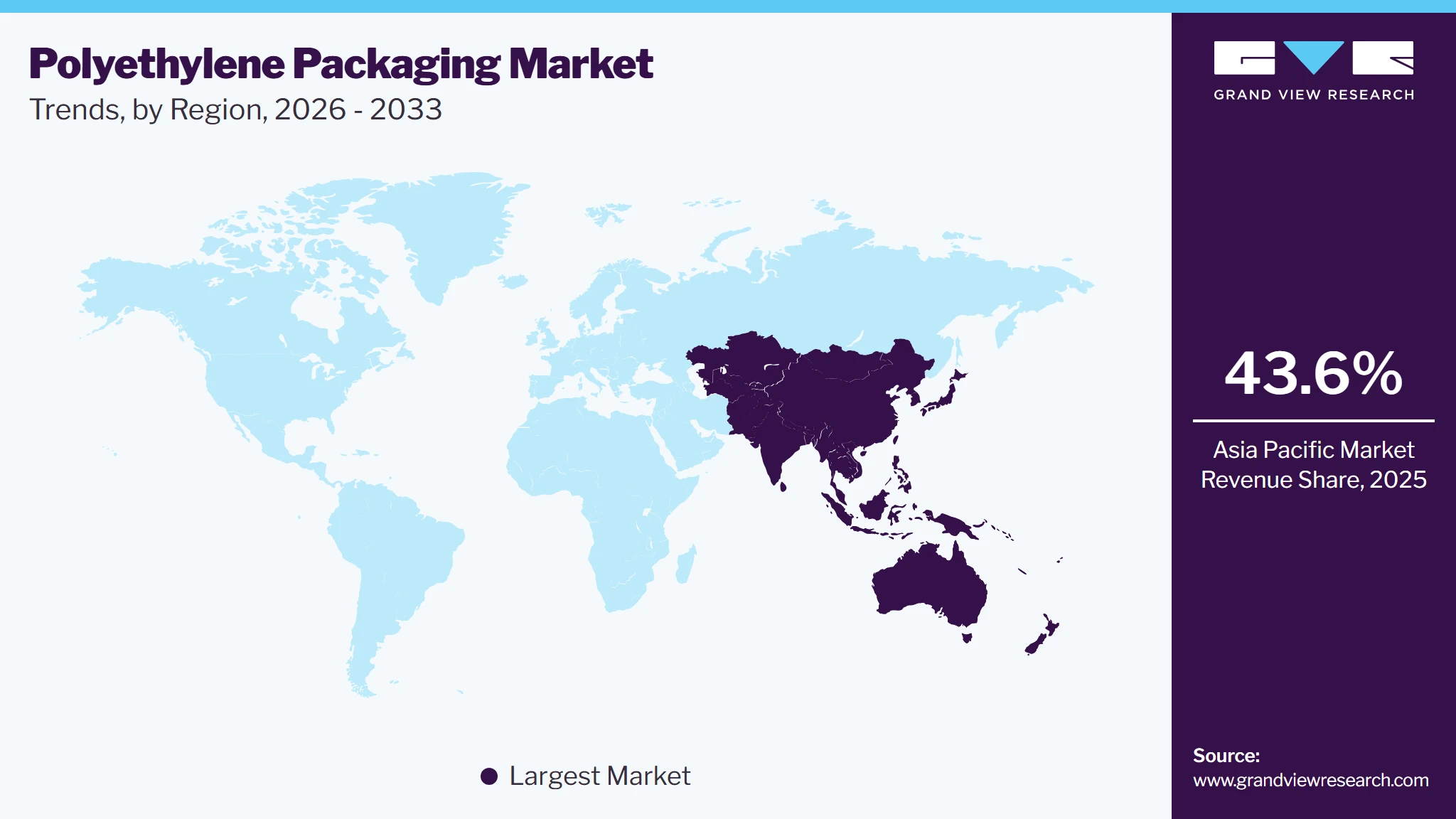
The Asia Pacific region dominated the global market, accounting for the largest revenue share of 43.6% in 2025 and is projected to register the fastest CAGR of 6.4% during 2026-2033. Regional growth is supported by expanding food processing, rising consumption of packaged goods, and the strong presence of manufacturing industries across China, India, Japan, and Southeast Asia. Increasing demand for flexible films, bags, pouches, and rigid containers is reinforcing polyethylene’s role in cost-efficient packaging production. The region’s expanding e-commerce sector and investments in packaging conversion capacity are also expected to strengthen its market leadership.
 To learn more about this report, Download Free Sample Report
China Polyethylene Packaging Market Trends
The China polyethylene packaging market is supported by the country’s extensive manufacturing ecosystem, large consumer base, and high-volume production of packaged goods. Strong demand from food and beverage processing, personal care, household products, and industrial sectors sustains the use of polyethylene films, bags, pouches, bottles, and containers. The growth of online retail and parcel delivery is further creating demand for lightweight protective packaging. In parallel, manufacturers are focusing on material efficiency, recyclable packaging designs, and improvements in production processes to address evolving sustainability expectations.
The India polyethylene packaging market is expected to witness strong growth during the forecast period, driven by expanding food processing, rising packaged-goods consumption, and the growth of e-commerce and organized retail. Increasing demand from agriculture, pharmaceuticals, personal care, and household product manufacturers is creating opportunities for both flexible and rigid polyethylene packaging. The expansion of domestic manufacturing and the need for affordable, lightweight packaging solutions are further supporting adoption. Growing attention to plastic waste management and packaging recyclability is also encouraging converters to explore material reduction and improved packaging designs.
North America Polyethylene Packaging Market Trends
The North America polyethylene packaging market is expected to experience steady growth during the forecast period, supported by sustained demand from food and beverage, healthcare, household products, and industrial applications. Packaging manufacturers benefit from established converting capabilities and widespread use of polyethylene films, bottles, containers, and protective wraps. Growing e-commerce distribution is contributing to demand for lightweight shipping and protective packaging, while increasing attention to packaging waste is encouraging manufacturers to explore recyclable designs, material reduction, and recycled polyethylene where suitable.
The U.S. polyethylene packaging market is expected to expand steadily, driven by demand for convenient food packaging, household product containers, pharmaceutical packaging, and e-commerce mailers. Established consumer goods and logistics industries continue to create opportunities for both flexible and rigid polyethylene formats. Manufacturers are also focusing on packaging redesign, lightweighting, and improved recyclability to meet brand-owner sustainability commitments and changing packaging requirements. Continued investment in material-efficient packaging solutions is expected to support market development.
Europe Polyethylene Packaging Market Trends
The Europe polyethylene packaging market is projected to grow at a moderate pace, with revenue expected to increase at a CAGR of 5.3% during 2026-2033. Demand comes from established food and beverage, personal care, healthcare, and industrial sectors that rely on polyethylene’s moisture resistance, flexibility, durability, and sealing performance. The region’s emphasis on packaging circularity is influencing product development, particularly through recyclable packaging structures, reduced material consumption, and greater consideration of recycled content. Manufacturers must balance these sustainability priorities with product protection, food-contact requirements, and cost efficiency.
The Germany polyethylene packaging market benefits from the country’s strong manufacturing base and demand from food processing, chemicals, personal care, and industrial goods industries. Polyethylene films, bottles, drums, and containers serve applications requiring dependable product protection and efficient handling. Demand is also shaped by the needs of established packaging converters and industrial users for consistent material quality and performance. Ongoing attention to resource efficiency and packaging recyclability is encouraging manufacturers to refine material selection and packaging designs.
The UK polyethylene packaging market is expected to record steady growth, supported by packaged food consumption, online retail, household products, and healthcare applications. Flexible polyethylene formats are important for shipping bags, films, liners, and pouches, while rigid formats provide containment for liquids and consumer products. Sustainability considerations are increasingly influencing packaging choices, with businesses examining recyclable designs, material reduction, and the suitability of recycled polyethylene. Demand will depend on how effectively manufacturers meet performance requirements while adapting to evolving packaging and waste-management expectations.
Latin America Polyethylene Packaging Market Trends
The Latin America polyethylene packaging market is projected to grow at a CAGR of 6.1% during 2026-2033, supported by demand from food and beverage processing, agriculture, consumer goods, and logistics. Polyethylene is used extensively in films, bags, sacks, containers, and protective packaging because it can accommodate different product types while offering moisture protection and cost-efficient processing. Expanding packaged-goods distribution and gradual modernization of manufacturing and retail supply chains are expected to create opportunities for polyethylene packaging producers across the region.
The Brazil polyethylene packaging market is supported by its large consumer market and established agricultural, food processing, and industrial sectors. Demand spans flexible films and bags used in food and agricultural supply chains, as well as bottles and containers for household and personal care products. The need to protect products during storage and distribution supports the use of lightweight, moisture-resistant polyethylene formats. Improvements in packaging collection and recycling, alongside manufacturers’ efforts to optimize material consumption, are likely to influence future product development.
The Argentina polyethylene packaging market is expected to develop steadily, with demand linked to food production, agriculture, household goods, and industrial packaging. Films, sacks, liners, and containers serve applications ranging from agricultural products to packaged consumer goods. Market opportunities are associated with the need for practical, durable packaging that can withstand handling and distribution conditions. The pace of growth will also be influenced by industrial investment, input-cost conditions, and the availability of packaging materials for local converters.
Middle East & Africa Polyethylene Packaging Market Trends
The Middle East and Africa polyethylene packaging market is forecast to grow at a comparatively slower CAGR of 3.1% during 2026-2033, despite rising demand from food distribution, agriculture, construction-related products, household goods, and industrial applications. Polyethylene packaging is valued for its moisture resistance and ability to protect goods under demanding storage and transportation conditions. Regional demand is supported by urbanization and the expansion of retail and manufacturing activities, although differences in industrial capacity, packaging recovery infrastructure, and purchasing power are expected to influence adoption across individual countries.
Key Polyethylene Packaging Company Insights
Some key companies in the polyethylene packaging market include Amcor plc, Mondi, Sealed Air, Coveris, Winpak Ltd., CCL Industries, Dow, Anchor Packaging LLC, UFlex Limited, NPF Polyfilms Pvt. Ltd., Sigma Plastics Group, and Constantia Flexibles. The market is characterized by the widespread use of high-density polyethylene (HDPE), low-density polyethylene (LDPE), and linear low-density polyethylene (LLDPE) across flexible and rigid packaging formats. Competition is shaped by packaging performance, manufacturing efficiency, material innovation, product customization, and sustainability initiatives. Key participants focus on developing lightweight films, durable containers, flexible pouches, recyclable packaging structures, and solutions incorporating recycled polyethylene to address changing customer requirements and environmental priorities.
-
Amcor plc develops flexible and rigid packaging solutions for food, beverage, healthcare, and consumer product applications. Its packaging portfolio addresses requirements such as product protection, shelf life, convenience, and material efficiency. The company’s capabilities across multiple packaging formats position it to serve brands seeking customized polyethylene-based packaging and designs aligned with recyclability objectives.
-
Mondi offers packaging solutions across consumer and industrial markets, including flexible packaging and technical films. Its packaging expertise supports applications requiring protection during storage, handling, and distribution. The company’s focus on fit-for-purpose packaging design and resource efficiency is relevant to polyethylene packaging applications where durability, material use, and end-of-life considerations influence product development.
Key Polyethylene Packaging Companies
The following key companies have been profiled for this study on the polyethylene packaging market.
-
Amcor plc
-
Mondi
-
Sealed Air
-
Coveris
-
Winpak LTD.
-
CCL Industries
-
Dow
-
Anchor Packaging LLC
-
UFlex Limited
-
NPF Polyfilms Pvt Ltd
-
Sigma Plastics Group
-
Constantia Flexibles
Competitive Benchmarking
Category
Operating Strategies
Competitive Edge
Weakness
Established Players (Amcor plc; Mondi; Sealed Air; Dow; UFlex Limited; Constantia Flexibles)
- Focus on expanding polyethylene packaging portfolios across flexible films, pouches, bags, and rigid packaging applications. Invest in resin technology, lightweighting, recyclable packaging structures, manufacturing efficiency, and customer-specific solutions for food, healthcare, consumer goods, and industrial markets.
- Strong manufacturing capabilities, established customer relationships, broad product portfolios, technical expertise, and global distribution networks support their competitiveness. Integrated resin or packaging capabilities and investments in material innovation strengthen their market position.
- High capital investment requirements, exposure to polyethylene resin price volatility, and increasing pressure to improve recyclability can affect margins. Complex packaging requirements and differences in recycling infrastructure also create challenges.
Specialized and Emerging Players (Coveris; Winpak Ltd.; CCL Industries; Anchor Packaging LLC; NPF Polyfilms Pvt. Ltd.; Sigma Plastics Group)
- Concentrate on specialized packaging formats, including flexible films, bags, food packaging, labels, and polyethylene-based packaging materials. Emphasize customized product development, application-specific performance, regional customer relationships, and efficient converting operations.
- Focused product expertise, flexible manufacturing capabilities, application-specific solutions, and responsiveness to customer requirements support competition in selected market segments. Regional presence and specialization can help address niche packaging needs.
- Comparatively narrower product coverage or geographic reach for some participants may limit access to large multinational customers. Dependence on resin supply, pricing competition, and the cost of developing recyclable packaging can con
Recent Development
-
In May 2026, Sigma Plastics Group received a commercial shipment of recycled polyethylene resin from NOVA Chemicals for use in stretch-film applications. The recycled material is intended for films supplied to retailers and distribution centers, including products in Sigma’s Sustain360 PCR stretch-film line, supporting the use of recycled PE in packaging applications.
Polyethylene Packaging Market Report Scope
Report Attribute
Details
Market size in 2025
USD 33.5 billion
Estimated market size in 2026
USD 35.2 billion
Projected market size by 2033
USD 52.1 billion
Growth Rate
CAGR of 5.8% from 2026 to 2033
Base year for estimation
2025
Historical data
2021 - 2024
Forecast period
2026 - 2033
Quantitative units
Revenue in USD million/billion and CAGR from 2026 to 2033
Report coverage
Revenue forecast, company ranking, competitive landscape, growth factors, and trends
Segments covered
Material, product type, packaging format, end-use industry, region
Regional Scope
North America, Europe, Asia Pacific, Latin America, Middle East & Africa
Country Scope
U.S.; Canada; Mexico; Germany; France; UK; Italy; Spain; China; India; Japan; South Korea; Australia; Brazil; Argentina; Saudi Arabia; UAE; South Africa
Key companies profiled
Amcor plc, Mondi, Sealed Air, Coveris, Winpak LTD., CCL Industries, Dow, Anchor Packaging LLC, UFlex Limited, NPF Polyfilms Pvt Ltd, Sigma Plastics Group, Constantia Flexibles
Customization scope
Free report customization (equivalent up to 8 analysts working days) with purchase. Addition or alteration to country, regional & segment scope.
Pricing and purchase options
Avail of customized purchase options to meet your exact research needs. Explore purchase options
Global Polyethylene Packaging Market Report Segmentation
This report forecasts revenue growth at the regional, and country levels and provides an analysis on the latest industry trends and opportunities in each of the sub-segments from 2021 to 2033. For the purpose of this study, Grand View Research has segmented the global polyethylene packaging market report on the basis of material, end-use industry, and region:
-
Material Outlook (Revenue, USD Million, 2021 - 2033)
-
High-Density Polyethylene (HDPE)
-
Low-Density Polyethylene (LDPE)
-
Linear Low-Density Polyethylene (LLDPE)
-
Medium-Density & Other PE Grades
-
-
Product Type Outlook (Revenue, USD Million, 2021 - 2033)
-
Films & Sheets
-
Bags & Sacks
-
Pouches & Sachets
-
Bottles & Containers
-
Drums, Jerricans & Bulk Containers
-
Caps & Closures
-
Other PE Packaging Products
-
-
Packaging Format Outlook (Revenue, USD Million, 2021 - 2033)
-
Rigid Packaging
-
Flexible Packaging
-
-
End-use Industry Outlook (Revenue, USD Million, 2021 - 2033)
-
Food & Beverages
-
Healthcare and Pharmaceuticals
-
Personal Care & Cosmetics
-
Household Care and Cleaning Products
-
Industrial Chemicals and Lubricants
-
Agriculture
-
E-commerce and Logistics
-
Other End-Use Industries
-
-
Regional Outlook (Revenue, USD Million, 2021 - 2033)
-
North America
-
U.S.
-
Canada
-
Mexico
-
-
Europe
-
Germany
-
France
-
UK
-
Italy
-
Spain
-
-
Asia Pacific
-
China
-
India
-
Japan
-
South Korea
-
Australia
-
-
Latin America
-
Brazil
-
Argentina
-
-
Middle East & Africa
-
Saudi Arabia
-
UAE
-
South Africa
-
-
Research Methodology
The polyethylene packaging market figures in this report are based on a proven research process that combines executive interviews with secondary research from proprietary databases, company filings, and recognized regulatory and institutional sources. Market size is built through value-chain sizing-reconciling supply-side and demand-side estimates-and triangulated with bottom-up and top-down approaches. Every estimate passes multiple levels of expert validation before publication, with each polyethylene packaging segment quantified using the revenue-capture definitions in the table below.
Segment Definition
Segment - Material Type
Revenue capture definition
High-Density Polyethylene (HDPE)
Revenue from HDPE-based packaging, including bottles, containers, jerrycans, drums, caps, and closures, used for food, household products, chemicals, and industrial goods.
Low-Density Polyethylene (LDPE)
Revenue from LDPE-based packaging, including flexible films, bags, pouches, liners, and wraps, valued for flexibility, moisture resistance, and heat-sealing properties.
Linear Low-Density Polyethylene (LLDPE)
Revenue from LLDPE-based packaging, including stretch films, shrink films, protective wraps, bags, and liners, offering puncture resistance, tensile strength, and flexibility.
Medium-Density and Other PE Grades
Revenue from packaging made using MDPE and other polyethylene grades, including specialized films, bags, containers, and customized packaging components for specific performance requirements.
Segment - Product Type
Revenue capture definition
Films and Sheets
Revenue from polyethylene films and sheets used for wrapping, lining, overwrapping, and protective packaging across food, agriculture, retail, and industrial applications.
Bags and Sacks
Revenue from polyethylene bags and sacks used for shopping, garbage collection, food storage, agriculture, and industrial material packaging.
Pouches and Sachets
Revenue from polyethylene-based pouches and sachets used for food, beverages, personal care, household products, and other consumer goods.
Bottles and Containers
Revenue from polyethylene bottles and containers used for packaging liquids, personal care products, household chemicals, food, and industrial products.
Drums, Jerricans and Bulk Containers
Revenue from polyethylene drums, jerricans, and bulk containers used for storing and transporting chemicals, lubricants, liquids, and industrial materials.
Caps and Closures
Revenue from polyethylene caps, lids, and closures used to seal bottles, containers, and other packaging formats, supporting leak prevention and product protection.
Other PE Packaging Products
Revenue from other polyethylene packaging products, including protective packaging components, specialty liners, and customized packaging formats not classified in the above segments.
Segment - Packaging Format
Revenue capture definition
Rigid Packaging
Revenue from polyethylene-based rigid packaging, including bottles, containers, drums, jerricans, caps, and closures used for liquids, chemicals, food, personal care, and industrial products.
Flexible Packaging
Revenue from polyethylene-based flexible packaging, including films, bags, pouches, sachets, liners, and wraps used for food, consumer goods, agriculture, and industrial applications.
Segment - End-use Industry
Revenue capture definition
Food and Beverage
Revenue from polyethylene packaging used for food and beverage products, including films, bags, pouches, bottles, containers, and closures.
Healthcare and Pharmaceuticals
Revenue from polyethylene packaging used for pharmaceutical products, medical supplies, and healthcare materials, including bottles, containers, bags, and protective films.
Personal Care and Cosmetics
Revenue from polyethylene packaging for skincare, haircare, cosmetics, and personal hygiene products, including bottles, tubes, pouches, and closures.
Household Care and Cleaning Products
Revenue from polyethylene packaging used for detergents, cleaners, disinfectants, and other household products, including bottles, containers, bags, and refill pouches.
Industrial Chemicals and Lubricants
Revenue from polyethylene packaging used to store and transport industrial chemicals, lubricants, oils, and other chemical products, including drums, jerricans, containers, and liners.
Agriculture
Revenue from polyethylene packaging used for seeds, fertilizers, pesticides, agricultural products, and related materials, including bags, sacks, films, and liners.
E-commerce and Logistics
Revenue from polyethylene packaging used for shipping, parcel handling, and product protection, including courier bags, mailers, stretch films, and protective wraps.
Other End-Use Industries
Revenue from polyethylene packaging used in other sectors, including automotive, construction, electronics, and consumer goods, across specialized films, bags, containers, and protective packaging products.
Estimation Model
Layer Name
Key Question
Description
End-Use Industry Layer
What drives demand?
Estimate demand from food and beverage, healthcare, personal care, household products, industrial chemicals, agriculture, and e-commerce industries that use polyethylene packaging for product protection, storage, and transportation.
Packaging Format Adoption Layer
Which packaging formats are preferred?
Assess the adoption of flexible and rigid polyethylene packaging based on requirements such as moisture resistance, flexibility, durability, sealing performance, and ease of handling.
Material and Product Consumption Layer
Which materials and products generate demand?
Evaluate consumption of HDPE, LDPE, LLDPE, and other polyethylene grades across films, sheets, bags, pouches, bottles, containers, drums, caps, and closures.
Revenue Estimation Layer
How is market revenue generated?
Calculate revenue generated from the sale of polyethylene packaging products across material types, product categories, packaging formats, and end-use industries, accounting for differences in product specifications and application requirements.
Delivered Customizations
This report has been delivered with the following In-depth customizations
Client Request
Customization Delivered
Value Adds
Competitive Benchmarking
Comparative assessment of key polyethylene packaging companies based on product portfolios, HDPE/LDPE/LLDPE capabilities, flexible and rigid packaging solutions, manufacturing footprint, innovation, sustainability initiatives, and strategic developments.
Supports competitor positioning, identification of product portfolio gaps, evaluation of competitive strengths, and development of market-entry and expansion strategies.
Cross-Segmentation Analysis
Comprehensive analysis across material types (HDPE, LDPE, LLDPE, and other PE grades), product types (films, bags, pouches, bottles, containers, and closures), packaging formats (flexible and rigid), end-use industries, and regional markets.
Helps identify high-potential material-product combinations, application-specific demand patterns, attractive end-use segments, and regional growth opportunities for targeted investment.
Trade Assessment
Assessment of polyethylene packaging trade flows, import-export patterns, key supplying and consuming countries, cross-border supply chains, and factors influencing trade, including resin availability, production capacity, logistics costs, tariffs, and regulatory requirements.
Enables businesses to evaluate sourcing opportunities, understand regional supply dependencies, identify potential export markets, manage supply-chain risks, and improve procurement and market-expansion decisions.
About the Author(s)
Plastics, Polymers & Resins Research Team
Bulk Chemicals · Plastics, Polymers & ResinsThis report was authored by the plastics, polymers & resins research team at Grand View Research - comprising two research analysts, one senior research analyst, and one industry expert - with specialized expertise in the plastics, polymers & resins segment of the bulk chemicals industry. All findings are based on proprietary bulk chemicals databases, executive interviews, and regulatory analysis, subject to internal peer review prior to publication.
Last Updated:
Speak to Analyst

Customize this report to your needs - add regions, segments, or data points, with 20% free customization.
Or view our licence options:


ISO 9001:2015 & 27001:2022 Certified
We are GDPR and CCPA compliant! Your transaction & personal information is safe and secure. For more details, please read our privacy policy.


