
- Home
- »
- Agrochemicals
- »
-
Potassium Sulfate Market Size & Share Report, 2026-2033GVR Report cover

Potassium Sulfate Market (2026 - 2033)
Size, Share & Trends Analysis By Report Application (Agriculture, Industrial, Pharmaceutical, Food & Beverage), By Region (North America, Europe, Asia Pacific, Middle East & Africa, Central & South America), And Segment Forecasts
Market Size, 2025
$2.1BMarket Estimate, 2026
$2.2BMarket Forecast, 2033
$2.8BCAGR, 2026–2033
3.9%Potassium Sulfate Market Summary
The global potassium sulfate market size was valued at USD 2.1 billion in 2025 and is projected to grow from USD 2.2 billion in 2026 to USD 2.8 billion by 2033, at a CAGR of 3.9% from 2026 to 2033. Asia Pacific market is dominant, with a revenue share of 53.8% in 2025. The growth of the global potassium sulfate market is primarily driven by the increasing adoption of chloride-free fertilizers in modern agriculture, particularly for high-value and chloride-sensitive crops such as fruits, vegetables, tobacco, and nuts.
 Source: Grand View Research, IR Documents, Primary Interviews, Paid DatabasesTo learn more about this report,
 Download Free Sample Report
Key Market Trends & Insights
- By application: Agriculture segment dominated the product segment with a market share of 83.8% in 2025.
Regional Highlights
- Largest regional market: Asia Pacific (53.8% revenue share, 2025)
- By country: China held the largest market share in 2025.
- Fastest-growing regional market: Central & South America (highest CAGR, 2026-2033)
Market Size & Forecasts
- Market size in 2025: USD 2.1 Billion
- Estimated market size in 2026: USD 2.2 Billion
- Projected market size by 2033: USD 2.8 Billion
- CAGR (2026-2033): 3.9%
Prism AI by Grand View Research Free to tryAsk a question about the potassium sulfate marketTry asking✓Every figure cited from GVR research Prefer the report? Download free sample →
Rising awareness regarding soil health and sustainable nutrient management practices has further strengthened the demand for potassium sulfate as an efficient source of potassium and sulfur. The expansion of greenhouse and precision farming across regions such as the Asia Pacific and Europe, coupled with supportive government initiatives promoting specialty fertilizers, is augmenting market growth. The growing use of potassium sulfate in industrial and pharmaceutical applications, including glass manufacturing and the formulation of medicines, is also contributing to steady demand diversification across multiple end-use sectors. To learn more about this report, Download Free Sample Report
Significant growth opportunities lie in the technological advancements in production processes and rising adoption of water-soluble fertilizers in drip and fertigation systems. Increasing investments in sustainable agriculture and the shift toward organic and specialty fertilizer formulations are expected to create lucrative prospects for potassium sulfate manufacturers, especially those offering high-purity and specialty grades. Moreover, the emerging markets of Asia Pacific, the Middle East, and Africa present untapped potential due to the rapid development of horticultural and cash crop cultivation, supported by improving irrigation infrastructure. Strategic collaborations between producers and agri-input distributors to expand regional supply chains, along with value-added offerings such as micronutrient-enriched potassium sulfate, are likely to strengthen market competitiveness and profitability.
Despite its growth prospects, the potassium sulfate market faces key challenges such as the high production cost and limited natural resource availability, which constrain large-scale manufacturing. The extraction and processing of raw materials, particularly through the Mannheim process or natural brine routes, are energy-intensive and subject to volatile feedstock prices, affecting overall profitability. Furthermore, the market experiences competition from lower-cost substitutes such as potassium chloride, especially in regions where crops are less sensitive to chloride ions. Trade restrictions, fluctuating freight rates, and supply chain disruptions have also posed operational hurdles for global suppliers. Compliance with stringent environmental regulations regarding mining and effluent disposal adds complexity to production and distribution, thereby impacting the long-term cost structure and market expansion plans.
Market Dynamics
The potassium sulfate market is experiencing stable growth, supported by the increasing need for chloride-free fertilizers in high-value agriculture. Potassium sulfate is widely used for crops that are sensitive to chloride, such as fruits, vegetables, nuts, tobacco, and specialty crops, where it improves crop quality, yield, and nutrient uptake. Rising global food demand, shrinking arable land, and the growing adoption of precision farming practices are encouraging farmers to use premium fertilizers that enhance productivity. Expanding horticultural cultivation and greater awareness of balanced crop nutrition are also contributing to market growth.
The rising cultivation of fruits, vegetables, pulses, and other high-value crops is a major factor driving demand for potassium sulfate. Unlike potassium chloride, potassium sulfate supplies both potassium and sulfur without introducing chloride, making it suitable for crops that require improved quality, color, taste, and storage life. Farmers are increasingly adopting this fertilizer to maximize crop performance while maintaining soil health, particularly in regions with intensive agricultural practices.
Growth in greenhouse farming, protected cultivation, and precision agriculture is further strengthening market demand. Modern farming techniques emphasize efficient nutrient management to improve yields and optimize fertilizer application. Potassium sulfate supports these objectives by enhancing nutrient utilization, improving plant resistance to environmental stress, and contributing to higher-value agricultural output.
The production of potassium sulfate involves relatively higher manufacturing costs compared to conventional potash fertilizers due to specialized production processes and dependence on raw materials such as potassium chloride and sulfur-based feedstocks. Fluctuations in energy prices and transportation expenses can increase production costs, affect product pricing and limiting affordability for price-sensitive farming communities.
Supply constraints associated with natural mineral deposits and regional availability of raw materials also pose challenges for market participants. Dependence on a limited number of producing countries may expose the supply chain to geopolitical uncertainties, trade restrictions, and logistics disruptions, creating volatility in product availability across international markets.
Growing emphasis on sustainable farming practices is creating significant opportunities for the potassium sulfate market. Governments and agricultural organizations are promoting balanced fertilizer application to improve soil fertility, reduce environmental impact, and enhance long-term agricultural productivity. This shift is encouraging wider adoption of potassium sulfate in integrated nutrient management programs, particularly for premium and export-oriented crops. Expanding cultivation of organic produce and specialty crops is opening new avenues for market growth. Producers are increasingly seeking fertilizers that improve crop quality while supporting environmentally responsible farming practices. Ongoing investments in fertilizer manufacturing capacity, advancements in production technologies, and the expansion of modern irrigation systems are expected to strengthen the adoption of potassium sulfate across both developed and emerging agricultural markets.
Market Concentration & Characteristics
The market is characterized by a moderately consolidated competitive landscape, with a mix of established fertilizer producers, specialty chemical manufacturers, and regional distributors competing across diversified application areas. Key industry participants such as SQM, Merck KGaA, Jost Chemical Co., Otsuka Chemical Co., Ltd., and Star Grace Mining Co., Ltd. dominate the market through broad product portfolios and strong global distribution networks. These players focus on high-purity, specialty-grade, and water-soluble formulations to cater to agriculture, food, and pharmaceutical industries. Major producers are strategically expanding production capacities and investing in process optimization technologies such as brine-based and Mannheim processes to improve efficiency and cost competitiveness. The long-term supply contracts with fertilizer distributors and agri-input suppliers enable leading players to maintain consistent market presence and ensure product availability in high-demand regions such as Asia Pacific and Europe.
 To learn more about this report, Download Free Sample Report
Market competition is increasingly influenced by product differentiation, vertical integration, and geographic expansion strategies. Companies are focusing on offering value-added potassium sulfate variants, including micronutrient-enriched or water-soluble products, to address evolving crop nutrition requirements and precision farming applications. Strategic collaborations, mergers, and acquisitions are becoming common as firms aim to strengthen regional market access and enhance technological capabilities. For instance, partnerships between raw material suppliers and downstream fertilizer formulators are improving cost efficiencies and ensuring supply chain stability. Meanwhile, emerging players such as Qingdao Haiwan Group Co., Ltd. and AG CHEMI GROUP s.r.o. are intensifying competition by offering cost-effective SOP grades for agricultural and industrial applications. As environmental regulations tighten and sustainability expectations rise, competitive advantage is likely to shift toward producers emphasizing eco-efficient manufacturing, renewable resource utilization, and sustainable fertilizer solutions, thereby shaping the future trajectory of the market.
Analyst Perspective
The global potassium sulfate market is positioned for steady growth, driven by increasing demand for high-efficiency, chloride-free fertilizers across the agriculture sector. Potassium sulfate is a vital source of both potassium and sulfur, making it particularly suitable for high-value and chloride-sensitive crops such as fruits, vegetables, tobacco, nuts, and specialty crops. The agriculture segment remains the largest application area, supported by the growing adoption of precision farming, balanced nutrient management, and sustainable agricultural practices aimed at improving crop yield and quality. Rising global food demand, expanding horticultural cultivation, and increasing awareness of soil nutrient management, along with investments in fertilizer production and modern farming technologies, continue to support the long-term growth of the potassium sulfate market.
Application Insights
Agriculture segment dominated the product segment with a market share of 83.8% in 2025, primarily driven by the extensive use of potassium sulfate as a premium, chloride-free fertilizer for high-value and chloride-sensitive crops such as fruits, vegetables, tobacco, and nuts. The growing emphasis on soil health management, precision farming, and sustainable nutrient application practices has accelerated the adoption of potassium sulfate, particularly in regions such as Asia Pacific and Europe, where horticultural and specialty crop cultivation is expanding rapidly. The product’s high solubility and compatibility with drip and fertigation systems have made it a preferred choice in controlled environment agriculture and greenhouse farming. Supportive government policies promoting balanced fertilizer usage, coupled with increasing farmer awareness regarding the adverse effects of chloride-based fertilizers on crop yields and soil productivity, have further consolidated the dominance of the agricultural segment.
 To learn more about this report, Download Free Sample Report
Beyond agriculture, the industrial, pharmaceutical, food & beverage, and other application segments represent smaller yet steadily growing market niches for potassium sulfate. In the industrial sector, potassium sulfate is utilized in glass manufacturing, metal treatment, and specialty chemical synthesis due to its stable thermal and chemical properties. The pharmaceutical segment employs high-purity grades of potassium sulfate as an excipient and electrolyte replenisher in formulations. Meanwhile, in the food and beverage industry, it serves as a nutrient additive, acidity regulator, and salt substitute in specific applications requiring low-sodium formulations. The other applications category includes its use in laboratory reagents, analytical chemistry, and minor feed supplement formulations. Although these segments collectively account for a limited share of the total market, ongoing advancements in product purification technologies and expanding use in specialty chemical processes are expected to gradually enhance their contribution to overall market growth during the forecast period.
Regional Insights
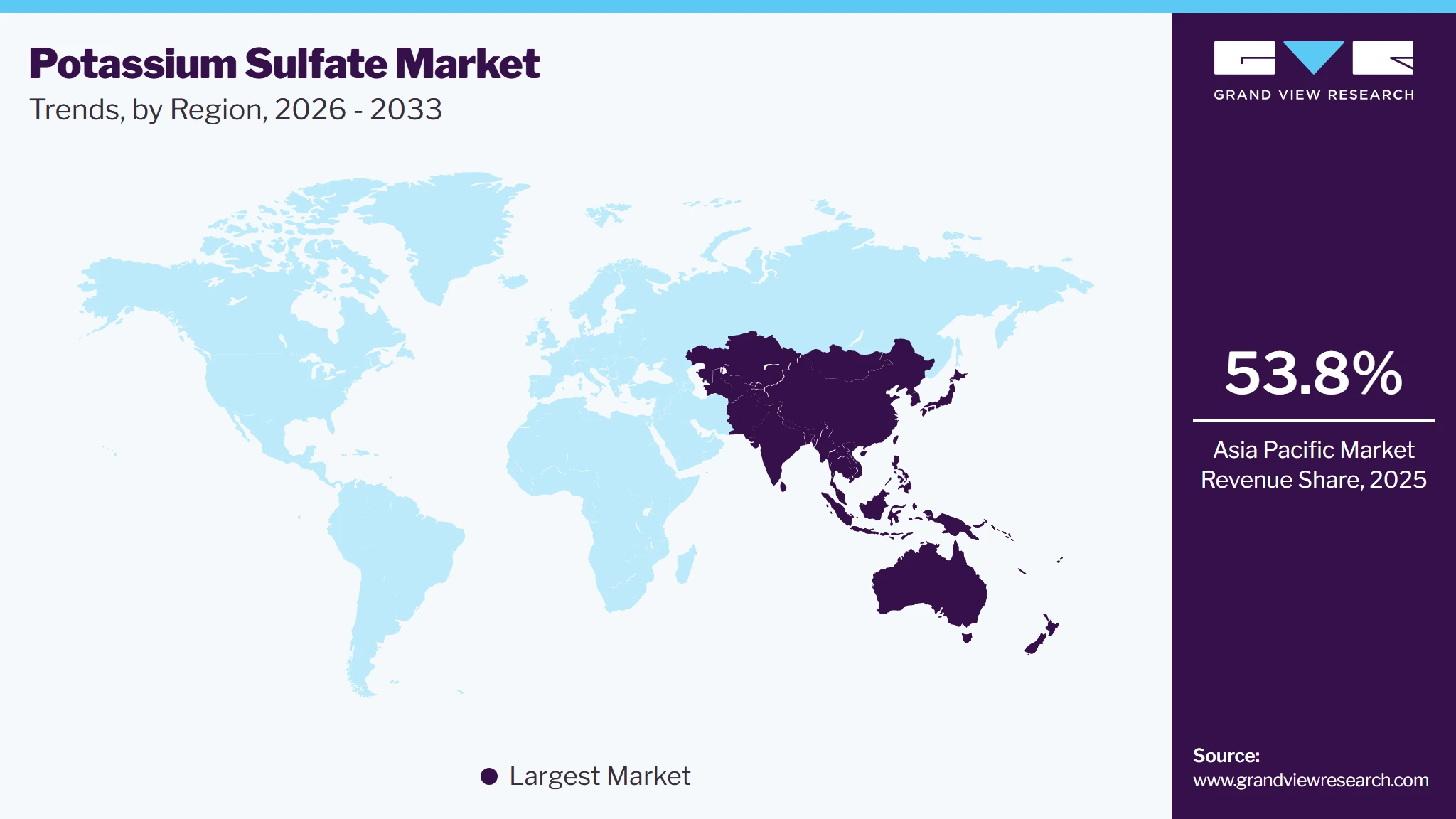
Asia Pacific accounted for 53.8% of the potassium sulfate market revenue in 2025, making it the largest regional market, supported by the region’s robust agricultural base and expanding horticultural sector. Countries such as China, India, and Southeast Asian nations have witnessed increasing adoption of potassium sulfate fertilizers due to their suitability for high-value crops and compatibility with drip irrigation systems. Rapid urbanization and the consequent reduction in arable land are driving the shift toward intensive and high-efficiency farming practices, further boosting demand for premium, chloride-free fertilizers. Government-led initiatives promoting balanced nutrient application, coupled with the expansion of greenhouse farming and export-oriented fruit and vegetable cultivation, have reinforced the region’s leadership position. The presence of large-scale producers and cost-efficient manufacturing capabilities, particularly in China, provides Asia Pacific with a strategic advantage in both domestic supply and export markets.
 To learn more about this report, Download Free Sample Report
China Potassium Sulfate Market Trends
China held the highest market revenue share in Asia Pacific in 2025, positioning itself as both a leading producer and consumer. The country’s dominance stems from its integrated fertilizer production infrastructure, large agricultural base, and strong demand from fruit, vegetable, and tobacco cultivation. Domestic manufacturers such as Qingdao Haiwan Group Co., Ltd. and Star Grace Mining Co., Ltd. have developed cost-efficient production routes, including the Mannheim and brine-based processes, enabling China to serve regional and international markets. Furthermore, government efforts to improve soil fertility and reduce chloride contamination in farmland have spurred the transition from potassium chloride to potassium sulfate-based fertilizers. The country’s growing export capacity, coupled with increasing investments in process optimization and quality enhancement, is expected to strengthen China’s role as a key global supply hub for potassium sulfate.
Europe Potassium Sulfate Market Trends
Europe held a 22.7% share of the global potassium sulfate market in 2024, driven by the region’s strong focus on sustainable agriculture and environmental compliance. Farmers across countries such as Germany, Spain, France, and Italy are increasingly adopting potassium sulfate due to its suitability for organic and chloride-sensitive crops like grapes, citrus fruits, and vegetables. The European Union’s stringent fertilizer regulations, which emphasize low chloride and low environmental impact formulations, have accelerated the demand for sulfate-based potassium sources. In addition, the presence of major specialty chemical and fertilizer producers, coupled with growing adoption of water-soluble fertilizers in precision and greenhouse farming, has contributed to market expansion. The region’s mature agricultural infrastructure and emphasis on high-quality, sustainable produce continue to position Europe as a high-value market for potassium sulfate manufacturers.
The Germanypotassium sulfate market represents one of the largest potassium sulfate markets in Europe, supported by its technologically advanced agricultural practices and high adoption rate of specialty fertilizers. The country’s focus on organic farming, precision irrigation, and environmentally compliant nutrient management systems has driven strong demand for potassium sulfate as a preferred chloride-free alternative to potassium chloride. German farmers, particularly in horticultural and viticulture sectors, rely heavily on SOP for soil enrichment and quality yield improvement. Moreover, the presence of well-established fertilizer distributors and research-driven chemical companies fosters continuous innovation in nutrient formulations. Germany’s leadership in agricultural sustainability and fertilizer technology continues to strengthen its position as a key contributor to Europe’s potassium sulfate consumption.
North America Potassium Sulfate Market Trends
North America accounted for 10.1% of the global potassium sulfate market in 2024, driven by its highly commercialized agriculture sector and the growing preference for specialty and organic fertilizers. The United States and Canada have seen increased adoption of potassium sulfate in high-value crop cultivation, including fruits, nuts, and vegetables, owing to its chloride-free composition and soil compatibility. Advances in precision farming technologies, alongside sustainability-focused agricultural policies, are further enhancing market penetration. The region also benefits from the presence of major distributors and agri-input suppliers that are expanding their specialty fertilizer portfolios to cater to evolving crop nutrition requirements. However, limited domestic production and dependency on imports from Asia and Central & South America pose mild supply-side constraints, influencing regional pricing dynamics.
The U.S. potassium sulfate market captured 52.6% of the North American potassium sulfate market in 2024, underpinned by robust demand from its large-scale fruit, nut, and vegetable production regions such as California and Florida. Farmers increasingly prefer potassium sulfate for chloride-sensitive crops like citrus, grapes, and almonds, where soil salinity management is critical. The U.S. market is also benefiting from the growing adoption of precision agriculture and fertigation systems, which enhance the efficiency of water-soluble SOP fertilizers. Additionally, environmental regulations and sustainability programs led by the USDA and state-level agricultural agencies are promoting the use of balanced nutrient inputs, further supporting market growth. Import partnerships with Asian and Central & South American producers remain crucial to meeting domestic demand, while the expansion of distribution networks and specialty product lines is fostering steady market development.
Middle East & Africa Potassium Sulfate Market Trends
The Middle East & Africa region presents emerging growth opportunities for the potassium sulfate market, driven by increasing agricultural modernization and water-efficient farming initiatives. Countries such as Saudi Arabia, the United Arab Emirates, and South Africa are investing heavily in greenhouse cultivation and precision irrigation systems, where potassium sulfate’s high solubility offers clear advantages. Limited arable land and challenging climatic conditions have accelerated demand for specialty fertilizers that enhance crop resilience and soil productivity. Furthermore, rising awareness of chloride-induced soil degradation is leading to a gradual shift from conventional potassium chloride to sulfate-based fertilizers. Although the region’s market share remains comparatively smaller, ongoing government programs promoting sustainable food production and reduced import dependency are expected to create strong growth prospects for potassium sulfate suppliers in the coming years.
Central & South America Potassium Sulfate Market Trends
The Central & South American potassium sulfate market is experiencing steady growth, supported by the region’s expanding horticulture and export-oriented crop sectors, particularly in countries such as Brazil, Chile, and Argentina. Farmers are increasingly adopting potassium sulfate to enhance the yield and quality of high-value crops like fruits, coffee, and tobacco. The region’s favorable climatic conditions and rising adoption of advanced irrigation systems have accelerated the shift toward water-soluble and specialty fertilizers. Additionally, regional players are forming partnerships with international suppliers to improve product availability and reduce dependence on imports. While cost sensitivity remains a key factor influencing adoption, ongoing efforts by governments and cooperatives to promote sustainable and chloride-free fertilization are expected to further boost market penetration across Central & South America.
Key Potassium Sulfate Company Insights
Key players, such as Jost Chemical Co., American Elements , Takasugi Pharmaceutical Co., Ltd., KISHIDA CHEMICAL CO., LTD. , Otsuka Chemical Co.,Ltd. , and Star Grace Mining Co.,Ltd are dominating the market.
-
Jost Chemical Co. is a U.S.-headquartered manufacturer of high-purity mineral salts, founded in 1984 and operating major FDA-registered and cGMP-compliant production facilities in St. Louis (USA) and Kościan (Poland). The company supplies more than 250 specialty salts, including multiple grades of potassium sulfate, to sectors such as pharmaceuticals, food & beverage, clinical nutrition and laboratory reagents, with certifications covering USP/NF/EP/FCC and kosher/halal standards. Jost’s technical focus on low-impurity, ultra-fine powders and granular forms, combined with global distribution and custom packaging capabilities, positions it as a key player in the specialty-grade potassium sulfate market rather than large-scale agricultural fertilizer volumes.
Key Potassium Sulfate Companies
The following key companies have been profiled for this study on the potassium sulfate market.
-
Jost Chemical Co.
-
American Elements
-
Takasugi Pharmaceutical Co., Ltd.
-
KISHIDA CHEMICAL CO., LTD.
-
Otsuka Chemical Co.,Ltd.
-
Star Grace Mining Co.,Ltd
-
Merck
-
SQM
-
Mineral Technologies, Inc.
-
AG CHEMI GROUP s.r.o.
Competitive Benchmarking
Category
Operating Strategies
Competitive Edge
Weakness
Established Players (Merck; SQM; Otsuka Chemical Co., Ltd.; American Elements; Mineral Technologies, Inc.)
- Expand production capacities for high-purity and specialty-grade potassium sulfate.
- Strengthening global distribution through strategic partnerships and regional expansion.
- Invest in process optimization, product quality, and sustainable manufacturing technologies.
- Focus on serving agriculture, pharmaceutical, food, and industrial customers through diversified product portfolios.
- Strong global presence with established customer relationships across multiple industries.
- Advanced manufacturing capabilities ensuring consistent product quality and regulatory compliance.
- Broad product portfolios supported by extensive R&D and technical expertise.
- Financial strength enables investments in capacity expansion and innovation.
- High operating and energy costs associated with specialty-grade production.
- Exposure to fluctuations in raw material availability and transportation costs.
- Compliance with stringent environmental and product quality regulations increases operational expenses.
- Premium pricing may limit competitiveness in cost-sensitive markets.
Emerging & Regional Players (Jost Chemical Co.; Takasugi Pharmaceutical Co., Ltd.; KISHIDA CHEMICAL CO., LTD.; Star Grace Mining Co., Ltd.; AG CHEMI GROUP s.r.o.)
- Focus on regional supply of agricultural, pharmaceutical, and industrial-grade potassium sulfate.
- Strengthen relationships with fertilizer manufacturers and regional distributors.
- Improve production efficiency through localized manufacturing and supply chains.
- Expand specialty-grade offerings to address niche customer requirements.
- Strong regional market knowledge and customer responsiveness.
- Competitive pricing is supported by localized sourcing and distribution.
- Flexibility to provide customized grades and smaller order volumes.
- Ability to quickly adapt to changing regional demand and regulatory requirements.
- Limited production capacity compared to multinational producers.
- Smaller international distribution networks and export presence.
- Lower investment capacity for large-scale technology upgrades and expansion projects.
- Greater dependence on regional demand and raw material supply conditions.
Potassium Sulfate Market Report Scope
Report Attribute
Details
Market size in 2025
USD 2.1 billion
Estimated market size in 2026
USD 2.2 billion
Projected market size by 2033
USD 2.8 billion
Growth rate
CAGR of 3.9% from 2026 to 2033
Base year for estimation
2025
Historical data
2021 - 2024
Forecast period
2026 - 2033
Quantitative units
Volume in kilotons, revenue in USD billion and CAGR from 2026 to 2033
Report coverage
Revenue forecast, company ranking, competitive landscape, growth factors, and trends
Segments covered
Application, region
Regional scope
North America; Europe; Asia Pacific; Central & South America; MEA
Country scope
U.S.; Canada; Mexico; Germany; UK; France; Italy; Spain; China; India; Japan; South Korea; Brazil; Argentina; South Africa; Saudi Arabia
Key companies profiled
Jost Chemical Co.; American Elements; Takasugi Pharmaceutical Co., Ltd.; KISHIDA CHEMICAL CO., LTD.; Otsuka Chemical Co.,Ltd.; Star Grace Mining Co.,Ltd; Merck; SQM; Mineral Technologies, Inc.; AG CHEMI GROUP s.r.o.
Customization scope
Free report customization (equivalent up to 8 analysts' working days) with purchase. Addition or alteration to country, regional & segment scope.
Pricing and purchase options
Avail customized purchase options to meet your exact research needs. Explore purchase options
Global Potassium Sulfate Market Report Segmentation
This report forecasts revenue growth at global, regional, and country levels and provides an analysis of the latest industry trends in each of the sub-segments from 2021 to 2033. For this study, Grand View Research has segmented the global potassium sulfate market report based on application, and region.
 To learn more about this report, Download Free Sample Report
-
Application Outlook (Volume, Kilotons; Revenue, USD Million; 2021 - 2033)
-
Agriculture
-
Industrial
-
Pharmaceutical
-
Food & Beverage
-
Other Applications
-
-
Regional Outlook (Volume, Kilotons; Revenue, USD Million; 2021 - 2033)
-
North America
-
U.S.
-
Canada
-
Mexico
-
-
Europe
-
Germany
-
UK
-
France
-
Italy
-
Spain
-
-
Asia Pacific
-
China
-
India
-
Japan
-
South Korea
-
-
Middle East & Africa
-
Saudi Arabia
-
South Africa
-
-
Central & South America
-
Brazil
-
Argentina
-
-
Research Methodology
The potassium sulfate market figures in this report are based on a proven research process that combines executive interviews with secondary research from proprietary databases, company filings, and recognized regulatory and institutional sources. Market size is built through value-chain sizing-reconciling supply-side and demand-side estimates-and triangulated with bottom-up and top-down approaches. Every estimate passes multiple levels of expert validation before publication, with each potassium sulfate segment quantified using the revenue-capture definitions in the table below.
Segment Definition
Segment - Application
Revenue capture definition
Agriculture
Captures revenue generated from potassium sulfate used as a chloride-free fertilizer to supply potassium and sulfur for improving crop yield, quality, nutrient uptake, and resistance to environmental stress in field crops, horticultural crops, and plantations.
Industrial
Represents revenue from potassium sulfate consumed in industrial applications, including glass manufacturing, specialty chemicals, dyes, explosives, and other chemical processing operations requiring high-purity potassium compounds.
Pharmaceutical
Accounts for revenue associated with pharmaceutical-grade potassium sulfate used in the formulation of medicines, laboratory reagents, and medical applications where high purity and stringent quality standards are required.
Food & Beverage
Captures revenue generated from food-grade potassium sulfate used as a food additive, acidity regulator, firming agent, and processing aid in food and beverage manufacturing while complying with food safety regulations.
Other Applications
Includes revenue from potassium sulfate utilized in applications such as water treatment, cosmetics, animal nutrition, research laboratories, and other niche industrial and commercial uses.
Estimation Model
Layer Name
Key Question
Description
Potassium Sulfate Production Layer
What forms is the supply base?
Identify the global production capacity of potassium sulfate by evaluating key manufacturing processes such as the Mannheim process, natural brine and mineral extraction, and other production routes. The analysis covers raw material availability, production capacities, manufacturing technologies, product grades, and key production facilities to establish the global supply landscape.
Application Adoption Layer
Where is potassium sulfate utilized?
Estimate the distribution of potassium sulfate consumption across major applications, including agriculture, industrial, pharmaceutical, food & beverage, and other specialty uses, by analyzing end-use demand, consumption patterns, and regional adoption trends.
Consumption Intensity Layer
How much potassium sulfate is consumed?
Assess potassium sulfate consumption by evaluating fertilizer application rates, crop cultivation areas, industrial production requirements, pharmaceutical manufacturing, food processing demand, and other commercial applications to estimate annual consumption across key regional markets.
Revenue Layer
How is market revenue generated?
Market revenue is generated through the sale of potassium sulfate across standard, granular, soluble, and specialty grades to agricultural producers, fertilizer manufacturers, industrial processors, pharmaceutical companies, food manufacturers, and distributors through direct supply agreements, retail channels, and integrated distribution networks.
Delivered Customizations
This report has been delivered with the following In-depth customizations
Client Request
Customization Delivered
Value Adds
Trade Analysis
Comprehensive assessment of the global potassium sulfate trade landscape, evaluating import-export trends, major exporting and importing countries, trade flows, pricing movements, tariff structures, supply-demand balance, and the impact of trade policies, logistics, and regional production capacities on international commerce.
Supports sourcing strategies and market expansion by identifying key trade corridors, supply risks, import dependency, export opportunities, pricing trends, and favorable markets for procurement, investment, and distribution planning.
Competitive Benchmarking
Comparative evaluation of leading potassium sulfate manufacturers based on production capacity, manufacturing process (Mannheim process, natural brine/mineral extraction, and others), product portfolio, geographic presence, distribution network, sustainability initiatives, and recent strategic developments across major regional markets.
Assists competitive intelligence and strategic decision-making by providing insights into market positioning, production capabilities, operational strengths, supply chain integration, and competitive advantages.
Opportunity Assessment
Comprehensive assessment of emerging opportunities across chloride-sensitive crops, specialty agriculture, precision farming, sustainable fertilizer adoption, greenhouse cultivation, and expanding agricultural production across key regional markets. The analysis also evaluates investments in fertilizer manufacturing capacity and technological advancements in potassium sulfate production.
Helps identify high-growth application areas, regional expansion opportunities, and investment priorities, supporting capacity expansion, product development, market entry strategies, and long-term revenue growth.
Frequently Asked Questions About This Report
Agriculture segment dominated the product segment with a market share of 83.8% in 2025.
Asia Pacific market dominated, with a revenue share of 53.8% in 2025.
Central & South America is the fastest-growing region over the forecast period.
The global potassium sulfate market size was valued at USD 2.1 billion in 2025 and is estimated at USD 2.2 billion in 2026.
The global potassium sulfate market is expected to grow at a CAGR of 3.9% from 2026 to 2033, reaching USD 2.8 billion by 2033.
The growth of the global potassium sulfate market is primarily driven by the rising demand for high-quality, chloride-free fertilizers to enhance yields of fruits, vegetables, and other high-value crops. Increasing adoption of precision and sustainable farming practices, along with government initiatives promoting balanced nutrient management, is further accelerating market expansion.
Key players include Jost Chemical Co.; American Elements; Takasugi Pharmaceutical Co., Ltd.; KISHIDA CHEMICAL CO., LTD.; Otsuka Chemical Co.,Ltd.; Star Grace Mining Co.,Ltd; Merck; SQM; Mineral Technologies, Inc.; AG CHEMI GROUP s.r.o.
About the Author(s)
Agrochemicals Research Team
Specialty & Chemicals · AgrochemicalsThis report was authored by the agrochemicals research team at Grand View Research - comprising two research analysts, one senior research analyst, and one industry expert - with specialized expertise in the agrochemicals segment of the specialty & chemicals industry. All findings are based on proprietary specialty & chemicals databases, executive interviews, and regulatory analysis, subject to internal peer review prior to publication.
Last Updated:
Speak to Analyst

Customize this report to your needs - add regions, segments, or data points, with 20% free customization.
Or view our licence options:


ISO 9001:2015 & 27001:2022 Certified
We are GDPR and CCPA compliant! Your transaction & personal information is safe and secure. For more details, please read our privacy policy.


