
- Home
- »
- Advanced Interior Materials
- »
-
Property Management Services Market Size, Growth Report, 2026-2033GVR Report cover

Property Management Services Market (2026 - 2033)
Size, Share & Trends Analysis Report By Service (Rent Collection, Mortgage & Utility Payment, Leasing), By Property (Residential, Commercial, Industrial), By End Use, By Region, And Segment Forecasts
Market Size, 2025
$660.2BMarket Estimate, 2026
$698.4BMarket Forecast, 2033
$1,125.0BCAGR, 2026–2033
7.0%Property Management Services Market Summary
The global property management services market size was valued at USD 660.2 billion in 2025 and is projected to grow from USD 698.4 billion in 2026 to USD 1125.0 billion by 2033, at a CAGR of 7.0% from 2026 to 2033. Asia Pacific dominated the global market, accounting for the largest revenue share of 46.5% in 2025. The market is driven by expanding real estate investments and larger, more complex property portfolios across residential and commercial sectors, creating greater demand for professional management.
 Source: Grand View Research, IR Documents, Primary Interviews, Paid DatabasesTo learn more about this report,
 Download Free Sample Report
 Key Market Trends & Insights
- By service: Repair & maintenance holds the largest share, accounting for approximately 33.7% of the market in 2025.
- By property: Commercial segment is projected to record the fastest CAGR of 7.6% in revenue during the period from 2026 to 2033.
- By end use: Institutional investors segment maintained a leading position in 2025, securing approximately 41.2% of the total revenue share.
Regional Highlights
- Largest regional market: Asia Pacific (46.5% revenue share, 2025)
- By country: The China property management services industry is a major contributor to the global market.
Market Size & Forecast
- Market size in 2025: USD 660.2 Billion
- Estimated market size in 2026: USD 698.4 Billion
- Projected market size by 2033: USD 1125.0 Billion
- CAGR (2026-2033): 7.0%
Three ways to get this report
Buy it, customize it, or ask a question.Ask an Analyst
Analyst response in 1 business day
- AccessReport author, directly
- Reply timeWithin 1 working day
- No sales callDirect answer only
- FormatEmail reply
- CostFree, no cost
Get the Full Report
What the study covers
- FormatsPDF · Excel · Dashboard
- Timeline2026–2033 annual, 2025 base
- Coverage20+ countries, 5 regions
- Companies10+ key players profiled
Customize the Report
20% free customization
- IncludeCountries, segments, points
- TailorTo your product definition
- ExtendDeeper competitor detail
- OrA fully bespoke study
- Turnaround5–10 working days
The adoption of digital tools is improving efficiency and transparency, while evolving tenant expectations and stricter regulatory requirements are encouraging property owners to outsource services, supporting steady market growth. Growing legal and administrative complexity in property operations is prompting owners to rely on specialized expertise for documentation, taxation, and compliance. A stronger focus on risk management and asset preservation is encouraging structured maintenance planning and professional oversight.
 To learn more about this report, Download Free Sample Report
 The shift toward integrated service models, where a single provider manages multiple functions, is improving convenience and cost efficiency. At the same time, the preference for data-driven decision-making is strengthening demand for services that enable performance tracking, financial reporting, and occupancy optimization, supporting more informed asset management strategies.
Market Concentration & Characteristics
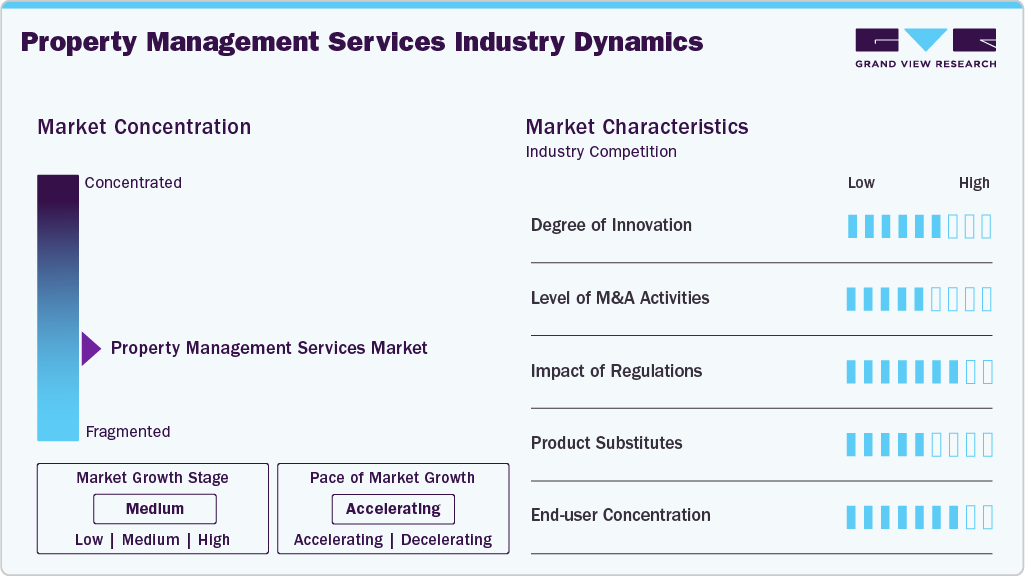
The market remains moderately fragmented, with a combination of large multinational firms and a broad base of regional and local service providers. Established companies manage extensive and geographically diverse portfolios, often supported by wider service capabilities and structured processes. At the same time, smaller firms continue to hold a meaningful share by focusing on specific locations or properties, offering closer client engagement and localized expertise. This mix sustains competition and provides property owners with varied choices based on scale, scope, and service depth.
Service delivery is largely anchored in long-term engagements, as property owners prioritize consistency and reliability in managing leasing, maintenance, and financial responsibilities. Contracts are typically structured to ensure continuity in operations and stable service quality over time. The approach remains flexible, with providers adapting their services to suit different asset classes, tenant profiles, and occupancy patterns, rather than relying on uniform service models.
 To learn more about this report, Download Free Sample Report
 Operational processes are becoming more structured with the increasing use of digital systems for reporting, communication, and performance monitoring. Property owners expect clear visibility into operations, costs, and asset performance, leading to a stronger focus on transparency and accountability. Efficiency and cost management remain central considerations, influencing how services are delivered and priced, while encouraging providers to maintain a balance between quality and operational control.
Drivers, Opportunities & Restraints
The market is supported by the continued expansion of real estate assets across residential, commercial, and mixed-use segments, which is increasing the need for structured property oversight. As portfolios become more extensive and diverse, property owners require professional support for leasing, maintenance, tenant management, and financial administration. The growing use of digital systems, including automation, cloud-based platforms, and smart building technologies, is improving operational control, enabling better monitoring of asset performance, and supporting more efficient service delivery.
Growth prospects are strengthened by the broader adoption of technology-enabled solutions that enhance coordination, reporting, and decision-making. Demand is extending to emerging formats such as co-living, serviced apartments, and short-term rentals, where continuous management and tenant engagement are essential. Increasing investment activity in developing regions, along with a stronger emphasis on sustainability, energy efficiency, and regulatory compliance, is creating scope for specialized and integrated service offerings. Leading companies are focusing on expanding service portfolios, adopting digital platforms, and forming strategic partnerships to strengthen market presence and improve client retention.
However, cost sensitivity among property owners continues to influence the adoption of external management services, particularly for smaller assets where in-house management remains a viable alternative. Differences in regulatory frameworks across regions introduce operational complexity and require localized knowledge and expertise, especially with evolving compliance standards related to tenant rights, safety, and environmental norms. Maintaining consistent service standards across diverse properties and geographies also presents a challenge, while the availability of basic self-management tools and platforms may limit demand for full-service providers in certain segments.
Service Insights
The repair and maintenance services segment represented the largest share within the market in 2025, reflecting their critical role in maintaining property condition and ensuring long-term asset performance. These services include routine upkeep, emergency repairs, and periodic upgrades required across residential and commercial properties. Demand remains steady due to aging infrastructure, increasing occupancy levels, and the need to meet safety and quality standards.
Rent collection services are gaining traction with the increasing use of digital payment systems and automated financial processes, and are projected to grow at a CAGR of 7.4% over the forecast period. Property owners are focusing on timely collections, improved cash flow visibility, and accurate financial management. The adoption of online platforms and tenant interfaces is streamlining transactions, reducing delays, and enhancing overall transparency.
Property Insights
The residential segment held the largest share, contributing approximately 63.9% of the market in 2025, with the scale of housing demand and the continued expansion of rental properties. A large base of individual landlords and multi-family units drives the need for services such as tenant management, maintenance, and rent administration. Urban population growth, increasing mobility, and the shift toward professionally managed housing are sustaining demand, while digital tools are improving tenant interaction and overall operational efficiency.
The commercial segment is projected to grow at a steady CAGR over the forecast period, driven by the need for efficient management of office spaces, retail centers, and mixed-use developments. Businesses are focusing on cost optimization, space utilization, and tenant satisfaction, which is encouraging the use of professional management services. Changing workplace models, along with the expansion of organized retail and logistics facilities, are supporting demand, while integrated service offerings and performance tracking systems are becoming more important in managing commercial assets effectively.
End Use Insights
Institutional investors represent the largest share of the market in 2025, supported by their involvement in large-scale and diversified real estate holdings across multiple asset classes. Their operations require structured governance, standardized processes, and detailed performance evaluation, which strengthens the demand for professionally managed services. There is a clear focus on portfolio optimization, risk mitigation, and alignment with long-term investment strategies, often supported by centralized management frameworks.
 To learn more about this report, Download Free Sample Report
 Individual property owners are expanding at a CAGR of 6.8% over the forecast period, driven by increasing participation in income-generating real estate. Many owners are seeking simplified ways to manage properties without direct involvement in day-to-day activities, leading to greater reliance on external service providers. The availability of accessible management platforms and flexible service options is making it easier for this segment to adopt professional solutions while maintaining control over their assets.
Regional Insights
Asia Pacific dominated the global property management services industry with the largest revenue share of 46.5% in 2025, shaped by rapid urban development, expanding real estate construction, and increasing participation from institutional investors. Countries across the region are seeing a shift toward more organized property operations, supported by growing awareness of professional management practices and the need for efficient handling of large-scale developments. In China, the market is influenced by extensive residential communities and mixed-use projects, where structured management, community services, and regulatory alignment play an important role. The presence of large property developers and management firms contributes to a more integrated approach, combining maintenance, security, and value-added services.
 To learn more about this report, Download Free Sample Report
 In India, the market is developing with the expansion of urban housing, commercial complexes, and gated communities, leading to greater demand for organized management solutions. The transition from informal management practices to more professional services is being supported by digital platforms that streamline communication, billing, and service coordination. Growth in office spaces, retail developments, and co-working environments is further shaping demand for specialized management capabilities. Overall, the region reflects a combination of scale-driven demand and gradual modernization of service delivery models.
North America Property Management Services Market Trends
North America property management services industry operates in a highly structured and mature environment, supported by a well-established real estate sector and a strong base of professional service providers. Demand is driven by large residential communities, commercial assets, and institutional properties that require standardized management and consistent service quality. Across the region, property owners emphasize efficiency, regulatory compliance, tenant satisfaction, and optimized asset performance. The adoption of digital platforms, automation tools, and data-driven systems is widespread, improving operational control and transparency.
U.S. property management services industry represents the most advanced segment of the market, driven by extensive multi-family housing, office spaces, and retail infrastructure. Property managers focus on enhancing tenant retention, reducing operational costs, and meeting strict regulatory requirements. Smart building solutions, cloud-based platforms, and integrated management systems are widely used to handle leasing, maintenance, accounting, and communication functions more efficiently.
Mexico property management services industry is evolving alongside rapid urbanization and growing investment in residential, commercial, and tourism-related developments. The expansion of organized housing projects and mixed-use complexes is increasing demand for professional property management services. Although still developing compared to the U.S., increasing adoption of digital tools and improving infrastructure are gradually strengthening service standardization and operational efficiency.
Europe Property Management Services Market Trends
Europe’s property management services industry is well-established and strongly regulated, supported by a large base of institutional investors and long-term rental demand. Growth is shaped by ongoing urban concentration, rising preference for managed rental housing, and the need for efficient oversight of diverse property portfolios across residential, commercial, and mixed-use segments. Service providers are increasingly focused on compliance management, energy efficiency standards, and improving tenant engagement, while digital tools are being used to simplify leasing, maintenance scheduling, and financial reporting.
Germany property management services industry stands out as one of the most structured markets in the region, driven by a dominant rental culture and stringent housing regulations. A significant share of the population rents homes, which sustains consistent demand for professional property management services. The market is also defined by strong tenant protection laws and rent control frameworks, making compliance and documentation key priorities for property managers. As a result, technology-enabled platforms are widely used to manage contracts, track regulations, and handle large residential portfolios more efficiently.
Mexico property management services industry is still developing but is gaining momentum alongside rapid urban growth and expanding real estate investment activity. Increasing construction of organized housing communities, commercial centers, and tourism-linked properties is creating stronger demand for structured management services. The market is gradually transitioning toward professional operators, supported by the growing use of digital systems for rent collection, maintenance coordination, and tenant communication. While the level of formalization is still evolving, improving infrastructure and rising service expectations are steadily strengthening the sector.
Middle East & Africa Property Management Services Market Trends
The Middle East & Africa property management services industry is developing steadily, supported by ongoing urban expansion, large infrastructure investments, and rising real estate activity across residential, commercial, and mixed-use segments. Increasing construction of planned cities, tourism projects, and commercial hubs is creating stronger requirements for organized property operations, including maintenance coordination, tenant services, and facility oversight. The involvement of institutional investors and developers is also encouraging more structured management practices, along with gradual adoption of digital systems to improve efficiency in day-to-day property operations.
Saudi Arabia property management services industry is emerging as a major contributor within the region, driven by large-scale development programs focused on urban transformation, tourism growth, and smart city initiatives. Expansion of mega projects and new residential and commercial communities is increasing the need for professional property management services to handle complex asset portfolios. The use of digital platforms for facility monitoring, leasing activities, and maintenance tracking is becoming more common, reflecting a gradual shift toward more organized and technology-supported real estate operations.
Latin America Property Management Services Market Trends
The property management services industry in Latin America is steadily evolving as urbanization accelerates, rental housing demand increases, and real estate development expands across residential, commercial, and mixed-use segments. The market remains largely fragmented, but there is a gradual shift toward more structured and professional management practices as property owners and developers seek improved efficiency in maintenance coordination, tenant services, leasing processes, and financial administration. The growing complexity of modern housing projects is also encouraging wider reliance on specialized service providers, along with increasing adoption of digital tools to streamline daily operations and improve transparency.
Brazil property management services industry accounts for a significant share of regional activity, supported by large urban populations and continuous residential and commercial construction activity. Demand for organized property management is rising as multi-unit developments and large-scale housing projects expand, requiring more efficient operational control. Technology adoption is improving across areas such as rent processing, maintenance scheduling, and compliance management, helping enhance overall service delivery. Across the wider region, markets such as Mexico, Chile, and Colombia are also experiencing gradual modernization, with increasing use of digital platforms for leasing, tenant interaction, and asset tracking, supported by urban growth and expanding investment flows.
Key Property Management Services Company Insights
Some of the key players operating in the market include CBRE Group, Cushman & Wakefield, among others.
-
CBRE Group operates as a global real estate services company providing a wide range of solutions across property management, facilities management, leasing, valuation, and investment advisory. It supports clients such as institutional investors, developers, and corporations in managing different types of real estate assets, including office buildings, retail spaces, logistics facilities, and residential properties. The company focuses on improving asset performance and operational efficiency through integrated service delivery, supported by data analytics, digital platforms, and sustainability-oriented practices. Its operations are influenced by demand for outsourced property services, urban development activity, and increasing use of technology in real estate management.
-
Cushman & Wakefield delivers commercial real estate services including property management, leasing, project and development services, valuation, and investment advisory. It works with property owners, occupiers, and investors to support the management and optimization of office, industrial, retail, and mixed-use assets. The company places emphasis on combining advisory expertise with operational support to improve property utilization and tenant outcomes. Its service model is increasingly shaped by digital adoption, ESG considerations, and the need for more efficient building operations, reflecting broader changes in how real estate assets are managed across global markets.
Key Property Management Services Companies:
The following key companies have been profiled for this study on the property management services market.
- CBRE Group
- JLL (Jones Lang LaSalle)
- Cushman & Wakefield
- Colliers International
- Greystar Real Estate Partners
- Lincoln Property Company
- Asset Living
- RPM Living
- FirstService Corporation
- Hines
- Brookfield Properties
- Savills
- Knight Frank
- Prologis
- AvalonBay Communities
Recent Developments
-
In March 2026, Greystar announced that it had acquired Native Communities, a UK-based residential and mixed-use property management company. The move is aimed at expanding its property management operations across Europe and strengthening its ability to manage large rental housing portfolios for institutional investors and property owners. Native Communities oversees around 9,000 homes across various residential and mixed-use developments, which adds scale to Greystar’s existing presence in the region.
-
In May 2025, FirstService Residential announced that it had acquired Core Real Estate Group, a property management company based in Edmonton, Canada. The acquisition adds more than 15,000 residential units to its managed portfolio and helps strengthen its operations across Western Canada. The move is aimed at combining Core Real Estate Group’s local market experience with FirstService Residential broader service capabilities and technology-driven management approach to improve day-to-day property operations and service quality for residents.
Property Management Services Market Report Scope
Report Attribute
Details
Market size in 2025
USD 660.2 billion
Estimated Market size in 2026
USD 698.4 billion
Projected Market size by 2033
USD 1125.0 billion
Growth rate
CAGR of 7.0% from 2026 to 2033
Base year for estimation
2025
Historical data
2021 - 2024
Forecast period
2026 - 2033
Quantitative units
Revenue in USD million and CAGR from 2026 to 2033
Report coverage
Revenue forecast, company market position analysis, competitive landscape, growth factors, and trends
Segments covered
Service, property, end use, region
Regional scope
North America; Europe; Asia Pacific; Latin America; Middle East & Africa
Country Scope
U.S.; Canada; Mexico; Germany; UK; Italy; Spain; France; China; Japan; India; Australia; South Korea; Brazil; Argentina; Saudi Arabia; UAE; South Africa
Key companies profiled
CBRE Group; JLL (Jones Lang LaSalle); Cushman & Wakefield; Colliers International; Greystar Real Estate Partners; Lincoln Property Company (Willow Bridge Property Company); Asset Living; RPM Living; FirstService Corporation (FirstService Residential); Hines; Brookfield Properties; Savills; Knight Frank; Prologis (industrial property management); AvalonBay Communities
Customization scope
Free report customization (equivalent up to 8 analysts working days) with purchase. Addition or alteration to country, regional & segment scope.
Pricing and purchase options
Avail customized purchase options to meet your exact research needs. Explore purchase options
Global Property Management Services Market Report Segmentation
This report forecasts revenue growth at global, regional & country levels and provides an analysis on the industry trends in each of the sub-segments from 2021 to 2033. For this study, Grand View Research has segmented the global property management services market report based on service, property, end use, and region:
 To learn more about this report, Download Free Sample Report
 -
Service Outlook (Revenue, USD Million, 2021 - 2033)
-
Rent Collection
-
Mortgage & Utility Payment
-
Leasing
-
Legal & Accounting Services
-
Repair & Maintenance
-
Other
-
-
Property Outlook (Revenue, USD Million, 2021 - 2033)
-
Residential
-
Commercial
-
Industrial
-
Other
-
-
End Use Outlook (Revenue, USD Million, 2021 - 2033)
-
Institutional Investors
-
Individual Property Owners
-
Housing Associations
-
Others
-
-
Regional Outlook (Revenue, USD Million, 2021 - 2033)
-
North America
-
U.S.
-
Canada
-
Mexico
-
-
Europe
-
Germany
-
France
-
UK
-
Spain
-
Italy
-
-
Asia Pacific
-
China
-
India
-
Japan
-
South Korea
-
Australia
-
-
Latin America
-
Brazil
-
Argentina
-
-
Middle East & Africa
-
Saudi Arabia
-
UAE
-
South Africa
-
-
Frequently Asked Questions About This Report
The repair & maintenance segment led with a 33.7% revenue share in 2025.
The residential segment led the market with the largest revenue share of 63.9% in 2025.
Institutional investors segment held the largest share (over 41.0%) in 2025.
The global property management services market size was valued at USD 660.2 billion in 2025 and is estimated at USD 698.4 billion for 2026.
The global property management services market is expected to grow at a CAGR of 7.0% from 2026 to 2033, reaching USD 1,125.0 billion by 2033.
Key players include CBRE Group; JLL (Jones Lang LaSalle); Cushman & Wakefield; Colliers International; Greystar Real Estate Partners; Lincoln Property Company (Willow Bridge Property Company); Asset Living; RPM Living; FirstService Corporation (FirstService Residential); Hines; Brookfield Properties; Savills; Knight Frank; Prologis (industrial property management); AvalonBay Communities.
The global property management services market is driven by ongoing urbanization, expansion of real estate infrastructure, and increasing preference for outsourced management of maintenance, leasing, and tenant-related functions. The growing integration of digital and proptech solutions is further enhancing operational efficiency, improving service coordination, and enabling better cost and asset management across properties.
Asia Pacific accounted for the largest share of 46.5% in the global property management services market, supported by rapid urban growth and ongoing real estate development across key countries such as China, India, Japan, and Southeast Asia. Increasing demand for professionally managed residential and commercial spaces, along with growing use of digital tools for maintenance, leasing, and tenant services, continues to strengthen the region’s leading position.
About the Author(s)
Advanced Interior Materials Research Team
Advanced Materials · Advanced Interior MaterialsThis report was authored by the advanced interior materials research team at Grand View Research - comprising two research analysts, one senior research analyst, and one industry expert - with specialized expertise in the advanced interior materials segment of the advanced materials industry. All findings are based on proprietary advanced materials databases, executive interviews, and regulatory analysis, subject to internal peer review prior to publication.
Last Updated:
Speak to Analyst

Customize this report to your needs - add regions, segments, or data points, with 20% free customization.
Or view our licence options:


ISO 9001:2015 & 27001:2022 Certified
We are GDPR and CCPA compliant! Your transaction & personal information is safe and secure. For more details, please read our privacy policy.


