
- Home
- »
- Next Generation Technologies
- »
-
Reinforcement Learning Market Size Report, 2026-2033GVR Report cover
![Reinforcement Learning Market (2026 - 2033)Report]()
Reinforcement Learning Market (2026 - 2033)
Size, Share & Trends Analysis Report By Component (Software, Hardware, Services), By Application (Autonomous Navigation, Dynamic Pricing, Algorithmic Trading), By End Use (BFSI, Automotive & Transportation), By Region, And Segment Forecasts
Market Size, 2025
$12.4BMarket Estimate, 2026
$16.2BMarket Forecast, 2033
$111.1BCAGR, 2026–2033
31.6%Reinforcement Learning Market Summary
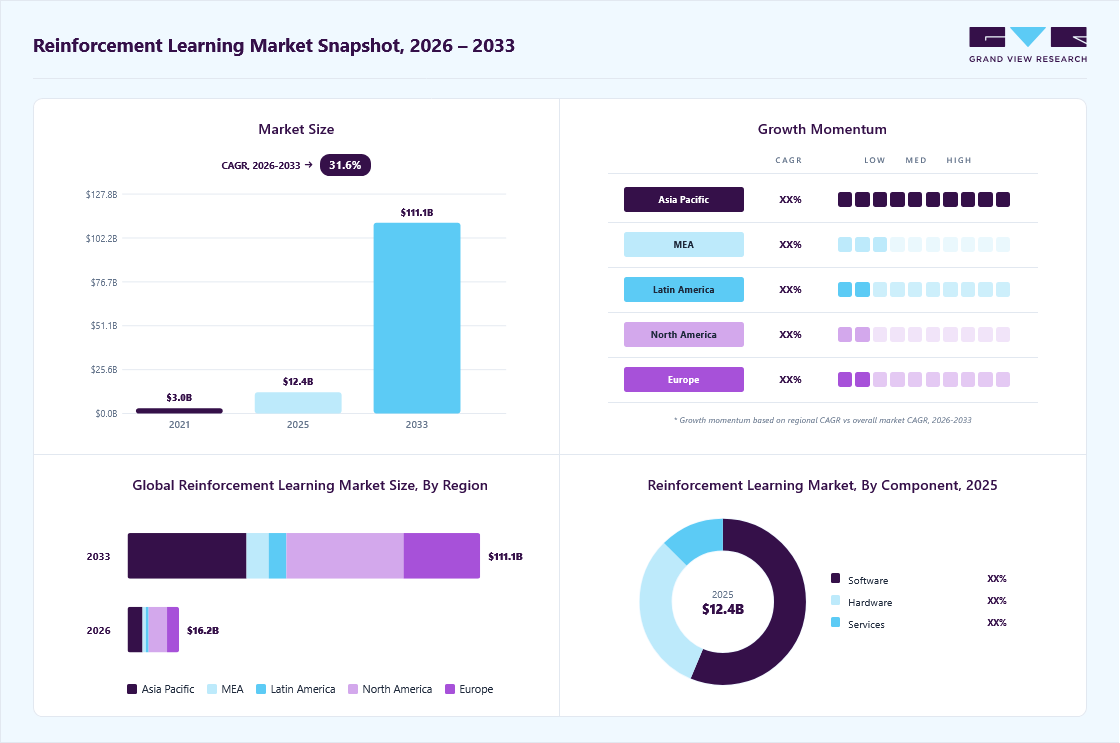
The global reinforcement learning market size was valued at USD 12.4 billion in 2025 and is projected to grow from USD 16.2 billion in 2026 to USD 111.1 billion by 2033, at a CAGR of 31.6% from 2026 to 2033. The market in North America dominated with a revenue share of 36.1% in 2025. The market is witnessing strong momentum due to its integration with generative AI and large language models for advanced decision-making capabilities.
Key Market Trends & Insights
- By component: Software segment held the largest market share of 56.2% in 2025.
- By application: Autonomous navigation segment held the largest market share of 26.2% in 2025.
- By end use: Automotive & transportation segment held the largest market share in 2025.
Regional Highlights
- Largest regional market: North America (36.1% revenue share, 2025)
- Fastest-growing regional market: Asia Pacific (highest CAGR, 2026-2033)
- By country: The U.S. held the largest market share in 2025
Market Size & Forecast
- Market size in 2025: USD 12.4 Billion
- Estimated market size in 2026: USD 16.2 Billion
- Projected market size by 2033: USD 111.1 Billion
- CAGR (2026-2033): 31.6%
Organizations are increasingly adopting reinforcement learning to build autonomous systems that can learn and adapt in real time. Its application is expanding rapidly in robotics, autonomous vehicles, gaming, and industrial automation. The reinforcement learning market is increasingly adopting serverless and cloud-based infrastructure. Organizations are leveraging flexible, on-demand GPU resources instead of investing in expensive in-house infrastructure. This approach enables faster model training and experimentation. It also supports greater scalability and efficient resource utilization. Reinforcement learning is becoming more accessible and commercially viable across industries. For instance, in October 2025, CoreWeave, a U.S.-based cloud computing company, launched a serverless reinforcement learning platform called Serverless RL enabling businesses to train and fine-tune AI models without managing their own GPU infrastructure. The aim of this launch is to make reinforcement learning more accessible, reduce reliance on a few large customers, and strengthen the company’s position as a specialized provider of AI infrastructure.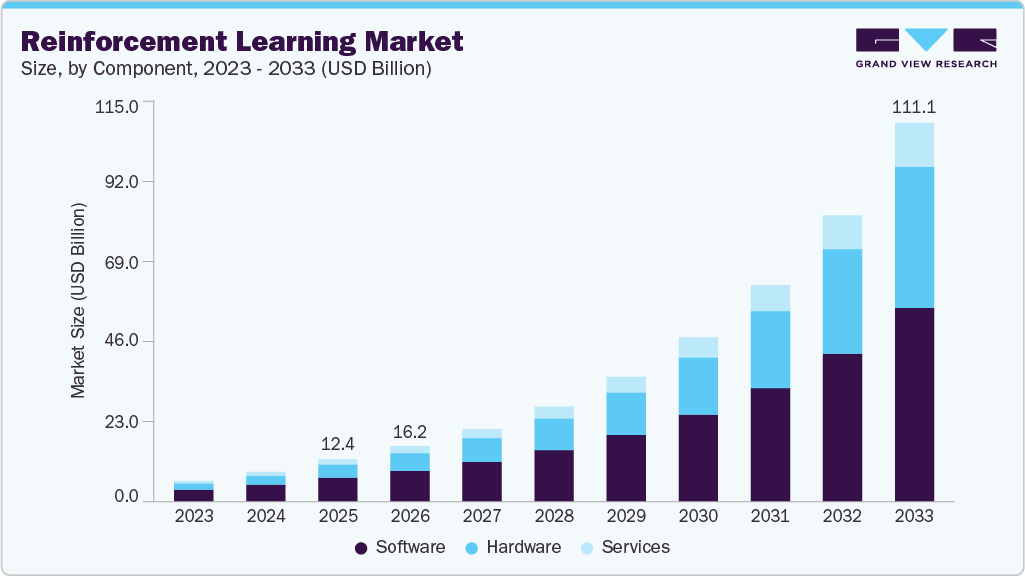
Reinforcement learning is increasingly being integrated with generative AI and large language models to enhance reasoning and decision-making capabilities. It is widely used to fine-tune foundation models after their initial training phase. This process improves contextual understanding and response relevance. Reinforcement Learning from Human Feedback (RLHF) is a technique used to make AI systems behave in ways that better match human expectations, preferences, and ethical standards. The approach strengthens model safety and reduces harmful or biased responses. It also enables continuous improvement through iterative feedback loops. Organizations are leveraging this integration to build more reliable conversational agents and intelligent assistants. The combination enhances adaptability in dynamic and complex environments. Reinforcement learning has become a core component in advancing next-generation AI systems.
There is a growing real-world deployment of reinforcement learning in industrial robotics and precision manufacturing. Companies are implementing RL systems directly on production lines to improve automation flexibility. Unlike traditional rule-based systems, RL allows robots to learn through interaction and feedback. This reduces the need for complex manual programming and constant recalibration. Robots can adapt to variations in product design, positioning, and environmental conditions. Training cycles that previously took weeks can now be completed in significantly shorter timeframes. Technology improves operational efficiency and reduces downtime during production changes. It also supports scalable deployment across multiple manufacturing units. Reinforcement learning is accelerating the transformation toward intelligent and adaptive industrial automation.
Component Insights
The Software segment dominated the global market for reinforcement learning with a revenue share of 56.2% in 2025, due to its critical role in enabling intelligent automation and data-driven decision-making. Manufacturers increasingly rely on AI-powered software for predictive maintenance, quality control, and production optimization. The growing adoption of machine learning and advanced analytics solutions has strengthened the demand for software platforms. Cloud-based AI software solutions are also gaining traction owing to their scalability and cost efficiency. Companies are investing heavily in customized AI software to improve operational efficiency and reduce downtime.
The hardware segment, particularly AI chips and GPUs, is experiencing significant growth in the AI market. Increasing demand for high-performance computing is driving the adoption of specialized AI processors. These chips enable faster data processing and support complex machine learning and deep learning workloads. Industries are investing in advanced GPUs to accelerate training and inference tasks. The rise of edge computing and real-time analytics is further boosting demand for AI hardware. As AI applications expand across sectors, the hardware segment continues to witness strong momentum.
Application Insights
Autonomous Navigation dominated this market in 2025, due to its wide adoption across multiple industries. Technology enables real-time decision-making and reduces human intervention in complex operations. Growing demand for efficiency, safety, and precision has accelerated its adoption. Companies are investing heavily in advanced navigation algorithms and sensor integration. As automation continues to expand, Autonomous Navigation remains the leading segment driving overall market growth. Its strong performance is further supported by continuous advancements in AI and robotics technologies.
The Personalization & Recommendations segment is experiencing strong growth across industries. Businesses are utilizing AI and reinforcement learning to deliver tailored content, products, and services to users. E-commerce and streaming platforms are increasingly using recommendation engines to enhance customer engagement. Advanced algorithms analyze user behavior, preferences, and real-time interactions to improve accuracy. This approach boosts customer satisfaction, retention rates, and overall revenue generation. As digital platforms expand globally, demand for intelligent personalization solutions continues to rise.
End Use Insights
The Automotive & Transportation segment dominated the global market in 2025. This leadership was driven by rapid advancements in autonomous driving technologies and smart mobility solutions. Companies heavily invested in AI, machine learning, and reinforcement learning to improve vehicle safety and efficiency. The integration of advanced driver-assistance systems significantly boosted market demand. Growth in electric vehicles and connected car technologies further strengthened the segment’s position. As innovation in mobility accelerates, the automotive & transportation segment continues to hold a strong market presence.
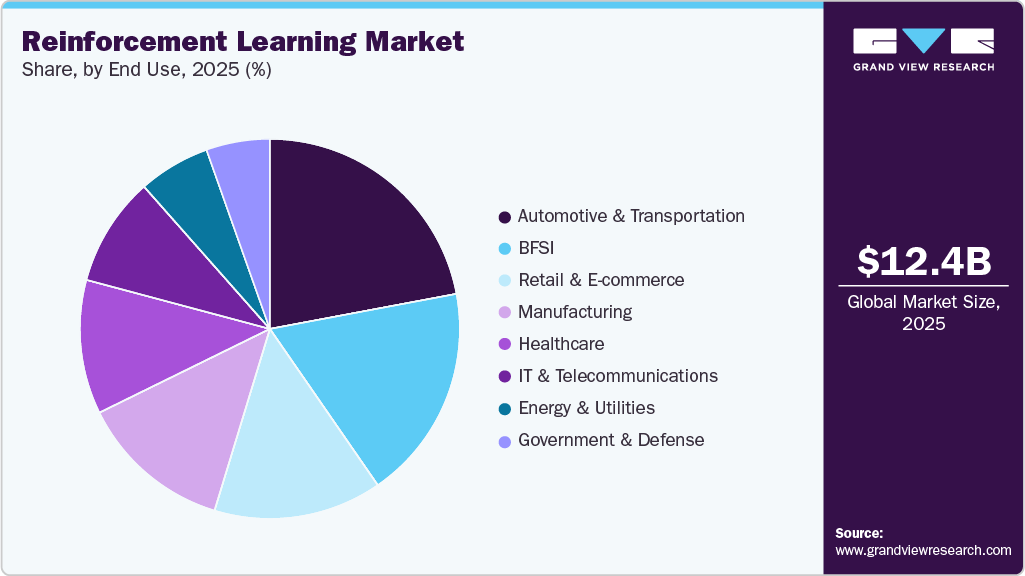
The Retail & E-commerce segment is expected to grow at the fastest CAGR over the forecast period. The Retail & E-commerce segment is experiencing strong growth in this market. Companies are utilizing AI-driven analytics to better understand consumer behavior and preferences. Personalized recommendations and targeted marketing strategies are enhancing customer engagement. Businesses are also using predictive models to optimize inventory and supply chain operations. The rapid expansion of online shopping platforms is further driving adoption. As digital transformation accelerates, the segment continues to expand steadily.
Regional Insights
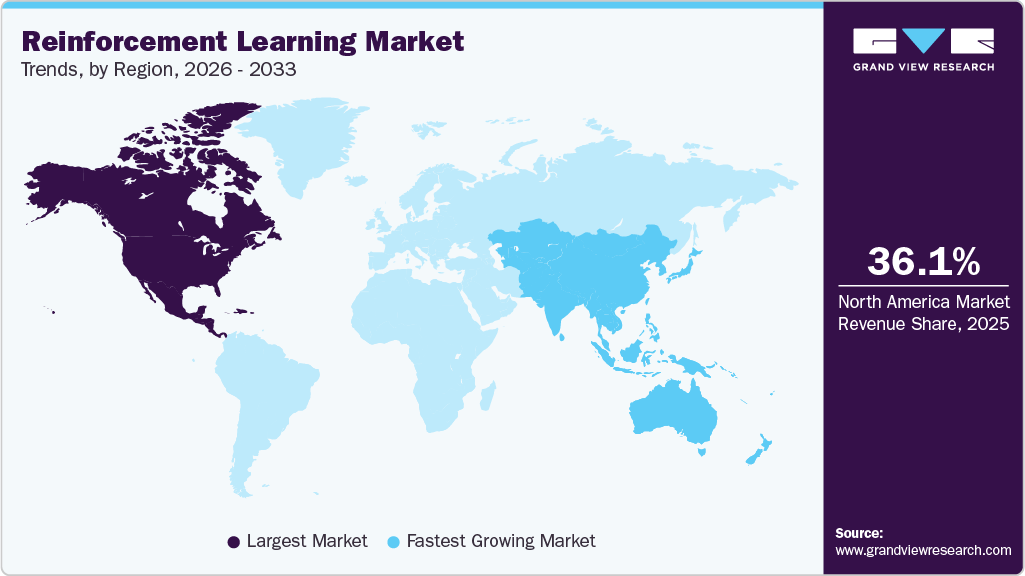
North America reinforcement learning market dominated the global industry with a revenue share of 36.1% in 2025. Strong adoption of advanced manufacturing technologies supported this leadership position. Significant investments in automation, robotics, and AI-driven analytics further accelerated market growth. The presence of major technology providers and established industrial infrastructure strengthened North America’s competitive advantage. Favorable government initiatives and research funding also contributed to sustained regional expansion.
U.S. Reinforcement Learning Market Trends
Reinforcement learning market in the U.S. is witnessing strong growth driven by increasing adoption across industries such as finance, healthcare, automotive, and technology. Leading research institutions and technology companies are investing heavily in advanced AI and deep reinforcement learning innovations. The country is at the forefront of developing autonomous systems, robotics, and algorithmic decision-making solutions powered by RL.
Europe Reinforcement Learning Market Trends
The Europe reinforcement learning market is expanding steadily, driven by strong adoption in countries such as Germany, the UK, and France. Growth is supported by increasing investments in AI research, innovation programs, and public-private partnerships across the region. Industries such as automotive, manufacturing, and healthcare are utilizing reinforcement learning for automation and optimization.
Asia Pacific Reinforcement Learning Trends
The Asia Pacific region is anticipated to be the fastest growing market over the forecast period. This leadership is supported by rapid industrialization and expanding manufacturing capacities across major economies. Governments are actively promoting smart manufacturing and Industry 4.0 initiatives. Significant investments in automation, robotics, and AI-driven analytics are accelerating adoption. Countries such as China, Japan, South Korea, and India are at the forefront of technological integration. Continuous infrastructure development and rising demand for efficient production systems further strengthen the region’s dominance.
Key Reinforcement Learning Company Insights
Some of the key companies in the Reinforcement Learning industry include Alibaba Group Holding Ltd., Amazon Web Services, Inc., Google LLC and others. Organizations are focusing on increasing customer base to gain a competitive edge in the industry. Therefore, key players are taking several strategic initiatives, such as mergers and acquisitions, and partnerships with other major companies.
-
Amazon Web Services, Inc. is actively expanding its capabilities in the reinforcement learning market through scalable cloud-based AI services. The company offers managed machine learning tools that support reinforcement learning model development and deployment. AWS enables enterprises to train, test, and optimize RL models using high-performance computing infrastructure. Its ecosystem integrates data storage, analytics, and AI services to streamline experimentation. The company also supports simulation-based training environments for robotics and autonomous systems.
-
Google LLC is a major contributor to advancements in the reinforcement learning market through its AI research and cloud platforms. The company leverages reinforcement learning across various applications, including autonomous systems, data center optimization, and AI model training. Its research initiatives have significantly improved deep reinforcement learning algorithms and real-world deployment capabilities. Google Cloud provides infrastructure and AI tools that enable businesses to build and scale RL-driven solutions. The company also integrates reinforcement learning into generative AI and advanced decision-making systems.
Key Reinforcement Learning Companies:
The following key companies have been profiled for this study on the reinforcement learning market.
- AGIBOT Innovation (Shanghai) Technology Co., Ltd.
- Alibaba Group Holding Ltd.
- Amazon Web Services, Inc.
- Google LLC
- IBM Corporation
- Intel Corporation
- Meta Platforms Inc.
- Microsoft
- NVIDIA Corporation
- OpenAI Inc.
Recent Developments
-
In December 2025, Amazon Web Services, Inc. introduced serverless customization in Amazon SageMaker AI, enabling users to fine-tune popular AI models such as Amazon Nova, GPT-OSS, Llama, and Qwen using reinforcement learning techniques. This feature streamlines model training, evaluation, and deployment entirely serverlessly, reducing customization time from month to days and allowing flexible deployment via SageMaker or Amazon Bedrock.
-
In November 2025, AGIBOT Innovation (Shanghai) Technology Co., Ltd., Robotics company in China deployed its Real-World Reinforcement Learning (RW-RL) system on a pilot production line in collaboration with Longcheer Technology, marking the first real industrial application of reinforcement learning in manufacturing robotics. The system enables rapid skill acquisition within minutes, high adaptability to production variations, and flexible reconfiguration, significantly improving efficiency and accelerating the integration of AI-driven automation in precision manufacturing.
Reinforcement Learning Market Report Scope
Report Attribute
Details
Market size in 2025
USD 12.4 billion
Estimated market size in 2026
USD 16.2 billion
Projected market size by 2033
USD 111.1 billion
Growth rate
CAGR of 31.6% from 2026 to 2033
Base year for estimation
2025
Historical data
2021 - 2024
Forecast period
2026 - 2033
Quantitative units
Revenue in USD million/billion and CAGR from 2026 to 2033
Report coverage
Revenue forecast, company ranking, competitive landscape, growth factors, and trends
Segments covered
Component, application, end use, region
Regional scope
North America; Europe; Asia Pacific; Latin America; MEA
Country scope
U.S.; Canada; Mexico; UK; Germany; France; China; Japan; India; South Korea; Australia; Brazil; KSA; UAE; South Africa
Key companies profiled
AGIBOT Innovation (Shanghai) Technology Co., Ltd.; Alibaba Group Holding Ltd.; Amazon Web Services, Inc.; Google LLC; IBM Corporation; Intel Corporation; Meta Platforms Inc.; Microsoft; NVIDIA Corporation; OpenAI Inc.
Customization scope
Free report customization (equivalent up to 8 analysts working days) with purchase. Addition or alteration to country, regional & segment scope.
Pricing and purchase options
Avail customized purchase options to meet your exact research needs. Explore purchase options
Global Reinforcement Learning Market Report Segmentation
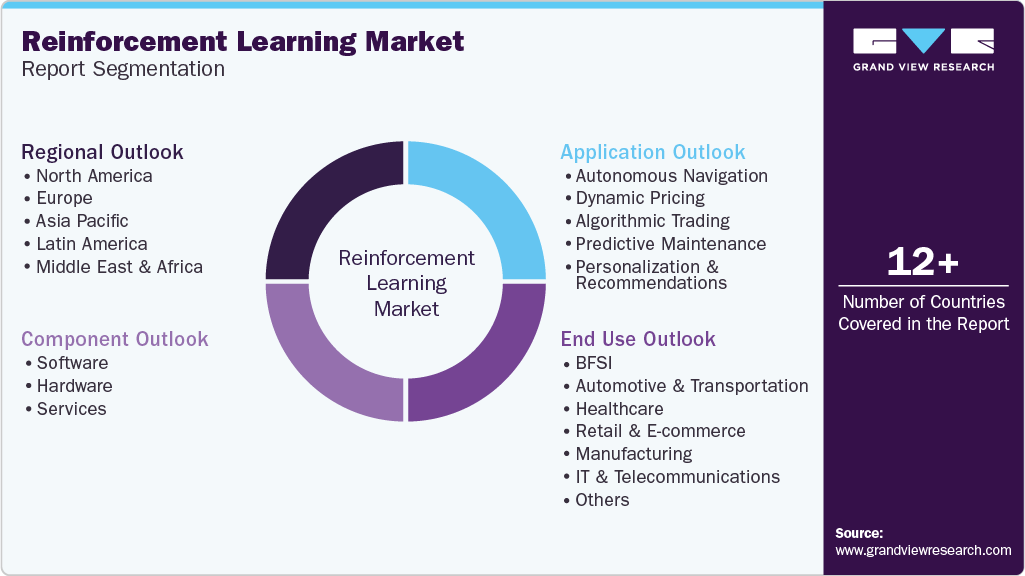
This report forecasts revenue growth at global, regional, and country levels and provides an analysis of the latest industry trends in each of the sub-segments from 2021 to 2033. For this study, Grand View Research has segmented the global reinforcement learning market report based on component, application, end use, and region:
-
Component Outlook (Revenue, USD Billion, 2021 - 2033)
-
Software
-
Hardware
-
Services
-
-
Application Outlook (Revenue, USD Billion, 2021 - 2033)
-
Autonomous Navigation
-
Dynamic Pricing
-
Algorithmic Trading
-
Predictive Maintenance
-
Personalization & Recommendations
-
-
End Use Outlook (Revenue, USD Billion, 2021 - 2033)
-
BFSI
-
Automotive & Transportation
-
Healthcare
-
Retail & E-commerce
-
Manufacturing
-
IT & Telecommunications
-
Energy & Utilities
-
Government & Defense
-
-
Regional Outlook (Revenue, USD Billion, 2021 - 2033)
-
North America
-
U.S.
-
Canada
-
Mexico
-
-
Europe
-
UK
-
Germany
-
France
-
-
Asia Pacific
-
China
-
Japan
-
India
-
South Korea
-
Australia
-
-
Latin America
-
Brazil
-
-
Middle East and Africa (MEA)
-
KSA
-
UAE
-
South Africa
-
-
Frequently Asked Questions About This Report
Asia Pacific is the fastest-growing region over the forecast period.
The software segment accounted for the largest revenue share of 56.2% in 2025.
The autonomous navigation segment led with a 26.2% revenue share in 2025.
The automotive & transportation segment held the largest revenue share in 2025, while retail & e-commerce is the fastest-growing segment.
The global reinforcement learning market size was valued at USD 12.4 billion in 2025 and is estimated at USD 16.2 billion for 2026.
The global reinforcement learning market is expected to grow at a CAGR of 31.6% from 2026 to 2033, reaching USD 111.1 billion by 2033.
Key players include AGIBOT Innovation (Shanghai) Technology Co., Ltd.; Alibaba Group Holding Ltd.; Amazon Web Services, Inc.; Google LLC; IBM Corporation; Intel Corporation; Meta Platforms Inc.; Microsoft; NVIDIA Corporation; OpenAI Inc.
Key factors that are driving the market growth include rising digital transformation initiatives, increasing adoption of advanced technologies, growing regulatory compliance requirements, and the need for improved operational efficiency and risk management across industries.
North America dominated the reinforcement learning market with a share of 36.1% in 2025. This is attributable to strong investments in AI research, the presence of leading technology companies, and early adoption of advanced machine learning solutions across industries.
About the Author(s)
Next Generation Technologies Research Team
Technology · Next Generation TechnologiesThis report was authored by the next generation technologies research team at Grand View Research - comprising two research analysts, one senior research analyst, and one industry expert - with specialized expertise in the next generation technologies segment of the technology industry. All findings are based on proprietary technology databases, executive interviews, and regulatory analysis, subject to internal peer review prior to publication.
Last Updated:
Speak to Analyst


Customize this report to your needs — add regions, segments, or data points, with 20% free customization.
Or view our licence options:


ISO 9001:2015 & 27001:2022 Certified
We are GDPR and CCPA compliant! Your transaction & personal information is safe and secure. For more details, please read our privacy policy.


