
- Home
- »
- Communications Infrastructure
- »
-
Rugged Servers Market Size And Share Report, 2026-2033GVR Report cover

Rugged Servers Market (2026 - 2033)
Size, Share & Trends Analysis Report By Component (Hardware, Software, Services), By Type (Rackmount Servers, Blade Servers, Edge Servers), By Memory Size, By Application, By End-use, By Region, And Segment Forecasts
Market Size, 2025
$713.2MMarket Estimate, 2026
$759.7MMarket Forecast, 2033
$1,244.9MCAGR, 2026–2033
7.3%Rugged Servers Market Summary
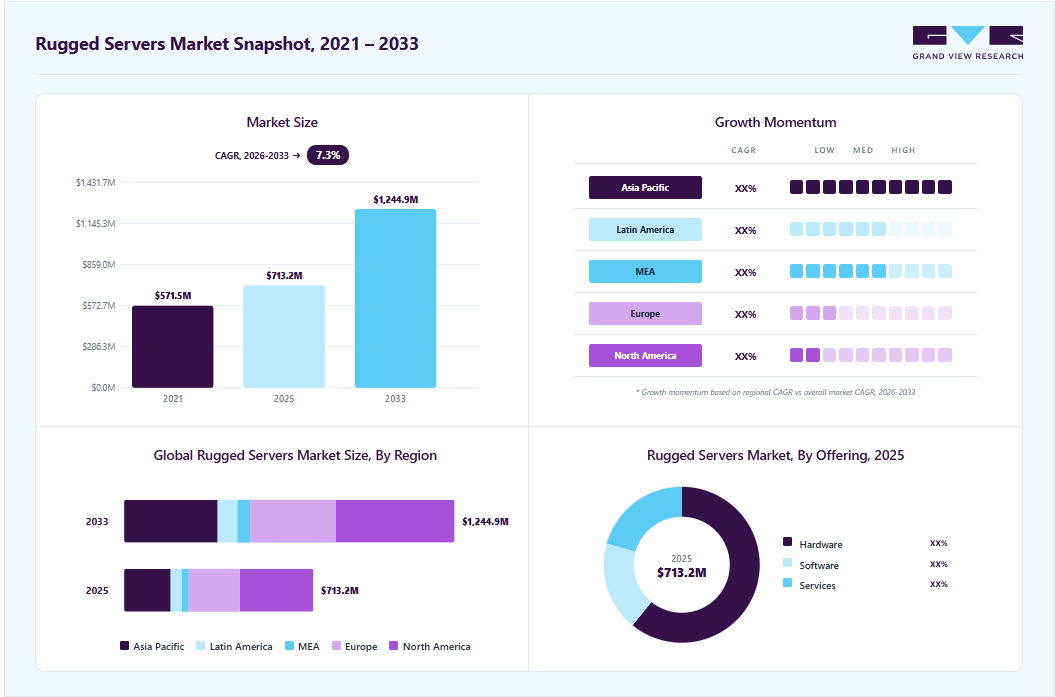
The global rugged servers market size was valued at USD 713.2 million in 2025 and is projected to grow from USD 759.7 million in 2026 to USD 1,244.9 million by 2033, at a CAGR of 7.3% from 2026 to 2033. The market in North America dominated with a revenue share of 38.9% in 2025. This growth is driven by increasing defense modernization programs, expanding edge AI deployments, and rising adoption of rugged computing across industrial automation, aerospace, telecommunications, and critical infrastructure sectors.
 Source: Grand View Research, IR Documents, Primary Interviews, Paid DatabasesTo learn more about this report,
 Download Free Sample Report
Key Market Trends & Insights
- By component: Hardware led the market and accounted for a share of 60.9% in 2025.
- By type: Rugged rackmount servers segment dominated the market, with a revenue share of 44.0% in 2025.
- By memory size: <256 GB segment dominated the market, with a revenue share of 43.5% in 2025.
- By application: Standard segment dominated the market, with a revenue share of 65.8% in 2025.
- By end use: Defense & military segment held the largest revenue share in 2025.
Regional Highlights
- Largest regional market: North America (38.9% revenue share, 2025)
- Fastest-growing regional market: Asia Pacific (highest CAGR, 2026-2033)
- By country: The U.S. held the largest market share in 2025.
Market Size & Forecast
- Market size in 2025: USD 713.2 Million
- Estimated market size in 2026: USD 759.7 Million
- Projected market size by 2033: USD 1,244.9 Million
- CAGR (2026-2033): 7.3%
Three ways to get this report
Buy it, customize it, or ask a question.Ask an Analyst
Analyst response in 1 business day
- AccessReport author, directly
- Reply timeWithin 1 working day
- No sales callDirect answer only
- FormatEmail reply
- CostFree, no cost
Get the Full Report
What the study covers
- FormatsPDF · Excel · Dashboard
- Timeline2026–2033 annual, 2025 base
- Coverage20+ countries, 5 regions
- Companies10+ key players profiled
Customize the Report
20% free customization
- IncludeCountries, segments, points
- TailorTo your product definition
- ExtendDeeper competitor detail
- OrA fully bespoke study
- Turnaround5–10 working days
This growth can be attributed to the increasing demand for high-performance computing in challenging and mission-critical environments, including defense, aerospace, industrial automation, telecommunications, transportation, and energy. This demand is further fueled by the expansion of 5G and edge computing, rising investments in smart infrastructure, and the growing deployment of military and public safety technologies. In addition, the growing adoption of IoT, AI-driven analytics, and autonomous systems across various industries drives the requirement for reliable and durable servers that can operate under extreme temperatures, shock, vibration, and dust conditions, accelerating market growth. Recent advancements in the rugged server industry include the integration of powerful processors, enhanced data storage capabilities, and improved networking features. For instance, in September 2025, Dell launched the PowerEdge XR8720t in the United States, delivering a rugged, single-server solution that enhanced Cloud RAN and edge deployments by improving performance, lowering costs, and strengthening connectivity. Furthermore, innovations such as Non-Volatile Memory Express (NVMe) storage technology enable faster data access and processing, which is crucial for applications requiring real-time data analysis.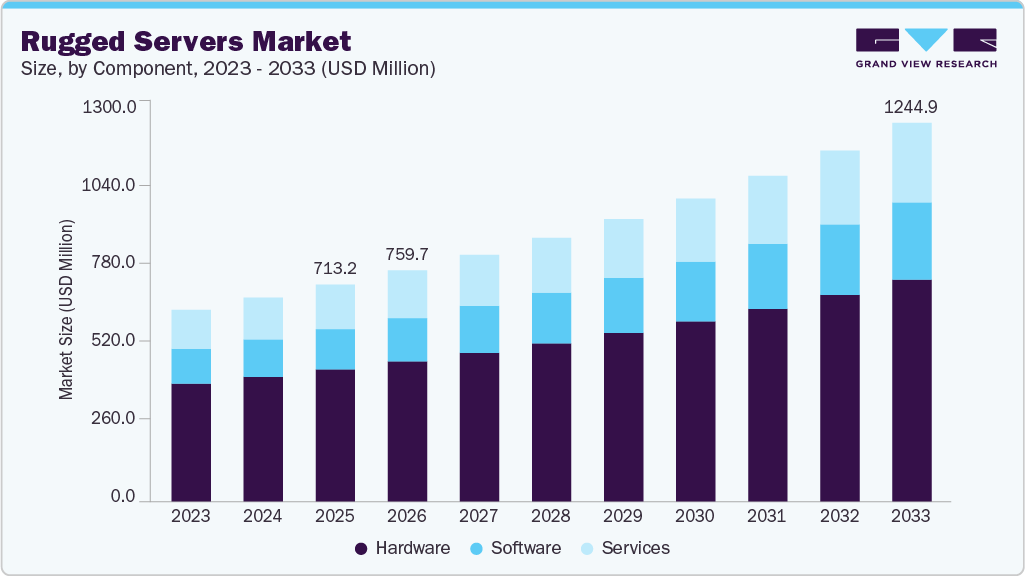 To learn more about this report, Download Free Sample Report
In addition, rugged servers are increasingly equipped with advanced security features to protect sensitive data from cyber threats, ensuring critical operations remain secure in hostile environments. Current trends indicate enhanced processing capabilities and integration with emerging technologies, such as 5G, for improved connectivity on the go. However, hurdles remain, including steep upfront expenses and risks to data security at exposed sites. Companies such as Dell Technologies, Siemens, and Mercury Systems lead the way by focusing on innovations that address these ongoing needs.
Market Dynamics
The global rugged servers market is witnessing robust growth as defense organizations, industrial enterprises, transportation operators, and critical infrastructure providers increasingly require reliable computing systems capable of operating in harsh and mission-critical environments. Rugged servers are designed to withstand extreme temperatures, shock, vibration, dust, humidity, and electromagnetic interference while delivering high-performance computing for real-time data processing, edge computing, AI applications, and secure communications. Modern rugged servers incorporate advanced multi-core processors, GPU acceleration, high-speed networking, modular architectures, enhanced cybersecurity features, and low-power designs to support demanding workloads in remote and challenging operating conditions. The growing adoption of edge computing, industrial automation, defense modernization, autonomous systems, and Industry 4.0 initiatives is accelerating demand for rugged servers that provide uninterrupted performance, operational resilience, and secure data processing across diverse field environments.
The rapid expansion of edge computing, defense modernization programs, and industrial automation is a major driver of the global rugged servers market. Organizations across military, aerospace, energy, manufacturing, mining, transportation, and telecommunications sectors are deploying rugged servers to process data closer to the source, enabling low-latency decision-making, real-time analytics, and uninterrupted operations in harsh environments. These systems support AI inference, IoT connectivity, autonomous platforms, command-and-control applications, and mission-critical industrial processes while ensuring high reliability under extreme operating conditions. Modern rugged servers integrate high-performance processors, GPU acceleration, advanced thermal management, modular expansion, and secure computing capabilities to enhance operational efficiency and system resilience. For instance, in March 2026, Crystal Group expanded its rugged computing portfolio with next-generation edge servers designed to support AI-enabled defense, industrial automation, and mission-critical edge computing applications, offering enhanced processing performance, cybersecurity, and environmental durability.
The high cost of designing, deploying, and maintaining rugged servers remains a significant restraint for the global rugged servers market. Ruggedized hardware requires specialized enclosures, advanced thermal management systems, shock and vibration protection, military-grade certifications, and extensive environmental testing, resulting in higher manufacturing and procurement costs compared to commercial servers. Additionally, integrating rugged servers into existing IT infrastructure, ensuring compatibility with legacy systems, and meeting industry-specific regulatory and security standards increase deployment complexity and lifecycle costs. Organizations operating under limited budgets, particularly in commercial industrial sectors, may postpone infrastructure upgrades due to the significant capital investment required for rugged computing solutions.
The increasing adoption of AI-driven edge computing, private 5G networks, and autonomous platforms presents a significant growth opportunity for the global rugged servers market. Organizations are investing in next-generation rugged servers capable of supporting AI inference, machine learning, computer vision, cybersecurity analytics, and real-time data processing in remote and disconnected environments. The expansion of smart manufacturing, autonomous defense systems, unmanned vehicles, intelligent transportation, energy exploration, and critical infrastructure monitoring is driving demand for compact, high-performance, and energy-efficient rugged computing platforms. Moreover, advancements in modular server architectures, high-speed connectivity, hardware-based security, and edge-to-cloud integration are enabling vendors to deliver scalable, resilient, and future-ready rugged server solutions that support digital transformation across defense, industrial, and mission-critical applications.
Market Concentration & Characteristics
The rugged servers industry is moderately fragmented, characterized by the presence of several well-established manufacturers alongside a wide range of specialized and regional vendors. The top 5 companies hold over 27% of the market share due to their strong engineering capabilities, defense certifications, and long-standing relationships with military, aerospace, industrial, and transportation customers. However, no single company commands a dominant share of the global market, as procurement is often project-based and driven by application-specific requirements such as shock resistance, temperature tolerance, cybersecurity, and long product lifecycles. The presence of multiple niche providers serving distinct use cases and geographies results in a moderately fragmented competitive landscape, with competition centered on product reliability, customization, certification, and technical support.
 To learn more about this report, Download Free Sample Report
The degree of innovation in the rugged servers industry is medium, as manufacturers continuously improve processing performance, thermal management, and durability while incorporating advances from mainstream server technologies. Innovation is primarily focused on enhancing resistance to shock, vibration, dust, moisture, and extreme temperatures, as well as supporting newer processors, GPU acceleration, and high-speed connectivity. Vendors also integrate cybersecurity features, modular architectures, and edge computing capabilities to meet evolving requirements in defense, industrial, and transportation applications. However, because products must undergo extensive testing and certification to meet military and industrial standards, technology adoption tends to be more incremental than disruptive, resulting in a moderate overall pace of innovation.
Analyst Perspective
The rugged servers market sits at the intersection of accelerating edge computing adoption, defense modernization initiatives, and increasing demand for reliable computing in harsh operating environments. Organizations are increasingly deploying rugged servers to support mission-critical applications across defense, aerospace, industrial automation, telecommunications, energy, and transportation sectors, where continuous performance under extreme temperatures, shock, vibration, dust, and humidity is essential. Traditional commercial servers are often unsuitable for these demanding environments, driving the adoption of rugged servers featuring reinforced enclosures, advanced thermal management, modular architectures, AI-ready processing capabilities, and enhanced cybersecurity to deliver resilient, high-performance, and secure computing for edge, autonomous, and mission-critical operations.
Component Insights
Based on component, the hardware segment led the market with the largest revenue share of 60.9% in 2025, as technological advancements and the rising need for reliable performance in harsh environments continue to fuel the growth of advanced hardware solutions. To meet these demands, manufacturers are focusing on enhancing the durability of server components, making them more resistant to physical impacts, extreme temperatures, dust, and moisture. Using cutting-edge materials and design practices enables these systems to perform consistently under challenging conditions. The trend has encouraged vendors to introduce next-generation, military-grade hardware designed to withstand extreme operational demands. For instance, Core Systems released the Rugged Cisco C220 M7 2U Server, offering a military-grade, all-aluminum design engineered for harsh environments. Such advancements strengthen the segment’s leadership by expanding adoption across mission-critical environments and accelerating overall market growth.
The software segment is expected to register the fastest CAGR over the forecast period from 2026 to 2033. The expansion of software solutions for rugged servers is driven by the demand for tailored applications and management tools that support reliable performance and security in demanding conditions. These environments require specialized software for real-time monitoring, predictive maintenance, and remote diagnostics, ensuring smooth and efficient server operations. In addition, heightened cybersecurity concerns in critical sectors are pushing the development of advanced software to defend against cyber threats and maintain data integrity. As rugged servers play an increasingly vital role in mission-critical tasks across various industries, the need for software that enhances their functionality, control, and protection continues to grow.
Type Insights
Based on type, the rugged rackmount servers segment led the market with the largest revenue share of 44.0% in 2025, driven by the increasing demand for secure, high-performance computing in space-constrained and environmentally harsh settings across defense, industrial, and telecommunications sectors. These servers offer scalability, centralized processing, and enhanced durability, making them ideal for deployment in mobile command centers, field data centers, and edge infrastructure. As industries adopt 5G, AI, and IoT technologies, the demand for reliable, rack-mounted computing solutions that can withstand shock, vibration, temperature extremes, and dust continues to increase, thereby further boosting market expansion. This growing demand has encouraged vendors to introduce advanced, highly customizable rackmount solutions designed for modern mission-critical workloads. For instance, in July 2025, RUGGED SCIENCE launched its NOMAD Rugged Rackmount Server Series, offering customizable 1U-3U systems engineered and assembled in Maryland, U.S. the lineup provided flexible, high-performance, rugged server options tailored to mission-specific needs with enhanced control, reliability, and deployment efficiency.
The rugged edge servers segment is expected to register the fastest CAGR over the forecast period from 2026 to 2033. The proliferation of AI and IoT technologies generates vast volumes of data at the network edge. Rugged edge servers equipped with AI acceleration, such as GPUs or dedicated AI chips, allow organizations to perform inferencing and advanced analytics on-site, eliminating the need to transmit sensitive or high-volume data to distant data centers. This capability is particularly valuable in autonomous vehicle deployments, predictive maintenance of industrial machinery, and smart city infrastructure, where response time and data sovereignty are vital. In addition, edge servers reduce operational risks by enabling localized computing even in areas with limited or unreliable connectivity, ensuring continuous functionality in mission-critical applications.
Memory Size Insights
Based on memory size, the <256 GB segment led the market with the largest revenue share of 43.5% in 2025. Rugged servers with less than 256 GB of memory are experiencing growth due to rising demand for affordable, energy-efficient solutions tailored to applications with moderate memory requirements. Sectors such as manufacturing, logistics, and transportation often rely on durable servers that can effectively manage data processing tasks without requiring high memory capacities. These servers offer a cost-efficient option with lower power consumption, making them well-suited for environments where budget limitations and energy efficiency are key priorities.
The 512 GB-1 TB segment is expected to grow at the fastest CAGR over the forecast period. Rugged servers with 512 GB to 1 TB of memory are gaining traction due to the growing need for high-performance computing in data-heavy and mission-critical environments. Industries such as defense, aerospace, and oil and gas depend on these servers to handle vast datasets, execute complex computations, and support real-time analytics. Their substantial memory capacity enables reliable, scalable performance under demanding conditions, making them essential for applications that require advanced processing power and robust data management capabilities.
Application Insights
Based on application, the standard segment led the market with the largest revenue share of 65.8% in 2025, due to its adaptability and wide-ranging use across industries that require dependable and durable computing systems. These servers are designed to deliver a balance of durability and general-purpose performance, making them well-suited for applications in various fields, including industrial automation, transportation, and telecommunications. As organizations seek reliable infrastructure capable of operating effectively in challenging environments, the need for standard rugged servers grows. Their ability to perform consistently across varied conditions and support diverse operational needs contributes significantly to their expanding market presence.
The dedicated segment is expected to grow at the fastest CAGR during the forecast period from 2026 to 2033. This segment consists of highly customized, purpose-built systems engineered for mission-critical and specialized operations in extreme environments, where off-the-shelf solutions cannot meet stringent requirements for performance, security, compliance, and reliability. These servers are deployed in defense and military applications for command and control, radar data processing, secure communications, and battlefield intelligence. The market growth is driven by the integration of advanced technologies, including AI acceleration, enhanced cybersecurity protocols, and high-density computing, which enable real-time decision-making with zero tolerance for downtime. For instance, in July 2025, Rugged Science launched the NOMAD rugged rackmount server lineup in 1U, 2U, and 3U configurations in North America, targeting the defense and military dedicated application segment with customizable, high-performance solutions for mission-critical environments.
End-use Insights
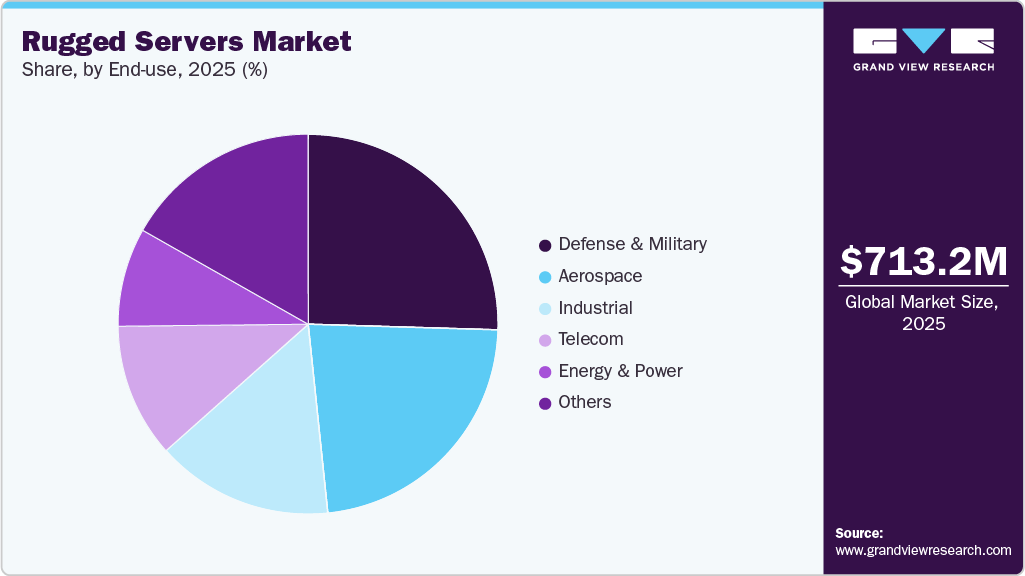
Based on end use, defense & military segment led the market with the largest revenue share of 25.5% in 2025. This segment is growing owing to the sector's constant need for reliable, high-performance computing in extreme and mission-critical environments. Modern defense operations increasingly rely on real-time data processing, secure communications, situational awareness, and AI-enabled decision-making, which demand computing systems that can operate seamlessly under harsh physical conditions. Rugged servers are engineered to withstand shock, vibration, dust, extreme temperatures, and electromagnetic interference, making them indispensable in a range of defense scenarios, including battlefield communications, mobile command centers, unmanned aerial vehicles (UAVs), ground combat systems, and naval platforms. Ongoing technological enhancements by key market participants further reinforce the adoption of ruggedized computing solutions within defense programs. For instance, in February 2025, Crystal Group advanced its rugged server portfolio by integrating next-generation processing technologies, leveraging strategic industry partnerships to deliver high-performance, reliable computing solutions engineered to meet stringent defense & military, government, and industrial requirements in demanding environments.
 To learn more about this report, Download Free Sample Report
The telecom segment is expected to register the fastest growth during the forecast period in the global market for rugged servers. The rapid growth of edge computing is changing the telecom industry by decentralizing data processing and moving computational power closer to the source of data generation. Unlike traditional cloud computing, where data is sent to centralized data centers, edge computing relies on distributed edge data centers-often located in harsh or remote environments process information in real time. Telecom providers increasingly deploy rugged servers in these edge locations to ensure reliability, low latency, and continuous operation under extreme conditions.
Regional Insights
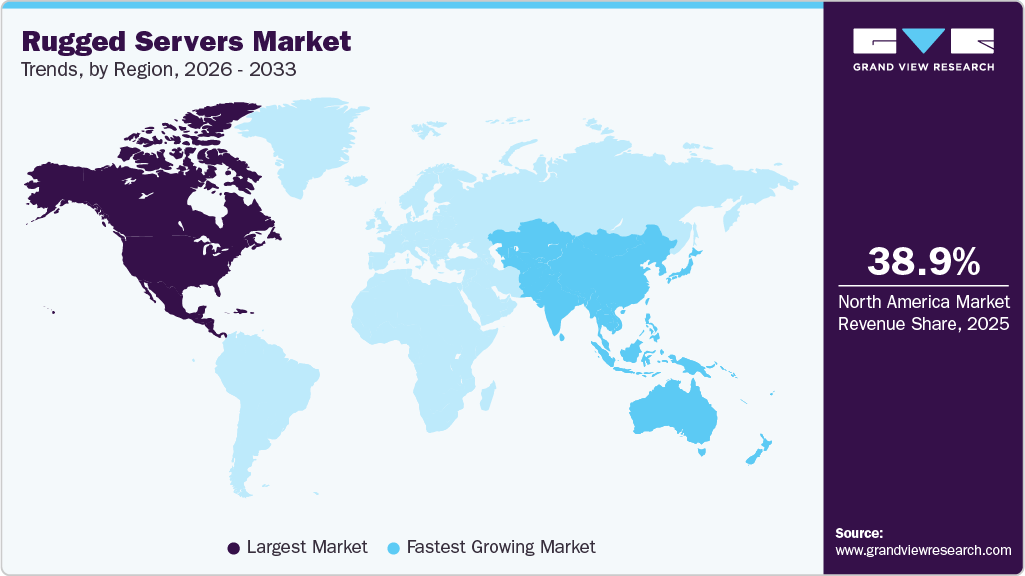
North America dominated the global rugged servers market with the largest revenue share of 38.9% in 2025 in the global industry. North America’s stringent regulations regarding data security and system resilience, especially in federal and critical infrastructure sectors, create a strong incentive to adopt rugged servers with enhanced physical and cybersecurity features. Rugged servers often support secure boot, TPM (Trusted Platform Module), and hardware-based encryption, making them well-suited for environments requiring secure and stable operations. Growing enterprise demand for secure, high-performance on-premise computing further accelerates the adoption of ruggedized server solutions across the region. For instance, in August 2024, Nextria provider of secure, on-premise generative AI platforms from Canada, partnered with PureLogic IT to enhance the deployment of its CastleGuard AI platform and Sentinel Server solution, providing integrated hardware, specialized implementation services, and secure on-premise AI capabilities for enterprise customers seeking controlled, high-performance technology environments.
 To learn more about this report, Download Free Sample Report
U.S. Rugged Servers Market Trends
The rugged servers market in the U.S. held the largest share in the North America region in 2025. This strong growth is due to rising demand in avionics, rail systems, and autonomous vehicles. In aviation, rugged servers are critical for flight control systems, in-flight entertainment, and real-time data processing in military and commercial aircraft. The expansion of unmanned aerial vehicles (UAVs) and next-gen fighter jets further drives adoption.
Europe Rugged Servers Market Trends
The rugged servers industry in Europe is anticipated to register significant growth from 2026 to 2033. The expansion of Industry 4.0 across Europe, particularly in manufacturing powerhouses such as Germany and Italy, drives the demand for rugged servers in smart factory environments. Rugged servers enable edge processing on the shop floor, where dust, temperature fluctuations, and vibrations are common. Moreover, sectors such as aerospace and telecommunications depend heavily on these servers to support real-time data processing in aircraft and 5G edge networks, while industrial automation in manufacturing and renewable energy projects in offshore wind farms demand their durability to ensure uninterrupted operations in harsh coastal or high-altitude settings.
In addition, the growing defense and military applications in Europe are further boosting the demand for ruggedized IT solutions. For instance, in October 2025, MilDef Group AB received a USD 5.5 million contract with L3Harris Technologies to supply rugged IT systems, including customized servers, Cisco-based routers, and fiber switches for armored vehicles. This deal support MilDef’s European defense market presence and is expected to drive increased adoption of durable, high-performance IT solutions across the region.
The UK rugged servers industry is projected to experience growth from 2026 to 2033. The UK defense sector is undergoing significant modernization, driven by programs such as the Future Combat Air System (FCAS) and naval fleet upgrades, which are accelerating the adoption of rugged servers. These high-performance computing systems are essential for military applications where reliability, durability, and security are paramount.
The rugged servers industry in Germany accounted for the largest share in 2025. The proliferation of Industry 4.0 initiatives across German manufacturing facilities creates substantial demand for ruggedized server solutions. Smart factories, particularly in the automotive and chemical sectors, require industrial-grade computing infrastructure capable of real-time data processing in environments characterized by extreme temperatures, particulate contamination, and electromagnetic interference.
Asia Pacific Rugged Servers Market Trends
The rugged servers industry in the Asia Pacific is expected to register the fastest CAGR from 2026 to 2033. Several countries, including China, India, Japan, and South Korea, are significantly increasing their defense budgets to modernize their armed forces and enhance border security. This includes investment in command-control systems, battlefield communications, and unmanned surveillance vehicles. The growing demand for ruggedized, high-performance computing solutions is further driven by regional initiatives focused on strengthening real-time mission capabilities. For instance, in May 2025, 7STARLAKE expanded its partnership with Dell Technologies in the Asia Pacific region by introducing rugged military servers engineered for mission-critical unmanned systems, delivering enhanced reliability, secure data processing, and high performance for next-generation ground control station operations.
The China rugged servers industry held a dominant share in 2025. China’s significant investment in military modernization and self-sufficiency in defense technology has led to rising demand for rugged computing infrastructure. Rugged servers are vital to military command centers, mobile units, and unmanned systems such as drones and autonomous ground vehicles.
The rugged servers industry Japan is expected to grow rapidly in the coming years. Japan’s highly advanced transportation network, including bullet trains, automated metros, and intelligent traffic systems, relies on rugged IT equipment for control systems, surveillance, and in-transit data processing. Rugged servers are used in vehicles and outdoor environments where temperature, motion, and humidity require specialized computing hardware.
Key Rugged Servers Company Insights
Key players operating in the industry are Mercury Systems, Inc., ADLINK Technology Inc., Advantech Co., Ltd., Core Systems, and Trenton Systems, Inc., among others. Companies are focusing on various strategic initiatives, including new product development, partnerships & collaborations, and agreements to gain a competitive advantage over their rivals. The following are some instances of such initiatives.
-
In May 2025, Kontron announced the release of the µDARC, an ultra-rugged, compact microserver designed for mission-critical mobile applications in challenging defense environments. Powered by a high-performance NXP Arm i.MX8X quad-core processor, the µDARC offers a lightweight, energy-efficient solution with extensive I/O capabilities, making it ideal for tactical edge computing. Tailored for real-time data collection and transmission, it supports a wide range of defense use cases, including wearable tech, UGVs with LiDAR and GPS, UAVs for object recognition and telemetry, and cybersecurity gateways and health monitoring systems.
-
In April 2025, ADLINK Technology Inc. and Elma Electronic announced a partnership to deliver rugged computing solutions for the railway and mission-critical applications. The collaboration combined ADLINK’s CPCI, CPCI Serial and VPX platforms with Elma’s chassis and integration capabilities to provide reliable, scalable systems designed for harsh, mission-critical environments and field deployments.
Key Rugged Servers Companies:
The following key companies have been profiled for this study on the rugged servers market.
-
ADLINK Technology Inc.
-
Advantech Co., Ltd.
-
Core Systems
-
General Micro Systems, Inc.
-
GETAC
-
Kontron
-
Mercury Systems, Inc.
-
One Stop Systems, Inc.
-
Trenton Systems, Inc.
-
Westek Technology
Competitive Benchmarking
Category
Operating Strategies
Competitive Edge
Weakness
Established Players (Mercury Systems, Inc.; ADLINK Technology Inc.; Advantech Co., Ltd.; Core Systems; Trenton Systems, Inc.; Crystal Group Inc.)
- Expand rugged server portfolios with high-performance processors, GPU acceleration, AI-ready edge computing capabilities, modular architectures, and advanced cybersecurity features to support defense, aerospace, industrial automation, and edge computing applications.
- Strengthen partnerships with defense agencies, OEMs, system integrators, telecom operators, and industrial automation providers while investing in next-generation edge AI, private 5G, and mission-critical computing solutions.
- Extensive global manufacturing, engineering, and service networks enable deployment of rugged computing platforms across military, aerospace, industrial, and critical infrastructure environments.
- Comprehensive product portfolios spanning rugged rackmount, blade, edge, and embedded servers, combined with long-term lifecycle support, customization capabilities, and industry certifications, provide strong customer retention and competitive differentiation.
- High R&D, certification, and ruggedization costs increase product pricing compared with commercial server vendors.
- Lengthy defense procurement cycles, stringent qualification requirements, and complex customization processes can extend deployment timelines and limit rapid market expansion.
Emerging Players (One Stop Systems, Inc.; Kontron AG; Westek Technology; GETAC)
- Focus on compact, AI-enabled rugged edge servers and application-specific computing platforms for industrial automation, transportation, energy, telecommunications, and autonomous systems.
- Differentiate through rapid product innovation, flexible customization, edge AI integration, localized engineering support, and cost-effective rugged computing solutions tailored to niche applications.
- Competitive pricing, faster product development, and specialized rugged computing expertise enable strong positioning in regional and vertical-specific markets.
- Flexible customization, edge computing capabilities, and close customer engagement allow rapid response to evolving mission-critical computing requirements.
- Limited global manufacturing capacity, smaller service networks, and lower brand recognition reduce competitiveness in large-scale defense and multinational enterprise projects.
- Narrower product portfolios, fewer strategic alliances, and lower investment capacity may restrict expansion into highly regulated, certification-intensive, and large-volume procurement opportunities.
Rugged Servers Market Report Scope
Report Attribute
Details
Market size in 2025
USD 713.2 million
Estimated market size in 2026
USD 759.7 million
Projected market size by 2033
USD 1,244.9 million
Growth rate
CAGR of 7.3% from 2026 to 2033
Base year for estimation
2025
Historical data
2021 - 2024
Forecast period
2026 - 2033
Quantitative units
Revenue in USD million/billion and CAGR from 2026 to 2033
Report coverage
Revenue forecast, company market share analysis, competitive landscape, growth factors, and trends
Segments covered
Component, type, memory size, application, end use, region
Regional scope
North America; Europe; Asia Pacific; Latin America; MEA
Country scope
U.S.; Canada; Mexico; Germany; UK; France; China; Japan; India; South Korea; Australia; Brazil; Saudi Arabia; South Africa; UAE
Key companies profiled
ADLINK Technology Inc.; Advantech Co., Ltd.; Core Systems; General Micro Systems, Inc.; GETAC; Kontron; Mercury Systems, Inc.; One Stop Systems, Inc.; Trenton Systems, Inc.; Westek Technology
Customization scope
Free report customization (equivalent up to 8 analysts' working days) with purchase. Addition or alteration to country, regional & segment scope.
Pricing and purchase options
Avail customized purchase options to meet your exact research needs. Explore purchase options
Global Rugged Servers Market Report Segmentation
This report forecasts revenue growth at global, regional, and country levels and provides an analysis of the latest industry trends in each of the sub-segments from 2021 to 2033. For this study, Grand View Research has segmented the global rugged servers market report based on component, type, memory size, application, end-use, and region.
-
Component Outlook (Revenue, USD Million, 2021 - 2033)
-
Hardware
-
Software
-
Services
-
-
Type Outlook (Revenue, USD Million, 2021 - 2033)
-
Rugged Rackmount Servers
-
Rugged Blade Servers
-
Rugged Edge Servers
-
-
Memory Size Outlook (Revenue, USD Million, 2021 - 2033)
-
<256 GB
-
256GB-512GB
-
512GB-1TB
-
>1TB
-
-
Application Outlook (Revenue, USD Million, 2021 - 2033)
-
Standard
-
Dedicated
-
-
End-use Outlook (Revenue, USD Million, 2021 - 2033)
-
Defense & Military
-
Aerospace
-
Industrial
-
Telecom
-
Energy & Power
-
Others
-
-
Regional Outlook (Revenue, USD Million, 2021 - 2033)
-
North America
-
U.S.
-
Canada
-
Mexico
-
-
Europe
-
UK
-
Germany
-
France
-
-
Asia Pacific
-
China
-
India
-
Japan
-
South Korea
-
Australia
-
-
Latin America
-
Brazil
-
-
Middle East & Africa
-
UAE
-
Saudi Arabia
-
South Africa
-
-
Research Methodology
The rugged servers market figures in this report are based on a proven research process that combines executive interviews with secondary research from proprietary databases, company filings, and recognized regulatory and institutional sources. Market size is built through value-chain sizing - reconciling supply-side and demand-side estimates - and triangulated with bottom-up and top-down approaches. Every estimate passes multiple levels of expert validation before publication, with each rugged servers segment quantified using the revenue-capture definitions in the table below.
Segment Definition
Segment - Component
Revenue capture definition
Hardware
Revenue is generated from the sale of rugged server hardware designed to operate reliably in harsh environmental conditions. Revenue includes rackmount, blade, edge, and embedded server systems, processors, memory, storage, networking interfaces, rugged enclosures, power supplies, and integrated hardware components.
Software
Revenue is generated from software solutions bundled with or deployed on rugged servers, including operating systems, virtualization platforms, server management software, remote monitoring, cybersecurity software, workload orchestration, AI acceleration software, firmware, and system management utilities.
Services
Revenue is generated from professional and managed services associated with rugged server deployments, including consulting, system integration, installation, customization, testing, certification, maintenance, technical support, lifecycle management, repair, and training services.
Segment - Type
Revenue capture definition
Rugged Rackmount Servers
Revenue is generated from rackmount rugged servers designed for deployment in military shelters, industrial facilities, transportation systems, telecom sites, and mission-critical environments. Revenue includes complete server systems, configurable hardware, installation, and support services.
Rugged Blade Servers
Revenue is generated from modular rugged blade server systems deployed in high-density computing environments requiring scalable processing, virtualization, AI workloads, and defense command-and-control applications. Revenue includes blade modules, chassis, management systems, and associated services.
Rugged Edge Servers
Revenue is generated from compact rugged edge servers deployed for real-time analytics, edge AI, IoT, autonomous systems, industrial automation, and remote mission-critical applications. Revenue includes server hardware, edge computing platforms, embedded GPUs, networking modules, and deployment services.
Segment - Memory Size
Revenue capture definition
<256 GB
Revenue is generated from rugged servers equipped with less than 256 GB of system memory, primarily supporting entry-level edge computing, industrial control, and lightweight mission-critical workloads.
256GB-512GB
Revenue is generated from rugged servers configured with 256 GB to 512 GB of memory for mid-range virtualization, industrial automation, defense, and telecommunications applications.
512GB-1TB
Revenue is generated from rugged servers equipped with 512 GB to 1 TB of memory, supporting AI inference, data analytics, command-and-control systems, and high-performance edge computing applications.
>1TB
Revenue is generated from high-performance rugged servers configured with more than 1 TB of memory for advanced AI, machine learning, high-performance computing (HPC), real-time intelligence, and defense mission systems.
Segment - Application
Revenue capture definition
Standard
Revenue is generated from commercially available rugged servers designed for general-purpose industrial, transportation, telecom, and enterprise edge computing applications requiring enhanced durability and reliable performance.
Dedicated
Revenue is generated from customized rugged servers engineered for specific mission-critical applications, including defense, aerospace, autonomous vehicles, naval systems, energy exploration, and specialized industrial operations requiring tailored configurations and certifications.
Segment - End Use
Revenue capture definition
Defense & Military
Revenue is generated from rugged server deployments supporting battlefield communications, command-and-control systems, intelligence, surveillance and reconnaissance (ISR), autonomous defense platforms, naval systems, and tactical edge computing.
Aerospace
Revenue is generated from rugged servers deployed in aircraft, ground support systems, avionics testing, space programs, satellite communications, and aerospace research requiring reliable computing in extreme environments.
Industrial
Revenue is generated from rugged server deployments in manufacturing, mining, oil & gas, industrial automation, smart factories, robotics, and process control applications operating in harsh industrial conditions.
Telecom
Revenue is generated from rugged servers deployed across telecommunications infrastructure, including 5G networks, edge data centers, network function virtualization (NFV), remote base stations, and mobile network operations.
Energy & Power
Revenue is generated from rugged server deployments supporting power generation, transmission and distribution, renewable energy facilities, smart grids, utilities, substations, and critical energy infrastructure requiring secure and reliable edge computing.
Energy
Revenue is generated from rugged servers deployed in upstream, midstream, and downstream oil & gas operations, offshore platforms, renewable energy assets, exploration sites, and remote field operations requiring resilient computing capabilities.
Others
Revenue is generated from rugged server deployments across transportation, railways, marine, public safety, emergency response, healthcare, research institutions, education, and other industries requiring reliable computing in harsh operating environments.
Estimation Model
Layer
Question
Analysis
Mission-Critical Computing Demand Layer
Who can benefit from rugged servers?
Identify organizations operating in harsh, remote, and mission-critical environments that require reliable computing under extreme conditions. These include defense and military agencies, aerospace organizations, industrial manufacturers, energy and utilities, telecommunications providers, transportation operators, public safety agencies, and research institutions. Organizations requiring continuous computing, real-time data processing, edge AI, and secure operations in environments exposed to shock, vibration, dust, humidity, and extreme temperatures represent the core demand base for rugged servers.
Infrastructure & Operational Readiness Layer
Who can deploy rugged servers?
Evaluate organizations based on their digital infrastructure maturity, edge computing adoption, mission-critical operations, environmental conditions, and IT modernization initiatives. Enterprises deploying industrial automation, AI-enabled edge computing, autonomous systems, private 5G networks, IoT platforms, and remote operational technologies possess the operational readiness to implement rugged server solutions capable of delivering reliable performance in challenging environments.
Adoption & Utilization Layer
Who actively uses rugged servers?
Analyze the deployment of rugged servers across defense command centers, tactical military vehicles, aircraft, naval platforms, industrial facilities, manufacturing plants, oil & gas operations, mining sites, telecom edge infrastructure, transportation networks, renewable energy facilities, and remote field operations. Active users include defense organizations, aerospace companies, industrial enterprises, telecom operators, energy companies, transportation authorities, emergency response agencies, and critical infrastructure providers requiring resilient, secure, and high-performance computing at the edge.
Monetization Layer
How much revenue is generated?
Assess revenue generated through the sale of rugged server hardware, rackmount servers, blade servers, edge servers, embedded computing platforms, processors, memory, storage, GPU accelerators, networking modules, rugged enclosures, and power supplies. Additional revenue streams include operating systems, server management software, virtualization platforms, AI software, cybersecurity solutions, installation, integration, customization, environmental testing, maintenance, technical support, lifecycle management, warranty services, system upgrades, and long-term managed service contracts supporting mission-critical rugged computing infrastructure.
Delivered Customizations
This report has been delivered with the following In-depth customizations
Client Request
Customization Delivered
Value Adds
Edge AI & Autonomous Computing Trends
Conducted a structured analysis of rugged server technologies focused on AI-enabled edge computing, GPU acceleration, autonomous systems, real-time analytics, and high-performance edge processing for mission-critical environments.
Helps stakeholders understand evolving edge AI infrastructure requirements, identify high-growth rugged server technologies, and evaluate commercialization opportunities across defense, industrial automation, and intelligent edge deployments.
Defense Modernization & Mission-Critical Computing Trends
Conducted a comprehensive analysis of rugged server adoption across defense modernization programs, command-and-control systems, ISR platforms, tactical communications, cybersecurity, and secure battlefield computing applications.
Helps stakeholders identify opportunities in military and government digital transformation initiatives, assess procurement trends, and evaluate investments aligned with next-generation mission-critical computing requirements.
Industrial Edge Computing & Industry 4.0 Trends
Conducted a comprehensive analysis of rugged servers supporting industrial automation, smart manufacturing, private 5G, Industrial IoT (IIoT), predictive maintenance, remote asset monitoring, and digital factory operations.
Helps stakeholders understand the growing demand for rugged edge computing, evaluate Industry 4.0 adoption strategies, and assess opportunities in resilient computing infrastructure for harsh industrial environments.
Frequently Asked Questions About This Report
The global rugged servers market size was estimated at USD 713.2 million in 2025 and is expected to reach USD 759.7 million in 2026.
The global rugged servers market is expected to grow at a compound annual growth rate of 7.3% from 2026 to 2033 to reach USD 1,244.9 million in 2033
Key factors include rapid expansion of edge computing, defense modernization programs, and industrial automation.
North America dominated with 38.9% revenue share in 2025.
Asia Pacific is the fastest-growing region over the forecast period.
The hardware segment led with a 60.9% revenue share in 2025, while the software segment is the fastest-growing segment.
The rugged rackmount servers segment led with a 44.0% revenue share in 2025, while the rugged edge servers segment is the fastest-growing segment.
The <256 GB segment held the largest share (over 43.5%) in 2025, while the 512 GB-1 TB segment is the fastest-growing segment.
Key players operating in the rugged servers market include ADLINK Technology Inc.; Advantech Co., Ltd.; Core Systems; General Micro Systems, Inc.; GETAC; Kontron; Mercury Systems, Inc.; One Stop Systems, Inc.; Trenton Systems, Inc.; Westek Technology
About the Author(s)
Communications Infrastructure Research Team
Technology · Communications InfrastructureThis report was authored by the communications infrastructure research team at Grand View Research - comprising two research analysts, one senior research analyst, and one industry expert - with specialized expertise in the communications infrastructure segment of the technology industry. All findings are based on proprietary technology databases, executive interviews, and regulatory analysis, subject to internal peer review prior to publication.
Last Updated:
Speak to Analyst

Customize this report to your needs - add regions, segments, or data points, with 20% free customization.
Or view our licence options:


ISO 9001:2015 & 27001:2022 Certified
We are GDPR and CCPA compliant! Your transaction & personal information is safe and secure. For more details, please read our privacy policy.


