
- Home
- »
- Plastics, Polymers & Resins
- »
-
Sheet Molding and Bulk Molding Compound Market Report, 2026-2033GVR Report cover
![Sheet Molding And Bulk Molding Compound Market (2026 - 2033)Report]()
Sheet Molding And Bulk Molding Compound Market (2026 - 2033)
Size, Share & Trends Analysis Report By Resin (Epoxy, Polyester), By Fiber (Glass Fiber, Carbon Fiber), By Application (Automotive & Transportation, Aerospace, Electrical & Electronics), By Region, And Segment Forecasts
Market Size, 2025
$4.3BMarket Estimate, 2026
$4.6BMarket Forecast, 2033
$7.4BCAGR, 2026–2033
7.0%Sheet Molding And Bulk Molding Compound Market Summary
The global sheet molding and bulk molding compound market size was valued at USD 4.3 billion in 2025 and is projected to grow from USD 4.6 billion in 2026 to USD 7.4 billion by 2033, at a CAGR of 7.0% from 2026 to 2033. Asia Pacific held the largest share of 63.0% of the global market in 2025. Sheet molding (SMC) and bulk molding compound (BMC) are increasingly used in infrastructure and industrial components due to their strong resistance to corrosion, chemicals, and moisture.

Key Market Trends & Insights
- By resin: Epoxy led the global sheet molding and bulk molding compound industry and accounted for a share of 68.8% in 2025.
- By fiber: Glass fiber segment led the market and accounted for a share of 62.1% in 2025.
- By application: Automotive & transportation segment led the market and accounted for a share of 33.4% in 2025.
Regional Highlights
- Largest regional market: Asia Pacific (63.0% revenue share, 2025)
Market Size & Forecast
- Market size in 2025: USD 4.3 Billion
- Estimated market size in 2026: USD 4.6 Billion
- Projected market size by 2033: USD 7.4 Billion
- CAGR (2026-2033): 7.0%

This reduces maintenance costs and extends product life, making them a preferred material in water systems, construction panels, and outdoor electrical enclosures. The market is witnessing a structural shift toward lightweight and high-performance SMC and BMC formulations, particularly aligned with electric mobility and advanced electrical systems. OEMs are increasingly adopting low-density and carbon fiber reinforced variants to reduce component weight while maintaining mechanical strength and thermal stability. Simultaneously, customization of resin systems and fillers is expanding application scope across automotive, electrical, and construction sectors. This trend is further supported by advancements in automated molding and formulation technologies, enabling consistent quality and high-volume production.
Drivers, Opportunities & Restraints
The primary growth driver is the rising demand for lightweight, high-strength materials across the automotive and electrical industries. SMC and BMC enable weight reduction of structural and semi-structural components, improving fuel efficiency and extending electric vehicle range. Moreover, the market for Sheet Molding Compounds (SMC) and Bulk Molding Compounds (BMC) is a key segment within the molding compounds market, featuring high-performance thermoset composite formulations. The growth of the overall molding compounds market is driven by the need for lightweight materials in the automotive sector, and electrical applications directly boost the demand for SMC and BMC. SMC and BMC, as advanced molding compounds, profit from the growing preference for materials that are durable, resistant to corrosion, and flexible in design for high-volume manufacturing.
A significant opportunity exists in renewable energy and emerging infrastructure applications. SMC and BMC are increasingly used in wind turbine housings, solar mounting systems, and electrical grid components due to their durability, corrosion resistance, and favorable strength-to-weight ratio. Rapid expansion of renewable energy capacity and infrastructure modernization in emerging economies is creating incremental demand. Additionally, advancements in recyclable and bio-based composite formulations are opening new avenues for sustainability-driven procurement, particularly in regions with strict environmental regulations and circular economy targets.
Market growth is constrained by fluctuations in raw material prices and inherent challenges in recyclability. Key inputs such as unsaturated polyester resins and glass fibers account for a major share of production costs, exposing manufacturers to margin pressure during feedstock volatility. At the same time, the thermoset nature of SMC and BMC limits end-of-life recyclability, creating compliance challenges under evolving environmental regulations. These factors increase production costs and R&D requirements, while also intensifying competition from recyclable thermoplastics and lightweight metals.
Market Concentration & Characteristics
The market is in a high-growth stage, and growth is accelerating. The market exhibits fragmentation, with key players dominating the industry landscape. Major companies such as IDI Composites International, MENZOLIT, Polynt (Polynt-Reichhold), Continental Structural Plastics Inc. (TEIJIN), ZOLTEK (Toray Group), Mitsui Chemicals, and TORAY INTERNATIONAL, and others play a significant role in shaping the market dynamics. These leading players often drive innovation in the market by introducing new products, technologies, and materials to meet the industry's evolving demands.
The SMC and BMC market demonstrate a moderate to high level of innovation, primarily focused on material engineering and process optimization rather than disruptive product redesign. Recent developments include low-density formulations, carbon fiber integration, and bio-based resin systems to meet evolving performance and sustainability requirements. Industry advancements also emphasize automated compression molding and improved fiber distribution for consistent mechanical properties. According to technical studies and industry associations, increasing integration of SMC in e-mobility components such as battery housings reflects innovation aligned with application-specific performance demands and mass production compatibility.
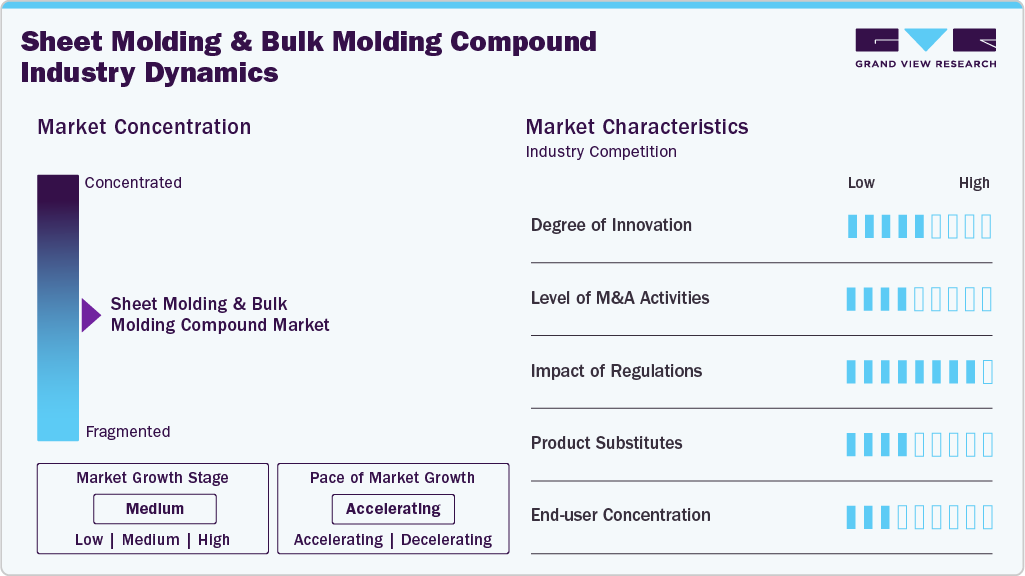
Regulatory frameworks are exerting a direct influence on material selection, formulation chemistry, and manufacturing processes in the SMC and BMC market. Environmental regulations targeting volatile emissions, waste management, and recyclability are driving shifts toward low-emission resins and sustainable composite solutions. At the same time, stringent certification standards in the automotive and electrical sectors are extending product development timelines and increasing compliance costs. According to industry regulatory assessments, regional variations in safety, documentation, and testing standards create additional complexity, requiring manufacturers to align product design with multi-market compliance requirements.
Resin Insights
The epoxy segment dominated the market in terms of revenue, accounting for 68.8% market share in 2025, and is forecast to grow at a 6.3% CAGR from 2026 to 2033. Epoxy-based SMC and BMC are gaining traction due to their superior mechanical strength, adhesion, and thermal resistance, which are critical for high-load and safety-sensitive components. Their adoption is increasing in aerospace-grade automotive parts, battery enclosures, and electrical systems where dimensional stability and heat resistance are essential. According to industry analysis, epoxy resins enable enhanced durability and chemical resistance, making them suitable for high-performance applications where failure risk must be minimized and lifecycle reliability is prioritized.
The polyester segment is expected to expand at an 8.3% CAGR in the sheet molding and bulk molding compound market over the forecast period. Polyester resins are driven by their strong suitability for large-scale manufacturing environments where cost control and processing efficiency are critical. Their fast-curing cycles, ease of molding, and compatibility with automated production lines support the mass production of automotive panels and construction components. According to industry data, polyester accounted for over 69% share due to its balanced mechanical performance and low processing complexity, enabling manufacturers to achieve high throughput while maintaining acceptable performance standards across diverse applications.
Fiber Insights
The glass fiber segment dominated the market in terms of revenue, accounting for 62.1% market share in 2025, and is forecast to grow at a 7.2% CAGR from 2026 to 2033. The growth can be attributed to its optimal balance between mechanical strength, cost efficiency, and material availability. It supports large-scale deployment of SMC and BMC in automotive panels, electrical housings, and infrastructure components where moderate strength and durability are sufficient. According to industry insights, glass fiber holds over 60% market share as it offers high tensile strength, corrosion resistance, and electrical insulation, making it suitable for a broad range of applications without significantly increasing material costs.
The carbon fiber segment is expected to expand at a 6.6% CAGR in the sheet molding and bulk molding compound market over the forecast period. Carbon fiber-based SMC and BMC are driven by the need for aggressive weight reduction in electric vehicles and advanced transportation systems. These materials offer superior stiffness-to-weight ratios, enabling significant weight savings while maintaining structural integrity. Their use is expanding in battery enclosures, structural reinforcements, and performance components where efficiency gains are critical. Industry findings indicate that carbon fiber composites support improved fuel efficiency and extended electric range, which directly aligns with evolving regulatory and performance requirements.
Application Insights
The automotive & transportation segment led the market by application, accounting for 33.4% of revenue in 2025, and is projected to grow at a 5.9% CAGR from 2026 to 2033. The segment is primarily driven by stringent emission regulations and the transition toward electric mobility, which require significant weight reduction without compromising safety. SMC and BMC enable replacement of metal components with lightweight composites, reducing vehicle mass by up to 25-35% in certain applications. According to industry insights, these materials are widely used in body panels, structural parts, and battery enclosures, supporting improved fuel efficiency and extended electric vehicle range while maintaining durability and crash performance.

The building & construction segment is expected to grow at the fastest CAGR of 8.1% over the forecast period. Growth in construction applications is driven by the need for materials that offer long service life with minimal maintenance in harsh environments. SMC and BMC are increasingly used in façade panels, water systems, and structural components due to their resistance to moisture, chemicals, and weathering. Industry analysis indicates that these composites provide superior durability and ease of installation compared to traditional materials, making them suitable for modern infrastructure projects and urban development initiatives across both developed and emerging markets.
Regional Insights
The Asia Pacific sheet molding and bulk molding compound industry held the largest revenue share of 63.0% in 2025. The region is expected to grow at a CAGR of 7.9% over the forecast period. Asia Pacific growth is driven by its cost-efficient manufacturing ecosystem and strong expansion in the automotive, electrical, and construction sectors. The region benefits from high production volumes and localized supply chains, enabling large-scale adoption of SMC and BMC in both domestic and export markets. According to industry analysis, the presence of major automotive and electronics industries across countries such as India, Japan, and South Korea significantly supports demand for lightweight and electrically insulating composite materials.

The sheet molding and bulk molding compound industry in China is supported by aggressive industrial expansion and its leading position in electric vehicle manufacturing. High domestic demand for lightweight materials in EV platforms is accelerating the adoption of SMC and BMC for structural and battery-related applications. In addition, strong growth in construction and electrical infrastructure continues to create demand for corrosion-resistant and high-performance composites. The country’s integrated supply chain and large-scale production capacity further enhance material adoption across multiple end-use sectors.
North America Sheet Molding and Bulk Molding Compound Market Trends
The sheet molding and bulk molding compound industry in North America is strongly driven by large-scale infrastructure investments and advanced manufacturing capabilities. According to the U.S. Department of Transportation, over USD 550 billion has been allocated for infrastructure upgrades, supporting increased use of corrosion-resistant and lightweight composites in bridges, utility systems, and transportation assets. In parallel, the presence of mature automotive and aerospace industries sustains consistent demand for SMC and BMC for structural and semi-structural applications that require durability and long service life.
U.S. Sheet Molding and Bulk Molding Compound Market Trends
The sheet molding and bulk molding compound industry in the U.S. is primarily driven by its large automotive production base and rapid transition toward electric vehicles. SMC and BMC are increasingly used in exterior panels, battery enclosures, and under-the-hood components due to their strength-to-weight advantages and design flexibility. According to industry insights, these materials enable the manufacturing of complex parts at scale while supporting fuel-efficiency and electrification targets. This combination of high-volume production and material substitution continues to accelerate domestic demand.
Europe Sheet Molding and Bulk Molding Compound Market Trends
The sheet molding and bulk molding compound industry in Europe is primarily influenced by strict carbon emission targets and sustainability mandates across automotive and industrial sectors. Regulatory frameworks requiring significant CO2 reductions are accelerating the replacement of metals with lightweight composites such as SMC and BMC in vehicle manufacturing. In addition, strong adoption of recyclable and low-emission material systems is supporting innovation in resin formulations. This regulatory environment continues to position composites as a critical solution for compliance and performance optimization.
Key Sheet Molding and Bulk Molding Compound Company Insights
The sheet molding and bulk molding compound industry is highly competitive, with several key players dominating the landscape. Major companies include IDI Composites International, MENZOLIT, Polynt (Polynt-Reichhold), Continental Structural Plastics Inc. (TEIJIN), ZOLTEK (Toray Group), Mitsui Chemicals, TORAY INTERNATIONAL, Core Molding Technologies, and Devi Polymers Private Limited. The sheet molding and bulk molding compound industry is characterized by a competitive landscape with several key players driving innovation and market growth. Major companies in this sector are investing heavily in research and development to enhance the performance, cost-effectiveness, and sustainability of their products.
Key Sheet Molding And Bulk Molding Compound Companies:
The following key companies have been profiled for this study on the sheet molding and bulk molding compound market.
- IDI Composites International
- National Composites
- MENZOLIT
- Polynt (Polynt-Reichhold)
- Continental Structural Plastics Inc. (TEIJIN)
- ZOLTEK (Toray Group)
- Mitsui Chemicals
- TORAY INTERNATIONAL
- Core Molding Technologies
- Devi Polymers Private Limited
- Zhejiang Yueqing SMC & BMC Manufacture Factory
- Huayuan Advanced Materials Co., Ltd.
- Resonac Holdings Corporation
Recent Developments
-
In March 2026, Core Molding Technologies said it launched proprietary sheet molding compound into Building Products and generated close to USD 10 million in revenue from the line. The company also indicated that additional SMC compound wins would begin production by the end of the third quarter of 2026.
-
In August 2025, Core Molding Technologies announced a USD 25 million organic investment to expand its Matamoros plant and add new plant and equipment in Monterrey, Mexico. The move was tied to new truck programs and added DCPD molding and paint capabilities, strengthening capacity for SMC-based structural parts.
Sheet Molding And Bulk Molding Compound Market Report Scope
Report Attribute
Details
Market size in 2025
USD 4.3 billion
Estimated Market size in 2026
USD 4.6 billion
Projected Market size by 2033
USD 7.4 billion
Growth rate
CAGR of 7.0% from 2026 to 2033
Historical data
2021 - 2025
Forecast period
2026 - 2033
Quantitative units
Revenue in USD million/billion, volume in Kilotons, and CAGR from 2026 to 2033
Report coverage
Revenue & volume forecast, competitive landscape, growth factors, and trends
Segments covered
Resin, fiber, application, region
Regional scope
North America; Europe; Asia Pacific; Central & South America; Middle East & Africa
Country Scope
U.S.; Canada; Mexico; Germany; UK; France; Italy; Spain; China; India; Japan; South Korea; Australia; Brazil; Argentina; Saudi Arabia; UAE; South Africa
Key companies profiled
IDI Composites International; MENZOLIT; Polynt (Polynt-Reichhold); Continental Structural Plastics Inc. (TEIJIN); ZOLTEK (Toray Group); Mitsui Chemicals; TORAY INTERNATIONAL; Core Molding Technologies; Devi Polymers Private Limited; Zhejiang Yueqing SMC & BMC Manufacture Factory; Huayuan Advanced Materials Co., Ltd.; National Composites; Resonac Holdings
Customization scope
Free report customization (equivalent to up to 8 analyst working days) with purchase. Addition or alteration to country, regional & segment scope
Pricing and purchase options
Avail customized purchase options to meet your exact research needs. Explore purchase options
Global Sheet Molding And Bulk Molding Compound Market Report Segmentation
This report forecasts revenue growth at the global, regional, and country levels and provides an analysis of the latest industry trends across sub-segments from 2021 to 2033. For this study, Grand View Research has segmented the global sheet molding and bulk molding compound market report based on resin, fiber, application, and region:

-
Resin Outlook (Volume, Kilotons; Revenue, USD Million, 2021 - 2033)
-
Epoxy
-
Polyester
-
-
Fiber Outlook (Volume, Kilotons; Revenue, USD Million, 2021 - 2033)
-
Glass Fiber
-
Carbon Fiber
-
-
Application Outlook (Volume, Kilotons; Revenue, USD Million, 2021 - 2033)
-
Automotive & Transportation
-
Aerospace
-
Electrical & Electronics
-
Building & Construction
-
Domestic Appliances
-
Others
-
-
Regional Outlook (Volume, Kilotons; Revenue, USD Million, 2021 - 2033)
-
North America
-
U.S.
-
Canada
-
Mexico
-
-
Europe
-
Germany
-
UK
-
France
-
Italy
-
Spain
-
-
Asia Pacific
-
China
-
India
-
Japan
-
South Korea
-
Australia
-
-
Central & South America
-
Brazil
-
Argentina
-
-
Middle East & Africa
-
Saudi Arabia
-
UAE
-
South Africa
-
-
Frequently Asked Questions About This Report
Some key players operating in the sheet molding and bulk molding compound market include IDI Composites International, MENZOLIT, Polynt (Polynt-Reichhold), Continental Structural Plastics Inc. (TEIJIN), ZOLTEK (Toray Group), Mitsui Chemicals, TORAY INTERNATIONAL, Core Molding Technologies, Devi Polymers Private Limited, Zhejiang Yueqing SMC & BMC Manufacture Factory, Huayuan Advanced Materials Co., Ltd., National Composites, and Resonac Holdings.
Market growth is driven as Sheet molding (SMC) and bulk molding compound (BMC) are increasingly used in infrastructure and industrial components due to their strong resistance to corrosion, chemicals, and moisture.
Asia Pacific dominated with a 38.0% revenue share in 2025.
The epoxy segment led with a 62.7% revenue share in 2025, while polyester is the fastest-growing segment.
The glass fiber segment held the highest market share of 62.1% in 2025, while carbon fiber is the fastest-growing segment.
The automotive & transportation segment held the highest market share of 33.4% in 2025, while building & construction is the fastest-growing segment.
About the Author(s)
Plastics, Polymers & Resins Research Team
Bulk Chemicals · Plastics, Polymers & ResinsThis report was authored by the plastics, polymers & resins research team at Grand View Research - comprising two research analysts, one senior research analyst, and one industry expert - with specialized expertise in the plastics, polymers & resins segment of the bulk chemicals industry. All findings are based on proprietary bulk chemicals databases, executive interviews, and regulatory analysis, subject to internal peer review prior to publication.
Last Updated:
Speak to Analyst


Customize this report to your needs — add regions, segments, or data points, with 20% free customization.
Or view our licence options:


ISO 9001:2015 & 27001:2022 Certified
We are GDPR and CCPA compliant! Your transaction & personal information is safe and secure. For more details, please read our privacy policy.


